Overview
Answer choice elimination is one of the most powerful and universally applicable strategies for tackling GRE Verbal Reasoning questions, particularly within Text Completion sections. Rather than attempting to predict the perfect word to fill a blank before examining the options, skilled test-takers systematically eliminate answer choices that create logical inconsistencies, contradict the passage's tone, or fail to maintain grammatical coherence. This strategic approach transforms difficult vocabulary questions into manageable logic puzzles, allowing students to arrive at correct answers even when they don't immediately recognize the right word.
The GRE is designed to test reasoning ability as much as vocabulary knowledge. GRE answer choice elimination leverages this design by focusing on what's definitively wrong rather than what might be right. This shift in perspective is crucial because the test writers deliberately include tempting distractors—words that seem plausible at first glance but create subtle logical flaws when inserted into the sentence. By methodically crossing out choices that violate the passage's logic, tone, or structural requirements, test-takers dramatically increase their probability of selecting the correct answer, even under time pressure.
Within the broader landscape of Verbal Reasoning, answer choice elimination serves as a foundational skill that enhances performance across all question types. While this guide focuses on Text Completion applications, the elimination principles discussed here also strengthen performance on Sentence Equivalence and Reading Comprehension questions. Mastering this technique creates a safety net for challenging questions where vocabulary gaps might otherwise prevent success, making it an essential component of any comprehensive GRE preparation strategy.
Learning Objectives
- [ ] Identify when Answer choice elimination is being tested
- [ ] Explain the core rule or strategy behind Answer choice elimination
- [ ] Apply Answer choice elimination to GRE-style questions accurately
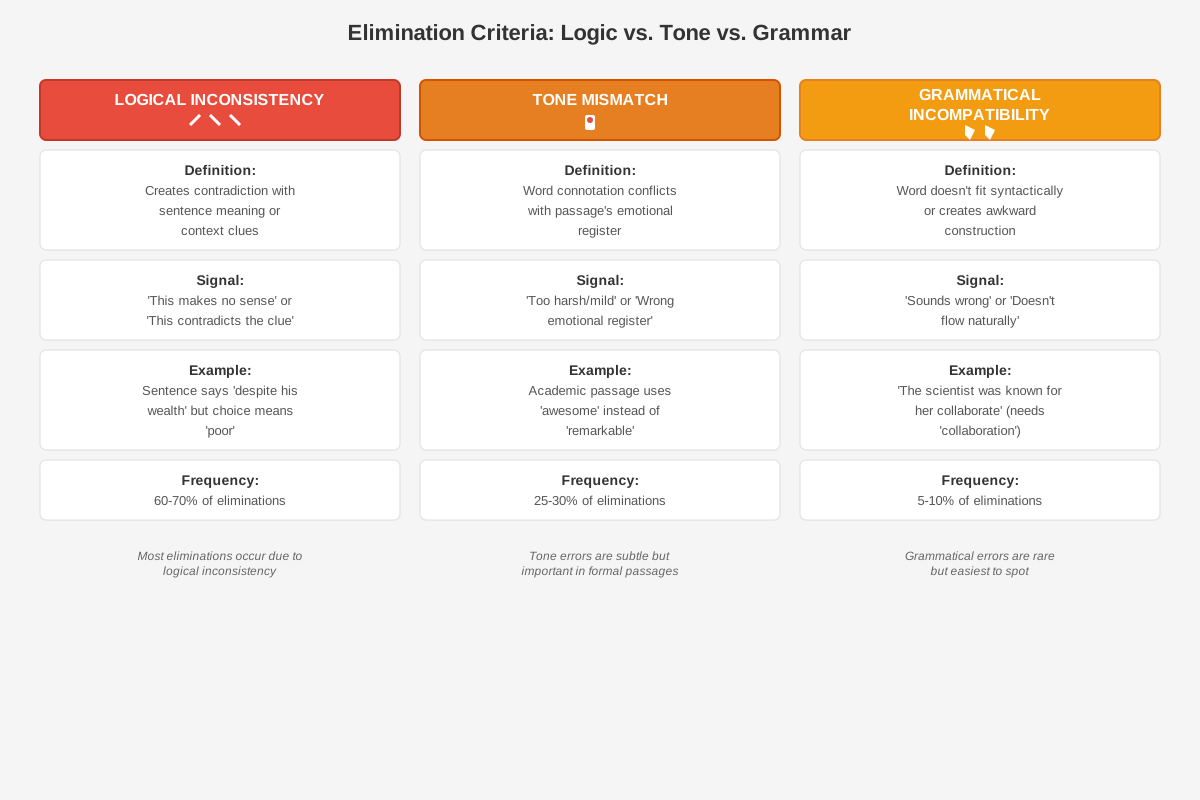
- [ ] Distinguish between elimination based on logical inconsistency versus tone mismatch
- [ ] Execute a systematic elimination process within 60-90 seconds per question
- [ ] Recognize common distractor patterns used by GRE test writers
- [ ] Combine elimination strategies with context clue analysis for maximum effectiveness
Prerequisites
- Basic sentence structure comprehension: Understanding subject-verb relationships and clause dependencies is essential for recognizing when an answer choice creates grammatical or logical inconsistencies.
- Fundamental vocabulary knowledge: While elimination reduces vocabulary demands, recognizing basic word meanings and connotations (positive/negative) enables faster, more confident elimination decisions.
- Context clue identification: The ability to locate and interpret signal words, contrast indicators, and continuation markers provides the logical framework upon which elimination strategies depend.
- Reading comprehension fundamentals: Understanding main ideas, author's tone, and logical flow allows test-takers to evaluate whether answer choices align with the passage's overall meaning.
Why This Topic Matters
Answer choice elimination represents a critical skill that directly addresses one of the most common student frustrations on the GRE: encountering unfamiliar vocabulary under time pressure. Rather than relying solely on vocabulary memorization—an approach with diminishing returns given the vast English lexicon—elimination strategies provide a systematic method for navigating challenging questions. This approach aligns with the GRE's fundamental purpose: assessing reasoning ability and critical thinking rather than mere vocabulary breadth.
From an exam statistics perspective, Text Completion questions constitute approximately 6 out of 20 questions per Verbal Reasoning section, representing roughly 30% of the verbal score. Within these questions, the ability to eliminate even one or two incorrect choices dramatically improves success rates. Statistically, eliminating two choices from a five-option question increases random guessing probability from 20% to 33%—but when combined with strategic reasoning, elimination often narrows choices to two strong candidates, creating a 50% success rate even on challenging items. For three-blank Text Completion questions, where students must select correct answers for all three blanks, elimination becomes even more critical, as the probability of guessing all three correctly without strategy is less than 1%.
The GRE consistently tests elimination skills through several recurring patterns: answer choices with similar meanings but different connotations, vocabulary words that sound sophisticated but create logical contradictions, and distractors that match only part of the sentence's requirements while failing elsewhere. Test writers deliberately construct these patterns to reward careful, systematic thinking over hasty decision-making. Questions frequently appear where the correct answer is a moderately difficult vocabulary word, but three of the four incorrect choices can be eliminated through logical analysis alone, making the final selection achievable even without perfect vocabulary knowledge.
Core Concepts
The Fundamental Principle of Strategic Elimination
The core principle underlying answer choice elimination is deceptively simple: it is often easier to identify what is definitively wrong than to predict what is perfectly right. This principle stems from the asymmetry of information in multiple-choice testing. When approaching a blank, students might imagine dozens of possible words that could work, but the GRE provides only five options. Among those five, typically three to four contain identifiable flaws—logical contradictions, tone mismatches, grammatical errors, or semantic inconsistencies. By systematically identifying and eliminating these flawed choices, test-takers reduce cognitive load and increase accuracy.
This approach reverses the typical student instinct to search for the "best" answer immediately. Instead, skilled test-takers adopt a critical mindset, asking of each choice: "What would make this wrong?" This question-framing activates analytical thinking and prevents premature commitment to attractive but incorrect options. The elimination process also provides a structured workflow that reduces anxiety and improves time management, as each elimination decision represents concrete progress toward the solution.
The Four-Step Elimination Process
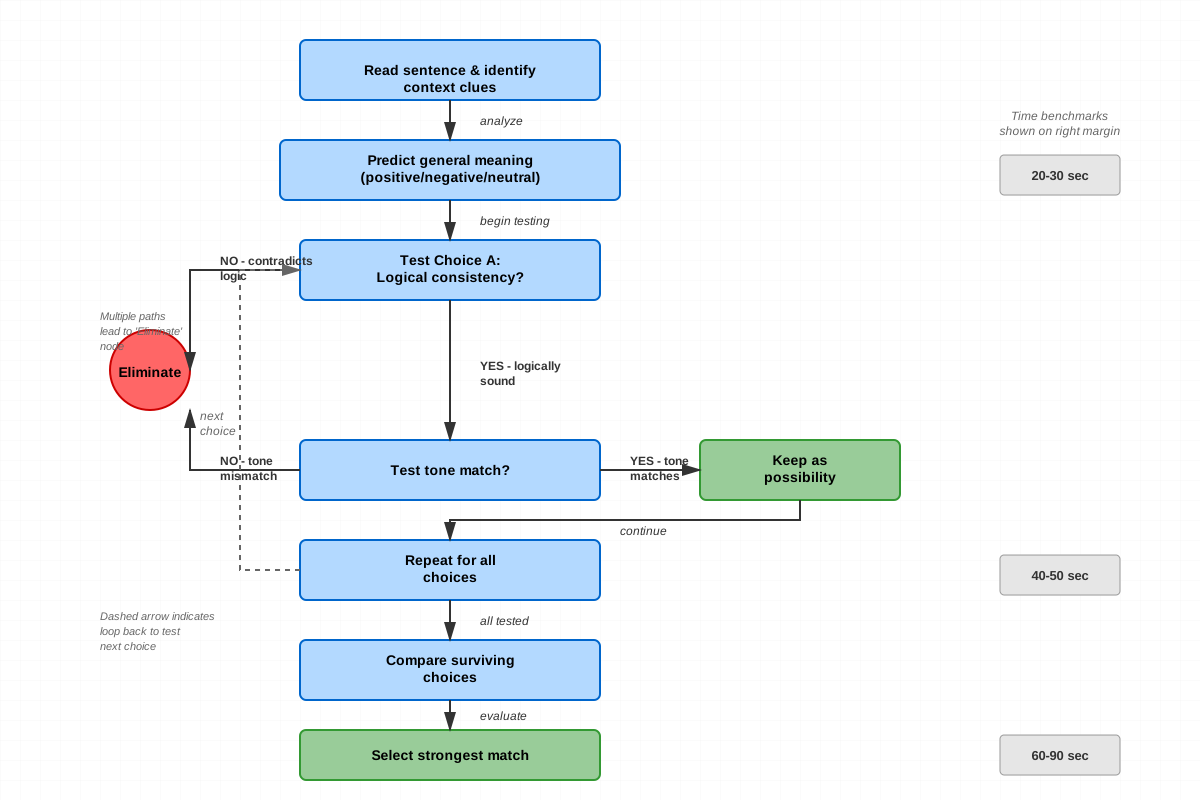
Effective GRE answer choice elimination follows a systematic sequence that maximizes efficiency while minimizing errors:
- Read the complete sentence carefully, noting structural clues: Before examining any answer choices, read the entire sentence (or passage for multi-sentence questions) to understand the overall logic, identify signal words (contrast indicators like "although," "however," "despite" or continuation signals like "furthermore," "similarly," "indeed"), and determine the required relationship between ideas. This initial reading establishes the logical framework against which all answer choices will be evaluated.
- Predict the general type of word needed: Rather than predicting a specific word, determine the general category: Does the blank require a positive or negative word? An intensifier or moderator? A concrete noun or abstract concept? This prediction creates a filter for rapid elimination without requiring precise vocabulary recall.
- Systematically evaluate each answer choice against the sentence logic: Examine each option individually, mentally inserting it into the blank and reading the complete sentence. Ask: Does this create a logical statement? Does it maintain consistency with the passage's tone? Does it preserve grammatical correctness? Physically cross out eliminated choices on scratch paper to maintain focus.
- Compare remaining choices for subtle distinctions: After eliminating obvious mismatches, carefully compare the remaining candidates. Often, two choices will seem plausible, but one will create a slightly stronger logical connection, better match the passage's tone, or more precisely fulfill the sentence's requirements.
Elimination Based on Logical Consistency
The most powerful elimination criterion involves logical consistency—whether an answer choice creates a coherent, non-contradictory statement when inserted into the sentence. The GRE frequently includes distractors that sound sophisticated but generate logical impossibilities or internal contradictions.
Consider the logical structure: "Despite the scientist's _____ approach, her conclusions were widely accepted." The word "despite" signals contrast, meaning the blank must describe an approach that would typically prevent wide acceptance. Answer choices like "rigorous," "systematic," or "thorough" can be eliminated because these qualities typically promote acceptance, creating no contrast. The correct answer must describe something negative or unconventional—perhaps "unorthodox," "controversial," or "speculative."
Logical elimination also applies to cause-and-effect relationships. If a sentence states "Because of the medication's _____ effects, doctors prescribed it cautiously," the blank must describe effects that logically justify caution—something negative or potentially dangerous. Positive descriptors like "beneficial" or "therapeutic" create logical contradictions and can be immediately eliminated.
Elimination Based on Tone and Connotation
Beyond pure logic, tone consistency provides another powerful elimination criterion. The GRE tests the ability to recognize subtle differences in connotation—the emotional or evaluative associations words carry beyond their literal definitions. Even when multiple words might be logically compatible with a sentence, only one will match the passage's tone.
Tone analysis requires distinguishing between:
| Tone Category | Characteristics | Example Words |
|---|---|---|
| Positive/Approving | Suggests endorsement, admiration, or favorable evaluation | commendable, exemplary, laudable, meritorious |
| Negative/Critical | Implies disapproval, criticism, or unfavorable judgment | deplorable, reprehensible, lamentable, egregious |
| Neutral/Objective | Lacks emotional coloring; purely descriptive | typical, standard, conventional, ordinary |
| Formal/Academic | Sophisticated, technical, scholarly register | erudite, perspicacious, sagacious, judicious |
| Informal/Colloquial | Conversational, casual language | sketchy, iffy, dodgy (rare on GRE) |
When a passage discusses a scientist's work with phrases like "groundbreaking research" and "innovative methodology," the overall tone is clearly positive. Answer choices with negative connotations can be eliminated even if they're logically possible. Conversely, if a passage criticizes a policy using words like "misguided" and "detrimental," positive descriptors become eliminable distractors.
Elimination Based on Semantic Precision
Semantic precision refers to how exactly an answer choice matches the specific meaning required by context. The GRE often includes near-synonyms that differ in subtle but important ways. Effective elimination requires distinguishing between words that are generally similar but contextually distinct.
For example, consider words describing lack of clarity: "ambiguous," "vague," "obscure," "cryptic," and "nebulous" all suggest unclear communication, but with different nuances. "Ambiguous" implies multiple possible interpretations; "vague" suggests lack of detail or specificity; "obscure" indicates difficulty in understanding due to complexity or unfamiliarity; "cryptic" suggests deliberately mysterious or coded language; "nebulous" implies hazy, ill-defined quality. In a sentence about a contract's language causing legal disputes, "ambiguous" would be most precise, as disputes arise from multiple interpretations. The other options, while related, lack this specific semantic fit and can be eliminated.
Recognizing Common Distractor Patterns
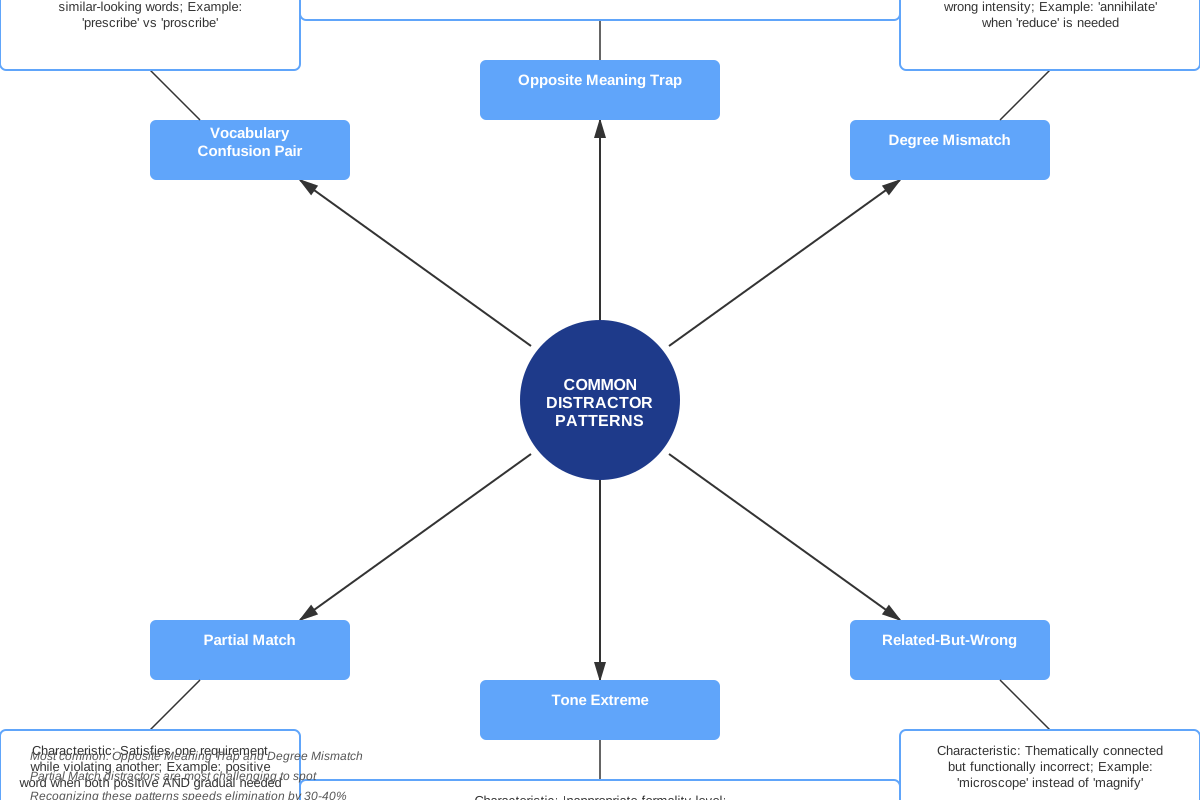
GRE test writers employ predictable distractor patterns—incorrect answer choices designed to attract students who aren't thinking carefully. Recognizing these patterns accelerates elimination:
- The "sounds right" distractor: A sophisticated-sounding word that creates a grammatical sentence but logical nonsense
- The partial match: A word that fits one part of the sentence but contradicts another element
- The wrong intensity: A word with the correct positive/negative orientation but inappropriate degree (e.g., "annoyed" vs. "enraged")
- The wrong register: A word that's too informal, too technical, or otherwise mismatched to the passage's style
- The thematic trap: A word topically related to the passage's subject matter but logically incompatible with the specific blank
By recognizing these patterns, test-takers can quickly identify and eliminate distractors, even when they don't immediately recognize the correct answer.
Concept Relationships
The concepts within answer choice elimination form an interconnected system where each element reinforces the others. The Four-Step Elimination Process serves as the overarching framework, incorporating Logical Consistency analysis in step three, Tone and Connotation evaluation as part of the same step, and Semantic Precision assessment during step four when comparing final candidates. Recognizing Common Distractor Patterns accelerates the entire process by enabling rapid identification of flawed choices during step three.
This topic connects directly to prerequisite knowledge of context clue identification, as the signal words and logical structures identified through context analysis provide the criteria against which answer choices are evaluated. The relationship flows: Context Clues → Logical Framework → Elimination Criteria → Systematic Evaluation → Correct Answer Selection.
Answer choice elimination also enables progression to more advanced Verbal Reasoning strategies. Mastery of elimination techniques provides the foundation for Sentence Equivalence approaches, where students must identify two words that create sentences with equivalent meanings—a task that relies heavily on eliminating choices that create different logical outcomes. Similarly, elimination skills transfer to Reading Comprehension questions, where incorrect answer choices often contain subtle logical flaws, tone mismatches, or semantic imprecisions that mirror Text Completion distractors.
The relationship map: Context Analysis → Prediction of Word Type → Systematic Elimination → Logical Consistency Check + Tone Evaluation + Semantic Precision Assessment → Final Selection → Verification
High-Yield Facts
⭐ Eliminating even one answer choice increases guessing probability from 20% to 25%; eliminating two increases it to 33%, making strategic elimination more valuable than random vocabulary memorization.
⭐ Contrast signal words (although, despite, however, nevertheless, yet) indicate the blank must create opposition to another part of the sentence, enabling immediate elimination of choices that continue rather than contrast.
⭐ Continuation signal words (furthermore, moreover, similarly, indeed, likewise) indicate the blank must reinforce or extend the existing idea, allowing elimination of contrasting concepts.
⭐ When two answer choices are near-synonyms, both are usually incorrect; the GRE rarely includes two correct answers, so similar meanings typically indicate shared incorrectness.
⭐ Extreme words (always, never, completely, absolutely, utterly) are more frequently incorrect than moderate words, as GRE passages typically present nuanced arguments rather than absolute claims.
- Answer choices that create grammatical errors (subject-verb disagreement, incorrect preposition pairing) can be immediately eliminated regardless of vocabulary meaning.
- Negative prefixes (un-, in-, dis-, non-) provide quick tone identification; if the sentence requires a positive word, all negative-prefix options can be rapidly eliminated.
- The correct answer often uses moderately difficult vocabulary (words students might recognize but rarely use), while distractors include either very common words or extremely obscure terms.
- Approximately 60-70% of Text Completion questions allow elimination of at least three answer choices through logical and tonal analysis alone.
- Time spent on careful initial sentence reading (15-20 seconds) reduces total question time by preventing hasty errors and enabling faster elimination.
- Answer choices that repeat words or concepts already present in the sentence are frequently incorrect, as the GRE tests vocabulary breadth rather than redundancy.
- When stuck between two choices, the one that creates a more specific, precise meaning is typically correct over the more general or vague option.
Quick check — test yourself on Answer choice elimination so far.
Try Flashcards →Common Misconceptions
Misconception: The correct answer is always the most sophisticated or difficult vocabulary word in the choices.
Correction: While correct answers often use moderately challenging vocabulary, the GRE includes very difficult words as distractors. Sophistication doesn't equal correctness; logical fit determines the right answer. Sometimes the correct choice is a relatively common word used precisely.
Misconception: Students should predict the exact correct word before looking at answer choices.
Correction: Predicting the specific word is often impossible and wastes time. Instead, predict the general type of word needed (positive/negative, concrete/abstract, intensifier/moderator) to create an elimination filter. The goal is to eliminate wrong answers, not to guess the right one independently.
Misconception: If a word "sounds good" in the sentence, it's probably correct.
Correction: The GRE deliberately includes choices that sound sophisticated and create grammatically correct sentences but contain subtle logical flaws. "Sounding good" is insufficient; the choice must create logical consistency, match tone, and provide semantic precision.
Misconception: Elimination only works when students know most of the vocabulary words.
Correction: Elimination is most valuable precisely when vocabulary knowledge is incomplete. Even recognizing that one word is negative and another positive enables elimination based on sentence logic, regardless of knowing precise definitions. Tone and logic can be assessed with partial vocabulary knowledge.
Misconception: All five answer choices are equally plausible before analysis.
Correction: GRE test writers deliberately include obviously incorrect choices alongside subtle distractors. Typically, 2-3 choices can be eliminated quickly through basic logical or tonal analysis, leaving 2-3 plausible candidates for careful evaluation. The choices are not equally weighted in difficulty.
Misconception: Elimination takes too much time and students should trust their first instinct.
Correction: Systematic elimination, when practiced, takes 60-90 seconds per question—well within time constraints. First instincts are frequently wrong on GRE Verbal questions because distractors are designed to appeal to hasty thinking. The time invested in elimination dramatically improves accuracy.
Misconception: If two answer choices seem equally good, students should just guess randomly between them.
Correction: When two choices remain after elimination, careful re-reading with focus on subtle semantic differences, tone precision, and logical strength usually reveals a distinction. The GRE rarely creates truly ambiguous questions; one choice will create a slightly stronger, more precise meaning.
Worked Examples
Example 1: Single-Blank Text Completion
Question: The historian's interpretation of the ancient texts was so _____ that even specialists in the field found her arguments difficult to follow.
(A) lucid
(B) convoluted
(C) conventional
(D) superficial
(E) derivative
Step 1 - Read and identify structural clues: The sentence contains the signal phrase "so _____ that," indicating a cause-and-effect relationship. The effect is that "even specialists found her arguments difficult to follow." The blank must describe an interpretation quality that logically causes difficulty in following arguments.
Step 2 - Predict word type: The blank requires a word describing something that makes arguments hard to follow—something negative related to clarity or complexity. The word should suggest confusion, complexity, or lack of clarity.
Step 3 - Systematic elimination:
- (A) lucid: This means "clear" or "easy to understand." If the interpretation were lucid, specialists would find it easy to follow, not difficult. This creates a logical contradiction. ELIMINATE.
- (B) convoluted: This means "complex and difficult to follow." If the interpretation were convoluted, specialists would indeed find it difficult to follow. This creates logical consistency. KEEP.
- (C) conventional: This means "following accepted standards." Conventional interpretations might be easy or difficult to follow, but conventionality doesn't logically cause difficulty. There's no clear cause-and-effect relationship. ELIMINATE.
- (D) superficial: This means "lacking depth." Superficial arguments are typically easier to follow, not harder, because they don't explore complexity. This contradicts the effect. ELIMINATE.
- (E) derivative: This means "imitative" or "unoriginal." Derivative work might be unimpressive, but it wouldn't necessarily be difficult to follow. No logical connection to the effect. ELIMINATE.
Step 4 - Final selection: Only (B) convoluted remains after elimination. Verification: "The historian's interpretation was so convoluted that even specialists found her arguments difficult to follow" creates perfect logical consistency—complex, tangled interpretations naturally cause difficulty in comprehension.
Answer: (B) convoluted
Connection to learning objectives: This example demonstrates elimination based on logical consistency (eliminating choices that contradict the cause-and-effect structure) and shows how systematic evaluation of each choice against sentence logic leads to the correct answer even if "convoluted" wasn't immediately predicted.
Example 2: Two-Blank Text Completion with Interdependent Blanks
Question: Although the committee members were initially _____(i)_____ the proposed changes, the director's _____(ii)_____ presentation eventually persuaded them to approve the plan.
Blank (i)
(A) enthusiastic about
(B) skeptical of
(C) indifferent to
Blank (ii)
(D) perfunctory
(E) compelling
(F) ambiguous
Step 1 - Read and identify structural clues: The sentence begins with "Although," a contrast signal indicating that the two blanks must create opposition. The committee's initial attitude (Blank i) must contrast with the outcome (approval). The presentation's quality (Blank ii) must logically explain the change from initial attitude to approval.
Step 2 - Predict word types: Blank (i) needs a word describing an attitude that would typically prevent approval (since "although" signals contrast with the eventual approval). Blank (ii) needs a word describing a presentation quality that could overcome initial resistance and persuade people.
Step 3 - Systematic elimination for Blank (i):
- (A) enthusiastic about: If members were initially enthusiastic, there's no contrast with eventual approval—they already supported it. The "although" becomes meaningless. ELIMINATE.
- (B) skeptical of: If members were initially skeptical (doubtful, questioning), this contrasts with eventual approval, making the "although" meaningful. KEEP.
- (C) indifferent to: If members were indifferent (uncaring), this somewhat contrasts with approval, but indifference doesn't create strong opposition that needs overcoming. Weaker than (B). TENTATIVELY KEEP.
Step 3 - Systematic elimination for Blank (ii) (considering remaining Blank i options):
- (D) perfunctory: This means "routine, superficial, done without care." A perfunctory presentation wouldn't persuade skeptical people to change their minds. ELIMINATE.
- (E) compelling: This means "convincing, persuasive." A compelling presentation could logically persuade skeptical people. KEEP.
- (F) ambiguous: This means "unclear, open to multiple interpretations." An ambiguous presentation wouldn't persuade skeptical people; it would increase doubt. ELIMINATE.
Step 4 - Test combinations:
- (B) skeptical + (E) compelling: "Although members were initially skeptical of the changes, the director's compelling presentation persuaded them." Perfect logical flow—strong initial opposition overcome by persuasive presentation.
- (C) indifferent + (E) compelling: "Although members were initially indifferent to the changes, the director's compelling presentation persuaded them." Less logical—indifferent people don't need much persuasion, so "compelling" seems excessive.
Answer: Blank (i) = (B) skeptical of; Blank (ii) = (E) compelling
Connection to learning objectives: This example demonstrates elimination based on logical consistency with signal words (the contrast indicator "although"), shows how blanks can be interdependent (the second blank must logically explain overcoming the first blank's attitude), and illustrates comparing remaining choices for the strongest logical connection.
Exam Strategy
Approaching Text Completion Questions with Elimination
When encountering a Text Completion question on the GRE, implement this strategic sequence:
Initial Assessment (10-15 seconds): Read the complete sentence or passage without looking at answer choices. Identify signal words (contrast indicators, continuation markers, cause-and-effect structures) and determine the logical relationships between ideas. For multi-blank questions, identify which blank has the strongest contextual clues and start there.
Trigger Words to Watch For: Certain words and phrases signal specific elimination opportunities:
- Contrast triggers (although, despite, however, nevertheless, yet, while, whereas, in contrast): The blank must oppose another element; eliminate choices that continue rather than contrast
- Continuation triggers (furthermore, moreover, similarly, likewise, indeed, in fact): The blank must reinforce the existing idea; eliminate opposing concepts
- Cause-and-effect markers (because, since, therefore, thus, consequently, as a result): The blank must create logical causation; eliminate choices that break the causal chain
- Degree modifiers (extremely, somewhat, slightly, moderately): These indicate the intensity required; eliminate choices with mismatched intensity
- Negative constructions (not, never, rarely, hardly, scarcely): These reverse the required word type; eliminate choices that would be correct without the negative
Process-of-Elimination Tips Specific to Text Completion
Use physical elimination: On scratch paper, write A B C D E (or the appropriate letters for multi-blank questions) and physically cross out eliminated choices. This prevents reconsidering already-rejected options and maintains focus on viable candidates.
Eliminate in passes: First pass eliminates obvious logical contradictions and tone mismatches (typically removes 2-3 choices). Second pass evaluates remaining choices for semantic precision and subtle distinctions (narrows to 1-2 choices). This two-pass approach prevents premature commitment and ensures thorough evaluation.
Trust elimination over recognition: If elimination leaves one choice but it's an unfamiliar word, trust the elimination process. The GRE frequently uses moderately difficult vocabulary for correct answers. If four choices are definitively wrong, the fifth must be correct regardless of familiarity.
For two-blank and three-blank questions, use interdependence: After eliminating options for one blank, test remaining combinations. Often, only one combination creates logical consistency across all blanks, allowing elimination of choices that work individually but fail in combination.
Time Allocation Advice
Allocate approximately 60-90 seconds per single-blank question and 90-120 seconds per multi-blank question. This breaks down as:
- 15-20 seconds: Initial reading and context analysis
- 30-50 seconds: Systematic elimination of each choice
- 10-20 seconds: Final comparison and selection
- 5-10 seconds: Verification (re-read with selected answer)
If stuck after 90 seconds on a single-blank question, eliminate what you can, make your best selection from remaining choices, and move forward. Spending more than 2 minutes on any Text Completion question compromises time for other questions. The goal is strategic efficiency, not perfection on every item.
Pacing checkpoint: After completing 5 questions, check that approximately 7-8 minutes have elapsed. This ensures you're maintaining appropriate pace for the 20-question, 30-minute Verbal section.
Memory Techniques
The CLEAT Mnemonic for Elimination Criteria
Remember the five primary elimination criteria with CLEAT:
- Contrast signals (although, despite, however) → blank must oppose
- Logical consistency → choice must create coherent statement
- Extreme words → usually incorrect; moderate words safer
- Attitude/tone → must match passage's positive/negative orientation
- Type prediction → eliminate choices outside predicted category (noun/verb/adjective, positive/negative, concrete/abstract)
Visualization Strategy: The Elimination Funnel
Visualize answer choices as entering a funnel with multiple filters:
Wide opening (5 choices) → Filter 1: Logical Consistency (removes 1-2 choices) → Filter 2: Tone Match (removes 1-2 choices) → Filter 3: Semantic Precision (removes remaining incorrect choices) → Narrow output (1 correct choice)
This mental image reinforces the systematic, multi-stage nature of elimination and prevents skipping evaluation steps.
The "Opposite Day" Technique for Contrast Signals
When encountering contrast signals (although, despite, however), mentally label the sentence "Opposite Day." The blank must be the opposite of what initially seems logical. If the sentence seems to call for something positive, Opposite Day means you need negative. This simple mental tag prevents the common error of missing contrast structures.
Acronym for Common Distractors: SWEPT
Remember common distractor patterns with SWEPT:
- Sophisticated-sounding but meaningless
- Wrong intensity (too strong or too weak)
- Extreme language (always, never, completely)
- Partial match (fits one part, fails another)
- Thematic trap (topically related but logically wrong)
Summary
Answer choice elimination represents the most powerful and universally applicable strategy for GRE Text Completion questions, transforming vocabulary challenges into logical reasoning tasks. Rather than attempting to predict specific correct answers, skilled test-takers systematically eliminate choices that create logical inconsistencies, tone mismatches, or semantic imprecisions. The four-step elimination process—careful reading with attention to signal words, prediction of general word type, systematic evaluation of each choice, and final comparison of remaining candidates—provides a structured approach that maximizes accuracy while maintaining efficient pacing. Elimination criteria include logical consistency (does the choice create a coherent statement?), tone matching (does it align with the passage's positive/negative orientation?), and semantic precision (does it provide the exact meaning required?). By recognizing common distractor patterns and leveraging signal words like contrast indicators and continuation markers, test-takers can typically eliminate 3-4 incorrect choices through analysis alone, dramatically improving success rates even when vocabulary knowledge is incomplete. This strategy proves especially valuable on multi-blank questions where interdependence between blanks allows elimination of combinations that fail to create overall coherence. Mastery of elimination techniques not only improves Text Completion performance but also transfers to Sentence Equivalence and Reading Comprehension questions, making it a foundational skill for Verbal Reasoning success.
Key Takeaways
- Answer choice elimination is more effective than prediction: Identifying what's definitively wrong is easier and more reliable than guessing what's perfectly right, especially under time pressure with unfamiliar vocabulary.
- Signal words provide elimination criteria: Contrast indicators (although, despite, however) and continuation markers (furthermore, moreover, similarly) dictate whether the blank must oppose or reinforce existing ideas, enabling rapid elimination.
- Systematic evaluation beats first instincts: The four-step process (read carefully, predict word type, evaluate each choice, compare finalists) prevents hasty errors caused by attractive distractors designed to appeal to quick thinking.
- Logical consistency trumps sophistication: A sophisticated-sounding word that creates logical contradictions is wrong; a simpler word that maintains coherent meaning is correct. The GRE tests reasoning, not vocabulary showmanship.
- Tone and semantic precision distinguish final candidates: When elimination narrows choices to two plausible options, careful attention to connotation (positive/negative/neutral) and exact meaning (ambiguous vs. vague vs. obscure) reveals the correct answer.
- Elimination works even with incomplete vocabulary knowledge: Recognizing basic positive/negative orientation and understanding sentence logic enables elimination of 60-70% of choices, making the strategy valuable precisely when vocabulary gaps exist.
- Physical elimination and time management are essential: Crossing out rejected choices on scratch paper maintains focus, while allocating 60-90 seconds per question ensures completion of all items without rushing or lingering.
Related Topics
Sentence Equivalence Strategies: Building on elimination techniques, Sentence Equivalence questions require identifying two words that create sentences with equivalent meanings. Mastery of elimination enables efficient identification of word pairs by eliminating choices that create different logical outcomes or tonal shifts.
Context Clue Analysis: This foundational skill provides the logical framework upon which elimination strategies depend. Deeper study of context clues—including contrast indicators, restatement signals, and example markers—enhances the ability to identify elimination criteria quickly and accurately.
Vocabulary in Context: While elimination reduces reliance on pure vocabulary memorization, understanding how word meanings shift based on context improves semantic precision assessment. This topic explores connotation, denotation, and contextual meaning variation.
Reading Comprehension Question Analysis: Elimination principles transfer directly to Reading Comprehension, where incorrect answer choices contain logical flaws, scope errors, and tone mismatches similar to Text Completion distractors. Mastering elimination in Text Completion builds skills for efficient Reading Comprehension performance.
Advanced Text Completion: Three-Blank Questions: After mastering elimination on single-blank questions, progression to three-blank questions requires managing interdependence across multiple blanks, where elimination of one choice cascades to eliminate combinations in other blanks.
Practice CTA
Now that you've mastered the principles and strategies of answer choice elimination, it's time to put these techniques into practice. The practice questions and flashcards that follow are specifically designed to reinforce the elimination process, helping you internalize the systematic approach until it becomes automatic under test conditions. Remember: elimination is a skill that improves dramatically with deliberate practice. Each practice question is an opportunity to refine your ability to spot logical inconsistencies, recognize tone mismatches, and distinguish semantic precision. Approach each question methodically, physically crossing out eliminated choices and verifying your reasoning. With consistent practice, you'll find that questions that once seemed impossibly difficult become manageable logic puzzles. Your GRE success depends not just on knowing these strategies, but on executing them fluently under pressure—and that fluency comes only through practice. Begin now, and watch your confidence and accuracy soar.
Sign up free to keep reading
Create a free AnvayaPrep account to finish this GRE guide on Answer choice elimination — plus flashcards and practice questions.