Overview
The dependent blank strategy is one of the most powerful and frequently tested approaches in GRE Text Completion questions. This strategy applies when a Text Completion question contains multiple blanks where the correct answer for one blank directly depends on or influences the answer for another blank. Rather than treating each blank as an independent puzzle, test-takers must recognize the logical relationship between blanks and use information from one to solve the other.
Mastering the GRE dependent blank strategy is essential because approximately 40-50% of two-blank and three-blank Text Completion questions on the GRE feature some form of dependency between blanks. Students who fail to recognize these dependencies often waste time evaluating answer choices in isolation, leading to incorrect answers even when they understand the vocabulary. The strategy transforms what appears to be a complex multi-blank question into a more manageable problem by establishing a clear solving sequence.
Within the broader context of Verbal Reasoning, the dependent blank strategy represents a critical bridge between reading comprehension skills and vocabulary application. It requires students to identify logical relationships (contrast, causation, elaboration, etc.) within sentences while simultaneously applying precise vocabulary knowledge. This strategy builds upon fundamental text completion skills while preparing students for the analytical reading required in Reading Comprehension passages, making it a cornerstone technique for achieving high Verbal Reasoning scores.
Learning Objectives
- [ ] Identify when Dependent blank strategy is being tested
- [ ] Explain the core rule or strategy behind Dependent blank strategy
- [ ] Apply Dependent blank strategy to GRE-style questions accurately
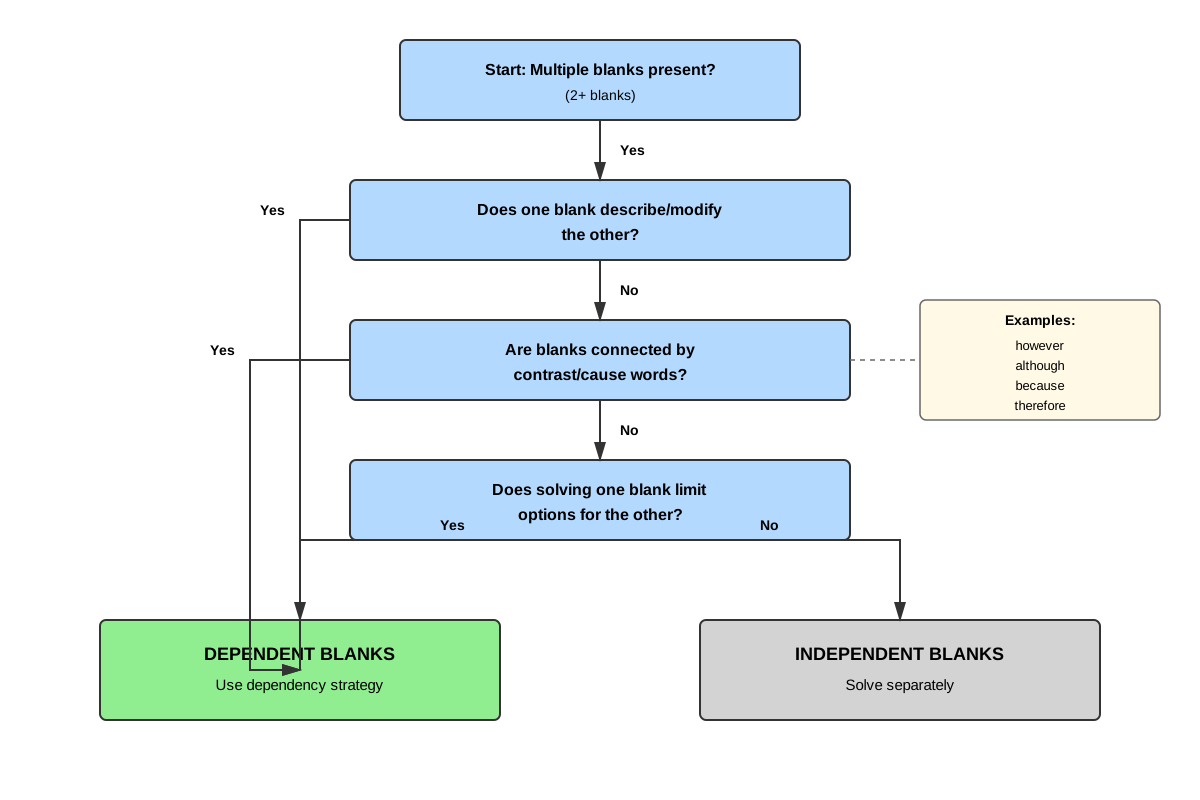
- [ ] Distinguish between dependent and independent blanks in multi-blank questions
- [ ] Determine the optimal solving sequence when multiple dependencies exist
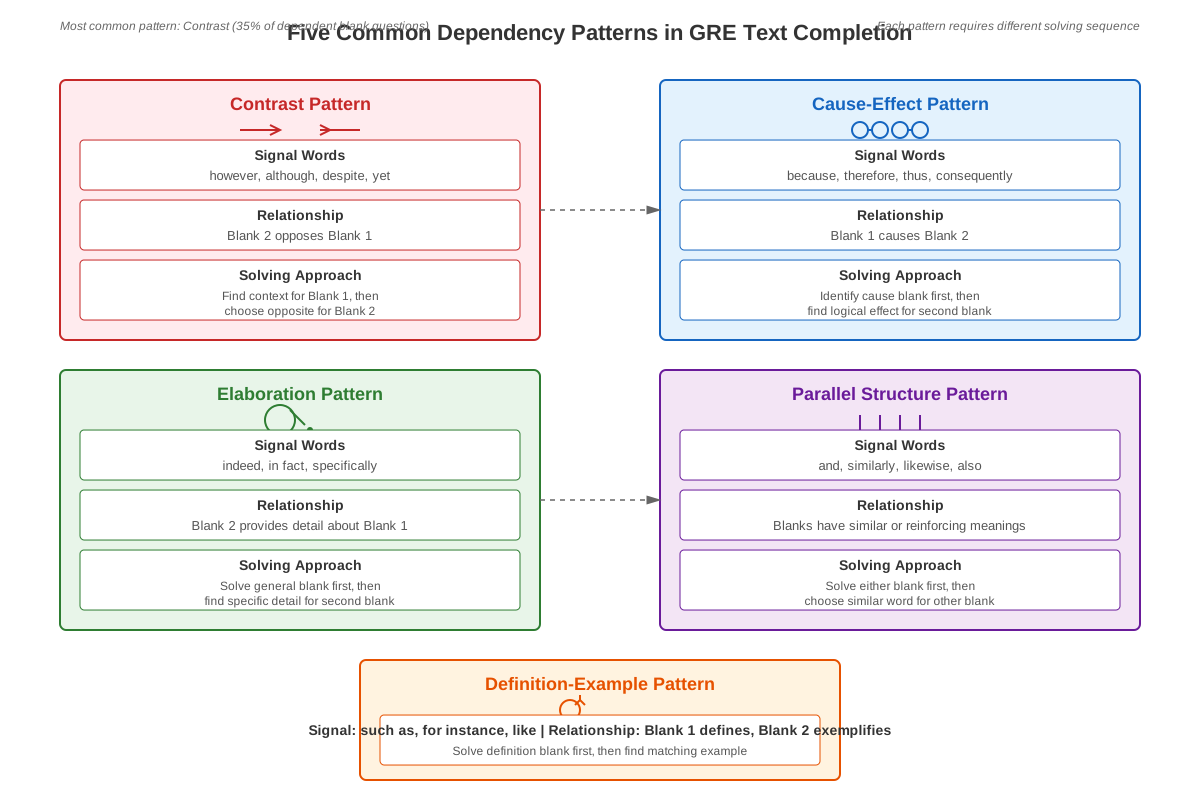
- [ ] Recognize the five most common dependency patterns in GRE Text Completion
- [ ] Evaluate answer choices systematically using dependency relationships
Prerequisites
- Basic Text Completion strategy: Understanding how to identify context clues and predict answers is essential because dependent blank strategy builds upon these fundamental skills by applying them across multiple blanks simultaneously.
- Logical relationship indicators: Familiarity with contrast words (however, although), continuation words (moreover, furthermore), and causal indicators (because, therefore) is necessary because these signal words often reveal the nature of dependencies between blanks.
- Vocabulary fundamentals: A working knowledge of common GRE vocabulary enables students to focus on strategic relationships rather than struggling with word meanings during the solving process.
Why This Topic Matters
The dependent blank strategy directly impacts performance on some of the highest-value questions in the Verbal Reasoning section. Two-blank questions are worth the same as single-blank questions but often take longer to solve without proper strategy. Three-blank questions, while less common, can consume excessive time if approached inefficiently. Students who master this strategy typically save 30-45 seconds per dependent blank question, creating valuable time for more challenging Reading Comprehension passages.
On the GRE, dependent blank questions appear in approximately 6-8 of the 20 Verbal Reasoning questions per section. These questions test not just vocabulary knowledge but also logical reasoning and the ability to synthesize information across sentence components. The Educational Testing Service (ETS) specifically designs these questions to reward strategic thinking over brute-force answer testing, making this strategy essential for scores above the 160 threshold (approximately 85th percentile).
In real-world applications, the cognitive skills developed through dependent blank strategy—identifying logical relationships, determining information dependencies, and solving problems in optimal sequence—transfer directly to academic reading, professional writing analysis, and critical thinking tasks. The strategy mirrors how skilled readers naturally process complex sentences by identifying which information clarifies other information, making it both a test-taking technique and a genuine reading comprehension skill.
Core Concepts
Understanding Blank Dependencies
A blank dependency exists when the correct answer for one blank is determined by, constrains, or logically relates to the answer for another blank in the same sentence. Dependencies can be unidirectional (Blank A determines Blank B, but not vice versa) or bidirectional (both blanks mutually constrain each other). Recognizing dependency is the first critical skill in this strategy.
The key indicator of dependency is when the sentence structure creates a logical relationship between the concepts that will fill the blanks. For example, in the sentence "The scientist's theory was so _____(i)_____ that even experts found it _____(ii)_____," the second blank depends on the first because the degree or nature of difficulty in understanding relates directly to the characteristic of the theory itself.
The Three Types of Dependencies
Direct dependencies occur when one blank explicitly describes, modifies, or explains the other. These are the most common and easiest to identify. Example: "Her _____(i)_____ nature made her _____(ii)_____ to criticism" creates a direct dependency where the personality trait determines the reaction to criticism.
Contrast dependencies appear when the relationship between blanks involves opposition or reversal. Signal words like "although," "despite," "however," and "yet" typically mark these relationships. Example: "Although the evidence was _____(i)_____, the jury remained _____(ii)_____" requires opposite or contrasting concepts.
Parallel dependencies exist when both blanks must align in tone, intensity, or direction. Words like "and," "similarly," "likewise," and "equally" often signal these relationships. Example: "The performance was both _____(i)_____ and _____(ii)_____, leaving the audience thoroughly impressed" requires both blanks to be positive and complementary.
Identifying the Anchor Blank
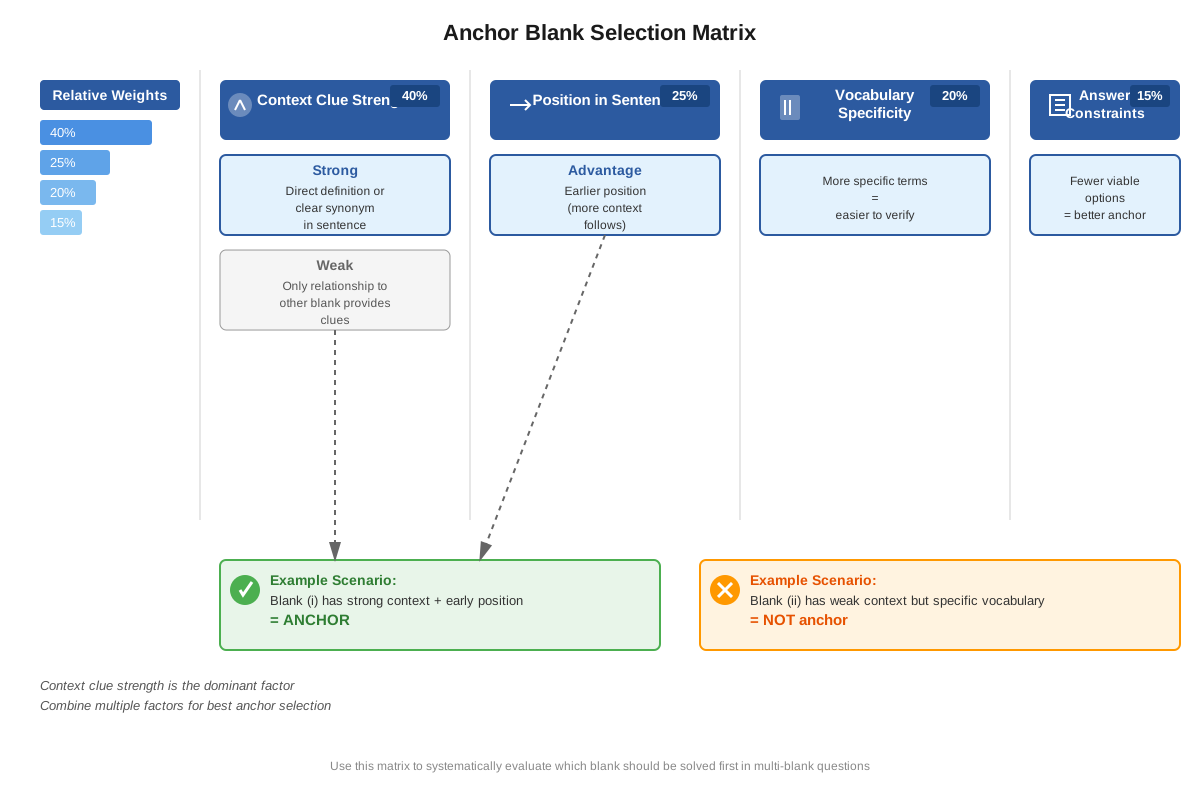
The anchor blank is the blank that should be solved first because it has stronger, more direct context clues from the sentence. Identifying the anchor blank correctly is crucial for efficient solving. The anchor blank typically has one or more of these characteristics:
- More explicit context clues in the surrounding text
- Fewer answer choices that could plausibly fit
- More concrete rather than abstract meaning
- Direct modification by descriptive phrases or clauses
Consider: "Despite the _____(i)_____ of evidence supporting the theory, skeptics remained _____(ii)_____, citing methodological flaws." The first blank is the anchor because "evidence supporting the theory" provides concrete context, while the second blank's meaning depends on whether the evidence is abundant or scarce.
The Dependency Solving Process
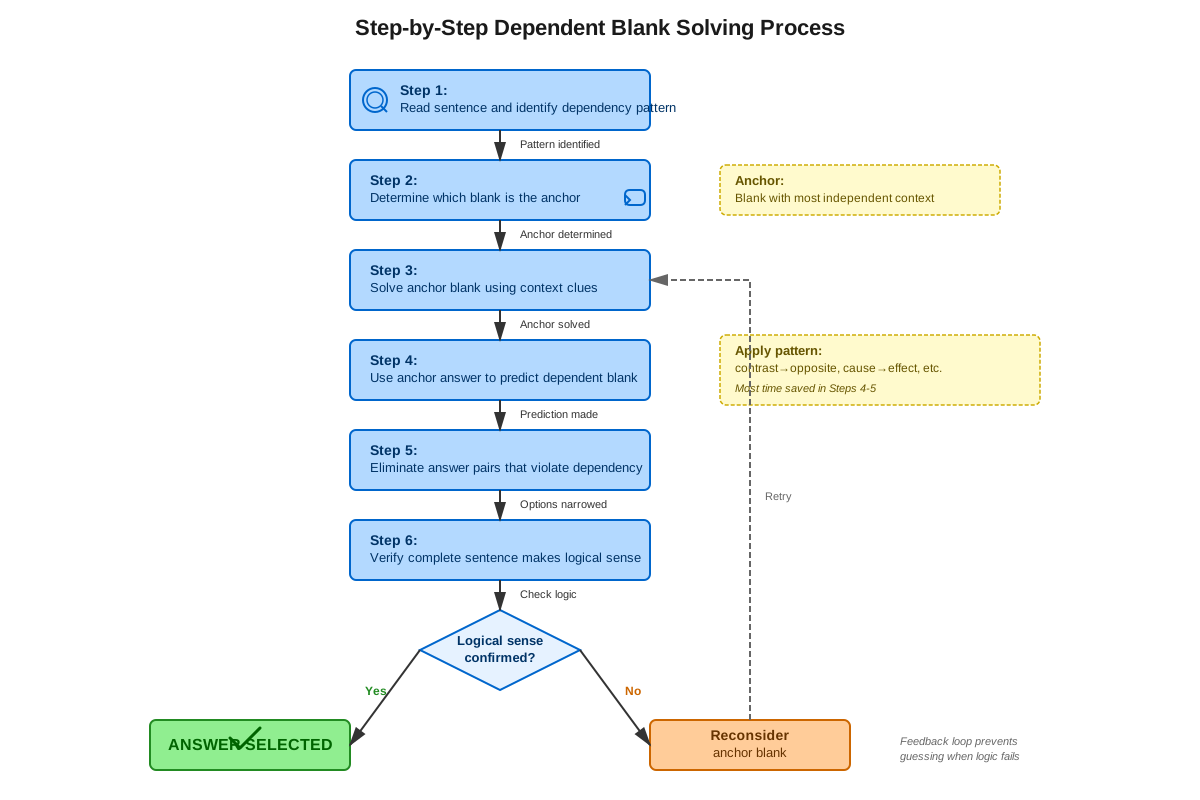
The systematic approach to dependent blank questions follows these steps:
- Read the entire sentence to understand the overall meaning and identify how many blanks exist
- Identify relationship indicators (contrast words, causal words, parallel structures)
- Determine which blanks are dependent by asking "Does the answer to Blank A affect what can go in Blank B?"
- Locate the anchor blank using the criteria above
- Solve the anchor blank using traditional context clues
- Use the anchor answer to constrain the dependent blank by considering what logical relationship must exist
- Verify both answers by reading the complete sentence with your choices
Common Dependency Patterns
| Pattern Type | Signal Words | Relationship | Example Structure |
|---|---|---|---|
| Cause-Effect | because, therefore, thus, consequently | First blank causes second | "Because of the _____(i)_____, the result was _____(ii)_____" |
| Contrast | although, despite, however, yet | Blanks oppose each other | "Despite being _____(i)_____, she was _____(ii)_____" |
| Elaboration | indeed, in fact, specifically | Second blank intensifies first | "The theory was _____(i)_____, indeed _____(ii)_____" |
| Parallel Support | and, similarly, equally, both | Blanks align in meaning | "Both _____(i)_____ and _____(ii)_____, the approach succeeded" |
| Conditional | if, when, unless | First blank sets condition for second | "If the data proves _____(i)_____, the hypothesis will be _____(ii)_____" |
Three-Blank Dependencies
Three-blank questions can feature multiple dependency relationships simultaneously. The most common patterns include:
- Linear dependency: Blank A → Blank B → Blank C (each depends on the previous)
- Hub dependency: Blank B depends on both Blank A and Blank C
- Split dependency: Blanks A and B are independent, but both influence Blank C
For three-blank questions, identifying the solving sequence becomes even more critical. Always start with the blank that has the most independent context clues, then work through the dependency chain.
Concept Relationships
The dependent blank strategy connects directly to fundamental text completion skills by adding a layer of inter-blank analysis to the standard context clue identification process. While basic text completion treats each blank as an isolated puzzle, the dependent blank strategy recognizes that blanks exist within a unified logical structure.
The relationship flow operates as follows: Context clue identification → Logical relationship recognition → Dependency determination → Anchor blank selection → Sequential solving → Answer verification. Each step builds upon the previous one, creating a systematic approach that reduces cognitive load and increases accuracy.
This strategy also connects to broader reading comprehension skills, particularly the ability to identify logical relationships between clauses and sentences. The same contrast, causation, and elaboration patterns that create dependencies between blanks also structure relationships between sentences in Reading Comprehension passages. Mastering dependent blank strategy thus strengthens overall analytical reading ability.
Furthermore, the strategy relates to time management principles in standardized testing. By establishing an optimal solving sequence, students avoid the inefficiency of testing all possible answer combinations (which could be 9 combinations for two-blank questions or 27 for three-blank questions). This efficiency gain compounds across the entire Verbal section.
High-Yield Facts
⭐ Approximately 40-50% of multi-blank Text Completion questions feature dependent blanks that should be solved sequentially rather than independently.
⭐ The anchor blank is almost always the blank with more concrete, specific context clues rather than abstract or general descriptions.
⭐ Contrast signal words (although, despite, however, yet) create the most common type of dependency on the GRE, appearing in roughly 30% of dependent blank questions.
⭐ When both blanks appear equally solvable, start with the first blank and use it to verify the second—this approach is faster than testing all combinations.
⭐ If you cannot determine a clear dependency, the blanks are likely independent and should be solved separately using standard context clues.
- Three-blank questions with dependencies typically feature one independent anchor blank and two dependent blanks rather than three mutually dependent blanks.
- Parallel dependencies (both blanks must align in tone) are often signaled by coordinating conjunctions like "and" or "both...and" structures.
- The correct answer pair in dependent blank questions will create a logical, coherent sentence even if individual words are unfamiliar—coherence is the ultimate verification test.
- Causal dependencies (because, therefore, thus) typically make the cause the anchor blank because effects can vary more widely than their causes.
- When time is limited, solving the anchor blank and making an educated guess on the dependent blank is more effective than randomly guessing both blanks.
- Dependent blank questions are intentionally placed throughout the section to test sustained strategic thinking rather than clustered together.
Quick check — test yourself on Dependent blank strategy so far.
Try Flashcards →Common Misconceptions
Misconception: All multi-blank questions feature dependent blanks that must be solved together. → Correction: Many two-blank and three-blank questions feature independent blanks that should be solved separately using their own context clues. The dependent blank strategy only applies when a logical relationship between blanks exists. Always assess whether a dependency exists before applying this strategy.
Misconception: The first blank should always be solved first in dependent blank questions. → Correction: The anchor blank—the one with stronger context clues—should be solved first, regardless of its position in the sentence. Sometimes the second or third blank has more explicit context and should serve as the anchor. Position in the sentence does not determine solving sequence.
Misconception: If you can't immediately see the dependency, you're missing something important. → Correction: Not all multi-blank questions have dependencies. If the logical relationship between blanks isn't clear after careful reading, the blanks are likely independent. Spending excessive time searching for non-existent dependencies wastes valuable test time.
Misconception: Both blanks in a dependent pair must be equally difficult vocabulary words. → Correction: GRE question writers often pair a more accessible anchor blank with a more challenging dependent blank. This design rewards strategic thinking—students who identify and solve the easier anchor blank can often determine the harder dependent blank through logical relationship even with limited vocabulary knowledge.
Misconception: Contrast dependencies always require opposite meanings (antonyms). → Correction: Contrast dependencies require logically opposing concepts within the sentence context, but not necessarily antonyms. For example, "abundant" and "skeptical" can form a contrast dependency (abundant evidence yet skeptical scientists) without being opposites. The contrast relates to the logical expectation, not pure word meaning.
Misconception: Testing all answer combinations is safer than using the dependency strategy. → Correction: Testing all combinations (9 for two blanks, 27 for three blanks) is time-prohibitive and cognitively overwhelming. The dependent blank strategy is both faster and more accurate because it uses logical constraints to eliminate impossible combinations before testing.
Worked Examples
Example 1: Two-Blank Contrast Dependency
Question: Although the new policy was designed to be _____(i)_____, critics argued that its implementation would actually _____(ii)_____ the very problems it sought to address.
Blank (i) Options:
- A) revolutionary
- B) ameliorative
- C) provocative
Blank (ii) Options:
- D) exacerbate
- E) mitigate
- F) analyze
Solution Process:
Step 1: Identify the relationship indicator. "Although" signals a contrast dependency—the second blank must contrast with the intended purpose in the first blank.
Step 2: Determine the anchor blank. Blank (i) is the anchor because "designed to be" provides direct context about the policy's intention, while Blank (ii) depends on what that intention was.
Step 3: Solve the anchor blank. The phrase "the very problems it sought to address" indicates the policy was meant to help or improve something. "Ameliorative" (meaning improving or making better) fits perfectly. "Revolutionary" is too extreme and doesn't specifically indicate improvement. "Provocative" is negative and contradicts the helpful intention.
Step 4: Use the anchor to solve the dependent blank. If the policy was designed to be ameliorative (improving), but critics say it will actually do the opposite, we need a word meaning "worsen." "Exacerbate" means to make worse, creating the perfect contrast. "Mitigate" means to make better (no contrast). "Analyze" means to examine (irrelevant).
Step 5: Verify. "Although the new policy was designed to be ameliorative, critics argued that its implementation would actually exacerbate the very problems it sought to address." This creates a logical, coherent contrast.
Answer: Blank (i): B) ameliorative; Blank (ii): D) exacerbate
Learning Objective Connection: This example demonstrates identifying dependency (contrast relationship), determining the anchor blank (first blank has clearer context), and applying the strategy to reach the correct answer efficiently.
Example 2: Three-Blank Linear Dependency
Question: The researcher's methodology was so _____(i)_____ that even her colleagues found her conclusions _____(ii)_____, leading the academic community to _____(iii)_____ her findings pending further verification.
Blank (i) Options:
- A) rigorous
- B) unorthodox
- C) meticulous
Blank (ii) Options:
- D) persuasive
- E) dubious
- F) innovative
Blank (iii) Options:
- G) embrace
- H) scrutinize
- I) dismiss
Solution Process:
Step 1: Identify dependencies. This features linear dependency: the methodology (i) affects how colleagues view conclusions (ii), which affects the community's response (iii).
Step 2: Locate the anchor. Blank (i) is the anchor—it has the most independent context and determines the cascade of effects.
Step 3: Solve the anchor blank. The phrase "so _____ that even her colleagues found her conclusions _____" suggests the methodology caused a problem or concern. "Unorthodox" (unconventional, unusual) fits this pattern—it would make colleagues question conclusions. "Rigorous" and "meticulous" are positive and wouldn't cause colleagues to doubt conclusions.
Step 4: Solve the second blank using the first. If the methodology was unorthodox, colleagues would find conclusions "dubious" (doubtful, questionable). "Persuasive" contradicts the concern. "Innovative" is positive and doesn't match the problematic tone.
Step 5: Solve the third blank using the second. If conclusions are dubious, the community would "scrutinize" (examine carefully with skepticism) the findings. "Embrace" contradicts doubt. "Dismiss" is too extreme—they're waiting for verification, not rejecting outright.
Step 6: Verify the complete sentence. "The researcher's methodology was so unorthodox that even her colleagues found her conclusions dubious, leading the academic community to scrutinize her findings pending further verification." Perfect logical flow.
Answer: Blank (i): B) unorthodox; Blank (ii): E) dubious; Blank (iii): H) scrutinize
Learning Objective Connection: This example demonstrates identifying complex multi-blank dependencies, determining optimal solving sequence, and systematically working through a dependency chain to reach accurate answers.
Exam Strategy
When approaching Text Completion questions on the GRE, invest 5-10 seconds in strategic assessment before attempting to solve. Ask yourself: "Are these blanks related, or can I solve them independently?" Look for the relationship indicators discussed in Core Concepts—contrast words, causal words, parallel structures. This brief assessment prevents the costly mistake of treating dependent blanks as independent or vice versa.
Trigger phrases to watch for include: "although," "despite," "because," "therefore," "so...that," "such...that," "both...and," "not only...but also," "if...then," and "while." These phrases almost always signal some form of dependency. When you see these structures spanning multiple blanks, immediately activate the dependent blank strategy.
Process of elimination becomes more powerful with dependent blanks. Once you've solved the anchor blank, you can eliminate entire answer choices for the dependent blank that don't create the required logical relationship. For example, if the anchor blank establishes a positive concept and the relationship is parallel, immediately eliminate all negative options for the dependent blank without even reading them carefully. This aggressive elimination saves significant time.
Time allocation should follow this pattern: 30 seconds for initial reading and dependency assessment, 30-45 seconds for solving the anchor blank, 20-30 seconds for solving each dependent blank using the established relationship, and 10-15 seconds for final verification. This totals approximately 90-120 seconds for a two-blank dependent question, which is efficient given these questions' complexity.
Exam Tip: If you're struggling to determine which blank is the anchor, default to solving the first blank and using it to verify the second. This approach is more time-efficient than extended deliberation and works well when both blanks have moderate context clues.
When running short on time, solve only the anchor blank carefully, then make an educated guess on the dependent blank based on the logical relationship. This approach yields approximately 60-70% accuracy on the dependent blank (much better than random 33% chance) while preserving time for other questions.
Memory Techniques
ACID mnemonic for identifying dependencies:
- Anchor: Find the blank with clearest context
- Connection: Identify the relationship word (although, because, etc.)
- Infer: Use the anchor to infer the dependent blank
- Double-check: Verify the complete sentence makes sense
Contrast vs. Parallel visualization: Picture contrast dependencies as a seesaw (one side up, one side down—opposite directions) and parallel dependencies as railroad tracks (both going the same direction). This visual distinction helps quickly categorize the relationship type.
The "Anchor Chain" metaphor: Think of dependent blank questions as a boat anchored in place. The anchor (anchor blank) is fixed firmly by context clues, and the dependent blank(s) are the boat—they can only move within the range allowed by the anchor chain (the logical relationship). This metaphor reinforces that solving the anchor first constrains and simplifies the dependent blank.
Three-finger rule for three-blank questions: Hold up three fingers. Point to the finger representing the blank with the most context clues—that's your anchor. Then trace the logical connections to the other fingers in sequence. This physical gesture helps organize the solving sequence during the test.
"STOP" before solving:
- Scan for relationship words
- Test for dependency (does one blank affect the other?)
- Order your solving sequence (anchor first)
- Proceed systematically through the chain
Summary
The dependent blank strategy is an essential GRE Verbal Reasoning technique that transforms complex multi-blank Text Completion questions into manageable, systematic problems. By recognizing when blanks are logically related rather than independent, identifying the anchor blank with the strongest context clues, and using that anchor to constrain the dependent blank through logical relationships, test-takers can solve these questions both more accurately and more efficiently. The strategy applies to approximately 40-50% of multi-blank questions and typically saves 30-45 seconds per question while improving accuracy. The three primary dependency types—direct, contrast, and parallel—are signaled by specific relationship indicators like "although," "because," and "both...and." Mastering this strategy requires practice in identifying dependencies, determining optimal solving sequences, and systematically working through logical relationships rather than testing all possible answer combinations.
Key Takeaways
- Dependent blanks are connected by logical relationships (contrast, causation, parallel) that must be identified before solving—approximately 40-50% of multi-blank questions feature dependencies.
- Always solve the anchor blank first—the blank with the clearest, most concrete context clues—then use that answer to constrain the dependent blank through the logical relationship.
- Relationship indicators are your roadmap: "although" and "despite" signal contrast dependencies; "because" and "therefore" signal causal dependencies; "and" and "both" signal parallel dependencies.
- The strategy dramatically reduces solving time by eliminating the need to test all possible answer combinations (9 for two blanks, 27 for three blanks) and instead using logical constraints.
- Not all multi-blank questions have dependencies—if you cannot identify a clear logical relationship between blanks after careful reading, solve them independently using standard context clues.
- Verification is essential: After solving both blanks, read the complete sentence to ensure it creates a coherent, logical statement—this catches errors in dependency identification.
- Strategic thinking matters more than vocabulary alone—students with moderate vocabulary who apply this strategy consistently outperform students with extensive vocabulary who solve blanks randomly.
Related Topics
Independent Blank Strategy: Understanding how to solve multi-blank questions where each blank has its own context clues and no logical dependencies exist. Mastering dependent blank strategy first makes it easier to recognize when blanks are truly independent.
Advanced Logical Relationships: Deeper study of the ten most common logical relationships in GRE sentences (contrast, causation, elaboration, exemplification, comparison, etc.) and how they create dependencies. This builds directly on the foundation established in dependent blank strategy.
Sentence Equivalence Strategy: Applying similar logical relationship analysis to Sentence Equivalence questions, where two answer choices must create equivalent meanings. The analytical skills from dependent blank strategy transfer directly to this question type.
Reading Comprehension Logical Structure: Using the same relationship identification skills to analyze how sentences and paragraphs connect in longer passages. The dependent blank strategy develops the micro-level analytical skills that scale up to passage-level comprehension.
Practice CTA
Now that you understand the dependent blank strategy, it's time to cement your mastery through deliberate practice. Attempt the practice questions designed specifically for this topic, focusing on identifying dependencies before solving and consciously applying the anchor-first approach. Use the flashcards to reinforce the relationship indicators and dependency patterns until recognition becomes automatic. Remember: strategic thinking is a skill that improves with practice, and each question you solve using this systematic approach builds the neural pathways that will make the strategy feel natural on test day. Your investment in mastering this high-yield strategy will pay dividends across 40-50% of your Text Completion questions—that's a significant score boost waiting to be unlocked!
Sign up free to keep reading
Create a free AnvayaPrep account to finish this GRE guide on Dependent blank strategy — plus flashcards and practice questions.