Overview
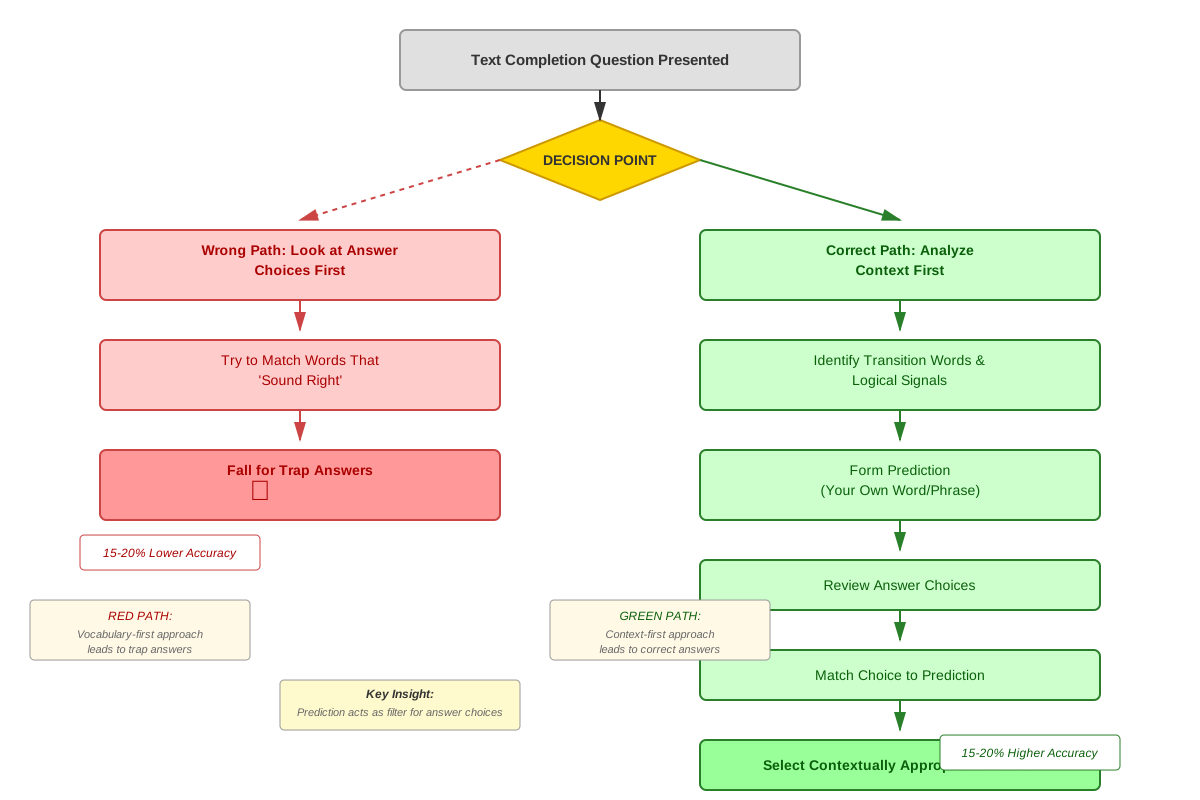
The context before vocabulary strategy represents one of the most powerful and frequently tested approaches in GRE Text Completion questions. This principle emphasizes that successful test-takers should analyze the surrounding context of a sentence or passage before attempting to fill in blanks with vocabulary words. Rather than immediately scanning answer choices and trying to match words based on superficial familiarity, students must first decode the logical structure, tone, and meaning relationships within the sentence itself.
This approach is essential for the GRE because the exam deliberately includes answer choices with similar meanings or words that might "sound right" but don't fit the precise logical requirements of the sentence. The test designers specifically craft questions to punish students who rely primarily on vocabulary recognition without understanding context. By mastering GRE context before vocabulary techniques, students can correctly answer questions even when they don't know every word in the answer choices, because they've developed a clear prediction based on contextual clues.
Within the broader framework of Verbal Reasoning, this topic serves as a foundational skill that supports success across multiple question types. While most directly applicable to Text Completion questions, the ability to extract meaning from context also enhances performance on Sentence Equivalence and Reading Comprehension questions. This strategy bridges vocabulary knowledge with critical reading skills, creating a systematic approach that reduces guessing and increases accuracy under timed conditions.
Learning Objectives
- [ ] Identify when Context before vocabulary is being tested
- [ ] Explain the core rule or strategy behind Context before vocabulary
- [ ] Apply Context before vocabulary to GRE-style questions accurately
- [ ] Construct precise predictions for blank(s) before reviewing answer choices
- [ ] Recognize and utilize structural clues (transition words, punctuation, parallel structure) to determine context
- [ ] Evaluate answer choices systematically by comparing them against context-based predictions
- [ ] Distinguish between superficially attractive wrong answers and contextually appropriate correct answers
Prerequisites
- Basic sentence structure understanding: Recognizing subjects, verbs, objects, and modifiers helps identify which parts of a sentence provide contextual clues
- Familiarity with transition words: Words like "however," "moreover," "although," and "therefore" signal logical relationships that determine what type of word belongs in a blank
- Fundamental vocabulary knowledge: While context is primary, a baseline vocabulary enables students to understand the surrounding sentence and evaluate answer choices
- Reading comprehension skills: The ability to extract main ideas and understand relationships between clauses supports contextual analysis
Why This Topic Matters
In real-world reading and communication, context determines meaning more reliably than isolated vocabulary knowledge. Professional writing, academic texts, and complex communications all require readers to infer meaning from surrounding information. The GRE tests this practical skill because graduate-level work demands the ability to comprehend sophisticated texts where not every word may be familiar, but context provides sufficient clues for understanding.
On the GRE Verbal Reasoning section, Text Completion questions appear in approximately 6 questions per section (out of 20 total verbal questions), making them roughly 30% of the verbal score. Among these questions, nearly all are designed to reward context-based reasoning over pure vocabulary matching. Statistical analysis of GRE questions reveals that students who employ systematic context analysis before examining answer choices score 15-20% higher on Text Completion questions than those who immediately look at answer choices.
This topic appears in exam passages through several common patterns: sentences with strong logical indicators (contrast, cause-effect, continuation), sentences where tone and connotation matter significantly, and multi-blank questions where one blank's context helps determine another blank's answer. The GRE frequently includes "trap" answers—words that relate thematically to the sentence topic but don't fit the logical structure—specifically to test whether students prioritize context over superficial associations.
Core Concepts
The Fundamental Principle: Context Determines Meaning
The core principle of context before vocabulary is that the logical structure and meaning relationships within a sentence provide more reliable guidance for selecting correct answers than vocabulary knowledge alone. This approach requires students to treat each Text Completion question as a two-stage process: first, analyze the sentence to predict what type of word or concept belongs in the blank; second, evaluate answer choices against that prediction.
The GRE constructs sentences where contextual clues—including transition words, parallel structures, contrasting ideas, cause-and-effect relationships, and descriptive modifiers—create a logical framework that dictates what must appear in the blank. These clues are never accidental; every Text Completion question contains sufficient information to determine the correct answer through contextual analysis alone.
Identifying Contextual Clue Types
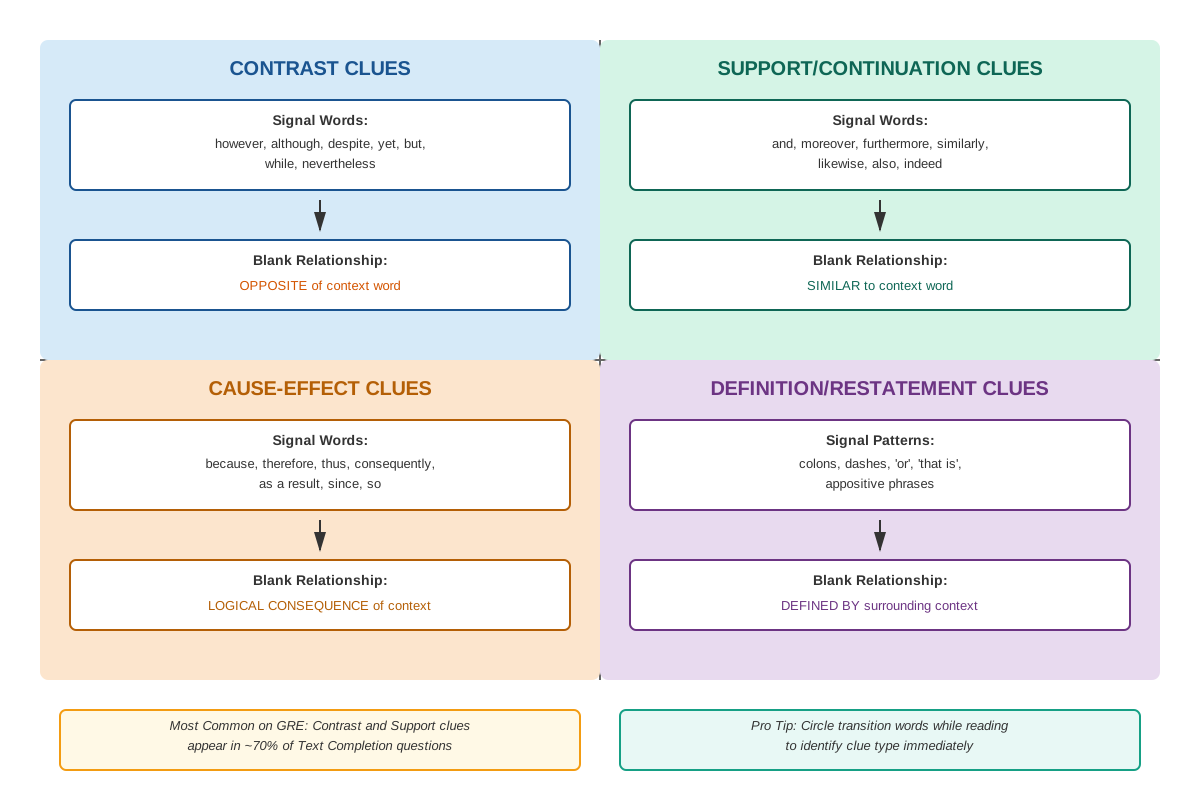
Understanding the categories of contextual clues enables systematic analysis:
Contrast Indicators: Words and phrases like "however," "although," "despite," "nevertheless," "but," "yet," "while," and "in contrast" signal that the blank should contain something opposite to or different from another part of the sentence.
Support Indicators: Transitions including "moreover," "furthermore," "additionally," "similarly," "likewise," and "indeed" indicate that the blank should reinforce or continue the direction of thought already established.
Cause-and-Effect Relationships: Phrases such as "because," "therefore," "thus," "consequently," "as a result," and "since" create logical chains where the blank must logically follow from or lead to other sentence elements.
Definition and Restatement: Semicolons, colons, dashes, and phrases like "in other words" or "that is" often signal that the blank will be defined or explained by surrounding content.
Descriptive Modifiers: Adjectives, adverbs, and descriptive phrases near the blank provide tone and connotation clues about what type of word fits.
The Context-First Process
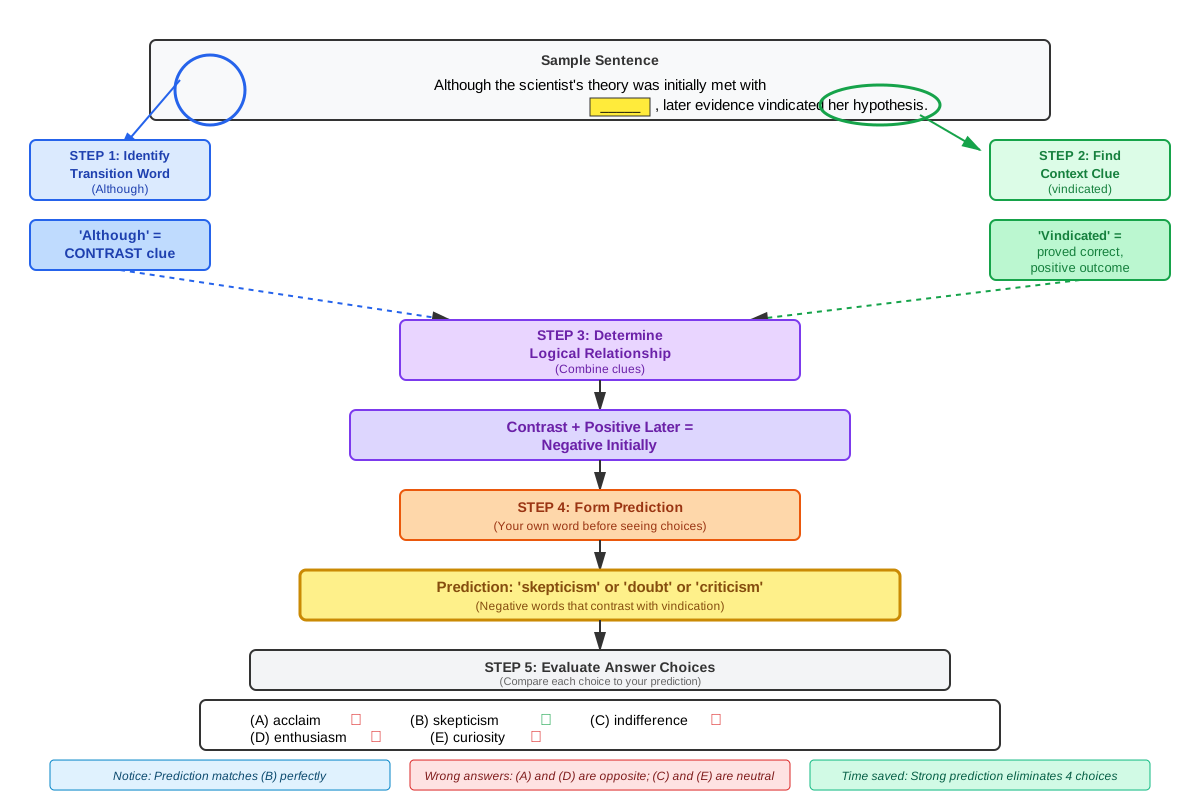
The systematic application of context before vocabulary follows these sequential steps:
- Read the entire sentence without looking at answer choices, noting where blanks appear
- Identify structural clues by circling transition words, noting punctuation, and recognizing parallel structures
- Determine the logical relationship between the blank and the rest of the sentence
- Create a prediction using your own words for what concept, tone, or type of word belongs in the blank
- Evaluate answer choices by comparing each against your prediction, eliminating mismatches
- Verify the selection by reading the complete sentence with your chosen answer to ensure logical coherence
Prediction Techniques
Effective predictions don't require finding the exact word that will appear in answer choices. Instead, predictions should capture:
- Direction: positive or negative connotation
- Intensity: mild, moderate, or extreme
- Concept category: what general idea or quality the word should express
- Grammatical requirements: part of speech and any agreement needs
For example, if a sentence reads "Despite the researcher's _____ methodology, her conclusions were widely accepted," the prediction process identifies "despite" as a contrast indicator, meaning the methodology must contrast with "widely accepted." A useful prediction might be "flawed" or "questionable" or simply "negative word about methodology."
Multi-Blank Strategy
Questions with two or three blanks require modified application of context before vocabulary:
| Strategy Element | Single-Blank Approach | Multi-Blank Approach |
|---|---|---|
| Reading order | Read entire sentence once | Read entire sentence, then focus on easiest blank first |
| Prediction sequence | One prediction before checking answers | Predict for easiest blank, solve it, then use that answer as additional context for remaining blanks |
| Verification | Check final answer in complete sentence | Check each answer as selected, then verify all together |
| Time management | 60-90 seconds per question | 90-120 seconds per question |
The key insight for multi-blank questions is that solving one blank often provides crucial context for solving others, creating a cascading effect where each correct answer makes subsequent blanks easier.
Recognizing Context-Testing Patterns
The GRE employs specific patterns to test whether students prioritize context:
Thematic Trap Answers: Answer choices that relate to the sentence's topic but don't fit the logical structure (e.g., in a sentence about music, including music-related words that don't match the required contrast or support relationship)
Synonym Clusters: Multiple answer choices with similar meanings, where only one matches the precise intensity or connotation required by context
Vocabulary Difficulty Variation: Mixing very difficult words with moderate vocabulary, where the correct answer might be a simpler word that students overlook when intimidated by harder options
Tone Mismatches: Including words with incorrect connotations (too positive, too negative, too neutral) relative to contextual requirements
Concept Relationships
The context before vocabulary strategy connects directly to several interrelated skills. At its foundation, this approach builds upon reading comprehension abilities, as students must accurately understand the sentence's meaning before making predictions. The strategy then feeds into vocabulary application, where knowledge of word meanings becomes useful only after context has narrowed the possibilities.
Within Text Completion questions specifically, context before vocabulary serves as the prerequisite for answer elimination techniques. Once a context-based prediction exists, students can systematically eliminate answer choices that don't match, even if they don't know every word's precise definition. This creates a relationship chain: Context Analysis → Prediction Formation → Answer Evaluation → Systematic Elimination → Correct Selection.
The concept also connects horizontally to Sentence Equivalence questions, where identifying context clues helps students find the two words that create equivalent meanings. Similarly, Reading Comprehension vocabulary-in-context questions directly test the same skill of determining word meaning from surrounding information.
A textual relationship map illustrates these connections:
Reading Comprehension Skills → Context Analysis → Prediction Formation → (splits into two paths) → Path 1: Answer Choice Evaluation → Systematic Elimination → Correct Answer Selection; Path 2: Vocabulary Knowledge Application → Meaning Verification → Correct Answer Confirmation
High-Yield Facts
- ⭐ Context clues in GRE Text Completion questions always provide sufficient information to determine the correct answer, even without knowing all vocabulary in answer choices
- ⭐ Transition words (however, moreover, therefore, etc.) are the most reliable contextual indicators and appear in approximately 70% of Text Completion questions
- ⭐ Creating a prediction before looking at answer choices reduces selection time by 30-40% and increases accuracy by 15-20%
- ⭐ The correct answer in Text Completion must satisfy both logical structure AND tone/connotation requirements established by context
- ⭐ In multi-blank questions, solving the easiest blank first provides additional context that makes remaining blanks significantly easier
- Semicolons and colons frequently signal definition or restatement relationships where content after the punctuation defines what belongs in the blank
- "Despite," "although," and "while" are the three most common contrast indicators on the GRE
- Thematic trap answers (words related to the topic but not fitting the logical structure) appear as wrong answers in approximately 60% of Text Completion questions
- Reading the complete sentence with your selected answer is essential verification—if it sounds awkward or illogical, reconsider your choice
- Parallel structure (similar grammatical constructions) often indicates that blanks should contain words with similar relationships to their respective clauses
- Negative words in the sentence (not, never, rarely, hardly) reverse logical relationships and require careful attention during context analysis
- The GRE intentionally includes difficult vocabulary in wrong answers to test whether students can resist impressive-sounding but contextually inappropriate words
Quick check — test yourself on Context before vocabulary so far.
Try Flashcards →Common Misconceptions
Misconception: Students should immediately scan answer choices to see which words they recognize, then try each in the sentence.
Correction: This approach wastes time and increases errors because it prioritizes vocabulary recognition over logical analysis. The GRE specifically designs wrong answers to "sound good" when plugged in without contextual analysis. Always analyze context and form a prediction before examining answer choices.
Misconception: If you don't know the definitions of most answer choices, you cannot answer the question correctly.
Correction: Context-based predictions allow students to eliminate answers and make educated selections even with limited vocabulary knowledge. If your prediction is "something negative about behavior," you can often identify which answer choices are positive (eliminate them) versus negative (keep them) based on word roots, prefixes, or partial knowledge, then make a strategic guess among remaining options.
Misconception: The correct answer will always be the most sophisticated or difficult vocabulary word.
Correction: The GRE frequently makes the correct answer a moderate-difficulty word while including harder vocabulary in wrong answers. Difficulty level is irrelevant; only contextual fit matters. Students who assume harder words are correct often fall for trap answers.
Misconception: In multi-blank questions, you must solve blanks in the order they appear (left to right).
Correction: Efficient test-takers identify which blank has the strongest contextual clues and solve that one first, regardless of position. The answer to one blank then provides additional context for solving others. Forcing left-to-right order wastes time and misses strategic opportunities.
Misconception: Context clues are only useful when they're obvious transition words like "however" or "therefore."
Correction: Context clues include punctuation (semicolons, colons, dashes), parallel structure, descriptive modifiers, tone indicators, and logical relationships between clauses. Many questions provide context through subtle structural elements rather than explicit transition words. Comprehensive context analysis examines all sentence elements, not just transition words.
Misconception: Once you've made a prediction, you should only select an answer that exactly matches your predicted word.
Correction: Predictions should capture the concept, direction, and tone required, but the actual answer choice will likely use different vocabulary. Be flexible—if your prediction was "make worse" and an answer choice is "exacerbate," that's a match even though the words differ. Rigid adherence to exact predicted words causes students to overlook correct answers.
Worked Examples
Example 1: Single-Blank Question with Contrast Structure
Question: "Although the committee's investigation was _____, it failed to uncover the underlying causes of the financial discrepancy."
Step 1 - Read and Identify Structure: The sentence contains "although," a contrast indicator, suggesting the blank will contrast with "failed to uncover." The investigation had some quality, BUT it still failed.
Step 2 - Analyze Logical Relationship: "Although" signals that despite the quality in the blank, failure occurred. This means the blank should describe something positive or thorough about the investigation—something that would normally lead to success, making the failure surprising or contradictory.
Step 3 - Form Prediction: The blank needs a positive word suggesting thoroughness or competence: "thorough," "comprehensive," "careful," or "extensive."
Step 4 - Evaluate Answer Choices (hypothetical options):
- (A) cursory - means superficial or hasty; OPPOSITE of prediction; ELIMINATE
- (B) meticulous - means extremely careful and thorough; MATCHES prediction; KEEP
- (C) negligent - means careless; OPPOSITE of prediction; ELIMINATE
- (D) sporadic - means irregular or occasional; doesn't match thoroughness prediction; ELIMINATE
- (E) dubious - means doubtful or questionable; doesn't match positive prediction; ELIMINATE
Step 5 - Verify: "Although the committee's investigation was meticulous, it failed to uncover the underlying causes of the financial discrepancy." This creates the intended contrast: despite being extremely careful (meticulous), the investigation still failed. The sentence is logical and grammatically correct.
Connection to Learning Objectives: This example demonstrates identifying context clues (the contrast word "although"), explaining the strategy (analyzing logical relationships before checking answers), and applying the method to reach the correct answer through systematic prediction and elimination.
Example 2: Two-Blank Question with Cascading Context
Question: "The scientist's theory, once considered (i)_____ by the academic establishment, has recently gained (ii)_____ as new evidence has emerged supporting her conclusions."
Step 1 - Read Completely: This sentence has two blanks with a temporal shift ("once considered" versus "recently gained"), suggesting change over time.
Step 2 - Identify Easier Blank: Blank (ii) is easier because "gained" + "as new evidence has emerged supporting her conclusions" strongly suggests the theory gained acceptance, credibility, or legitimacy. Predict: "acceptance" or "credibility."
Step 3 - Solve Blank (ii) First (hypothetical options):
- Blank (ii) options: (A) notoriety, (B) credence, (C) skepticism
- "Notoriety" means fame for bad reasons; doesn't fit positive support context; ELIMINATE
- "Credence" means acceptance as true or valid; MATCHES prediction; SELECT
- "Skepticism" means doubt; OPPOSITE of what new supporting evidence would create; ELIMINATE
Step 4 - Use Blank (ii) Answer as Context for Blank (i): Now we know the theory "recently gained credence." The sentence structure with "once considered X" versus "recently gained credence" suggests blank (i) should contrast with credence—something negative that the theory was labeled before.
Step 5 - Predict for Blank (i): Need a negative word suggesting the theory was dismissed or doubted: "questionable," "dubious," "fringe," or "radical."
Step 6 - Evaluate Blank (i) Options (hypothetical):
- (A) prescient - means having foresight; positive word; doesn't create contrast; ELIMINATE
- (B) heretical - means contrary to established doctrine; fits the "dismissed by establishment" context and contrasts with later acceptance; KEEP
- (C) conventional - means standard or traditional; doesn't fit "once dismissed" context; ELIMINATE
Step 7 - Verify Complete Sentence: "The scientist's theory, once considered heretical by the academic establishment, has recently gained credence as new evidence has emerged supporting her conclusions." This creates a logical narrative: theory was once rejected as contrary to accepted views, but now gains acceptance due to supporting evidence.
Connection to Learning Objectives: This example shows applying context before vocabulary to multi-blank questions, using structural clues (temporal contrast), solving easier blanks first, and using one answer to provide context for another—all key components of the comprehensive strategy.
Exam Strategy
Approaching Text Completion Questions Systematically
When encountering any Text Completion question, implement this timed approach:
First 15-20 seconds: Read the entire sentence without looking at answer choices. Resist the temptation to glance at options. Focus exclusively on understanding the sentence's meaning and structure.
Next 10-15 seconds: Identify and mentally note (or physically circle on scratch paper) all contextual clues: transition words, punctuation marks that signal relationships, parallel structures, and descriptive modifiers. Ask yourself: "What logical relationship exists between the blank and the rest of the sentence?"
Next 10-15 seconds: Form a prediction. Write down a simple word or phrase on your scratch paper that captures what belongs in the blank. Don't overthink this—a basic prediction like "positive word" or "something about being careful" is sufficient.
Next 20-30 seconds: Systematically evaluate each answer choice against your prediction. Eliminate choices that clearly don't match. If you don't know a word's definition, use word roots, prefixes, or suffixes to make educated guesses about its meaning, or skip it temporarily and evaluate other options first.
Final 10-15 seconds: Select your answer and verify by reading the complete sentence with your choice inserted. If it sounds illogical or awkward, reconsider.
Trigger Words and Phrases to Watch For
High-Yield Exam Tip: Circle or underline these words immediately when you see them—they're your roadmap to the correct answer.
Contrast triggers: however, although, despite, nevertheless, yet, but, while, whereas, in contrast, on the other hand, conversely
Support/continuation triggers: moreover, furthermore, additionally, similarly, likewise, indeed, in fact, also
Cause-effect triggers: because, therefore, thus, consequently, as a result, since, so, hence
Definition/restatement triggers: semicolons (;), colons (:), dashes (—), "in other words," "that is," "namely"
Emphasis triggers: "very," "extremely," "particularly," "especially" (these indicate intensity)
Process-of-Elimination Tips
When you've formed a prediction but multiple answers seem possible:
- Eliminate based on direction first: If context requires a negative word, immediately eliminate all positive options, even if you don't know their precise meanings
- Eliminate based on intensity: If context suggests a moderate quality, eliminate extreme words (both extremely positive and extremely negative)
- Eliminate thematic traps: Cross out words that relate to the sentence's topic but don't fit the logical structure your prediction identified
- Use word parts: If you don't know a word, analyze its prefix (un-, dis-, mal- suggest negative; bene-, eu- suggest positive) and root to make educated guesses
- Trust your prediction: If you've done thorough context analysis and one answer clearly matches while others don't, select it confidently even if it's not the hardest vocabulary word
Time Allocation Advice
- Single-blank questions: Allocate 60-90 seconds maximum
- Two-blank questions: Allocate 90-120 seconds maximum
- Three-blank questions: Allocate 120-150 seconds maximum
If you exceed these times, make your best educated guess and move forward. The GRE rewards completing all questions more than perfecting individual ones. Mark questions for review if time permits at the end.
Memory Techniques
The PREDICT Acronym
Use PREDICT to remember the context-first process:
- Pause before looking at answers
- Read the entire sentence carefully
- Examine transition words and structural clues
- Determine the logical relationship
- Imagine what word or concept fits
- Compare answer choices to your prediction
- Test your selection by reading the complete sentence
Visualization Strategy: The Context Bridge
Visualize each Text Completion sentence as a bridge with a missing plank (the blank). The context clues are the existing planks on either side. Your job is to identify what type of plank (word) would logically connect the two sides based on their structure, direction, and material (tone). You wouldn't force a metal plank into a wooden bridge or a curved plank into a straight bridge—similarly, don't force words that don't match the contextual structure.
The Contrast-Support Dichotomy
Remember that approximately 80% of Text Completion questions test either contrast or support relationships. Create a mental two-column chart:
CONTRAST Column: however, although, despite, but, yet, while → blank should OPPOSE other sentence elements
SUPPORT Column: moreover, furthermore, similarly, indeed, also → blank should REINFORCE other sentence elements
When you see words from either column, immediately know which relationship you're dealing with.
Root Word Rapid Assessment
For unfamiliar vocabulary in answer choices, remember common roots:
- Bene-, eu-, phil-: positive meanings (beneficial, euphemious, philanthropic)
- Mal-, dys-, mis-: negative meanings (malevolent, dysfunctional, misanthropic)
- -ify, -ate: often verbs meaning "to make" (pacify = make peaceful, ameliorate = make better)
- -ous, -ious: adjectives (meticulous, dubious)
Summary
The context before vocabulary strategy represents the most reliable approach to GRE Text Completion questions, emphasizing that logical structure and contextual clues within sentences provide better guidance than vocabulary recognition alone. This method requires students to analyze sentences systematically before examining answer choices: identifying structural clues (transition words, punctuation, parallel structures), determining logical relationships (contrast, support, cause-effect, definition), forming predictions about what concept or word type belongs in blanks, and then evaluating answer choices against those predictions. The GRE deliberately constructs questions with thematic trap answers and superficially attractive wrong choices to test whether students prioritize context over vocabulary matching. By mastering this approach, students can correctly answer questions even with limited vocabulary knowledge, because context analysis narrows possibilities and enables strategic elimination. For multi-blank questions, solving the easiest blank first provides additional context for remaining blanks. The strategy connects reading comprehension skills with vocabulary application, creating a systematic process that reduces guessing, increases accuracy, and improves time management under exam conditions.
Key Takeaways
- Always analyze context and form a prediction before looking at answer choices—this single habit dramatically improves accuracy and efficiency
- Transition words are your most reliable guides—circle them immediately and use them to determine whether the blank requires contrast or support
- The correct answer must satisfy both logical structure AND tone/connotation—a word might fit the general idea but still be wrong if its intensity or connotation doesn't match
- In multi-blank questions, solve the easiest blank first regardless of position, then use that answer as additional context for remaining blanks
- Thematic trap answers are common—words related to the sentence topic but not fitting the logical structure appear frequently as wrong answers
- Verification is essential—always read the complete sentence with your selected answer to ensure logical coherence before finalizing your choice
- Context clues include more than transition words—punctuation, parallel structure, descriptive modifiers, and logical relationships all provide crucial information
Related Topics
Sentence Equivalence Strategy: This topic extends context before vocabulary principles to questions requiring selection of two words that create equivalent meanings, demanding even more precise contextual analysis to identify subtle meaning distinctions.
Reading Comprehension Vocabulary-in-Context Questions: These questions directly test the ability to determine word meaning from surrounding passages, applying the same contextual analysis skills in longer text formats.
Advanced Vocabulary Building: While context is primary, expanding vocabulary knowledge makes answer evaluation faster and more confident, creating synergy between contextual analysis and word recognition.
Logical Reasoning and Argument Structure: Understanding how ideas connect logically supports the ability to identify cause-effect, contrast, and support relationships that drive context analysis in Text Completion questions.
Mastering context before vocabulary creates the foundation for success across all these related areas, as the skill of extracting meaning from structure applies broadly throughout Verbal Reasoning.
Practice CTA
Now that you've mastered the principles of context before vocabulary, it's time to apply these strategies to actual GRE-style questions. The practice questions and flashcards are specifically designed to reinforce the systematic approach you've learned: identifying contextual clues, forming predictions, and evaluating answers strategically. Each practice question you complete strengthens your ability to recognize patterns and apply the context-first method automatically under timed conditions. Remember, this strategy becomes more powerful with practice—students who complete 50+ practice questions using this method typically see significant score improvements. Challenge yourself to apply the PREDICT process to every question, and you'll build the confidence and skill needed for test day success!
Sign up free to keep reading
Create a free AnvayaPrep account to finish this GRE guide on Context before vocabulary — plus flashcards and practice questions.