Overview
Definition clues represent one of the most reliable and high-yield strategies for solving Text Completion questions on the GRE Verbal Reasoning section. These clues occur when the sentence or passage directly defines, explains, or restates the meaning of the blank, essentially providing the answer within the text itself. Unlike more subtle contextual clues that require inference, definition clues offer explicit guidance about what word or phrase should fill the blank, making them among the most straightforward clue types to identify and exploit.
Understanding GRE definition clues is essential because they appear in approximately 25-30% of all Text Completion questions, making them one of the most frequently tested clue types on the exam. When students learn to recognize these clues, they can often predict the exact meaning of the missing word before even looking at the answer choices, dramatically improving both accuracy and speed. This skill becomes particularly valuable under timed conditions, as definition clues allow for confident, rapid elimination of incorrect options.
Within the broader landscape of Verbal Reasoning, definition clues serve as a foundational strategy that connects to other critical skills including vocabulary recognition, sentence structure analysis, and logical reasoning. Mastering definition clues builds the analytical framework necessary for tackling more complex clue types such as contrast clues, cause-and-effect clues, and support clues. This topic also reinforces the fundamental GRE principle that the answer is always in the passage—students must learn to trust the text and extract meaning systematically rather than relying on outside knowledge or assumptions.
Learning Objectives
- [ ] Identify when Definition clues is being tested
- [ ] Explain the core rule or strategy behind Definition clues
- [ ] Apply Definition clues to GRE-style questions accurately
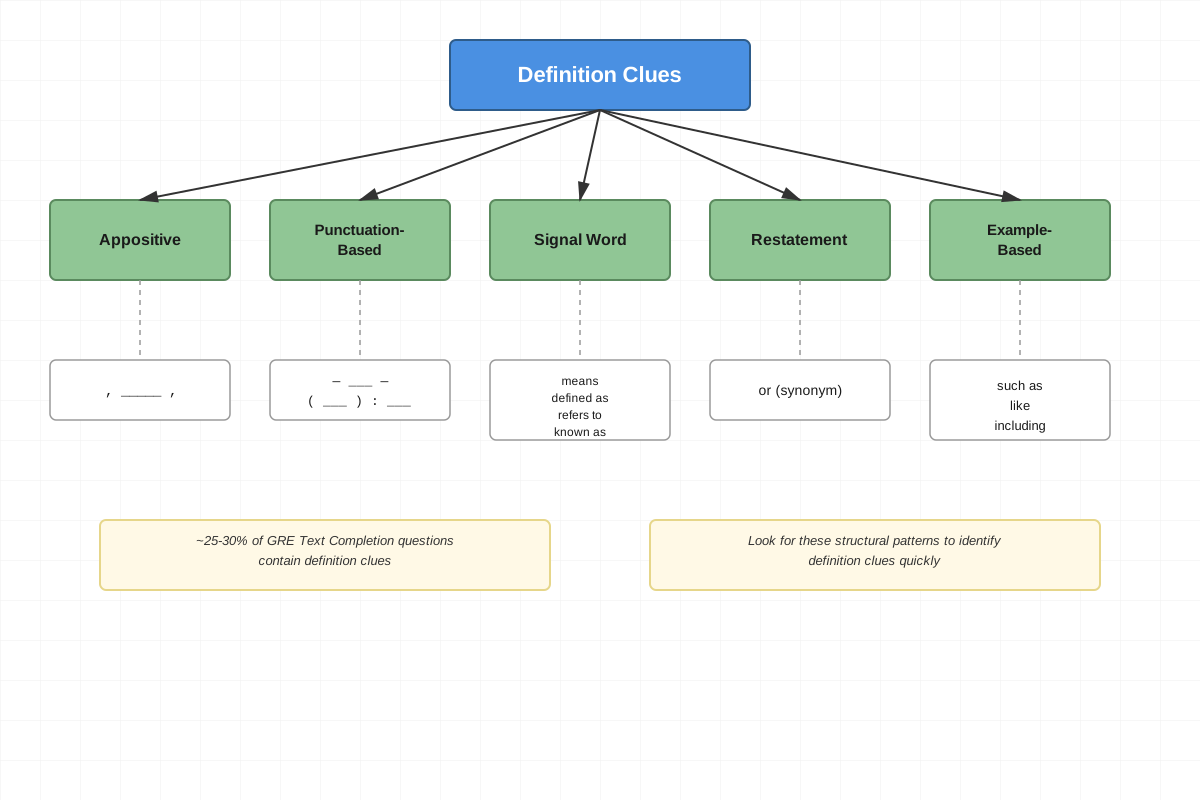
- [ ] Recognize and categorize the five major types of definition clue structures
- [ ] Distinguish definition clues from other clue types in complex sentences
- [ ] Predict the precise meaning of blanks before reviewing answer choices using definition clues
- [ ] Identify signal words and punctuation marks that indicate definition clues
Prerequisites
- Basic sentence structure understanding: Recognizing subjects, verbs, objects, and modifiers is essential for parsing where definition clues appear within sentences.
- Fundamental vocabulary knowledge: While definition clues help with difficult words, students need baseline vocabulary to understand the defining phrases themselves.
- Text Completion question format familiarity: Understanding how blanks function and how answer choices are structured allows focus on the clue-identification strategy.
- Reading comprehension skills: The ability to extract main ideas and supporting details from sentences enables recognition of definitional relationships.
Why This Topic Matters
Definition clues represent a critical skill set that extends beyond standardized testing into academic and professional contexts. In graduate-level reading, technical documents, and scholarly articles, authors frequently define specialized terminology within the text itself. The ability to identify these embedded definitions enables efficient comprehension of complex material without constant dictionary consultation. This skill proves particularly valuable in fields like law, medicine, and scientific research where precise terminology matters.
On the GRE specifically, definition clues appear in approximately 25-30% of Text Completion questions across both single-blank and multi-blank formats. They are particularly common in medium-difficulty questions (the 50th-75th percentile range), though they also appear in harder questions where the vocabulary itself becomes more challenging. The ETS (Educational Testing Service) deliberately includes definition clues because they test whether students can extract meaning from context—a fundamental graduate school skill.
Definition clues most commonly appear in several question formats: sentences containing appositives set off by commas or dashes; sentences with explicit definitional phrases like "that is" or "in other words"; sentences where a colon introduces an explanation; and sentences where examples or lists clarify the blank's meaning. Recognizing these patterns allows students to quickly categorize questions and apply the appropriate strategy, often solving problems in 30-45 seconds rather than the full minute typically allocated per Text Completion question.
Core Concepts
What Are Definition Clues?
Definition clues are words, phrases, or punctuation marks within a sentence that directly explain, define, or restate the meaning of a blank. Rather than requiring inference or interpretation, these clues provide explicit information about what concept, quality, or idea should fill the missing word. The defining characteristic of definition clues is their directness—they function as built-in dictionaries within the sentence structure itself.
The fundamental principle behind definition clues is semantic equivalence: the clue and the blank must mean essentially the same thing, or the clue must directly explain what the blank represents. This relationship differs from other clue types where the relationship might be oppositional (contrast clues) or causal (cause-and-effect clues). With definition clues, students should be able to substitute the clue phrase directly for the blank and maintain the sentence's logical coherence.
The Five Major Types of Definition Clues
1. Appositive Definition Clues
Appositives are noun phrases that rename or define another noun, typically set off by commas, dashes, or parentheses. These create some of the most obvious definition clues on the GRE.
Structure: Noun/Blank + , + defining phrase + , + continuation
Example: "The scientist's hypothesis, a tentative explanation awaiting experimental verification, proved _______ when subsequent tests contradicted her predictions."
The phrase "a tentative explanation awaiting experimental verification" defines what a hypothesis is, helping us understand that the blank should mean something like "incorrect" or "wrong."
2. Explicit Signal Word Definition Clues
Certain phrases explicitly announce that a definition or restatement follows. These signal words function as arrows pointing directly to the definition clue.
Common signal words and phrases include:
- that is
- in other words
- which means
- defined as
- known as
- or (when used to mean "in other words")
- namely
- specifically
- i.e. (id est)
Example: "The professor's lectures were _______, that is, they wandered from topic to topic without clear organization."
The phrase "that is" signals that what follows defines the blank. The definition "wandered from topic to topic without clear organization" indicates the blank should mean "disorganized" or "rambling."
3. Colon and Dash Definition Clues
Punctuation marks, particularly colons and dashes, often introduce explanations or definitions. A colon typically introduces information that explains or elaborates on what came before, while dashes can set off explanatory information similar to commas but with greater emphasis.
Example: "The committee's decision was _______: they rejected every proposal without serious consideration."
The colon introduces an explanation of the decision. Since they "rejected every proposal without serious consideration," the blank should mean something like "dismissive" or "arbitrary."
4. Example-Based Definition Clues
Sometimes the sentence provides specific examples that collectively define what should go in the blank. These example clues require students to identify the common characteristic shared by all examples.
Structure: Blank + such as/including/like + example 1, example 2, example 3
Example: "The garden contained many _______ plants, including roses, tulips, and daffodils."
The examples (roses, tulips, daffodils) are all flowering plants, so the blank should mean "flowering" or "ornamental."
5. Definitional Relative Clauses
Relative clauses beginning with "which," "who," or "that" sometimes provide definitional information about the blank. These clauses function as embedded definitions within the sentence structure.
Example: "The speaker demonstrated _______, which is the ability to express ideas clearly and persuasively."
The relative clause "which is the ability to express ideas clearly and persuasively" directly defines the blank, indicating it should be "eloquence" or "articulateness."
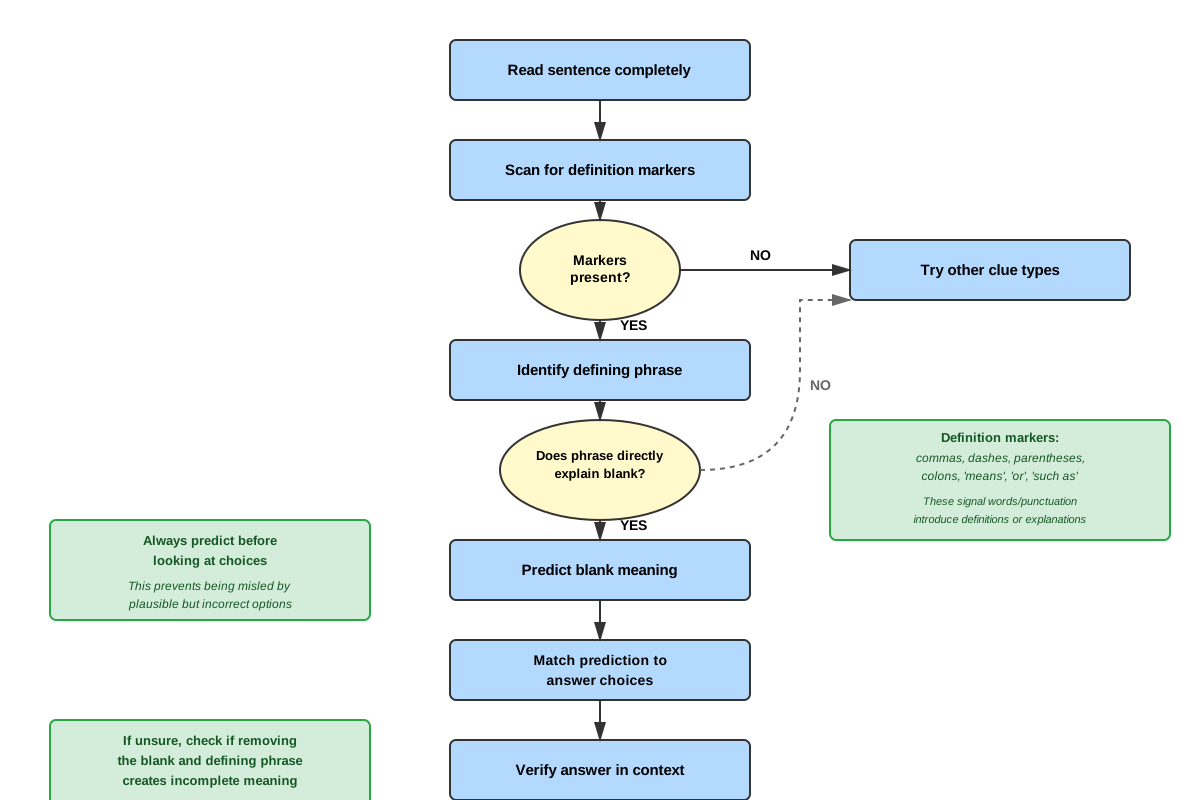
Identifying Definition Clues: The Three-Step Process
Step 1: Locate structural markers
Scan for commas, dashes, colons, signal words, and relative pronouns that might introduce definitions.
Step 2: Test for semantic equivalence
Ask: "Does this phrase mean the same thing as the blank, or does it explain what the blank is?"
Step 3: Predict before looking at choices
Based on the definition clue, write down your own word or phrase for the blank before reviewing answer options.
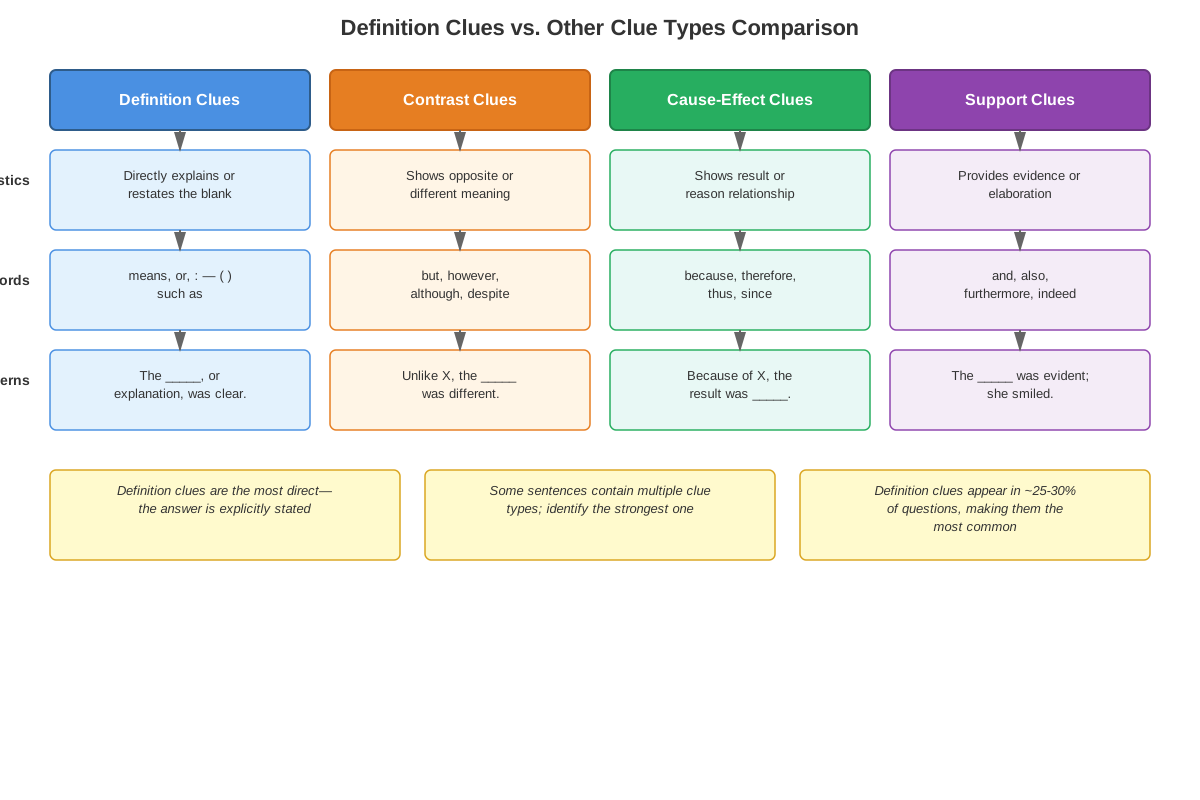
Definition Clues vs. Other Clue Types
| Feature | Definition Clues | Contrast Clues | Cause-Effect Clues |
|---|---|---|---|
| Relationship | Equivalence/Restatement | Opposition | Causation |
| Signal words | "that is," "or," colons | "but," "however," "although" | "because," "therefore," "thus" |
| Logic | A = B | A ≠ B | A → B |
| Prediction method | Use the definition directly | Use the opposite | Use the result/cause |
Concept Relationships
Definition clues form the foundation of a hierarchical system of contextual clue strategies. At the base level, recognizing definition clues requires understanding sentence structure and punctuation—the prerequisite knowledge of grammar and syntax. Once students master definition clues, they develop the analytical framework for identifying other clue types, since all clue identification begins with asking "What is the relationship between this phrase and the blank?"
The relationship flow works as follows:
Sentence Structure Analysis → Punctuation Recognition → Definition Clue Identification → Semantic Equivalence Testing → Answer Prediction → Answer Choice Elimination
Definition clues connect directly to vocabulary development because they teach students how words are defined in context. This skill transfers to learning new vocabulary from reading, a critical graduate school competency. Additionally, definition clues relate to the broader Text Completion strategy of "predicting before looking," which applies across all clue types but is most straightforward with definition clues.
Within multi-blank Text Completion questions, definition clues for one blank often help solve other blanks by clarifying the sentence's overall meaning. For example, if blank (i) has a clear definition clue, solving it first may reveal whether blank (ii) requires a word that supports or contrasts with the first blank's meaning. This interconnection demonstrates why definition clues serve as an entry point to more sophisticated Text Completion strategies.
High-Yield Facts
⭐ Definition clues appear in approximately 25-30% of all GRE Text Completion questions, making them the second most common clue type after support clues.
⭐ Appositives set off by commas or dashes are the most frequently tested definition clue structure on the GRE.
⭐ The phrase "that is" and colons are the highest-yield signal markers for definition clues, appearing in roughly 40% of definition clue questions.
⭐ When a definition clue is present, students should be able to predict the blank's meaning with 90%+ accuracy before looking at answer choices.
⭐ Definition clues can appear before or after the blank; the clue's position does not affect its validity.
- Parenthetical phrases (text within parentheses) frequently contain definition clues, especially in science-oriented passages.
- Multiple definition clues for the same blank may appear in a single sentence, providing redundant confirmation of the answer.
- Definition clues in multi-blank questions often define the first blank, which then helps solve subsequent blanks through logical relationships.
- The word "or" when appearing between two phrases often signals a restatement rather than presenting alternatives (e.g., "The theory was specious, or deceptively plausible").
- Example-based definition clues require identifying the common characteristic among all examples, not just matching one example.
- Definition clues remain valid even when the sentence contains other clue types; sentences can have multiple clue structures simultaneously.
- In difficult questions, the definition clue itself may contain challenging vocabulary, requiring students to understand the defining phrase before using it to solve the blank.
Quick check — test yourself on Definition clues so far.
Try Flashcards →Common Misconceptions
Misconception: Definition clues always appear after the blank.
Correction: Definition clues can appear anywhere in the sentence—before the blank, after the blank, or even in a separate clause. Students must scan the entire sentence for definitional information rather than assuming a fixed position.
Misconception: The word "or" always presents alternatives between two different options.
Correction: In GRE sentences, "or" frequently functions as a restatement signal meaning "in other words" rather than presenting genuine alternatives. Context determines whether "or" signals definition or true alternatives.
Misconception: Definition clues only work with single-blank questions.
Correction: Definition clues appear in multi-blank questions and can be even more valuable there, as solving one blank through a definition clue often clarifies the logical structure needed to solve remaining blanks.
Misconception: If a definition clue is present, the answer will be a synonym of a word in the clue.
Correction: The answer must match the meaning of the clue, but it may not be a direct synonym of any single word. Students must understand the entire concept expressed by the definition clue and find an answer that captures that meaning.
Misconception: Commas always signal appositives and therefore definition clues.
Correction: While commas can set off appositives that function as definition clues, commas serve many grammatical purposes. Students must verify that the phrase between commas actually defines or renames the noun/blank rather than simply providing additional information.
Misconception: Definition clues make questions easy, so they only appear in low-difficulty questions.
Correction: Definition clues appear across all difficulty levels. In harder questions, the vocabulary within the definition clue itself becomes more challenging, or the sentence structure becomes more complex, requiring careful parsing to identify the definitional relationship.
Misconception: You should always use definition clues when present and ignore other clue types.
Correction: While definition clues are highly reliable, students should verify their prediction against the full sentence context. Some sentences contain multiple clue types that should work together to confirm the answer.
Worked Examples
Example 1: Appositive Definition Clue
Question: "Despite his reputation for _______, a tendency to make hasty decisions without adequate deliberation, the judge carefully considered every aspect of the complex case before issuing his ruling."
Step 1 - Identify the structure: The phrase "a tendency to make hasty decisions without adequate deliberation" is set off by commas immediately after the blank, forming an appositive structure.
Step 2 - Recognize the definition clue: This appositive directly defines what the blank represents. The phrase tells us exactly what quality the judge has a reputation for.
Step 3 - Extract the meaning: "Making hasty decisions without adequate deliberation" describes acting quickly without careful thought—this is the definition of impetuousness, rashness, or precipitousness.
Step 4 - Note the contrast: The word "Despite" signals that the judge's actual behavior (carefully considered) contrasts with his reputation. However, this doesn't change what the blank means—it only tells us the reputation doesn't match reality.
Step 5 - Predict the answer: Before looking at choices, predict: "impetuousness," "rashness," "hastiness," or "precipitousness."
Step 6 - Evaluate choices (hypothetical options):
- (A) perspicacity - means keen insight; opposite of what we need
- (B) impetuosity - means acting hastily; matches our prediction perfectly
- (C) judiciousness - means showing good judgment; opposite of what we need
- (D) alacrity - means eager willingness; doesn't capture the negative aspect of hasty decisions
- (E) deliberation - means careful consideration; exactly opposite of what we need
Answer: (B) impetuosity
Connection to learning objectives: This example demonstrates identifying definition clues (the appositive structure), explaining the strategy (using the appositive to define the blank), and applying it accurately (predicting and selecting the correct answer).
Example 2: Colon Definition Clue with Complexity
Question: "The archaeologist's interpretation of the artifacts was entirely _______: she attributed religious significance to objects that were actually mundane household items, mistook decorative patterns for written language, and dated the site to the wrong millennium."
Step 1 - Identify the structure: The colon after the blank signals that what follows will explain or define the blank.
Step 2 - Analyze the definition: The three examples after the colon all describe errors in interpretation:
- Attributed wrong significance (religious vs. household)
- Mistook decoration for language
- Got the dating wrong by a millennium
Step 3 - Find the common thread: All three examples show the interpretation was wrong, mistaken, or inaccurate. The errors are fundamental and comprehensive.
Step 4 - Consider the word "entirely": This intensifier suggests the blank should be a strong word indicating complete incorrectness.
Step 5 - Predict the answer: "erroneous," "incorrect," "fallacious," "mistaken," or "spurious."
Step 6 - Evaluate choices (hypothetical options):
- (A) meticulous - means showing great attention to detail; positive quality, doesn't fit
- (B) erroneous - means containing errors; perfect match
- (C) innovative - means introducing new ideas; doesn't address correctness
- (D) preliminary - means initial or introductory; doesn't indicate wrongness
- (E) comprehensive - means complete or thorough; doesn't indicate incorrectness
Answer: (B) erroneous
Key insight: This example shows how definition clues can consist of multiple examples that collectively define the blank. Students must identify what all the examples have in common rather than focusing on just one example.
Exam Strategy
Systematic Approach to Definition Clue Questions
Phase 1 - Initial Scan (5-10 seconds)
Before reading the full sentence, quickly scan for structural markers:
- Commas surrounding phrases
- Dashes (—) setting off information
- Colons (:) introducing explanations
- Signal words: "that is," "or," "namely," "specifically"
- Parentheses containing explanatory information
Phase 2 - Sentence Analysis (10-15 seconds)
Read the complete sentence carefully, identifying:
- Where is the blank positioned?
- What punctuation or signal words appear near the blank?
- Does any phrase seem to explain or define the blank?
- Are there examples that collectively describe the blank?
Phase 3 - Clue Verification (5-10 seconds)
Test whether you've found a true definition clue:
- Can you substitute the clue phrase for the blank and maintain logical sense?
- Does the clue directly explain what the blank IS rather than what it causes or contrasts with?
- If you covered the answer choices, could you predict the blank's meaning from the clue alone?
Phase 4 - Prediction (5 seconds)
Write down or mentally note your prediction before looking at choices. This prevents answer choices from biasing your interpretation of the clue.
Phase 5 - Answer Selection (10-15 seconds)
Compare each answer choice to your prediction:
- Eliminate choices that don't match the definition clue's meaning
- Don't be distracted by words that appear in the sentence but don't match the clue
- Select the choice that best captures the meaning of the definition clue
Exam Tip: If you identify a clear definition clue, you should be able to solve the question in 30-45 seconds total. If you're taking longer, verify that you've correctly identified the clue and its relationship to the blank.
Trigger Words and Phrases to Watch For
High-priority signals (appear in 60%+ of definition clue questions):
- Commas setting off phrases immediately before or after the blank
- Colons (:) anywhere in the sentence
- "that is" or "that is to say"
- "or" when it means "in other words"
Medium-priority signals (appear in 20-40% of definition clue questions):
- Dashes (—) setting off explanatory phrases
- "in other words"
- "namely" or "specifically"
- "which is" or "who is" (relative clauses)
- Parentheses with explanatory content
Context-dependent signals (require verification):
- "such as" or "including" (may signal example-based definition)
- "known as" or "called"
- "defined as" or "meaning"
Time Allocation Strategy
For a typical one-blank Text Completion question with a definition clue:
- 10 seconds: Identify the definition clue structure
- 10 seconds: Extract the meaning from the clue
- 5 seconds: Predict your answer
- 20 seconds: Evaluate and eliminate answer choices
- Total: 45 seconds (leaving 15 seconds of buffer from the recommended 1 minute per question)
This time efficiency is one of the major strategic advantages of mastering definition clues—they allow you to bank time for more difficult questions.
Memory Techniques
The DEFINE Acronym
Use DEFINE to remember the major types of definition clues:
- Dashes and commas (appositives)
- Explicit signals ("that is," "in other words")
- Following colons (explanations after :)
- Including examples ("such as," "including")
- Naming clauses (relative clauses with "which is")
- Equivalence test (does the clue = the blank?)
The Punctuation Power Trio
Remember: Commas, Colons, Dashes are your three best friends for finding definition clues. Visualize these three punctuation marks as spotlights illuminating the definition within the sentence.
The Substitution Test Visualization
Imagine the sentence as a mathematical equation where the blank and the definition clue are on opposite sides of an equals sign:
BLANK = DEFINITION CLUE
If you can substitute one for the other and the sentence still makes logical sense, you've found a valid definition clue.
The "That Is" Translation
Whenever you see "or" in a GRE sentence, mentally replace it with "that is" and see if the sentence still makes sense. If it does, you've found a definition clue:
- Original: "The theory was specious, or deceptively plausible."
- Translation: "The theory was specious, that is, deceptively plausible."
- Result: "or" is functioning as a definition signal
The Example Umbrella
For example-based definition clues, visualize an umbrella where the blank is the umbrella top and the examples are the raindrops beneath it. The umbrella (blank) must be large enough to cover all the raindrops (examples). This helps you find the common characteristic that unites all examples.
Summary
Definition clues represent the most direct and reliable strategy for solving GRE Text Completion questions, appearing in approximately 25-30% of all questions. These clues occur when the sentence explicitly defines, explains, or restates the meaning of the blank through five major structures: appositives set off by punctuation, explicit signal words like "that is," colons introducing explanations, example-based definitions, and definitional relative clauses. The fundamental principle is semantic equivalence—the definition clue and the blank must mean essentially the same thing. Students should identify definition clues by scanning for structural markers (commas, dashes, colons, signal words), verify the definitional relationship through substitution testing, and predict the blank's meaning before reviewing answer choices. This approach enables rapid, accurate question solving, often in 30-45 seconds per question. Mastering definition clues builds the analytical foundation for recognizing other clue types and reinforces the core GRE principle that the answer always exists within the passage itself. Success requires systematic practice in identifying the five clue structures, extracting meaning from definition phrases, and maintaining confidence in predictions even when answer choices contain tempting distractors.
Key Takeaways
- Definition clues provide explicit information about the blank's meaning through direct explanation, restatement, or examples—making them the most straightforward clue type to identify and exploit.
- The five major structures are appositives (commas/dashes), explicit signals ("that is"), colons, examples ("such as"), and relative clauses ("which is")—memorize these patterns for rapid recognition.
- Punctuation is your primary tool: commas, colons, and dashes are the highest-yield markers for locating definition clues in GRE sentences.
- Always predict before looking at answer choices—definition clues should enable 90%+ accuracy in prediction, preventing distraction from incorrect options.
- Test for semantic equivalence: the definition clue and the blank must be interchangeable; if you can substitute one for the other, you've found a valid definition clue.
- Definition clues appear across all difficulty levels—harder questions feature more challenging vocabulary within the definition itself, not absence of the clue structure.
- Time efficiency is a major advantage—mastering definition clues enables solving questions in 30-45 seconds, banking time for more complex questions.
Related Topics
Contrast Clues in Text Completion: After mastering definition clues, students should study contrast clues, which signal that the blank means the opposite of another word or phrase in the sentence. Understanding definition clues first makes contrast clues easier because students already know how to identify structural relationships between blanks and clues.
Support Clues and Continuation Patterns: Support clues indicate that the blank continues or reinforces an idea already expressed in the sentence. The analytical skills developed through definition clue practice transfer directly to identifying support relationships.
Multi-Blank Text Completion Strategy: Definition clues become even more powerful in two-blank and three-blank questions, where solving one blank through a definition clue often reveals the logical structure needed for remaining blanks.
Sentence Equivalence Questions: The semantic equivalence testing used for definition clues applies directly to Sentence Equivalence questions, where students must find two answer choices that create sentences with equivalent meanings.
Vocabulary in Context: Mastering definition clues teaches students how to extract word meanings from context, a skill that transfers to learning new vocabulary from reading and to Reading Comprehension questions about word meaning.
Practice CTA
Now that you understand the core principles and strategies behind definition clues, it's time to cement your mastery through active practice. Attempt the practice questions associated with this topic, focusing on identifying the five major definition clue structures before predicting answers. Use the flashcards to reinforce recognition of signal words and punctuation markers. Remember: definition clues are among the highest-yield strategies for the GRE Verbal section—investing 20-30 minutes in focused practice now will save you valuable time and boost your accuracy on test day. Approach each practice question systematically using the DEFINE framework, and track which clue types you identify most quickly. Your goal is to recognize definition clues automatically within 5-10 seconds of reading a sentence, making them a reliable foundation for your Text Completion strategy.
Sign up free to keep reading
Create a free AnvayaPrep account to finish this GRE guide on Definition clues — plus flashcards and practice questions.