Overview
Example clues are one of the most powerful and frequently tested contextual strategies in GRE Text Completion questions. These clues appear when the sentence or passage provides specific instances, illustrations, or concrete cases that demonstrate the meaning of the blank. Rather than relying on contrast, cause-and-effect, or continuation signals, example clues work by showing rather than telling—the surrounding text offers tangible examples that directly reveal what type of word belongs in the blank.
Understanding gre example clues is essential because they represent approximately 20-25% of all Text Completion questions on the exam. Unlike more subtle clue types that require inference, example clues often provide the most direct path to the correct answer. When students learn to recognize the signal words and structural patterns that introduce examples, they can quickly identify the relationship between the blank and its context, significantly improving both accuracy and speed. The key insight is that examples function as evidence: they demonstrate characteristics, qualities, or categories that the blank must describe or name.
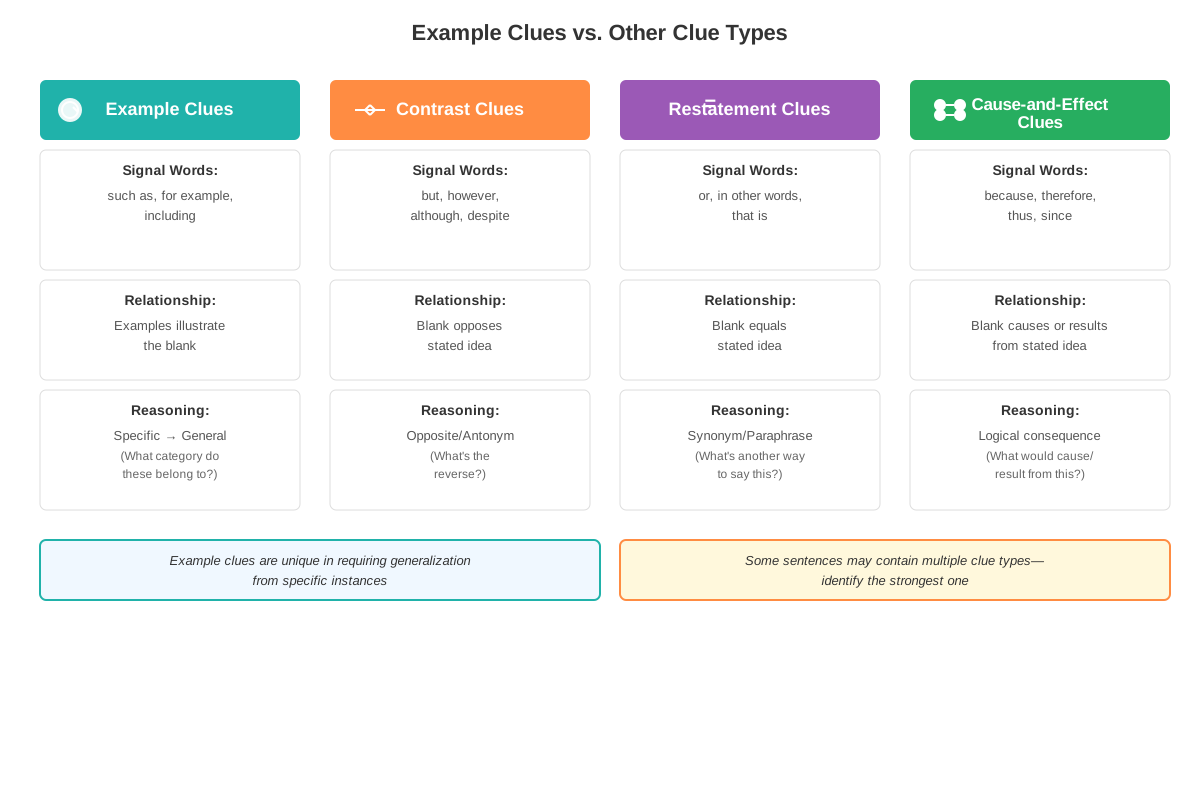
This topic sits at the heart of the Text Completion strategy framework within GRE Verbal Reasoning. While other clue types (contrast, restatement, cause-and-effect) require understanding logical relationships between ideas, example clues demand pattern recognition and the ability to generalize from specific instances to broader concepts. Mastering example clues builds the foundation for tackling complex multi-blank questions where different clue types interact, and it strengthens overall reading comprehension skills by training students to identify how authors support their claims with concrete evidence.
Learning Objectives
- [ ] Identify when Example clues is being tested in GRE Text Completion questions
- [ ] Explain the core rule or strategy behind Example clues and how they function in sentences
- [ ] Apply Example clues to GRE-style questions accurately and efficiently
- [ ] Recognize and categorize the various signal words and phrases that introduce example clues
- [ ] Distinguish example clues from other clue types (contrast, restatement, cause-and-effect) in complex sentences
- [ ] Predict the correct answer category before reviewing answer choices using example-based reasoning
- [ ] Evaluate answer choices by testing whether they logically encompass or describe the provided examples
Prerequisites
- Basic sentence structure comprehension: Understanding subjects, predicates, and modifying phrases is necessary to identify which parts of a sentence provide examples versus which parts contain the blank being described.
- Vocabulary fundamentals: A working knowledge of common GRE vocabulary helps students recognize when examples are providing definitional clues about unfamiliar words.
- Text Completion question format: Familiarity with how blanks appear in sentences and how answer choices are presented allows students to focus on strategy rather than format.
- Context clue awareness: General understanding that sentences contain hints about missing words provides the conceptual foundation for learning specific clue types like examples.
Why This Topic Matters
Example clues represent one of the highest-yield strategies for GRE success because they appear consistently across all difficulty levels and provide the most concrete pathway to correct answers. In real-world communication, examples serve as the primary method for clarifying abstract concepts, defining unfamiliar terms, and supporting generalizations—skills that graduate programs value highly. The GRE tests this reasoning pattern because it mirrors academic reading and writing, where students must understand how specific evidence supports broader claims.
On the GRE Verbal Reasoning section, example clues appear in approximately 20-25% of Text Completion questions, making them the second or third most common clue type after restatement and contrast clues. They appear across all difficulty levels: easy questions might provide obvious examples with clear signal words, while hard questions embed examples within complex sentence structures or use subtle introductory phrases. Example clues are particularly common in single-blank Text Completion questions (appearing in roughly 30% of these) and frequently appear as one component of multi-blank questions where different clue types work together.
Common manifestations include: scientific passages where specific organisms or phenomena exemplify broader categories; historical passages where particular events illustrate general trends; social science contexts where individual behaviors demonstrate psychological concepts; and literary discussions where specific works represent artistic movements. The GRE favors example clues in sentences discussing classification, categorization, characteristics, and definitional relationships—all frequent topics in graduate-level academic discourse.
Core Concepts
Definition and Function of Example Clues
Example clues are contextual signals within a sentence or passage where specific instances, cases, illustrations, or concrete examples reveal the meaning required for a blank. The fundamental mechanism is inductive reasoning: the sentence provides particular examples, and the correct answer must be a general term, category, or descriptor that encompasses those examples. The examples function as evidence that demonstrates what the blank should mean.
The relationship works in one direction: examples → general term. The blank typically requires a word that names the category, describes the shared characteristic, or identifies the quality that all the examples possess. For instance, if a sentence states "The scientist studied various _____, such as butterflies, beetles, and ants," the examples (butterflies, beetles, ants) all belong to the category "insects," making that the logical answer.
Signal Words and Phrases
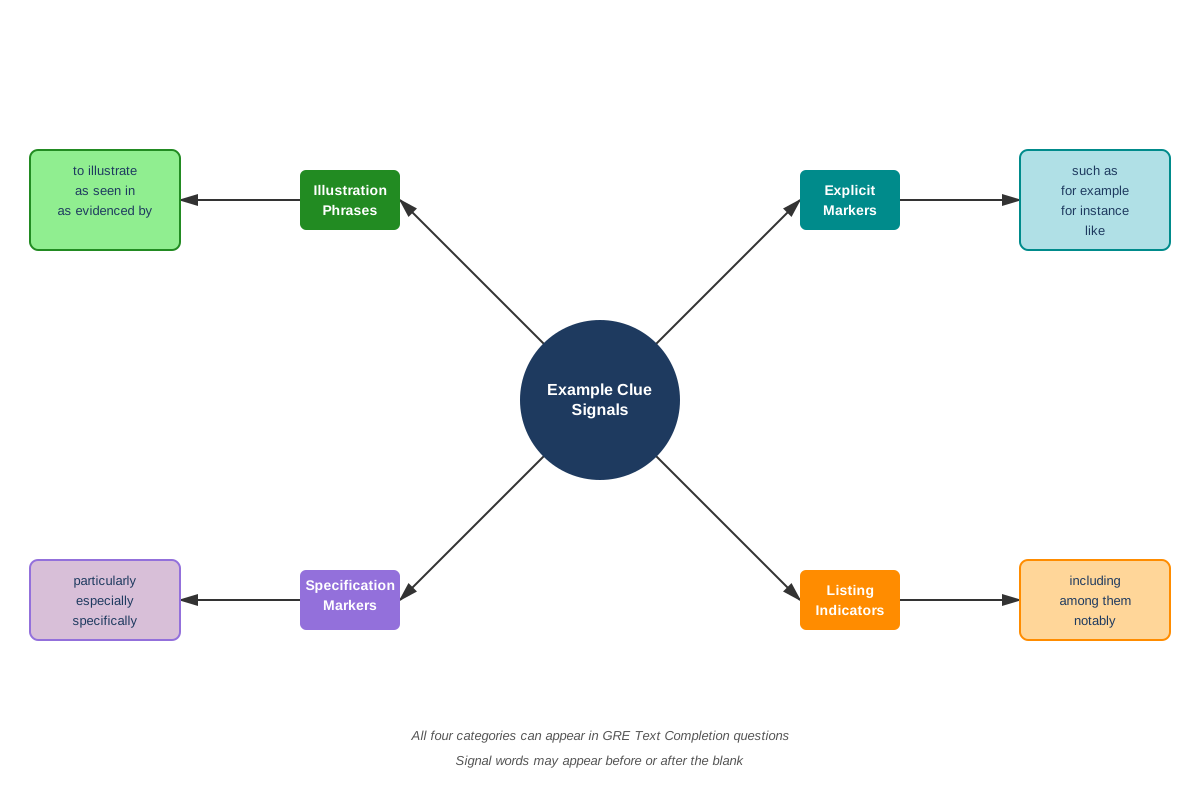
Example clues are introduced by specific signal words that alert careful readers to the presence of examples. Recognizing these triggers is crucial for rapid identification:
| Signal Type | Common Signals | Function |
|---|---|---|
| Direct example markers | such as, for example, for instance, like, including | Explicitly announce that examples follow |
| Listing indicators | namely, specifically, particularly, especially | Introduce specific cases of a general category |
| Illustration phrases | as seen in, as demonstrated by, as evidenced by | Point to examples as proof or demonstration |
| Punctuation signals | colons (:), dashes (—), parentheses ( ) | Set off examples from the main clause |
| Implicit markers | (no signal word, just a list) | Examples appear as a series without explicit introduction |
The most frequently tested signals on the GRE are "such as," "including," "like," and "for example." However, harder questions often omit explicit signals, requiring students to recognize examples through context and sentence structure alone.
Structural Patterns
Example clues follow predictable sentence structures that help with identification:
Pattern 1: Blank followed by examples
- Structure: "The [BLANK], such as X, Y, and Z..."
- Example: "The garden contained many _____, such as roses, tulips, and daisies."
- Strategy: The blank must name the category that includes all listed items (flowers).
Pattern 2: Examples followed by blank
- Structure: "X, Y, and Z are examples of _____."
- Example: "Honesty, integrity, and loyalty are all _____."
- Strategy: Identify what quality or category unites the examples (virtues/values).
Pattern 3: Blank describes examples
- Structure: "The _____ animals, including X and Y..."
- Example: "The _____ animals, including lions and tigers, require large territories."
- Strategy: The blank must describe a characteristic shared by the examples (carnivorous/predatory).
Pattern 4: Embedded examples with punctuation
- Structure: "The [BLANK]—X, Y, and Z—demonstrated..."
- Example: "The innovations—electricity, the telephone, the automobile—transformed society."
- Strategy: Examples appear between dashes or parentheses; the blank names what they represent.
The Generalization Process
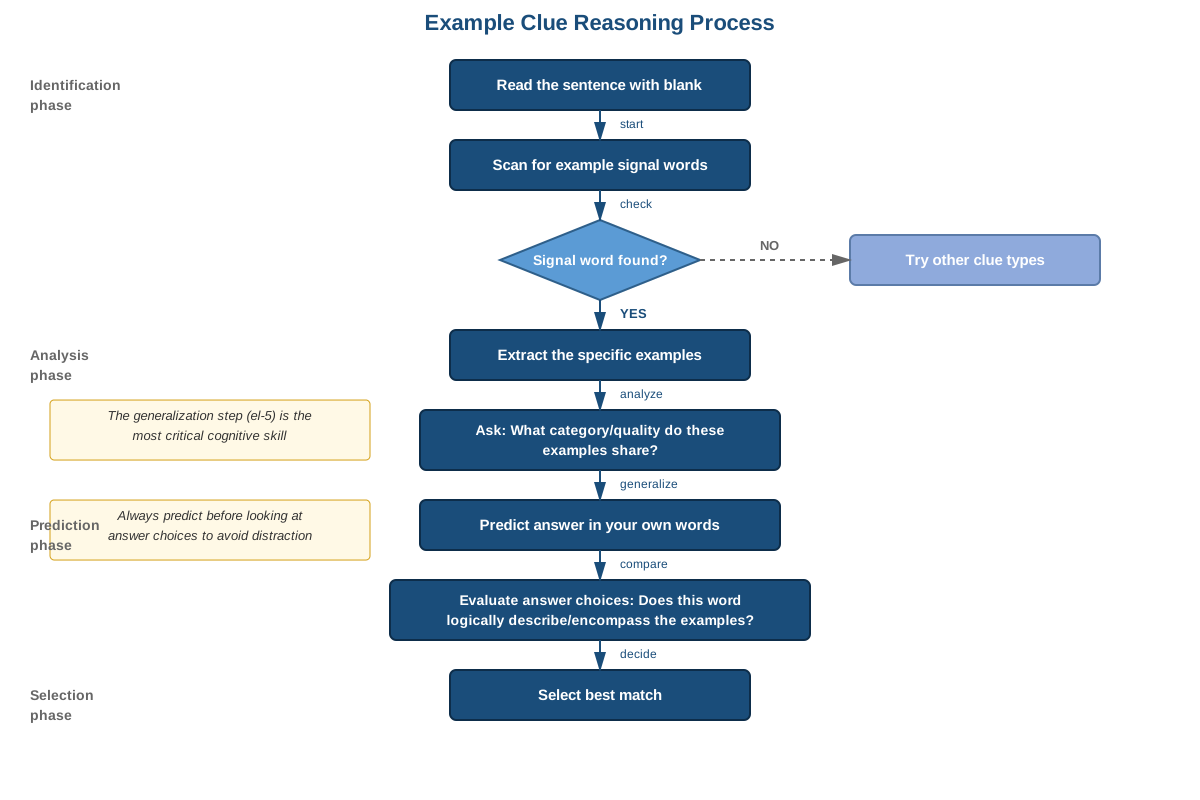
Successfully using example clues requires moving from specific to general through a three-step process:
- Identify the examples: Locate the specific instances provided in the sentence, typically following signal words or set off by punctuation.
- Analyze commonalities: Determine what the examples share—this might be a category membership (all are types of X), a shared characteristic (all are X in nature), or a common quality (all demonstrate X).
- Predict the general term: Before looking at answer choices, formulate what word would logically encompass or describe all the examples. This prediction serves as your target.
This process prevents the common error of selecting answer choices that match only some examples or that are too broad or narrow for the specific examples given.
Multiple Examples vs. Single Examples
The GRE presents example clues with varying numbers of instances:
Multiple examples (most common): Two or more specific cases are provided, making the pattern more obvious. The variety of examples helps narrow down the exact category or characteristic needed. For instance, "mammals such as whales, bats, and humans" clearly requires a term describing what these diverse creatures share.
Single examples (more challenging): Only one instance is provided, requiring more inference. "The _____, such as the platypus, defies easy classification" demands that students know enough about the platypus to identify what makes it notable (it's a monotreme, or an unusual mammal, or an egg-laying mammal).
Example Clues in Multi-Blank Questions
In sentences with multiple blanks, example clues may provide information for one blank while other clue types address other blanks. Students must:
- Identify which blank the examples relate to (usually the nearest one)
- Solve that blank first using the example clue
- Use the solved blank as additional context for remaining blanks
- Recognize when examples support multiple blanks simultaneously
Concept Relationships
Example clues connect to other Text Completion strategies through a hierarchy of contextual reasoning. At the foundation level, example clues represent one of four major clue types (alongside contrast, restatement, and cause-and-effect), all of which fall under the broader umbrella of context-based solving strategies.
The relationship flow works as follows: General context awareness → Specific clue type identification → Example clue recognition → Signal word detection → Generalization process → Answer prediction → Answer choice evaluation.
Example clues share an inverse relationship with contrast clues: while contrast clues signal that the blank means the opposite of something in the sentence, example clues signal that the blank means something that encompasses or describes the examples. Understanding this distinction prevents confusion when sentences contain both "but" (contrast) and "such as" (example) signals.
Example clues also connect to vocabulary building strategies: when students encounter unfamiliar words in answer choices, they can test whether those words logically encompass the provided examples, even without knowing precise definitions. This makes example clues particularly valuable for handling vocabulary gaps.
Within the broader Verbal Reasoning section, example clue mastery supports Reading Comprehension skills, particularly questions about author's purpose and supporting evidence, since examples in passages serve similar illustrative functions as they do in Text Completion questions.
High-Yield Facts
⭐ Example clues appear in approximately 20-25% of all GRE Text Completion questions, making them one of the most frequently tested clue types.
⭐ The most common signal phrases are "such as," "including," "like," and "for example"—these appear in over 60% of example clue questions.
⭐ The blank typically requires a general term or category that encompasses all provided examples, not a term that matches only one example.
⭐ Colons, dashes, and parentheses can introduce examples without explicit signal words, particularly in harder questions.
⭐ When multiple examples are given, the correct answer must logically include ALL of them, not just some—this is a key elimination strategy.
- Example clues can appear before or after the blank, but the logical relationship remains the same: examples demonstrate what the blank should mean.
- Single-example clues are more challenging because they require more background knowledge about the specific instance provided.
- In multi-blank questions, example clues typically provide information for the nearest blank, though occasionally they support multiple blanks.
- The GRE often pairs example clues with other clue types in the same sentence, requiring students to use multiple strategies simultaneously.
- Incorrect answer choices in example clue questions often include words that are too broad (encompass more than the examples show) or too narrow (match only one example).
- Scientific and technical passages use example clues more frequently than humanities passages, often providing specific organisms, phenomena, or cases as examples.
- When examples are proper nouns (names of people, places, or specific things), background knowledge becomes more important for identifying the category they represent.
Quick check — test yourself on Example clues so far.
Try Flashcards →Common Misconceptions
Misconception: Example clues always use explicit signal words like "such as" or "for example."
Correction: While these signals are common, approximately 30% of example clue questions on the GRE present examples without explicit markers, using only punctuation (colons, dashes, parentheses) or sentence structure to indicate the relationship. Students must recognize examples through context even when signals are absent.
Misconception: The correct answer should be a synonym for one of the examples provided.
Correction: The correct answer must be a general term that encompasses or describes ALL the examples, not a synonym for any individual example. If examples are "roses, tulips, and daisies," the answer is "flowers" (the category), not "plants with petals" (too specific to one example) or "botanicals" (too broad).
Misconception: If you don't know what the examples are, you cannot solve the question.
Correction: Even with unfamiliar examples, students can often use process of elimination by testing whether answer choices could logically encompass the examples based on context clues, sentence tone, and the grammatical role of the blank. Additionally, knowing even one example can help eliminate impossible answers.
Misconception: Example clues only appear in single-blank questions.
Correction: Example clues frequently appear in multi-blank Text Completion questions, where they may provide information for one blank while other clue types address other blanks. Students must identify which blank the examples relate to and solve accordingly.
Misconception: The examples always appear immediately after the blank.
Correction: Examples can appear before the blank, after the blank, or even in a different clause of the sentence. The key is recognizing the logical relationship between examples and blank, regardless of their position. Signal words and punctuation help identify this relationship across different sentence structures.
Misconception: More examples always make the question easier.
Correction: While multiple examples can provide more information, they can also make questions harder if the examples are obscure, if they represent an unexpected category, or if they require recognizing a subtle shared characteristic rather than an obvious category membership. A single clear example can sometimes be easier than three obscure ones.
Worked Examples
Example 1: Standard Example Clue with Signal Phrase
Question: The curator sought to acquire more _____ for the museum's collection, such as ancient pottery, medieval tapestries, and Renaissance paintings.
Answer Choices:
(A) curiosities
(B) artifacts
(C) ornaments
(D) antiquities
(E) reproductions
Solution Process:
Step 1 - Identify the clue type: The phrase "such as" is a clear example clue signal, indicating that what follows will demonstrate what the blank should mean.
Step 2 - Analyze the examples: The examples are "ancient pottery, medieval tapestries, and Renaissance paintings." What do these share?
- All are old/historical objects
- All are human-made objects
- All are objects of cultural/artistic significance
- All are items typically found in museums
Step 3 - Predict the answer: The blank needs a word meaning "historical objects of cultural significance" or "old valuable items from past civilizations."
Step 4 - Evaluate choices:
- (A) curiosities - too informal and doesn't emphasize the historical/cultural aspect
- (B) artifacts - possible, but typically refers to archaeological objects, not paintings
- (C) ornaments - too narrow; paintings aren't primarily decorative
- (D) antiquities - ⭐ CORRECT: specifically means valuable objects from ancient times or past civilizations, encompasses all three examples
- (E) reproductions - contradicts the context; museums seek originals, not copies
Answer: (D) antiquities
Key Takeaway: The correct answer must encompass ALL examples and match the context's tone and specificity. "Antiquities" is more precise than "artifacts" for this museum context and better captures the historical value implied.
Example 2: Example Clue Without Explicit Signal
Question: The politician's speech was marked by _____ : she promised lower taxes while proposing expensive new programs, claimed to support small businesses while advocating for regulations that would burden them, and declared her commitment to transparency while refusing to release financial records.
Answer Choices:
(A) ambiguity
(B) hypocrisy
(C) inconsistency
(D) eloquence
(E) pragmatism
Solution Process:
Step 1 - Identify the clue type: The colon introduces examples without an explicit signal word like "such as." The structure "The X was marked by _____ : [examples]" indicates that what follows the colon demonstrates the blank's meaning.
Step 2 - Analyze the examples: Three examples are provided:
- Promising lower taxes while proposing expensive programs (contradictory positions)
- Supporting small businesses while advocating burdensome regulations (contradictory positions)
- Claiming transparency while refusing to release records (contradictory actions)
Step 3 - Identify the pattern: All three examples show contradictions between stated positions and actual proposals/actions. The common thread is saying one thing while doing/proposing another.
Step 4 - Predict the answer: The blank needs a word meaning "contradiction" or "saying one thing and doing another" or "self-contradiction."
Step 5 - Evaluate choices:
- (A) ambiguity - means unclear or vague, but the examples show clear contradictions, not vagueness
- (B) hypocrisy - ⭐ CORRECT: means claiming to have beliefs/standards while acting contrary to them; perfectly describes all three examples
- (C) inconsistency - close, but doesn't capture the moral dimension of claiming one thing while doing another
- (D) eloquence - means persuasive speaking; doesn't relate to the contradictions shown
- (E) pragmatism - means practical approach; doesn't address the contradictions
Answer: (B) hypocrisy
Key Takeaway: When examples appear after a colon without explicit signals, analyze what pattern or quality unites all the examples. Here, the pattern isn't just inconsistency but specifically the problematic behavior of professing values while acting against them, which is the definition of hypocrisy.
Exam Strategy
Recognition Strategy
When approaching any Text Completion question, scan first for example clue signals before reading the entire sentence. Look for:
- Signal words: "such as," "including," "like," "for example," "for instance," "namely," "particularly"
- Punctuation: colons, dashes, or parentheses that set off lists or specific cases
- Structural patterns: lists of items (X, Y, and Z) that might be examples
Exam Tip: Spend 5-10 seconds identifying the clue type before attempting to solve. This prevents wasted time pursuing wrong strategies.
Solving Process
Follow this systematic approach for example clue questions:
- Locate and underline the examples (2-3 seconds)
- Identify what they share - category, characteristic, or quality (5-10 seconds)
- Predict your answer in simple terms before looking at choices (5 seconds)
- Eliminate choices that don't encompass all examples (10-15 seconds)
- Select the best match to your prediction (2-3 seconds)
Total time target: 25-35 seconds per question
Trigger Words to Watch For
High-priority signals (appear in 60%+ of example clue questions):
- "such as"
- "including"
- "like"
- "for example"
Medium-priority signals (appear in 20-30% of questions):
- "for instance"
- "namely"
- "particularly"
- "especially"
- "as seen in"
Subtle signals (appear in 10-15% of questions):
- Colons followed by lists
- Dashes setting off examples
- Parenthetical examples
- "ranging from X to Y"
Process of Elimination Tips
Eliminate answers that:
- Match only one example but not others
- Are too broad (could include things beyond the examples)
- Are too narrow (exclude some examples)
- Contradict the tone or context of the sentence
- Require the examples to be something they're not
Keep answers that:
- Logically encompass ALL provided examples
- Match the level of specificity suggested by the examples
- Fit the grammatical role of the blank
- Align with the sentence's overall meaning
Time Allocation
- Easy example clue questions (obvious signals, familiar examples): 20-25 seconds
- Medium example clue questions (subtle signals or one unfamiliar example): 30-40 seconds
- Hard example clue questions (no explicit signals, multiple unfamiliar examples, or multi-blank): 45-60 seconds
If you don't recognize the examples after 15 seconds, use process of elimination with answer choices rather than spending more time trying to identify the category.
Multi-Blank Strategy
When example clues appear in multi-blank questions:
- Identify which blank the examples relate to (usually the nearest)
- Solve that blank first using the example clue
- Use your solved blank as additional context for other blanks
- Check that all blanks create a logical, coherent sentence together
Memory Techniques
The SIGNAL Mnemonic
Remember the most common example clue signals with SIGNAL:
- Such as
- Including
- Given (as in "given examples like")
- Namely
- As seen in / As demonstrated by
- Like
The Three-Question Method
When you spot examples, ask yourself three questions:
- "What are they?" (Identify the examples)
- "What do they share?" (Find the commonality)
- "What word names that?" (Predict the answer)
This creates a memorable problem-solving rhythm: Identify → Analyze → Predict.
Visualization: The Umbrella Technique
Picture the blank as an umbrella and the examples as items underneath it. The correct answer is the umbrella term that covers all the examples. If an answer choice doesn't cover all the examples, it's the wrong umbrella.
The Punctuation Reminder
Remember: "Colons, dashes, and parentheses are example clue friends." These punctuation marks often introduce examples without explicit signal words, especially in harder questions.
The Category Ladder
Visualize moving up a ladder from specific (examples) to general (blank):
- Bottom rung: Specific examples (roses, tulips, daisies)
- Middle rung: Category (flowers)
- Top rung: Too broad (plants, living things)
The correct answer is usually on the middle rung—general enough to include all examples but specific enough to match the context.
Summary
Example clues are a high-yield Text Completion strategy where specific instances, cases, or illustrations reveal the meaning needed for a blank. These clues appear in approximately 20-25% of GRE Text Completion questions and provide one of the most direct paths to correct answers. The fundamental mechanism involves inductive reasoning: moving from specific examples to the general term, category, or descriptor that encompasses them. Success requires recognizing signal words ("such as," "including," "like," "for example") and structural patterns (colons, dashes, lists), analyzing what the examples share in common, predicting the general term before reviewing answer choices, and eliminating options that don't logically encompass all provided examples. While explicit signals appear in most questions, harder items present examples through punctuation alone or embed them within complex sentence structures. The correct answer must always encompass ALL examples at the appropriate level of specificity—not too broad, not too narrow. Mastering example clues improves both accuracy and speed on Text Completion questions while building broader skills in recognizing how specific evidence supports general claims, a pattern essential throughout graduate-level academic work.
Key Takeaways
- Example clues provide specific instances that demonstrate what the blank should mean—the correct answer is the general term that encompasses all examples.
- Signal words like "such as," "including," and "like" appear in most example clue questions, but colons, dashes, and parentheses can introduce examples without explicit signals.
- The correct answer must logically include ALL provided examples, not just some—use this as a powerful elimination criterion.
- Follow the three-step process: identify the examples, analyze their commonalities, predict the general term before looking at answer choices.
- Example clues appear in 20-25% of Text Completion questions, making them one of the highest-yield strategies to master for GRE success.
- In multi-blank questions, identify which blank the examples relate to and solve that blank first using the example clue strategy.
- Even with unfamiliar examples, use process of elimination by testing whether answer choices could logically encompass the examples based on context and tone.
Related Topics
Contrast Clues: While example clues show what the blank should encompass, contrast clues indicate the blank means the opposite of something in the sentence. Mastering both allows students to handle the majority of Text Completion questions, as these two clue types account for approximately 45-50% of all questions combined.
Restatement Clues: These clues provide synonyms or paraphrases of the blank's meaning. Understanding the distinction between restatement (same idea, different words) and example (specific instances of general idea) prevents confusion when both appear in complex sentences.
Cause-and-Effect Clues: These indicate that the blank is either the cause or effect of something stated in the sentence. Combining cause-and-effect recognition with example clue skills enables solving sophisticated multi-blank questions where different clue types interact.
Vocabulary in Context: Example clues provide one of the best opportunities to determine word meanings from context, even when the blank contains an unfamiliar word in the answer choices. This skill transfers directly to Reading Comprehension vocabulary questions.
Multi-Blank Text Completion Strategy: After mastering individual clue types like examples, students progress to questions where multiple blanks require coordinating different clue types, testing the ability to solve blanks in optimal order and use solved blanks as context for remaining ones.
Practice CTA
Now that you understand the mechanics and strategy behind example clues, it's time to put your knowledge into action. Attempt the practice questions to reinforce your ability to recognize signals, analyze examples, and predict answers before reviewing choices. The flashcards will help you internalize signal words and common patterns until recognition becomes automatic. Remember: example clues are one of the most reliable question types on the GRE—master them, and you'll have a significant advantage on test day. Every practice question you complete builds the pattern recognition and speed you need for top performance!
Sign up free to keep reading
Create a free AnvayaPrep account to finish this GRE guide on Example clues — plus flashcards and practice questions.