Overview
Cause and effect clues represent one of the most powerful and frequently tested contextual relationships in GRE Text Completion questions. These clues establish logical connections between events, actions, or states, where one element (the cause) produces or leads to another element (the effect). Understanding how to identify and leverage these relationships is fundamental to selecting the correct answer choice, as the GRE consistently tests whether students can recognize how ideas within a sentence or passage relate to one another through causal logic.
On the GRE Verbal Reasoning section, gre cause and effect clues appear in approximately 25-30% of Text Completion questions, making them one of the highest-yield contextual clue types to master. These clues manifest through specific signal words and phrases that indicate causation, such as "because," "therefore," "consequently," or "as a result." When students learn to spot these indicators, they can predict the meaning and tone of the missing word with remarkable accuracy, even before examining the answer choices. This predictive approach dramatically improves both accuracy and speed—two critical factors for GRE success.
Within the broader framework of Verbal Reasoning, cause and effect clues connect intimately with other contextual relationship types, including contrast clues, continuation clues, and definition clues. While contrast clues signal opposition and continuation clues indicate agreement, cause and effect clues specifically establish directional logical relationships where one idea produces another. Mastering this distinction enables students to decode complex sentence structures and navigate the sophisticated academic prose that characterizes GRE passages. This topic serves as a cornerstone skill that supports performance not only in Text Completion but also in Reading Comprehension and Sentence Equivalence questions.
Learning Objectives
- [ ] Identify when Cause and effect clues is being tested
- [ ] Explain the core rule or strategy behind Cause and effect clues
- [ ] Apply Cause and effect clues to GRE-style questions accurately
- [ ] Recognize and categorize all major cause and effect signal words and phrases
- [ ] Distinguish between direct causation and indirect causal relationships in complex sentences
- [ ] Predict the semantic content and tone of missing words based on causal logic
- [ ] Evaluate answer choices by testing their logical fit within causal relationships
Prerequisites
- Basic sentence structure understanding: Recognition of subjects, verbs, and objects is essential for identifying which elements function as causes and which as effects
- Vocabulary fundamentals: A working knowledge of common GRE vocabulary enables students to understand the semantic content of causes and effects
- Logical reasoning basics: Understanding that arguments contain premises and conclusions helps students recognize the directional flow of causal relationships
- Contextual clue awareness: General familiarity with the concept that sentences contain internal clues about missing words provides the foundation for specialized cause-and-effect analysis
Why This Topic Matters
Cause and effect reasoning forms the backbone of academic discourse across disciplines—from scientific research papers explaining experimental results to historical analyses examining the consequences of political decisions. The GRE tests this skill because graduate-level work requires students to understand, evaluate, and construct causal arguments. Students who cannot recognize causal relationships struggle to comprehend complex texts, synthesize information, or develop coherent arguments in their own writing.
On the GRE specifically, cause and effect clues appear in multiple question formats. In Text Completion questions, they most commonly appear in single-blank, double-blank, and triple-blank formats where understanding the causal relationship is essential to selecting the correct answer. Approximately 1-2 questions per Verbal section explicitly test cause and effect recognition, but the underlying skill supports performance on an additional 3-4 questions where causal logic operates alongside other contextual clues. Reading Comprehension passages frequently contain causal arguments that students must track to answer inference and detail questions correctly.
Common manifestations include: sentences explaining why a phenomenon occurs ("The drought occurred because rainfall decreased"); statements describing consequences of actions ("The policy change led to increased enrollment"); and complex multi-clause sentences where causes and effects appear in non-adjacent positions ("Given the economic downturn, which reduced consumer spending, retailers consequently lowered prices"). The GRE favors sophisticated sentence structures that embed causal relationships within subordinate clauses, making signal word recognition and logical analysis essential skills.
Core Concepts
Definition of Cause and Effect Relationships
A cause and effect relationship exists when one event, action, or condition (the cause) produces, creates, or brings about another event, action, or condition (the effect). In GRE Text Completion questions, these relationships provide crucial information about the missing word because the blank typically represents either the cause or the effect in the relationship. Understanding which role the blank plays allows students to predict the semantic content needed.
The relationship operates directionally: causes precede effects in logical (though not always chronological) order. For example, in the sentence "The scientist's rigorous methodology resulted in reliable data," the methodology (cause) produces the reliable data (effect). The GRE tests whether students can trace this logical flow and select words that maintain the causal coherence of the sentence.
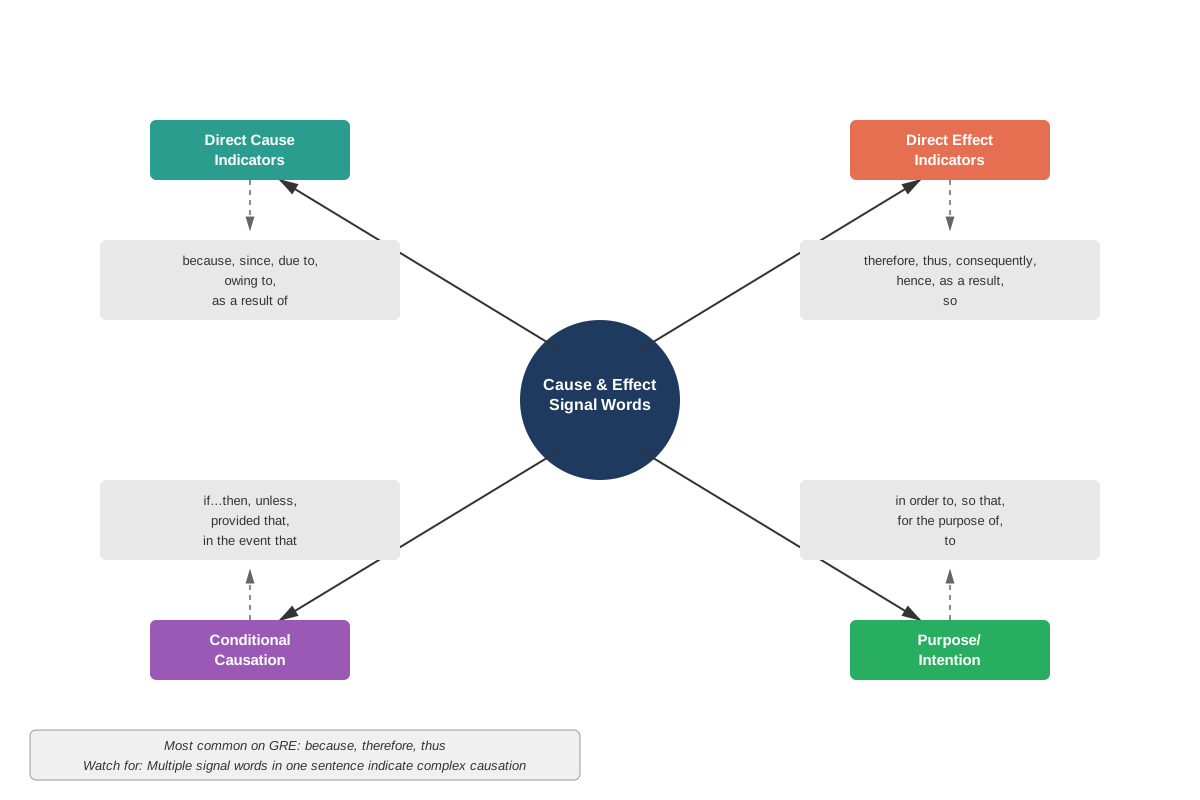
Signal Words and Phrases
Signal words are linguistic markers that explicitly indicate causal relationships. These words function as road signs, alerting readers to the presence of cause-and-effect logic. Mastering these signals is the most direct path to identifying when cause and effect clues are being tested.
| Signal Type | Examples | Sentence Position |
|---|---|---|
| Cause indicators | because, since, due to, owing to, given that, as, for | Typically introduce the cause |
| Effect indicators | therefore, thus, consequently, as a result, hence, so, accordingly | Typically introduce the effect |
| Causative verbs | cause, create, produce, generate, lead to, result in, bring about, give rise to | Connect cause to effect |
| Conditional markers | if...then, when...then, provided that | Establish hypothetical causation |
Direct vs. Indirect Causation
Direct causation occurs when one element immediately produces another without intervening steps. Example: "The medication caused drowsiness." The relationship is straightforward and unmediated.
Indirect causation involves multiple steps or intermediate factors. Example: "The economic recession, which reduced tax revenues, ultimately led to cuts in public services." Here, the recession doesn't directly cut services; it first reduces revenues, which then necessitates cuts. The GRE frequently tests indirect causation because it requires more sophisticated logical tracking.
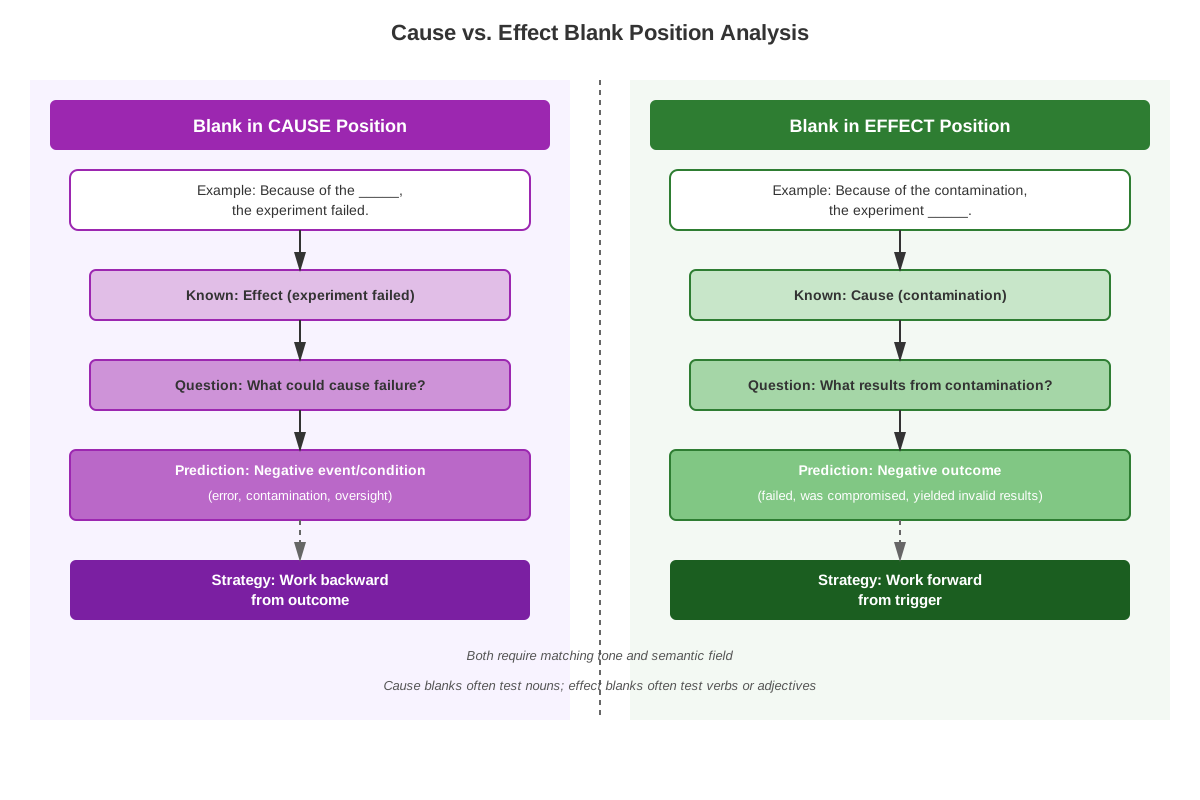
Causal Direction and Blank Position
Understanding where the blank appears relative to the causal signal determines the prediction strategy:
- Blank represents the cause: "Because of the ______, the experiment failed." Students must identify what would logically produce failure (e.g., "contamination," "oversight," "malfunction").
- Blank represents the effect: "The policy change resulted in ________ among voters." Students must identify what the policy would logically produce (e.g., "confusion," "enthusiasm," "apathy").
- Blank modifies cause or effect: "The ________ drought caused crop failures." Here, the blank describes the nature of the cause, requiring students to understand what type of drought would cause failures (e.g., "severe," "prolonged," "unprecedented").
Tone and Semantic Consistency
Causal relationships constrain not only the logical content but also the tone of the missing word. If a negative cause is stated, the effect must be logically consistent (typically also negative, unless the sentence indicates an unexpected reversal). Example: "The scandal caused the politician's reputation to ________." The negative cause (scandal) predicts a negative effect (e.g., "deteriorate," "collapse," "suffer").
However, students must watch for contrastive elements that reverse expected tone: "Despite the scandal, the politician's reputation remained ________." Here, "despite" introduces contrast that overrides the expected negative effect.
Multiple Causal Chains
Advanced GRE sentences often contain multiple causal relationships within a single sentence: "Because the drought reduced crop yields, which increased food prices, consumers consequently reduced their spending." This creates a causal chain: drought → reduced yields → increased prices → reduced spending. Students must track each link to understand the complete logical structure.
Concept Relationships
Cause and effect clues form part of a larger ecosystem of contextual clues in GRE Text Completion. They connect most directly to contrast clues (which signal opposition rather than causation) and continuation clues (which signal agreement or elaboration). Understanding these relationships helps students avoid confusion when multiple clue types appear in the same sentence.
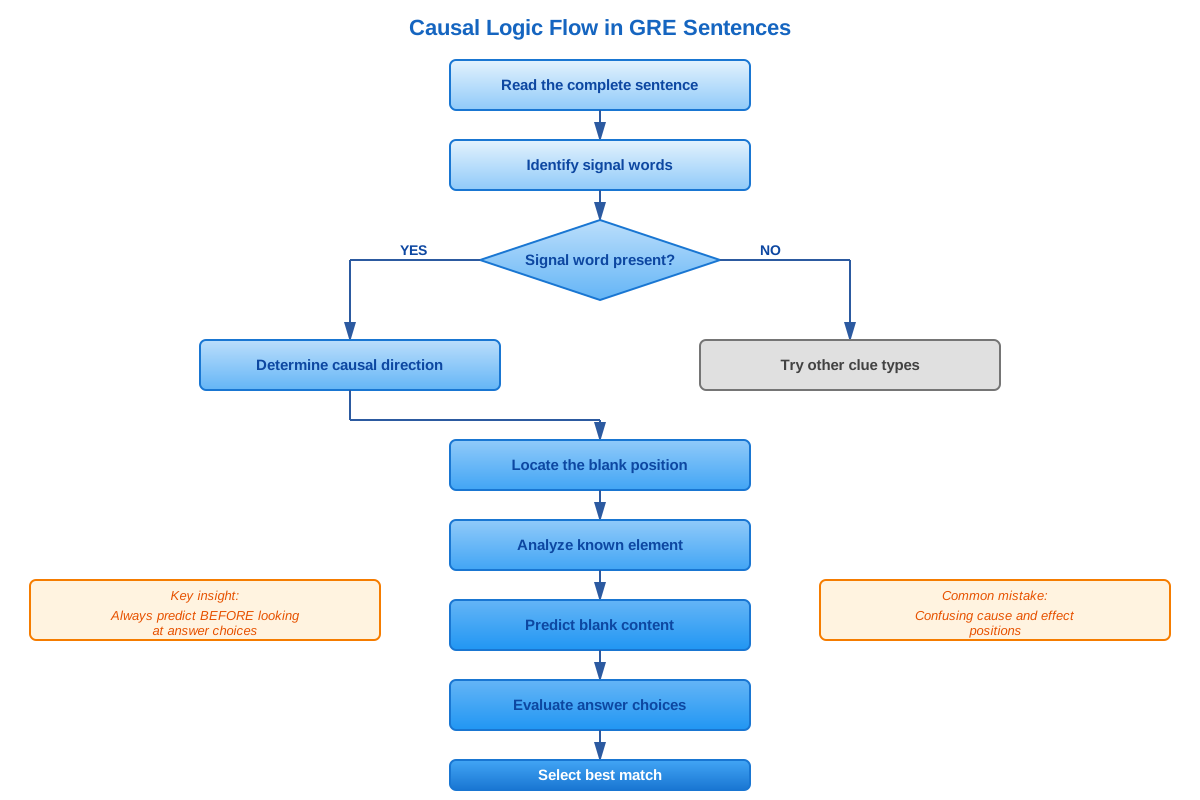
The relationship map flows as follows:
Contextual Clues (general category) → branches into → Cause and Effect Clues + Contrast Clues + Continuation Clues + Definition Clues
Within cause and effect clues specifically:
Signal Word Recognition → enables → Causal Direction Identification → leads to → Semantic Prediction → guides → Answer Choice Evaluation
Cause and effect clues also connect to prerequisite knowledge of logical reasoning, as causal relationships represent a specific type of logical connection. Students who understand premises and conclusions in arguments can more easily identify causes (analogous to premises) and effects (analogous to conclusions).
Furthermore, cause and effect clues support performance in Reading Comprehension questions, particularly those asking about the author's reasoning, the relationship between paragraphs, or the explanation for a phenomenon discussed in the passage. The same signal words and logical analysis techniques apply across question types.
High-Yield Facts
⭐ Cause and effect signal words appear in approximately 25-30% of GRE Text Completion questions, making them one of the most frequently tested contextual clue types.
⭐ The most common cause indicators are "because," "since," "due to," and "given that"—these four account for roughly 60% of explicit cause signals.
⭐ The most common effect indicators are "therefore," "thus," "consequently," and "as a result"—recognizing these immediately identifies the effect portion of the relationship.
⭐ When a blank appears after an effect indicator, it represents the effect; when it appears after a cause indicator, it represents the cause.
⭐ Causative verbs like "cause," "produce," "generate," and "lead to" directly connect causes to effects and indicate that elements on either side of the verb are causally related.
- Negative causes typically produce negative effects unless a contrast word (like "despite" or "although") intervenes to reverse the expected relationship.
- Multiple causal chains can appear in a single sentence, requiring students to track several cause-effect links sequentially.
- Indirect causation involves intermediate steps between cause and effect, making the relationship less obvious but equally testable.
- Conditional statements ("if...then") establish hypothetical causal relationships that follow the same logical patterns as actual causation.
- The GRE often places causal signals in subordinate clauses or mid-sentence positions rather than at the beginning, requiring careful reading.
- Causal relationships can be stated explicitly (with signal words) or implied through context, though explicit signals are more common in Text Completion.
- Understanding causal direction (which element produces which) is more important than identifying the specific signal word used.
Quick check — test yourself on Cause and effect clues so far.
Try Flashcards →Common Misconceptions
Misconception: All sentences with "because" or "therefore" are testing cause and effect clues. → Correction: While these words indicate causal relationships, the question only tests cause and effect clues if understanding that relationship is necessary to select the correct answer. Some sentences contain causal elements that are not central to solving the blank.
Misconception: The cause always appears before the effect in sentence order. → Correction: Logical order and chronological/sentence order are different. A sentence can state the effect first, then explain the cause: "The crops failed because of the drought." Here, the effect (crop failure) appears before the cause (drought) in sentence structure.
Misconception: Positive causes always produce positive effects, and negative causes always produce negative effects. → Correction: While tone consistency is common, the GRE tests unexpected relationships. A negative cause might produce a positive effect if the sentence indicates an ironic or counterintuitive outcome: "The scandal, surprisingly, increased the politician's popularity among certain voters."
Misconception: Only one causal relationship exists per sentence. → Correction: Complex GRE sentences frequently contain multiple causal chains or parallel causal relationships. Students must track all relationships to understand the complete logical structure.
Misconception: Cause and effect clues only appear in Text Completion questions. → Correction: While this study guide focuses on Text Completion, causal reasoning appears throughout the Verbal section, including Reading Comprehension passages and Sentence Equivalence questions. The same analytical skills apply across question types.
Misconception: Memorizing signal words is sufficient for mastering cause and effect clues. → Correction: Signal word recognition is necessary but not sufficient. Students must also understand causal direction, track logical flow, predict semantic content, and evaluate answer choices for logical fit. Signal words are tools, not solutions.
Worked Examples
Example 1: Single-Blank Text Completion
Question: "Because the archaeological evidence was ________, researchers could not definitively determine the age of the settlement."
Step 1 - Identify the signal word: "Because" is a cause indicator, signaling that what follows is the cause of the effect stated in the main clause.
Step 2 - Identify cause and effect:
- Cause: the nature of the archaeological evidence (blank)
- Effect: researchers could not definitively determine the age
Step 3 - Determine causal direction: The blank represents the cause. We need to identify what characteristic of evidence would cause an inability to determine age definitively.
Step 4 - Predict semantic content: The effect is negative (inability to determine something). What causes of evidence would prevent definitive conclusions? The evidence must be insufficient, unclear, contradictory, or ambiguous.
Step 5 - Predict tone: Negative, since it prevents successful determination.
Step 6 - Evaluate answer choices (hypothetical):
- (A) abundant - Incorrect; abundant evidence would help, not hinder, determination
- (B) fragmentary - Correct; fragmentary (incomplete) evidence would logically prevent definitive conclusions
- (C) ancient - Incorrect; age of evidence doesn't prevent age determination
- (D) preserved - Incorrect; well-preserved evidence would aid determination
- (E) valuable - Incorrect; value doesn't relate to ability to determine age
Answer: (B) fragmentary
Connection to learning objectives: This example demonstrates identifying when cause and effect clues are tested (objective 1), applying the core strategy of tracking causal direction (objective 2), and accurately selecting the answer (objective 3).
Example 2: Double-Blank Text Completion
Question: "The new policy proved (i)________ to implement; consequently, the anticipated benefits were (ii)________ rather than immediate."
Blank (i) options: (A) straightforward (B) challenging (C) innovative
Blank (ii) options: (D) substantial (E) delayed (F) negligible
Step 1 - Identify signal words: "consequently" is an effect indicator, signaling that blank (ii) represents an effect of blank (i).
Step 2 - Map the causal relationship:
- Cause: the nature of policy implementation (blank i)
- Effect: the timing of benefits (blank ii)
Step 3 - Use additional context: "rather than immediate" provides a contrast clue for blank (ii), indicating the benefits were NOT immediate, so they must be delayed or slow to arrive.
Step 4 - Work backwards: If benefits were delayed (blank ii), what about implementation would cause this? Difficult or challenging implementation would logically delay benefits.
Step 5 - Predict and evaluate:
- Blank (i): Must be something that would delay benefits. "Challenging" (B) fits; difficult implementation delays results.
- Blank (ii): Must contrast with "immediate." "Delayed" (E) directly contrasts with immediate.
Step 6 - Verify logical coherence: "The new policy proved challenging to implement; consequently, the anticipated benefits were delayed rather than immediate." This creates a logical causal chain: difficult implementation → delayed benefits.
Answer: Blank (i) = (B) challenging; Blank (ii) = (E) delayed
Connection to learning objectives: This example shows how to distinguish between direct causation (objective 5), predict semantic content based on causal logic (objective 6), and evaluate multiple answer choices for logical fit (objective 7).
Exam Strategy
Recognition Strategy
When approaching any Text Completion question, scan first for cause and effect signal words. This takes 2-3 seconds and immediately reveals whether causal logic will guide your answer selection. Create a mental checklist: "Do I see because, since, therefore, thus, consequently, or causative verbs?" If yes, cause and effect clues are likely being tested.
The Three-Step Causal Analysis Process
- Identify the signal: Circle or mentally note the cause/effect indicator
- Map the relationship: Determine which element is the cause and which is the effect
- Predict the blank: Based on causal direction, predict what semantic content and tone the blank requires
Trigger Words to Watch
Beyond the common signals, watch for these less obvious causal indicators:
- Verbs of causation: spark, trigger, prompt, induce, foster, engender, precipitate
- Prepositional phrases: in light of, on account of, by virtue of, thanks to
- Subordinating conjunctions: as, whereas (when indicating causation), given that
- Adverbs: accordingly, thereby, hence, wherefore
Process of Elimination Tips
When evaluating answer choices:
- Eliminate tone mismatches first: If the causal logic requires a negative effect, eliminate all positive-toned words
- Test logical coherence: Plug each remaining choice into the sentence and ask, "Does this cause logically produce this effect?"
- Watch for trap answers: The GRE includes words that are semantically related to the topic but don't fit the causal logic
Time Allocation
Spend approximately:
- 10-15 seconds identifying and analyzing the causal relationship
- 15-20 seconds predicting the blank's content
- 20-30 seconds evaluating answer choices
- Total: 45-65 seconds per question (slightly longer for triple-blank questions)
Investing time in causal analysis upfront saves time during answer evaluation because you'll have a clear prediction to match against choices.
Common Traps to Avoid
- Don't assume chronological order equals causal order: The effect might be stated before the cause in sentence structure
- Don't ignore contrast words: "Despite," "although," and "however" can reverse expected causal relationships
- Don't select answers based on topic relevance alone: The word must fit the causal logic, not just relate to the subject matter
Memory Techniques
The CAUSE Acronym
Connect the signal word to its function (cause vs. effect indicator)
Analyze the direction (which produces which)
Understand the tone (positive, negative, neutral)
Semantically predict the blank's meaning
Evaluate choices against your prediction
Visualization Strategy
Picture causal relationships as arrows: CAUSE → EFFECT. When reading a sentence, mentally draw this arrow from the cause to the effect. If the blank appears at the arrow's tail, it's the cause; if at the arrow's head, it's the effect.
The "Because-Therefore" Test
For any sentence with a blank, try inserting "because" before the blank and "therefore" after it (or vice versa). Whichever sounds more natural indicates whether the blank represents a cause or effect:
- "Because [blank], X happened" → blank is the cause
- "X happened, therefore [blank]" → blank is the effect
Signal Word Categories Mnemonic
Causes Come Before: Remember that cause indicators (because, since, due to) typically introduce the cause, which logically comes before the effect.
Effects Exit After: Remember that effect indicators (therefore, thus, consequently) typically introduce the effect, which logically comes after the cause.
Summary
Cause and effect clues represent a high-yield, frequently tested concept on the GRE Verbal Reasoning section, appearing in approximately 25-30% of Text Completion questions. These clues establish logical relationships where one element produces another, and recognizing them enables students to predict missing words with remarkable accuracy. The core strategy involves three steps: identifying signal words (such as "because," "therefore," "consequently," or causative verbs), mapping the causal direction to determine whether the blank represents the cause or effect, and predicting the semantic content and tone required by the logical relationship. Students must distinguish between direct and indirect causation, track multiple causal chains in complex sentences, and maintain awareness of how contrast words can reverse expected relationships. Mastery requires not just memorizing signal words but developing the analytical skill to trace logical flow and evaluate answer choices for causal coherence. This foundational skill supports performance across multiple question types and connects to broader logical reasoning abilities essential for graduate-level academic work.
Key Takeaways
- Cause and effect signal words are the primary indicators that causal logic will determine the correct answer; memorize common cause indicators (because, since, due to) and effect indicators (therefore, thus, consequently)
- Causal direction determines prediction strategy: identify whether the blank represents the cause or the effect to predict the required semantic content
- Tone consistency matters: negative causes typically produce negative effects unless contrast words intervene to reverse the relationship
- Logical order differs from sentence order: the effect may appear before the cause in sentence structure, requiring careful analysis of the relationship rather than position
- Multiple causal chains require tracking each link: complex sentences may contain several cause-effect relationships that must be understood sequentially
- Prediction before evaluation saves time: invest 10-15 seconds analyzing the causal relationship to create a clear prediction before examining answer choices
- Causal coherence is the ultimate test: the correct answer must make logical sense within the cause-effect relationship, not just relate to the topic
Related Topics
Contrast Clues in Text Completion: While cause and effect clues establish directional logical relationships, contrast clues signal opposition or reversal. Mastering cause and effect clues provides a foundation for understanding how different contextual clue types interact within complex sentences.
Continuation Clues and Parallel Structure: Continuation clues indicate agreement or elaboration rather than causation. Understanding the distinction between these clue types prevents confusion when multiple signals appear in the same sentence.
Logical Reasoning in Reading Comprehension: The causal analysis skills developed for Text Completion directly transfer to Reading Comprehension questions that ask about the author's reasoning, the relationship between ideas, or the explanation for phenomena discussed in passages.
Sentence Equivalence Strategy: While Sentence Equivalence questions don't explicitly test cause and effect clues, understanding causal relationships helps students identify synonymous answer pairs that maintain logical coherence.
Practice CTA
Now that you've mastered the core concepts, signal words, and analytical strategies for cause and effect clues, it's time to put your knowledge into action. Attempt the practice questions designed specifically for this topic, focusing on applying the three-step causal analysis process: identify the signal, map the relationship, and predict the blank. Use the flashcards to reinforce your recognition of signal words until identifying them becomes automatic. Remember, cause and effect clues appear in roughly one out of every four Text Completion questions—mastering this skill will directly impact your Verbal Reasoning score. Consistent practice with immediate feedback is the key to transforming understanding into test-day performance. You've built the foundation; now strengthen it through deliberate practice.
Sign up free to keep reading
Create a free AnvayaPrep account to finish this GRE guide on Cause and effect clues — plus flashcards and practice questions.