Overview
Extreme answer choices represent a critical pattern recognition skill in GRE Text Completion questions. These answer choices contain words with absolute, unqualified, or intensely strong meanings—words like "always," "never," "impossible," "perfect," "catastrophic," or "revolutionary." Understanding how to evaluate these choices is essential because the GRE frequently includes extreme options as both correct answers and attractive distractors, depending on the context and tone of the passage.
The ability to identify and properly evaluate gre extreme answer choices separates high-scoring test-takers from average performers. Many students instinctively avoid extreme words, assuming that moderate or neutral choices are safer. However, this blanket approach leads to errors because some passages genuinely call for extreme language—particularly when describing historical breakthroughs, complete failures, absolute contradictions, or emphatic opinions. The key lies not in automatically accepting or rejecting extreme choices, but in carefully matching the intensity and tone of the answer choice to the intensity and tone established by the passage's context clues.
Within the broader framework of Verbal Reasoning, extreme answer choices connect directly to tone analysis, context clue interpretation, and logical consistency. This topic builds upon fundamental text completion strategies by adding a layer of nuance: students must not only find words that fit logically but also calibrate the degree of intensity appropriate to the passage. Mastering this skill improves performance across all text completion question types and enhances reading comprehension abilities by training students to detect subtle shifts in authorial tone and emphasis.
Learning Objectives
- [ ] Identify when Extreme answer choices is being tested
- [ ] Explain the core rule or strategy behind Extreme answer choices
- [ ] Apply Extreme answer choices to GRE-style questions accurately
- [ ] Distinguish between passages that warrant extreme language and those that require moderate language
- [ ] Evaluate the relative intensity of answer choices on a spectrum from mild to extreme
- [ ] Recognize common extreme words and phrases that appear frequently in GRE answer choices
- [ ] Analyze context clues that signal whether extreme language is appropriate
Prerequisites
- Basic vocabulary knowledge: Understanding word meanings and connotations is essential for recognizing when a word qualifies as extreme versus moderate
- Context clue identification: Students must be able to locate and interpret signal words, transitions, and logical indicators within passages that guide answer choice selection
- Fundamental text completion strategy: Familiarity with predicting answers before looking at choices and using process of elimination forms the foundation for applying extreme answer choice strategies
Why This Topic Matters
In real-world communication, the difference between "the plan had some problems" and "the plan was catastrophically flawed" carries enormous weight. Academic writing, professional communication, and critical analysis all require precise calibration of language intensity. The GRE tests this skill because graduate-level work demands the ability to distinguish between nuanced positions and to express ideas with appropriate force.
On the GRE Verbal Reasoning section, extreme answer choices appear in approximately 60-70% of text completion questions, either as correct answers or as prominent distractors. Questions testing this concept typically appear 3-5 times per verbal section, making it one of the highest-yield topics for score improvement. The Educational Testing Service (ETS) deliberately includes extreme options because they effectively differentiate between students who read carefully and those who apply simplistic rules.
This topic most commonly appears in single-blank and double-blank text completion questions where the passage contains clear tonal indicators. Passages discussing scientific discoveries, historical assessments, critical reviews, or comparative analyses frequently test extreme answer choice evaluation. The GRE also embeds this concept in sentence equivalence questions, where students must select two words that create sentences with similar meanings—requiring precise matching of intensity levels between choices.
Core Concepts
Defining Extreme Answer Choices
An extreme answer choice contains language that expresses absolute positions, maximum intensity, or unqualified statements. These words leave no room for exceptions, partial truths, or moderate positions. Examples include: unprecedented, impossible, perfect, catastrophic, revolutionary, universal, never, always, completely, utterly, and absolute. In contrast, moderate answer choices use qualified language: somewhat, relatively, generally, often, significant, notable, or considerable.
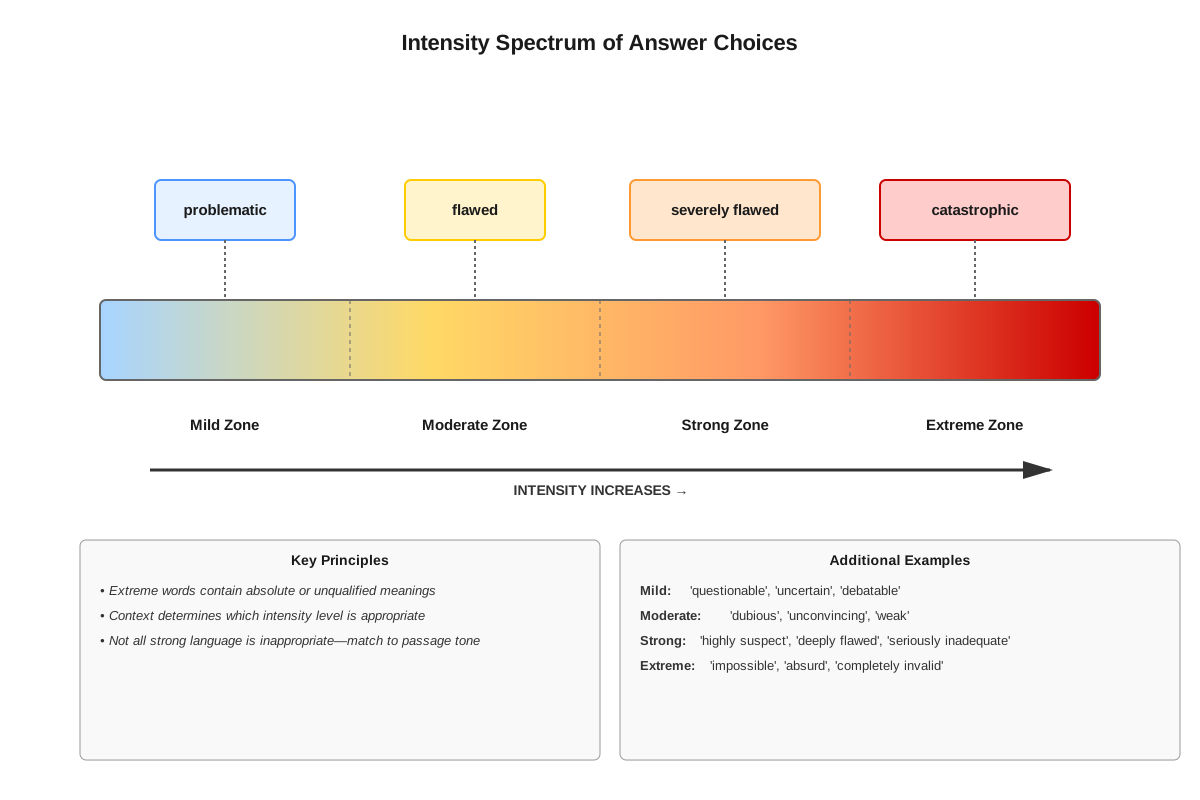
The spectrum of intensity ranges from mild (slight, minor, modest) through moderate (significant, substantial, important) to extreme (revolutionary, catastrophic, unprecedented). Understanding this spectrum is crucial because the GRE tests whether students can match answer choice intensity to passage intensity.
The Core Strategy: Match Passage Tone and Context
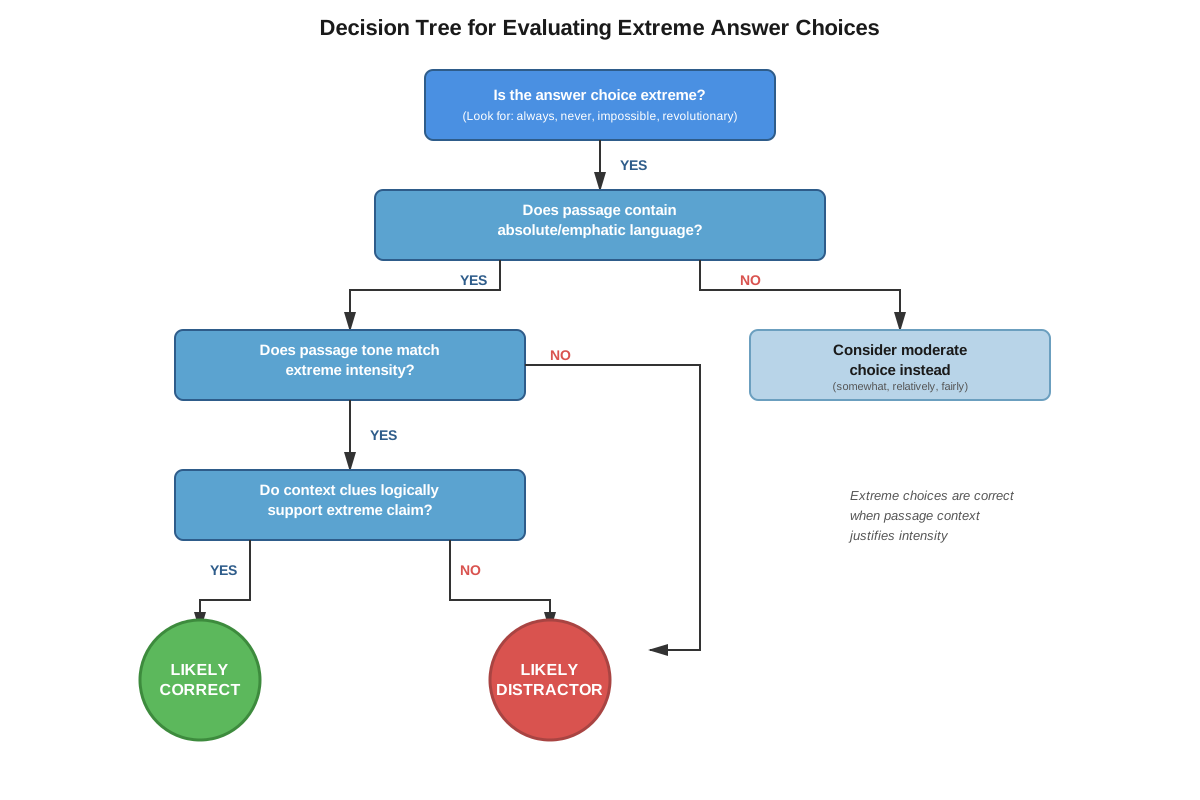
The fundamental rule for handling extreme answer choices is: select extreme words when the passage's context clues indicate extreme circumstances, and avoid them when context clues suggest moderation or qualification. This strategy requires three steps:
- Identify context clues that establish tone and intensity (signal words, descriptive language, logical structure)
- Assess the degree of intensity warranted by these clues
- Match answer choice intensity to passage intensity
This approach replaces the common but flawed strategy of automatically eliminating extreme choices. The GRE deliberately punishes this oversimplification by making extreme choices correct whenever passages genuinely describe extreme situations.
Context Clues That Signal Extreme Language Is Appropriate
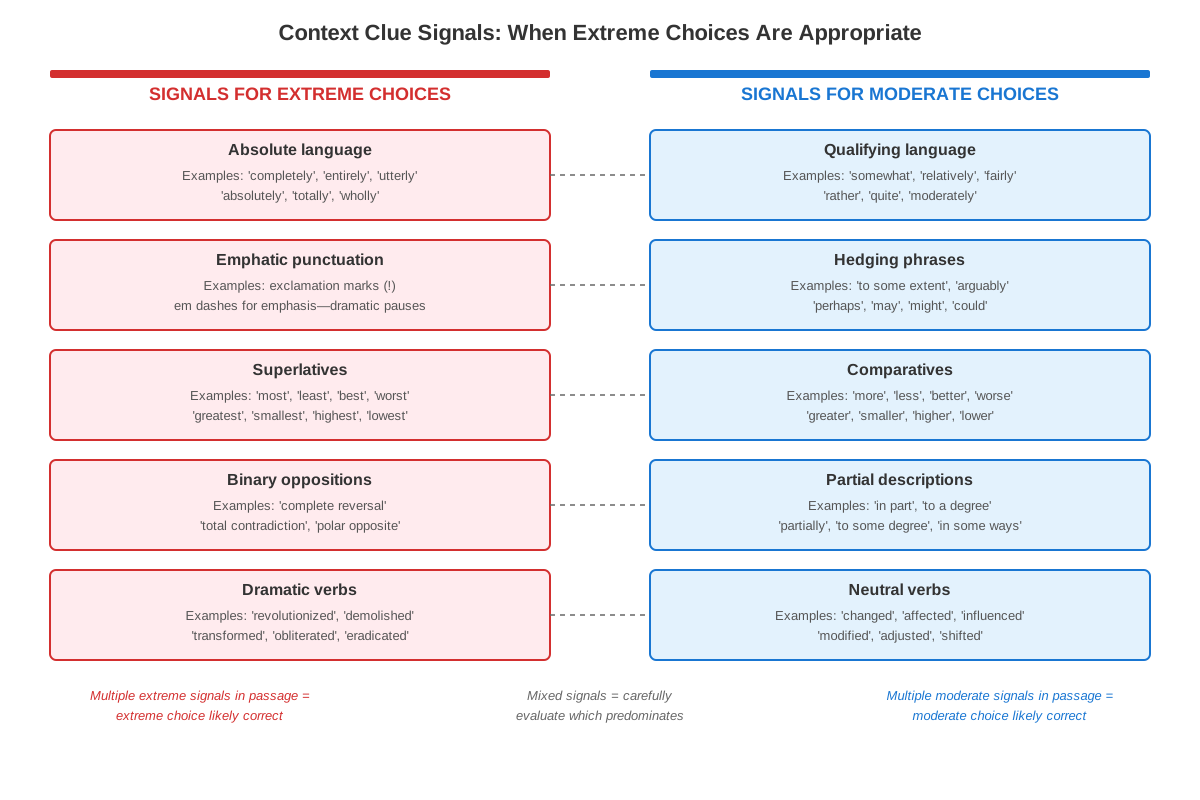
Several passage features indicate that extreme language is warranted:
Superlative constructions: Phrases like "the most," "the least," "the only," or "unlike any other" signal that extreme language may be appropriate. If a passage states "unlike any previous discovery," an answer choice like "unprecedented" fits perfectly.
Absolute negations or affirmations: Words like "no," "none," "all," "every," or "entirely" within the passage suggest that extreme answer choices may be correct. A passage stating "no evidence whatsoever" supports an extreme answer like "completely unfounded."
Emphatic descriptors: When passages use intensifiers like "remarkably," "extraordinarily," "utterly," or "profoundly," they establish a tone that welcomes extreme answer choices.
Contrast structures indicating complete opposition: Phrases like "far from," "contrary to all," or "the opposite of" often require extreme language to capture the full force of the contrast.
Context Clues That Signal Moderate Language Is Appropriate
Conversely, certain passage features indicate that moderate language is more appropriate:
Qualifying language: Words like "somewhat," "relatively," "generally," "often," or "tends to" signal that moderate answer choices are preferred.
Partial descriptions: Phrases like "one of several," "among the factors," or "contributed to" suggest that extreme language would overstate the case.
Hedging language: Academic writing often uses hedges like "appears to," "suggests that," or "may indicate," which call for moderate answer choices.
Comparative rather than superlative constructions: Phrases like "more than" or "less than" (without "most" or "least") typically require moderate rather than extreme language.
Common Extreme Words on the GRE
| Category | Extreme Words | Moderate Alternatives |
|---|---|---|
| Degree | completely, utterly, entirely, absolutely | largely, significantly, considerably |
| Frequency | always, never, invariably, without exception | often, rarely, typically, generally |
| Quality | perfect, flawless, catastrophic, disastrous | excellent, problematic, concerning |
| Uniqueness | unprecedented, unique, singular, unparalleled | unusual, distinctive, notable, remarkable |
| Change | revolutionary, transformative, radical | significant, substantial, important |
| Possibility | impossible, inevitable, certain, guaranteed | unlikely, probable, expected |
The Trap of Automatic Elimination
Many test-preparation resources teach students to automatically eliminate extreme answer choices, treating them as "too strong" or "too absolute." This oversimplified rule causes errors on 20-30% of questions where extreme choices are correct. The GRE exploits this misconception by including passages that genuinely warrant extreme language, making the extreme choice correct while offering moderate choices as attractive but incorrect distractors.
The sophisticated approach recognizes that extreme choices are neither inherently correct nor inherently incorrect—their validity depends entirely on passage context. High-scoring students evaluate each choice against the specific evidence and tone of the passage rather than applying blanket rules.
Concept Relationships
The evaluation of extreme answer choices builds directly upon context clue identification. Students must first locate signal words and logical indicators before they can assess whether extreme language is appropriate. This relationship flows in one direction: context clues → intensity assessment → answer choice selection.
Tone analysis and extreme answer choice evaluation are reciprocal concepts. Understanding a passage's tone helps determine whether extreme language fits, while recognizing the intensity of answer choices helps clarify the passage's tone. These skills reinforce each other: Tone analysis ↔ Extreme answer choice evaluation.
Within text completion strategy, extreme answer choice evaluation represents an advanced application of the prediction method. Students first predict an answer based on context, then evaluate whether their prediction requires extreme or moderate language. This relationship follows the sequence: Context analysis → Prediction → Intensity calibration → Answer selection.
The concept also connects to process of elimination strategies. When multiple answer choices seem logically plausible, comparing their relative intensity often reveals which best matches the passage. This creates a refinement relationship: Logical fit → Intensity comparison → Final selection.
High-Yield Facts
⭐ Extreme answer choices appear in 60-70% of text completion questions, either as correct answers or prominent distractors
⭐ The presence of superlatives ("most," "least," "only") in the passage often signals that extreme language is appropriate
⭐ Passages with qualifying language ("somewhat," "relatively," "generally") typically require moderate rather than extreme answer choices
⭐ Automatically eliminating extreme choices causes errors on approximately 20-30% of questions where extreme language is correct
⭐ Words like "unprecedented," "impossible," "perfect," and "catastrophic" are extreme; words like "significant," "unlikely," "excellent," and "problematic" are moderate
- Contrast structures ("far from," "contrary to") often require extreme language to capture the full force of opposition
- Academic hedging language ("appears to," "suggests," "may indicate") signals that moderate choices are preferred
- The GRE deliberately includes extreme choices as correct answers to test careful reading and context analysis
- Intensity matching is more important than logical fit alone—a logically plausible but inappropriately intense choice is incorrect
- Sentence equivalence questions require matching intensity levels between the two correct choices, not just similar meanings
Quick check — test yourself on Extreme answer choices so far.
Try Flashcards →Common Misconceptions
Misconception: Extreme answer choices are always wrong because they're "too strong" for the GRE.
Correction: Extreme choices are correct whenever the passage's context genuinely warrants extreme language. Passages describing complete failures, unprecedented discoveries, or absolute contradictions require extreme vocabulary. The GRE tests whether students can recognize when extreme language is appropriate rather than applying blanket elimination rules.
Misconception: If a passage seems negative, any negative extreme word will work.
Correction: Tone matching requires precision beyond simple positive/negative categorization. A passage describing a "serious problem" calls for words like "significant" or "substantial," not "catastrophic" or "disastrous." Students must calibrate the degree of negativity, not just its presence.
Misconception: Moderate answer choices are always safer bets.
Correction: When passages contain superlatives, absolute negations, or emphatic language, moderate choices understate the case and are incorrect. "Safe" choices that don't match passage intensity are wrong choices. The GRE rewards precision, not caution.
Misconception: Words like "unprecedented" or "revolutionary" never appear as correct answers.
Correction: These words are correct when passages describe genuinely unique or transformative situations. Historical passages about major scientific breakthroughs, for example, often require words like "revolutionary" or "unprecedented" to accurately capture the significance described.
Misconception: All extreme words have the same level of intensity.
Correction: Even within extreme language, gradations exist. "Impossible" is more extreme than "highly unlikely"; "catastrophic" is more extreme than "very problematic." Students must distinguish between different levels of extreme language and match the specific degree of intensity to the passage.
Misconception: If one blank requires an extreme word, all blanks in a multi-blank question will require extreme words.
Correction: Each blank must be evaluated independently based on its specific context clues. A passage might describe an "unprecedented discovery" (extreme) that had "significant implications" (moderate). The intensity appropriate for one blank doesn't determine the intensity for others.
Worked Examples
Example 1: When Extreme Language Is Correct
Passage: "The archaeologist's discovery was unlike anything previously unearthed in the region; no comparable artifacts had ever been found, making this find _______ in the field's history."
Answer Choices:
A) notable
B) unprecedented
C) interesting
D) significant
E) unusual
Analysis:
Step 1: Identify context clues. The passage contains several indicators of extreme language: "unlike anything previously," "no comparable artifacts had ever been found," and the superlative construction "in the field's history."
Step 2: Assess intensity. The phrase "unlike anything previously" and "no comparable artifacts" indicate absolute uniqueness, not merely high significance. The passage describes something that has never occurred before.
Step 3: Evaluate answer choices by intensity:
- "Notable" (A) and "significant" (D) are moderate words suggesting importance but not uniqueness
- "Interesting" (C) is mild and doesn't capture the historical importance
- "Unusual" (E) is moderate, suggesting rarity but not absolute uniqueness
- "Unprecedented" (B) is extreme, meaning "never done or known before"
Step 4: Match intensity. The passage's absolute language ("unlike anything," "no comparable") requires an extreme answer. "Unprecedented" perfectly captures the sense that nothing like this has ever been found before.
Correct Answer: B) unprecedented
Learning Objective Connection: This example demonstrates how to identify when extreme answer choices are being tested (superlatives and absolute negations in the passage) and how to apply the strategy accurately by matching passage intensity to answer choice intensity.
Example 2: When Moderate Language Is Correct
Passage: "While the new policy addressed several concerns raised by employees, critics argued that it remained _______ flawed, failing to resolve some fundamental issues."
Answer Choices:
A) catastrophically
B) significantly
C) slightly
D) utterly
E) perfectly
Analysis:
Step 1: Identify context clues. The passage contains qualifying language: "several concerns" (not all), "some fundamental issues" (not all issues), and "While...critics argued" (suggesting debate, not consensus).
Step 2: Assess intensity. The word "While" introduces a concession, suggesting partial success. The phrase "some fundamental issues" indicates serious but not complete failure. The passage describes a mixed situation with both improvements and remaining problems.
Step 3: Evaluate answer choices by intensity:
- "Catastrophically" (A) and "utterly" (D) are extreme words suggesting complete or devastating failure
- "Perfectly" (E) is extreme and positive, contradicting the negative context
- "Slightly" (C) is too mild given that "fundamental issues" remain
- "Significantly" (B) is moderate, indicating serious but not complete problems
Step 4: Match intensity. The passage's qualified language ("several," "some") and mixed assessment (addressed concerns but failed to resolve issues) requires moderate language. "Significantly" captures serious flaws without overstating the case as complete failure.
Correct Answer: B) significantly
Learning Objective Connection: This example shows how to recognize when moderate language is appropriate by identifying qualifying context clues and explains the core strategy of matching answer choice intensity to passage tone rather than automatically selecting or avoiding extreme choices.
Exam Strategy
Systematic Approach to Extreme Answer Choice Questions
When encountering text completion questions, follow this process:
- Read the entire passage first without looking at answer choices to understand overall tone and context
- Identify and underline context clues that indicate intensity: superlatives, absolute language, qualifiers, hedges
- Predict an answer and assess whether your prediction is extreme, moderate, or mild
- Scan answer choices for intensity before evaluating meaning, categorizing each as extreme, moderate, or mild
- Eliminate choices with mismatched intensity first, then evaluate remaining choices for logical fit
Trigger Words and Phrases
Triggers for extreme language:
- Superlatives: "the most," "the least," "the only," "the first"
- Absolute negations: "no," "none," "never," "nothing"
- Absolute affirmations: "all," "every," "always," "entirely"
- Emphatic intensifiers: "utterly," "completely," "absolutely," "totally"
- Unique comparisons: "unlike any," "unprecedented," "unparalleled"
Triggers for moderate language:
- Qualifiers: "somewhat," "relatively," "fairly," "rather"
- Frequency indicators: "often," "typically," "generally," "usually"
- Partial descriptors: "some," "several," "many," "one of"
- Hedges: "appears to," "seems to," "suggests," "may"
- Comparative (not superlative): "more than," "less than," "greater"
Process of Elimination Tips
When multiple choices seem logically plausible, use intensity as a tiebreaker. If the passage contains no extreme language indicators, eliminate extreme choices. If the passage contains superlatives or absolutes, eliminate moderate choices that understate the case.
For sentence equivalence questions, remember that both correct answers must match in intensity as well as meaning. If you're confident one correct answer is extreme, look for another extreme word with similar meaning rather than a moderate synonym.
Time Allocation
Spend 5-10 seconds identifying context clues before looking at answer choices. This upfront investment prevents the time waste of reconsidering choices multiple times. If you find yourself debating between an extreme and moderate choice, return to the passage to verify intensity indicators rather than guessing based on general impressions.
Exam Tip: When stuck between two choices, ask yourself: "Does the passage contain absolute language (all, none, never, only, most) or qualified language (some, often, generally)?" This question often immediately reveals the correct intensity level.
Memory Techniques
The SUPERLATIVE Mnemonic
To remember when extreme language is appropriate, use SUPERLATIVE:
- Superlatives present ("most," "least," "only")
- Unique comparisons ("unlike any")
- Perfect or complete descriptions
- Emphatic intensifiers ("utterly," "completely")
- Revolutionary or transformative language
- Language that's absolute ("all," "none," "never")
- Absolute negations or affirmations
- Total or comprehensive statements
- Intensifiers that strengthen claims
- Very strong descriptive language
- Extreme circumstances described
The MODERATE Mnemonic
To remember when moderate language is appropriate, use MODERATE:
- Many but not all
- Often but not always
- Debatable or qualified claims
- Exceptions acknowledged
- Relatively or comparatively stated
- Appears or seems (hedging)
- Typically or generally
- Expressions of partial truth
Visualization Strategy
Picture a volume dial ranging from 1 (mild) to 10 (extreme). As you read the passage, adjust the dial based on context clues. Superlatives and absolutes turn the dial to 8-10. Qualifiers and hedges keep it at 4-6. Your answer choice should match the dial setting.
The "Would a Scholar Say This?" Test
When evaluating extreme choices, ask: "Would a careful academic scholar use this word in a peer-reviewed paper about this topic?" Scholars use extreme language sparingly but do employ it when describing genuinely extreme situations. This mental test helps calibrate appropriate intensity.
Summary
Extreme answer choices represent a sophisticated pattern recognition skill that separates high-scoring GRE test-takers from average performers. The core strategy requires matching answer choice intensity to passage intensity rather than automatically accepting or rejecting extreme language. Context clues—including superlatives, absolute language, qualifiers, and hedges—signal whether extreme or moderate language is appropriate. Passages containing words like "most," "only," "never," or "all" often require extreme answer choices such as "unprecedented," "impossible," or "revolutionary." Conversely, passages with qualifying language like "somewhat," "generally," or "appears to" call for moderate choices like "significant," "notable," or "considerable." The GRE deliberately includes extreme choices as both correct answers and distractors, testing whether students read carefully and analyze context rather than applying simplistic elimination rules. Success requires evaluating each answer choice on a spectrum of intensity and selecting the option that precisely matches the degree of force, certainty, or emphasis established by the passage's context clues.
Key Takeaways
- Extreme answer choices are correct when passage context genuinely warrants extreme language; automatic elimination causes errors on 20-30% of questions
- Superlatives ("most," "least," "only") and absolute language ("all," "none," "never") in passages signal that extreme answer choices may be correct
- Qualifying language ("somewhat," "generally," "relatively") and hedges ("appears to," "suggests") indicate that moderate choices are preferred
- Intensity matching is as important as logical fit—an answer must match both the meaning and the degree of force appropriate to the passage
- The spectrum ranges from mild (slight, minor) through moderate (significant, substantial) to extreme (unprecedented, catastrophic, revolutionary)
- Context clues must be identified before evaluating answer choices to avoid being misled by initial impressions
- Both meaning and intensity must align in sentence equivalence questions—the two correct answers must match in degree of force as well as definition
Related Topics
Tone and Attitude in Reading Comprehension: Understanding how authors convey intensity and emphasis through word choice extends beyond text completion into passage analysis. Mastering extreme answer choices builds the foundation for identifying authorial tone in longer passages.
Connotation and Denotation: Distinguishing between words with similar dictionary definitions but different intensity levels (e.g., "problem" vs. "catastrophe") requires understanding connotation. This topic deepens the ability to evaluate extreme versus moderate language.
Sentence Equivalence Strategy: Applying extreme answer choice principles to sentence equivalence questions requires matching intensity between two correct answers, not just finding synonyms. This advanced application builds directly on the concepts covered here.
Context Clue Mastery: Developing more sophisticated context clue identification skills—including recognizing subtle intensifiers, qualifiers, and tonal shifts—enables more accurate assessment of when extreme language is appropriate.
Practice CTA
Now that you understand the principles behind evaluating extreme answer choices, it's time to apply these strategies to actual GRE-style questions. The practice questions and flashcards will help you internalize the pattern recognition skills needed to quickly identify context clues and match answer choice intensity to passage tone. Remember: this skill improves dramatically with deliberate practice. Each question you analyze strengthens your ability to calibrate language intensity and avoid the common trap of automatically eliminating extreme choices. Approach the practice materials with the systematic strategy outlined in this guide, and you'll see measurable improvement in your text completion accuracy. Your investment in mastering this high-yield topic will pay dividends across the entire Verbal Reasoning section!
Sign up free to keep reading
Create a free AnvayaPrep account to finish this GRE guide on Extreme answer choices — plus flashcards and practice questions.