Overview
Trap words are deliberately misleading answer choices in GRE Text Completion questions that appear correct at first glance but actually distort the intended meaning of the sentence. These deceptive options are strategically placed by test makers to exploit common reading errors, hasty reasoning, and superficial vocabulary associations. Understanding trap words is not merely about avoiding wrong answers—it represents a fundamental shift in how test-takers approach the GRE Verbal section, moving from passive reading to active, critical analysis of both passages and answer choices.
The GRE consistently employs gre trap words as a primary mechanism to differentiate between average and high-scoring test-takers. These words often share semantic fields with the correct answer, appear in the same context in everyday usage, or sound sophisticated enough to seem "GRE-like." The test makers understand that under time pressure, students gravitate toward familiar-sounding words or those that create a grammatically correct sentence, even when the logical relationship within the sentence demands a different meaning entirely. Mastering trap word identification requires developing a systematic approach to sentence analysis that prioritizes logical coherence over surface-level plausibility.
Within the broader Verbal Reasoning framework, trap words connect directly to critical reading skills, vocabulary in context, and logical reasoning. They test whether students can distinguish between words that are merely related to the topic versus words that precisely fulfill the logical requirements established by the sentence structure. This topic bridges vocabulary knowledge with analytical reasoning, making it one of the highest-yield areas for score improvement in Text Completion questions.
Learning Objectives
- [ ] Identify when Trap words is being tested
- [ ] Explain the core rule or strategy behind Trap words
- [ ] Apply Trap words to GRE-style questions accurately
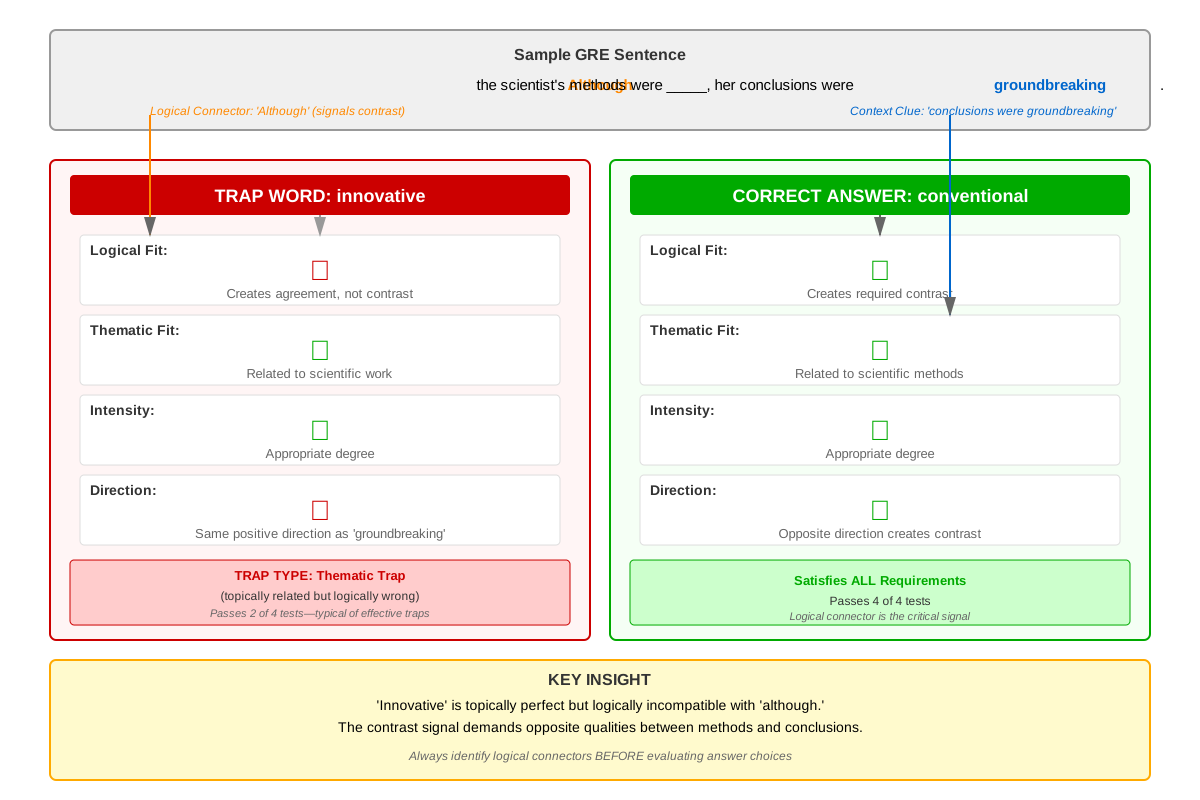
- [ ] Distinguish between trap words and correct answers based on logical sentence requirements
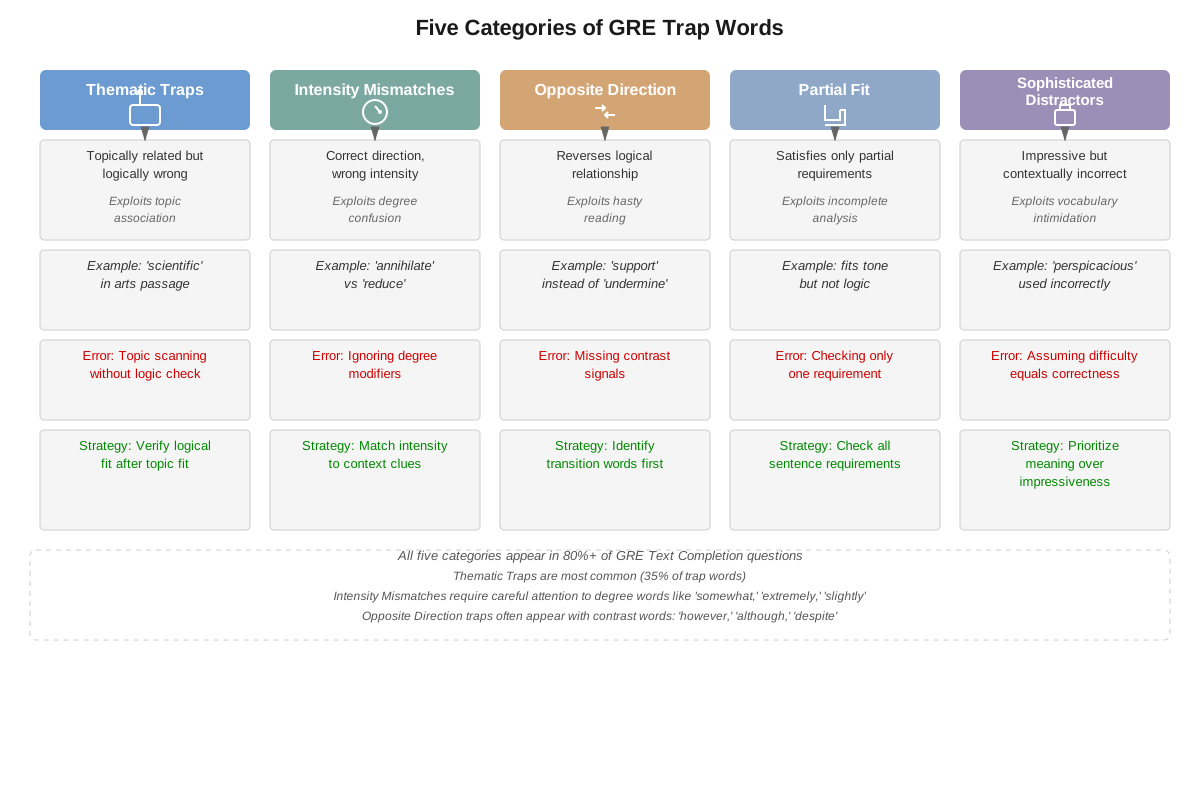
- [ ] Recognize the five major categories of trap words commonly used on the GRE
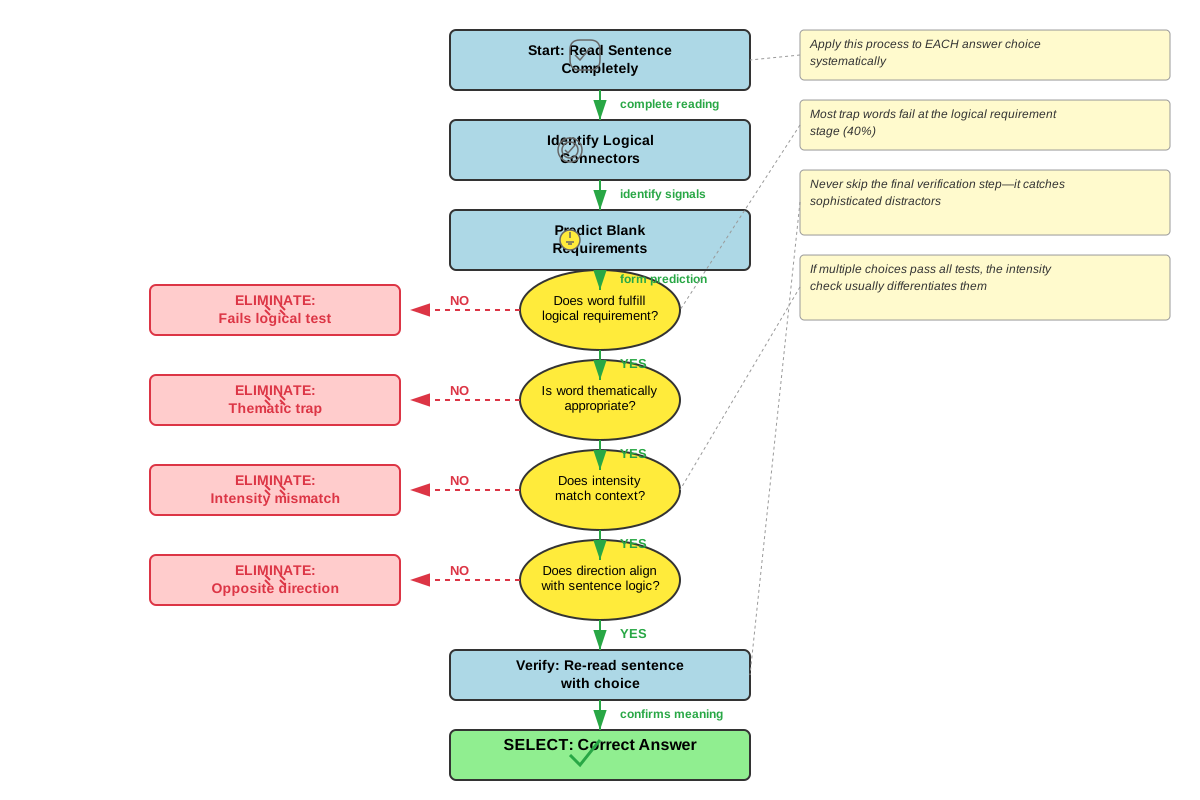
- [ ] Develop a systematic elimination process that neutralizes trap word effectiveness
- [ ] Analyze sentence structure to predict trap word patterns before viewing answer choices
Prerequisites
- Vocabulary fundamentals: Understanding word definitions, connotations, and usage is essential because trap words exploit subtle distinctions between similar terms
- Sentence structure analysis: Recognizing subjects, predicates, and logical connectors enables identification of what the blank actually requires
- Context clues: The ability to extract meaning from surrounding text helps distinguish between contextually appropriate and merely topically related words
- Basic logical relationships: Understanding cause-effect, contrast, and support relationships is necessary to evaluate whether an answer choice fulfills the sentence's logical demands
Why This Topic Matters
Trap words appear in approximately 70-80% of all GRE Text Completion questions, making them one of the most frequently tested concepts in Verbal Reasoning. The Educational Testing Service (ETS) deliberately includes 2-3 trap words among the answer choices for each blank, meaning that the majority of options are designed to mislead rather than to serve as neutral distractors. Students who cannot identify trap words effectively face a significant disadvantage, as they may eliminate correct answers while confidently selecting wrong ones.
In real-world applications, the skill of identifying trap words translates to critical reading in academic and professional contexts—distinguishing between arguments that sound persuasive versus those that are logically sound, recognizing when language is being used to obscure rather than clarify, and making precise word choices in one's own writing. Graduate-level coursework demands this level of linguistic precision, which is why the GRE tests it so rigorously.
On the exam itself, trap words most commonly appear in Text Completion questions (both single-blank and multi-blank), though the underlying principle also applies to Sentence Equivalence questions. They typically manifest in medium-to-hard difficulty questions where the test makers want to separate students who truly understand vocabulary in context from those who have merely memorized word lists. The most dangerous trap words appear in questions where the sentence discusses a familiar topic, as students may select words based on topical association rather than logical necessity.
Core Concepts
Definition and Mechanism of Trap Words
Trap words are answer choices that possess one or more characteristics that make them superficially attractive but fundamentally incorrect. They function by exploiting predictable cognitive shortcuts and reading errors that test-takers make under time pressure. The mechanism operates on multiple levels: semantic (meaning-based), syntactic (grammar-based), and pragmatic (context-based). Understanding this multi-layered deception is crucial because a word might be semantically related to the topic, grammatically correct in the sentence, and still be wrong because it violates the logical relationship the sentence establishes.
The test makers construct trap words by analyzing how students typically misread or misinterpret sentences. They identify common associations, frequent vocabulary confusions, and typical reasoning errors, then craft answer choices that reward these mistakes. This systematic approach means that trap words are not random—they follow predictable patterns that can be learned and countered with appropriate strategies.
Five Major Categories of Trap Words
1. Topical Association Traps
These words relate to the general subject matter of the sentence but do not fulfill the specific logical requirement of the blank. For example, in a sentence about scientific research, words like "empirical," "hypothesis," or "methodology" might appear as trap answers even when the blank requires a word describing an emotional state or ethical consideration. The trap exploits the tendency to select words that "sound right" for the topic without checking whether they fit the precise logical slot.
2. Opposite Meaning Traps
These words convey the exact opposite of what the sentence logic requires, often appearing in sentences with negation words, contrast signals, or complex logical structures. Students who misread a "not" or "although" may select these words confidently. For instance, if the sentence requires a word meaning "to criticize," the trap might offer "to praise" or "to commend." These traps are particularly effective when the sentence contains multiple clauses or complex syntax that obscures the logical flow.
3. Degree Mismatch Traps
These words point in the correct semantic direction but are too extreme or too mild for the context. If a sentence describes a "minor setback," a trap word might be "catastrophic" (too extreme) when "inconvenient" is correct. Similarly, if the context demands "furious," a trap might offer "annoyed" (too mild). The GRE frequently tests whether students can calibrate intensity appropriately, as this skill reflects sophisticated reading comprehension.
4. Grammatical Fit Traps
These words create grammatically correct sentences but semantically nonsensical or illogical ones. They exploit the tendency to rely on "ear" rather than meaning. For example, a word might agree in number and tense, flow smoothly when read aloud, yet create a logical contradiction or meaningless statement. Students who read quickly or who prioritize fluency over meaning are particularly vulnerable to these traps.
5. Partial Synonym Traps
These words share some semantic overlap with the correct answer but differ in crucial connotations, register, or specific usage. For instance, "frugal" and "miserly" both relate to spending little money, but "frugal" is positive while "miserly" is negative. A sentence praising someone's financial habits requires "frugal," making "miserly" a trap despite the semantic similarity. These traps test nuanced vocabulary knowledge and the ability to distinguish between words in the same semantic field.
The Anatomy of a Trap Word Question
A typical GRE Text Completion question with trap words follows this structure:
- The sentence establishes a logical relationship (cause-effect, contrast, elaboration, etc.)
- Signal words indicate what type of relationship exists (although, because, moreover, etc.)
- The blank requires a word that fulfills a specific logical role
- Answer choices include:
- One correct answer that satisfies all logical and semantic requirements
- Two to four trap words from various categories
- Possibly one neutral distractor (clearly wrong but not deliberately misleading)
Understanding this structure allows test-takers to approach questions systematically rather than intuitively.
Comparison Table: Correct Answers vs. Trap Words
| Feature | Correct Answer | Trap Word |
|---|---|---|
| Logical fit | Satisfies the sentence's logical requirement | Creates logical inconsistency or irrelevance |
| Semantic precision | Matches the exact meaning needed | Close but imprecise; wrong connotation or degree |
| Contextual appropriateness | Fits both immediate and broader context | Fits topic but not specific context |
| Signal word alignment | Aligns with contrast/support signals | Ignores or contradicts signal words |
| Sentence coherence | Creates a meaningful, coherent statement | Creates grammatical but illogical statement |
Concept Relationships
The concept of trap words sits at the intersection of multiple Verbal Reasoning skills. Vocabulary knowledge provides the foundation—students must know what words mean to distinguish between similar options. This knowledge feeds into contextual analysis, where students determine which meaning is appropriate for the specific sentence. Contextual analysis depends on sentence structure comprehension, as understanding the grammatical relationships reveals what logical role the blank must fulfill.
The relationship flows as follows: Sentence Structure Analysis → Logical Relationship Identification → Prediction of Blank Requirements → Evaluation of Answer Choices → Trap Word Elimination → Correct Answer Selection. Each step builds on the previous one, and weakness at any stage increases vulnerability to trap words.
Trap words also connect to broader test-taking strategy. Time management affects trap word susceptibility—rushed students are more likely to fall for superficial attractiveness. Process of elimination becomes more effective when students can categorize why an answer is wrong (identifying it as a specific type of trap) rather than just feeling it's incorrect. Confidence calibration improves when students understand that attractive-looking answers are often deliberately designed traps rather than signs of their own confusion.
High-Yield Facts
⭐ Approximately 70-80% of GRE Text Completion questions include at least two trap words among the answer choices
⭐ The most common trap word category is topical association—words related to the subject but not the specific logical requirement
⭐ Sentences with negation words (not, never, rarely) or contrast signals (although, despite, however) almost always include opposite meaning traps
⭐ If an answer choice immediately "sounds right" without analysis, it is likely a trap designed to reward hasty reading
⭐ Trap words often appear in positions B or C in the answer list, as test makers know students tend to select middle options when uncertain
- Degree mismatch traps are most common in sentences describing emotions, evaluations, or changes in intensity
- Grammatical fit traps exploit the tendency to read for fluency rather than meaning, particularly in longer sentences
- Partial synonym traps require knowledge of connotation and register, not just denotation
- The presence of multiple trap words in a question indicates higher difficulty level and greater point value
- Students who create their own prediction before viewing answer choices are 60-70% less likely to select trap words
Quick check — test yourself on Trap words so far.
Try Flashcards →Common Misconceptions
Misconception: Sophisticated or difficult vocabulary words are more likely to be correct answers on the GRE.
Correction: The GRE tests vocabulary in context, not vocabulary difficulty. Correct answers can be relatively common words used precisely, while trap words are often impressive-sounding terms that don't fit the logical requirements. Complexity does not equal correctness.
Misconception: If a word creates a grammatically correct sentence, it must be a viable answer choice.
Correction: Grammatical correctness is necessary but not sufficient. Many trap words create grammatically perfect sentences that are logically incoherent or semantically inappropriate. Always evaluate meaning and logic, not just grammar.
Misconception: Words related to the topic of the sentence are safer choices than unrelated words.
Correction: Topical association is one of the most common trap word categories. The GRE specifically includes topic-related words that don't fulfill the blank's logical function. The correct answer must fit the specific logical slot, regardless of topical relevance.
Misconception: If you can't immediately identify why an answer is wrong, it's probably correct.
Correction: Trap words are designed to resist immediate identification as wrong. The inability to quickly spot an error often indicates a well-constructed trap rather than a correct answer. Systematic analysis is required, not intuitive judgment.
Misconception: Eliminating obviously wrong answers and guessing among the remaining choices is an effective strategy.
Correction: This approach fails because trap words are specifically designed not to be obviously wrong. They survive initial elimination rounds and trap students who guess among "reasonable" options. Positive identification of the correct answer through logical analysis is necessary.
Worked Examples
Example 1: Topical Association and Degree Mismatch Traps
Question: The scientist's methodology was __________, incorporating both traditional experimental techniques and innovative computational approaches that had never been applied to this field before.
Answer Choices:
(A) empirical
(B) eclectic
(C) rigorous
(D) conventional
(E) theoretical
Step 1: Analyze the sentence structure
The sentence describes a methodology that combines two elements: traditional techniques AND innovative approaches. The word "both...and" signals that the blank should describe something that encompasses multiple, different approaches.
Step 2: Identify signal words and logical requirements
- "both...and" = combination/diversity
- "traditional" + "innovative" = mixing different types
- "never been applied before" = emphasizes the innovative, mixed nature
Step 3: Predict before looking at choices
The blank needs a word meaning "diverse," "varied," or "combining different elements."
Step 4: Evaluate each choice
(A) empirical - TRAP: Topical association. This word relates to scientific methodology but means "based on observation/experiment," not "diverse" or "combining different approaches." It sounds right for a science context but doesn't fulfill the logical requirement.
(B) eclectic - CORRECT: Means "deriving ideas from various sources" or "diverse in content." This precisely captures the combination of traditional and innovative approaches.
(C) rigorous - TRAP: Topical association. Another science-related word that sounds appropriate but means "thorough" or "precise," not "diverse." It describes quality, not variety.
(D) conventional - TRAP: Opposite meaning. The sentence emphasizes innovation and new applications, making "conventional" (traditional, standard) the opposite of what's needed.
(E) theoretical - TRAP: Topical association. Science-related but means "based on theory rather than practice," which contradicts the mention of "experimental techniques."
Answer: (B) eclectic
Key Lesson: Three of the four wrong answers are topical association traps—words that fit the scientific context but don't fulfill the specific logical requirement of describing diversity/combination. This pattern is extremely common on the GRE.
Example 2: Opposite Meaning and Partial Synonym Traps
Question: Although the committee's initial response to the proposal was __________, further investigation revealed numerous practical obstacles that ultimately led to its rejection.
Answer Choices:
(A) hostile
(B) enthusiastic
(C) ambivalent
(D) skeptical
(E) indifferent
Step 1: Analyze the sentence structure
"Although" signals contrast. The initial response contrasts with the ultimate rejection. The structure is: "Although [initial response], [problems led to rejection]."
Step 2: Identify the logical relationship
If the proposal was ultimately rejected due to obstacles, the contrast word "although" indicates the initial response must have been positive or favorable. The sentence structure is: "Although [positive initial response], [it was rejected]."
Step 3: Predict before looking at choices
Need a word meaning "positive," "favorable," or "supportive."
Step 4: Evaluate each choice
(A) hostile - TRAP: Opposite meaning (but wrong direction). This is negative, which would align with rejection rather than contrast with it. Students who misread the "although" might select this.
(B) enthusiastic - CORRECT: Positive and favorable, creating the necessary contrast with ultimate rejection. "Although initially enthusiastic, they later rejected it" makes logical sense.
(C) ambivalent - TRAP: Degree mismatch. This means "having mixed feelings," which is neutral rather than positive. It doesn't create a strong enough contrast with rejection.
(D) skeptical - TRAP: Partial synonym with the outcome. "Skeptical" aligns with eventual rejection rather than contrasting with it. Students might select this because it seems to fit the overall negative outcome, missing the contrast signal.
(E) indifferent - TRAP: Similar to (C), this is too neutral to create meaningful contrast with rejection.
Answer: (B) enthusiastic
Key Lesson: The word "although" is a critical signal that demands contrast. Multiple trap answers either ignore this signal (D, A) or provide insufficient contrast (C, E). Always identify and honor signal words before evaluating answer choices.
Exam Strategy
Pre-Reading Strategy
Before looking at answer choices, invest 15-20 seconds in sentence analysis:
- Identify signal words (contrast: although, despite, however; support: because, since, therefore; elaboration: moreover, furthermore)
- Determine the logical relationship the blank must fulfill
- Create a prediction in your own words (doesn't need to be sophisticated—"something positive" or "a word meaning to criticize" is sufficient)
- Note the tone and degree required (mild or extreme? positive or negative?)
This pre-reading investment dramatically reduces trap word vulnerability because you approach answer choices with clear criteria rather than evaluating them in isolation.
Trigger Words and Phrases to Watch For
High Alert: When you see these words in the sentence, expect opposite meaning traps in the answer choices: - although, though, even though, despite, in spite of - however, nevertheless, nonetheless, yet - rather than, instead of, contrary to - not, never, rarely, seldom, hardly
Degree Indicators: These words signal that degree mismatch traps are likely: - somewhat, slightly, moderately (expect "too extreme" traps) - extremely, utterly, completely, absolutely (expect "too mild" traps) - increasingly, progressively, gradually (expect static vs. changing traps)
Process of Elimination Specific to Trap Words
Use this systematic approach:
- First pass: Eliminate answers that create logical contradictions or nonsensical statements (often grammatical fit traps)
- Second pass: Eliminate answers that ignore signal words, especially contrast markers (opposite meaning traps)
- Third pass: Among remaining choices, eliminate topical association traps by asking "Does this word fulfill the specific logical requirement, or does it just relate to the topic?"
- Final evaluation: Between two similar words, choose based on degree and connotation precision (eliminates partial synonym and degree mismatch traps)
Time Allocation Advice
- Simple sentences (one clause, clear logic): 30-45 seconds total
- Complex sentences (multiple clauses, subtle logic): 60-90 seconds total
- Multi-blank questions: 90-120 seconds total, analyzing blanks in logical order (not necessarily left-to-right)
Spending adequate time on sentence analysis prevents the false economy of quick guessing that leads to trap word selection. A correct answer in 75 seconds is far better than a wrong answer in 30 seconds.
Red Flags That You've Selected a Trap Word
If you experience any of these, reconsider your choice:
- The answer "just sounds right" without clear logical justification
- You selected it primarily because it relates to the topic
- You can't articulate why the other choices are wrong
- You ignored or didn't notice a signal word in the sentence
- You chose the most sophisticated or GRE-like sounding word
Memory Techniques
TRAPS Acronym for Trap Word Categories
Topical association (relates to subject, not specific requirement)
Reversed meaning (opposite of what's needed)
Amplitude wrong (degree too extreme or too mild)
Partial match (similar but wrong connotation)
Sounds right (grammatical but illogical)
The "SIGNAL" Method for Sentence Analysis
Spot signal words (contrast, support, elaboration)
Identify the logical relationship
Generate your own prediction
Note tone and degree requirements
Analyze each answer against these criteria
Logic check: Does the complete sentence make sense?
Visualization Strategy
Picture trap words as attractive but poisonous plants: they look appealing (sophisticated vocabulary, topical relevance, grammatical correctness) but consuming them (selecting them) leads to a wrong answer. The correct answer might look plainer but is actually nutritious (logically sound, contextually appropriate, precisely meaningful).
The "Three-Question Test"
Before finalizing any answer, ask:
- Does it fit the logic? (Not just the topic)
- Does it honor signal words? (Especially contrast markers)
- Is the degree right? (Not too extreme, not too mild)
If you can't answer "yes" to all three, you likely have a trap word.
Summary
Trap words represent one of the GRE's most systematic and predictable testing mechanisms, appearing in the vast majority of Text Completion questions as deliberately misleading answer choices. These words exploit common reading errors, hasty reasoning, and superficial associations by appearing correct at first glance while violating the logical requirements established by the sentence structure. The five major categories—topical association, opposite meaning, degree mismatch, grammatical fit, and partial synonym traps—account for nearly all wrong answers in Text Completion questions. Mastering trap word identification requires a systematic approach: analyzing sentence structure before viewing answer choices, identifying signal words that establish logical relationships, creating predictions based on logical requirements rather than topical associations, and evaluating each answer choice against specific criteria rather than intuitive judgment. Students who develop this systematic approach dramatically improve their Text Completion accuracy because they shift from passive answer selection to active logical analysis, making them resistant to the cognitive shortcuts that trap words are designed to exploit.
Key Takeaways
- Trap words are not random—they follow predictable patterns across five major categories that can be learned and systematically countered
- Topical association is the most common trap: words that relate to the subject matter but don't fulfill the specific logical requirement of the blank
- Signal words are critical: contrast markers (although, despite, however) and support markers (because, therefore) indicate what logical relationship the blank must satisfy
- Pre-reading analysis prevents trap selection: creating your own prediction before viewing answer choices reduces trap word vulnerability by 60-70%
- Grammatical correctness ≠ logical correctness: many trap words create fluent, grammatically perfect sentences that are semantically inappropriate or logically incoherent
- Sophisticated vocabulary is not a reliable indicator: correct answers can be common words used precisely, while trap words are often impressive-sounding terms that don't fit the context
- Systematic elimination beats intuitive guessing: using specific criteria to evaluate each answer choice is far more effective than selecting what "sounds right"
Related Topics
Sentence Equivalence Strategy: Builds directly on trap word identification by requiring students to find two words that create equivalent meanings, with four trap words designed to create plausible but non-equivalent sentences. Mastering trap words in Text Completion provides the foundation for the more complex analysis required in Sentence Equivalence.
Context Clues and Inference: Develops the skill of extracting precise meaning from surrounding text, which is essential for distinguishing between trap words and correct answers. Understanding how to use context clues enables more accurate predictions and better trap word resistance.
Vocabulary in Context: Extends trap word concepts by teaching how word meaning shifts based on context, register, and connotation. This advanced skill helps identify partial synonym traps and degree mismatch traps with greater precision.
Logical Reasoning in Reading Comprehension: Applies the same logical analysis skills used in trap word identification to longer passages, where students must distinguish between statements that are topically related versus logically supported by the text.
Practice CTA
Now that you understand the systematic patterns behind trap words and have learned specific strategies to identify and eliminate them, it's time to put these skills into practice. Attempt the practice questions designed for this topic, focusing on applying the SIGNAL method and the three-question test to each question. Use the flashcards to reinforce the five trap word categories and common signal words. Remember: trap word mastery is not about memorizing vocabulary lists—it's about developing a systematic analytical approach that makes you resistant to the GRE's most common deception tactics. Each practice question is an opportunity to strengthen these analytical habits until they become automatic, transforming you from a test-taker who falls for attractive wrong answers into one who confidently identifies logical requirements and selects precise, correct responses.
Sign up free to keep reading
Create a free AnvayaPrep account to finish this GRE guide on Trap words — plus flashcards and practice questions.