Overview
Text completion review strategy is a systematic approach to checking and verifying answers on GRE Text Completion questions before finalizing them. This critical skill separates high-scoring test-takers from those who leave points on the table through careless errors or incomplete reasoning. While many students focus exclusively on initial problem-solving techniques, the review phase represents an opportunity to catch mistakes, refine answer choices, and ensure logical consistency across multi-blank questions.
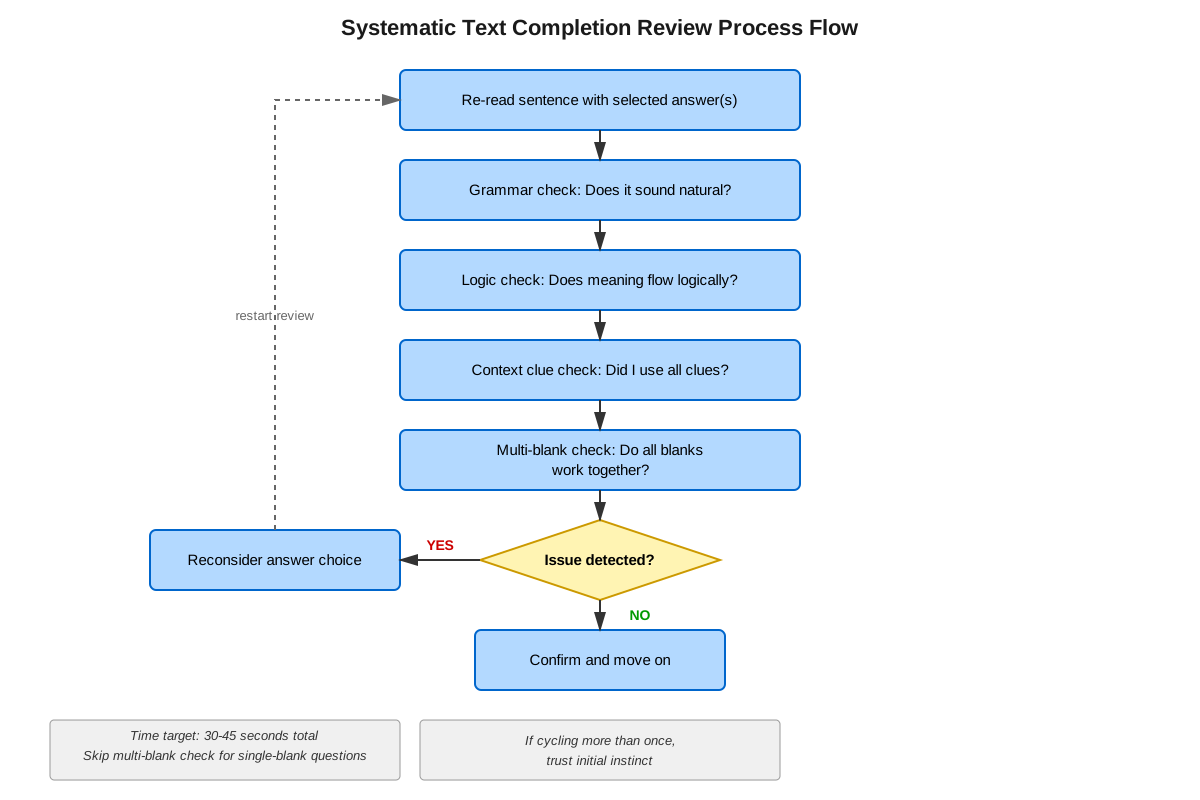
The GRE text completion review strategy encompasses a structured set of verification steps that test-takers should employ after selecting their initial answers. This process involves re-reading the completed sentence with chosen answers, checking for grammatical coherence, verifying that the logic flows naturally, and ensuring that all contextual clues have been properly considered. Unlike simple proofreading, this strategy requires active re-engagement with the question's logical structure and semantic relationships.
Within the broader context of Verbal Reasoning, text completion review strategy serves as the quality control mechanism that maximizes accuracy across all text completion question types. It connects directly to fundamental skills like context clue identification, vocabulary application, and logical reasoning, while also preparing students for the similar verification processes needed in Reading Comprehension and Sentence Equivalence questions. Mastering this review strategy can improve accuracy by 15-20% on questions where students have narrowed choices down to two possibilities, making it one of the highest-yield skills for score improvement.
Learning Objectives
- [ ] Identify when Text completion review strategy is being tested
- [ ] Explain the core rule or strategy behind Text completion review strategy
- [ ] Apply Text completion review strategy to GRE-style questions accurately
- [ ] Execute a systematic review process within 30-45 seconds per question
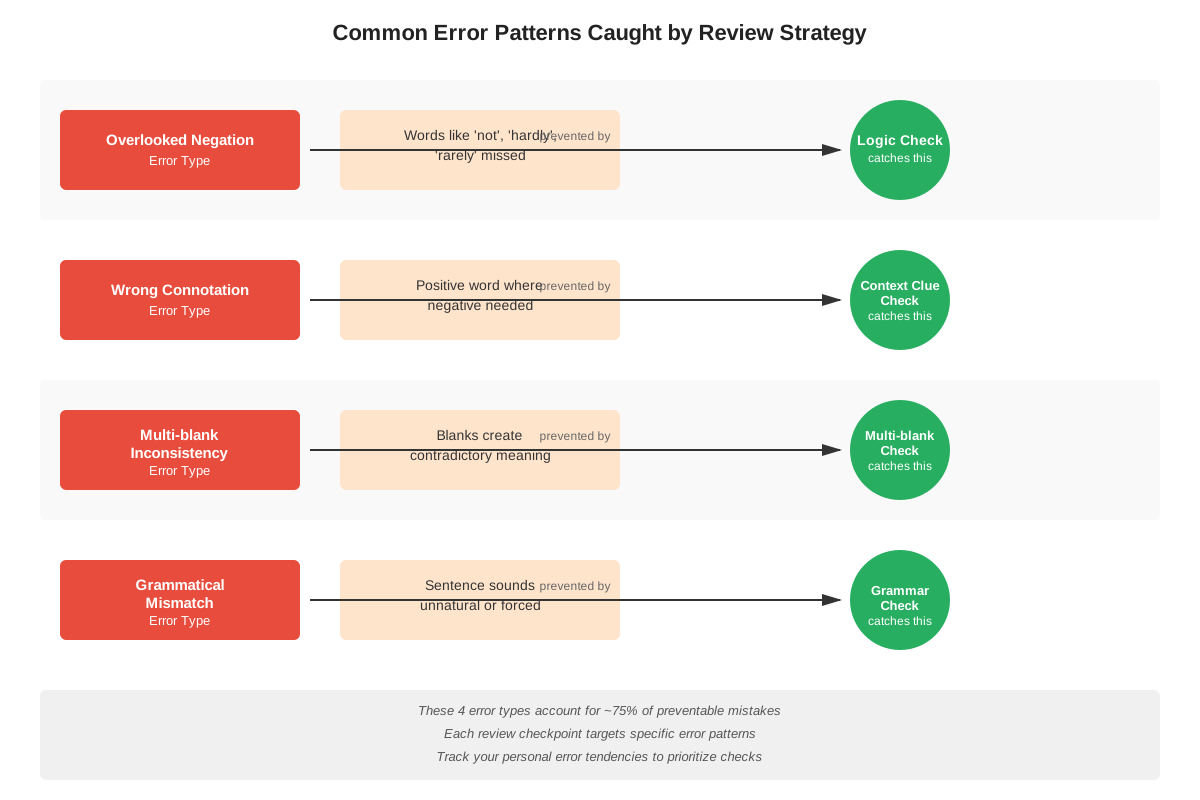
- [ ] Recognize common error patterns that review strategy helps catch
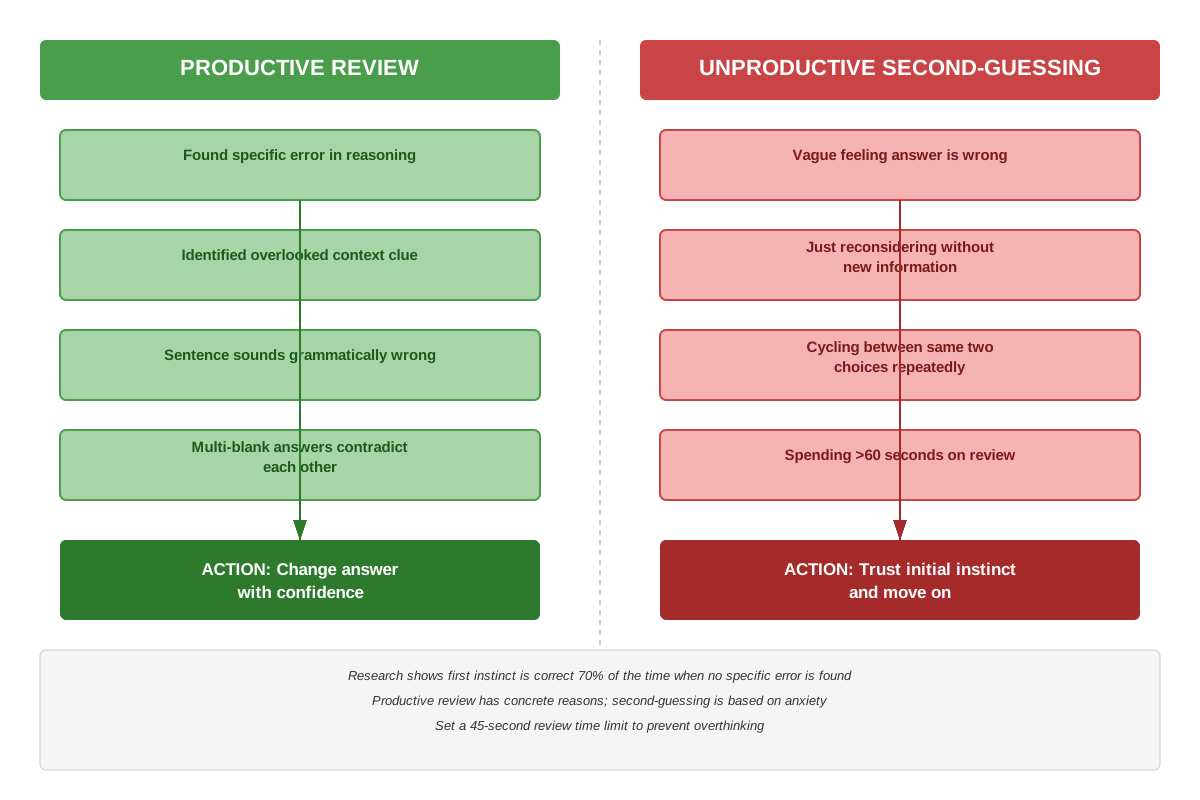
- [ ] Differentiate between productive review and time-wasting second-guessing
- [ ] Implement a prioritization system for which questions require deeper review
Prerequisites
- Basic Text Completion Strategy: Understanding how to identify context clues and predict answer choices is essential because review strategy builds upon initial problem-solving approaches
- Vocabulary Knowledge: Familiarity with GRE-level vocabulary enables accurate assessment of whether chosen words fit the context during review
- Logical Reasoning Skills: The ability to follow argument structure and causal relationships is necessary to verify that completed sentences maintain logical coherence
- Time Management Fundamentals: Awareness of pacing requirements ensures that review strategy can be implemented without compromising overall section timing
Why This Topic Matters
Text completion review strategy directly impacts test performance by serving as the final checkpoint before committing to an answer. Research on GRE performance patterns shows that approximately 30-40% of incorrect text completion answers result from errors that could have been caught through systematic review—not from vocabulary gaps or initial misunderstanding. These preventable errors include overlooking negative words, misreading sentence structure, selecting words with incorrect connotations, and failing to check multi-blank consistency.
On the GRE Verbal Reasoning section, text completion questions constitute approximately 50% of the scored questions (roughly 12 out of 27 questions per section). Each question carries equal weight, making every preventable error costly to the final score. The adaptive nature of the GRE means that catching errors through effective review can determine whether a test-taker receives a harder second section, directly influencing the maximum achievable score.
Text completion review strategy appears most critically in three scenarios: (1) multi-blank questions where internal consistency must be verified, (2) questions with subtle vocabulary distinctions where connotation matters, and (3) complex sentences where grammatical structure might obscure logical relationships. The strategy proves especially valuable when test-takers have eliminated some options but remain uncertain between final choices, providing a structured decision-making framework rather than relying on gut feeling.
Core Concepts
The Systematic Review Framework
The foundation of effective text completion review strategy rests on a structured, repeatable process that can be executed quickly under test conditions. This framework consists of five sequential steps that address the most common sources of error:
- Complete Re-read: Read the entire sentence with all selected answers inserted, treating it as if encountering it for the first time
- Logic Verification: Confirm that the sentence's meaning makes logical sense and that cause-effect relationships are preserved
- Tone and Register Check: Ensure that all selected words match the passage's formality level and emotional tone
- Grammar Audit: Verify subject-verb agreement, pronoun reference, and idiomatic correctness
- Context Clue Reconciliation: Confirm that each answer aligns with specific context clues identified during initial solving
This systematic approach prevents the most common review pitfall: vague re-reading that fails to catch specific error types. By following discrete steps, test-takers engage different cognitive processes that increase error detection rates.
Multi-Blank Consistency Verification
For questions with two or three blanks, internal consistency checking represents the highest-yield review activity. The GRE deliberately designs multi-blank questions where individual word choices might seem plausible in isolation but create logical contradictions when combined. The review strategy must therefore assess:
| Consistency Type | What to Check | Example Error |
|---|---|---|
| Logical Flow | Do the blanks work together to create a coherent argument? | Selecting "praised" for blank 1 and "criticism" for blank 2 when they should align |
| Parallel Structure | Do blanks in parallel positions require parallel meanings? | Using "innovative" and "traditional" when both should be positive or both negative |
| Degree Matching | Do intensity levels match across blanks? | Pairing "slightly" with "catastrophic" when degrees don't align |
| Temporal Consistency | Do verb tenses and time references align? | Mixing past and present inappropriately |
The review process for multi-blank questions should involve reading the sentence multiple times: once with all answers, then focusing on each blank individually while considering its relationship to other blanks.
Context Clue Reconciliation
During review, test-takers must explicitly reconnect each answer choice to the context clues that should have guided initial selection. This process involves:
- Identifying signal words: Confirming that transition words (however, moreover, although) are properly honored
- Checking contrast indicators: Verifying that words like "despite," "rather than," or "instead" are reflected in answer choices
- Validating support relationships: Ensuring that examples, explanations, or elaborations align with selected answers
- Confirming definitional clues: Checking that any definitions or restatements in the sentence match chosen words
A common error caught during this review step occurs when test-takers initially focus on one context clue while missing a contradictory clue elsewhere in the sentence. The systematic review forces attention to all clues.
Connotation and Register Verification
Beyond literal meaning, connotation checking during review ensures that selected words carry appropriate emotional valence and formality levels. The GRE frequently includes answer choices that are semantically similar but differ in:
- Emotional tone: Neutral vs. positive vs. negative (e.g., "frugal" vs. "miserly")
- Intensity: Mild vs. strong expressions (e.g., "concerned" vs. "alarmed")
- Formality: Academic vs. colloquial register (e.g., "residence" vs. "place")
- Precision: General vs. specific terms (e.g., "said" vs. "proclaimed")
During review, test-takers should ask: "Does this word's feeling match the passage's overall tone?" This question often reveals mismatches that weren't apparent during initial solving.
The Negative Word Audit
One of the most frequent errors in text completion involves overlooking negative words or negation structures. The review strategy must include a specific check for:
- Explicit negatives: not, no, never, neither, nor
- Implicit negatives: hardly, scarcely, rarely, seldom
- Negative prefixes: un-, in-, dis-, non-
- Negative constructions: "far from," "anything but," "failed to"
The review process should involve circling or mentally noting every negative element and confirming that answer choices reflect the correct polarity. A sentence with two negatives requires a positive answer; three negatives require a negative answer.
Time-Efficient Review Protocols
Effective GRE text completion review strategy must balance thoroughness with time constraints. The recommended time allocation is:
- Single-blank questions: 15-20 seconds for review
- Two-blank questions: 25-35 seconds for review
- Three-blank questions: 35-45 seconds for review
To achieve this efficiency, test-takers should develop automaticity in the review framework through practice. The goal is not to re-solve the question but to verify the existing solution through targeted checks.
Strategic Review Prioritization
Not all questions require equal review depth. Test-takers should implement a prioritization system based on:
- High priority (full systematic review): Questions where you were uncertain between two choices, multi-blank questions, questions with complex sentence structure
- Medium priority (quick verification): Questions where you felt confident but want to catch careless errors
- Low priority (minimal review): Questions where you were immediately certain and the answer clearly fits
This prioritization ensures that limited review time is allocated to questions where it provides maximum value.
Concept Relationships
The text completion review strategy integrates multiple foundational skills into a cohesive verification process. Context clue identification (prerequisite knowledge) → feeds into → context clue reconciliation (review step), ensuring that initial problem-solving insights are validated during review. Similarly, vocabulary knowledge → enables → connotation verification, as test-takers can only assess emotional tone if they understand subtle word meanings.
Within the review strategy itself, concepts follow a logical sequence: Complete re-read → establishes baseline → for logic verification, which then → informs → tone checking. The multi-blank consistency verification → depends on → all other review steps being completed first, as it synthesizes insights from logic, tone, and grammar checks.
The review strategy also connects forward to broader test-taking skills: systematic review framework → transfers to → Reading Comprehension answer verification and Sentence Equivalence checking. The time-efficient protocols developed for text completion → support → overall section time management, while strategic prioritization → exemplifies → adaptive test-taking that maximizes score potential.
High-Yield Facts
⭐ The systematic review framework should take 15-45 seconds depending on question complexity, not longer
⭐ Approximately 30-40% of text completion errors are preventable through proper review strategy
⭐ Multi-blank questions require explicit consistency checking across all blanks, not just individual verification
⭐ Negative words (not, hardly, scarcely) are the most commonly overlooked elements during initial solving
⭐ Connotation mismatches (choosing words with wrong emotional tone) account for 20-25% of errors on medium-difficulty questions
- Context clue reconciliation should explicitly connect each answer to specific words or phrases in the sentence
- Grammar errors in completed sentences often indicate wrong answer choices, even if meaning seems plausible
- Reading the completed sentence aloud (silently, in your mind) activates different error-detection mechanisms than visual scanning
- Questions where you hesitated between two choices deserve full systematic review, not quick verification
- The review process should feel like verification, not re-solving; if you're re-solving, your initial strategy needs improvement
- Parallel structure in sentences (lists, comparisons) requires parallel answer choices in meaning and grammatical form
- Formal academic passages require formal vocabulary choices; colloquial words are almost always incorrect
Quick check — test yourself on Text completion review strategy so far.
Try Flashcards →Common Misconceptions
Misconception: Review strategy means re-reading the question and answers multiple times until something "feels right"
Correction: Effective review follows a systematic framework with specific checks (logic, tone, grammar, context clues) rather than relying on intuition or vague re-reading
Misconception: If an answer seemed correct during initial solving, reviewing it wastes time
Correction: Systematic review catches errors that weren't apparent during initial solving, particularly overlooked negatives, connotation mismatches, and multi-blank inconsistencies; even confident answers benefit from quick verification
Misconception: Review strategy should focus on reconsidering eliminated answer choices to see if they might work
Correction: Review should verify that selected answers are correct through positive confirmation (checking logic, tone, grammar), not by second-guessing elimination decisions, which typically leads to changing correct answers to incorrect ones
Misconception: Multi-blank questions only need review if you're uncertain about one of the blanks
Correction: Multi-blank questions require consistency checking across all blanks even when individual choices seem certain, as the GRE designs these questions to have plausible individual choices that create logical contradictions when combined
Misconception: Grammar checking during review means looking for obvious errors like subject-verb disagreement
Correction: Grammar checking includes subtle issues like idiomatic correctness (preposition choice), pronoun reference clarity, and whether the sentence structure supports the intended meaning, not just basic grammatical rules
Misconception: Review strategy is only necessary for difficult questions
Correction: Careless errors occur across all difficulty levels; medium-difficulty questions often contain trap answers that seem correct without careful review, making systematic verification valuable regardless of perceived difficulty
Misconception: Spending more time on review always improves accuracy
Correction: Review exhibits diminishing returns beyond 45 seconds per question; excessive review leads to overthinking and changing correct answers, while also compromising time for other questions
Worked Examples
Example 1: Two-Blank Question with Consistency Check
Question: The scientist's methodology was ___(i)___ by her peers, who found her experimental design ___(ii)___ despite its unconventional approach.
Blank (i): A) criticized B) lauded C) ignored
Blank (ii): D) flawed E) rigorous F) confusing
Initial Solving: The word "despite" signals contrast. If the design was unconventional, peers might be expected to criticize it, but "despite" suggests they didn't. The second blank needs a positive word. Selected answers: B) lauded and E) rigorous.
Systematic Review Process:
- Complete Re-read: "The scientist's methodology was lauded by her peers, who found her experimental design rigorous despite its unconventional approach." This reads naturally.
- Logic Verification: The logic works: peers praised the methodology AND found the design rigorous, which makes sense together. The "despite" correctly contrasts "rigorous" with "unconventional"—the design was rigorous even though unconventional.
- Tone Check: Both "lauded" and "rigorous" are positive, formal academic terms appropriate for a science context. Tone is consistent.
- Grammar Audit: "Methodology was lauded" (passive voice, correct). "Found her design rigorous" (object complement structure, correct). No grammar issues.
- Context Clue Reconciliation: "Despite" is the key clue. It creates contrast between "unconventional" and "rigorous," not between the two blanks. Both blanks should be positive. ✓ Confirmed.
Multi-blank Consistency Check: Do "lauded" and "rigorous" work together logically? Yes—if peers found the design rigorous, they would praise (laud) the methodology. The blanks support each other.
Verification Result: Answers confirmed. Both blanks align with context clues, maintain consistent positive tone, and create logical coherence.
Example 2: Single-Blank Question with Negative Word Audit
Question: The politician's speech was anything but ___; rather than offering concrete solutions, she spoke only in vague generalities.
A) eloquent B) specific C) lengthy D) controversial E) impromptu
Initial Solving: The phrase "rather than offering concrete solutions" and "vague generalities" suggest the blank should mean something like "vague." Selected answer: B) specific.
Systematic Review Process:
- Complete Re-read: "The politician's speech was anything but specific; rather than offering concrete solutions, she spoke only in vague generalities." This reads well.
- Negative Word Audit: "Anything but" is a negative construction! This means the speech was NOT [blank]. If the speech was "anything but specific," it was vague/general. Check: The second part says she spoke in "vague generalities," which confirms the speech was not specific. ✓ Correct.
- Logic Verification: The structure is: "The speech was NOT specific; rather, it was vague." This creates proper contrast with "rather than." The logic flows correctly.
- Context Clue Reconciliation: "Rather than offering concrete solutions" = she didn't offer concrete solutions. "Vague generalities" = opposite of concrete/specific. The blank should be the opposite of vague (because of "anything but"), which is specific. ✓ Confirmed.
- Tone Check: "Specific" is neutral and formal, appropriate for political commentary.
Common Error Check: Would "eloquent" work? No—"anything but eloquent" would mean the speech was poorly delivered, but the passage criticizes content (vague vs. concrete), not delivery quality. This confirms "specific" is correct.
Verification Result: Answer confirmed. The negative construction "anything but" is properly accounted for, and "specific" correctly contrasts with "vague generalities."
Exam Strategy
Trigger Phrases for Review Priority
Certain question characteristics signal that systematic review will be especially valuable:
- High-priority triggers: "anything but," "hardly," "scarcely," "far from" (negative constructions); "although," "despite," "while" (contrast indicators); questions with three blanks; questions where you eliminated choices through connotation rather than meaning
- Medium-priority triggers: Two-blank questions; sentences with multiple clauses; questions where two answer choices seemed equally plausible
- Quick-verification triggers: Single-blank questions with clear context clues; questions where one answer was obviously correct
Process-of-Elimination During Review
Review strategy can incorporate targeted elimination to confirm answer choices:
- Polarity check: If the sentence requires a positive word, eliminate any selected negative words (and vice versa)
- Degree mismatch: If context clues suggest mild intensity, eliminate extreme words you may have selected
- Register violation: If the passage is formal academic prose, eliminate any colloquial or informal words
- Grammatical impossibility: If your selected word creates grammatical errors, it's definitely wrong
Exam Tip: If review reveals that your selected answer is definitely wrong but you're uncertain about the correct alternative, use the remaining time to make an educated guess among remaining choices rather than leaving the original wrong answer.
Time Allocation Decision Tree
Use this decision framework during the exam:
- If confident and sentence reads naturally: 10-15 second quick verification (re-read once, check for negatives)
- If uncertain between two choices: 30-40 second systematic review (full framework)
- If multi-blank question: 35-45 second review regardless of confidence (consistency checking required)
- If running low on time: Prioritize reviewing multi-blank questions and questions where you were uncertain; skip review on questions where you were immediately confident
Strategic Marking for Review
During initial solving, mark questions that will require deeper review:
- Mark for full review: Questions where you're uncertain, questions with complex negation, three-blank questions
- Mark for quick check: Questions where you're confident but want to verify
- No mark needed: Questions where you're certain and the answer clearly fits
This marking system enables efficient time use if you finish the section early and have time for additional review.
Memory Techniques
The CLANG Mnemonic for Review Steps
Context clues - Reconcile each answer with specific clues
Logic - Verify cause-effect and argument flow
Audit grammar - Check structure and idioms
Negatives - Circle and account for all negative words
General re-read - Read completed sentence naturally
This mnemonic provides a memorable sequence for the systematic review framework.
The "Traffic Light" Visualization
Visualize three colored lights for review prioritization:
- Red light (stop and review thoroughly): Multi-blank questions, uncertain choices, negative constructions
- Yellow light (proceed with caution): Two-blank questions, medium confidence
- Green light (quick verification): Single-blank, high confidence, clear context
This visual system helps make rapid prioritization decisions during the exam.
The "TONE" Acronym for Connotation Checking
Tone - Positive, negative, or neutral?
Originality - Formal or colloquial?
Nuance - Mild or intense?
Emotion - What feeling does it convey?
Use TONE to systematically assess whether word connotations match passage requirements.
The "Negative Detector" Habit
Train yourself to automatically circle these negative indicators whenever you see them:
- NOT family: not, no, never, nothing, nowhere, neither, nor
- HARDLY family: hardly, scarcely, barely, rarely, seldom
- NEGATIVE PREFIX family: un-, in-, im-, dis-, non-, a-
- NEGATIVE PHRASE family: anything but, far from, failed to, refused to
Making this a physical habit (actually circling them during practice) builds automaticity for the exam.
Summary
Text completion review strategy represents a systematic approach to verifying answers before finalizing them, serving as essential quality control that can improve accuracy by 15-20% on GRE Verbal Reasoning. The core framework involves five sequential steps: complete re-read, logic verification, tone and register checking, grammar audit, and context clue reconciliation. For multi-blank questions, an additional consistency check ensures that all blanks work together logically. The strategy specifically targets the most common error sources—overlooked negative words, connotation mismatches, and logical inconsistencies—through structured verification rather than vague re-reading. Effective implementation requires balancing thoroughness with time efficiency, allocating 15-45 seconds per question depending on complexity and confidence level. Strategic prioritization ensures that review time focuses on high-value questions: those with uncertainty, multiple blanks, or complex negation structures. By transforming review from an afterthought into a systematic process, test-takers can catch preventable errors and maximize their text completion performance.
Key Takeaways
- Systematic review following the five-step framework (re-read, logic, tone, grammar, context clues) catches 30-40% of preventable errors
- Multi-blank questions require explicit consistency checking across all blanks, not just individual verification
- Negative words and constructions (not, hardly, anything but) are the most commonly overlooked elements and deserve specific attention during review
- Effective review takes 15-45 seconds per question; longer review leads to overthinking and changing correct answers
- Prioritize review time for uncertain answers, multi-blank questions, and complex sentence structures rather than reviewing all questions equally
- Connotation checking (emotional tone, formality, intensity) often reveals errors that meaning-based analysis misses
- Review should verify existing answers through positive confirmation, not reconsider eliminated choices or second-guess initial reasoning
Related Topics
Sentence Equivalence Review Strategy: Builds on text completion review by adding the requirement to verify that two selected answers create equivalent meanings; mastering text completion review provides the foundation for this more complex verification process
Reading Comprehension Answer Verification: Applies similar systematic checking to longer passages, using evidence-based confirmation rather than intuition; the review framework transfers directly with modifications for passage-based questions
Advanced Context Clue Identification: Deepens the context clue reconciliation step of review by teaching recognition of subtle clues like tone shifts and implicit contrasts; stronger context clue skills make review more efficient
Vocabulary in Context: Enhances connotation checking ability by teaching nuanced word meanings and usage patterns; this knowledge enables more accurate assessment during the tone verification step
Time Management for Verbal Reasoning: Integrates review strategy into overall section pacing, teaching when to invest time in review versus moving forward; mastering review strategy is prerequisite to optimizing overall time allocation
Practice CTA
Now that you understand the systematic approach to text completion review strategy, it's time to build automaticity through deliberate practice. Access the practice questions to apply the five-step review framework to authentic GRE-style questions, focusing on catching the specific error types discussed in this guide. Use the flashcards to reinforce the CLANG mnemonic and review triggers until they become second nature. Remember: review strategy isn't about second-guessing yourself—it's about implementing a reliable verification system that catches errors your initial solving missed. With consistent practice, this systematic approach will become automatic, giving you confidence that every answer you select has been properly verified. Your investment in mastering review strategy will pay dividends across every text completion question you encounter on test day.
Sign up free to keep reading
Create a free AnvayaPrep account to finish this GRE guide on Text completion review strategy — plus flashcards and practice questions.