Overview
Addressing complexity is one of the most critical skills tested in the GRE Analytical Writing section, particularly within the "Analyze an Issue" task. This competency requires test-takers to demonstrate sophisticated thinking by acknowledging that most meaningful issues contain multiple perspectives, nuances, exceptions, and contextual factors that resist simple binary analysis. Rather than presenting a one-dimensional argument, successful GRE essays recognize the multifaceted nature of complex topics while still maintaining a clear, defensible position.
The ability to address complexity distinguishes high-scoring essays (5.0-6.0) from mediocre ones (3.0-4.0). When students fail to acknowledge counterarguments, alternative perspectives, or limiting conditions, their essays appear intellectually shallow and unconvincing to trained raters. Conversely, essays that thoughtfully explore complexity while maintaining argumentative coherence demonstrate the kind of critical thinking valued in graduate-level academic work. This skill directly correlates with success in graduate programs, where students must regularly analyze multifaceted problems without oversimplifying them.
Within the broader Analytical Writing framework, addressing complexity serves as the bridge between basic argumentation and sophisticated academic discourse. It builds upon fundamental skills like thesis development and evidence presentation while elevating the analysis to demonstrate intellectual maturity. This topic intersects with other essential Analytical Writing concepts including counterargument acknowledgment, qualification of claims, contextual analysis, and nuanced reasoning—all of which contribute to the holistic evaluation of critical thinking ability that the GRE measures.
Learning Objectives
- [ ] Identify when addressing complexity is being tested in GRE Analytical Writing prompts
- [ ] Explain the core rule or strategy behind addressing complexity in essay construction
- [ ] Apply addressing complexity to GRE-style questions accurately and effectively
- [ ] Distinguish between productive complexity (that strengthens arguments) and unfocused complexity (that weakens coherence)
- [ ] Construct paragraphs that acknowledge limitations, exceptions, or alternative perspectives while maintaining a clear position
- [ ] Evaluate sample essays to identify where complexity has been addressed successfully versus where it remains superficial
- [ ] Synthesize multiple perspectives into a unified argument that demonstrates intellectual sophistication
Prerequisites
- Basic essay structure: Understanding introduction, body paragraphs, and conclusion organization is essential because complexity must be integrated into a coherent framework rather than disrupting essay flow
- Thesis statement construction: The ability to articulate a clear position is necessary because addressing complexity requires maintaining that position while exploring nuances
- Evidence and reasoning: Familiarity with supporting claims through examples and logical reasoning provides the foundation upon which complex analysis builds
- Counterargument basics: Recognizing opposing viewpoints is the starting point for the more sophisticated complexity analysis required at higher score levels
Why This Topic Matters
In real-world academic and professional contexts, the ability to address complexity separates superficial thinkers from sophisticated analysts. Graduate programs require students to engage with research that rarely offers simple answers, and professional environments demand decision-making that accounts for multiple stakeholder perspectives, unintended consequences, and contextual variables. The GRE's emphasis on this skill reflects its predictive validity for graduate school success.
According to ETS data, addressing complexity appears as an explicit or implicit requirement in approximately 85-90% of "Analyze an Issue" prompts. The scoring rubric for scores of 5.0 and above specifically requires that essays "develop the position fully with compelling reasons and/or persuasive examples" while also demonstrating "insightful analysis." This insightful quality almost invariably involves recognizing complexity. Essays that score 6.0 consistently demonstrate "particularly insightful analysis" and "cogent examination of the issue's complexities."
Common manifestations in exam passages include prompts that ask test-takers to consider "the extent to which" a claim is valid (inviting discussion of conditions and limitations), prompts presenting absolute statements that beg for qualification, and prompts explicitly requesting consideration of "circumstances in which" a recommendation might or might not apply. The GRE addressing complexity requirement also appears when prompts ask about policy recommendations, educational philosophies, or societal values—all inherently multifaceted topics.
Core Concepts
What Constitutes Addressing Complexity
Addressing complexity in GRE Analytical Writing means explicitly acknowledging and thoughtfully exploring the multidimensional nature of an issue while maintaining a coherent argumentative position. This involves recognizing that most meaningful claims contain exceptions, depend on context, affect different groups differently, or require qualification to remain accurate. Complexity is not mere fence-sitting or indecisiveness; rather, it demonstrates intellectual maturity by showing that the writer understands an issue deeply enough to recognize its nuances.
The core components of addressing complexity include:
- Acknowledging limitations of one's own position
- Recognizing valid points in opposing perspectives
- Identifying contextual factors that influence the issue's validity
- Exploring exceptions to general rules or claims
- Considering multiple stakeholder perspectives
- Qualifying absolute statements with appropriate conditions
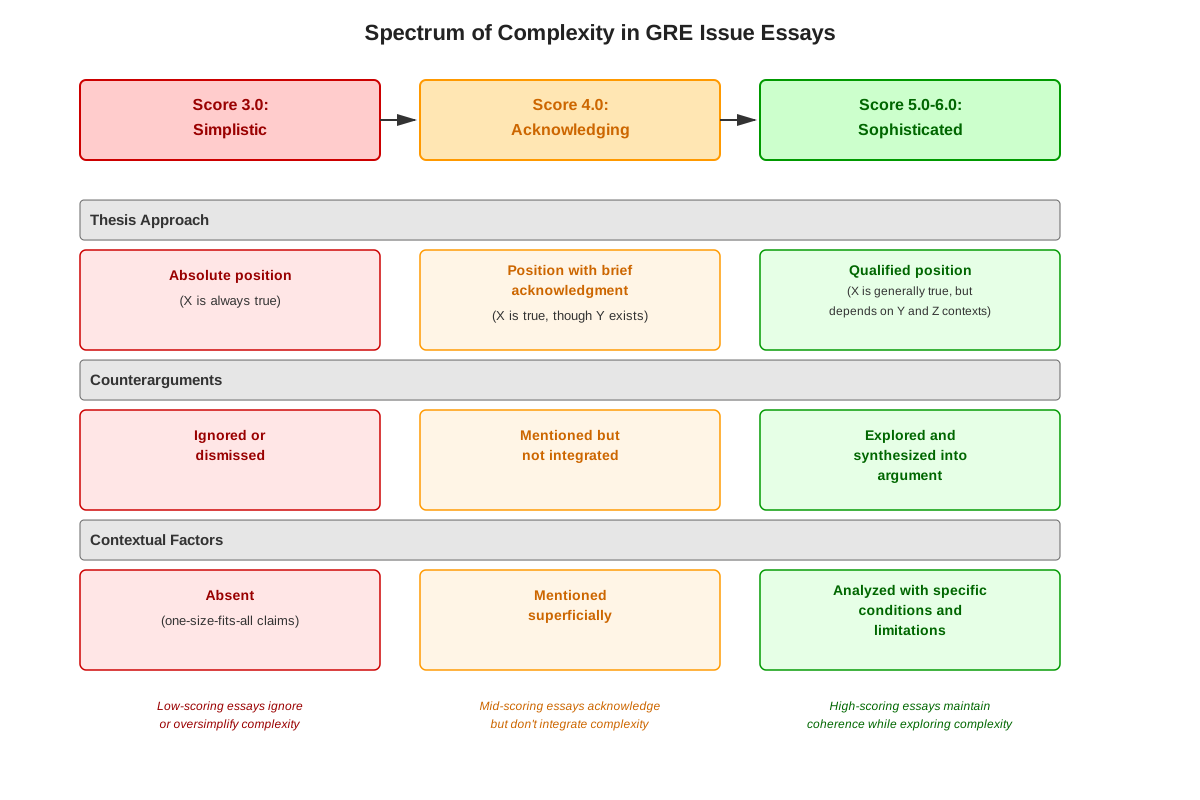
The Spectrum of Complexity in GRE Essays
Not all complexity is created equal. Understanding the spectrum helps writers target the level appropriate for high scores:
| Level | Characteristics | Typical Score Range |
|---|---|---|
| Absent | Binary thinking; no acknowledgment of nuance; treats issue as simple yes/no | 1.0-3.0 |
| Superficial | Brief mention of "other side" without development; token acknowledgment | 3.0-4.0 |
| Adequate | Discusses counterarguments or limitations in dedicated paragraph; shows awareness | 4.0-5.0 |
| Sophisticated | Integrates complexity throughout; uses it to strengthen position; demonstrates insight | 5.0-6.0 |
Strategic Placement of Complexity
Effective essays integrate complexity strategically rather than relegating it to a single paragraph. Three primary placement strategies exist:
Integrated approach: Weave acknowledgment of complexity into each body paragraph by discussing both strengths and limitations of each supporting point. This demonstrates continuous sophisticated thinking.
Dedicated complexity paragraph: Include one substantial paragraph (typically the second or third body paragraph) that explores counterarguments, exceptions, or alternative perspectives before explaining why the thesis position remains strongest.
Bookend strategy: Address complexity both in the introduction (by framing the issue as nuanced) and in the conclusion (by synthesizing how the position accounts for various perspectives).
Complexity Versus Contradiction
A critical distinction exists between productive complexity and self-contradictory writing. Productive complexity acknowledges nuances while maintaining a clear position: "While technology generally improves education, its effectiveness depends heavily on implementation quality and student socioeconomic context." Contradictory writing undermines its own thesis: "Technology improves education. However, technology harms education."
The key difference lies in synthesis. Sophisticated complexity writing synthesizes multiple perspectives into a coherent position that accounts for nuance. It uses transitional language like "however," "although," "in certain contexts," and "depending on" to signal qualification rather than contradiction.
Types of Complexity in GRE Prompts
Different prompt types invite different complexity approaches:
Absolute claim prompts ("The best way to teach is...") invite qualification by identifying contexts where the claim holds versus where it doesn't.
Policy recommendation prompts ("Governments should...") invite consideration of implementation challenges, unintended consequences, and varying circumstances.
Value judgment prompts ("Success is defined by...") invite exploration of multiple valid definitions and perspectives.
Comparative prompts ("X is more important than Y") invite discussion of contexts where each takes priority.
The Complexity-Coherence Balance
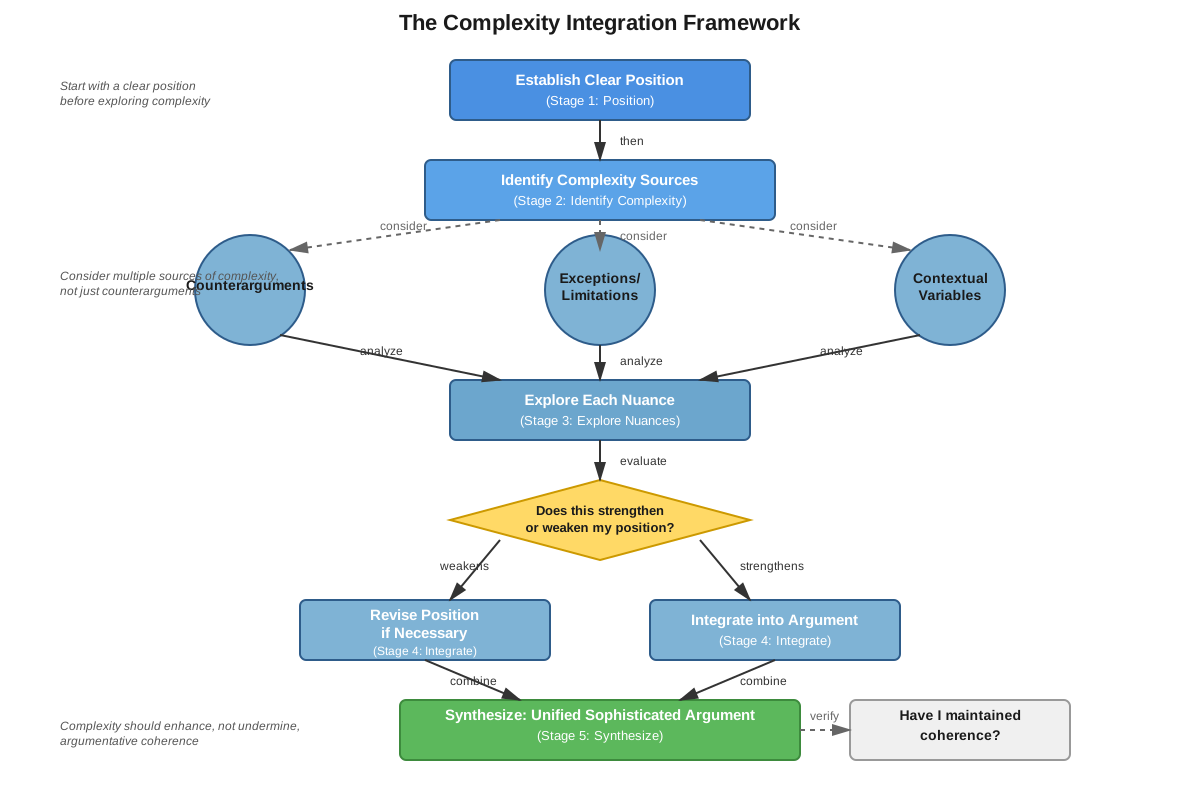
The most challenging aspect of addressing complexity is maintaining coherence. Essays must explore nuance without becoming unfocused or wishy-washy. This requires:
- Clear thesis statement that establishes the primary position
- Consistent return to that thesis after exploring complexity
- Explicit synthesis showing how complexity strengthens rather than undermines the position
- Transitional language that signals the relationship between main argument and qualifying points
Concept Relationships
The concepts within addressing complexity form an interconnected system. Acknowledging limitations and recognizing opposing perspectives both feed into qualifying absolute statements, as writers cannot appropriately qualify claims without understanding their boundaries and alternatives. Identifying contextual factors enables exploring exceptions, since exceptions typically arise from specific contextual conditions. All of these elements support the overarching goal of maintaining coherence while demonstrating nuance.
Addressing complexity connects directly to prerequisite topics: thesis statement construction provides the anchor position that complexity explores without abandoning, while counterargument basics offers the foundational skill that complexity analysis extends and deepens. Evidence and reasoning supplies the material that complexity analysis examines for limitations and contextual dependencies.
The relationship map flows as follows:
Clear Thesis → Enables → Exploration of Nuance → Requires → Acknowledgment of Limitations → Leads to → Qualification of Claims → Strengthens → Overall Argument → Demonstrates → Intellectual Sophistication → Results in → Higher Scores
This topic also connects forward to advanced Analytical Writing skills like rhetorical analysis, assumption identification, and logical reasoning evaluation—all of which require recognizing complexity in arguments.
High-Yield Facts
⭐ Essays scoring 5.0 or higher consistently address complexity explicitly, while essays below 4.0 typically present one-dimensional arguments
⭐ The most effective placement for complexity is integrated throughout the essay rather than isolated in a single paragraph
⭐ Acknowledging limitations of your own position strengthens rather than weakens your argument by demonstrating intellectual honesty
⭐ Prompts containing words like "extent," "circumstances," or "always/never" explicitly invite complexity analysis
⭐ Sophisticated complexity includes explaining WHY exceptions exist or WHY context matters, not just noting that they do
- Addressing complexity requires approximately 20-30% of essay content to achieve optimal balance with position development
- The phrase "it depends" signals complexity thinking but must be followed by explanation of what it depends on and why
- Effective complexity paragraphs use transitional phrases like "admittedly," "granted," "in certain contexts," and "under specific conditions"
- Complexity can be demonstrated through examples that show varying outcomes in different scenarios
- The conclusion should synthesize how the thesis accounts for the complexity discussed, not simply restate the thesis
- Raters specifically look for "insightful analysis" and "cogent examination of complexities" in the 5.0-6.0 score range
- Addressing complexity without maintaining a clear position results in lower scores for lack of coherence
- The most common error is mentioning complexity superficially without developing the analysis
- Time management should allocate 5-7 minutes specifically to planning how complexity will be addressed
- Complexity analysis often distinguishes between ideal conditions and real-world constraints
Quick check — test yourself on Addressing complexity so far.
Try Flashcards →Common Misconceptions
Misconception: Addressing complexity means being indecisive or not taking a clear position → Correction: Sophisticated complexity analysis maintains a clear thesis while acknowledging that the issue contains nuances, exceptions, or contextual dependencies. The position remains firm; the analysis simply demonstrates awareness that the issue is multifaceted.
Misconception: A single sentence acknowledging "some people disagree" is sufficient complexity → Correction: Superficial acknowledgment without development scores poorly. Effective complexity requires explaining the alternative perspective, why it has merit, and how your position accounts for or outweighs those concerns—typically requiring 3-5 sentences minimum.
Misconception: Addressing complexity should always occupy a separate "counterargument paragraph" → Correction: While a dedicated paragraph is one valid approach, the highest-scoring essays often integrate complexity throughout, showing sophisticated thinking in each body paragraph rather than compartmentalizing nuance.
Misconception: More complexity always leads to higher scores → Correction: Excessive complexity that undermines coherence or makes the essay unfocused reduces scores. The goal is balanced sophistication—enough complexity to demonstrate insight without sacrificing clarity of position.
Misconception: Complexity means presenting both sides equally → Correction: The essay must still advocate for a position. Complexity involves acknowledging other perspectives while explaining why the chosen position is stronger, more applicable, or better supported—not treating all views as equally valid.
Misconception: Only certain prompts require addressing complexity → Correction: Virtually all GRE "Analyze an Issue" prompts benefit from complexity analysis. Even prompts that don't explicitly request it reward essays that demonstrate nuanced thinking, as this is a core component of the scoring rubric's "insightful analysis" criterion.
Worked Examples
Example 1: Technology in Education Prompt
Prompt: "The best way to improve education is to increase access to technology in classrooms. Write a response discussing the extent to which you agree or disagree with this statement."
Analysis Process:
First, identify that "the best way" and "extent to which" signal explicit complexity requirements. The prompt invites discussion of conditions, limitations, and alternative factors.
Thesis with complexity: "While increased technology access can significantly enhance educational outcomes, its effectiveness depends critically on teacher training, curriculum integration, and student socioeconomic context, suggesting that technology alone cannot constitute 'the best' improvement strategy."
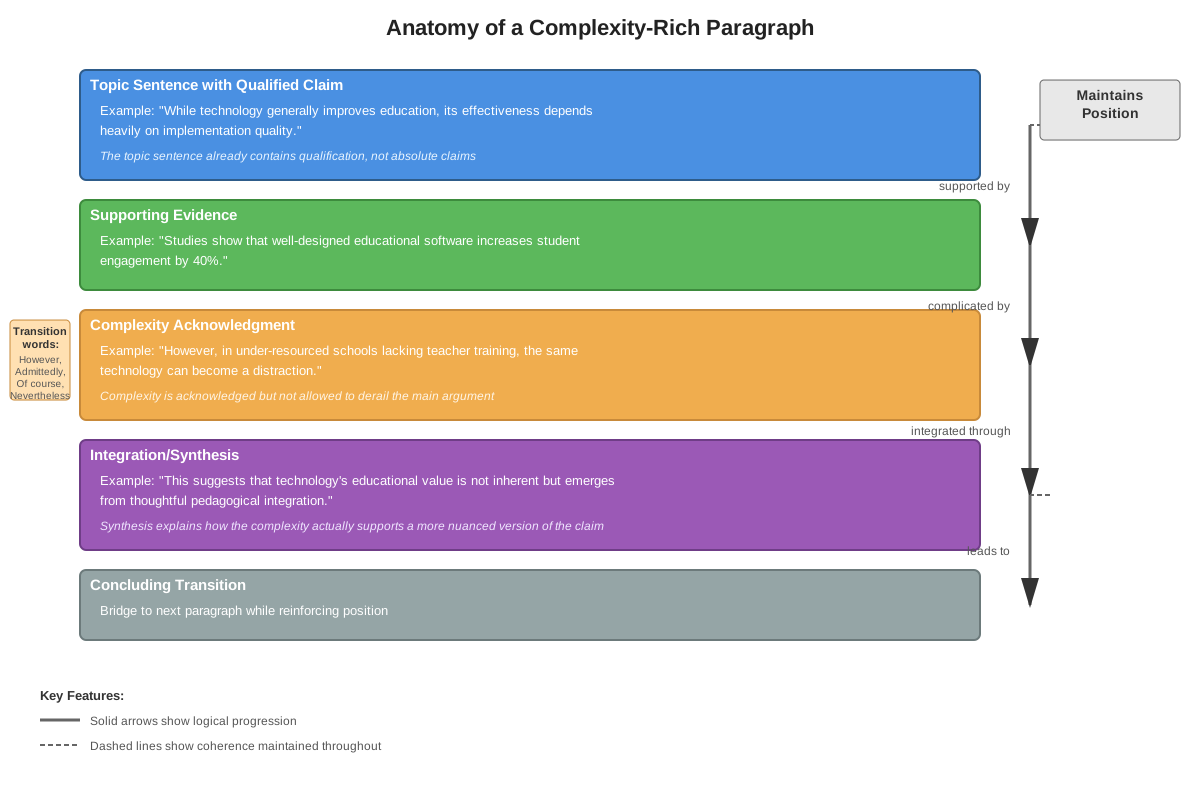
Body paragraph demonstrating integrated complexity:
"Technology undeniably offers powerful educational tools, from interactive simulations that make abstract concepts tangible to online resources that democratize access to information. In well-resourced schools where teachers receive adequate training, technology integration has produced measurable improvements in student engagement and learning outcomes. However, the effectiveness of this technology depends heavily on implementation quality. Schools that simply purchase devices without investing in professional development often see minimal educational gains, as teachers default to using expensive equipment for tasks that could be accomplished with traditional methods. Moreover, in low-income districts where students lack reliable internet access at home, classroom technology may actually exacerbate educational inequality by creating homework assignments that disadvantaged students cannot complete. This contextual dependency suggests that technology access, while valuable, functions as an educational multiplier rather than a standalone solution—amplifying good teaching but unable to compensate for inadequate instruction or systemic resource gaps."
Why this works: This paragraph maintains a clear position (technology is valuable) while exploring multiple dimensions of complexity: implementation quality, teacher preparation, socioeconomic context, and the distinction between technology as tool versus solution. It uses specific examples and explains WHY these factors matter rather than simply listing them.
Example 2: Competition Versus Cooperation Prompt
Prompt: "Competition is more important than cooperation in preparing students for success in the modern world."
Analysis Process:
The absolute comparative claim ("more important than") invites qualification by identifying contexts where each takes priority.
Thesis addressing complexity: "While competition develops certain valuable skills like resilience and performance under pressure, the modern workplace's emphasis on collaborative problem-solving and interdisciplinary teamwork suggests that cooperation deserves at least equal emphasis in educational settings, with the optimal balance varying by developmental stage and subject area."
Complexity paragraph structure:
"Admittedly, competition offers genuine educational benefits that cooperation alone cannot provide. Competitive environments teach students to perform under pressure, develop individual accountability, and strive for excellence—skills that remain relevant in contexts from graduate school admissions to entrepreneurship. Athletic competitions, academic contests, and performance-based assessments all leverage competitive motivation to drive achievement. However, this perspective overlooks how fundamentally modern professional environments have shifted toward collaborative models. Contemporary workplaces increasingly organize around cross-functional teams, where success depends on communication, compromise, and collective problem-solving rather than individual dominance. The most significant innovations—from medical breakthroughs to technological advances—emerge from collaborative research teams rather than isolated competitors. Furthermore, the optimal balance between competition and cooperation varies by context: elementary students benefit from cooperative learning that builds social skills and reduces anxiety, while older students can productively engage with more competitive structures once foundational collaborative abilities are established. Subject areas also matter; scientific inquiry and creative projects often benefit from cooperation, while certain skill assessments require individual demonstration. This contextual variability suggests that rather than prioritizing one approach universally, educational systems should strategically employ both competition and cooperation based on developmental appropriateness and learning objectives."
Why this works: This example acknowledges genuine merits of the opposing view (competition), provides specific reasoning for the alternative position (cooperation), identifies multiple contextual factors (age, subject area, workplace trends), and synthesizes these elements into a nuanced position that avoids false binary thinking.
Exam Strategy
Identifying Complexity Triggers in Prompts
Watch for these high-yield trigger words and phrases that explicitly signal complexity requirements:
- "To what extent..."
- "Under what circumstances..."
- "Always, never, all, none" (absolute terms inviting qualification)
- "The best way..." or "The most important..." (superlatives inviting comparison)
- "Should [policy recommendation]" (inviting discussion of implementation and consequences)
When these appear, allocate extra planning time to mapping out complexity dimensions.
The 3-Minute Complexity Planning Protocol
During the initial planning phase:
- Identify your position (30 seconds): Decide your thesis clearly
- List limitations (60 seconds): What are 2-3 limitations, exceptions, or contexts where your position doesn't fully apply?
- Consider alternatives (60 seconds): What's the strongest opposing perspective and why does it have merit?
- Plan synthesis (30 seconds): How will you acknowledge these complexities while maintaining your position?
This structured approach ensures complexity is planned rather than awkwardly inserted during drafting.
Integration Versus Isolation Decision
Choose your complexity strategy based on time and confidence:
If you have strong command of the topic (25+ minutes remaining after planning): Use the integrated approach, weaving complexity into each body paragraph.
If time is tighter (20-25 minutes remaining): Use a dedicated complexity paragraph as your second or third body paragraph.
If very pressed for time (under 20 minutes): Ensure at least one substantial paragraph addresses complexity, and include qualifying language in your thesis and conclusion.
Process of Elimination for Complexity
When evaluating whether you've addressed complexity sufficiently, check for these markers:
- ✓ Have you used qualifying language ("often," "typically," "in many cases") rather than only absolutes?
- ✓ Have you explained WHY context matters, not just that it does?
- ✓ Have you acknowledged at least one limitation of your position?
- ✓ Have you explained why your position remains strongest despite complexity?
- ✓ Does your conclusion synthesize the complexity rather than ignoring it?
If any answer is "no," revise before concluding.
Time Allocation
In a 30-minute essay:
- 3 minutes: Planning (including complexity mapping)
- 20 minutes: Drafting (with 5-7 minutes on complexity development)
- 5 minutes: Revision (checking complexity-coherence balance)
- 2 minutes: Proofreading
Memory Techniques
The SCALE Acronym for Complexity Dimensions
Stakeholders: Who is affected differently?
Context: What circumstances change the outcome?
Alternatives: What other perspectives exist?
Limitations: What are the boundaries of this claim?
Exceptions: When doesn't this apply?
When planning complexity, run through SCALE to identify at least 2-3 dimensions to explore.
The "Yes, But, So" Framework
Structure complexity paragraphs using this three-part pattern:
Yes: Acknowledge the merit in an alternative view or limitation
But: Explain why your position still holds or matters more
So: Synthesize what this means for your overall argument
Example: "Yes, competition builds resilience. But cooperation develops equally crucial teamwork skills. So, both deserve emphasis rather than prioritizing one universally."
Visualization: The Complexity Sandwich
Picture your essay as a sandwich:
- Top bun: Thesis with qualifying language
- Filling: Body paragraphs with complexity integrated or dedicated complexity paragraph
- Bottom bun: Conclusion that synthesizes complexity
This image reminds you that complexity should appear at multiple points, not just in the middle.
The "Depends On" Trigger
Whenever you write a claim, mentally ask: "Does this depend on anything?" If yes, you've found a complexity opportunity. This automatic questioning habit builds sophisticated thinking into your drafting process.
Summary
Addressing complexity in GRE Analytical Writing requires demonstrating sophisticated thinking by acknowledging the multifaceted nature of issues while maintaining a clear, defensible position. This skill distinguishes high-scoring essays (5.0-6.0) from lower-scoring ones by showing intellectual maturity and nuanced analysis. Effective complexity involves recognizing limitations, considering alternative perspectives, identifying contextual factors, and exploring exceptions—all while synthesizing these elements into a coherent argument. The key is balance: enough complexity to demonstrate insight without sacrificing clarity or coherence. Strategic placement matters, with the highest-scoring essays typically integrating complexity throughout rather than isolating it. Prompts containing words like "extent," "circumstances," or absolute terms explicitly invite this analysis, though virtually all GRE prompts reward nuanced thinking. Success requires planning complexity during the initial brainstorming phase, using qualifying language appropriately, developing rather than merely mentioning alternative perspectives, and synthesizing how the thesis accounts for complexity in the conclusion.
Key Takeaways
- Addressing complexity is essential for scores of 5.0 and above, appearing in the scoring rubric's requirement for "insightful analysis"
- Effective complexity maintains a clear position while acknowledging nuances, limitations, and contextual factors—it is not indecisiveness
- The highest-scoring essays integrate complexity throughout rather than relegating it to a single paragraph
- Prompts with "extent," "circumstances," or absolute terms explicitly signal complexity requirements, but all prompts benefit from nuanced analysis
- Complexity must be developed with explanation of WHY exceptions exist or WHY context matters, not just superficial acknowledgment
- The complexity-coherence balance is critical: essays must explore nuance without becoming unfocused or contradictory
- Strategic planning using frameworks like SCALE or "Yes, But, So" ensures complexity is thoughtfully integrated rather than awkwardly inserted
Related Topics
Counterargument Development: While addressing complexity includes counterarguments, this related topic focuses specifically on anticipating and refuting opposing positions, providing deeper strategies for engaging with alternative perspectives.
Thesis Qualification and Hedging: This advanced topic explores the linguistic techniques for appropriately qualifying claims without appearing uncertain, building directly on the complexity foundation.
Contextual Analysis in Argument Evaluation: The "Analyze an Argument" task requires identifying how context affects argument validity, applying complexity thinking to critique rather than position development.
Evidence Evaluation and Sufficiency: Understanding when evidence is sufficient versus when it requires qualification connects to complexity by helping writers recognize the limitations of their supporting examples.
Mastering addressing complexity provides the foundation for these advanced analytical writing skills, as all require recognizing that issues resist simple binary analysis.
Practice CTA
Now that you understand the principles and strategies for addressing complexity in GRE Analytical Writing, it's time to apply these concepts to actual practice questions. Work through the practice prompts, focusing specifically on identifying complexity triggers, planning your complexity approach using the SCALE framework, and integrating nuanced analysis while maintaining a clear position. Review the flashcards to reinforce the key distinctions between productive complexity and contradictory writing. Remember: sophisticated complexity analysis is what transforms a good essay into an excellent one. Your investment in mastering this skill will directly translate to higher scores and stronger graduate-level writing. You've got this!
Sign up free to keep reading
Create a free AnvayaPrep account to finish this GRE guide on Addressing complexity — plus flashcards and practice questions.