Overview
The nuanced argument represents one of the most sophisticated and highly-valued skills tested in the GRE Analytical Writing section, particularly within the "Analyze an Issue" task. Rather than presenting a simplistic, one-sided position on a complex topic, a nuanced argument demonstrates intellectual maturity by acknowledging multiple perspectives, recognizing legitimate counterpoints, and articulating a thoughtful position that accounts for complexity and context. This approach moves beyond binary thinking to embrace the gray areas that characterize most real-world issues, showing evaluators that the test-taker can engage with ideas at an advanced academic level.
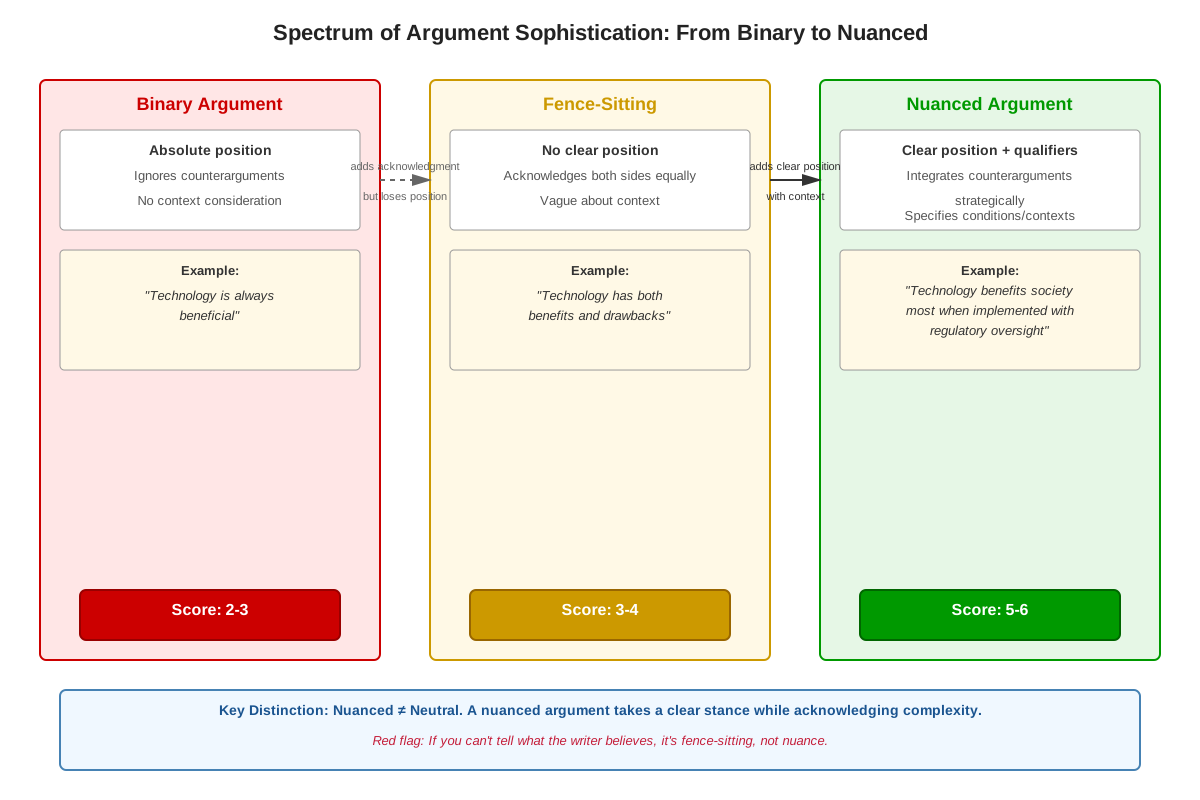
Understanding how to construct a GRE nuanced argument is essential because the scoring rubric explicitly rewards essays that "develop a position on the issue with insightful reasons and/or persuasive examples" while considering "complexities and implications." Essays that score in the highest ranges (5-6) consistently demonstrate nuanced thinking, while those that present oversimplified or one-dimensional arguments rarely exceed a score of 3-4. The ability to craft nuanced arguments directly correlates with higher scores because it signals critical thinking skills that graduate programs value highly.
Within the broader Analytical Writing framework, nuanced argumentation serves as the bridge between basic thesis development and sophisticated academic discourse. It builds upon fundamental skills like identifying claims and supporting evidence, while preparing students for the kind of balanced, context-sensitive analysis expected in graduate-level coursework. This topic connects directly to other Analytical Writing concepts such as counterargument acknowledgment, conditional reasoning, and evidence evaluation—all of which contribute to creating essays that demonstrate intellectual depth rather than superficial treatment of complex issues.
Learning Objectives
- [ ] Identify when Nuanced argument is being tested in GRE prompts and scoring criteria
- [ ] Explain the core rule or strategy behind Nuanced argument construction
- [ ] Apply Nuanced argument techniques to GRE-style questions accurately
- [ ] Distinguish between genuinely nuanced positions and weak, fence-sitting arguments
- [ ] Construct qualifying statements that strengthen rather than weaken an argument
- [ ] Integrate counterarguments effectively while maintaining a clear position
- [ ] Evaluate the appropriate degree of nuance for different types of issue prompts
Prerequisites
- Basic essay structure: Understanding introduction, body paragraphs, and conclusion organization is necessary because nuanced arguments must be presented within a coherent framework.
- Thesis statement construction: The ability to articulate a clear position is essential because nuance refines rather than replaces a central claim.
- Evidence identification and evaluation: Recognizing different types of support is relevant because nuanced arguments require weighing multiple forms of evidence.
- Logical reasoning fundamentals: Understanding basic argument structure matters because nuance involves sophisticated manipulation of logical relationships.
Why This Topic Matters
In professional and academic contexts, the ability to construct nuanced arguments distinguishes competent thinkers from exceptional ones. Graduate programs seek students who can navigate complex issues without resorting to oversimplification, recognize when context matters, and articulate positions that account for legitimate competing concerns. These skills prove essential in research, policy analysis, ethical decision-making, and any field requiring sophisticated judgment.
On the GRE specifically, nuanced argumentation appears in virtually every "Analyze an Issue" prompt, making it one of the highest-frequency skills tested. The scoring rubric for scores of 5 and 6 explicitly references the ability to "develop a position on the issue with insightful reasons" and "convey ideas fluently and precisely, using effective vocabulary and sentence variety." Approximately 85-90% of high-scoring essays (5-6 range) demonstrate clear nuance, while only 10-15% of essays scoring 3 or below show this sophistication. The ETS scoring guide emphasizes that top essays "thoughtfully consider the complexities and implications of the issue," making nuanced argumentation not just helpful but essential for competitive scores.
This topic commonly appears through prompts that present seemingly absolute claims ("All students should...," "The best way to...," "Society must always...") that invite test-takers to either blindly agree, disagree, or—more sophisticatedly—identify conditions, contexts, or qualifications that affect the validity of the claim. Other common manifestations include prompts presenting two competing values (innovation vs. tradition, individual freedom vs. collective good) where nuanced responses explore how both values matter in different contexts or can be balanced.
Core Concepts
Defining Nuanced Argumentation
A nuanced argument is a position that acknowledges complexity, recognizes legitimate competing perspectives, and articulates conditions or contexts that affect the validity of claims. Unlike simplistic arguments that treat issues as binary (completely right or completely wrong), nuanced arguments demonstrate intellectual sophistication by identifying when, where, how, or to what extent a claim holds true. The key distinction lies in maintaining a clear position while simultaneously recognizing that absolute statements rarely capture the full truth of complex issues.
Nuanced argumentation does not mean being indecisive or "sitting on the fence." Rather, it means taking a definitive stance while demonstrating awareness of the issue's complexity. For example, instead of arguing "Technology always improves education" or "Technology never improves education," a nuanced position might be: "Technology significantly enhances education when implemented with clear pedagogical goals and adequate teacher training, though it can prove counterproductive when adopted merely for its novelty or without addressing equity concerns."
Components of Effective Nuance
Effective nuanced arguments contain several essential components that work together to demonstrate sophisticated thinking:
| Component | Function | Example Language |
|---|---|---|
| Qualifying language | Indicates conditions or limitations | "In most cases," "typically," "when properly implemented," "under certain conditions" |
| Contextual awareness | Shows understanding that circumstances matter | "In developed nations," "for younger students," "in emergency situations," "depending on the field" |
| Counterargument acknowledgment | Recognizes legitimate opposing views | "While critics correctly note that...," "Although some argue...," "Despite valid concerns about..." |
| Degree specification | Indicates extent rather than absolutes | "Significantly," "moderately," "to some extent," "primarily," "partially" |
| Conditional reasoning | Establishes when claims apply | "If X, then Y," "provided that," "assuming," "in cases where" |
The Spectrum of Nuance
Understanding where an argument falls on the nuance spectrum helps test-takers calibrate their responses appropriately:
Oversimplified (Score 1-3): "Standardized testing is bad and should be eliminated." This position ignores any potential benefits, contexts where testing might be useful, or practical considerations.
Moderately Nuanced (Score 4): "While standardized testing has some benefits for comparing student performance, it also has significant drawbacks including teaching to the test and increased student stress. Overall, the negatives outweigh the positives." This acknowledges both sides but doesn't explore conditions or contexts deeply.
Highly Nuanced (Score 5-6): "Standardized testing serves valuable functions in providing comparable data across diverse educational contexts and identifying achievement gaps requiring intervention. However, its utility depends critically on how results are used—as one data point among many rather than the sole determinant of student or school quality—and on ensuring tests are culturally fair and aligned with meaningful learning objectives. In contexts where high-stakes consequences are attached to single test scores, the negative effects of narrowed curriculum and test anxiety can outweigh benefits, whereas low-stakes diagnostic testing can inform instruction without these drawbacks." This position takes a clear stance while exploring multiple dimensions of the issue.
Strategies for Developing Nuance
Strategy 1: The "Yes, but..." Approach
Begin by acknowledging the validity of a claim or perspective, then introduce important qualifications, limitations, or conditions. This demonstrates intellectual generosity while maintaining critical thinking. Example: "Yes, competition can drive innovation and efficiency, but unregulated competition in essential services like healthcare can lead to inequitable access and prioritization of profit over patient welfare."
Strategy 2: The Contextual Framework
Identify specific contexts, situations, or conditions where different positions hold varying degrees of validity. This shows understanding that few claims are universally true or false. Example: "In stable, well-resourced organizations, incremental change allows for careful implementation and stakeholder buy-in, whereas organizations facing existential threats or rapidly changing markets may require more radical transformation."
Strategy 3: The Balanced Synthesis
Rather than simply listing pros and cons, integrate competing considerations into a coherent position that honors multiple values or goals. Example: "Effective education policy must balance the need for accountability and measurable outcomes with recognition that the most important learning outcomes—critical thinking, creativity, ethical reasoning—resist simple quantification."
Strategy 4: The Degree Specification
Instead of absolute agreement or disagreement, specify the extent to which you support a claim and what factors affect that degree. Example: "I largely agree that practical experience is essential for professional development, though the optimal balance between theoretical knowledge and hands-on practice varies significantly across fields—with medicine requiring extensive supervised practice before independent work, while fields like theoretical mathematics may prioritize conceptual understanding."
Common Pitfalls in Attempting Nuance
False Balance: Treating all perspectives as equally valid when evidence clearly favors one position represents pseudo-nuance rather than genuine sophistication. Nuanced arguments can and should take clear positions when warranted by evidence.
Excessive Hedging: Overusing qualifying language ("might," "could," "possibly," "perhaps") can make arguments appear weak or indecisive. Effective nuance uses qualifiers strategically, not constantly.
Losing Your Position: In attempting to acknowledge multiple perspectives, some writers fail to articulate their own clear stance. Nuanced arguments must still have a discernible thesis that guides the essay.
Superficial Acknowledgment: Simply mentioning a counterargument without genuinely engaging with it ("Some people disagree, but they are wrong") fails to demonstrate nuanced thinking. Effective nuance requires substantive engagement with competing perspectives.
Concept Relationships
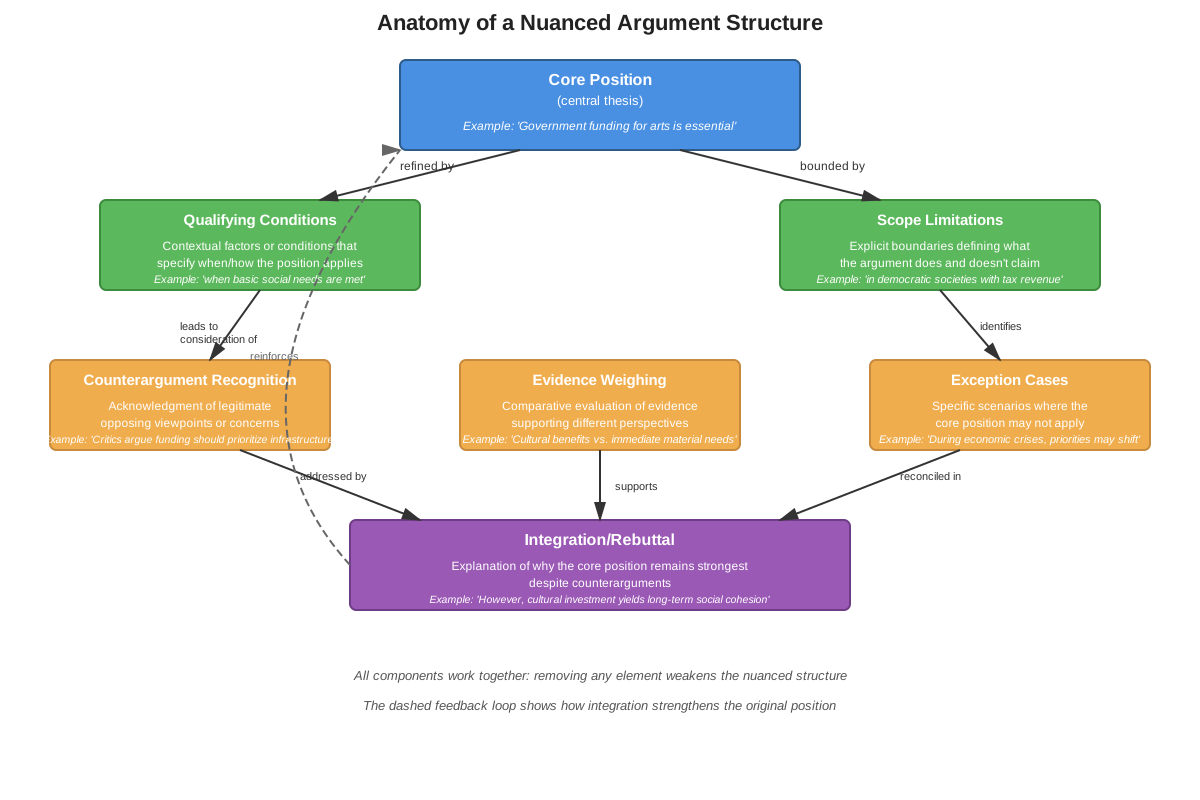
The concepts within nuanced argumentation form an interconnected system where each element reinforces the others. Qualifying language enables contextual awareness by providing the linguistic tools to specify when and where claims apply. Counterargument acknowledgment naturally leads to conditional reasoning as writers explore under what conditions different perspectives hold validity. Degree specification works in tandem with all other components, allowing writers to indicate not just whether they agree or disagree, but to what extent and under what circumstances.
This topic builds directly on prerequisite knowledge of basic argument structure: the thesis statement becomes more sophisticated through nuance, body paragraphs incorporate counterargument acknowledgment, and evidence evaluation becomes more complex as writers must weigh competing considerations. The relationship flows as: Basic thesis → Qualified thesis → Contextually-aware position → Fully nuanced argument.
Nuanced argumentation also connects forward to related topics in Analytical Writing. It provides the foundation for the "Analyze an Argument" task, where identifying unstated assumptions and recognizing conditions that would strengthen or weaken arguments requires similar sophisticated thinking. The relationship map looks like:
Thesis Development → Nuanced Argumentation → Counterargument Integration → Sophisticated Academic Writing
Additionally: Evidence Evaluation ↔ Nuanced Argumentation ↔ Conditional Reasoning (bidirectional relationships where each skill enhances the others)
High-Yield Facts
⭐ Essays scoring 5-6 on the GRE consistently demonstrate nuanced thinking by acknowledging complexity and considering multiple perspectives while maintaining a clear position.
⭐ Qualifying language (e.g., "typically," "in most cases," "when properly implemented") is essential for nuanced arguments but must be used strategically rather than excessively.
⭐ Effective nuanced arguments take clear positions—they do not "sit on the fence" or avoid commitment to a stance.
⭐ Contextual awareness—recognizing that circumstances, conditions, and situations affect the validity of claims—is a hallmark of sophisticated argumentation.
⭐ Acknowledging counterarguments strengthens rather than weakens an argument when done effectively, demonstrating intellectual honesty and critical thinking.
- Nuanced arguments distinguish between absolute claims and conditional claims, recognizing that few statements are universally true without qualification.
- The GRE scoring rubric explicitly rewards "insightful reasons" and consideration of "complexities and implications," making nuance essential for top scores.
- Degree specification (indicating extent: "significantly," "moderately," "slightly") demonstrates more sophisticated thinking than binary agreement/disagreement.
- False balance—treating all perspectives as equally valid regardless of evidence—represents a failure of nuanced thinking rather than its achievement.
- Conditional reasoning ("if X, then Y," "provided that," "in cases where") provides the logical structure for expressing nuanced positions.
- Oversimplified arguments that ignore legitimate competing perspectives rarely score above 3 on the 6-point GRE scale.
- Effective nuance requires substantive engagement with counterarguments, not merely superficial acknowledgment followed by dismissal.
Quick check — test yourself on Nuanced argument so far.
Try Flashcards →Common Misconceptions
Misconception: Nuanced arguments are wishy-washy or indecisive, failing to take a clear position.
Correction: Genuine nuanced arguments take definitive stances while acknowledging complexity. The position is clear but sophisticated, recognizing conditions and contexts rather than making oversimplified absolute claims. A nuanced argument is actually stronger because it demonstrates the writer has considered multiple angles and still arrived at a reasoned conclusion.
Misconception: To be nuanced, an essay must give equal weight to all perspectives on an issue.
Correction: Nuance does not require false balance. When evidence clearly favors one position, a nuanced argument can strongly support that position while acknowledging limited contexts where alternatives might apply or recognizing legitimate concerns that don't ultimately outweigh the primary position. Intellectual honesty, not artificial equality, defines nuanced thinking.
Misconception: Using qualifying language like "might," "could," or "possibly" throughout an essay demonstrates nuance.
Correction: Excessive hedging weakens arguments and signals uncertainty rather than sophistication. Effective nuance uses qualifiers strategically to indicate genuine conditions or limitations, not to avoid commitment. Strong verbs and confident language can coexist with nuanced thinking when the writer specifies contexts or conditions clearly.
Misconception: Nuanced arguments simply list pros and cons without integrating them into a coherent position.
Correction: Listing advantages and disadvantages represents basic analysis, not nuanced argumentation. True nuance synthesizes competing considerations into a unified position that explains how different factors interact, which considerations outweigh others in specific contexts, or under what conditions different conclusions apply.
Misconception: Acknowledging counterarguments means agreeing with them or giving them credibility that undermines your position.
Correction: Acknowledging counterarguments actually strengthens your position by demonstrating you've considered alternatives and still find your position most compelling. The key is to engage substantively with counterarguments—explaining why they don't ultimately change your conclusion, identifying their limitations, or specifying narrow contexts where they might apply—rather than simply dismissing them.
Worked Examples
Example 1: Transforming a Simple Argument into a Nuanced Position
Prompt: "The best way to teach is to praise positive actions and ignore negative ones."
Oversimplified Response (Score 2-3):
"I disagree with this statement. Teachers should not ignore negative actions because students need to learn right from wrong. If teachers only praise positive actions, students who misbehave will never learn. Discipline is important in education, so teachers must address negative behaviors. Ignoring problems doesn't make them go away."
Analysis of Weaknesses: This response takes an absolute position without acknowledging any validity in the opposing view. It treats the issue as binary (either praise positive actions OR address negative ones) without recognizing that both approaches might have value in different contexts or that the optimal approach might vary by situation.
Nuanced Response (Score 5-6):
"While positive reinforcement represents a powerful and often underutilized teaching tool, the claim that ignoring negative actions constitutes the 'best' approach oversimplifies the complex dynamics of effective classroom management and student development. The validity of this approach depends critically on the nature of the negative behavior, the developmental stage of the students, and the specific learning objectives at stake.
For minor attention-seeking behaviors or initial mistakes in skill acquisition, strategic ignoring combined with praise for positive alternatives often proves highly effective. Research in behavioral psychology demonstrates that attention—even negative attention—can reinforce unwanted behaviors, making selective ignoring a valuable strategy. When a student calls out without raising their hand, for instance, praising students who do raise their hands while not responding to call-outs can effectively shape behavior without creating confrontation.
However, this approach has clear limitations that prevent it from being universally 'best.' Serious negative actions—those involving safety, bullying, or significant disruption to learning—require direct intervention rather than ignoring. A teacher who ignored bullying behavior in favor of only praising kind actions would fail in their fundamental duty to maintain a safe learning environment. Additionally, students benefit from constructive feedback on errors, particularly in academic contexts where understanding mistakes is essential for learning. Ignoring a student's mathematical error while only praising correct answers would deprive them of valuable learning opportunities.
The most effective teaching integrates positive reinforcement as a primary tool while maintaining the flexibility to address negative actions constructively when circumstances warrant. The optimal balance depends on factors including student age (younger children often respond better to positive reinforcement, while older students may need more explicit feedback), the specific behavior in question, and whether the goal is behavior management or academic skill development."
Analysis of Strengths: This response demonstrates nuance through: (1) acknowledging the validity of positive reinforcement while questioning its universality, (2) identifying specific contexts where the approach works well, (3) recognizing clear limitations and conditions where alternative approaches are necessary, (4) synthesizing competing considerations into a coherent position, and (5) using qualifying language strategically ("often," "can," "depends critically on") without excessive hedging.
Example 2: Developing Nuance Through Contextual Analysis
Prompt: "In any field—business, politics, education, government—those in power should step down after five years."
Developing the Nuanced Response:
Step 1 - Identify the Core Claim and Its Implicit Assumptions:
The claim assumes that mandatory term limits benefit all fields equally and that five years represents an optimal duration universally. It implies that the costs of extended tenure (entrenchment, stagnation) always outweigh benefits (expertise, continuity).
Step 2 - Consider Multiple Contexts Where Validity Varies:
- Elected political positions vs. appointed technical positions
- Fields requiring deep specialized expertise vs. those requiring fresh perspectives
- Stable environments vs. rapidly changing contexts
- Organizations in crisis vs. those performing well
Step 3 - Acknowledge Legitimate Concerns Behind the Claim:
The proposal addresses real problems: concentration of power, resistance to innovation, disconnection from constituents, and the value of new perspectives.
Step 4 - Identify Significant Limitations:
Mandatory limits waste valuable expertise, create artificial disruption, may increase influence of unelected advisors, and ignore performance differences.
Step 5 - Synthesize into a Nuanced Position:
"The proposal to mandate five-year term limits across all fields addresses legitimate concerns about entrenched power and organizational stagnation, yet its universal application fails to account for crucial differences across contexts that determine whether such limits would prove beneficial or counterproductive.
In elected political positions, term limits offer significant advantages by reducing incumbency advantages, encouraging fresh perspectives, and limiting the accumulation of excessive power. The five-year timeframe provides sufficient time to implement meaningful initiatives while preventing the calcification that can occur with decades-long tenure. Democratic accountability functions best when combined with regular leadership renewal.
However, extending this principle to all fields proves problematic. In technical or scientific leadership positions—such as heading a research laboratory or serving as a university department chair—the deep expertise required for effective leadership often takes years to develop, and arbitrary term limits would waste this hard-won knowledge. A medical school dean who has spent four years understanding complex accreditation requirements, building relationships with clinical partners, and developing strategic initiatives would be forced out just as their expertise peaks.
Similarly, in business contexts, the appropriateness of term limits depends on performance and circumstances rather than arbitrary time periods. A CEO successfully navigating a company through transformation should not be forced out due to tenure limits, while a failing leader should be replaced regardless of how recently they assumed the position. Market accountability and board oversight provide more appropriate mechanisms than rigid time limits.
The most defensible position recognizes that regular leadership renewal serves important functions while rejecting one-size-fits-all mandates. Elected positions benefit from term limits, appointed positions should be evaluated based on performance and organizational needs, and the optimal tenure varies by field, organizational context, and individual circumstances."
Key Nuance Techniques Demonstrated: Contextual differentiation (political vs. technical positions), acknowledgment of legitimate concerns, conditional reasoning (when term limits help vs. harm), and synthesis that maintains a clear position while recognizing complexity.
Exam Strategy
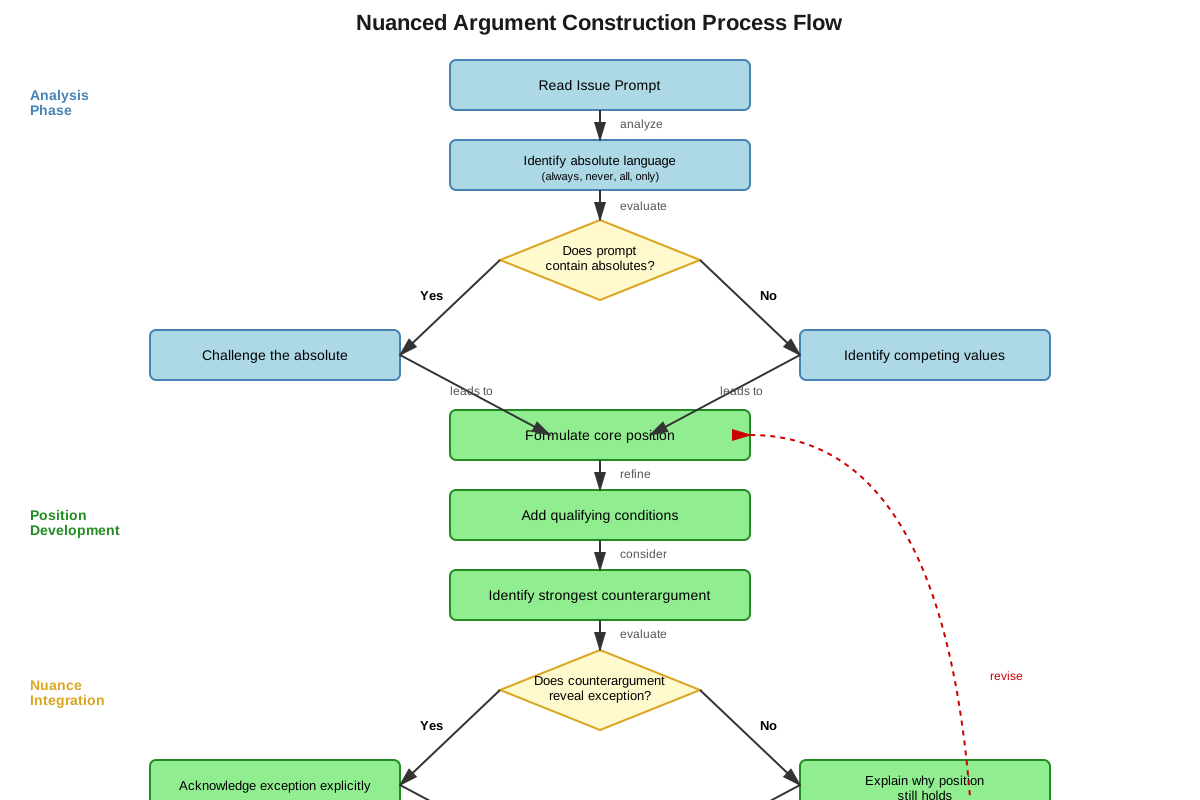
When approaching GRE "Analyze an Issue" prompts, use this systematic process to develop nuanced arguments:
Step 1: Identify Absolute Language in the Prompt (30 seconds)
Look for words like "always," "never," "all," "best," "only," "must," or "should." These absolute terms signal opportunities for nuanced responses that explore conditions, contexts, or qualifications. Even prompts without explicit absolute language often present claims that benefit from nuanced treatment.
Step 2: Brainstorm Multiple Contexts (2-3 minutes)
Before committing to a position, quickly list 3-4 different contexts, situations, or conditions where the claim might be more or less valid. Consider: different fields, different populations, different time periods, different scales (individual vs. societal), different goals or values at stake.
Step 3: Develop Your Core Position (1 minute)
Based on your contextual analysis, articulate a clear thesis that takes a definitive stance while acknowledging complexity. Use this template: "While [acknowledge validity of claim or opposing view], [your position] because [primary reasoning], though [important qualification or condition]."
Step 4: Structure for Strategic Nuance (during writing)
- Introduction: Present your nuanced thesis clearly
- Body Paragraph 1: Strongest support for your position with specific examples
- Body Paragraph 2: Acknowledge where opposing views have validity or where your position has limitations, then explain why your position still holds
- Body Paragraph 3: Explore contextual factors that affect the issue, demonstrating sophisticated understanding
- Conclusion: Synthesize your nuanced position, emphasizing the conditions or contexts you've identified
Exam Tip: Trigger phrases that signal opportunities for nuance include "the best way," "should always," "never acceptable," "most important," and "only solution." When you see these, immediately think: "Under what conditions? In what contexts? To what extent?"
Time Allocation for Nuanced Arguments:
- Planning (including contextual brainstorming): 5-6 minutes
- Writing: 22-24 minutes
- Revision: 2-3 minutes
Invest slightly more time in planning than you might for simpler arguments because developing genuine nuance requires thinking through multiple angles before writing.
Process-of-Elimination for Self-Evaluation:
As you write, check whether your argument:
- ❌ Takes an absolute position without qualification → Add contextual awareness
- ❌ Lists pros and cons without synthesis → Integrate into coherent position
- ❌ Acknowledges counterarguments but dismisses them superficially → Engage more substantively
- ❌ Uses excessive hedging language → Replace with strategic qualifiers
- ❌ Fails to take a clear position → Strengthen your thesis while maintaining nuance
Memory Techniques
CONTEXT Acronym for Developing Nuance:
- Conditions: Under what conditions does the claim apply?
- Opposing views: What legitimate counterarguments exist?
- Nature of the field/situation: How does the specific domain affect validity?
- Time and scale: Does the claim work differently at different scales or time periods?
- Extent: To what degree is the claim valid?
- Xceptions: What are important exceptions or limitations?
The "Yes, And..." vs. "Yes, But..." Visualization:
Imagine a balance scale. "Yes, and..." adds weight to one side (agreement without nuance). "Yes, but..." acknowledges weight on one side while adding important weight to the other (nuanced agreement). "No, but..." acknowledges some weight on the opposing side while loading your side (nuanced disagreement). Visualize yourself as carefully placing weights on both sides while ensuring your preferred side ultimately tips the scale.
The Three Levels Mnemonic (for remembering sophistication levels):
- Level 1 (Simple): "Black or White" - Binary thinking
- Level 2 (Moderate): "Gray Exists" - Acknowledges both sides
- Level 3 (Nuanced): "Contextual Colors" - Different contexts create different valid positions
The QUALIFIED Thesis Checklist:
- Question absolute claims
- Understand multiple perspectives
- Acknowledge legitimate counterpoints
- Limit overgeneralizations
- Identify contexts and conditions
- Frame your clear position
- Integrate competing considerations
- Express appropriate degree
- Demonstrate sophisticated thinking
Summary
Nuanced argumentation represents the hallmark of sophisticated analytical writing on the GRE, distinguishing high-scoring essays (5-6) from those that demonstrate only basic competence (3-4). Rather than presenting oversimplified, binary positions on complex issues, nuanced arguments acknowledge legitimate complexity while maintaining clear, defensible positions. This sophistication manifests through strategic use of qualifying language, contextual awareness that recognizes how circumstances affect validity, substantive engagement with counterarguments, and conditional reasoning that specifies when and to what extent claims hold true. The key to effective nuance lies in balancing intellectual honesty about complexity with the confidence to take definitive stances supported by careful reasoning. Students must avoid common pitfalls including false balance, excessive hedging, and superficial acknowledgment of opposing views. By systematically considering multiple contexts, identifying conditions that affect validity, and synthesizing competing considerations into coherent positions, test-takers can demonstrate the critical thinking skills that graduate programs value and that the GRE explicitly rewards through its scoring rubric.
Key Takeaways
- Nuanced arguments take clear positions while acknowledging complexity—they are sophisticated, not indecisive or wishy-washy
- The GRE scoring rubric explicitly rewards consideration of "complexities and implications," making nuance essential for scores of 5-6
- Effective nuance requires strategic use of qualifying language, contextual awareness, and conditional reasoning rather than excessive hedging or false balance
- Acknowledging counterarguments strengthens your position when you engage substantively and explain why your position remains most compelling
- Context matters: Recognizing that circumstances, fields, scales, and conditions affect the validity of claims demonstrates sophisticated thinking
- Avoid the "list pros and cons" trap: Genuine nuance synthesizes competing considerations into a coherent position rather than simply cataloging both sides
- Absolute language in prompts ("always," "never," "best," "only") signals opportunities to develop nuanced responses that explore conditions and contexts
Related Topics
Counterargument Integration: Building directly on nuanced argumentation, this topic explores specific techniques for incorporating opposing views effectively, including the concession-refutation structure and strategic placement of counterarguments within essays. Mastering nuance provides the foundation for this more specialized skill.
Conditional and Causal Reasoning: Understanding how to construct "if-then" relationships and identify necessary versus sufficient conditions enhances the ability to express nuanced positions that specify when claims apply. This logical framework supports the contextual awareness central to nuanced arguments.
Evidence Evaluation and Weighing: Nuanced arguments require assessing the relative strength of competing evidence and determining which considerations prove most significant in specific contexts. This analytical skill enables the synthesis that distinguishes sophisticated from superficial nuance.
Analyze an Argument Task: The critical thinking skills developed through nuanced argumentation transfer directly to identifying unstated assumptions, recognizing conditions that would strengthen or weaken arguments, and evaluating logical soundness—all central to the second Analytical Writing task.
Academic Writing Style and Tone: Nuanced argumentation connects to broader questions of maintaining appropriate academic voice, balancing confidence with intellectual humility, and using sophisticated vocabulary to express complex ideas precisely.
Practice CTA
Now that you understand the principles and strategies behind nuanced argumentation, the next crucial step is application. Attempt the practice questions designed to test your ability to identify opportunities for nuance, construct qualified theses, and develop sophisticated positions on complex issues. The flashcards will help reinforce key concepts including the components of effective nuance, common pitfalls to avoid, and trigger words that signal opportunities for contextual analysis. Remember: nuanced thinking is a skill that improves with deliberate practice. Each practice essay you write with attention to acknowledging complexity while maintaining a clear position strengthens your ability to demonstrate the sophisticated critical thinking that distinguishes top GRE scores. You've learned the framework—now apply it to achieve the analytical writing score that reflects your true intellectual capabilities.
Sign up free to keep reading
Create a free AnvayaPrep account to finish this GRE guide on Nuanced argument — plus flashcards and practice questions.