Overview
The conclusion strategy represents one of the most critical yet frequently underestimated components of a successful GRE Analytical Writing essay. While many test-takers focus intensely on crafting compelling introductions and developing robust body paragraphs, the conclusion serves as the final opportunity to leave a lasting impression on the grader and demonstrate sophisticated analytical thinking. A well-executed GRE conclusion strategy does far more than simply restate the thesis—it synthesizes the essay's arguments, elevates the discussion to broader implications, and provides intellectual closure that signals mastery of analytical writing conventions.
On the GRE Analyze an Issue task, the conclusion paragraph typically accounts for approximately 15-20% of the essay's total impact on scoring. ETS graders specifically evaluate whether conclusions demonstrate "cogent development of ideas" and provide "focused, coherent" closure to the argument presented. A weak or rushed conclusion can undermine an otherwise strong essay, potentially dropping a score from a 5 to a 4, or from a 4 to a 3. Conversely, a strategically crafted conclusion can elevate borderline essays by demonstrating the writer's ability to think beyond surface-level analysis and connect ideas to larger contexts.
The conclusion strategy integrates seamlessly with other Analytical Writing concepts, including thesis development, evidence presentation, and counterargument acknowledgment. It serves as the culminating demonstration of critical thinking skills that the entire essay has been building toward. Understanding how to construct effective conclusions requires mastery of synthesis techniques, awareness of rhetorical impact, and the ability to manage time effectively during the 30-minute writing window. This guide provides comprehensive instruction on developing conclusion strategies that consistently earn high scores on the GRE.
Learning Objectives
- [ ] Identify when Conclusion strategy is being tested
- [ ] Explain the core rule or strategy behind Conclusion strategy
- [ ] Apply Conclusion strategy to GRE-style questions accurately
- [ ] Construct conclusions that synthesize rather than merely summarize essay arguments
- [ ] Implement time-management techniques to ensure adequate conclusion development
- [ ] Evaluate the effectiveness of sample conclusions using GRE scoring criteria
- [ ] Adapt conclusion strategies to different types of Issue task prompts
Prerequisites
- Thesis statement construction: Understanding how to craft a clear position statement is essential because the conclusion must circle back to and reinforce this central claim without simply repeating it verbatim.
- Essay organization and structure: Familiarity with the overall architecture of a GRE essay (introduction, body paragraphs, conclusion) enables strategic placement and proportioning of the conclusion within the time constraints.
- Analytical reasoning fundamentals: The ability to analyze claims, evaluate evidence, and consider multiple perspectives provides the foundation for synthesizing ideas in the conclusion rather than merely restating them.
- Basic paragraph development: Competence in constructing coherent paragraphs with topic sentences and supporting details ensures the conclusion maintains the essay's overall quality and cohesion.
Why This Topic Matters
The conclusion strategy directly impacts GRE Analytical Writing scores across multiple evaluation criteria. According to ETS scoring guidelines, essays receiving scores of 5 or 6 demonstrate "generally thoughtful, well-developed analysis" with "appropriate" or "insightful" organization—qualities that strong conclusions exemplify. Research on GRE scoring patterns indicates that essays with weak or missing conclusions rarely score above a 4, regardless of body paragraph quality. The conclusion represents approximately 15-20% of the essay's total word count and carries disproportionate weight in forming the grader's final impression due to recency effects in human evaluation.
In real-world applications, the ability to craft effective conclusions translates directly to professional and academic writing contexts. Graduate-level research papers, business proposals, policy recommendations, and legal briefs all require writers to synthesize complex information and articulate broader implications—precisely the skills that GRE conclusion strategies develop. Employers and graduate programs value candidates who can not only analyze information but also communicate the significance of their analysis, making conclusion-writing skills highly transferable.
On the GRE Analyze an Issue task, conclusion strategy appears in every single essay prompt, making it a 100% frequency topic. The conclusion is tested implicitly through the holistic scoring rubric's emphasis on "cogent development," "coherent organization," and "appropriate" structure. Graders specifically look for conclusions that avoid mechanical repetition, demonstrate synthesis of ideas, acknowledge complexity, and connect to broader contexts. Common manifestations include prompts requiring writers to take positions on educational policies, technological impacts, societal values, or institutional practices—all of which benefit from conclusions that elevate the discussion beyond the specific examples discussed in body paragraphs.
Core Concepts
The Purpose of a GRE Conclusion
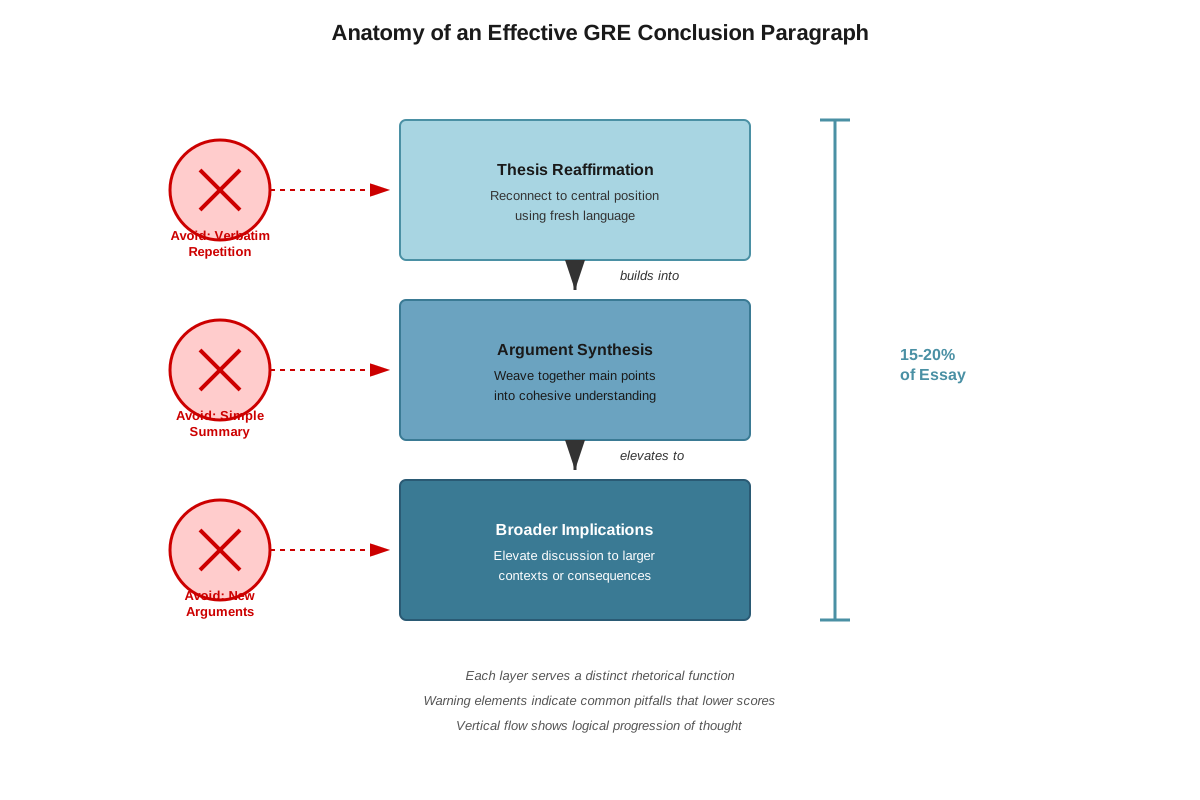
The conclusion serves three primary functions in a GRE Analytical Writing essay. First, it provides intellectual closure by signaling to the reader that the argument has reached its natural endpoint. This closure reassures graders that the writer has maintained control over the essay's structure and completed the analytical task. Second, the conclusion synthesizes the essay's main points, demonstrating the writer's ability to see connections between ideas rather than treating each body paragraph as an isolated unit. Third, it elevates the discussion by connecting specific arguments to broader implications, universal principles, or wider contexts—a hallmark of sophisticated analytical thinking that distinguishes score 5-6 essays from score 3-4 essays.
Unlike conclusions in other writing contexts, GRE conclusions must be crafted under severe time pressure (typically 3-5 minutes of the 30-minute writing window). This constraint necessitates a strategic approach that balances thoroughness with efficiency. The conclusion should typically comprise 4-6 sentences or approximately 80-120 words, representing about 15-20% of a 500-600 word essay. This proportioning ensures adequate development without consuming excessive time that could be better spent on body paragraphs.
The Four-Component Conclusion Framework
An effective GRE conclusion incorporates four distinct components, though not necessarily in rigid order. The thesis reaffirmation restates the essay's central position using different language than the introduction, demonstrating vocabulary range and avoiding mechanical repetition. Rather than copying the thesis verbatim, this component should rephrase the main claim in a way that reflects the analytical journey the essay has undertaken.
The synthesis statement connects the essay's major supporting points, showing how they work together to support the thesis. This component moves beyond mere summary by identifying patterns, relationships, or cumulative effects among the arguments presented. For example, if body paragraphs discussed economic, social, and environmental factors, the synthesis might note how these dimensions intersect or reinforce one another.
The broader implications component addresses the "so what?" question by explaining why the argument matters beyond the specific prompt. This might involve discussing real-world applications, long-term consequences, policy recommendations, or connections to fundamental values or principles. This element is particularly crucial for achieving scores of 5 or 6, as it demonstrates the ability to think beyond the immediate analytical task.
The final thought provides a memorable closing sentence that leaves the reader with a clear sense of completion. This might take the form of a call to action, a thought-provoking question (used sparingly), a return to an opening anecdote, or a statement of principle. The final thought should feel definitive rather than tentative, avoiding phrases like "In conclusion, there are many factors to consider" that suggest incomplete analysis.
Synthesis vs. Summary: A Critical Distinction
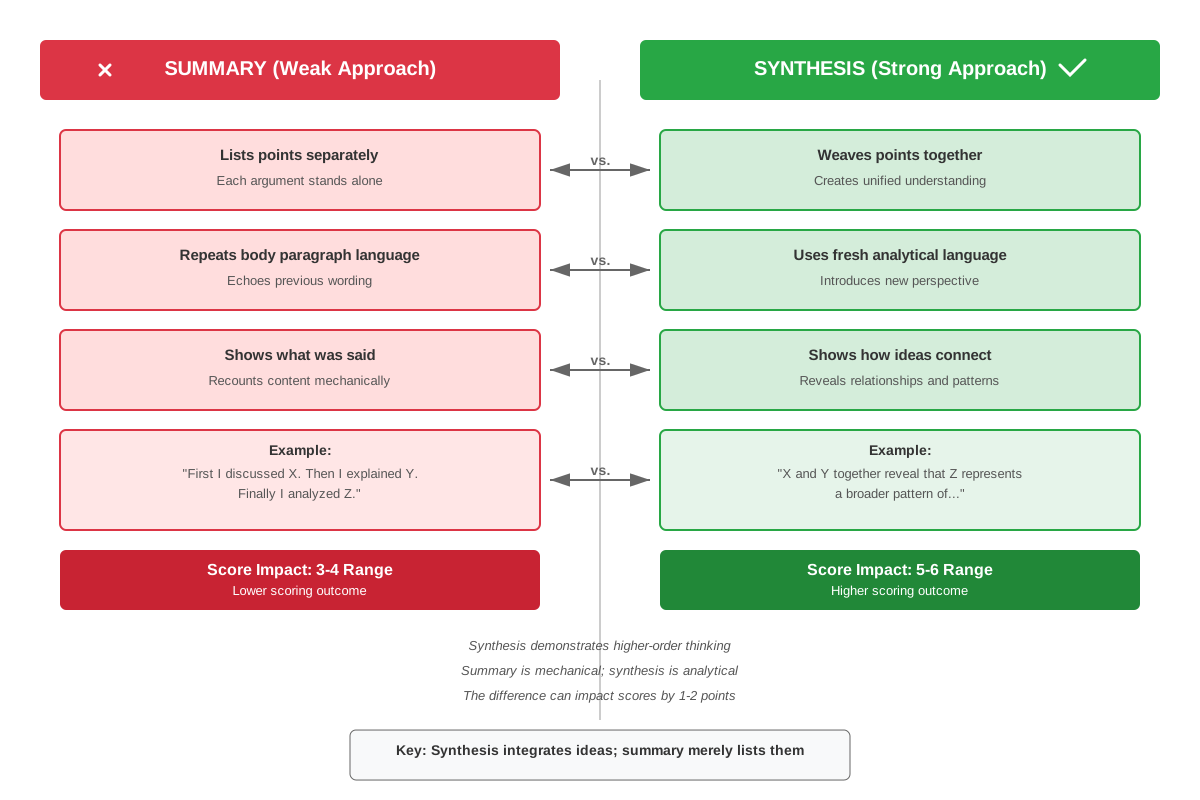
The most common weakness in GRE conclusions is mechanical summary—simply listing the topics of each body paragraph without showing how they connect or what they collectively demonstrate. A summary-based conclusion might state: "This essay discussed economic factors, social considerations, and environmental impacts." This approach adds minimal value and suggests superficial thinking.
In contrast, synthesis demonstrates analytical sophistication by identifying relationships, patterns, or cumulative effects. A synthesis-based conclusion might state: "When economic incentives align with social values and environmental sustainability, policies achieve both immediate effectiveness and long-term viability." This approach shows the writer understands how the pieces fit together and can articulate their collective significance.
The distinction between summary and synthesis directly correlates with GRE scoring outcomes. Essays that merely summarize typically receive scores of 3-4, while those that synthesize effectively position themselves for scores of 5-6. Graders specifically look for evidence that writers can "examine the complexities of an issue" and "develop ideas in a cogent manner"—both qualities that synthesis demonstrates.
Conclusion Strategies for Different Prompt Types
GRE Issue prompts fall into several categories, each benefiting from tailored conclusion approaches. Recommendation prompts (e.g., "The best way to teach is...") work well with conclusions that acknowledge implementation challenges while reaffirming the recommended approach's overall merit. These conclusions might discuss conditions under which the recommendation works best or acknowledge necessary adaptations for different contexts.
Claim evaluation prompts (e.g., "Technology has made the world a better place") benefit from conclusions that acknowledge the claim's partial validity while maintaining the essay's overall position. These conclusions often employ nuanced language like "largely," "primarily," or "in most contexts" to demonstrate sophisticated thinking that avoids false dichotomies.
Comparative prompts (e.g., "Competition is more important than cooperation") work well with conclusions that synthesize the comparison by identifying contexts where each element dominates or showing how they interact. Rather than declaring an absolute winner, these conclusions might discuss how the two elements complement each other or serve different purposes.
Policy prompts (e.g., "Governments should fund the arts") benefit from conclusions that address practical implementation considerations, potential objections, or necessary conditions for success. These conclusions demonstrate awareness that policy questions involve trade-offs and real-world constraints.
Time Management and Conclusion Planning
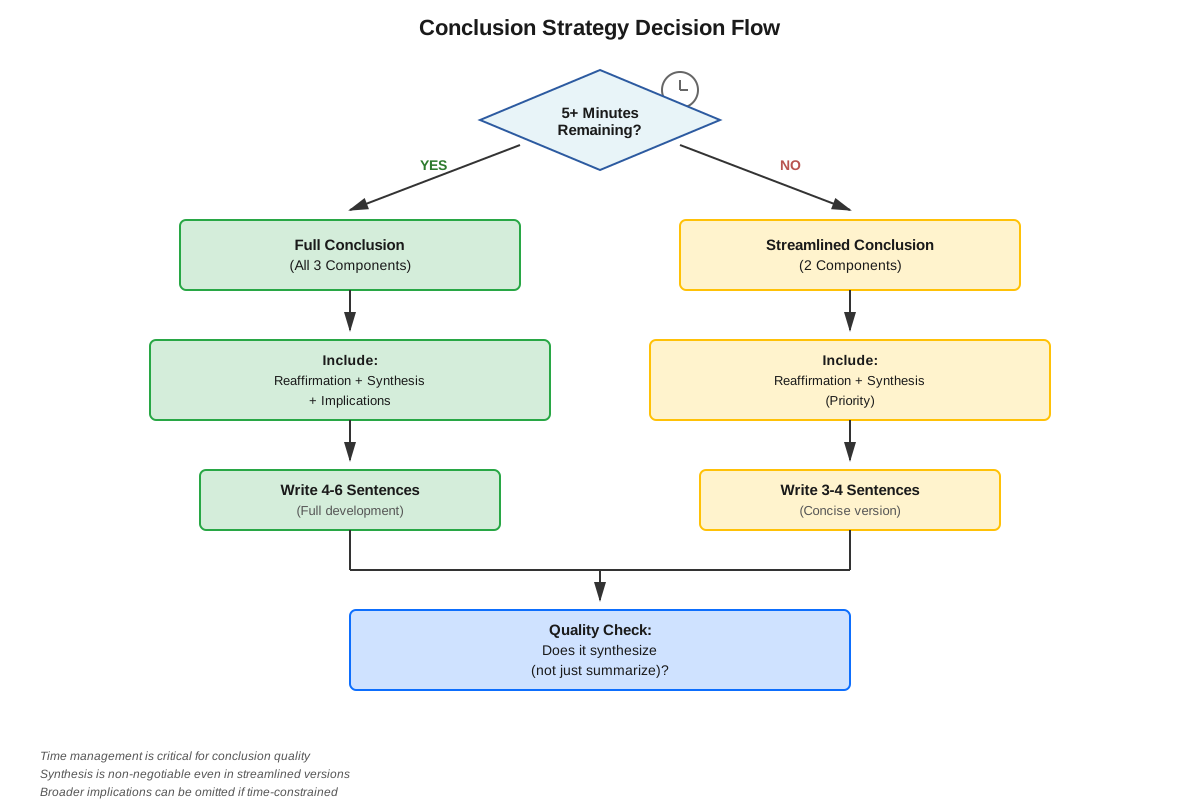
Effective conclusion strategy requires deliberate time allocation during the 30-minute writing window. The recommended approach involves reserving the final 3-5 minutes specifically for conclusion writing, with an additional 1-2 minutes for final proofreading. This allocation ensures the conclusion receives adequate attention rather than being rushed or omitted entirely—a fatal error that virtually guarantees a score below 4.
During the initial planning phase (first 2-3 minutes), writers should note potential broader implications or synthesis points that might appear in the conclusion. This advance planning prevents the common problem of reaching the conclusion with no clear sense of how to elevate the discussion beyond the body paragraphs. Even brief notes like "connect to long-term sustainability" or "discuss balance between competing values" provide valuable direction when time pressure intensifies.
If time runs critically short (less than 2 minutes remaining), a strategic approach involves writing a condensed three-sentence conclusion: (1) thesis reaffirmation, (2) brief synthesis, and (3) final thought. While not ideal, this abbreviated structure is vastly superior to omitting the conclusion entirely or ending mid-thought. The key is maintaining the synthesis element even in compressed form, as this demonstrates analytical thinking that summary alone cannot achieve.
Concept Relationships
The conclusion strategy connects intimately with thesis development, as the conclusion must circle back to the essay's central claim while demonstrating how the analysis has enriched or nuanced that position. The thesis provides the destination that the conclusion confirms has been reached, though ideally with greater sophistication than the initial statement suggested. This relationship operates bidirectionally: a strong thesis makes conclusion-writing easier by providing a clear target, while planning the conclusion during the outlining phase can help refine the thesis itself.
Body paragraph development directly feeds into conclusion synthesis. Each body paragraph's main point becomes raw material for the synthesis statement, which identifies patterns or relationships among these points. The relationship flows as follows: Body Paragraph Topics → Synthesis Statement → Broader Implications. For example, if body paragraphs discuss economic efficiency, social equity, and environmental sustainability, the synthesis might note how these three dimensions of policy evaluation interact, and the broader implications might discuss the importance of multi-dimensional policy analysis in democratic governance.
Counterargument acknowledgment in body paragraphs connects to conclusion strategy through the nuancing function. When an essay acknowledges opposing viewpoints in body paragraphs, the conclusion can demonstrate sophisticated thinking by incorporating these perspectives into a more nuanced final position. This creates a progression: Initial Thesis → Counterargument Acknowledgment → Nuanced Conclusion that shows intellectual growth throughout the essay.
Time management skills underpin all aspects of conclusion strategy. The relationship operates as: Effective Planning → Adequate Time Allocation → Quality Conclusion Development → Higher Scores. Without proper time management, even writers who understand conclusion strategy intellectually may fail to implement it effectively under test conditions.
High-Yield Facts
⭐ Conclusions should comprise approximately 15-20% of total essay length (80-120 words in a 500-600 word essay)
⭐ Essays lacking conclusions rarely score above 4, regardless of body paragraph quality
⭐ Synthesis (showing relationships between ideas) is more valuable than summary (listing topics discussed)
⭐ The conclusion should reaffirm the thesis using different language, not repeat it verbatim
⭐ Broader implications that connect to universal principles or real-world contexts distinguish score 5-6 essays from score 3-4 essays
- Effective conclusions incorporate four components: thesis reaffirmation, synthesis statement, broader implications, and final thought
- Reserve 3-5 minutes of the 30-minute writing window specifically for conclusion development
- Avoid introducing entirely new arguments in the conclusion; focus on synthesizing existing points
- The final sentence should provide definitive closure, avoiding tentative language like "there are many factors to consider"
- Conclusions that acknowledge complexity and nuance demonstrate sophisticated thinking valued by GRE graders
- Planning potential broader implications during the initial outline phase (first 2-3 minutes) prevents conclusion-writing paralysis
- If time runs short, a three-sentence conclusion (thesis reaffirmation, synthesis, final thought) is vastly superior to no conclusion
- Mechanical phrases like "In conclusion" or "To summarize" are acceptable but not required; transitioning naturally is preferable
- The conclusion's recency effect means it disproportionately influences the grader's final impression
- Different prompt types (recommendation, claim evaluation, comparative, policy) benefit from tailored conclusion approaches
Quick check — test yourself on Conclusion strategy so far.
Try Flashcards →Common Misconceptions
Misconception: The conclusion should introduce new arguments or evidence to strengthen the essay.
Correction: The conclusion should synthesize existing arguments rather than introduce new ones. Introducing new points in the conclusion suggests poor organization and leaves arguments underdeveloped, as there's no space to properly support them. The conclusion's purpose is to show how existing arguments connect and what they collectively demonstrate.
Misconception: Simply restating the thesis word-for-word demonstrates consistency and clarity.
Correction: Verbatim thesis repetition suggests limited vocabulary and mechanical thinking. Effective conclusions rephrase the thesis using different language, demonstrating vocabulary range and showing how the analytical journey has enriched the initial position. The reaffirmation should feel like a return to the thesis with greater sophistication.
Misconception: Longer conclusions always score higher because they show more effort.
Correction: Conclusion quality matters far more than length. A concise, well-synthesized 80-word conclusion outperforms a rambling 150-word conclusion that merely summarizes. Graders evaluate whether the conclusion demonstrates analytical thinking and provides appropriate closure, not whether it meets an arbitrary word count. Excessive length often indicates repetition or padding rather than substantive synthesis.
Misconception: The conclusion is the least important paragraph, so it's acceptable to rush it or skip it if time runs short.
Correction: The conclusion carries disproportionate weight due to recency effects—it's the last thing graders read before assigning a score. Essays without conclusions rarely score above 4, and rushed conclusions that merely summarize can drop otherwise strong essays from 5 to 4. Time management should prioritize ensuring adequate conclusion development, even if it means slightly shorter body paragraphs.
Misconception: Ending with a rhetorical question demonstrates sophisticated thinking and engages the reader.
Correction: While occasional rhetorical questions can work, they often feel like cop-outs that avoid taking a definitive stance. GRE graders prefer conclusions that provide clear closure and demonstrate confident analytical thinking. If using a question, it should be followed by a definitive statement that provides closure, not left hanging as the final sentence.
Misconception: The broader implications component should discuss personal experiences or opinions.
Correction: Broader implications should connect to universal principles, real-world applications, policy considerations, or fundamental values—not personal anecdotes or unsupported opinions. The GRE Analytical Writing section evaluates analytical thinking about issues of general interest, not personal narrative skills. Effective broader implications discuss why the argument matters to society, institutions, or fields of study, not why it matters to the individual writer.
Worked Examples
Example 1: Technology and Education Prompt
Prompt: "The best way to teach—whether as an educator, employer, or parent—is to praise positive actions and ignore negative ones."
Sample Conclusion (Demonstrating Effective Strategy):
"While positive reinforcement undoubtedly plays a valuable role in effective teaching, the claim that negative actions should be ignored oversimplifies the complex dynamics of learning and development. As this essay has demonstrated, addressing mistakes constructively provides essential learning opportunities, ignoring negative behaviors can enable harmful patterns to persist, and different contexts require different balancing points between praise and correction. The most effective teaching approaches recognize that both positive reinforcement and constructive feedback serve complementary purposes: praise motivates and builds confidence, while appropriate correction guides learners away from counterproductive patterns and helps them develop self-regulation skills. Ultimately, the question is not whether to use praise or correction, but rather how to calibrate both tools to serve each learner's developmental needs and the specific learning context. Educational excellence emerges not from rigid adherence to a single approach, but from thoughtful adaptation of multiple strategies to the complex realities of human learning."
Analysis of Effectiveness:
This conclusion demonstrates all four components of effective GRE conclusion strategy. The thesis reaffirmation appears in the opening sentence, which restates the essay's position (that the claim oversimplifies) without repeating the introduction verbatim. The synthesis statement appears in the second sentence ("As this essay has demonstrated..."), which connects the three main body paragraph topics and shows how they collectively support the thesis. The broader implications appear in the middle sentences, which elevate the discussion from the specific prompt to general principles about teaching effectiveness and the need for adaptive approaches. The final thought provides definitive closure with a statement about educational excellence that feels conclusive rather than tentative.
The conclusion avoids mechanical summary by not simply listing the three body paragraph topics. Instead, it shows how these points work together to support a nuanced position. The language demonstrates sophistication through phrases like "complementary purposes," "calibrate both tools," and "complex realities of human learning." The conclusion acknowledges complexity without being wishy-washy, maintaining a clear position while recognizing that effective teaching requires contextual judgment.
Example 2: Government and Arts Funding Prompt
Prompt: "Governments should focus on solving the immediate problems of today rather than on trying to solve the anticipated problems of the future."
Sample Conclusion (Demonstrating Effective Strategy):
"The dichotomy between addressing immediate problems and anticipating future challenges presents a false choice that effective governance must reject. This analysis has revealed that many current crises stem from past failures to anticipate and prevent foreseeable problems, that resource allocation decisions inevitably involve both short-term and long-term considerations, and that certain investments—particularly in infrastructure, education, and environmental protection—require long time horizons to yield returns. Rather than viewing present and future as competing priorities, effective governance recognizes them as interconnected dimensions of policy-making. Today's preventive investments become tomorrow's avoided crises, while today's neglected long-term challenges become tomorrow's immediate emergencies. The most successful societies balance urgent needs with strategic foresight, understanding that sustainable solutions to current problems often require addressing their root causes and preventing their recurrence. Governance that focuses exclusively on immediate problems without considering future implications is not pragmatic but rather myopic, ultimately creating more crises than it resolves."
Analysis of Effectiveness:
This conclusion exemplifies sophisticated synthesis by identifying the false dichotomy in the prompt and showing how the essay's arguments collectively support a more nuanced position. The thesis reaffirmation appears in the opening sentence, which clearly states the essay's position while using different language than the introduction. The synthesis statement ("This analysis has revealed...") connects three body paragraph topics and shows their collective significance rather than merely listing them.
The broader implications appear throughout the middle sentences, which discuss the interconnected nature of present and future, the concept of preventive investment, and the characteristics of successful societies. These implications elevate the discussion from the specific prompt to general principles of governance and policy-making. The final thought provides strong closure with a definitive statement that reframes "pragmatic" governance in terms of long-term thinking rather than short-term focus.
The conclusion demonstrates advanced analytical thinking by showing how present and future are interconnected rather than opposed, using phrases like "interconnected dimensions" and "sustainable solutions." It avoids the trap of mechanical summary by synthesizing the relationship between the body paragraph topics rather than simply listing them. The language is sophisticated without being pretentious, and the conclusion maintains a clear position while acknowledging complexity.
Exam Strategy
When approaching the conclusion during the GRE Analytical Writing section, begin by checking the time remaining. If 5 or more minutes remain, proceed with a full four-component conclusion. If 3-4 minutes remain, plan for a slightly condensed version that still includes all components but with less elaboration. If fewer than 3 minutes remain, implement the emergency three-sentence structure: thesis reaffirmation, brief synthesis, and final thought.
Trigger words and phrases that signal the need for conclusion strategy include any indication that the essay is nearing its planned length or that time is running short. During the writing process, when completing the final body paragraph, this serves as the trigger to transition into conclusion mode. Mental triggers should include thoughts like "I've made my main points" or "I need to wrap this up"—these indicate it's time to shift from development to synthesis and closure.
Process-of-elimination tips for conclusion development involve recognizing what to avoid. Eliminate any impulse to introduce entirely new arguments or examples—if a point is important enough to include, it belongs in a body paragraph where it can be properly developed. Eliminate verbatim repetition of the thesis or mechanical listing of body paragraph topics—these suggest summary rather than synthesis. Eliminate tentative language like "there are many factors to consider" or "this is a complex issue with no easy answers"—while acknowledging complexity is valuable, the conclusion should demonstrate that the essay has successfully navigated that complexity, not that the writer is uncertain.
Time allocation strategy involves working backward from the 30-minute limit. Reserve minutes 27-30 for conclusion writing and final proofreading. This means the final body paragraph should be completed by minute 26-27 at the latest. If running behind schedule, slightly compress the final body paragraph rather than eliminating the conclusion—a strong conclusion can partially compensate for a somewhat shorter final body paragraph, but no body paragraph quality can compensate for a missing or inadequate conclusion.
During the conclusion-writing phase, use the first 30-60 seconds to mentally review the essay's main points and identify a synthesis angle—how do these points connect or what do they collectively demonstrate? This brief planning prevents the common problem of starting the conclusion without a clear sense of direction. Then write continuously, trusting the four-component framework to guide the structure. If a particular component proves difficult (often broader implications), move to the next component and return if time permits—it's better to have a conclusion with three strong components than to get stuck and run out of time.
Exam Tip: If you find yourself with only 90 seconds remaining and no conclusion written, immediately write a three-sentence conclusion: (1) "While [acknowledge complexity], [restate thesis in different words]." (2) "The [synthesis of main points] demonstrates [what they collectively show]." (3) "[Definitive final statement about broader principle or implication]." This emergency structure takes 60-90 seconds to execute and is vastly superior to no conclusion.
Memory Techniques
The STBF Acronym helps remember the four components of an effective conclusion:
- Synthesize the main arguments (show how they connect)
- Thesis reaffirmation (restate position in different words)
- Broader implications (connect to universal principles or real-world contexts)
- Final thought (provide definitive closure)
The "Zoom Out" Visualization helps remember the conclusion's purpose. Imagine the essay as a camera that starts with a wide shot (introduction), zooms in on specific details (body paragraphs), then zooms back out to show the bigger picture (conclusion). This visualization reinforces that the conclusion should elevate the discussion to broader contexts rather than remaining focused on specific examples.
The "Three S's" Mnemonic distinguishes effective conclusions from weak ones:
- Synthesize (don't just summarize)
- Significance (explain why it matters)
- Sophistication (demonstrate nuanced thinking)
The "Time Checkpoint" Technique involves associating specific time markers with conclusion-related actions:
- Minute 25: Complete or be completing the final body paragraph
- Minute 26-27: Begin conclusion
- Minute 29-30: Final proofreading with emphasis on conclusion clarity
The "So What?" Question serves as a mental trigger for developing broader implications. After synthesizing the main points, ask "So what? Why does this matter beyond this specific prompt?" The answer becomes the broader implications component.
Summary
Conclusion strategy represents a high-impact component of GRE Analytical Writing success, directly influencing scores through its demonstration of synthesis, analytical sophistication, and organizational competence. Effective conclusions incorporate four essential components: thesis reaffirmation using varied language, synthesis of main arguments that shows relationships rather than merely listing topics, broader implications that connect to universal principles or real-world contexts, and a final thought that provides definitive closure. The critical distinction between synthesis and summary separates score 5-6 essays from score 3-4 essays—synthesis demonstrates how arguments connect and what they collectively prove, while summary merely lists topics discussed. Time management is crucial, requiring deliberate allocation of 3-5 minutes for conclusion development and advance planning during the initial outline phase to identify potential synthesis angles and broader implications. Different prompt types benefit from tailored approaches, but all effective conclusions elevate the discussion beyond specific examples to demonstrate sophisticated analytical thinking. Under test conditions, even a condensed three-sentence conclusion (thesis reaffirmation, synthesis, final thought) vastly outperforms omitting the conclusion entirely, which virtually guarantees a score below 4 regardless of body paragraph quality.
Key Takeaways
- Conclusions account for approximately 15-20% of essay impact and carry disproportionate weight due to recency effects in grader evaluation
- Synthesis (showing how arguments connect) is fundamentally more valuable than summary (listing topics discussed) and distinguishes high-scoring essays
- The four-component framework—thesis reaffirmation, synthesis statement, broader implications, and final thought—provides a reliable structure for effective conclusions
- Reserve 3-5 minutes of the 30-minute writing window specifically for conclusion development, and plan potential broader implications during the initial outline phase
- Essays without conclusions rarely score above 4, making conclusion strategy a non-negotiable element of GRE Analytical Writing success
- Broader implications that connect to universal principles, real-world applications, or fundamental values demonstrate the sophisticated thinking that characterizes score 5-6 essays
- Different prompt types (recommendation, claim evaluation, comparative, policy) benefit from tailored conclusion approaches that address the specific analytical task
Related Topics
Introduction Strategy: Mastering conclusion strategy naturally connects to introduction development, as these bookend paragraphs work together to frame the essay's argument. Strong introductions set up positions that strong conclusions reaffirm with greater sophistication, creating a sense of analytical progression throughout the essay.
Body Paragraph Development: Effective conclusions depend on well-developed body paragraphs that provide the raw material for synthesis. Understanding how to construct body paragraphs with clear main points enables more effective conclusion synthesis that shows relationships between these points.
Thesis Statement Construction: The conclusion's thesis reaffirmation component requires understanding how to craft and rephrase thesis statements effectively. Mastering thesis development enables conclusions that circle back to the central claim while demonstrating analytical growth.
Counterargument Integration: Advanced conclusion strategies often incorporate nuanced positions that acknowledge counterarguments discussed in body paragraphs. Understanding how to integrate opposing viewpoints enables conclusions that demonstrate sophisticated, balanced thinking.
Time Management for Analytical Writing: Conclusion strategy depends fundamentally on effective time allocation throughout the 30-minute writing window. Developing comprehensive time management skills ensures adequate conclusion development without compromising other essay components.
Practice CTA
Now that you understand the comprehensive framework for GRE conclusion strategy, it's time to apply these concepts through deliberate practice. Attempt the practice questions to test your ability to identify effective conclusions, construct synthesis statements, and develop broader implications under time pressure. Use the flashcards to reinforce the four-component framework and key distinctions between synthesis and summary. Remember that conclusion-writing is a skill that improves dramatically with focused practice—each essay you write provides an opportunity to refine your ability to synthesize arguments and articulate broader implications. Your investment in mastering conclusion strategy will pay dividends not only on test day but throughout your graduate studies and professional career, as the ability to synthesize complex information and articulate its significance is universally valued. Approach each practice opportunity with the goal of implementing at least one new technique from this guide, and you'll steadily build the confidence and competence needed to craft conclusions that consistently earn high scores.
Sign up free to keep reading
Create a free AnvayaPrep account to finish this GRE guide on Conclusion strategy — plus flashcards and practice questions.