Overview
In the GRE Analytical Writing section, particularly in the "Analyze an Issue" task, the ability to acknowledge opposing viewpoints while maintaining a strong argumentative stance is crucial for achieving a top score. This rhetorical technique is known as concession, and it represents one of the most sophisticated strategies test-takers can employ to demonstrate critical thinking and nuanced reasoning. A concession involves acknowledging the validity or merit of an opposing argument or counterpoint before refuting it, qualifying it, or explaining why your position remains stronger despite its existence. This approach shows evaluators that you can think critically about multiple perspectives rather than presenting a one-sided argument.
The GRE scoring rubric explicitly rewards essays that "convey ideas fluently and precisely, using effective vocabulary and sentence variety" while demonstrating "a clear understanding of the complexities and implications of the issue." Effective use of concession directly addresses these criteria by showing intellectual maturity and the ability to engage with complexity. When test-takers fail to acknowledge counterarguments, their essays often appear simplistic or dogmatic, resulting in lower scores in the 3.0-4.0 range. Conversely, essays that skillfully incorporate concessions while maintaining a clear position typically score in the 5.0-6.0 range, as they demonstrate the sophisticated reasoning that graduate-level academic work requires.
Within the broader context of Analytical Writing, GRE concession serves as a bridge between thesis development, evidence presentation, and counterargument refutation. It works in tandem with other essential writing strategies such as providing specific examples, maintaining logical coherence, and developing well-supported claims. Mastering concession enables test-takers to transform potentially weak points in their arguments into opportunities to demonstrate comprehensive understanding and strengthen their overall position through strategic acknowledgment and rebuttal.
Learning Objectives
- [ ] Identify when Concession is being tested in GRE Analytical Writing prompts
- [ ] Explain the core rule or strategy behind Concession in argumentative writing
- [ ] Apply Concession to GRE-style questions accurately and effectively
- [ ] Construct concession statements that acknowledge opposing views without undermining the main argument
- [ ] Integrate concession seamlessly into essay structure using appropriate transitional language
- [ ] Distinguish between effective concessions that strengthen arguments and weak concessions that undermine thesis statements
- [ ] Evaluate sample essays to identify where concessions would improve argumentative quality
Prerequisites
- Basic essay structure: Understanding of introduction, body paragraphs, and conclusion organization is essential because concessions must be strategically placed within this framework to maximize effectiveness.
- Thesis statement development: The ability to craft a clear position statement is necessary because concessions must relate back to and ultimately support the central thesis.
- Counterargument recognition: Familiarity with identifying opposing viewpoints enables students to determine which counterarguments merit concession and acknowledgment.
- Logical reasoning fundamentals: Understanding basic argumentation principles helps students recognize when acknowledging an opposing point actually strengthens rather than weakens their position.
Why This Topic Matters
In professional and academic contexts, the ability to acknowledge complexity while maintaining a clear position is fundamental to persuasive communication. Scholars, researchers, and business leaders regularly employ concession strategies in research papers, policy recommendations, and strategic proposals. This rhetorical skill demonstrates intellectual honesty and thoroughness—qualities that graduate programs value highly. By showing awareness of multiple perspectives, writers build credibility with their audiences and preempt potential objections.
On the GRE specifically, concession appears as a critical evaluation criterion in approximately 85-90% of high-scoring Issue essays. ETS raters consistently note that essays scoring 5.0 or higher typically include at least one well-developed concession that acknowledges complexity. The Issue task explicitly asks test-takers to "develop a position on the issue" while considering "the most compelling reasons and/or examples that could be used to challenge your position." This language directly invites concession as a strategic response. Questions may present prompts about education policy, technology's impact on society, government responsibility, or artistic expression—all topics where reasonable people disagree and multiple valid perspectives exist.
Common manifestations of concession opportunities in GRE prompts include statements with absolute language ("always," "never," "all"), claims about universal human behavior, assertions about the best approach to complex problems, and recommendations for policy or practice. When prompts contain phrases like "to what extent," "discuss the extent," or "consider both views," they explicitly signal that acknowledging multiple perspectives will be rewarded. Even when prompts don't explicitly request consideration of opposing views, the most sophisticated responses incorporate concession to demonstrate comprehensive thinking.
Core Concepts
Definition and Function of Concession
A concession is a rhetorical strategy in which a writer acknowledges a point, argument, or piece of evidence that appears to contradict or weaken their position. Rather than ignoring opposing viewpoints, the writer explicitly recognizes their validity or merit before explaining why their own position remains stronger, more comprehensive, or more applicable. The primary function of concession is to demonstrate intellectual honesty and critical thinking while ultimately reinforcing the writer's main argument through strategic acknowledgment and rebuttal.
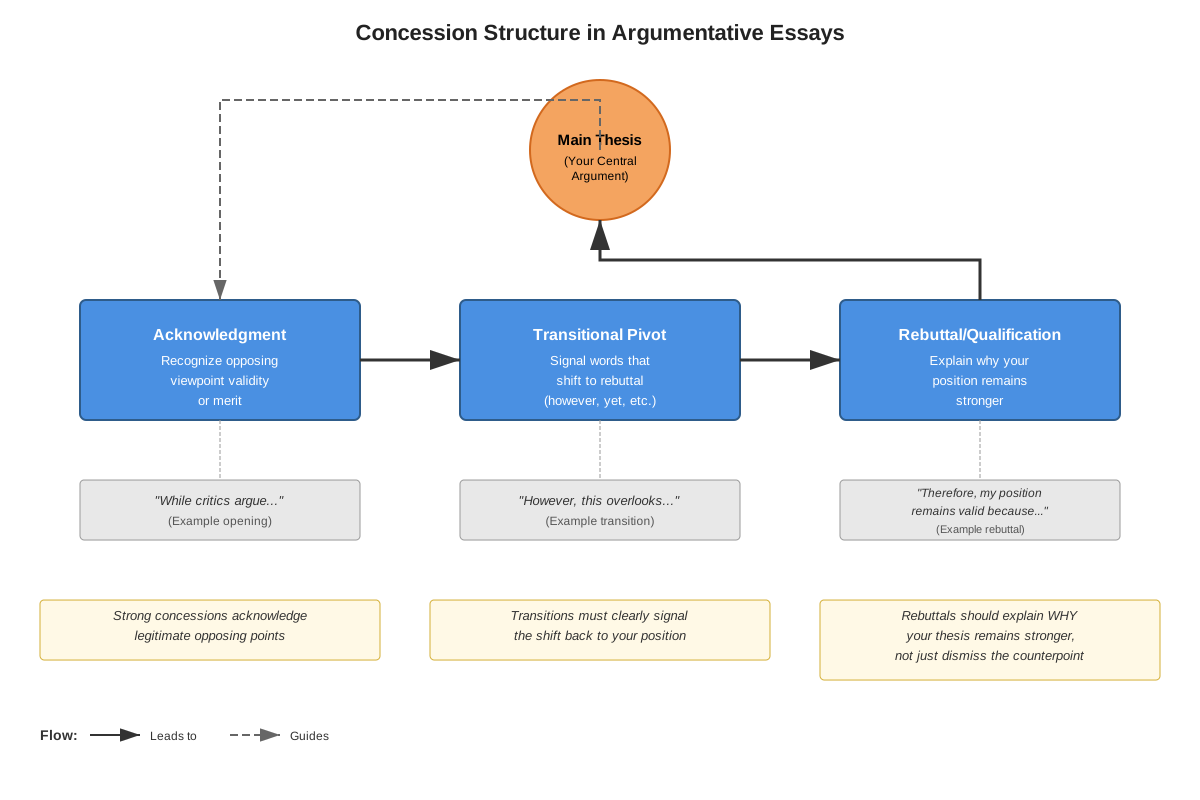
Concessions typically follow a three-part structure: (1) acknowledgment of the opposing point using transitional language, (2) brief explanation of why this point has merit or validity, and (3) refutation, qualification, or contextualization that explains why the writer's position remains superior despite this acknowledgment. This structure can be compressed into a single sentence or expanded across multiple sentences depending on the complexity of the counterargument being addressed.
Types of Concession Strategies
| Concession Type | Function | Example Signal Phrase |
|---|---|---|
| Full Concession with Rebuttal | Acknowledges validity of opposing point, then refutes it | "While it is true that..., nevertheless..." |
| Partial Concession | Acknowledges limited validity in specific contexts | "Although this may be true in some cases..." |
| Concession with Qualification | Accepts opposing point but limits its scope | "Granted, this approach works when..., but..." |
| Concession with Outweighing | Acknowledges opposing merit but argues your point is more important | "Despite these benefits, the drawbacks are more significant because..." |
Strategic Placement of Concessions
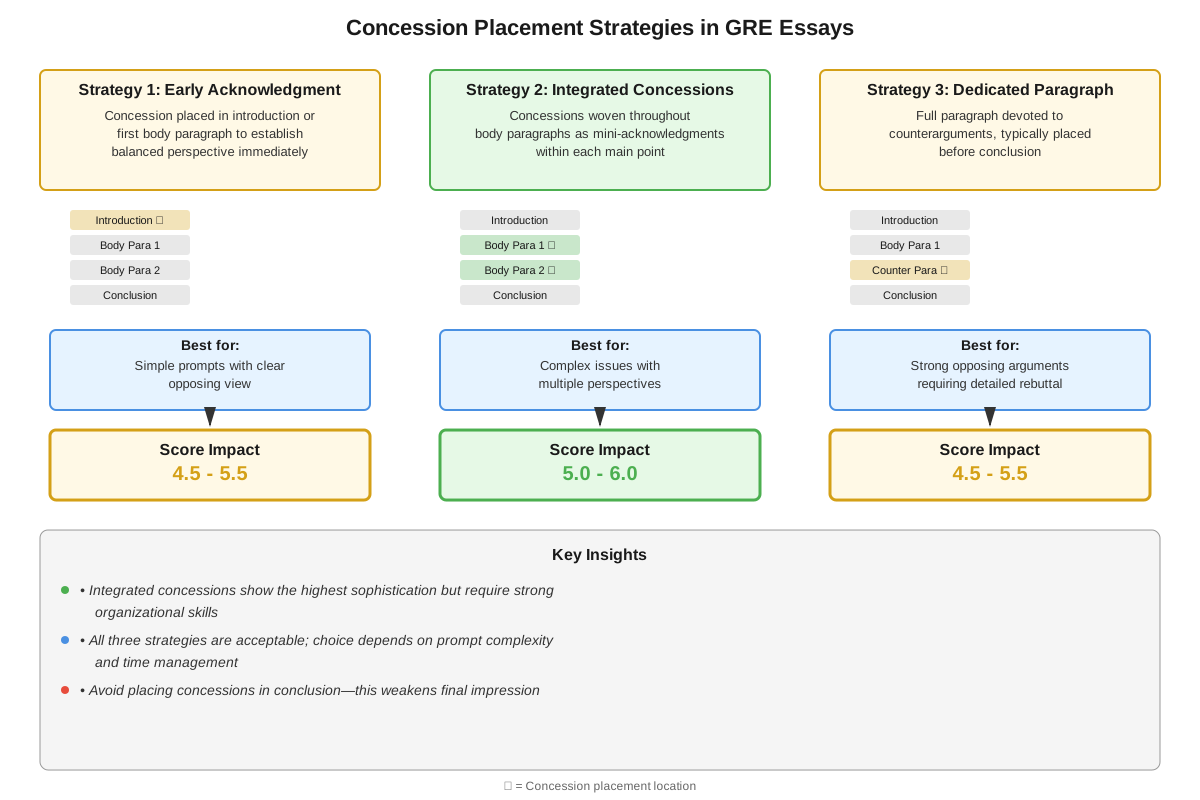
Effective concession placement significantly impacts argumentative strength. The most common and effective positions include:
- After the introduction and before main arguments: This placement addresses the strongest counterargument early, removing it as an obstacle to accepting your position
- Within body paragraphs: Embedding concessions within paragraphs discussing related points creates sophisticated, nuanced arguments
- In a dedicated counterargument paragraph: Typically the penultimate paragraph, this placement allows comprehensive treatment of opposing views before the conclusion
- Before the conclusion: Acknowledging final objections before restating your thesis demonstrates thoroughness
The least effective placement is in the conclusion itself, as this leaves readers with doubts rather than confidence in your position.
Transitional Language for Concessions
Mastering transitional phrases that signal concession is essential for clear communication. These phrases alert readers that you are temporarily acknowledging an opposing view:
Acknowledgment phrases: Admittedly, Granted, To be sure, Certainly, It is true that, One cannot deny that, There is no doubt that, It must be acknowledged that
Contrast/rebuttal phrases: However, Nevertheless, Nonetheless, Even so, That said, Still, Yet, Despite this, In spite of this, On the other hand, Conversely
Qualification phrases: Although, While, Though, Even though, Whereas, Despite the fact that, In spite of the fact that
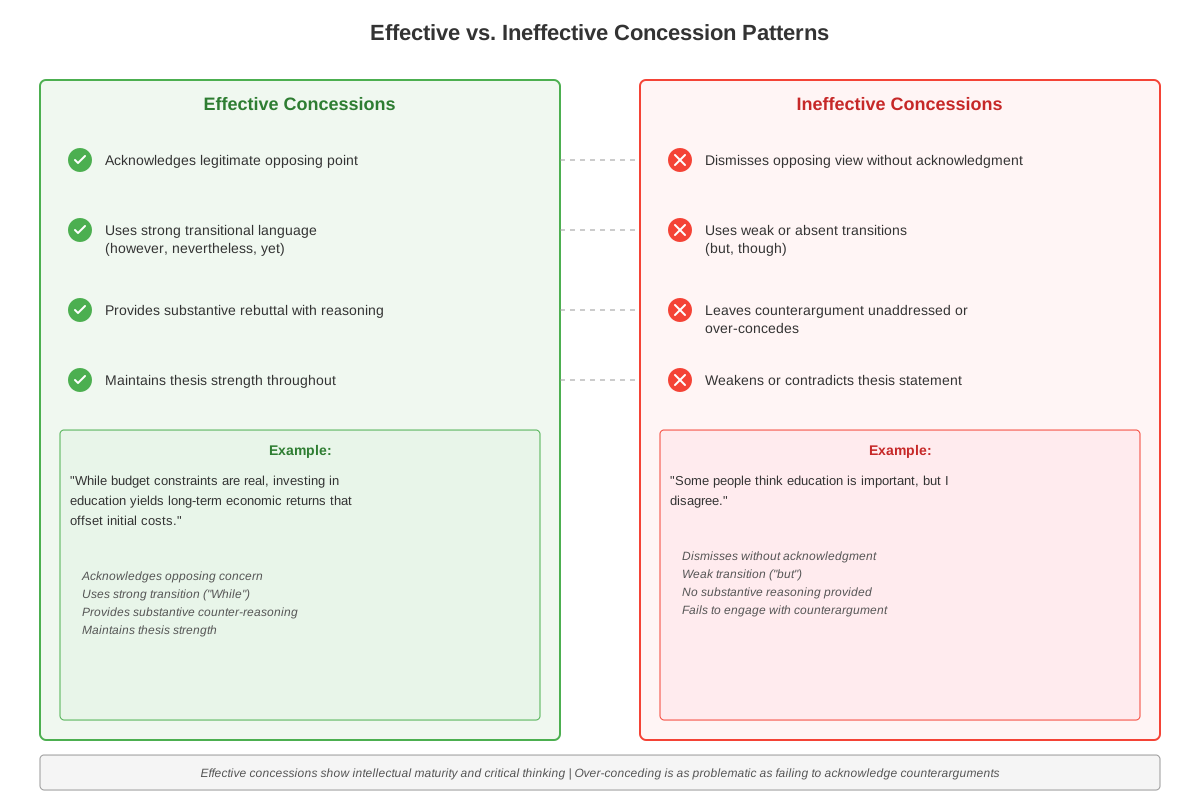
Effective concession typically combines an acknowledgment phrase with a contrast phrase: "Admittedly, technology has created some social isolation; however, it has simultaneously enabled unprecedented global connection."
Balancing Concession and Argument Strength
The most challenging aspect of concession involves acknowledging opposing views without undermining your own position. Several principles guide this balance:
Proportionality: Concessions should occupy approximately 10-20% of essay content. More than this risks appearing uncertain; less suggests insufficient engagement with complexity.
Selectivity: Address only the strongest or most relevant counterarguments. Acknowledging weak opposing points wastes space and may introduce doubts readers hadn't considered.
Confidence: Use definitive language when returning to your position after concession. Phrases like "more importantly," "the evidence overwhelmingly shows," and "ultimately" signal that your position remains superior.
Integration: Connect concessions back to your thesis explicitly. Each concession should include a clear explanation of why, despite the acknowledged point, your position remains valid.
Concept Relationships
The concept of concession exists within a network of interconnected argumentative strategies. At its foundation, concession depends on thesis development—a clear position statement provides the anchor point to which all concessions must ultimately return. Without a strong thesis, concessions can appear as contradictions rather than sophisticated acknowledgments.
Concession directly enables counterargument refutation, which represents the next logical step after acknowledging an opposing view. The relationship flows: Identify counterargument → Acknowledge its merit (concession) → Explain why it doesn't invalidate your position (refutation). This sequence demonstrates the critical thinking that GRE evaluators seek.
The relationship between concession and evidence presentation is bidirectional. Strong evidence makes concessions less risky because writers can confidently acknowledge opposing points knowing they have substantial support for their own position. Conversely, effective concessions create opportunities to present additional evidence that outweighs the acknowledged counterpoint.
Logical coherence serves as the framework within which concessions operate. Each concession must connect logically to surrounding arguments through appropriate transitions and clear reasoning. The relationship map appears as:
Thesis Statement → Main Arguments (with supporting evidence) → Concession (acknowledging strongest counterargument) → Refutation/Qualification (explaining why thesis remains valid) → Additional Supporting Arguments → Conclusion (restating strengthened thesis)
Concession also relates to tone and style in academic writing. The language used in concessions must maintain the formal, objective tone expected in GRE essays while demonstrating intellectual flexibility. This connection influences word choice, sentence structure, and the overall voice of the essay.
High-Yield Facts
⭐ Concession involves acknowledging opposing viewpoints while maintaining your argumentative position, demonstrating critical thinking rather than weakness.
⭐ Essays scoring 5.0-6.0 on the GRE Issue task typically include at least one well-developed concession with clear refutation or qualification.
⭐ The most effective concession structure follows the pattern: acknowledge → explain merit → refute/qualify → return to thesis.
⭐ Transitional phrases like "Admittedly," "Granted," and "To be sure" signal concession, while "However," "Nevertheless," and "Nonetheless" signal the return to your position.
⭐ Concessions should address the strongest counterarguments, not weak or irrelevant opposing points that waste space.
- Effective concessions occupy approximately 10-20% of total essay content, balancing acknowledgment with argument development.
- Placing concessions after the introduction or in a dedicated counterargument paragraph (typically paragraph 3 or 4) maximizes their strategic impact.
- Partial concessions that acknowledge limited validity ("in some cases," "under certain circumstances") allow writers to maintain stronger positions than full concessions.
- Concession language should remain confident and definitive when returning to the main argument, using phrases like "more importantly" or "ultimately."
- The GRE Issue task explicitly invites concession through prompts asking test-takers to consider challenges to their position or discuss "the extent" of agreement.
Quick check — test yourself on Concession so far.
Try Flashcards →Common Misconceptions
Misconception: Acknowledging opposing viewpoints weakens your argument and makes you appear uncertain or indecisive.
Correction: Strategic concession actually strengthens arguments by demonstrating intellectual honesty, critical thinking, and comprehensive understanding. Ignoring obvious counterarguments makes essays appear simplistic or dogmatic, resulting in lower scores.
Misconception: Concessions should only appear in essays where you partially agree with the prompt.
Correction: Concessions are valuable regardless of whether you strongly agree, strongly disagree, or take a middle position. Even when strongly disagreeing with a prompt, acknowledging why some people might hold the opposing view demonstrates sophisticated thinking.
Misconception: Longer, more detailed concessions demonstrate better critical thinking.
Correction: Concessions should be proportional and strategic. Spending too much time developing counterarguments can undermine your position. Brief acknowledgment followed by strong refutation is more effective than lengthy exploration of opposing views.
Misconception: Concessions must always be followed by complete refutation that proves the opposing point entirely wrong.
Correction: Effective concessions often involve qualification rather than complete refutation. Acknowledging that an opposing point has merit in limited circumstances while explaining why your position is more broadly applicable or more important demonstrates nuanced thinking.
Misconception: Using concession language like "Admittedly" or "Granted" is sufficient without actually engaging with counterarguments.
Correction: Transitional phrases alone don't constitute effective concession. Writers must genuinely acknowledge the merit of opposing views and explain the relationship between these views and their own position. Surface-level use of concession language without substantive engagement appears formulaic.
Misconception: Every body paragraph should include a concession to maximize sophistication.
Correction: Strategic placement of one or two well-developed concessions is more effective than scattering superficial acknowledgments throughout the essay. Quality and integration matter more than quantity.
Worked Examples
Example 1: Technology and Education Prompt
Prompt: "The best way to teach—whether as an educator, employer, or parent—is to praise positive actions and ignore negative ones."
Sample Concession Paragraph:
"Admittedly, positive reinforcement has demonstrated effectiveness in certain learning contexts, particularly with young children developing foundational skills. Educational psychology research confirms that praise can increase motivation and build confidence when learners are acquiring new abilities. In classroom settings where students face repeated failure, focusing on incremental successes rather than dwelling on mistakes can prevent discouragement and maintain engagement. This approach aligns with growth mindset principles that emphasize effort and improvement over innate ability.
However, ignoring negative actions entirely creates significant problems that outweigh these benefits. In professional environments, employees who receive no feedback about poor performance cannot improve, potentially harming organizational outcomes and their own career development. Moreover, in parenting contexts, completely ignoring negative behaviors—particularly those involving safety or ethics—would constitute neglect of fundamental developmental guidance. The most effective teaching approach combines acknowledgment of positive actions with constructive feedback about areas needing improvement, creating a balanced framework that promotes growth while maintaining necessary standards."
Analysis: This example demonstrates full concession with rebuttal. The writer acknowledges specific contexts where positive reinforcement works (young children, foundational skills, preventing discouragement) using the transitional phrase "Admittedly." The concession includes concrete reasoning (educational psychology research, growth mindset principles) that shows genuine engagement with the opposing view. The transition "However" signals the return to the writer's position, followed by specific examples (professional environments, parenting contexts) that explain why the concession doesn't invalidate the main argument. The paragraph concludes by explicitly stating the writer's position (balanced approach) in contrast to the prompt's absolute claim.
Example 2: Government and Individual Responsibility Prompt
Prompt: "Governments should place few, if any, restrictions on scientific research and development."
Sample Concession Sentences Integrated into Body Paragraph:
"Scientific progress has historically accelerated when researchers enjoy intellectual freedom to pursue unconventional hypotheses without bureaucratic interference. The development of CRISPR gene-editing technology, for instance, emerged from curiosity-driven research into bacterial immune systems rather than directed government programs. Granted, excessive regulation can stifle innovation by creating administrative burdens that divert resources from actual research, and some restrictions may reflect political considerations rather than legitimate ethical concerns. Nevertheless, certain areas of scientific research—particularly those involving human subjects, potential biological weapons, or technologies with catastrophic risk potential—require governmental oversight to prevent harm that individual researchers or private institutions might not adequately consider. The thalidomide tragedy of the 1960s, where inadequate testing protocols led to severe birth defects, illustrates the consequences of insufficient regulatory frameworks. While scientific freedom remains valuable, strategic government restrictions in high-risk domains protect public welfare without significantly impeding overall research progress."
Analysis: This example shows concession integrated within a larger argument paragraph rather than standing alone. The writer presents supporting evidence for their position (CRISPR development) before introducing a concession using "Granted." The concession acknowledges two legitimate concerns about regulation (administrative burden, political interference) without abandoning the main position. The transition "Nevertheless" returns to the thesis, followed by specific examples of necessary restrictions (human subjects, biological weapons) and historical evidence (thalidomide tragedy). The final sentence explicitly reconciles the concession with the main argument, showing how both can coexist through "strategic" rather than excessive restrictions.
Exam Strategy
When approaching GRE Issue prompts, immediately identify whether the statement makes an absolute claim ("always," "never," "only," "all") or presents a complex issue where reasonable disagreement exists. These characteristics signal opportunities for effective concession. During the brief planning period (2-3 minutes), list the strongest counterargument to your position—this becomes your concession target.
Trigger words and phrases that indicate concession opportunities include:
- Absolute language: "always," "never," "only," "all," "none," "every," "must"
- Universal claims about human behavior or societal needs
- Recommendations presented as the "best" or "only" approach
- Prompts explicitly asking about "extent" of agreement or to "consider challenges" to your position
Process-of-elimination approach: When deciding which counterarguments to address through concession, eliminate weak opposing points that would waste space. Focus on counterarguments that:
- Reasonable, intelligent people actually hold
- Have some empirical or logical support
- Directly challenge your strongest claims
- Readers are likely to think of themselves
Avoid addressing strawman arguments or tangential objections that don't meaningfully engage with your thesis.
Time allocation: In the 30-minute Issue task, dedicate approximately 3-5 minutes to developing your concession content. This typically translates to 3-6 sentences or one paragraph of your 4-5 paragraph essay. Don't let concession development consume time needed for your main arguments—remember that concession supports rather than replaces your primary evidence.
Structural decision-making: Choose concession placement based on the strength of the counterargument. If the opposing view is particularly compelling or widely held, address it early (paragraph 2) to remove it as an obstacle. If it's less central, place it later (paragraph 3 or 4) after establishing your main arguments. Never place substantive concessions in your conclusion.
Exam Tip: If you're running short on time, a single well-developed concession is more valuable than multiple superficial acknowledgments. Quality trumps quantity in demonstrating critical thinking.
Memory Techniques
ACR Mnemonic for concession structure:
- Acknowledge the opposing point
- Concede its limited merit or validity
- Return to your position with refutation or qualification
GRANT Framework for remembering when to use concession:
- Genuine counterarguments exist
- Reasonable people disagree
- Absolute language in prompt
- Nuanced thinking required
- Top scores demand complexity
Visualization Strategy: Picture concession as a bridge. You start on your side (your thesis), walk partway across to acknowledge the other side (concession), then walk back to your side with additional support (refutation). You never fully cross to the other side, but you demonstrate awareness of its existence.
Transitional Phrase Pairing: Remember concession phrases in pairs—one for acknowledging, one for returning:
- "Admittedly... However..."
- "Granted... Nevertheless..."
- "To be sure... Yet..."
- "Certainly... Nonetheless..."
The 80/20 Rule: Your position should occupy approximately 80% of essay content, with concession and counterargument acknowledgment comprising roughly 20%. This ratio helps maintain argumentative strength while demonstrating sophistication.
Summary
Concession represents a sophisticated rhetorical strategy essential for achieving top scores on the GRE Analytical Writing Issue task. By acknowledging opposing viewpoints while maintaining a clear argumentative position, test-takers demonstrate the critical thinking and intellectual maturity that graduate programs value. Effective concession follows a three-part structure: acknowledging the counterargument, explaining its limited merit, and returning to the main position with refutation or qualification. Strategic placement—typically after the introduction or in a dedicated counterargument paragraph—maximizes impact without undermining the thesis. Transitional language signals these moves clearly to readers, with phrases like "Admittedly" and "Granted" introducing concessions and "However" and "Nevertheless" marking the return to the main argument. The key to successful concession lies in proportionality and selectivity: addressing only the strongest counterarguments in approximately 10-20% of essay content. This balance allows writers to demonstrate comprehensive understanding while maintaining confident advocacy for their position, directly addressing the GRE scoring criteria that reward engagement with complexity and nuanced reasoning.
Key Takeaways
- Concession strengthens rather than weakens arguments by demonstrating critical thinking and intellectual honesty
- Effective concessions follow the pattern: acknowledge → explain merit → refute/qualify → return to thesis
- High-scoring GRE essays (5.0-6.0) typically include at least one well-developed concession with clear refutation
- Strategic transitional phrases ("Admittedly," "However," "Nevertheless") signal concession structure to readers
- Address only the strongest counterarguments that reasonable people actually hold, avoiding weak or tangential opposing points
- Concessions should occupy approximately 10-20% of essay content, maintaining proportionality with main arguments
- Placement matters: position concessions after the introduction or in a dedicated counterargument paragraph for maximum strategic impact
Related Topics
Counterargument Refutation: Building directly on concession skills, this topic explores techniques for systematically dismantling opposing arguments after acknowledging them. Mastering concession provides the foundation for effective refutation strategies.
Thesis Development and Positioning: Understanding how to craft nuanced thesis statements that accommodate complexity enables more sophisticated concession strategies. Strong theses create the anchor points to which concessions must return.
Evidence Selection and Analysis: The ability to choose and analyze compelling evidence determines how confidently writers can make concessions. Strong evidence allows acknowledgment of opposing views without risking argumentative strength.
Logical Fallacies and Reasoning: Recognizing common logical fallacies helps writers avoid weak concessions that inadvertently undermine their positions while identifying legitimate counterarguments worth acknowledging.
Advanced Paragraph Development: Integrating concessions seamlessly into body paragraphs requires sophisticated paragraph construction skills, including effective topic sentences, transitions, and concluding statements that maintain coherence.
Practice CTA
Now that you understand the strategic importance of concession in GRE Analytical Writing, it's time to apply these concepts to actual practice questions. Work through the practice prompts to identify concession opportunities, construct effective acknowledgment-refutation sequences, and integrate transitional language smoothly. Use the flashcards to reinforce key transitional phrases and concession structures until they become automatic. Remember that concession is a skill that improves with deliberate practice—each essay you write offers opportunities to refine your ability to acknowledge complexity while maintaining argumentative strength. Your investment in mastering this sophisticated rhetorical strategy will directly translate to higher scores and stronger graduate-level writing skills.
Sign up free to keep reading
Create a free AnvayaPrep account to finish this GRE guide on Concession — plus flashcards and practice questions.