Overview
The rebuttal is a critical component of the GRE Analytical Writing section, particularly within the "Analyze an Issue" task. A rebuttal represents the acknowledgment and systematic refutation of opposing viewpoints or counterarguments to the position a writer advocates. Mastering the art of rebuttal demonstrates intellectual maturity, critical thinking depth, and the ability to engage with complex ideas from multiple perspectives—all qualities that graduate programs seek in prospective students.
On the GRE, the ability to construct effective rebuttals distinguishes average essays from high-scoring ones. Test-takers who merely present their own position without addressing potential objections produce one-dimensional arguments that rarely score above a 4.0. In contrast, essays that anticipate counterarguments and systematically dismantle them through logical reasoning and evidence demonstrate the sophisticated analytical skills that earn scores of 5.0 or 6.0. The GRE rebuttal strategy involves more than simple disagreement; it requires understanding opposing perspectives deeply enough to expose their logical flaws, evidentiary gaps, or limited applicability.
Within the broader framework of Analytical Writing, rebuttal connects intimately with argument construction, evidence evaluation, and logical reasoning. While thesis development establishes what a writer believes, and supporting paragraphs explain why, the rebuttal section addresses the crucial question of "what about the other side?" This creates a dialectical structure that mirrors academic discourse and demonstrates readiness for graduate-level intellectual engagement. Effective rebuttals strengthen the overall argument by showing that the writer's position withstands scrutiny even when challenged by reasonable alternative perspectives.
Learning Objectives
- [ ] Identify when Rebuttal is being tested in GRE Analytical Writing prompts
- [ ] Explain the core rule or strategy behind Rebuttal construction
- [ ] Apply Rebuttal to GRE-style questions accurately
- [ ] Distinguish between weak and strong rebuttal techniques in sample essays
- [ ] Construct multi-layered rebuttals that address both surface-level and fundamental objections
- [ ] Integrate rebuttals seamlessly into essay structure without disrupting argumentative flow
- [ ] Evaluate the relative strength of different counterarguments to prioritize which to address
Prerequisites
- Basic argument structure: Understanding thesis statements, topic sentences, and supporting evidence is essential because rebuttals function as specialized argumentative components within the larger essay framework.
- Logical reasoning fundamentals: Familiarity with deductive and inductive reasoning enables recognition of logical flaws in counterarguments that rebuttals exploit.
- Evidence evaluation: The ability to assess the quality and relevance of evidence allows writers to identify weaknesses in opposing positions that rebuttals can target.
- Paragraph organization: Knowledge of effective paragraph construction ensures rebuttals integrate smoothly rather than appearing as disconnected afterthoughts.
Why This Topic Matters
In professional and academic contexts, the ability to anticipate and address objections is fundamental to persuasive communication. Researchers must address potential criticisms in grant proposals, attorneys must counter opposing counsel's arguments, and business leaders must respond to stakeholder concerns. The rebuttal skill developed for the GRE transfers directly to these real-world applications, making it one of the most practically valuable components of the Analytical Writing section.
On the GRE specifically, rebuttal appears in approximately 85-90% of high-scoring Issue essays. ETS scoring guidelines explicitly reward "thoughtful consideration of alternative perspectives" and "addressing potential counterarguments." Essays that omit rebuttals rarely score above 4.0, regardless of how well-developed their supporting arguments are. The scoring rubric for the 5.0-6.0 range specifically mentions "insightful analysis" and "compelling examination of implications," both of which typically require engaging with opposing viewpoints.
Common manifestations of rebuttal opportunities in GRE prompts include: statements with absolute language ("always," "never," "only") that invite consideration of exceptions; claims about causation that could have alternative explanations; policy recommendations that might have unintended consequences; and value judgments that different stakeholders might dispute. Recognizing these patterns allows test-takers to identify where rebuttals will strengthen their essays most effectively.
Core Concepts
Definition and Function of Rebuttal
A rebuttal is a structured response to a counterargument that demonstrates why an opposing viewpoint, while potentially reasonable on the surface, ultimately fails to undermine the writer's thesis. Unlike simple dismissal or contradiction, effective rebuttals engage seriously with opposing perspectives, acknowledge their potential validity in limited contexts, and then systematically explain why they don't apply to the situation at hand or why they're outweighed by stronger considerations.
The primary function of rebuttal in GRE essays is to demonstrate intellectual sophistication and argumentative completeness. By addressing potential objections preemptively, writers show they've considered multiple angles of an issue rather than cherry-picking evidence that supports a predetermined conclusion. This creates credibility and makes the overall argument more persuasive because readers see that the writer's position withstands scrutiny.
The Three-Part Rebuttal Structure
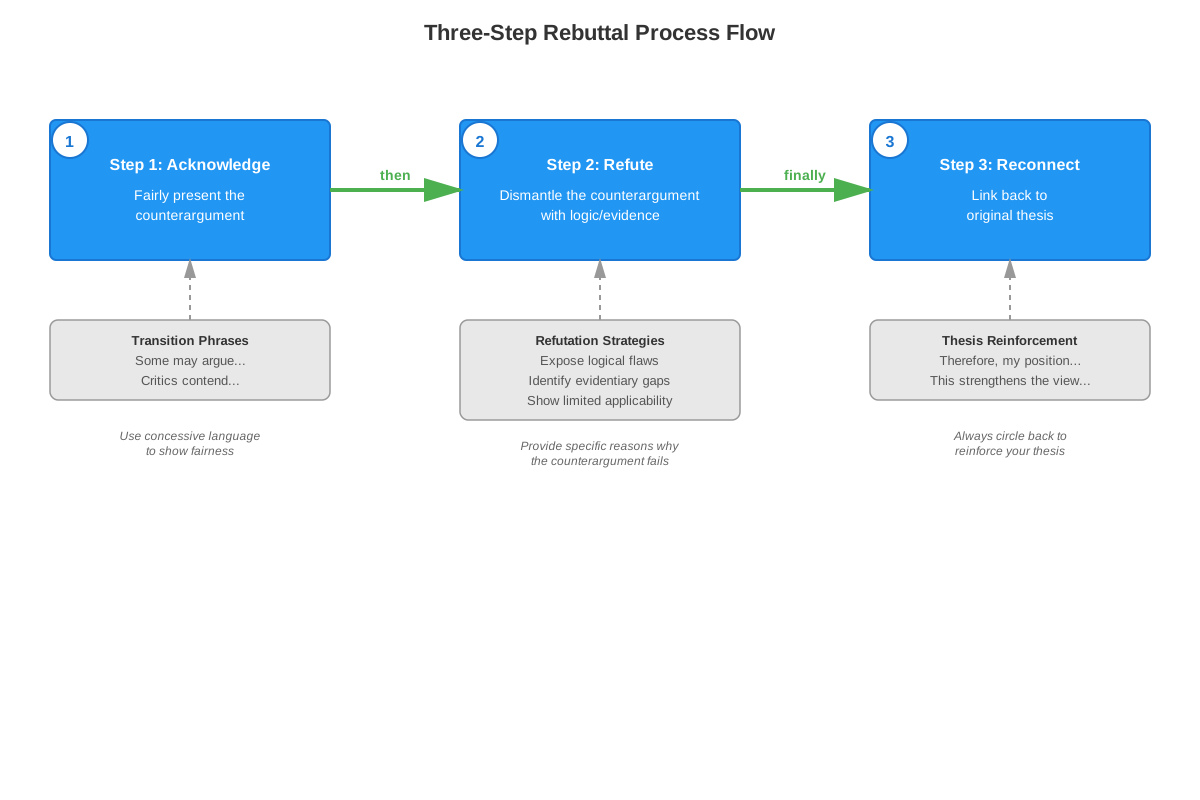
Effective rebuttals typically follow a three-part structure that can be remembered as ACR: Acknowledge, Counter, Reinforce.
Acknowledge: Begin by fairly representing the counterargument without strawmanning or oversimplifying. This demonstrates intellectual honesty and shows the writer understands opposing perspectives. For example: "Proponents of standardized testing argue that these assessments provide objective measures of student achievement across diverse educational contexts."
Counter: Present logical reasoning, evidence, or analysis that reveals limitations, flaws, or inapplicability of the counterargument. This is the substantive core of the rebuttal. Continuing the example: "However, this objectivity is illusory because standardized tests measure only a narrow band of cognitive skills while ignoring creativity, collaboration, and practical problem-solving abilities that are equally important for academic and professional success."
Reinforce: Connect back to the thesis by explaining how the rebuttal strengthens the original position. This prevents the rebuttal from becoming a digression. Completing the example: "Therefore, rather than providing genuine objectivity, standardized tests create a false equivalence that privileges certain types of intelligence while systematically undervaluing others, supporting the argument that alternative assessment methods should be developed."
Types of Counterarguments to Address
Understanding the categories of counterarguments helps writers identify which objections to rebut in their essays:
| Counterargument Type | Description | Rebuttal Strategy |
|---|---|---|
| Practical Objection | Claims the proposal is too difficult, expensive, or time-consuming to implement | Demonstrate feasibility through examples, compare costs to benefits, or show phased implementation |
| Alternative Explanation | Suggests a different cause or interpretation of evidence | Show why the alternative is less plausible, has less supporting evidence, or doesn't account for all observations |
| Exception or Edge Case | Points to situations where the general rule doesn't apply | Acknowledge the exception while showing it doesn't invalidate the general principle or affects only a small minority of cases |
| Value Conflict | Prioritizes a different value or goal | Argue for the relative importance of competing values or show how both can be accommodated |
| Unintended Consequence | Warns of negative side effects | Demonstrate the consequence is unlikely, manageable, or outweighed by benefits |
Strategic Placement of Rebuttals
The positioning of rebuttals within an essay affects their impact and the overall argumentative flow. Three main placement strategies exist:
Integrated Approach: Address counterarguments within supporting paragraphs immediately after presenting related evidence. This creates a point-counterpoint rhythm that feels dynamic and responsive. For instance, after arguing that technology enhances education, immediately address concerns about screen time before moving to the next supporting point.
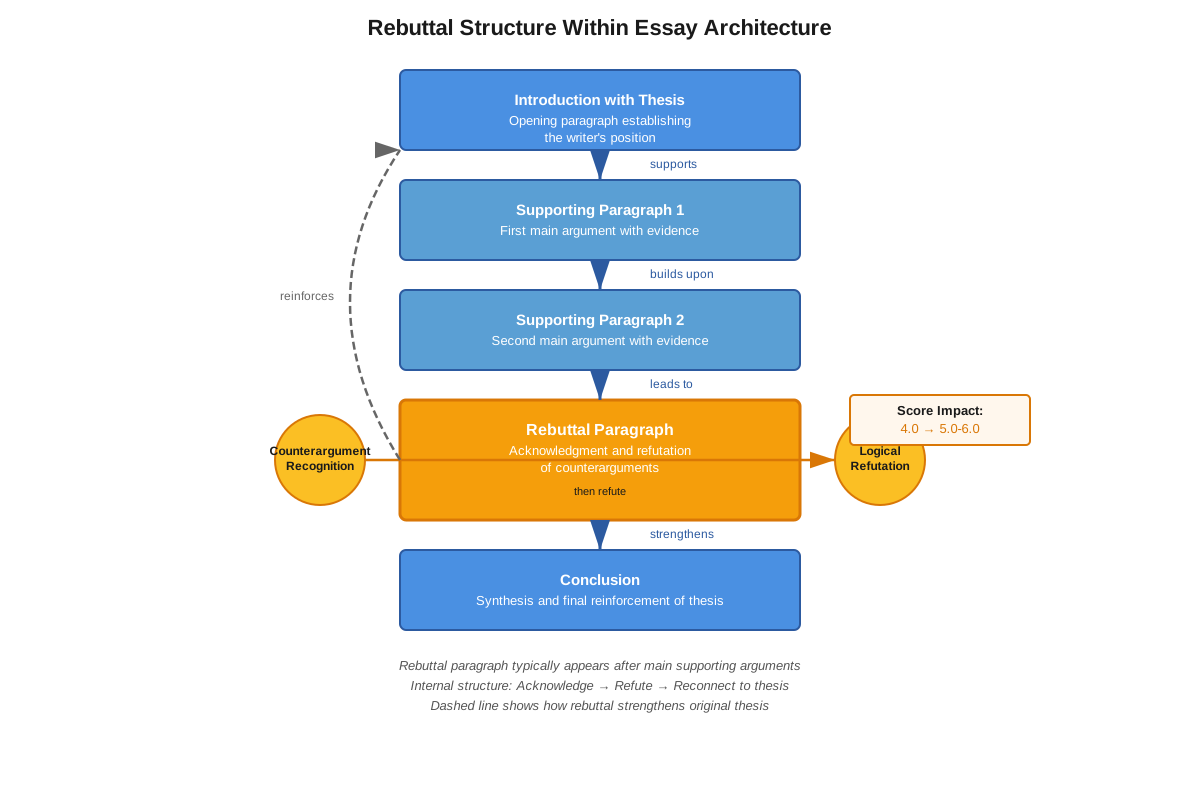
Dedicated Paragraph: Create a separate paragraph (typically the penultimate one) that addresses multiple counterarguments systematically. This approach works well when several related objections can be grouped together and when the writer wants to demonstrate comprehensive consideration of opposing views.
Hybrid Strategy: Combine both approaches by addressing minor objections within supporting paragraphs while dedicating a full paragraph to the strongest counterargument. This is often the most effective strategy for GRE essays because it shows nuanced thinking throughout while giving serious attention to the most substantial opposition.
Rebuttal Strength Hierarchy
Not all rebuttals carry equal persuasive weight. Understanding this hierarchy helps writers construct more compelling responses:
- Logical Refutation: Demonstrates internal contradiction or logical fallacy in the counterargument (strongest)
- Empirical Contradiction: Provides evidence that directly contradicts the counterargument's factual claims
- Scope Limitation: Shows the counterargument applies only to narrow circumstances
- Comparative Weighing: Acknowledges validity but argues the writer's position is more important or applicable
- Concession with Qualification: Accepts part of the counterargument while maintaining the overall thesis (weakest, but sometimes necessary)
Common Rebuttal Techniques
Several specific techniques strengthen rebuttals in GRE essays:
The "Even If" Technique: Temporarily grant the counterargument's premise, then show the thesis still holds. Example: "Even if we accept that standardized tests measure certain skills objectively, this doesn't justify using them as the sole criterion for college admissions."
The Burden of Proof Shift: Question whether the counterargument has sufficient evidence to support its claims. Example: "While critics claim that environmental regulations harm economic growth, they provide no empirical data demonstrating causation rather than mere correlation."
The False Dichotomy Exposure: Reveal that the counterargument presents a false either-or choice when other options exist. Example: "The assumption that we must choose between economic development and environmental protection ignores sustainable development models that achieve both simultaneously."
The Precedent Challenge: Question whether past examples cited by counterarguments actually apply to the current situation. Example: "Historical instances of failed government programs don't necessarily predict the outcome of this proposal, which incorporates safeguards specifically designed to address those earlier shortcomings."
Concept Relationships
The rebuttal concept connects to other Analytical Writing elements through multiple pathways. Thesis development → establishes the position that rebuttals defend → supporting arguments provide the positive case → rebuttals address challenges to that case → conclusion synthesizes how the argument withstands scrutiny. This sequential relationship creates a complete argumentative arc.
Rebuttals also have a reciprocal relationship with evidence evaluation. Strong evidence makes rebuttals more convincing, while the process of constructing rebuttals often reveals what additional evidence would strengthen the argument. Similarly, logical reasoning both enables rebuttal construction (by identifying flaws in counterarguments) and is strengthened by it (by forcing writers to examine their own reasoning more rigorously).
Within the rebuttal itself, the three components (Acknowledge-Counter-Reinforce) form a dependent sequence: acknowledgment without countering is mere summary, countering without acknowledgment appears defensive or strawmanning, and countering without reinforcement creates digression. Each element depends on the others for effectiveness.
The relationship between rebuttal and audience awareness is particularly important. Effective rebuttals anticipate what objections the specific audience would raise, requiring writers to consider multiple perspectives simultaneously. This connects rebuttal to the broader skill of rhetorical analysis—understanding how different audiences respond to different types of arguments.
High-Yield Facts
⭐ Essays that include substantive rebuttals score an average of 0.5-1.0 points higher than those that don't, according to ETS data analysis.
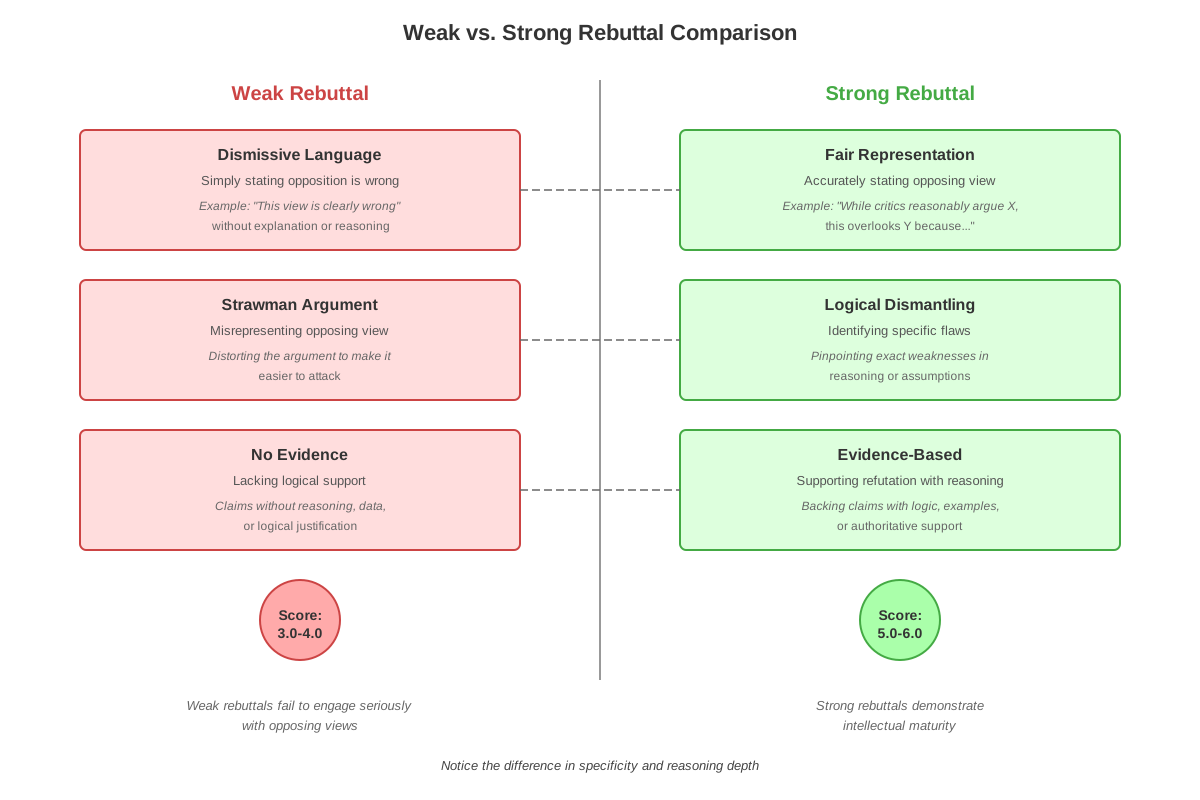
⭐ The most effective rebuttals acknowledge counterarguments fairly before refuting them; strawman rebuttals that misrepresent opposing views are penalized in scoring.
⭐ Addressing at least one significant counterargument is explicitly mentioned in the GRE scoring rubric for scores of 5.0 and above.
⭐ Rebuttals should comprise approximately 15-20% of the total essay length—typically one full paragraph or several integrated mini-rebuttals.
⭐ The strongest rebuttals expose logical flaws rather than merely presenting contradictory evidence, as logical refutation is more definitive.
- Transition phrases like "admittedly," "critics might argue," and "some contend that" signal rebuttal sections to readers and scorers.
- Rebuttals placed too early in an essay can confuse readers who haven't yet understood the main argument being defended.
- Addressing multiple weak counterarguments is less effective than thoroughly rebutting one strong objection.
- Conceding minor points while defending the core thesis demonstrates nuance and often strengthens credibility more than absolute positions.
- The "even if" technique is particularly valuable on timed exams because it allows writers to address counterarguments efficiently without extensive evidence gathering.
- Rebuttals should never introduce entirely new supporting arguments for the thesis; their function is defensive, not offensive.
- Effective rebuttals often reveal unstated assumptions in counterarguments, exposing why those arguments rest on shaky foundations.
Quick check — test yourself on Rebuttal so far.
Try Flashcards →Common Misconceptions
Misconception: Rebuttals weaken an argument by acknowledging opposing views. → Correction: Rebuttals actually strengthen arguments by demonstrating they withstand scrutiny. Ignoring counterarguments makes essays appear one-sided and intellectually shallow, while addressing them shows confidence and thoroughness.
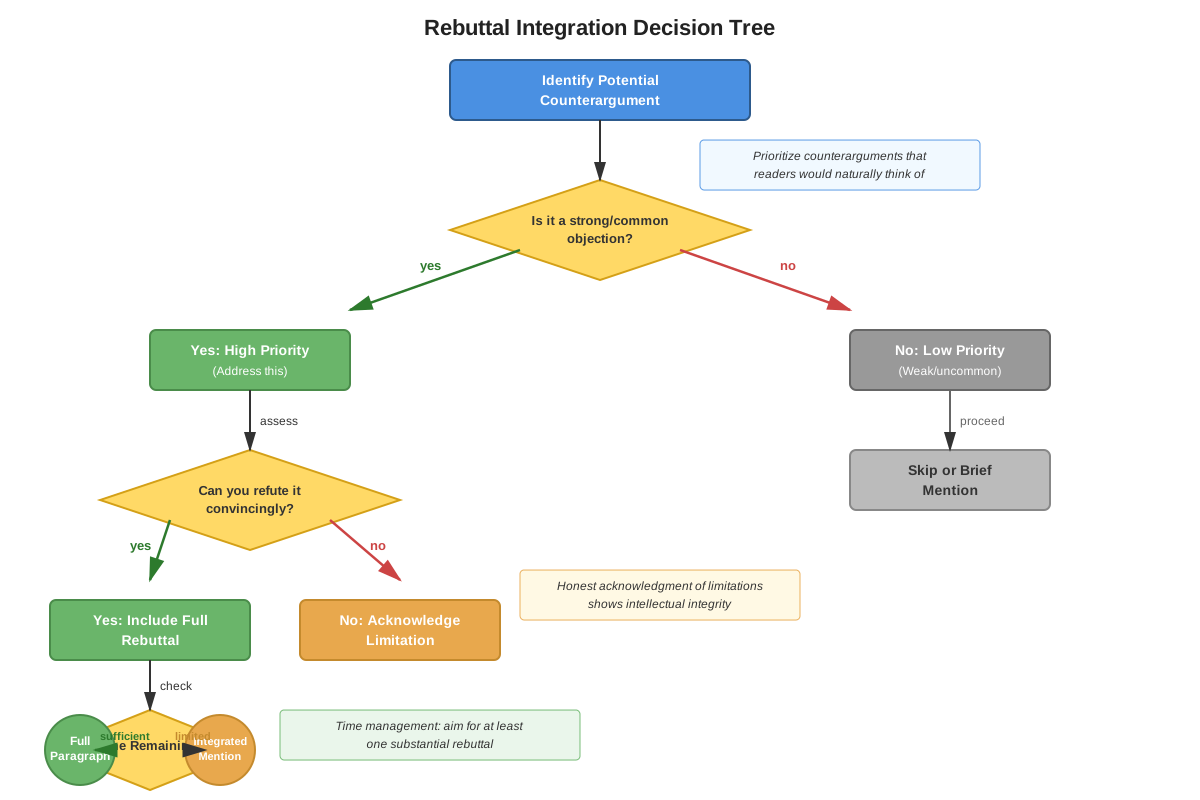
Misconception: Writers should address every possible counterargument to show comprehensive thinking. → Correction: Addressing too many counterarguments dilutes focus and consumes valuable time. Writers should identify the 1-2 strongest objections and rebut those thoroughly rather than superficially addressing many weak objections.
Misconception: Rebuttals should completely demolish counterarguments to be effective. → Correction: Sometimes the most sophisticated rebuttals acknowledge partial validity in counterarguments while explaining why they don't undermine the thesis. Absolute refutation isn't always possible or necessary; comparative weighing often suffices.
Misconception: Rebuttals and counterarguments are the same thing. → Correction: A counterargument is an objection to the writer's position, while a rebuttal is the writer's response to that counterargument. The counterargument is what opponents would say; the rebuttal is what the writer says back.
Misconception: Rebuttals should use aggressive or dismissive language to show confidence. → Correction: Effective rebuttals maintain respectful, analytical tone even while disagreeing. Phrases like "this view fails to consider" work better than "this argument is completely wrong" because they maintain academic discourse standards.
Misconception: The rebuttal paragraph should come at the end of the essay, just before the conclusion. → Correction: While this placement can work, rebuttals are often more effective when integrated throughout the essay or placed after the supporting arguments but before the conclusion. Ending with a rebuttal can leave readers focused on objections rather than the thesis.
Misconception: Writers should only rebut counterarguments they can completely refute. → Correction: Sometimes addressing a strong counterargument that can't be fully refuted—but can be outweighed or contextualized—demonstrates more intellectual honesty and sophistication than ignoring it or only addressing weak objections.
Worked Examples
Example 1: Technology in Education Prompt
Prompt: "The increasing use of technology in classrooms is more harmful than beneficial to student learning. Discuss the extent to which you agree or disagree with this statement."
Writer's Position: Technology in classrooms is primarily beneficial when implemented thoughtfully.
Counterargument to Address: Technology reduces face-to-face interaction and social skill development.
Worked Rebuttal:
Acknowledge: "Critics of classroom technology reasonably point out that increased screen time may reduce opportunities for face-to-face interaction, potentially hindering students' development of crucial social skills like reading body language, engaging in spontaneous conversation, and building interpersonal relationships."
Counter: "However, this concern conflates technology use with technology misuse. When properly implemented, educational technology actually facilitates different types of social interaction rather than eliminating it. Collaborative platforms like Google Docs enable students to work together on projects in real-time, providing written communication practice that complements rather than replaces verbal interaction. Video conferencing tools connect classrooms with experts, students in other countries, and diverse perspectives that would be impossible to access otherwise. Furthermore, the dichotomy between 'screen time' and 'social time' is increasingly artificial in a world where much professional and social interaction occurs through digital mediums."
Reinforce: "Rather than viewing technology as inherently antisocial, educators should recognize it as a tool that, when thoughtfully integrated, expands the range of social interactions available to students, preparing them for a world where digital communication skills are as essential as traditional face-to-face abilities."
Analysis: This rebuttal succeeds because it (1) fairly represents the counterargument without exaggeration, (2) distinguishes between technology itself and how it's used, (3) provides specific examples of technology facilitating social interaction, (4) challenges the underlying assumption that digital interaction isn't "real" social interaction, and (5) connects back to the thesis about thoughtful implementation. The rebuttal uses the "false dichotomy exposure" technique by showing that screen time and social development aren't mutually exclusive.
Example 2: Specialization vs. Broad Education Prompt
Prompt: "Universities should require all students to take courses outside their major field of study to ensure a well-rounded education."
Writer's Position: Disagree—students should have flexibility to focus on their chosen field.
Counterargument to Address: Broad education creates more adaptable graduates who can think across disciplines.
Worked Rebuttal:
Acknowledge: "Proponents of general education requirements argue persuasively that exposure to diverse disciplines creates more adaptable graduates capable of integrating insights from multiple fields—a valuable skill in an increasingly interdisciplinary professional landscape."
Counter: "While this interdisciplinary ideal is appealing, mandatory distribution requirements often fail to achieve it in practice. Students frequently approach required courses outside their major as obstacles to overcome rather than opportunities to explore, selecting the easiest options to fulfill requirements with minimal effort. This 'checkbox mentality' produces superficial exposure rather than genuine intellectual broadening. Moreover, the assumption that breadth must come through formal coursework ignores the reality that deep expertise in one field often requires understanding adjacent disciplines. Engineering students studying structural design naturally encounter physics, materials science, and even aesthetics; literature students analyzing historical texts engage with history, philosophy, and sociology. This organic interdisciplinarity, driven by genuine intellectual need rather than administrative mandate, produces more meaningful integration of diverse perspectives."
Reinforce: "Therefore, rather than mandating breadth through distribution requirements, universities should trust students to develop the interdisciplinary knowledge their chosen field demands, resulting in more motivated learning and more authentic intellectual integration."
Analysis: This rebuttal employs the "empirical contradiction" technique by pointing to the reality of how students actually respond to requirements, and the "alternative explanation" strategy by showing that interdisciplinary learning happens naturally through deep study. It's particularly effective because it accepts the value of interdisciplinary thinking (the goal behind the counterargument) while questioning whether mandatory distribution requirements actually achieve that goal. The rebuttal also uses specific examples to make abstract concepts concrete.
Exam Strategy
When approaching GRE Issue essays, identify rebuttal opportunities during the initial planning phase (2-3 minutes). As you outline your supporting arguments, ask yourself: "What would someone who disagrees with me say about this?" The most productive counterarguments to address are those that challenge your strongest points, not your weakest ones—rebutting objections to your best arguments shows your position is truly robust.
Trigger words in prompts that signal rebuttal opportunities include: "always," "never," "only," "must," "should," "best," and "most important." These absolute or comparative terms invite consideration of exceptions, alternatives, or competing priorities. When you see these words, immediately think about contexts where the claim might not hold or values that might conflict with the stated priority.
Process-of-elimination for rebuttal construction: If struggling to formulate a rebuttal, work backwards. First, identify what someone opposing your thesis would say. Second, ask what evidence or reasoning that counterargument relies on. Third, question whether that evidence is sufficient, whether the reasoning is sound, or whether the conclusion follows from the premises. This systematic approach reveals rebuttal angles even when they don't immediately come to mind.
Time allocation: In a 30-minute Issue essay, dedicate approximately 4-5 minutes to rebuttal content. This might be one full paragraph (3-4 minutes to write) plus transitions (1 minute), or 2-3 integrated mini-rebuttals (1.5-2 minutes each). Don't let rebuttal consume more than 20% of your writing time, as the positive case for your thesis remains primary.
Exam Tip: If running short on time, a single well-developed rebuttal is better than multiple rushed ones. Quality trumps quantity in demonstrating analytical sophistication.
Strategic rebuttal selection: When multiple counterarguments exist, prioritize based on: (1) strength—address the most compelling objection, not the easiest to dismiss; (2) relevance—choose counterarguments directly related to your main supporting points; (3) scope—prefer counterarguments that, when rebutted, strengthen your entire thesis rather than just one supporting point.
Language precision: Use hedging language appropriately in rebuttals. Phrases like "may," "might," "could," and "in some cases" acknowledge uncertainty without undermining your argument. However, don't over-hedge to the point of seeming indecisive. Balance confidence in your position with intellectual humility about limitations.
Memory Techniques
ACR Mnemonic: Remember the three-part rebuttal structure as ACR = Acknowledge, Counter, Reinforce. Visualize an "acre" of land that you're defending against encroachment—you acknowledge the boundary dispute, counter the claim, and reinforce your property rights.
The DEBATE Framework for identifying counterarguments:
- Different values (what if someone prioritizes different goals?)
- Exceptions (when might this not apply?)
- Burden of proof (what evidence is missing?)
- Alternative explanations (what else could account for this?)
- Trade-offs (what are the costs or downsides?)
- Execution challenges (what practical obstacles exist?)
Visualization Strategy: Picture your argument as a fortress and counterarguments as attacking forces. Your rebuttals are defensive structures—walls, moats, towers—that protect against specific types of attacks. This mental model helps you think strategically about which defenses (rebuttals) are most important to construct given the likely attacks (counterarguments) your position faces.
The "Even If" Shortcut: When stuck, start any sentence with "Even if [counterargument], [thesis still holds because]..." This formula automatically generates rebuttal structure and often reveals angles you hadn't considered.
Acronym for Rebuttal Strength: LESCO ranks rebuttal types from strongest to weakest:
- Logical refutation
- Empirical contradiction
- Scope limitation
- Comparative weighing
- Outright concession
Summary
Rebuttal represents a sophisticated analytical skill that distinguishes high-scoring GRE essays from mediocre ones by demonstrating the writer's ability to engage with multiple perspectives on complex issues. Effective rebuttals follow a three-part structure—acknowledging counterarguments fairly, countering them with logical reasoning or evidence, and reinforcing how this strengthens the original thesis. The strategic placement of rebuttals, whether integrated throughout the essay or concentrated in a dedicated paragraph, affects argumentative flow and persuasive impact. Understanding different types of counterarguments (practical objections, alternative explanations, exceptions, value conflicts, and unintended consequences) enables writers to anticipate and address the most relevant objections to their positions. The strongest rebuttals expose logical flaws or challenge unstated assumptions rather than merely presenting contradictory evidence. By dedicating approximately 15-20% of essay length to rebuttal content and selecting the most compelling counterarguments to address, test-takers demonstrate the intellectual maturity and analytical sophistication that graduate programs value, typically improving scores by 0.5-1.0 points compared to essays that ignore opposing perspectives entirely.
Key Takeaways
- Rebuttals are essential for scores of 5.0 and above; essays without them rarely exceed 4.0 regardless of other strengths
- The ACR structure (Acknowledge-Counter-Reinforce) provides a reliable framework for constructing effective rebuttals
- Address 1-2 strong counterarguments thoroughly rather than many weak ones superficially
- Fair acknowledgment of opposing views demonstrates intellectual honesty and strengthens credibility
- Rebuttals should comprise approximately 15-20% of total essay length and can be integrated or concentrated in a dedicated paragraph
- The strongest rebuttals expose logical flaws or challenge assumptions rather than merely presenting contradictory evidence
- Strategic rebuttal placement—after establishing the positive case but before the conclusion—typically produces the most persuasive essays
Related Topics
Argument Analysis Task: While Issue essays require constructing rebuttals to defend your own position, the Argument task requires identifying flaws in someone else's argument—a complementary skill that strengthens overall analytical ability. Mastering rebuttal in Issue essays provides excellent preparation for recognizing logical weaknesses in Argument prompts.
Logical Fallacies: Understanding common reasoning errors (ad hominem, false dichotomy, slippery slope, etc.) enhances both rebuttal construction and counterargument identification. Many effective rebuttals work by exposing fallacies in opposing positions.
Evidence Evaluation: The ability to assess evidence quality, relevance, and sufficiency directly supports rebuttal construction by revealing weaknesses in counterarguments' factual foundations. This skill also helps writers select the strongest evidence for their own rebuttals.
Thesis Development: Strong thesis statements anticipate potential objections and position the argument to address them effectively. Understanding rebuttal improves thesis formulation by encouraging writers to consider their position's vulnerabilities during the planning phase.
Conclusion Writing: Effective conclusions often briefly reference how the argument withstands the counterarguments addressed in rebuttals, creating a sense of completeness and intellectual rigor. Mastering rebuttal enables more sophisticated conclusion strategies.
Practice CTA
Now that you understand the principles and strategies of effective rebuttal construction, apply this knowledge through targeted practice. Work through the practice questions to identify rebuttal opportunities in various prompts, and use the flashcards to reinforce key concepts like the ACR structure and rebuttal strength hierarchy. Remember that rebuttal is a skill that improves dramatically with practice—each essay you write provides an opportunity to refine your ability to anticipate objections and construct compelling responses. The investment you make in mastering rebuttal will pay dividends not only on test day but throughout your graduate education and professional career, where the ability to address opposing viewpoints persuasively is invaluable. Start practicing today, and watch your analytical writing scores rise!
Sign up free to keep reading
Create a free AnvayaPrep account to finish this GRE guide on Rebuttal — plus flashcards and practice questions.