Overview
The issue essay scoring criteria form the foundation of success on the GRE Analytical Writing section's "Analyze an Issue" task. Understanding these criteria is not merely about knowing what graders look for—it represents a comprehensive framework for constructing persuasive, well-reasoned arguments under timed conditions. The GRE issue essay scoring criteria encompass six distinct score levels (0-6) with specific descriptors that evaluate how effectively test-takers develop and support a position on a given issue. These criteria assess multiple dimensions simultaneously: the clarity and insightfulness of ideas, the organization and development of arguments, the use of relevant examples and reasoning, and the facility with language and conventions of standard written English.
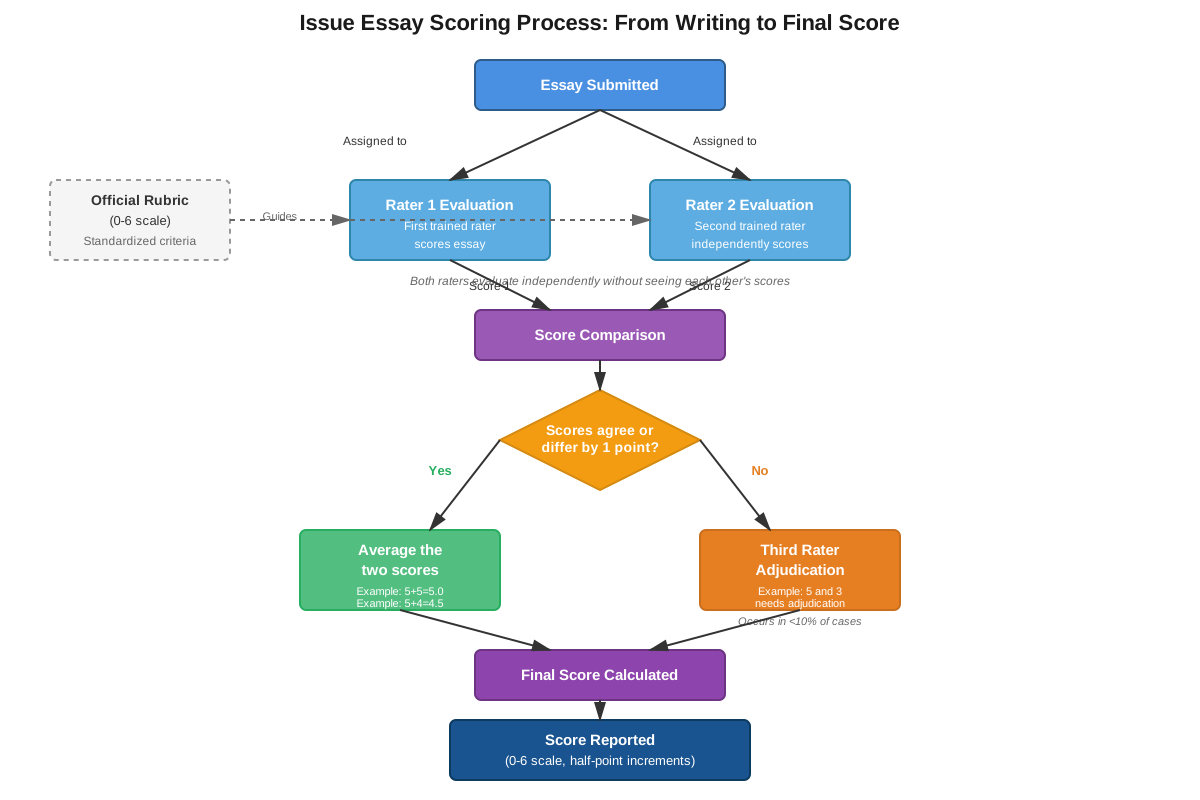
Mastering these scoring criteria is essential because they serve as both the roadmap for essay construction and the lens through which trained raters evaluate performance. Unlike subjective grading systems, the GRE employs highly specific rubrics that allow test-takers to reverse-engineer successful responses. Each essay receives two independent scores from trained raters, and these scores are averaged (or adjudicated by a third rater if they differ by more than one point) to produce a final score on the 0-6 scale, reported in half-point increments. This systematic approach means that understanding the criteria provides a competitive advantage: students can align their writing strategies directly with what evaluators prioritize.
Within the broader Analytical Writing section, the issue essay scoring criteria connect intimately with fundamental skills in critical thinking, argumentation, and academic writing. These criteria don't exist in isolation—they reflect the same analytical and compositional abilities tested in the Argument essay task, though applied differently. While the Argument essay asks test-takers to critique someone else's reasoning, the Issue essay requires constructing original arguments, making the scoring criteria particularly focused on idea generation, position development, and the sophistication of one's own reasoning rather than analytical deconstruction.
Learning Objectives
- [ ] Identify when Issue essay scoring criteria is being tested
- [ ] Explain the core rule or strategy behind Issue essay scoring criteria
- [ ] Apply Issue essay scoring criteria to GRE-style questions accurately
- [ ] Distinguish between score levels by analyzing specific textual features and organizational patterns
- [ ] Evaluate sample essays using the official rubric to predict scores within one point
- [ ] Construct essays that deliberately incorporate high-scoring elements from multiple criteria dimensions
- [ ] Diagnose weaknesses in practice essays by mapping deficiencies to specific scoring criteria
Prerequisites
- Basic essay structure: Understanding of introduction, body paragraphs, and conclusion organization is essential because the scoring criteria evaluate how effectively these components work together to develop ideas
- Argumentation fundamentals: Familiarity with claims, evidence, and reasoning enables recognition of how the criteria assess logical development and support
- Academic writing conventions: Knowledge of standard written English grammar, syntax, and usage is necessary since language facility constitutes one dimension of the scoring rubric
- Critical thinking skills: Ability to analyze complex issues from multiple perspectives underlies the criteria's emphasis on insightful analysis and nuanced position-taking
Why This Topic Matters
Understanding the issue essay scoring criteria directly impacts performance on a high-stakes component of the GRE. The Analytical Writing section, while sometimes underemphasized by test-takers focused on Quantitative and Verbal scores, carries significant weight in graduate admissions decisions. Many programs establish minimum writing score thresholds, and competitive programs often view strong writing scores as differentiators among candidates with similar quantitative and verbal performance. Business schools, in particular, frequently cite analytical writing scores when evaluating communication skills essential for case discussions and professional presentations.
On the exam itself, the Issue essay appears as one of two Analytical Writing tasks, and test-takers have exactly 30 minutes to plan, write, and review their response. The scoring criteria appear in approximately 100% of Issue essay evaluations—they are not optional or variable. Every single Issue essay written on the GRE is assessed using the identical six-level rubric, making this knowledge universally applicable. The criteria manifest in exam passages through the evaluation of how well test-takers articulate and develop a position on issues ranging from education policy to technology's societal impact, from governmental responsibilities to the nature of progress and innovation.
Statistical data from ETS reveals that the mean Analytical Writing score hovers around 3.5-4.0, with scores of 5.0 or higher placing test-takers in approximately the 80th percentile or above. This distribution demonstrates that truly understanding and applying the scoring criteria—rather than simply writing competently—creates measurable competitive advantage. Graduate programs in humanities, social sciences, and professional fields weight these scores particularly heavily, recognizing that the criteria assess skills directly transferable to graduate-level research, writing, and analysis.
Core Concepts
The Six-Level Scoring Scale
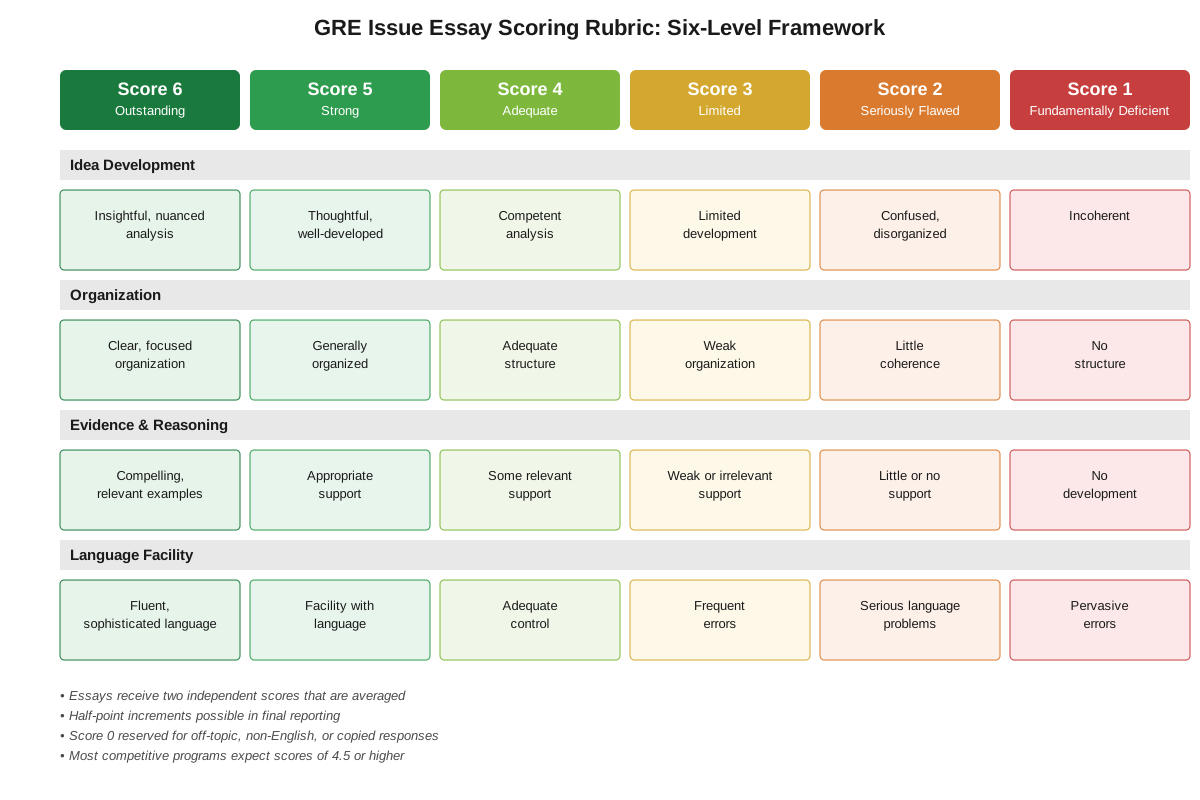
The issue essay scoring criteria operate on a six-level scale from 0 to 6, with each level representing distinct performance characteristics. Scores are reported in half-point increments (e.g., 4.5, 5.0) because two raters independently score each essay and their scores are averaged. Understanding this scale requires recognizing that it is not merely quantitative but qualitative—each level represents a fundamentally different type of essay performance.
Score 6 (Outstanding): Essays at this level present a cogent, well-articulated analysis of the issue's complexities. They develop a position with insightful reasons and persuasive examples, maintaining focus while exploring subtleties and implications. Organization is clear and logical, with smooth transitions connecting ideas. Language is precise, varied, and demonstrates facility with the conventions of standard written English, though minor errors may appear.
Score 5 (Strong): These essays present a generally thoughtful, well-developed analysis. They take a clear position and support it with relevant reasons and examples, though the analysis may not be as insightful or compelling as a 6. Organization is clear and ideas are connected logically, though transitions may be less sophisticated. Language is clear and demonstrates good control of standard written English, with occasional minor errors.
Score 4 (Adequate): Essays at this level present a competent analysis of the issue. They develop a position with relevant reasons and examples, though development may be limited. Organization is adequate, with ideas generally connected, but transitions may be mechanical. Language demonstrates adequate control, with some errors that do not significantly interfere with meaning.
Score 3 (Limited): These essays demonstrate some competence in analytical writing but are clearly flawed. They may have vague or limited analysis, weak development of ideas, poor organization, frequent problems with language use and sentence structure, or patterns of errors in grammar and usage.
Score 2 (Seriously Flawed): Essays at this level demonstrate serious weaknesses in analytical writing. They may provide little or no development of a position, lack organization, demonstrate fundamental problems with language use, or contain pervasive errors that interfere with meaning.
Score 1 (Fundamentally Deficient): These essays demonstrate fundamental deficiencies in analytical writing skills, providing little evidence of the ability to develop and organize a coherent response.
Score 0: Reserved for essays that are off-topic, written in a foreign language, merely copy the prompt, consist of keystroke characters, or are blank.
Four Primary Evaluation Dimensions
The scoring criteria assess essays across four interconnected dimensions, each contributing to the holistic score:
Dimension 1: Quality of Ideas and Analysis
This dimension evaluates the depth, insight, and sophistication of thinking. High-scoring essays don't simply state obvious positions—they explore complexities, acknowledge nuances, and demonstrate intellectual engagement with the issue. The criteria reward essays that:
- Recognize multiple perspectives on the issue
- Identify underlying assumptions and implications
- Explore contexts where the claim holds or fails
- Demonstrate original thinking rather than rehearsed examples
- Show awareness of counterarguments and address them thoughtfully
For example, an issue about whether "true success can only be measured by one's ability to contribute to society" requires more than agreeing or disagreeing. A sophisticated analysis might explore how "success" and "contribution" are culturally defined, examine cases where personal and societal success align or conflict, and consider whether the claim's absolutism ("only") is justified.
Dimension 2: Development and Support
This dimension assesses how effectively the essay develops its position through reasoning and examples. The criteria distinguish between essays that merely assert claims and those that substantiate them with relevant, specific support. High-scoring essays:
- Provide specific, relevant examples rather than vague generalities
- Explain the connection between examples and claims explicitly
- Develop ideas fully rather than listing multiple underdeveloped points
- Use reasoning that logically connects premises to conclusions
- Balance breadth (multiple supporting points) with depth (thorough development)
The difference between score levels often lies in specificity. An essay citing "many historical leaders" scores lower than one discussing "Nelson Mandela's 27-year imprisonment and subsequent reconciliation approach in post-apartheid South Africa" with explicit connection to the thesis.
Dimension 3: Organization and Coherence
This dimension evaluates structural clarity and logical flow. The criteria reward essays where readers can easily follow the progression of ideas. Effective organization includes:
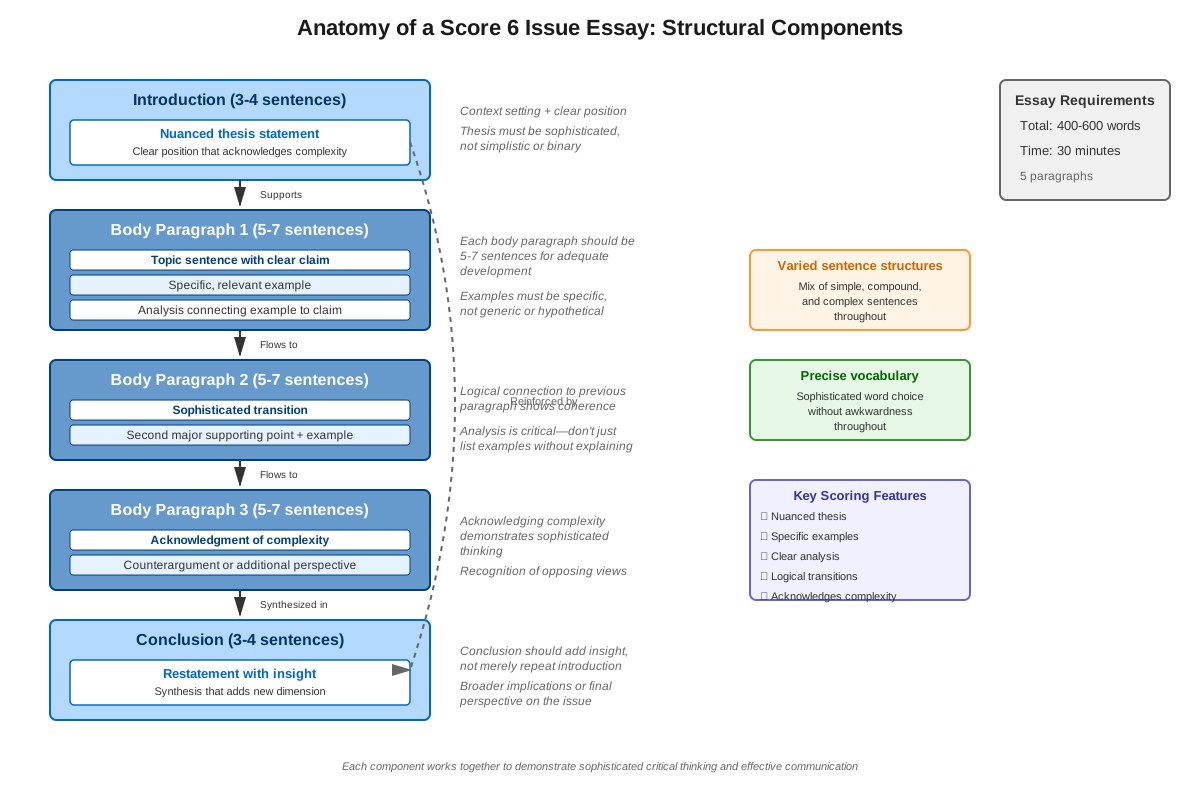
- Clear introduction establishing the position and analytical approach
- Body paragraphs with distinct, focused purposes
- Logical sequencing of ideas (e.g., moving from strongest to weakest argument, or building complexity progressively)
- Transitions that show relationships between ideas rather than merely connecting sentences
- Conclusion that synthesizes rather than simply restates
High-scoring essays demonstrate organizational sophistication—perhaps using a concession-refutation structure, organizing by contexts or conditions, or building toward a nuanced synthesis. Lower-scoring essays may have mechanical five-paragraph structures with weak connections between paragraphs.
Dimension 4: Language Facility and Conventions
This dimension assesses writing quality, including vocabulary, sentence variety, and grammatical correctness. The criteria recognize that even high-scoring essays may contain minor errors, but they distinguish between occasional slips and patterns of weakness. Strong language facility includes:
- Varied sentence structures (simple, compound, complex sentences used appropriately)
- Precise word choice that conveys meaning effectively
- Appropriate academic tone without excessive informality or pretension
- Grammatical correctness in subject-verb agreement, pronoun reference, verb tense consistency
- Proper punctuation and spelling
Importantly, the criteria emphasize that language should facilitate communication of ideas rather than obscure them. Overly complex vocabulary used incorrectly scores lower than clear, precise language.
Holistic vs. Checklist Scoring
A critical concept in understanding the GRE issue essay scoring criteria is that scoring is holistic rather than checklist-based. Raters don't assign points for specific elements (e.g., "has three examples = 2 points"). Instead, they read the entire essay and determine which score level description best characterizes the overall performance. This means:
- An essay with excellent ideas but poor organization might score 4 rather than 5 or 6
- An essay with perfect grammar but shallow analysis will not score highly
- Strengths in one dimension cannot fully compensate for serious weaknesses in another
- The overall impression matters—essays that demonstrate consistent competence across dimensions score higher than those with uneven performance
The Role of Position and Complexity
The scoring criteria explicitly state that raters are not evaluating the position taken—test-takers can agree, disagree, or take a qualified stance on the issue. What matters is how well the chosen position is developed and supported. However, the criteria do reward complexity of thought. Essays that:
- Acknowledge that issues have multiple valid perspectives
- Recognize contexts or conditions that affect the claim's validity
- Avoid absolute, black-and-white thinking
- Demonstrate intellectual flexibility
...typically score higher than essays presenting simplistic, one-sided arguments. This doesn't mean fence-sitting or refusing to take a position; rather, it means taking a thoughtful, nuanced position that recognizes complexity while still making a clear argument.
Concept Relationships
The four evaluation dimensions within the issue essay scoring criteria are deeply interconnected rather than independent. Quality of ideas and analysis directly influences development and support—sophisticated ideas require and enable more nuanced development, while superficial ideas limit the depth of support possible. Similarly, organization and coherence both reflects and facilitates analytical quality; a well-organized essay allows complex ideas to unfold logically, while poor organization can obscure even strong insights.
Language facility serves as the medium through which all other dimensions are expressed. Precise vocabulary enables nuanced analysis, varied sentence structures can emphasize logical relationships, and grammatical correctness ensures that ideas are communicated without distraction. However, strong language alone cannot compensate for weak analysis—the criteria consistently prioritize substance over style while recognizing that effective style enhances substance.
The relationship between these concepts and the six-level scoring scale is hierarchical and cumulative. Moving from score 3 to 4 typically requires addressing fundamental organizational or developmental weaknesses. Advancing from 4 to 5 demands stronger analytical insight and more compelling support. Reaching score 6 requires excellence across all dimensions simultaneously—insightful analysis, thorough development, clear organization, and facility with language.
These criteria connect to prerequisite knowledge in argumentation by operationalizing abstract principles. Understanding claims, evidence, and reasoning provides the foundation, but the scoring criteria specify exactly how these elements must be deployed in a timed essay context. The criteria also relate to the Argument essay task by emphasizing complementary skills: while Argument essays assess analytical critique, Issue essays assess constructive argumentation, with both requiring clear organization and effective language use.
High-Yield Facts
⭐ The GRE uses a 0-6 scoring scale with half-point increments, where two independent raters score each essay and their scores are averaged
⭐ Scoring is holistic—raters assess overall performance across multiple dimensions rather than using a checklist or point system
⭐ The criteria do not evaluate the position taken (agree/disagree) but rather how well that position is developed and supported
⭐ Score 6 essays demonstrate insightful analysis, compelling development, clear organization, and language facility, though minor errors are acceptable
⭐ Score 4 represents adequate competence—a baseline that demonstrates basic analytical writing skills but lacks the depth and sophistication of higher scores
- The four primary evaluation dimensions are: quality of ideas/analysis, development/support, organization/coherence, and language facility/conventions
- Specific, relevant examples with explicit connection to claims distinguish higher-scoring essays from lower-scoring ones
- Organizational sophistication (smooth transitions, logical sequencing, purposeful structure) separates scores 5-6 from scores 3-4
- Acknowledging complexity, counterarguments, and multiple perspectives typically elevates analytical quality
- Patterns of grammatical errors lower scores more than occasional minor mistakes, even in otherwise strong essays
- Essays that explore contexts, conditions, or limitations of the issue claim demonstrate more sophisticated analysis than absolute, one-sided arguments
- The mean Analytical Writing score is approximately 3.5-4.0, making scores of 5.0+ competitive advantages
- Raters spend approximately 2-3 minutes per essay, making first impressions and overall clarity crucial
- Length correlates with higher scores not because of word count itself, but because thorough development typically requires more extensive writing
- The scoring criteria are identical for all Issue essay prompts, regardless of topic, making the framework universally applicable
Quick check — test yourself on Issue essay scoring criteria so far.
Try Flashcards →Common Misconceptions
Misconception: Longer essays automatically receive higher scores because they demonstrate more effort or content.
Correction: Length correlates with higher scores only when additional length reflects more thorough development, deeper analysis, and more comprehensive support. Verbose, repetitive essays that lack substance score lower than concise, well-developed essays. The criteria reward quality of development, not quantity of words.
Misconception: Using sophisticated vocabulary and complex sentence structures will compensate for weak analysis or poor organization.
Correction: The scoring criteria prioritize substance over style. While language facility is one evaluation dimension, it cannot overcome fundamental weaknesses in ideas, development, or organization. Overly complex language that obscures meaning or includes errors actually lowers scores. Clear, precise language that effectively communicates strong ideas scores higher than pretentious vocabulary masking shallow thinking.
Misconception: Essays must present a balanced, neutral position that equally considers both sides of the issue to score well.
Correction: The criteria reward clear positions that are well-developed and supported. Test-takers can strongly agree, strongly disagree, or take a qualified stance—what matters is how effectively they develop their chosen position. Fence-sitting without commitment to a position typically results in vague, underdeveloped essays. Acknowledging counterarguments strengthens an essay, but this differs from refusing to take a position.
Misconception: Raters expect specific types of examples (historical, literary, personal) and essays lacking certain example types will score lower.
Correction: The criteria evaluate whether examples are relevant and effectively support the argument, not what category they fall into. Personal experiences, current events, historical examples, hypothetical scenarios, and logical reasoning can all serve as effective support if they are specific, relevant, and clearly connected to claims. The key is appropriateness and development, not example type.
Misconception: Perfect grammar and zero errors are required for scores of 5 or 6.
Correction: The score 6 description explicitly states that essays may contain "occasional minor errors." Raters recognize that timed writing conditions make some errors inevitable. The criteria distinguish between minor, occasional errors that don't interfere with meaning and patterns of errors or fundamental problems with language use. An essay with insightful analysis, strong development, and clear organization can score 6 even with a few typos or minor grammatical slips.
Misconception: Following a rigid five-paragraph structure (introduction, three body paragraphs, conclusion) guarantees adequate organization scores.
Correction: While five-paragraph structure can provide basic organization, the criteria reward organizational sophistication and logical coherence rather than adherence to a formula. Mechanical, formulaic organization with weak transitions and disconnected paragraphs scores lower than flexible, purposeful structure that serves the essay's analytical goals. Higher-scoring essays often use more than three body paragraphs or employ organizational strategies beyond simple listing of points.
Worked Examples
Example 1: Analyzing a Score 4 vs. Score 6 Essay
Issue Prompt: "The best way to teach is to praise positive actions and ignore negative ones."
Score 4 Essay Analysis:
A competent essay at this level might take the position that praising positive actions is important but ignoring negative ones is problematic. It would provide relevant examples—perhaps a classroom scenario where a teacher praises students who complete homework, and a workplace example where managers recognize good performance. The essay would have adequate organization with an introduction stating the position, body paragraphs developing points, and a conclusion restating the thesis.
However, this essay would demonstrate limitations that prevent higher scoring:
- Analysis: The essay might not explore the complexity of "ignore"—does this mean providing no feedback, or avoiding punishment? It might not consider contexts where the claim works better (young children vs. adults, learning new skills vs. correcting dangerous behaviors).
- Development: Examples might be somewhat generic ("In schools, teachers should praise students") without specific details or thorough explanation of how they support the argument.
- Organization: Transitions might be mechanical ("Another reason is..." or "In addition...") rather than showing sophisticated logical relationships.
- Language: Adequate control with some errors that don't significantly interfere with meaning, but without the precision and variety of higher-scoring essays.
Score 6 Essay Analysis:
An outstanding essay would take a nuanced position—perhaps arguing that the effectiveness of this teaching approach depends on the learner's developmental stage, the nature of the behavior, and the learning context. The essay would demonstrate insightful analysis by:
- Exploring what "best" means (most effective for learning? most ethical? most practical?)
- Distinguishing between ignoring (providing no response) and not punishing (providing corrective feedback without negative consequences)
- Examining contexts: early childhood education where positive reinforcement is well-supported by research, versus professional training where ignoring safety violations would be irresponsible
- Acknowledging the psychological research supporting positive reinforcement while recognizing that completely ignoring negative actions may leave learners without necessary corrective information
The development would include specific, compelling examples:
- A detailed scenario of a piano teacher who praises a student's improved rhythm while gently correcting finger positioning (not ignoring the error but not dwelling on it negatively)
- Reference to B.F. Skinner's operant conditioning research and its applications in educational settings
- A contrasting example from medical training where ignoring a resident's sterile technique violation could endanger patients, requiring direct corrective intervention
Organization would be sophisticated, perhaps using a structure that examines the claim's validity across different contexts, with smooth transitions showing how each context illuminates different aspects of the issue. Language would be precise, varied, and demonstrate facility with standard written English while remaining clear and accessible.
Example 2: Applying Criteria to Diagnose Essay Weaknesses
Issue Prompt: "In any field—business, politics, education, government—those in power should step down after five years."
Sample Essay Excerpt:
"I agree with this statement because people in power for too long become corrupt. There are many examples throughout history of leaders who stayed too long. They made bad decisions and hurt their countries. Fresh perspectives are important. New leaders bring new ideas. This is good for progress. In business, CEOs who stay forever make companies stagnant. In politics, term limits prevent dictatorships. Therefore, five years is enough time."
Diagnostic Analysis Using Scoring Criteria:
Quality of Ideas/Analysis: This excerpt demonstrates limited analytical depth. The position is clear (agreement) but the analysis is superficial. The essay doesn't explore:
- Why specifically five years rather than four, six, or ten?
- What about fields requiring deep expertise developed over decades?
- Are there contexts where leadership continuity is valuable?
- What does "power" mean across these different fields?
The thinking is absolute and one-dimensional, lacking the nuance that characterizes higher-scoring essays.
Development and Support: The support is vague and underdeveloped. "Many examples throughout history" provides no specific evidence. "CEOs who stay forever" is hyperbolic and unspecific. The essay lists claims without explaining or substantiating them. To improve, the writer should:
- Provide specific examples (e.g., "Robert Mugabe's 37-year rule in Zimbabwe, which began with promise but deteriorated into economic collapse and human rights violations")
- Explain the connection between examples and claims explicitly
- Develop fewer points more thoroughly rather than listing multiple underdeveloped assertions
Organization and Coherence: The excerpt shows weak organization. Ideas are listed rather than logically sequenced. Transitions are absent or simplistic ("Therefore"). The structure appears to be a series of loosely related claims rather than a coherent argument building toward a conclusion.
Language Facility: The language is adequate but simplistic. Sentence structures are repetitive and basic. Word choice is imprecise ("bad decisions," "good for progress"). There are no significant grammatical errors, but the writing lacks the variety and precision of higher-scoring essays.
Predicted Score: This essay would likely score in the 2-3 range. It demonstrates some basic competence (clear position, relevant topic discussion, adequate grammar) but has significant weaknesses across multiple dimensions that prevent it from reaching even the "adequate" level of score 4.
Exam Strategy
Pre-Writing Strategy (5 minutes)
When approaching the Issue essay, immediately identify which aspects of the scoring criteria your response must address. Spend the first 3-4 minutes:
- Analyzing the prompt for complexity: Identify absolute words ("only," "always," "never"), multiple components, or embedded assumptions that provide opportunities for nuanced analysis
- Choosing your position strategically: Select the position that allows for the most sophisticated analysis and strongest support, not necessarily your personal belief
- Brainstorming specific examples: Generate 2-3 specific, detailed examples rather than vague generalities
- Planning organizational structure: Decide on a logical sequence that serves your analytical goals
Exam Tip: The scoring criteria reward depth over breadth. Plan to develop 2-3 points thoroughly rather than listing 5-6 points superficially.
Trigger Words in Prompts
Certain prompt features signal opportunities to demonstrate the analytical sophistication the criteria reward:
- Absolute language ("always," "never," "only," "all"): Signals opportunity to explore contexts where the claim holds or fails
- Causal claims ("leads to," "results in," "causes"): Invites analysis of whether the causal relationship is necessary, sufficient, or conditional
- Value judgments ("best," "most important," "should"): Allows exploration of competing values or priorities
- Comparative claims ("more than," "rather than"): Enables analysis of whether the comparison is valid or whether both elements have merit
Writing Strategy (23 minutes)
Allocate time strategically to address all scoring dimensions:
Introduction (3 minutes): Craft an introduction that immediately demonstrates analytical sophistication. Rather than simply restating the prompt and stating agreement/disagreement, preview your analytical approach. For example: "While [issue claim] holds true in contexts where [condition], it overlooks [complexity] and fails to account for [consideration]."
Body Paragraphs (15 minutes): Develop 2-4 body paragraphs, each with:
- A clear topic sentence stating the paragraph's purpose
- Specific, detailed examples or reasoning
- Explicit explanation of how the support connects to your thesis
- Acknowledgment of complexity or counterarguments where appropriate
Focus on the development and support dimension by asking yourself: "Have I explained WHY this example supports my point?" Don't assume connections are obvious.
Conclusion (2 minutes): Synthesize rather than merely restate. A strong conclusion might acknowledge the issue's complexity while reaffirming your position, or suggest implications of your analysis.
Review (3 minutes): Reserve time to check for:
- Clarity of position and argument
- Logical flow and transitions
- Grammatical errors that might interfere with meaning
- Completeness of development
Process of Elimination for Self-Assessment
During practice, evaluate your essays by asking dimension-specific questions:
Ideas/Analysis:
- Does my essay explore complexity or present one-dimensional thinking?
- Have I acknowledged contexts, conditions, or counterarguments?
- Would a reader find my analysis insightful or obvious?
Development/Support:
- Are my examples specific or vague?
- Have I explained connections explicitly or assumed they're obvious?
- Have I developed points thoroughly or just listed them?
Organization:
- Can a reader easily follow my argument's progression?
- Do my transitions show logical relationships or just connect sentences?
- Does each paragraph have a clear, distinct purpose?
Language:
- Is my word choice precise or imprecise?
- Have I varied sentence structures or used repetitive patterns?
- Do errors interfere with meaning or are they minor and occasional?
Time Allocation Advice
The 30-minute time limit requires disciplined allocation:
- Planning: 4-5 minutes (resist the urge to start writing immediately)
- Writing: 22-23 minutes (maintain steady pace without rushing)
- Review: 2-3 minutes (essential for catching errors and ensuring clarity)
If you find yourself running short on time, prioritize completing your argument over crafting a formal conclusion. An essay with thorough body paragraph development but a brief conclusion scores higher than one with an elaborate conclusion but underdeveloped support.
Memory Techniques
The "IDEA" Framework for Score 6 Essays
Insightful analysis that explores complexity
Detailed, specific examples with explicit connections
Effective organization with sophisticated transitions
Adept language use with precision and variety
This acronym captures the four dimensions of the scoring criteria in a memorable format. When planning your essay, mentally check: "Does my approach include all IDEA elements?"
The "3-2-1" Development Rule
For each major point in your essay:
- 3 sentences explaining your reasoning or analysis
- 2 specific details or examples
- 1 explicit connection back to your thesis
This ensures adequate development (addressing the support dimension) while maintaining focus (addressing the organization dimension).
Visualization: The Scoring Pyramid
Visualize the scoring criteria as a pyramid:
Base (Foundation): Language facility and basic organization—without these, the essay cannot score above 3
Middle: Adequate development and clear position—these elements enable scores of 4
Top: Insightful analysis and sophisticated organization—these distinguish scores of 5-6
This visualization reinforces that all dimensions matter, but analytical sophistication represents the highest level of achievement.
The "CAR" Method for Examples
When developing examples, use the CAR structure:
Context: Briefly establish the situation
Action: Describe what happened specifically
Relevance: Explicitly explain how this supports your argument
This mnemonic ensures examples are specific (Context and Action) and clearly connected to claims (Relevance), addressing the development dimension of the criteria.
Summary
The issue essay scoring criteria provide a comprehensive framework for evaluating analytical writing on the GRE, assessing essays holistically across four interconnected dimensions: quality of ideas and analysis, development and support, organization and coherence, and language facility. Operating on a 0-6 scale with half-point increments, the criteria reward essays that demonstrate insightful analysis of complexity, thorough development with specific and relevant support, clear and sophisticated organization, and precise language use. Understanding these criteria enables strategic essay construction aligned with rater expectations. The criteria are holistic rather than checklist-based, meaning overall performance across dimensions determines scores rather than presence of specific elements. Crucially, the criteria evaluate how well a position is developed rather than what position is taken, rewarding nuanced thinking that acknowledges complexity while maintaining a clear argument. Mastery requires recognizing that the four dimensions are interdependent—strong ideas require effective development, clear organization facilitates sophisticated analysis, and precise language enables communication of complex thinking. Success on the Issue essay demands not just competent writing but strategic application of these criteria to demonstrate analytical excellence within the 30-minute time constraint.
Key Takeaways
- The GRE issue essay scoring criteria assess four dimensions holistically: ideas/analysis, development/support, organization/coherence, and language facility, with scores ranging from 0-6 in half-point increments
- Score 6 essays demonstrate insightful analysis exploring complexity, compelling development with specific examples, sophisticated organization, and language facility, though minor errors are acceptable
- The criteria reward depth over breadth—thoroughly developing 2-3 points with specific, relevant support scores higher than superficially listing many underdeveloped claims
- Analytical sophistication means acknowledging complexity, exploring contexts and conditions, and recognizing multiple perspectives while maintaining a clear position, not fence-sitting or refusing to commit
- Scoring is holistic, not checklist-based—raters assess overall performance rather than counting specific elements, meaning strengths in one dimension cannot fully compensate for serious weaknesses in another
- The position taken (agree/disagree/qualified) does not affect scoring; what matters is how effectively that position is developed and supported with reasoning and examples
- Strategic time allocation (4-5 minutes planning, 22-23 minutes writing, 2-3 minutes reviewing) enables addressing all scoring dimensions within the 30-minute constraint
Related Topics
Argument Essay Scoring Criteria: Understanding how the Argument essay is evaluated provides complementary insight into GRE Analytical Writing expectations, with emphasis on analytical critique rather than constructive argumentation. Mastering Issue essay criteria provides transferable skills in organization and language use.
Issue Essay Prompt Analysis: Learning to deconstruct prompts for complexity, identify embedded assumptions, and recognize opportunities for nuanced analysis directly supports the analytical sophistication the scoring criteria reward.
Argumentation Strategies: Studying formal argumentation techniques (deductive reasoning, inductive reasoning, analogical reasoning) enhances the quality of ideas and development dimensions by providing structured approaches to building persuasive cases.
Academic Writing Conventions: Deepening knowledge of transitions, paragraph development, thesis construction, and synthesis strengthens the organization and language dimensions of the scoring criteria.
Time Management for Timed Essays: Developing strategies for efficient planning, writing, and revision under time pressure enables consistent application of scoring criteria knowledge in actual test conditions.
Practice CTA
Now that you understand the comprehensive framework of the issue essay scoring criteria, it's time to apply this knowledge actively. Attempt the practice questions to test your ability to identify scoring levels, diagnose essay weaknesses, and construct responses that deliberately incorporate high-scoring elements. Use the flashcards to reinforce your memory of the six score levels and four evaluation dimensions. Remember: understanding the criteria intellectually is only the first step—mastery comes through repeated application and self-assessment using these standards. Each practice essay you write and evaluate brings you closer to the analytical sophistication and strategic execution that distinguish top-scoring performances. Your investment in understanding these criteria will pay dividends not just on test day, but in developing analytical writing skills valuable throughout graduate study and professional life.
Sign up free to keep reading
Create a free AnvayaPrep account to finish this GRE guide on Issue essay scoring criteria — plus flashcards and practice questions.