Overview
The argument essay scoring system is one of the most critical components of the GRE Analytical Writing section, directly determining half of a test-taker's writing score. Understanding how essays are evaluated enables students to strategically craft responses that meet the specific criteria ETS (Educational Testing Service) readers use when assigning scores. Unlike creative writing or opinion pieces, the GRE Argument essay is assessed using a precise rubric that values analytical thinking, logical reasoning, and clear communication above all else.
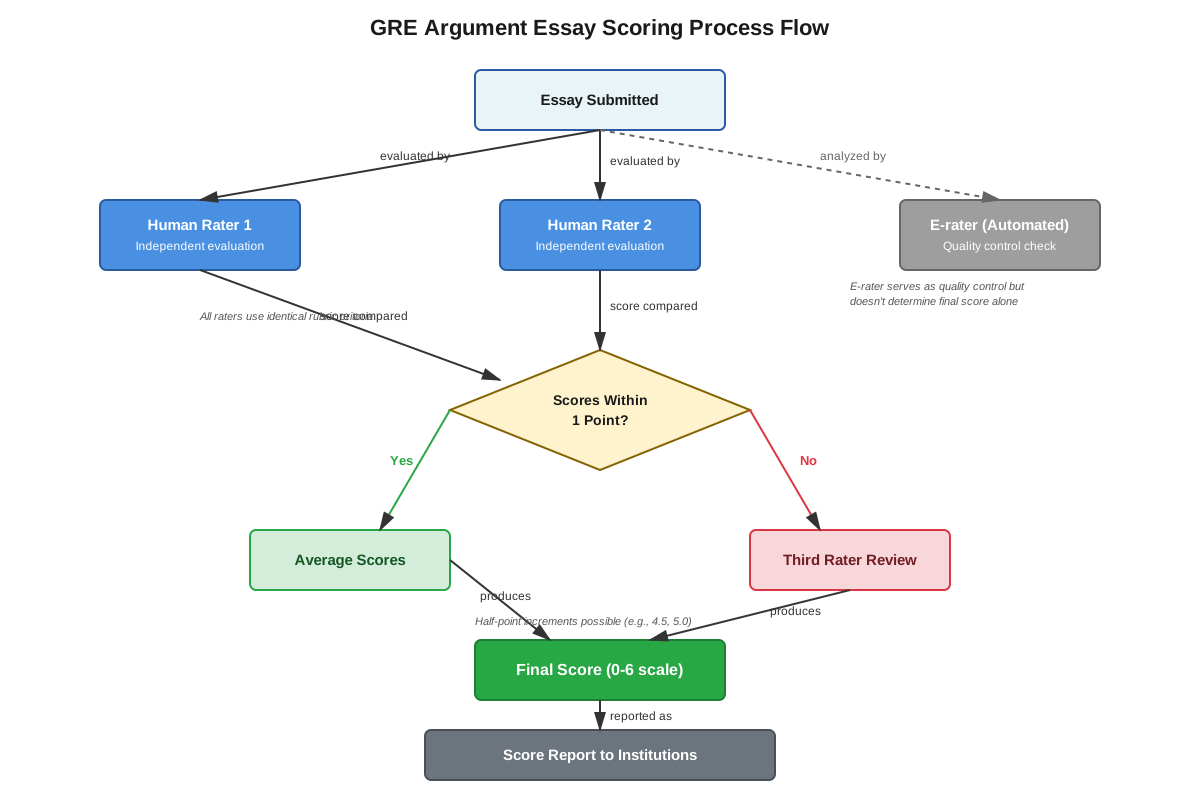
The GRE argument essay scoring process involves both human raters and an automated e-rater system, with scores ranging from 0 to 6 in half-point increments. Each essay receives at least two independent scores from trained readers who evaluate the response against established criteria. These criteria focus on how well the test-taker identifies and analyzes the logical flaws in a given argument, rather than whether they agree or disagree with the argument's conclusion. This distinction is fundamental: the GRE Argument essay tests critical thinking and analytical writing skills, not personal opinions or subject-matter expertise.
Within the broader Analytical Writing framework, argument essay scoring represents the evaluative standard that guides all preparation and strategy. Understanding the scoring rubric allows students to reverse-engineer their approach, ensuring every paragraph, sentence, and word choice serves the specific purpose of demonstrating analytical competence. This knowledge transforms the writing task from an intimidating challenge into a systematic process with clear benchmarks for success.
Learning Objectives
- [ ] Identify when Argument essay scoring is being tested
- [ ] Explain the core rule or strategy behind Argument essay scoring
- [ ] Apply Argument essay scoring to GRE-style questions accurately
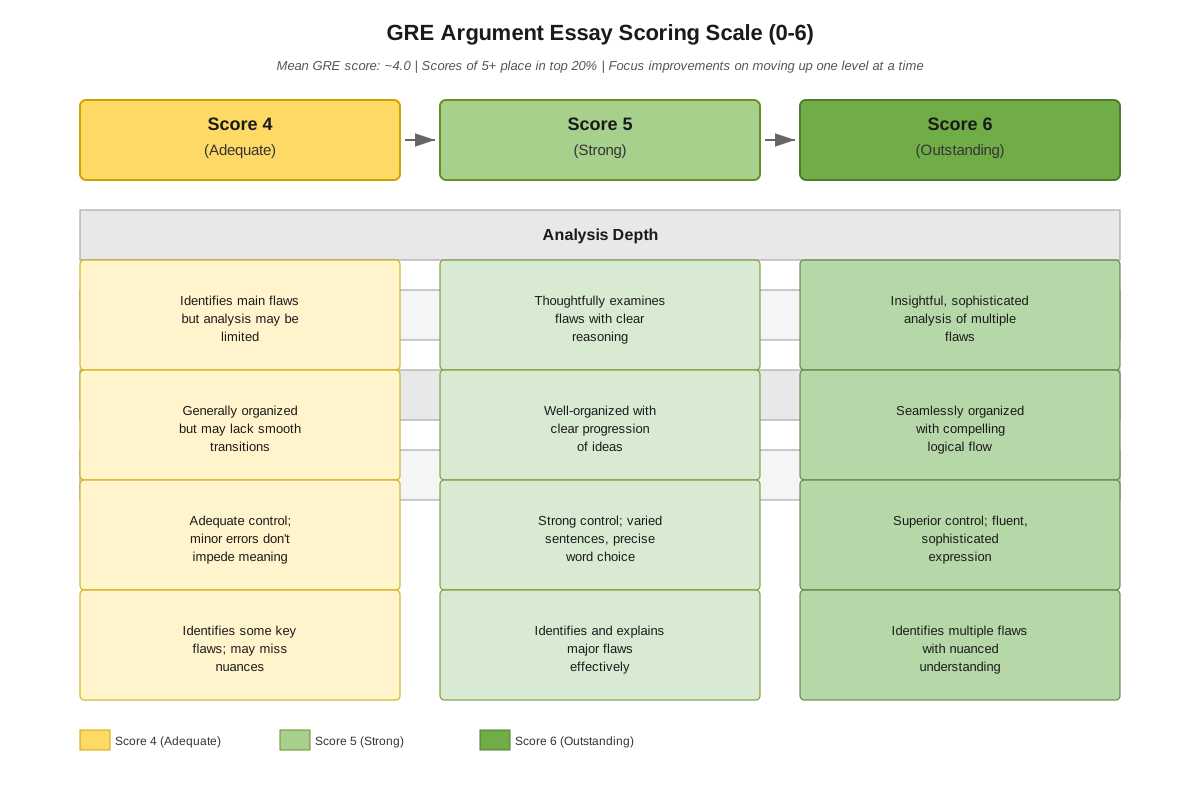
- [ ] Distinguish between score levels (4, 5, and 6) based on specific rubric criteria
- [ ] Evaluate sample essays and predict their scores using official scoring guidelines
- [ ] Recognize which essay elements contribute most significantly to higher scores
- [ ] Implement targeted improvements to raise an essay from one score level to the next
Prerequisites
- Basic essay structure: Understanding introductions, body paragraphs, and conclusions is essential because the scoring rubric evaluates organizational coherence
- Logical reasoning fundamentals: Familiarity with common logical fallacies helps identify the flaws that must be analyzed in argument essays
- Academic writing conventions: Knowledge of formal writing style, grammar, and mechanics ensures the essay meets baseline communication standards
- GRE Argument essay task requirements: Understanding what the prompt asks (analyzing an argument's reasoning, not stating personal opinions) prevents fundamental misunderstandings that result in low scores
Why This Topic Matters
Understanding argument essay scoring is not merely academic—it directly impacts graduate school admissions outcomes. Many competitive programs use the Analytical Writing score as a screening tool, with minimum thresholds that can eliminate candidates regardless of their quantitative or verbal scores. Programs in humanities, social sciences, law, and business particularly emphasize writing scores, recognizing them as predictors of academic success in research and communication-intensive environments.
On the GRE, the Argument essay appears as one of two Analytical Writing tasks, contributing 50% of the overall writing score. This score is reported separately on a 0-6 scale and appears prominently on score reports sent to institutions. According to ETS data, the mean Argument essay score hovers around 4.0, meaning scores of 5.0 or higher place test-takers in approximately the top 20% of all examinees. This percentile advantage can be decisive in competitive admissions scenarios.
The scoring criteria appear consistently across all argument prompts, regardless of the specific topic (business, education, public policy, etc.). Test-takers encounter argument essay scoring through the evaluation of their written response, but understanding the rubric beforehand allows strategic preparation. Common manifestations include recognizing that a well-organized essay with clear transitions scores higher than a disorganized one with brilliant insights, or that addressing multiple logical flaws thoroughly outperforms superficial treatment of many flaws.
Core Concepts
The Six-Point Scoring Scale
The argument essay scoring system uses a six-point scale where scores are assigned in half-point increments (0, 0.5, 1.0, 1.5, 2.0, 2.5, 3.0, 3.5, 4.0, 4.5, 5.0, 5.5, 6.0). Each score level represents a distinct quality threshold:
| Score | Quality Level | Key Characteristics |
|---|---|---|
| 6 | Outstanding | Insightful, well-developed analysis; superior control of language; identifies major flaws and explores implications thoroughly |
| 5 | Strong | Thoughtful, well-developed analysis; clear control of language; identifies important flaws with good development |
| 4 | Adequate | Competent analysis; adequate control of language; identifies some flaws with reasonable development |
| 3 | Limited | Limited analysis; some control of language; identifies few flaws with minimal development |
| 2 | Seriously Flawed | Serious weaknesses in analysis; weak control of language; misunderstands task or provides little analysis |
| 1 | Fundamentally Deficient | Little or no analysis; severe language problems; demonstrates fundamental incompetence |
| 0 | Off-topic/Blank | Does not address the prompt or is blank |
The Four Primary Evaluation Criteria
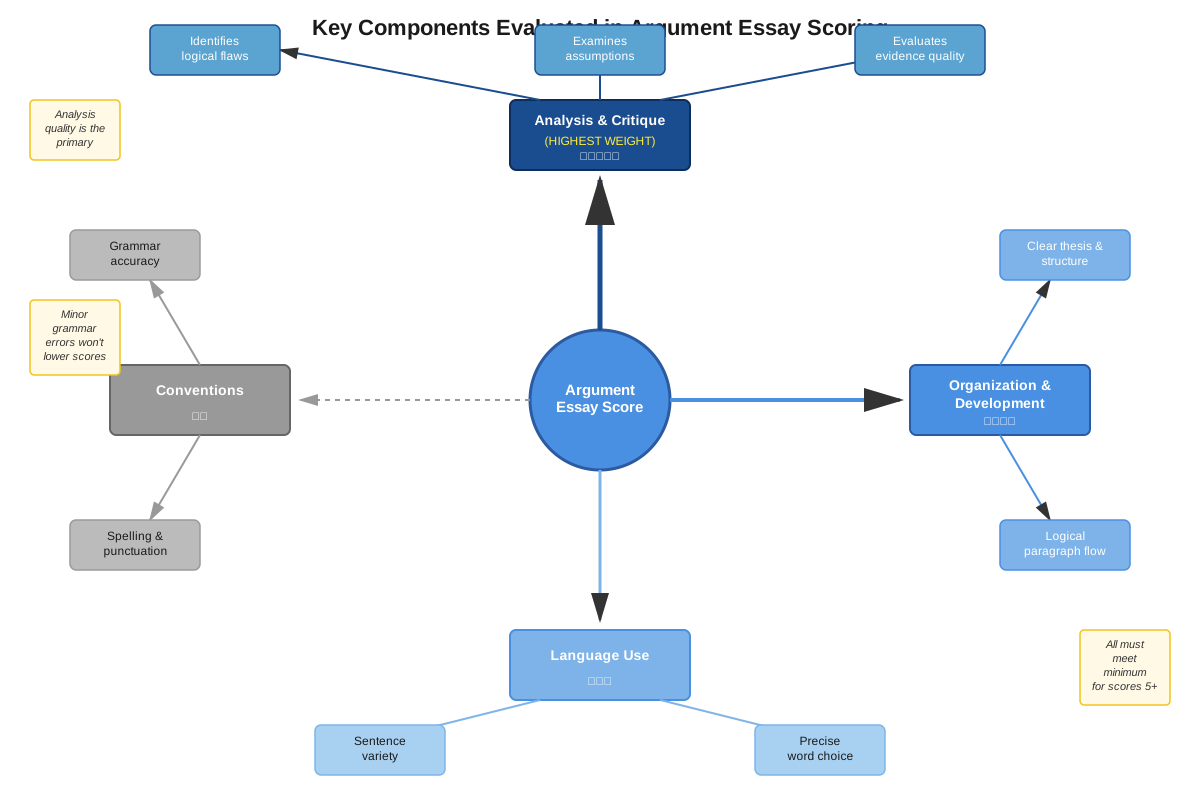
GRE argument essay scoring relies on four interconnected criteria that readers apply holistically:
1. Identification and Analysis of Logical Flaws: This criterion examines whether the test-taker recognizes the argument's unstated assumptions, logical gaps, and reasoning errors. Higher-scoring essays identify multiple significant flaws rather than focusing on minor issues. The analysis must explain why each flaw weakens the argument and how it could be addressed.
2. Development and Support: This criterion assesses the depth and thoroughness of the analysis. A score-6 essay doesn't merely list flaws—it explores their implications, provides specific examples of how they undermine the conclusion, and discusses what additional evidence would strengthen the argument. Development means moving beyond surface-level observations to demonstrate sophisticated critical thinking.
3. Organization and Coherence: This criterion evaluates the essay's logical structure and flow. Effective organization includes a clear introduction that frames the analysis, body paragraphs that each focus on a distinct flaw, smooth transitions between ideas, and a conclusion that synthesizes the critique. Coherence means that every sentence contributes to the overall analytical purpose without digression or confusion.
4. Language Facility and Conventions: This criterion examines sentence variety, word choice precision, grammar, mechanics, and overall clarity. While minor errors don't significantly impact scores, patterns of grammatical mistakes, awkward phrasing, or unclear expression can lower scores. Higher-scoring essays demonstrate sophisticated vocabulary used appropriately and varied sentence structures that enhance readability.
The Dual-Scoring Process
Each essay receives evaluation from two independent sources:
- Human Raters: Trained ETS readers who have undergone extensive calibration exercises score essays holistically based on the rubric. These readers spend approximately 2-3 minutes per essay, making rapid but informed judgments.
- E-rater: An automated scoring engine that analyzes linguistic features including grammar, vocabulary usage, essay structure, and development patterns. The e-rater has been trained on thousands of human-scored essays.
The final score represents the average of these two scores. If the human and e-rater scores differ by more than one point, a second human reader evaluates the essay, and the e-rater score is discarded. This system ensures reliability while maintaining efficiency.
Score-Level Distinctions
Understanding what differentiates adjacent score levels enables targeted improvement:
Moving from 4 to 5: The primary difference involves depth of analysis and language control. A score-4 essay competently identifies flaws but may treat them somewhat superficially or with limited development. A score-5 essay explores the implications of each flaw more thoroughly, demonstrates clearer organization, and exhibits stronger command of language with fewer errors and more sophisticated expression.
Moving from 5 to 6: This leap requires exceptional analytical insight and near-flawless execution. Score-6 essays often identify subtle assumptions that score-5 essays miss, explore counterarguments or alternative explanations, and demonstrate superior writing quality with varied, sophisticated sentence structures and precise vocabulary. The analysis feels comprehensive and insightful rather than merely competent.
The Holistic Nature of Scoring
Readers don't assign separate scores for each criterion and then average them. Instead, they form an overall impression based on how well the essay fulfills its analytical purpose. This holistic approach means that exceptional strength in one area can partially compensate for moderate weakness in another. For example, an essay with brilliant analysis but occasional grammatical errors might still score 5 or higher if the errors don't impede understanding.
However, severe deficiency in any single criterion typically caps the overall score. An essay with excellent organization and grammar but superficial analysis cannot score above 4, just as an essay with profound insights but incomprehensible writing cannot achieve a high score.
Concept Relationships
The four evaluation criteria function interdependently rather than in isolation. Identification of logical flaws provides the raw material that development and support transforms into substantive analysis. Without identifying significant flaws, there's nothing meaningful to develop; without thorough development, identified flaws remain superficial observations that don't demonstrate analytical depth.
Organization and coherence serves as the structural framework that makes the analysis accessible to readers. Even brilliant insights lose impact when presented in a disorganized manner. Clear organization → enhances → reader comprehension → which enables → proper evaluation of analytical quality. Conversely, poor organization → obscures → analytical content → which results in → lower perceived quality.
Language facility acts as the medium through which all other criteria are expressed. Precise vocabulary → clarifies → analytical points, while varied sentence structure → maintains → reader engagement. However, language facility alone cannot compensate for weak analysis; it amplifies the quality of the underlying content rather than substituting for it.
The relationship between human and e-rater scoring creates a quality control mechanism: human judgment → provides → nuanced evaluation of analytical insight, while e-rater → ensures → consistency in evaluating linguistic features. When these scores align → confidence increases → in the final score's accuracy.
Understanding the six-point scale → enables → strategic goal-setting. Test-takers can identify their current performance level → diagnose → specific weaknesses in particular criteria → implement → targeted improvements → to reach → the next score level.
High-Yield Facts
⭐ The GRE Argument essay is scored on a 0-6 scale in half-point increments, with the final score representing the average of two independent evaluations.
⭐ Readers spend approximately 2-3 minutes evaluating each essay, making holistic judgments rather than detailed line-by-line analysis.
⭐ The scoring rubric emphasizes analysis of the argument's reasoning and assumptions, not agreement or disagreement with the conclusion.
⭐ A score of 4.0 represents adequate competence and approximates the mean score for all test-takers.
⭐ Scores of 5.0 and above place test-takers in approximately the top 20% of all examinees, providing significant competitive advantage.
- Each essay receives evaluation from both a trained human rater and an automated e-rater system.
- If human and e-rater scores differ by more than one point, a second human reader evaluates the essay and the e-rater score is discarded.
- The four primary evaluation criteria are: identification and analysis of flaws, development and support, organization and coherence, and language facility.
- Minor grammatical errors do not significantly impact scores unless they form patterns that impede understanding.
- Score-6 essays demonstrate insightful analysis that goes beyond obvious flaws to identify subtle assumptions and explore implications thoroughly.
- Essays that misunderstand the task (such as arguing for or against the conclusion rather than analyzing the reasoning) typically score 3 or below.
- Length alone does not determine scores, but higher-scoring essays typically require sufficient length (400-600 words) to develop analysis thoroughly.
- The scoring criteria remain consistent across all argument prompts regardless of topic area.
- Readers are trained to ignore factual accuracy of examples; the quality of analytical reasoning matters, not whether claims about the real world are true.
- An essay that addresses only one logical flaw, even if analyzed brilliantly, typically cannot score above 4 due to limited scope.
Quick check — test yourself on Argument essay scoring so far.
Try Flashcards →Common Misconceptions
Misconception: Longer essays automatically receive higher scores. → Correction: While thorough analysis typically requires adequate length (400-600 words), length alone doesn't determine scores. A concise, well-developed 450-word essay can outscore a rambling 700-word essay that lacks analytical depth. Quality of analysis and clarity of expression matter more than word count.
Misconception: The essay should state whether the argument's conclusion is right or wrong. → Correction: The task requires analyzing the reasoning that leads to the conclusion, not evaluating whether the conclusion itself is correct. Test-takers should remain neutral about the conclusion while critiquing the logical pathway and unstated assumptions.
Misconception: Using sophisticated vocabulary guarantees a higher score. → Correction: Vocabulary should be precise and appropriate, not merely complex. Using advanced words incorrectly or awkwardly actually lowers scores. Readers value clear communication over vocabulary showmanship; a well-chosen simple word outperforms a misused complex one.
Misconception: Identifying more flaws always produces higher scores than analyzing fewer flaws deeply. → Correction: Depth trumps breadth. A score-6 essay might thoroughly analyze three significant flaws with exploration of implications and alternative evidence, while a score-4 essay might superficially mention five flaws without meaningful development. Quality of analysis matters more than quantity of flaws identified.
Misconception: Perfect grammar is required for a score of 6. → Correction: Score-6 essays demonstrate "superior control" of language, not perfection. Occasional minor errors are acceptable if they don't impede understanding. The overall quality of expression, sentence variety, and clarity matter more than absolute grammatical perfection.
Misconception: The e-rater can be "gamed" with specific keywords or formulaic structures. → Correction: While the e-rater analyzes linguistic features, it has been trained on thousands of human-scored essays and recognizes authentic analytical writing. Attempting to manipulate the system with keyword stuffing or rigid templates typically backfires, as these strategies produce awkward, inauthentic writing that both human raters and the e-rater recognize as low-quality.
Misconception: Personal examples and anecdotes strengthen argument essay analysis. → Correction: The Argument essay requires logical analysis of the given argument's reasoning, not personal experiences or real-world examples. While hypothetical examples illustrating how a flaw could manifest might be useful, personal anecdotes are irrelevant and waste valuable time and space.
Worked Examples
Example 1: Evaluating a Score-4 vs. Score-5 Essay
Argument Prompt: "The following appeared in a memo from the director of a large group of hospitals: 'In a controlled laboratory study of liquid hand soaps, a concentrated solution of extra strength UltraClean hand soap produced a 40 percent greater reduction in harmful bacteria than did the liquid hand soaps currently used in our hospitals. During our recent test of UltraClean at our hospital in Worktown, that hospital reported significantly fewer cases of patient infection than did any of the other hospitals in our group. Therefore, to prevent serious patient infections, we should supply UltraClean at all hand-washing stations throughout our hospital system.'"
Score-4 Essay Excerpt:
"The argument has several problems with its reasoning. First, the laboratory study might not reflect real-world conditions. Laboratory studies are controlled, but hospitals are not controlled environments. Second, the Worktown hospital might have had fewer infections for other reasons besides the soap. Maybe they had better procedures or cleaner facilities. Third, the argument assumes that the 40 percent reduction in bacteria will lead to fewer infections, but this might not be true. These flaws weaken the argument's conclusion."
Analysis of Score-4 Essay: This excerpt demonstrates adequate competence. It identifies three legitimate flaws (laboratory vs. real-world conditions, alternative explanations for Worktown's success, and the bacteria-to-infection assumption). However, the development remains superficial. Each flaw receives only 1-2 sentences without exploring implications or discussing what evidence would address the weakness. The language is clear but basic, with repetitive sentence structures ("First... Second... Third...") and simple vocabulary.
Score-5 Essay Excerpt:
"The argument's reliance on laboratory findings introduces a significant flaw in reasoning. Controlled laboratory conditions differ fundamentally from actual hospital environments where numerous variables affect bacterial transmission. The laboratory study tested a 'concentrated solution' of UltraClean, but the argument provides no evidence that hospitals would use this same concentration. Healthcare workers might dilute the soap differently, apply it for shorter durations, or use it less frequently than laboratory protocols specified. To strengthen this reasoning, the director would need evidence that UltraClean performs similarly in actual hospital settings with real usage patterns, not just in controlled laboratory conditions.
Furthermore, attributing Worktown hospital's lower infection rates solely to UltraClean commits a causal reasoning error. The argument overlooks numerous alternative explanations for Worktown's success. Perhaps Worktown recently implemented stricter hygiene protocols, hired additional infection control staff, upgraded its ventilation systems, or treats a patient population with fewer risk factors for infection. The temporal relationship between UltraClean's introduction and reduced infections doesn't establish causation without ruling out these confounding variables."
Analysis of Score-5 Essay: This excerpt demonstrates stronger analytical depth. Each flaw receives thorough development with specific examples of how the problem manifests (dilution differences, application duration, confounding variables). The analysis explores implications rather than merely stating that flaws exist. The language shows greater sophistication with varied sentence structures and precise vocabulary ("causal reasoning error," "confounding variables," "temporal relationship"). The essay explicitly discusses what evidence would strengthen the argument, demonstrating understanding of how to address logical weaknesses.
Key Differences: The score-5 essay moves beyond identification to exploration, uses more sophisticated analytical vocabulary, provides specific examples of how flaws undermine the conclusion, and discusses remedies. These elements distinguish adequate from strong performance.
Example 2: Predicting Scores Based on Rubric Criteria
Essay Scenario: A test-taker writes a 500-word essay that identifies two major logical flaws (sampling bias and questionable causation) and develops each thoroughly with specific examples and discussion of alternative explanations. The essay has clear organization with an introduction, two body paragraphs (one per flaw), and a conclusion. However, the essay contains frequent grammatical errors including subject-verb agreement problems, comma splices, and inconsistent verb tenses. The vocabulary is appropriate but not particularly sophisticated.
Score Prediction: 4.0-4.5
Reasoning:
- Identification and Analysis: Strong (identifies significant flaws and develops them thoroughly) → suggests score of 5
- Development and Support: Strong (provides specific examples and explores implications) → suggests score of 5
- Organization and Coherence: Adequate to Strong (clear structure, though transitions might be basic) → suggests score of 4-5
- Language Facility: Weak to Adequate (frequent grammatical errors create patterns that impede smooth reading) → suggests score of 3-4
Holistic Assessment: The frequent grammatical errors prevent this essay from reaching score-5 territory despite strong analytical content. Readers would recognize the solid analysis but be distracted by language problems. The essay demonstrates competent analytical thinking but inadequate control of writing conventions, placing it in the score-4 range. If the grammatical errors were less frequent or less disruptive, the score could reach 4.5 or even 5.0, demonstrating how language facility acts as a ceiling on overall scores when significantly deficient.
Exam Strategy
Pre-Writing Strategy
Before writing a single word, invest 2-3 minutes analyzing the argument and planning the response. This investment pays dividends in organization and analytical depth. Identify 2-4 major logical flaws rather than trying to address every possible weakness. Quality of analysis matters more than quantity of flaws identified.
Exam Tip: Focus on flaws involving unstated assumptions, questionable causation, sampling problems, and insufficient evidence. These categories appear frequently and allow for substantial development.
Trigger Words in Scoring Rubrics
When reviewing the official scoring guide, pay attention to these distinguishing terms:
- Score 6: "insightful," "cogent," "superior," "perceptive"
- Score 5: "thoughtful," "well-developed," "clear"
- Score 4: "adequate," "competent," "reasonable"
- Score 3: "limited," "insufficient," "some"
These descriptors reveal what readers seek at each level. Aim to demonstrate "thoughtful" and "well-developed" analysis (score-5 territory) as a realistic target, with "insightful" analysis as a stretch goal.
Time Allocation
With 30 minutes total, allocate time strategically:
- Minutes 0-3: Read prompt, identify flaws, outline response
- Minutes 3-25: Write the essay (introduction, 2-3 body paragraphs, conclusion)
- Minutes 25-30: Proofread for clarity and major errors
Resist the temptation to start writing immediately. The planning phase prevents organizational problems and ensures comprehensive analysis.
Process of Elimination for Self-Evaluation
After completing practice essays, evaluate them using these questions aligned with scoring criteria:
- Did I identify at least 2-3 significant logical flaws? (If no → score likely below 4)
- Did I explain WHY each flaw weakens the argument? (If no → score likely 3-4)
- Did I discuss what evidence would address each flaw? (If no → score likely 4; if yes → potential for 5+)
- Is my essay clearly organized with distinct paragraphs? (If no → score likely below 4)
- Can someone unfamiliar with the prompt follow my reasoning? (If no → coherence problems limit score)
- Are there patterns of grammatical errors? (If yes → score likely capped at 4)
Strategic Priorities by Target Score
For Target Score 4.0: Focus on identifying 2-3 clear flaws, organizing the essay logically, and writing clearly without major grammatical errors. Adequate development of each flaw with 3-4 sentences is sufficient.
For Target Score 5.0: Everything from 4.0, plus deeper development of each flaw with specific examples, discussion of alternative explanations, and suggestions for strengthening evidence. Aim for 5-6 sentences per flaw with varied sentence structures.
For Target Score 6.0: Everything from 5.0, plus identification of subtle assumptions others might miss, exploration of implications and counterarguments, and sophisticated language use. The analysis should feel comprehensive and insightful, not merely competent.
Memory Techniques
The "DICE" Framework for Scoring Criteria
Development - How thoroughly are flaws analyzed?
Identification - Which logical flaws are recognized?
Coherence - How clearly is the essay organized?
Expression - How well is language controlled?
This acronym helps recall the four primary evaluation criteria during both preparation and writing.
The "5-4-3" Scoring Visualization
Visualize the scoring scale as a ladder:
- 5-6: The "insight zone" - sophisticated analysis with strong execution
- 4: The "competence platform" - adequate analysis with reasonable execution
- 3 and below: The "struggle zone" - limited analysis or weak execution
This mental model helps set realistic goals and identify which "zone" practice essays occupy.
The "STAR" Development Pattern
For each logical flaw identified, use this pattern to ensure thorough development:
State the flaw clearly
Tell why it weakens the argument
Alternatives - discuss other explanations or possibilities
Remedy - suggest what evidence would address the weakness
This pattern ensures each body paragraph contains sufficient development for score-5 territory.
Transition Phrase Bank
Memorize these high-utility transitions to enhance coherence:
- Introducing flaws: "A critical weakness in this reasoning..." / "The argument's reliance on... introduces..."
- Developing analysis: "Specifically..." / "For instance..." / "This matters because..."
- Discussing alternatives: "Alternatively..." / "The argument overlooks..." / "Other factors might explain..."
- Suggesting remedies: "To strengthen this reasoning..." / "Evidence of... would address..." / "The director would need to demonstrate..."
Having these phrases readily available reduces cognitive load during timed writing.
Summary
Argument essay scoring represents the evaluative framework that determines half of the GRE Analytical Writing score, using a 0-6 scale where essays receive holistic evaluation from both human raters and an automated e-rater system. The scoring process emphasizes four interconnected criteria: identification and analysis of logical flaws, development and support of that analysis, organization and coherence of the essay structure, and facility with language conventions. Understanding these criteria enables strategic preparation focused on demonstrating analytical thinking rather than personal opinions. Score-4 essays show adequate competence with reasonable identification and development of flaws, while score-5 essays demonstrate thoughtful, well-developed analysis with clear organization and strong language control. Score-6 essays achieve insightful analysis that explores subtle assumptions and implications with superior writing quality. The holistic nature of scoring means that severe weakness in any single criterion can cap the overall score, while balanced competence across all criteria enables higher scores. Success requires identifying significant logical flaws, developing each thoroughly with specific examples and discussion of alternative explanations, organizing the analysis clearly, and expressing ideas with grammatical accuracy and appropriate sophistication.
Key Takeaways
- The GRE uses a 0-6 scoring scale with half-point increments, where each essay receives evaluation from both a human rater and e-rater system
- Four primary criteria determine scores: identification/analysis of flaws, development/support, organization/coherence, and language facility
- Score-5 essays (top 20% of test-takers) demonstrate thoughtful, well-developed analysis with clear organization and strong language control
- Depth of analysis matters more than breadth—thoroughly developing 2-3 significant flaws outperforms superficially mentioning many flaws
- The task requires analyzing the argument's reasoning and assumptions, not agreeing or disagreeing with its conclusion
- Holistic scoring means severe weakness in any criterion can cap the overall score, while balanced competence enables higher scores
- Strategic preparation involves understanding what distinguishes adjacent score levels and targeting specific improvements in weaker criteria
Related Topics
Issue Essay Scoring: Understanding how the companion Analytical Writing task is evaluated helps test-takers recognize similarities and differences in scoring criteria, particularly regarding development, organization, and language facility.
Logical Fallacies and Reasoning Errors: Deeper knowledge of specific fallacy types (false causation, hasty generalization, false analogy, etc.) enables more sophisticated identification and analysis of argument flaws, directly supporting higher scores.
Essay Organization and Structure: Mastering techniques for creating clear introductions, coherent body paragraphs with topic sentences, effective transitions, and synthesizing conclusions enhances the organization/coherence criterion.
Academic Writing Style and Conventions: Developing facility with formal academic writing, including appropriate tone, precise vocabulary, varied sentence structures, and grammatical accuracy, directly addresses the language facility criterion.
Evidence Evaluation and Critical Thinking: Understanding how to assess the quality and relevance of evidence strengthens the ability to identify what information is missing from arguments and what would strengthen their reasoning.
Practice CTA
Now that you understand the argument essay scoring system and criteria, it's time to apply this knowledge through deliberate practice. Attempt the practice questions to test your ability to evaluate sample essays using the scoring rubric, and use the flashcards to reinforce key distinctions between score levels. Remember: understanding the scoring criteria transforms the Argument essay from a subjective writing challenge into a systematic analytical task with clear benchmarks for success. Each practice essay you write with the rubric in mind builds the skills that readers will evaluate in just 2-3 minutes on test day. Your investment in understanding these scoring principles will pay dividends in both your practice performance and your official GRE score.
Sign up free to keep reading
Create a free AnvayaPrep account to finish this GRE guide on Argument essay scoring — plus flashcards and practice questions.