Overview
The issue essay timing component of the GRE Analytical Writing section represents one of the most critical yet frequently underestimated aspects of achieving a high score. While many test-takers focus exclusively on developing strong arguments and polished prose, the ability to manage the strict 30-minute time constraint effectively often determines whether a well-conceived essay reaches completion or remains frustratingly unfinished. The GRE issue essay timing challenge requires candidates to simultaneously plan, compose, and revise a coherent analytical essay under significant time pressure—a skill that demands deliberate practice and strategic preparation.
Understanding issue essay timing extends far beyond simply watching the clock. It encompasses the strategic allocation of minutes across distinct phases of the writing process, the development of efficient planning techniques that don't consume excessive time, and the cultivation of writing fluency that allows ideas to flow onto the screen without paralyzing deliberation. Test-takers who master timing strategies consistently produce more complete, well-structured essays that address all components of the prompt, while those who neglect this dimension often find themselves rushing through conclusions or leaving arguments underdeveloped.
This topic serves as the operational framework within which all other Analytical Writing skills must function. Even the most sophisticated analytical abilities and eloquent writing style cannot compensate for poor time management that results in an incomplete essay. Conversely, effective timing strategies amplify the impact of strong content by ensuring that every element of the essay—from the introduction through the conclusion—receives appropriate attention and development. Mastering issue essay timing creates the structural foundation upon which high-scoring essays are built.
Learning Objectives
- [ ] Identify when Issue essay timing is being tested
- [ ] Explain the core rule or strategy behind Issue essay timing
- [ ] Apply Issue essay timing to GRE-style questions accurately
- [ ] Construct a personalized time allocation plan for the 30-minute essay period
- [ ] Recognize and correct timing-related weaknesses in practice essays
- [ ] Implement emergency strategies when falling behind the planned timeline
- [ ] Evaluate the completeness and balance of essay sections relative to time invested
Prerequisites
- Basic essay structure knowledge: Understanding introductions, body paragraphs, and conclusions is essential because timing strategies allocate specific minutes to each structural component
- Familiarity with the Issue task format: Knowing what the prompt requires allows for accurate time planning rather than discovering requirements mid-essay
- Typing proficiency: Reasonable keyboard skills are assumed since slow typing fundamentally alters time allocation strategies
- Understanding of argument development: Recognizing what constitutes a complete argument helps determine how much time each point requires
Why This Topic Matters
Effective time management in the Issue essay directly impacts scores in ways that extend beyond simple completion. ETS scoring guidelines explicitly evaluate "the extent to which an essay develops and supports its ideas," and incomplete essays by definition cannot fully develop their arguments. Research on GRE scoring patterns indicates that essays lacking proper conclusions or containing only two body paragraphs instead of three typically score at least one point lower on the 6-point scale, representing a significant penalty for timing failures.
The Issue essay appears as the first or second task in the Analytical Writing section, and timing problems create cascading effects. Test-takers who struggle with the 30-minute constraint often experience heightened anxiety that impairs performance on subsequent sections. Conversely, those who finish with time to spare for revision consistently produce cleaner, more polished essays that score higher across multiple evaluation criteria.
On the actual GRE, timing challenges manifest in several predictable patterns. Approximately 15-20% of test-takers fail to write a conclusion paragraph, while 30-35% report feeling rushed during the final 10 minutes. The most common timing failure involves spending excessive time (12+ minutes) on planning and the introduction, leaving insufficient time for body paragraph development. Understanding these patterns allows test-takers to avoid the most frequent pitfalls and implement strategies that align with how high-scorers actually allocate their 30 minutes.
Core Concepts
The 30-Minute Constraint
The GRE provides exactly 30 minutes for the Issue essay, with no exceptions or extensions. This fixed timeframe creates a unique challenge: test-takers must produce a complete analytical essay—including planning, drafting, and revision—in the same time many would typically spend just outlining a longer academic paper. The constraint is intentional, designed to assess not only analytical and writing abilities but also the capacity to perform under time pressure, a skill relevant to graduate-level work where deadlines are non-negotiable.
The 30-minute limit appears on screen as a countdown timer, visible throughout the writing process. This timer cannot be paused or hidden, serving as a constant reminder of the temporal constraint. Understanding how to work productively with this timer—checking it strategically rather than obsessively—forms a crucial component of effective timing management.
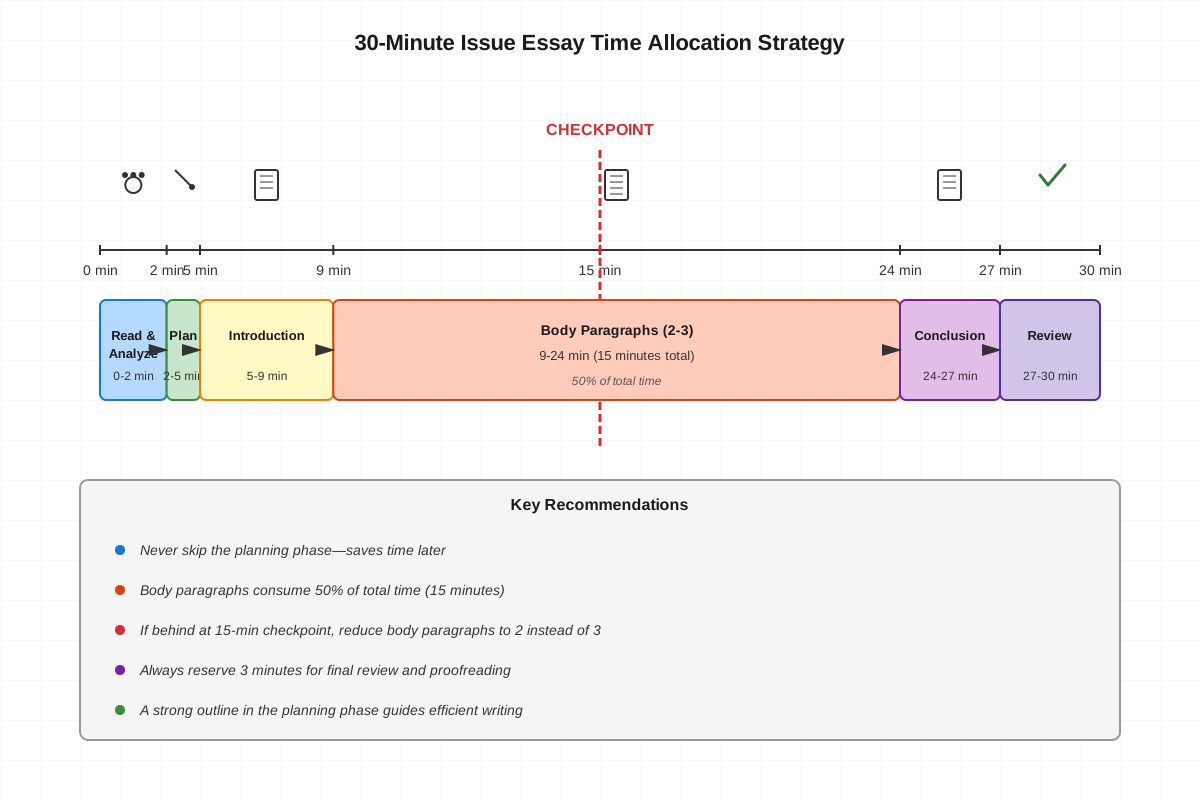
The Four-Phase Time Allocation Model
Successful test-takers typically divide the 30 minutes into four distinct phases, each serving a specific purpose in essay development:
| Phase | Time Allocation | Primary Activities | Key Outputs |
|---|---|---|---|
| Planning | 5-6 minutes | Analyze prompt, brainstorm examples, outline structure | Written outline with thesis and 2-3 main points |
| Introduction | 3-4 minutes | Write opening paragraph with clear thesis statement | Complete introduction (4-6 sentences) |
| Body Development | 15-17 minutes | Write 2-3 body paragraphs with examples and analysis | Fully developed supporting paragraphs |
| Conclusion & Revision | 4-5 minutes | Write conclusion, proofread, make corrections | Complete essay with polished conclusion |
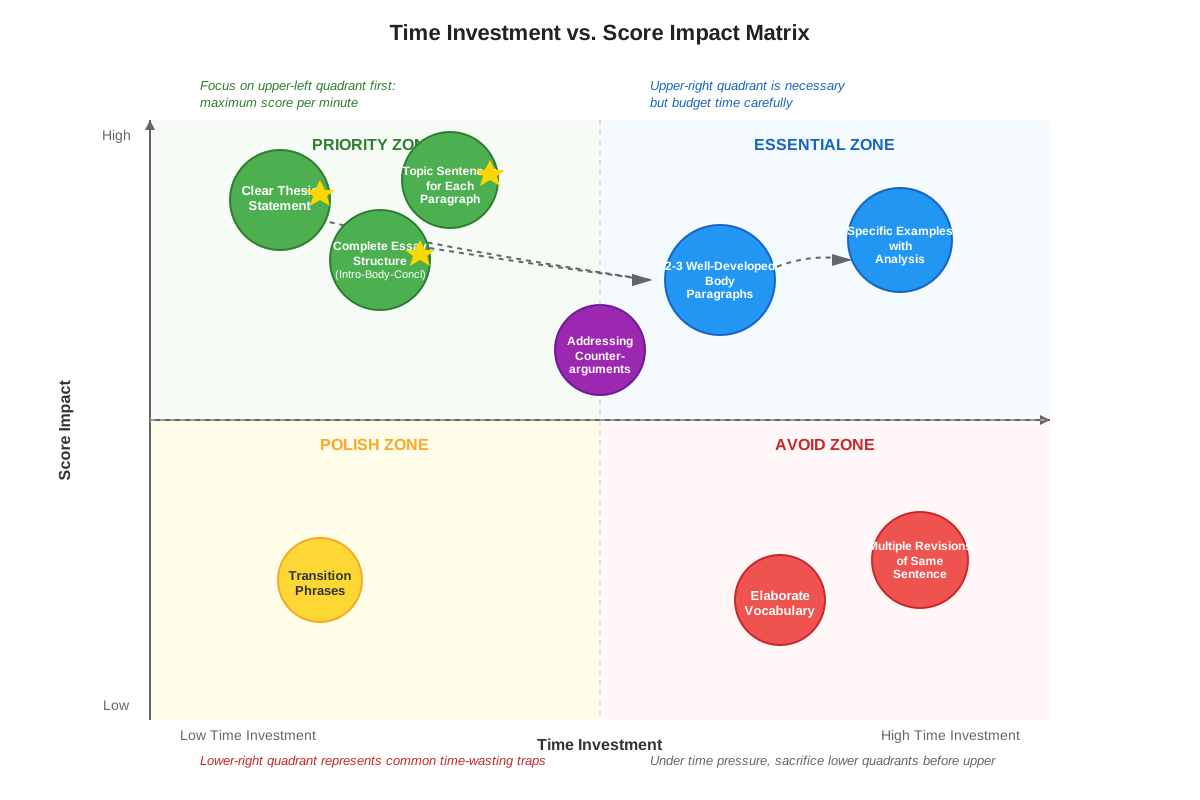
This model represents the most common high-scoring approach, though individual variations exist. The critical principle underlying this allocation is that body paragraphs receive the largest time investment because they contain the substantive analysis that determines the essay's score. Many unsuccessful test-takers invert this priority, spending disproportionate time on introductions while rushing through body paragraphs.
Strategic Planning Within Time Limits
The planning phase (5-6 minutes) must accomplish several objectives efficiently. First, test-takers must analyze the prompt to identify the specific claim being made and the instruction words (discuss, explain, consider, etc.) that define the task. Second, they must generate a position on the issue—agreement, disagreement, or qualified stance. Third, they must identify 2-3 supporting reasons with concrete examples. Fourth, they must create a brief outline that sequences these elements logically.
Effective planning avoids two common extremes: over-planning (spending 10+ minutes creating detailed outlines) and under-planning (beginning to write with only a vague sense of direction). The optimal approach produces a working outline—a simple structure that guides writing without constraining it. This might consist of:
- Thesis statement (one sentence)
- Body point 1 + example (3-4 words each)
- Body point 2 + example (3-4 words each)
- Body point 3 + example (3-4 words each, optional)
- Conclusion approach (2-3 words)
This level of planning provides sufficient direction while consuming only 5-6 minutes, leaving the majority of time for actual writing.
Writing Velocity and Fluency
Writing velocity—the speed at which ideas translate into written sentences—significantly impacts timing success. Test-takers must develop the ability to compose at approximately 30-40 words per minute to complete a 500-600 word essay within the time constraint. This velocity requires writing in a state of "flow" where sentences emerge relatively smoothly rather than through labored word-by-word construction.
Developing appropriate writing velocity involves practicing continuous writing during the body paragraph phase. Rather than composing a sentence, pausing to evaluate it, revising it, and then moving forward, effective test-takers write complete paragraphs in continuous drafts, reserving evaluation and revision for the final phase. This approach prevents the perfectionism that consumes excessive time during drafting.
The Checkpoint System
Successful time management requires temporal awareness—knowing where you should be at specific time points. The checkpoint system involves noting target times for completing each phase:
- 25 minutes remaining: Planning complete, beginning introduction
- 22 minutes remaining: Introduction complete, beginning first body paragraph
- 15 minutes remaining: First body paragraph complete, midway through second
- 8 minutes remaining: All body paragraphs complete, beginning conclusion
- 3 minutes remaining: Conclusion complete, beginning revision
These checkpoints function as early warning signals. If a test-taker reaches "15 minutes remaining" but hasn't completed the first body paragraph, immediate strategic adjustments are necessary. The checkpoint system prevents the common scenario where test-takers suddenly realize with 5 minutes remaining that they haven't written a conclusion.
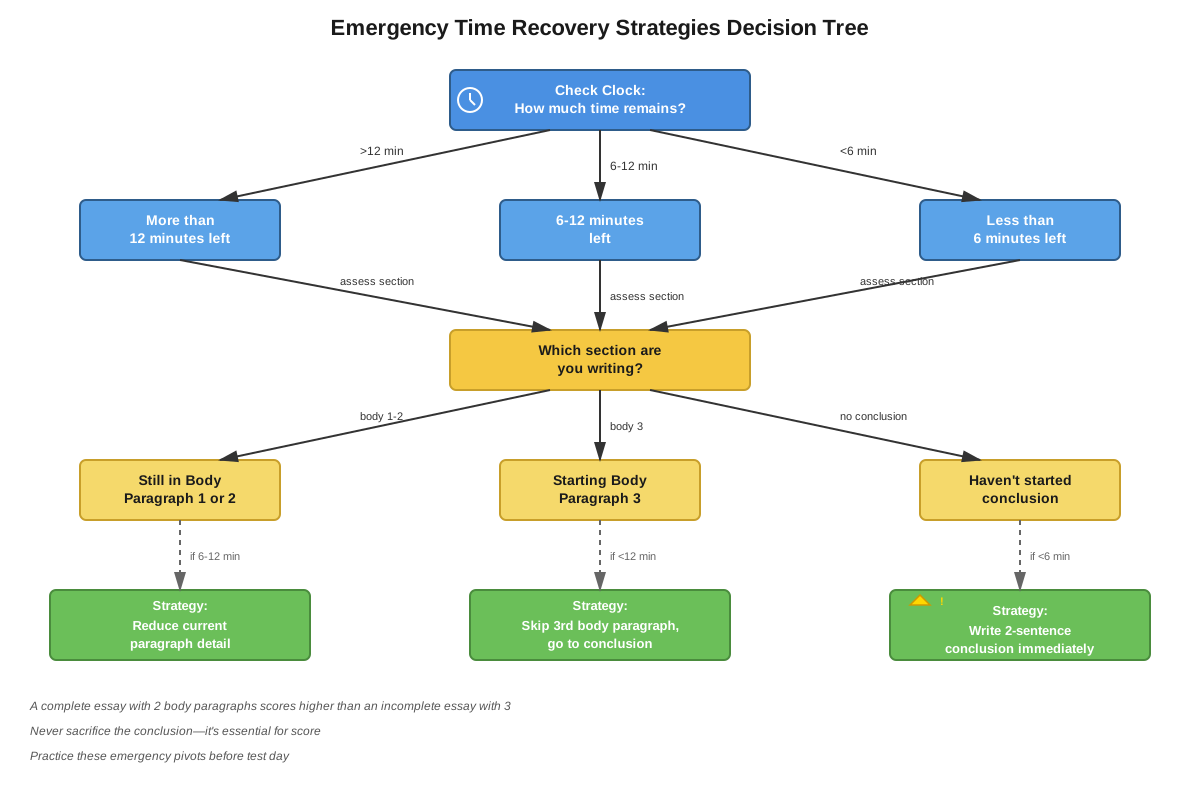
Adaptive Strategies for Time Deficits
Even with careful planning, test-takers sometimes fall behind schedule. Adaptive strategies allow for course correction without catastrophic score impact:
Strategy 1: Reduce body paragraph count. If running significantly behind at the 15-minute checkpoint, commit to writing only two body paragraphs instead of three, but ensure both are fully developed with examples and analysis.
Strategy 2: Simplify the conclusion. Rather than crafting an elaborate concluding paragraph, write a concise 2-3 sentence conclusion that restates the thesis and provides brief closure.
Strategy 3: Prioritize completion over perfection. If time becomes critically short, focus on getting all structural elements on the page—even in rough form—rather than polishing existing paragraphs.
Strategy 4: Use transition efficiency. When time is limited, employ simple transitional phrases ("Furthermore," "Additionally," "However") rather than elaborate transitional sentences between paragraphs.
The Revision Window
The final 4-5 minutes serve a dual purpose: completing the conclusion and conducting a focused revision. This revision differs from comprehensive editing; it targets high-impact corrections that improve clarity and reduce errors. Priorities include:
- Spelling corrections for words that appear multiple times
- Subject-verb agreement errors that undermine credibility
- Missing words that create confusion
- Unclear pronoun references that obscure meaning
- Thesis-conclusion alignment to ensure consistency
Test-takers should resist the temptation to rewrite entire sentences during revision unless critical errors exist. The goal is error reduction, not stylistic perfection. A complete essay with minor imperfections scores higher than an incomplete essay with polished prose.
Concept Relationships
The four-phase time allocation model serves as the central organizing framework, with planning establishing the foundation for all subsequent phases. Effective planning directly enables writing velocity because test-takers with clear outlines experience fewer mid-paragraph pauses to determine what to write next. This relationship flows: Strategic Planning → Increased Writing Velocity → Adequate Time for All Phases.
The checkpoint system functions as a monitoring mechanism that overlays the four-phase model, creating feedback loops that trigger adaptive strategies when necessary. When checkpoints reveal time deficits, adaptive strategies modify the original plan: Checkpoint Assessment → Time Deficit Identification → Adaptive Strategy Implementation → Modified Completion Plan.
Writing velocity and the revision window exist in a trade-off relationship. Test-takers who write more slowly have less time for revision, making initial accuracy more critical. Conversely, those who write quickly can allocate more time to revision, allowing for a "draft-then-polish" approach. This relationship connects to the prerequisite of typing proficiency—faster typists can implement different timing strategies than slower typists.
All concepts ultimately serve the goal of producing a complete, well-structured essay within 30 minutes. Incompleteness (missing conclusions, underdeveloped body paragraphs) represents the primary timing-related score penalty, making completion the non-negotiable objective that all timing strategies prioritize.
High-Yield Facts
⭐ The GRE Issue essay provides exactly 30 minutes with no extensions or pauses available
⭐ Body paragraphs should receive 15-17 minutes (50-55% of total time), the largest allocation of any phase
⭐ Incomplete essays (lacking conclusions) typically score at least one point lower than complete essays of similar quality
⭐ The optimal planning phase lasts 5-6 minutes, producing a working outline rather than detailed notes
⭐ Test-takers should check the timer at specific checkpoints (25, 22, 15, 8, and 3 minutes remaining) rather than continuously
- Writing velocity of 30-40 words per minute enables completion of a 500-600 word essay within time constraints
- The conclusion should be written even if time is critically short, using a simplified 2-3 sentence format if necessary
- Revision should focus on high-impact corrections (spelling, agreement, missing words) rather than comprehensive editing
- Two fully developed body paragraphs score higher than three rushed, underdeveloped paragraphs
- Test-takers who spend more than 10 minutes on planning and introduction typically fail to complete their essays
- The timer countdown is visible throughout the essay and cannot be hidden or paused
- Adaptive strategies should be implemented at the 15-minute checkpoint if the first body paragraph isn't complete
Quick check — test yourself on Issue essay timing so far.
Try Flashcards →Common Misconceptions
Misconception: More planning time always produces better essays → Correction: Planning beyond 6-7 minutes typically yields diminishing returns and creates time deficits in later phases. A working outline is sufficient; detailed planning consumes time better spent on body paragraph development.
Misconception: The introduction requires the most time and attention because it creates the first impression → Correction: While important, the introduction should consume only 3-4 minutes (10-13% of total time). Body paragraphs contain the substantive analysis that determines scores and deserve the largest time investment.
Misconception: Writing should stop at 26-27 minutes to allow extensive revision time → Correction: Revision requires only 4-5 minutes for focused corrections. Stopping writing too early often results in underdeveloped body paragraphs, a more serious flaw than minor errors that revision would catch.
Misconception: Fast typing is essential for success on the Issue essay → Correction: While helpful, typing speed is less critical than writing fluency (the ability to generate ideas continuously). Test-takers with moderate typing speed (30-40 wpm) can succeed by maximizing writing fluency and minimizing pauses.
Misconception: Checking the timer frequently helps maintain awareness and prevents timing problems → Correction: Obsessive timer-checking (every 1-2 minutes) creates anxiety and interrupts writing flow. The checkpoint system (checking at 5-6 specific time points) provides adequate awareness without disruption.
Misconception: If running out of time, the best strategy is to write faster and compress all remaining content → Correction: Writing faster typically reduces quality without proportional time savings. Adaptive strategies (reducing body paragraph count, simplifying conclusion) are more effective than attempting to accelerate writing speed under pressure.
Worked Examples
Example 1: Applying the Four-Phase Model to a Practice Essay
Scenario: A test-taker begins the Issue essay with the prompt: "The best way to teach is to praise positive actions and ignore negative ones." The task is to write a response discussing the extent to which you agree or disagree with the recommendation and explain your reasoning.
Phase 1 - Planning (Minutes 30:00 to 25:00)
The test-taker spends the first minute reading and analyzing the prompt, identifying that it makes an absolute claim ("the best way") about teaching methodology. They decide to take a qualified disagreement position: praising positive actions is valuable, but ignoring negative ones is problematic.
By minute 28:00, they've brainstormed examples:
- Positive: Elementary student praised for sharing → reinforces behavior
- Negative ignored: Student disrupting class → behavior escalates
- Workplace training: Ignoring safety violations → dangerous outcomes
At minute 26:00, they create a brief outline:
- Thesis: Praise is effective, but ignoring negatives is problematic
- Body 1: Praise reinforces positive (elementary example)
- Body 2: Ignoring negatives allows escalation (classroom disruption)
- Body 3: Real consequences in professional contexts (safety)
- Conclusion: Balanced approach needed
Phase 2 - Introduction (Minutes 25:00 to 22:00)
From 25:00 to 22:00, they write a 5-sentence introduction that presents the issue, acknowledges the value of positive reinforcement, states their qualified disagreement, and previews their reasoning. They finish at 21:30, slightly ahead of schedule.
Phase 3 - Body Development (Minutes 21:30 to 7:00)
First body paragraph (21:30 to 16:30): They write about positive reinforcement in elementary education, using the sharing example and explaining how praise shapes behavior. The paragraph reaches 120 words with clear topic sentence, example, and analysis.
Second body paragraph (16:30 to 11:00): They develop the classroom disruption scenario, explaining how ignoring negative behavior allows it to escalate and affect other students. This paragraph reaches 130 words.
Third body paragraph (11:00 to 7:00): They write about workplace safety training, arguing that ignoring violations can lead to serious consequences. This paragraph reaches 110 words.
At the 7:00 checkpoint, they've completed all body paragraphs and are on schedule.
Phase 4 - Conclusion & Revision (Minutes 7:00 to 0:00)
From 7:00 to 4:00, they write a conclusion that restates their position and synthesizes their arguments, emphasizing that effective teaching requires both praise and appropriate responses to negative actions.
From 4:00 to 0:00, they conduct focused revision, catching three spelling errors, fixing two subject-verb agreement issues, and clarifying one unclear pronoun reference.
Result: Complete 580-word essay with all structural elements, clear examples, and minimal errors—achieved through disciplined adherence to the time allocation model.
Example 2: Implementing Adaptive Strategies When Behind Schedule
Scenario: A test-taker begins the same prompt but encounters timing problems.
Minutes 30:00 to 23:00: They spend 7 minutes on planning, creating a very detailed outline with multiple examples for each point. This exceeds the recommended 5-6 minutes.
Minutes 23:00 to 18:00: They write an elaborate introduction with background information about teaching philosophy, consuming 5 minutes instead of the recommended 3-4 minutes.
Checkpoint at 22:00 minutes remaining: They should be beginning their first body paragraph but are still writing the introduction. They're approximately 3 minutes behind schedule.
Minutes 18:00 to 10:00: They write their first body paragraph, which takes 8 minutes due to extensive example development. The paragraph is excellent but consumes too much time.
Critical Checkpoint at 10:00 minutes remaining: They've completed only one body paragraph when they should be finishing their second. They're now 5-7 minutes behind schedule.
Adaptive Strategy Implementation: Recognizing the time deficit, they make immediate adjustments:
- Decision: Write only one more body paragraph instead of two, but ensure it's fully developed
- Simplification: Plan a 2-sentence conclusion rather than a full paragraph
- Focus: Commit to continuous writing without pausing for perfection
Minutes 10:00 to 4:30: They write a second body paragraph, maintaining focus and writing continuously. The paragraph reaches 115 words with clear development.
Minutes 4:30 to 2:00: They write a concise 2-sentence conclusion that restates their thesis and provides closure.
Minutes 2:00 to 0:00: They conduct rapid revision, focusing only on obvious spelling errors and missing words.
Result: Complete 520-word essay with two well-developed body paragraphs and a brief conclusion. While not ideal, the adaptive strategies prevented a worse outcome (incomplete essay or three rushed paragraphs). The essay remains scoreable at a reasonable level because it's complete and coherent.
Key Lesson: The checkpoint system provided early warning of timing problems, and adaptive strategies (reducing paragraph count, simplifying conclusion) enabled completion despite the time deficit.
Exam Strategy
Recognizing Timing-Related Challenges
The GRE doesn't explicitly "test" timing as a separate skill, but timing management directly impacts the evaluable product. Scorers cannot distinguish between an incomplete essay caused by poor time management versus one caused by insufficient content knowledge—both receive lower scores. Therefore, every Issue essay implicitly tests timing through the 30-minute constraint.
Trigger for timing awareness: The moment the Issue prompt appears on screen, the 30-minute countdown begins automatically. This is the trigger to implement the four-phase model immediately rather than beginning to write without a time plan.
Process-of-Elimination Applied to Time Allocation
When deciding how to allocate time, test-takers can eliminate ineffective approaches:
Eliminate: Spending equal time on all paragraphs (6 minutes each for intro, three body paragraphs, and conclusion)
Reason: This treats all sections as equally important when body paragraphs should receive priority
Eliminate: Beginning to write immediately without any planning
Reason: This often leads to mid-essay confusion about direction and wastes time on false starts
Eliminate: Planning to write four or more body paragraphs
Reason: Four body paragraphs require 20+ minutes to develop adequately, leaving insufficient time for other phases
Retain: The 5-6 / 3-4 / 15-17 / 4-5 minute allocation model
Reason: This model prioritizes body paragraph development while ensuring all structural elements receive attention
Strategic Timer Checking
Develop a consistent timer-checking routine:
- After planning (should see 24-25 minutes remaining): Confirms planning didn't overrun
- After introduction (should see 21-22 minutes remaining): Confirms readiness to begin body paragraphs with adequate time
- Mid-body development (should see 14-16 minutes remaining): Provides early warning if first body paragraph consumed too much time
- Before conclusion (should see 7-9 minutes remaining): Determines whether adaptive strategies are necessary
- Beginning revision (should see 4-5 minutes remaining): Confirms adequate time for focused corrections
Emergency Protocols
If the timer shows 5 minutes remaining and the essay lacks a conclusion:
- Immediately stop developing the current body paragraph, even mid-sentence
- Write a 2-sentence conclusion (3 minutes maximum)
- Use remaining time for rapid error correction
If the timer shows 2 minutes remaining and the essay lacks a conclusion:
- Write a single-sentence conclusion that restates the thesis
- Conduct 30-second scan for only the most obvious errors
- Accept imperfection rather than leaving the essay incomplete
Memory Techniques
The "5-3-15-5" Mnemonic
Remember the time allocation model as "5-3-15-5" (rounding for simplicity):
- 5 minutes planning
- 3 minutes introduction
- 15 minutes body paragraphs
- 5 minutes conclusion and revision
This sequence is easy to recall under test pressure and provides quick reference points.
The "CHECKPOINT" Acronym
Check timer at Half-minute intervals (every 5-7 minutes)
Evaluate progress against targets
Correct course if behind schedule
Keep writing continuously during body paragraphs
Prioritize completion over perfection
Outline briefly (5-6 minutes maximum)
Introduce thesis quickly (3-4 minutes)
Never skip the conclusion
Time the revision phase (4-5 minutes)
Visualization: The Essay Timeline
Visualize the 30-minute period as a horizontal timeline divided into four colored zones:
- Blue zone (0-6 minutes): Planning phase—cool, analytical thinking
- Green zone (6-10 minutes): Introduction—fresh start, establishing direction
- Red zone (10-25 minutes): Body paragraphs—intense, sustained writing effort
- Yellow zone (25-30 minutes): Conclusion and revision—caution, careful checking
This color-coded mental image helps maintain awareness of which phase should be active at any given time.
Summary
Mastering issue essay timing requires understanding that the 30-minute constraint is not merely a logistical challenge but a fundamental component of GRE Analytical Writing assessment. The four-phase time allocation model—planning (5-6 minutes), introduction (3-4 minutes), body development (15-17 minutes), and conclusion with revision (4-5 minutes)—provides a proven framework that prioritizes the substantive analysis in body paragraphs while ensuring all structural elements receive appropriate attention. Successful test-takers implement a checkpoint system that provides temporal awareness at critical junctures (25, 22, 15, 8, and 3 minutes remaining), enabling early detection of timing problems and implementation of adaptive strategies before deficits become catastrophic. The ultimate goal of all timing strategies is producing a complete essay, as incomplete essays suffer significant score penalties regardless of the quality of their existing content. By developing writing fluency, practicing the time allocation model, and preparing adaptive strategies for time deficits, test-takers transform timing from a source of anxiety into a manageable, strategic component of their Issue essay approach.
Key Takeaways
- The GRE Issue essay provides exactly 30 minutes with no extensions; incomplete essays receive substantially lower scores than complete essays of similar quality
- Body paragraphs should receive 50-55% of total time (15-17 minutes) because they contain the substantive analysis that determines scores
- The optimal planning phase lasts 5-6 minutes and produces a working outline, not detailed notes; planning beyond 7 minutes creates time deficits
- Implement a checkpoint system by checking the timer at five specific points (25, 22, 15, 8, and 3 minutes remaining) rather than continuously
- When falling behind schedule, use adaptive strategies: reduce body paragraph count to two, simplify the conclusion to 2-3 sentences, and prioritize completion over perfection
- Writing velocity (30-40 words per minute) matters less than writing fluency—the ability to compose continuously without frequent pauses
- Always write a conclusion, even if time is critically short; a 1-2 sentence conclusion is better than no conclusion
Related Topics
Argument Essay Timing: The Argument essay also operates under a 30-minute constraint but requires different time allocation because the task involves critique rather than position development. Mastering Issue essay timing provides transferable skills for managing the Argument essay timeline.
Essay Planning Strategies: Deeper exploration of efficient planning techniques, including various outline formats and brainstorming methods that maximize idea generation within the 5-6 minute planning window.
Body Paragraph Development: Detailed study of how to construct well-developed body paragraphs efficiently, including example selection, analysis techniques, and paragraph length optimization—all critical for making effective use of the 15-17 minute body development phase.
Revision Techniques for Timed Essays: Advanced strategies for conducting focused, high-impact revision in 4-5 minutes, including error prioritization and rapid proofreading methods.
Test Anxiety Management: Psychological strategies for maintaining composure under time pressure, particularly relevant for test-takers who experience heightened anxiety when watching the countdown timer.
Practice CTA
Now that you understand the strategic framework for managing the 30-minute Issue essay constraint, it's time to put these timing principles into practice. Attempt the practice questions and flashcards to reinforce your understanding of the four-phase model, checkpoint system, and adaptive strategies. Remember: timing mastery doesn't develop through passive reading—it requires active practice under actual time constraints. Set a 30-minute timer for your next practice essay and implement the strategies you've learned. Each timed practice session builds the fluency and confidence that transforms timing from a source of stress into a competitive advantage on test day. You've learned the framework; now make it automatic through deliberate practice.
Sign up free to keep reading
Create a free AnvayaPrep account to finish this GRE guide on Issue essay timing — plus flashcards and practice questions.