Overview
Using real-world examples is one of the most powerful techniques for strengthening arguments in the GRE Analytical Writing section, particularly in the Analyze an Issue task. This skill involves drawing upon historical events, scientific discoveries, contemporary social phenomena, business cases, technological developments, and personal observations to support claims and demonstrate the validity of positions. The ability to effectively incorporate concrete, specific examples transforms abstract reasoning into compelling, persuasive prose that demonstrates critical thinking depth and breadth of knowledge.
The GRE evaluates not just whether test-takers can construct grammatically correct sentences, but whether they can build sophisticated arguments that reflect real-world complexity. Graders specifically look for essays that move beyond theoretical speculation to ground claims in observable reality. An essay that discusses education reform in purely abstract terms scores significantly lower than one that references specific educational initiatives, their outcomes, and measurable impacts. The difference between a score of 3.5 and 5.5 often hinges on the quality, relevance, and integration of real-world examples throughout the response.
Within the broader Analytical Writing framework, gre using real-world examples connects directly to other essential skills including developing a clear thesis, organizing paragraphs logically, and anticipating counterarguments. Examples serve as the evidentiary foundation upon which persuasive arguments rest. They provide the concrete support that transforms opinion into reasoned analysis. This topic also relates to critical reading skills tested in the Verbal Reasoning section, as recognizing how authors use examples to support claims helps test-takers both analyze passages and construct their own arguments more effectively.
Learning Objectives
- [ ] Identify when Using real-world examples is being tested
- [ ] Explain the core rule or strategy behind Using real-world examples
- [ ] Apply Using real-world examples to GRE-style questions accurately
- [ ] Evaluate the relevance and effectiveness of different types of examples for specific claims
- [ ] Generate diverse categories of examples quickly under timed conditions
- [ ] Integrate examples seamlessly into argumentative paragraphs without disrupting logical flow
- [ ] Distinguish between high-impact examples that strengthen arguments and weak examples that add little value
Prerequisites
- Basic essay structure: Understanding introduction, body paragraphs, and conclusion organization is essential because examples must be strategically placed within this framework to maximize impact.
- Thesis development: The ability to formulate a clear position is necessary because examples must directly support the specific claims being made rather than tangentially relate to the general topic.
- Paragraph organization: Knowledge of topic sentences and supporting details helps determine where and how to introduce examples within the logical flow of an argument.
- Critical thinking fundamentals: The capacity to analyze cause-and-effect relationships and evaluate evidence enables selection of examples that genuinely support rather than merely illustrate claims.
Why This Topic Matters
Real-world examples demonstrate intellectual maturity and the ability to connect abstract concepts to concrete reality—a skill valued in graduate-level academic work and professional contexts. In academic research, scholars must support theoretical claims with empirical evidence. In business, leaders must justify strategic decisions with market data and case studies. In policy-making, effective arguments require historical precedents and statistical evidence. The GRE Analytical Writing section simulates these real-world demands by requiring test-takers to substantiate their positions with specific, relevant examples.
Statistically, essays scoring in the 5.0-6.0 range consistently feature multiple well-developed examples, while essays scoring below 4.0 typically rely on vague generalizations or hypothetical scenarios. According to ETS scoring guidelines, essays demonstrating "insightful analysis" and "compelling reasons and/or persuasive examples" receive the highest marks. The Analyze an Issue task appears as one of two Analytical Writing prompts, and performance on this section can significantly impact graduate school admissions, particularly for programs emphasizing research and writing skills.
On the GRE, this topic appears in every Analyze an Issue prompt, though the specific requirement varies. Some prompts explicitly request examples ("Write a response in which you discuss the extent to which you agree or disagree with the statement and explain your reasoning for the position you take. In developing and supporting your position, you should consider ways in which the statement might or might not hold true and explain how these considerations shape your position."). The implicit expectation for concrete support remains constant regardless of the specific task instructions. Common prompt themes include education, technology, government policy, social values, and leadership—all domains where real-world examples prove essential for credible argumentation.
Core Concepts
Definition and Purpose of Real-World Examples
Using real-world examples refers to the strategic incorporation of specific, verifiable instances from history, current events, science, business, culture, or personal experience to support argumentative claims. Unlike hypothetical scenarios ("Imagine if a company did X...") or vague generalizations ("Many people believe..."), real-world examples reference actual events, individuals, organizations, or phenomena that can be verified or are widely recognized. The primary purpose is to provide concrete evidence that demonstrates the validity of abstract claims, making arguments more persuasive and demonstrating the writer's ability to connect theory to practice.
Examples serve multiple rhetorical functions: they illustrate abstract concepts by making them tangible, prove claims by providing evidence, contextualize arguments by showing real-world applications, and engage readers by connecting to shared knowledge or experiences. A well-chosen example transforms a theoretical assertion into a demonstrable truth, significantly increasing the argument's persuasive power.
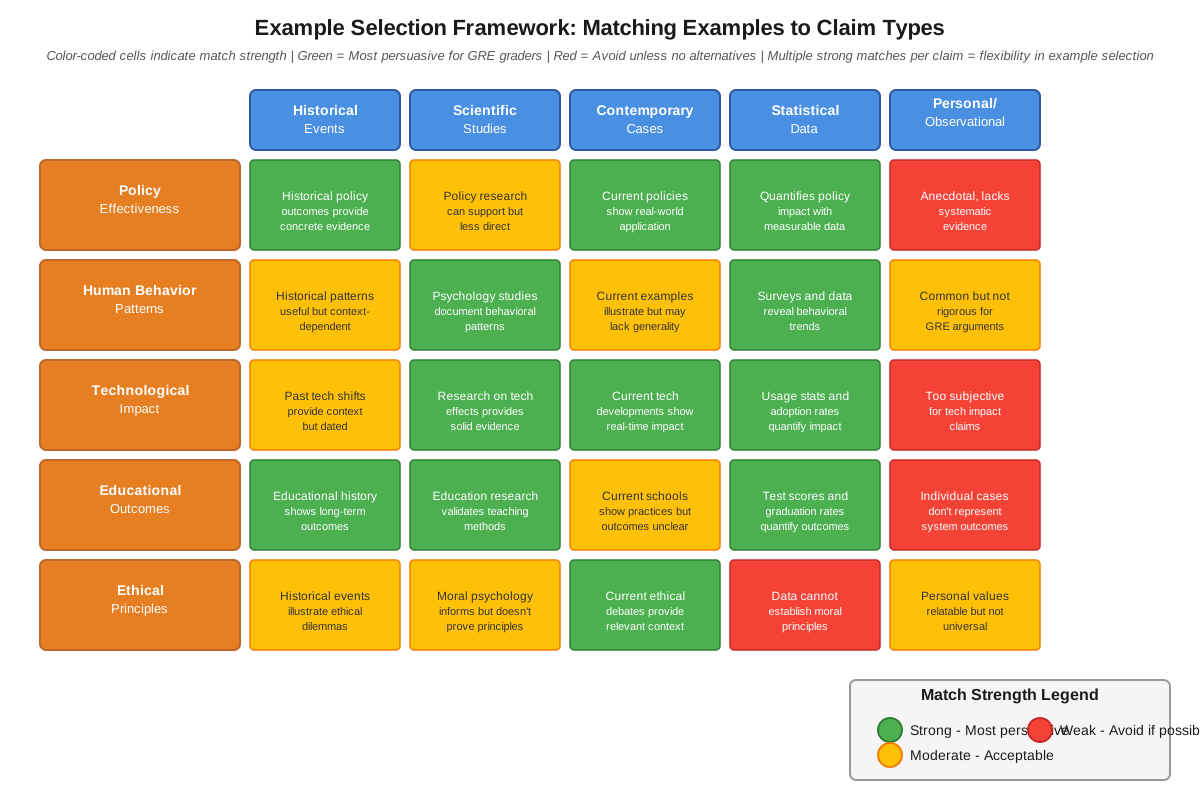
Categories of Effective Examples
Real-world examples fall into several categories, each offering distinct advantages:
| Category | Description | Strengths | Considerations |
|---|---|---|---|
| Historical Events | Major occurrences from the past (wars, movements, discoveries) | Widely recognized; demonstrate long-term patterns; show cause-effect over time | Must be accurately represented; avoid oversimplification |
| Contemporary Issues | Current events and ongoing situations | Highly relevant; demonstrate awareness of present context | May be less familiar to all readers; require careful explanation |
| Scientific Studies | Research findings and experiments | Provide empirical evidence; demonstrate analytical thinking | Should be described accurately; avoid overstating conclusions |
| Business Cases | Company successes, failures, or strategies | Show practical application; demonstrate economic understanding | Must be relevant to the argument; avoid excessive detail |
| Cultural Phenomena | Social trends, artistic movements, technological adoption | Illustrate societal values and changes; broadly accessible | Should connect clearly to the argument's main point |
| Personal Experience | Individual observations or experiences | Authentic and specific; demonstrate reflective thinking | Use sparingly; must be relevant and representative |
Criteria for Selecting Strong Examples
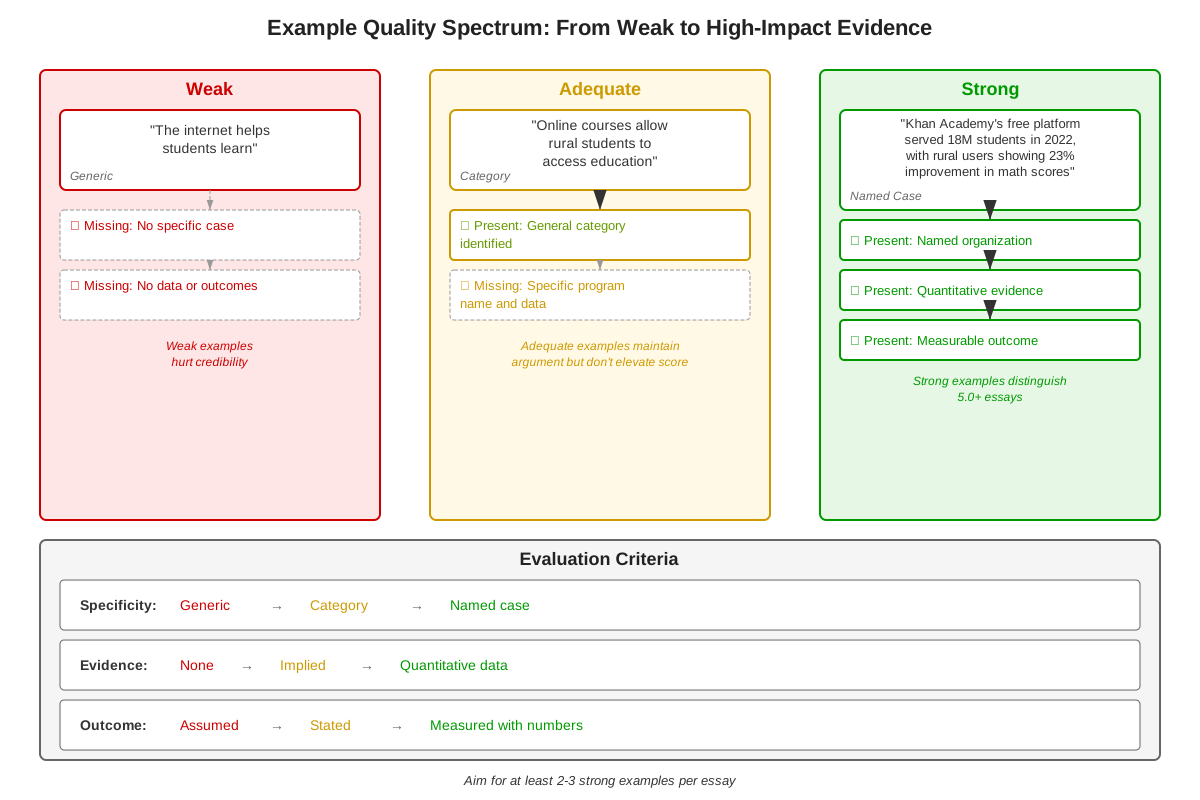
Not all examples strengthen arguments equally. The most effective examples meet several key criteria:
- Relevance: The example directly supports the specific claim being made, not just the general topic. If arguing that "competition drives innovation," an example must demonstrate this causal relationship, not merely show that innovation exists.
- Specificity: Strong examples include concrete details—names, dates, locations, or measurable outcomes—rather than vague references. "The Apollo 11 mission in 1969" is more effective than "space exploration programs."
- Clarity: The connection between the example and the claim must be explicit. Writers should explain how the example supports the argument rather than assuming readers will make the connection independently.
- Credibility: Examples should be accurate and verifiable. While perfect recall isn't expected under timed conditions, major factual errors undermine credibility.
- Diversity: Using examples from different domains (history, science, contemporary events) demonstrates breadth of knowledge and strengthens the argument by showing patterns across contexts.
Integration Techniques
The mechanical process of incorporating examples into argumentative prose requires specific techniques:
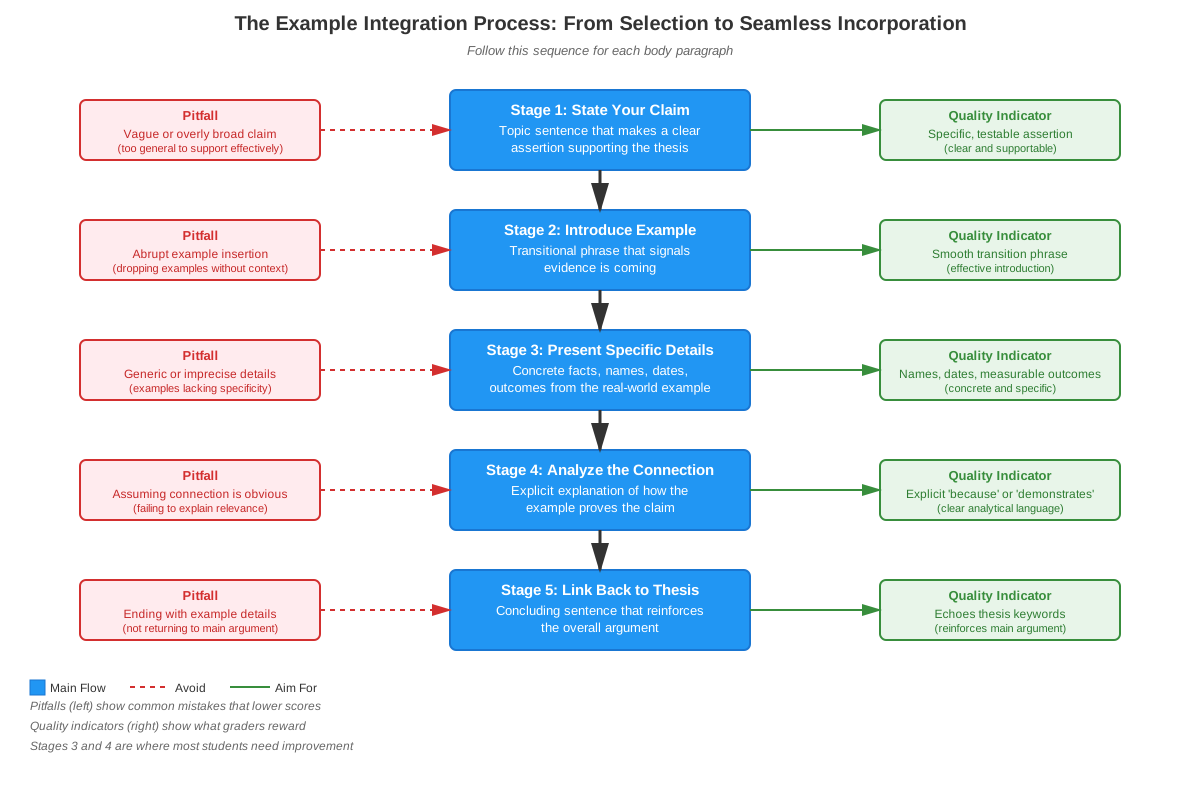
The Claim-Evidence-Analysis Structure provides the most effective framework:
- State the claim clearly
- Introduce the example with appropriate context
- Explain explicitly how the example supports the claim
- Connect back to the thesis
For instance: "Innovation often emerges from competitive pressure rather than comfortable monopolies. [CLAIM] When Apple introduced the iPhone in 2007, it disrupted the mobile phone market dominated by Nokia and BlackBerry. These established companies, facing existential threats, rapidly innovated—Nokia developed the Lumia line and BlackBerry enhanced its touchscreen capabilities. [EVIDENCE] This pattern demonstrates that competition created urgency and resource allocation toward innovation that had been absent when these companies felt secure in their market positions. [ANALYSIS] Thus, competitive environments generate the conditions necessary for breakthrough innovations. [CONNECTION TO THESIS]"
Transitional phrases help integrate examples smoothly:
- "Consider the case of..."
- "This principle is evident in..."
- "Historical evidence supports this view; for instance..."
- "A compelling illustration comes from..."
- "Recent developments in [field] demonstrate..."
Common Pitfalls in Example Usage
Several mistakes weaken the effectiveness of examples:
Excessive detail occurs when writers provide so much information about the example that it overshadows the argument. The example should support the claim, not become the focus. A paragraph about World War II's causes, major battles, and outcomes distracts from an argument about leadership unless those specific details directly support leadership claims.
Insufficient connection happens when writers present an example but fail to explain its relevance. Simply stating "Google is a successful company" doesn't support any particular claim until the writer explains what aspect of Google's success relates to the argument.
Hypothetical examples ("If a school implemented this policy, students might...") lack the persuasive power of actual cases. While occasional hypothetical scenarios can explore possibilities, they shouldn't replace real-world evidence.
Repetitive examples from the same domain suggest limited knowledge. Three examples from World War II, regardless of their quality, demonstrate less intellectual range than examples from different historical periods or fields.
Developing Example Repertoires
Successful GRE test-takers develop mental databases of versatile examples that can be adapted to various prompts. This preparation involves:
Identifying multi-purpose examples: Some cases illustrate multiple principles. The Industrial Revolution can support arguments about technological change, economic development, social disruption, environmental impact, or labor rights. Understanding an example's multiple dimensions increases its utility.
Organizing by theme: Mentally categorizing examples by common GRE themes (education, technology, leadership, social change, ethics) enables quick retrieval under timed conditions.
Practicing application: Regularly practicing how to connect familiar examples to different claims builds flexibility. The same example—such as the development of vaccines—can support arguments about scientific progress, public health policy, international cooperation, or the importance of funding basic research, depending on which aspects are emphasized and how the connection is explained.
Concept Relationships
The skill of using real-world examples exists within a network of interconnected Analytical Writing competencies. Thesis development → determines what types of examples are relevant → guides example selection. A thesis arguing that "technological progress creates more problems than it solves" requires different examples than one claiming "technological progress generally improves quality of life," even though both address technology.
Critical thinking skills → enable evaluation of example quality → strengthen argument persuasiveness. The ability to analyze cause-and-effect relationships helps writers select examples that genuinely demonstrate their claims rather than merely relating to the topic. This analytical capacity also helps writers explain the connection between examples and claims explicitly.
Paragraph organization ↔ example integration form a bidirectional relationship. Well-organized paragraphs provide clear positions where examples can be introduced effectively (typically after the topic sentence and claim), while strong examples help structure paragraphs by providing concrete content around which analysis can be built.
Counterargument anticipation → requires examples that address opposing views. When acknowledging that a position has limitations, providing real-world examples of those limitations demonstrates intellectual honesty and strengthens the overall argument by showing comprehensive thinking.
Within the broader GRE preparation context, the skill of using real-world examples connects to Verbal Reasoning passage analysis, where recognizing how authors use examples to support claims improves reading comprehension. It also relates to Argument Analysis tasks, where evaluating the quality of evidence requires understanding what makes examples effective or weak.
High-Yield Facts
⭐ Essays scoring 5.0 or higher consistently include at least 2-3 well-developed, specific examples with clear connections to claims.
⭐ The most effective examples include specific details (names, dates, locations, or measurable outcomes) rather than vague references.
⭐ Examples must be explicitly connected to claims through analysis; simply presenting an example without explanation weakens the argument.
⭐ Diverse examples from different domains (history, science, contemporary events, business) demonstrate broader knowledge and strengthen arguments more than multiple examples from the same field.
⭐ Historical examples (major events, movements, or figures) are generally safer choices than very recent events because they're more widely recognized and less controversial.
- Personal examples should be used sparingly and only when they're genuinely relevant and representative of broader patterns.
- Hypothetical examples ("If a company were to...") lack the persuasive power of actual cases and should be avoided when real-world examples are available.
- Minor factual errors in examples are less damaging than complete absence of examples, but accuracy matters for credibility.
- The analysis explaining how an example supports a claim is often more important than the example itself.
- Examples should be proportionate to the argument—typically 2-4 sentences within a paragraph, not entire paragraphs devoted to a single example.
Quick check — test yourself on Using real-world examples so far.
Try Flashcards →Common Misconceptions
Misconception: More examples always make an argument stronger. → Correction: Quality and relevance matter more than quantity. Two well-developed, clearly connected examples strengthen an argument more effectively than five superficial or tangentially related examples. Each example requires explanation and analysis, so including too many can result in insufficient development of each.
Misconception: Examples must be perfectly accurate with exact dates and details. → Correction: While accuracy is important, graders understand that test-takers write under timed conditions without reference materials. Approximate dates ("in the early 1960s") and general accuracy are acceptable. The key is avoiding major factual errors that undermine credibility, such as placing events in the wrong century or attributing discoveries to the wrong people.
Misconception: Personal examples are weak and should be avoided entirely. → Correction: Personal examples can be effective when they're specific, relevant, and representative of broader patterns. An observation about how a school policy affected learning outcomes can support educational arguments. However, personal examples shouldn't dominate the essay, and they work best when combined with other types of evidence.
Misconception: The example itself proves the argument. → Correction: Examples illustrate and support claims but don't prove them independently. The analysis explaining how the example demonstrates the claim is essential. Without explicit connection, even a perfect example adds little persuasive value.
Misconception: Obscure or sophisticated examples impress graders more than commonly known examples. → Correction: Clarity and relevance matter more than obscurity. A well-explained example from widely known history (the Civil Rights Movement, the Industrial Revolution) is more effective than a poorly explained reference to an obscure event. Graders value how examples are used, not how esoteric they are.
Misconception: Examples should only come from academic or historical sources. → Correction: Contemporary business cases, technological developments, cultural phenomena, and even well-chosen popular culture references can effectively support arguments when they're relevant and clearly connected to claims. The key is appropriateness to the argument, not the source domain.
Worked Examples
Example 1: Technology and Education Prompt
Prompt: "The best way to teach is to praise positive actions and ignore negative ones."
Task: Write a response in which you discuss the extent to which you agree or disagree with the recommendation and explain your reasoning for the position you take.
Sample Paragraph with Effective Example Usage:
While positive reinforcement certainly plays an important role in education, completely ignoring negative actions can undermine learning and social development. [CLAIM] The case of progressive education reforms in certain California school districts in the early 2000s illustrates this limitation. [EXAMPLE INTRODUCTION] Several schools adopted policies that eliminated traditional disciplinary measures and focused exclusively on rewarding positive behavior. Within two years, these schools reported increased classroom disruptions, declining test scores, and higher teacher turnover rates. [SPECIFIC DETAILS] Teachers found that students who engaged in disruptive behavior faced no consequences and therefore had no incentive to change, while students who behaved appropriately felt that their efforts were devalued when disruptive peers received the same treatment. [ANALYSIS OF IMPACT] This outcome demonstrates that ignoring negative actions doesn't eliminate them; instead, it creates an environment where such actions persist and multiply, ultimately harming the learning environment for all students. [EXPLICIT CONNECTION TO CLAIM] Therefore, while praise for positive actions should be emphasized, completely ignoring negative behaviors proves counterproductive in real educational settings. [CONCLUSION]
Why This Works:
- Specific example with location and timeframe
- Concrete outcomes (increased disruptions, declining scores, teacher turnover)
- Clear analysis of cause and effect
- Explicit connection between example and claim
- Balanced tone that acknowledges positive reinforcement's value while demonstrating limitations
Example 2: Leadership and Innovation Prompt
Prompt: "The best leaders are those who encourage feedback from the people whom they lead."
Task: Write a response discussing your views on the policy and explain your reasoning.
Sample Paragraph with Multiple Examples:
Leaders who actively solicit and incorporate feedback from their teams consistently achieve better outcomes than those who rely solely on their own judgment. [CLAIM] In the business world, Satya Nadella's transformation of Microsoft after becoming CEO in 2014 exemplifies this principle. [FIRST EXAMPLE] Nadella implemented a "growth mindset" culture that explicitly encouraged employees at all levels to share ideas and challenge existing practices. This approach led to Microsoft's successful pivot to cloud computing and collaboration tools, reversing years of stagnation and making Microsoft one of the world's most valuable companies by 2020. [SPECIFIC OUTCOMES] Similarly, in the public sector, New Zealand Prime Minister Jacinda Ardern's response to the COVID-19 pandemic demonstrated the value of feedback-driven leadership. [SECOND EXAMPLE] Ardern held regular consultations with health experts, community leaders, and citizens, adjusting policies based on their input. This responsive approach resulted in New Zealand achieving one of the lowest COVID-19 death rates among developed nations during the pandemic's first year. [MEASURABLE RESULT] Both cases demonstrate that leaders who create channels for feedback and genuinely incorporate diverse perspectives make more informed decisions and achieve superior results compared to leaders who operate in isolation. [SYNTHESIS AND CONNECTION] The pattern across different sectors—business and government—suggests this principle applies broadly rather than being limited to specific contexts. [BROADER IMPLICATION]
Why This Works:
- Two examples from different domains (business and government)
- Specific individuals, organizations, and timeframes
- Measurable outcomes in both cases
- Explicit analysis of how feedback led to success
- Synthesis showing the pattern across contexts
- Clear connection to the original claim
Exam Strategy
Approaching Example-Based Questions
When encountering any Analyze an Issue prompt, immediately identify 2-3 potential examples that could support different positions on the issue. This pre-writing step (30-60 seconds) ensures examples are available regardless of which position is ultimately chosen. Create a mental or brief written list of domains: history, science/technology, business, contemporary events, education. Try to identify at least one example from different domains to demonstrate breadth.
Trigger Words and Phrases
Certain prompt language signals that examples will be particularly important:
- "Provide reasons and/or examples" (explicit requirement)
- "Discuss the extent to which you agree or disagree" (requires evidence for position)
- "Consider ways in which the statement might or might not hold true" (needs examples of both)
- "Explain your reasoning" (examples serve as reasoning foundation)
- Any prompt about education, technology, leadership, or social policy (domains where concrete examples are essential)
Process of Elimination for Example Selection
When multiple potential examples come to mind, use these criteria to select the strongest:
- Eliminate examples you can't remember clearly: Vague recollections lead to weak, unconvincing examples
- Eliminate examples that only tangentially relate: If the connection requires extensive explanation, the example isn't strong enough
- Eliminate examples from the same domain as others you're using: Diversity strengthens the argument
- Prioritize examples with measurable outcomes: Concrete results are more persuasive than general descriptions
- Choose examples you can explain in 3-4 sentences: If an example requires extensive background, it's too complex for timed conditions
Time Allocation
In the 30-minute Analyze an Issue task:
- Minutes 0-2: Read prompt, choose position, identify 2-3 potential examples
- Minutes 2-5: Outline argument structure, noting where each example will appear
- Minutes 5-25: Write essay, spending approximately 3-4 minutes per body paragraph (including example development and analysis)
- Minutes 25-30: Review and revise, ensuring each example has clear connection to claims
Allocate roughly equal time to each body paragraph. If an example isn't flowing well during writing, move to the next point rather than spending excessive time perfecting one example at the expense of overall essay development.
Integration Strategy
Follow this sequence for each example:
- State the claim (1 sentence)
- Introduce the example with minimal context (1 sentence)
- Provide specific details (1-2 sentences)
- Analyze how the example supports the claim (1-2 sentences)
- Connect back to thesis (1 sentence)
This structure ensures examples are developed sufficiently without dominating the paragraph or disconnecting from the argument.
Memory Techniques
The STAR Method for Example Development
Situation: What was the context?
Task: What challenge or goal existed?
Action: What specific action was taken?
Result: What measurable outcome occurred?
This framework, adapted from interview techniques, helps structure example presentation clearly and completely. For instance, with the Apollo program: Situation—Cold War space race; Task—land humans on the moon; Action—massive investment in NASA, recruitment of scientists, development of new technologies; Result—successful moon landing in 1969, technological innovations that benefited society.
Domain Categories Acronym: BEST-CH
Business (companies, economic trends, market developments)
Education (schools, teaching methods, learning outcomes)
Science (discoveries, experiments, technological innovations)
Technology (digital developments, social media, automation)
Culture (social movements, artistic developments, demographic changes)
History (major events, influential figures, significant periods)
During preparation, develop 2-3 examples in each BEST-CH category. This ensures diverse examples are available for any prompt.
The "Three Levels" Visualization
Visualize arguments as a three-story building:
- Top floor: Abstract claims and thesis (the roof that covers everything)
- Middle floor: Examples and evidence (the solid structure that supports the roof)
- Ground floor: Analysis and explanation (the foundation that connects structure to ground)
This visualization reminds test-takers that examples (middle floor) must be supported by analysis (ground floor) and must support claims (top floor). All three levels are necessary for a stable structure.
Example Preparation Template
Create mental "example cards" during preparation:
Front: Example name (e.g., "Industrial Revolution")
Back:
- Key facts (timeframe, location, major figures)
- Possible applications (economic change, technological progress, social disruption, environmental impact)
- Specific details (steam engine, factory system, urbanization)
- Measurable outcomes (increased production, population shifts)
This mental organization enables quick retrieval and flexible application during the exam.
Summary
Using real-world examples effectively is essential for achieving high scores on the GRE Analytical Writing section's Analyze an Issue task. This skill involves selecting specific, relevant instances from history, contemporary events, science, business, or personal experience that directly support argumentative claims. The most effective examples include concrete details such as names, dates, locations, or measurable outcomes, and they are integrated into arguments through clear analysis that explicitly connects the example to the claim being made. Strong essays typically feature 2-3 well-developed examples from diverse domains, demonstrating both breadth of knowledge and depth of critical thinking. The key to success lies not merely in presenting examples but in explaining how they support specific claims through the claim-evidence-analysis structure. Test-takers should prepare by developing mental repertoires of versatile examples organized by theme and domain, practicing their application to various prompts, and mastering integration techniques that seamlessly incorporate examples into coherent argumentative paragraphs without excessive detail or insufficient connection.
Key Takeaways
- Specificity matters: Examples with concrete details (names, dates, measurable outcomes) are significantly more persuasive than vague references
- Analysis is essential: The explanation of how an example supports a claim is as important as the example itself; never present an example without explicit connection
- Diversity strengthens arguments: Examples from different domains (history, science, business, contemporary events) demonstrate broader knowledge and more convincing patterns
- Quality over quantity: Two well-developed, clearly connected examples outperform five superficial or tangentially related examples
- Structure examples consistently: Use the claim-evidence-analysis framework to ensure complete development and clear integration
- Prepare versatile examples: Develop a mental database of multi-purpose examples that can be adapted to various prompts and themes
- Balance detail and focus: Provide enough specific information to make examples credible without overwhelming the argument with excessive detail
Related Topics
Developing Strong Thesis Statements: Mastering real-world examples enables more confident thesis development because writers know they can support their positions with concrete evidence. This topic explores how to craft clear, defensible positions that examples can effectively support.
Analyzing Counterarguments: Using examples to acknowledge and address opposing viewpoints strengthens arguments by demonstrating comprehensive thinking. This advanced skill builds on example usage by applying it to more complex argumentative structures.
Paragraph Organization and Coherence: Understanding how to structure body paragraphs ensures examples are positioned effectively within the logical flow of arguments. This topic provides the framework within which examples operate most effectively.
Time Management in Analytical Writing: Efficiently selecting and developing examples under timed conditions requires strategic time allocation. This topic addresses how to balance planning, writing, and revision to maximize essay quality.
Critical Reading for Argument Analysis: Recognizing how published authors use examples to support claims improves both reading comprehension and writing skills, creating a virtuous cycle of analytical improvement.
Practice CTA
Now that you understand the principles and strategies for using real-world examples effectively, it's time to apply this knowledge through deliberate practice. Attempt the practice questions to test your ability to select relevant examples, integrate them smoothly into arguments, and analyze their connection to claims. Use the flashcards to reinforce key concepts and criteria for effective example usage. Remember that this skill improves significantly with practice—each essay you write strengthens your ability to recall examples quickly, assess their relevance accurately, and integrate them persuasively. Your investment in mastering this high-yield skill will pay dividends not only on test day but throughout your graduate studies and professional career, where the ability to support abstract claims with concrete evidence remains essential for persuasive communication.
Sign up free to keep reading
Create a free AnvayaPrep account to finish this GRE guide on Using real-world examples — plus flashcards and practice questions.