Overview
The argument essay timing component of the GRE Analytical Writing section represents one of the most critical yet frequently underestimated aspects of test preparation. While many students focus exclusively on developing analytical skills and writing techniques, the ability to manage the strict 30-minute time constraint effectively often determines the difference between a mediocre score and an exceptional one. The GRE argument essay timing challenge requires test-takers to read a brief argument, identify its logical flaws, plan a coherent response, write a well-structured essay, and review their work—all within half an hour.
Understanding and mastering argument essay timing is essential because even the most brilliant analysis becomes worthless if left incomplete or poorly organized due to time mismanagement. The GRE scoring rubric explicitly evaluates the development and organization of ideas, both of which suffer dramatically when students run out of time. A rushed conclusion, incomplete body paragraphs, or lack of proofreading can reduce a potentially high-scoring essay to a mediocre one. Research on GRE performance consistently shows that students who practice timed writing and develop systematic time allocation strategies score significantly higher than those with equal analytical abilities but poor time management.
This topic sits at the intersection of strategic planning, writing efficiency, and test-taking psychology within the broader Analytical Writing curriculum. It connects directly to essay structure, argument analysis techniques, and revision strategies, serving as the framework that enables all other skills to function effectively under exam conditions. Mastering timing transforms theoretical knowledge about logical fallacies and essay organization into practical, executable performance on test day.
Learning Objectives
- [ ] Identify when argument essay timing is being tested
- [ ] Explain the core rule or strategy behind argument essay timing
- [ ] Apply argument essay timing to GRE-style questions accurately
- [ ] Develop and implement a personalized 30-minute time allocation strategy
- [ ] Recognize and correct timing-related errors during practice sessions
- [ ] Adjust pacing dynamically based on essay progress and remaining time
- [ ] Execute efficient pre-writing and revision processes within time constraints
Prerequisites
- Basic essay structure knowledge: Understanding introduction, body paragraph, and conclusion formats provides the foundation for allocating time to each component
- Familiarity with GRE argument essay task: Knowing that the task requires identifying logical flaws rather than agreeing or disagreeing prevents wasted time on incorrect approaches
- Typing proficiency: Adequate typing speed (minimum 30-40 words per minute) ensures that physical writing ability doesn't become the limiting factor in time management
- Fundamental logical reasoning: Recognizing common argument flaws enables faster analysis during the reading phase
Why This Topic Matters
In real-world professional and academic contexts, the ability to analyze arguments quickly and communicate findings efficiently under time pressure is invaluable. Graduate programs, business environments, and research settings frequently demand rapid critical analysis with tight deadlines. The GRE argument essay timing challenge simulates these conditions, testing not just analytical ability but also the practical skill of delivering quality work within constraints.
From an exam statistics perspective, timing issues affect approximately 60-70% of test-takers, making it one of the most common performance limiters on the Analytical Writing section. ETS research indicates that incomplete essays—those missing conclusions or containing underdeveloped body paragraphs—rarely score above a 4.0, regardless of the quality of the content that was completed. Conversely, students who master timing strategies and complete well-organized essays with all required components consistently score in the 5.0-6.0 range when their analytical content is strong.
The timing challenge appears in every single GRE argument essay, making it a universal concern rather than a topic-specific issue. Common manifestations include: students spending 10-15 minutes on analysis and planning, leaving insufficient time for writing; test-takers writing excessively long introductions that consume valuable minutes; candidates failing to monitor time and discovering they have only 5 minutes remaining with two body paragraphs unwritten; and students skipping the revision phase entirely, submitting essays with careless errors that undermine otherwise strong analysis.
Core Concepts
The 30-Minute Framework
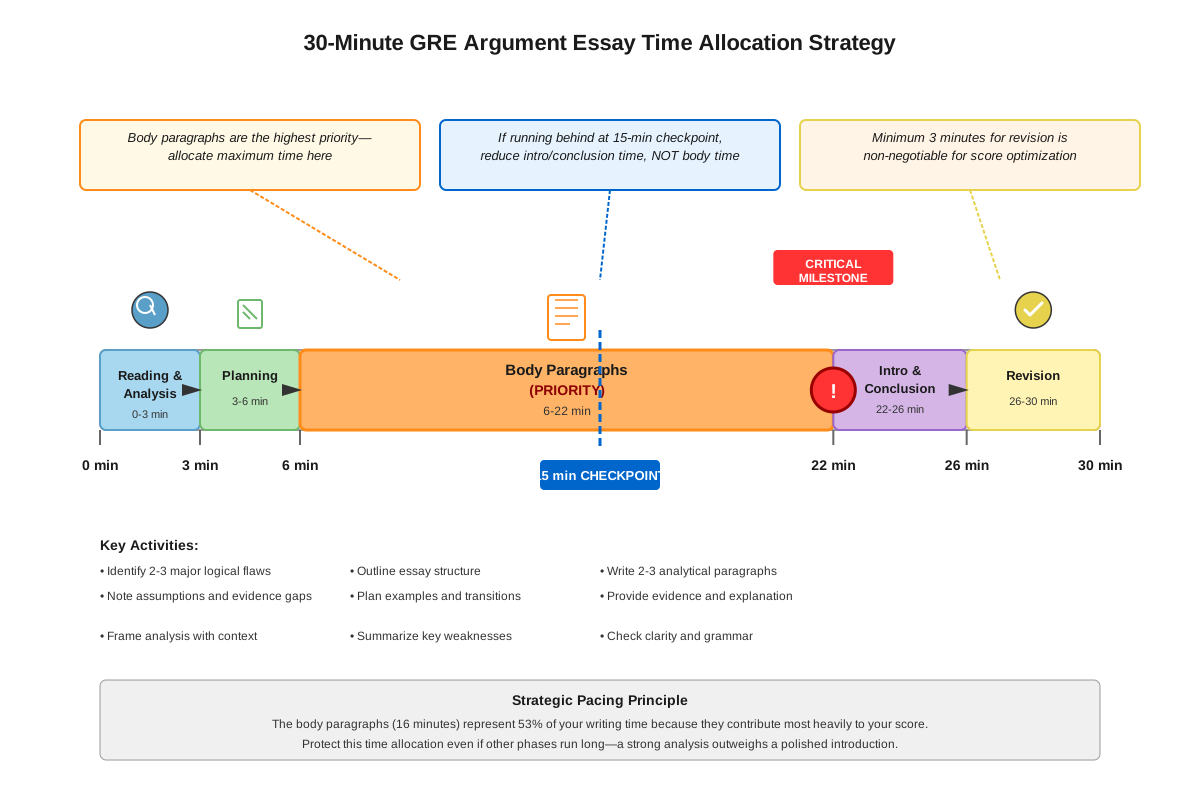
The fundamental constraint of argument essay timing is the strict 30-minute limit imposed by the GRE. This non-negotiable timeframe requires a systematic approach that balances four essential phases: reading and analysis, planning, writing, and revision. Unlike untimed writing situations where students can iterate and refine indefinitely, the GRE demands a "first draft is final draft" mentality with minimal revision time.
The optimal time allocation strategy divides the 30 minutes into specific segments:
| Phase | Time Allocation | Percentage | Key Activities |
|---|---|---|---|
| Reading & Analysis | 3-5 minutes | 10-17% | Read prompt, identify 3-4 major flaws, note assumptions |
| Planning | 2-3 minutes | 7-10% | Outline structure, sequence arguments, plan examples |
| Writing | 20-22 minutes | 67-73% | Draft introduction, body paragraphs, conclusion |
| Revision | 2-3 minutes | 7-10% | Check coherence, fix obvious errors, verify completion |
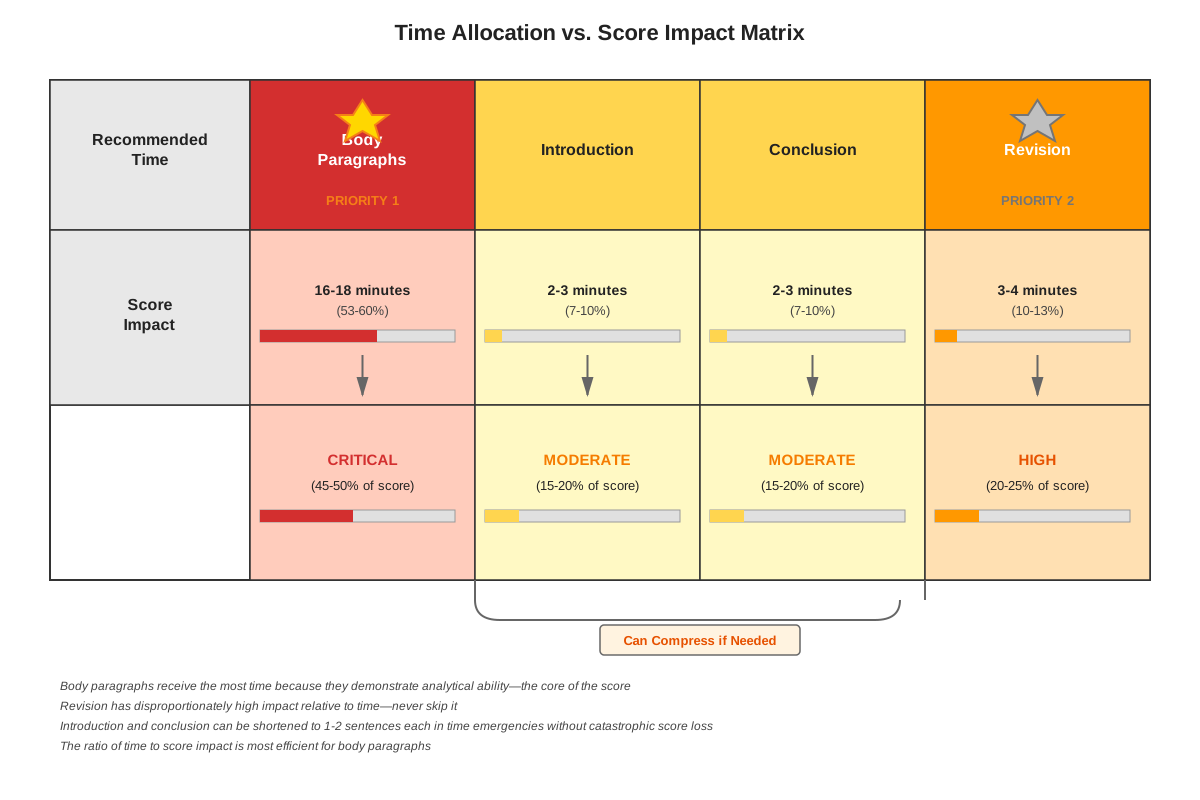
This framework ensures that adequate time is devoted to the writing phase—where the bulk of scoring occurs—while maintaining essential planning and quality control phases.
The Reading and Analysis Phase
Efficient reading and analysis form the foundation of successful GRE argument essay timing. During the initial 3-5 minutes, test-takers must accomplish several critical tasks: read the argument prompt carefully (typically 100-150 words), identify the conclusion and supporting premises, recognize 3-4 significant logical flaws or unstated assumptions, and mentally note potential evidence that would strengthen or weaken the argument.
The key to efficiency in this phase is avoiding the trap of exhaustive analysis. Students don't need to identify every possible flaw—just 3-4 substantial ones that can support well-developed body paragraphs. A practical approach involves:
- Reading the prompt once completely without stopping
- Identifying the conclusion (usually in the first or last sentence)
- Scanning for evidence/reasoning that supports the conclusion
- Asking "What's missing?" or "What's assumed?" for each piece of evidence
- Selecting the 3-4 most significant gaps to discuss
The Planning Phase
The planning phase, though brief (2-3 minutes), dramatically improves writing efficiency and essay coherence. A simple outline prevents mid-essay confusion about what to write next and ensures logical flow. The planning process should produce a skeletal structure:
Introduction: Restate argument + thesis (argument has several flaws)
Body 1: Flaw #1 (e.g., unrepresentative sample) + explanation + impact
Body 2: Flaw #2 (e.g., causal assumption) + explanation + impact
Body 3: Flaw #3 (e.g., temporal assumption) + explanation + impact
Conclusion: Summary + what evidence would help evaluate
This outline need not be elaborate—bullet points or even mental organization suffices for experienced test-takers. The goal is to establish a roadmap that eliminates decision-making during the writing phase.
The Writing Phase
The writing phase consumes 20-22 minutes—approximately two-thirds of available time. This allocation reflects the reality that the essay's substance and development occur here. Efficient writing requires maintaining steady momentum without perfectionism. Students should aim for approximately:
- Introduction (3-4 minutes): 4-6 sentences establishing context and thesis
- Body Paragraph 1 (5-6 minutes): 6-8 sentences analyzing first major flaw
- Body Paragraph 2 (5-6 minutes): 6-8 sentences analyzing second major flaw
- Body Paragraph 3 (4-5 minutes): 6-8 sentences analyzing third major flaw
- Conclusion (2-3 minutes): 3-5 sentences summarizing and suggesting improvements
The critical timing strategy during writing is maintaining awareness of the clock at transition points. Checking time after completing each paragraph allows for dynamic adjustment—if running behind, the third body paragraph can be shortened or the conclusion streamlined.
The Revision Phase
The final 2-3 minutes provide essential quality control. This phase is not for major rewrites but for catching errors that undermine credibility: obvious typos, missing words, unclear pronoun references, and incomplete sentences. A systematic revision approach involves:
- Skim for completeness (30 seconds): Verify all paragraphs are present and concluded
- Check introduction and conclusion (60 seconds): Ensure thesis is clear and conclusion exists
- Scan for obvious errors (60-90 seconds): Fix glaring typos and grammatical mistakes
- Verify examples (30 seconds): Confirm each body paragraph addresses a distinct flaw
Students should resist the temptation to make substantial changes during revision unless something is clearly wrong. The goal is polish, not transformation.
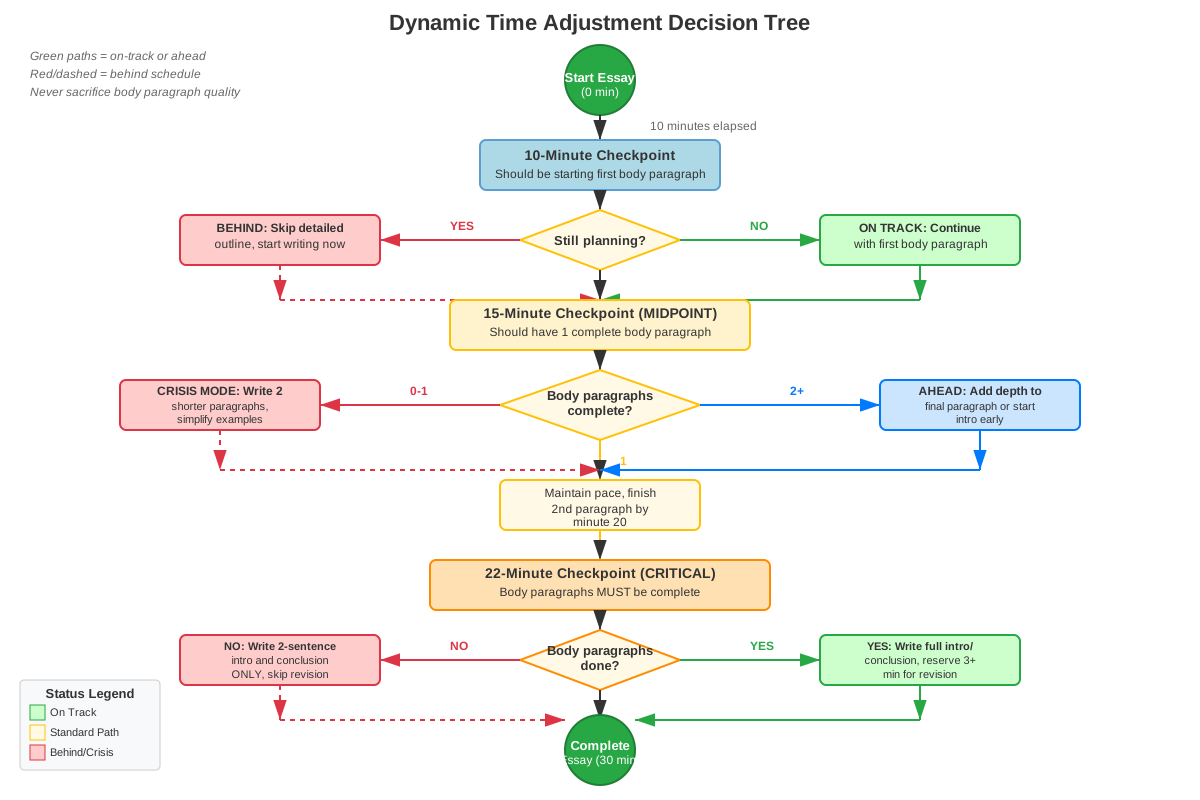
Dynamic Time Adjustment
Advanced argument essay timing involves real-time adaptation based on progress. If a student reaches the 15-minute mark and has only completed the introduction and one body paragraph, immediate adjustment is necessary. Strategies include:
- Shortening remaining body paragraphs to 4-5 sentences each
- Combining two related flaws into a single paragraph
- Writing a brief 2-3 sentence conclusion
- Eliminating the third body paragraph entirely if necessary (though this impacts scoring)
Conversely, if a student completes all body paragraphs with 8 minutes remaining, they can expand the conclusion or add more sophisticated analysis to existing paragraphs.
Concept Relationships
The components of argument essay timing form an interconnected system where each phase enables and constrains the others. The Reading and Analysis phase → determines the quality and quantity of material available for the Planning phase → which establishes the structure that guides the Writing phase → which produces the content that the Revision phase refines.
Time allocation decisions create trade-offs: spending extra time on analysis (6-7 minutes) may identify more flaws but reduces writing time, potentially leaving paragraphs underdeveloped. Conversely, rushing analysis (2 minutes) preserves writing time but may result in weak or repetitive arguments. The optimal balance varies by individual writing speed and analytical ability.
This topic connects to prerequisite knowledge of essay structure by providing the temporal framework within which structural elements must be executed. It relates to argument analysis techniques by imposing time constraints that require prioritization—students must identify the most significant flaws quickly rather than cataloging every minor issue. The timing framework also connects to revision strategies by defining how much refinement is realistic within exam constraints.
Quick check — test yourself on Argument essay timing so far.
Try Flashcards →High-Yield Facts
⭐ The GRE argument essay allows exactly 30 minutes with no exceptions or extensions
⭐ Optimal time allocation is approximately 5 minutes planning, 22 minutes writing, 3 minutes revising
⭐ Incomplete essays (missing conclusions or body paragraphs) rarely score above 4.0 regardless of quality
⭐ The writing phase should consume 65-75% of total time, as this is where scoring primarily occurs
⭐ Students should check the clock after completing each major section (introduction, each body paragraph)
- The planning phase, though brief, reduces total writing time by eliminating mid-essay confusion
- Typing speed below 30 words per minute creates significant timing challenges requiring additional practice
- The revision phase should focus on obvious errors, not substantial rewrites or additions
- Most timing problems stem from excessive analysis (>7 minutes) or perfectionist writing habits
- Dynamic adjustment is essential—students must adapt their approach if falling behind schedule
Common Misconceptions
Misconception: More planning time always produces better essays → Correction: Beyond 5 minutes, additional planning yields diminishing returns and sacrifices crucial writing time. The GRE rewards well-developed written analysis, not elaborate outlines.
Misconception: Revision time can be skipped if running behind schedule → Correction: Even 60-90 seconds of revision catches errors that significantly impact reader perception. A complete essay with minor typos scores better than an incomplete essay with perfect grammar.
Misconception: Faster typing automatically solves timing problems → Correction: While typing speed matters, most timing issues stem from inefficient analysis, poor planning, or perfectionist editing during the writing phase. Students with 60+ WPM still struggle if they spend 12 minutes analyzing.
Misconception: All three body paragraphs must be equal length → Correction: Paragraph length can vary based on complexity of the flaw being discussed. If time becomes tight, the third paragraph can be shorter (4-5 sentences) without major scoring impact.
Misconception: The introduction must be elaborate and attention-grabbing → Correction: The GRE argument essay introduction needs only to contextualize the argument and state a clear thesis. Elaborate hooks or extensive background waste valuable time without improving scores.
Worked Examples
Example 1: Standard Timing Execution
Prompt: "The following appeared in a memo from the director of a large group of hospitals: 'In a laboratory study of liquid antibacterial hand soaps, a concentrated solution of UltraClean produced a 40 percent greater reduction in the bacteria population than did the liquid hand soaps currently used in our hospitals. During a subsequent test of UltraClean at our hospital in Workby, that hospital reported significantly fewer cases of patient infection than did any of the other hospitals in our group. Therefore, to prevent serious patient infections, we should supply UltraClean at all hand-washing stations throughout our hospital system.'"
Timing Breakdown:
Minutes 0-4 (Reading & Analysis):
- Read prompt (1 minute)
- Identify conclusion: Should supply UltraClean throughout hospital system
- Identify three major flaws:
1. Lab study used concentrated solution, not the actual product
2. Correlation between UltraClean use and fewer infections doesn't prove causation
3. Workby hospital may differ from other hospitals in relevant ways
- Note these flaws in margin or scratch paper (3 minutes total)
Minutes 4-6 (Planning):
- Outline structure:
- Intro: Argument seems reasonable but has several logical flaws
- Body 1: Lab vs. real-world conditions
- Body 2: Correlation/causation problem
- Body 3: Workby hospital may be unrepresentative
- Conclusion: Need more evidence about actual product effectiveness
Minutes 6-27 (Writing):
- Introduction (3 minutes): "The hospital director's recommendation to implement UltraClean hand soap system-wide appears reasonable at first glance, but the argument relies on several questionable assumptions that undermine its persuasiveness..."
- Body 1 (6 minutes): Discuss lab study using concentrated solution vs. actual product strength
- Body 2 (6 minutes): Explain correlation/causation issue with Workby hospital data
- Body 3 (5 minutes): Analyze potential differences between Workby and other hospitals
- Conclusion (3 minutes): Summarize flaws and suggest evidence needed
Minutes 27-30 (Revision):
- Skim for completeness (30 seconds)
- Fix two typos in body paragraph 2 (30 seconds)
- Verify conclusion summarizes main points (30 seconds)
- Final read of introduction for clarity (30 seconds)
Result: Complete, well-organized essay with three developed body paragraphs and proper conclusion.
Example 2: Recovery from Timing Problem
Situation: Student reaches minute 18 and has completed only introduction and one body paragraph (should have completed two body paragraphs by this point).
Problem Identification: Writing pace is too slow—spending 8-9 minutes per body paragraph instead of target 5-6 minutes.
Dynamic Adjustment Strategy:
- Immediate decision (minute 18): Recognize the timing problem and commit to adjustment
- Streamline remaining paragraphs: Reduce body paragraphs 2 and 3 to 5 sentences each (instead of 7-8)
- Accelerate writing pace: Focus on clear, direct sentences without elaborate phrasing
- Allocate time: Body 2 (5 minutes, complete by minute 23), Body 3 (4 minutes, complete by minute 27), Conclusion (2 minutes, complete by minute 29), Revision (1 minute)
- Execute plan: Write body paragraph 2 with focused analysis of one flaw, no tangential discussion
- Monitor progress: Check clock at minute 23—if on track, continue; if still behind, further streamline
- Complete essay: Ensure conclusion exists even if brief (3 sentences minimum)
Result: Complete essay with slightly shorter body paragraphs but all required components present. Score impact: minimal (perhaps 0.5 points lower than ideal) versus catastrophic impact of incomplete essay.
Exam Strategy
When approaching GRE argument essay timing, students should implement a systematic strategy that begins before the 30-minute clock starts. During the tutorial or break before the Analytical Writing section, mentally review the time allocation framework and commit to checking the clock at specific intervals.
Trigger words and timing awareness: The moment the argument prompt appears, note the start time and calculate checkpoint times. For example, if starting at 10:00, plan to complete analysis by 10:04, planning by 10:06, introduction by 10:09, first body paragraph by 10:15, second body paragraph by 10:21, third body paragraph by 10:26, conclusion by 10:28, leaving 2 minutes for revision.
Process-of-elimination for timing decisions: When facing time pressure, eliminate the least valuable activities first:
- Eliminate: Elaborate introductory hooks, extensive background information, fourth body paragraph
- Reduce: Third body paragraph length, conclusion length, revision time
- Protect: Thesis statement, at least two well-developed body paragraphs, conclusion existence
Time allocation advice: Set mental or written checkpoints at minutes 5, 15, 22, and 27. At each checkpoint, assess whether on track:
- Minute 5: Should have completed analysis and planning, starting introduction
- Minute 15: Should have completed introduction and first body paragraph, starting second
- Minute 22: Should have completed two body paragraphs, working on third or conclusion
- Minute 27: Should be finishing conclusion or starting revision
If behind at any checkpoint, immediately implement streamlining strategies rather than hoping to "catch up" through faster writing.
Memory Techniques
The "5-22-3 Rule": Remember the core time allocation as "5-22-3"—5 minutes for reading and planning, 22 minutes for writing, 3 minutes for revision. This simple numeric sequence is easy to recall under test pressure.
The "RPWR" Cycle: Visualize the essay process as Read-Plan-Write-Revise, a continuous cycle that must complete within 30 minutes. The acronym sounds like "repair," reminding students that revision "repairs" the essay.
The "Three-Checkpoint" System: Remember to check time after three key moments: First paragraph done (introduction), Middle paragraph done (second body paragraph), Last paragraph starting (conclusion). "FML" is memorable (if slightly irreverent) and ensures regular time monitoring.
The "Two-Minute Minimum" Rule: Always reserve a minimum of 2 minutes for revision—visualize this as a "safety buffer" that cannot be spent on writing. This prevents the common mistake of writing until the final second with no quality control.
Summary
Mastering argument essay timing requires understanding that the 30-minute constraint is not merely a logistical challenge but a fundamental aspect of the GRE Analytical Writing assessment. Successful test-takers develop and practice a systematic time allocation strategy that balances reading, planning, writing, and revision phases, typically following a 5-22-3 minute framework. The key to effective timing lies in efficient analysis that identifies 3-4 major flaws quickly, brief but focused planning that creates a structural roadmap, steady writing momentum that prioritizes completion over perfection, and targeted revision that catches obvious errors without attempting major rewrites. Students must develop the metacognitive skill of monitoring their progress at regular checkpoints and implementing dynamic adjustments when falling behind schedule. The most critical insight is that incomplete essays suffer severe scoring penalties regardless of content quality, making completion the primary timing objective. By practicing timed writing regularly and refining their personal time allocation strategy, students transform timing from a source of anxiety into a manageable, systematic process that enables their analytical skills to shine within the exam's constraints.
Key Takeaways
- The GRE argument essay's 30-minute limit requires a systematic time allocation strategy, typically 5 minutes for analysis/planning, 22 minutes for writing, and 3 minutes for revision
- Incomplete essays rarely score above 4.0, making completion more important than perfection in any single paragraph
- Regular time monitoring at checkpoints (minutes 5, 15, 22, 27) enables dynamic adjustment before timing problems become catastrophic
- The writing phase should consume 65-75% of total time, as this is where essay development and scoring primarily occur
- Efficient analysis focuses on identifying 3-4 major flaws quickly rather than exhaustively cataloging every minor issue
- Brief planning (2-3 minutes) dramatically improves writing efficiency by eliminating mid-essay confusion about structure
- Revision should focus on obvious errors and completeness verification, not substantial content changes or additions
Related Topics
Essay Structure and Organization: Understanding how to construct effective introductions, body paragraphs, and conclusions provides the framework that timing strategies must accommodate. Mastering timing enables efficient execution of structural principles.
Logical Fallacy Identification: Rapid recognition of common argument flaws (sampling errors, causal assumptions, analogies) accelerates the analysis phase, creating more time for writing and revision.
Issue Essay Timing: The companion essay task follows similar timing principles but requires different content generation strategies. Skills developed for argument essay timing transfer directly to issue essay time management.
Typing Efficiency and Accuracy: While not strictly a GRE content topic, typing proficiency directly impacts the feasibility of various timing strategies and determines minimum viable time allocations.
Stress Management and Test Anxiety: Timing pressure often triggers anxiety that impairs performance. Understanding psychological strategies for maintaining composure under time constraints enhances timing execution.
Practice CTA
Now that you understand the principles and strategies of argument essay timing, the next critical step is deliberate practice under realistic conditions. Attempt the practice questions using strict 30-minute time limits, implementing the checkpoint system and time allocation framework discussed in this guide. Use the flashcards to reinforce key timing benchmarks and decision rules until they become automatic. Remember that timing mastery develops through repeated practice with conscious attention to pacing—each timed essay provides data about your personal writing speed and helps refine your optimal time allocation strategy. The difference between knowing timing principles and executing them under pressure is practice. Start your timed practice today, and watch your confidence and scores improve as timing transforms from obstacle to advantage.
Sign up free to keep reading
Create a free AnvayaPrep account to finish this GRE guide on Argument essay timing — plus flashcards and practice questions.