Overview
The argument essay structure is the foundational framework that determines how effectively test-takers can analyze and critique flawed reasoning on the GRE Analytical Writing section. Unlike the Issue essay, which asks students to develop their own position, the Argument essay requires examinees to evaluate someone else's reasoning by identifying logical fallacies, unsupported assumptions, and weaknesses in evidence. The GRE argument essay structure provides a systematic approach to organizing this critical analysis in a way that demonstrates clear thinking, logical progression, and sophisticated analytical skills—all qualities that graduate programs value highly.
Mastering this structure is essential because it directly impacts scoring across multiple dimensions of the GRE rubric. A well-structured argument essay demonstrates the ability to identify and analyze important features of an argument, organize ideas coherently, develop ideas fully, and communicate effectively in standard written English. Test-takers who understand the optimal structure can efficiently allocate their 30 minutes to maximize their score, knowing exactly what content belongs in each paragraph and how to transition smoothly between analytical points. This structural competence allows writers to focus their cognitive energy on the quality of their analysis rather than struggling with organization during the exam.
The argument essay structure connects intimately with other Analytical Writing concepts, particularly critical reasoning skills, logical fallacy identification, and evidence evaluation. While these analytical skills provide the content of the essay, the structure serves as the delivery mechanism that makes that analysis accessible and persuasive to graders. Understanding this relationship helps test-takers recognize that structure and content work synergistically—excellent analysis presented in a disorganized format will score lower than moderately strong analysis presented with crystal-clear organization.
Learning Objectives
- [ ] Identify when Argument essay structure is being tested
- [ ] Explain the core rule or strategy behind Argument essay structure
- [ ] Apply Argument essay structure to GRE-style questions accurately
- [ ] Construct a complete five-paragraph argument essay outline within 5 minutes
- [ ] Differentiate between effective and ineffective organizational patterns for argument analysis
- [ ] Evaluate sample essays to identify structural strengths and weaknesses
- [ ] Adapt the standard structure to accommodate different types of argument prompts
Prerequisites
- Basic paragraph structure: Understanding topic sentences, supporting details, and concluding sentences is essential because each body paragraph in an argument essay must function as a self-contained analytical unit
- Fundamental logical reasoning: Familiarity with basic concepts of premises, conclusions, and assumptions enables recognition of what elements need structural placement in the essay
- Academic writing conventions: Knowledge of formal writing standards, including thesis statements and transitions, provides the foundation upon which argument-specific structure builds
- Reading comprehension skills: The ability to quickly understand complex passages is necessary because test-takers must analyze the given argument before structuring their response
Why This Topic Matters
The argument essay structure matters profoundly because it represents one of the most predictable and controllable elements of GRE performance. While the specific argument prompt changes with each test administration, the optimal organizational framework remains constant. Graduate programs use the Analytical Writing score to assess whether applicants can think critically and communicate complex ideas clearly—skills essential for academic success. A well-structured essay signals to admissions committees that the applicant can organize thoughts logically, a competency that translates directly to writing research papers, grant proposals, and dissertations.
On the GRE, the Argument essay appears as one of two Analytical Writing tasks, accounting for 50% of the writing score. This score is reported separately on a 0-6 scale in half-point increments and is sent to all graduate programs alongside quantitative and verbal scores. According to ETS data, the mean Analytical Writing score hovers around 3.5, meaning that test-takers who master structure and consistently produce organized, well-developed essays can easily score in the 4.5-5.5 range, placing them in the top quartile of test-takers. Many competitive graduate programs, particularly in humanities and social sciences, place significant weight on this score.
The argument essay structure is tested explicitly through the scoring rubric's emphasis on "organization and focus." Graders specifically evaluate whether ideas are "cogently organized," whether the essay maintains "clear coherence," and whether transitions effectively connect ideas. Common manifestations in exam passages include prompts that present multi-layered arguments requiring systematic breakdown, arguments with multiple distinct flaws that demand organized treatment, and complex reasoning chains that necessitate clear structural signposting to avoid confusing the reader.
Core Concepts
The Five-Paragraph Framework
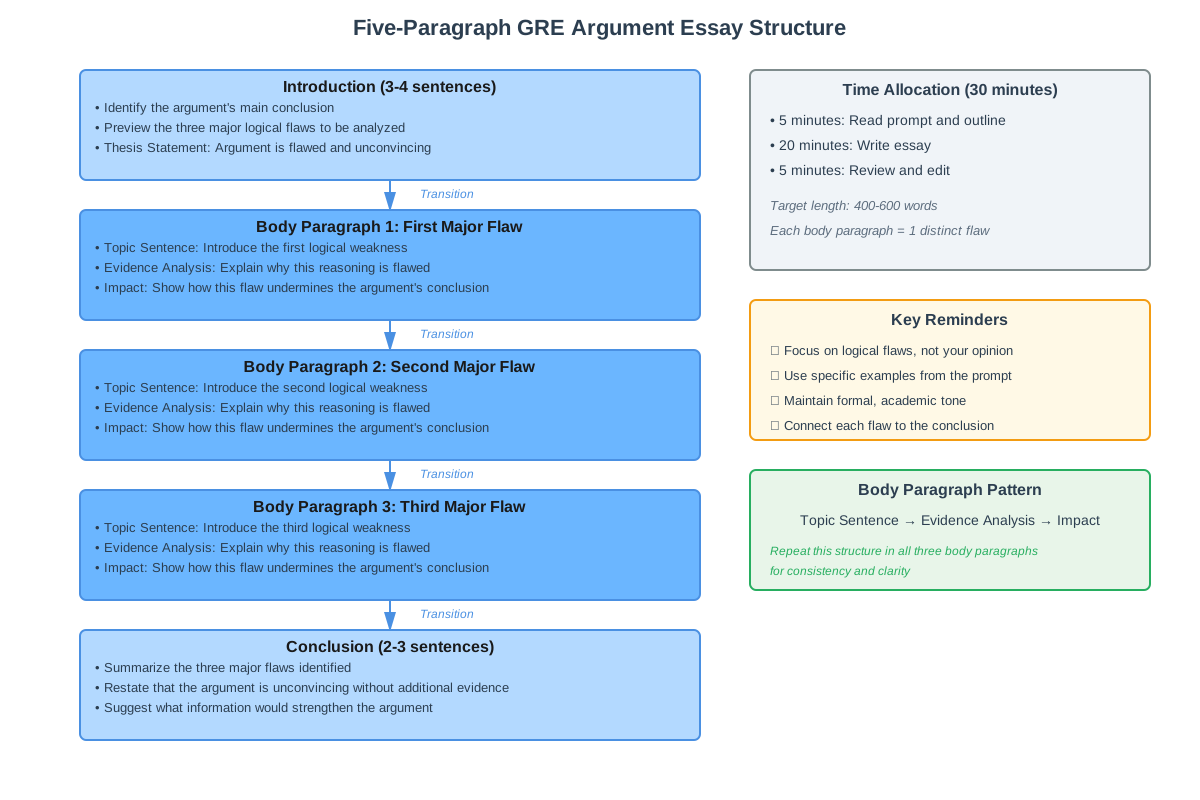
The standard argument essay structure follows a five-paragraph format that has proven optimal for the 30-minute time constraint and the analytical demands of the task. This framework consists of an introduction, three body paragraphs, and a conclusion. Each component serves a distinct rhetorical purpose and contains specific content elements that graders expect to see.
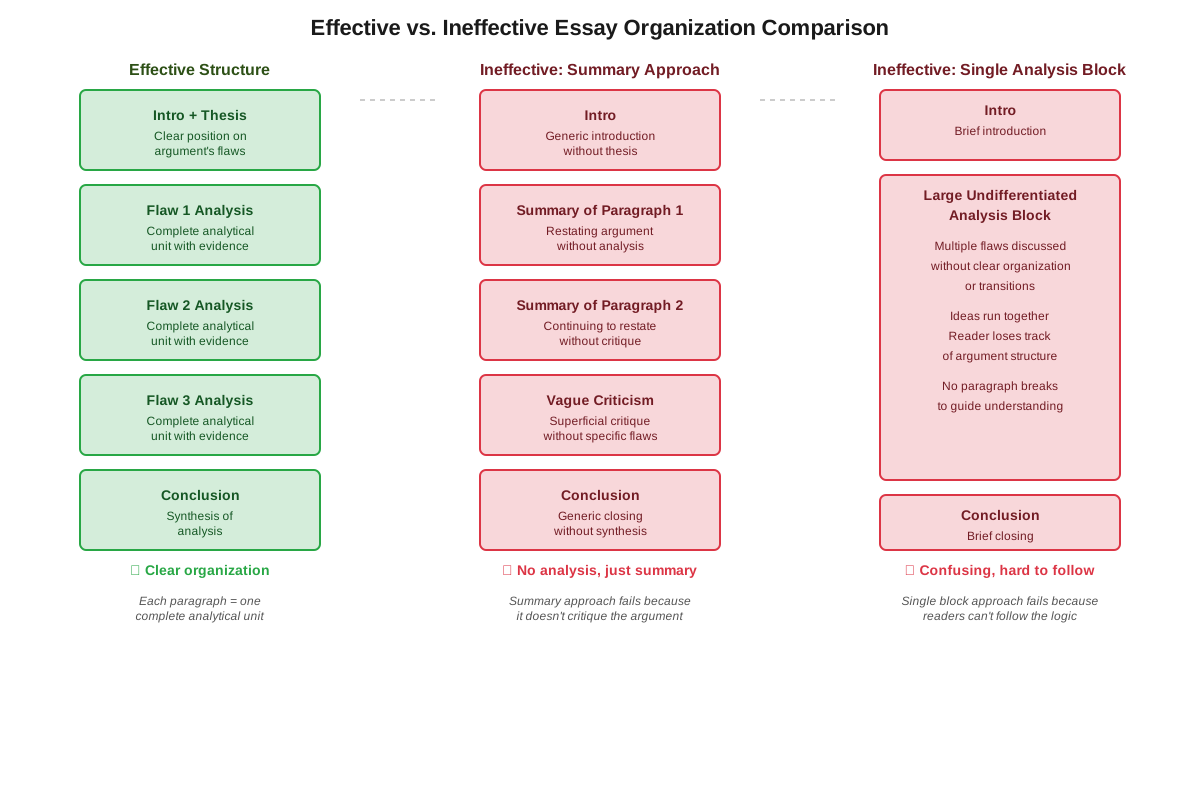
The five-paragraph structure provides several advantages: it creates natural organizational boundaries that prevent rambling, it allows for systematic coverage of multiple flaws in the argument, it provides sufficient space for depth of analysis without becoming unwieldy, and it aligns with the expectations of trained GRE graders who evaluate hundreds of essays using this framework as their mental template.
| Essay Section | Primary Function | Typical Length | Key Components |
|---|---|---|---|
| Introduction | Frame the analysis and present thesis | 3-5 sentences | Hook, argument summary, thesis statement |
| Body Paragraph 1 | Analyze first major flaw | 5-7 sentences | Topic sentence, explanation, evidence, impact |
| Body Paragraph 2 | Analyze second major flaw | 5-7 sentences | Topic sentence, explanation, evidence, impact |
| Body Paragraph 3 | Analyze third major flaw | 5-7 sentences | Topic sentence, explanation, evidence, impact |
| Conclusion | Synthesize analysis and reinforce thesis | 3-4 sentences | Restatement, summary, final insight |
Introduction Paragraph Architecture
The introduction establishes the analytical framework and must accomplish three critical objectives within approximately 75-100 words. First, it should provide a brief contextual statement that demonstrates understanding of the argument's topic and conclusion. Second, it must present a clear thesis statement that articulates the overall evaluation—typically that the argument is flawed due to unwarranted assumptions, insufficient evidence, or logical gaps. Third, it should preview the main analytical points that will be developed in the body paragraphs.
An effective introduction avoids simply restating the prompt verbatim. Instead, it paraphrases the argument's core claim and immediately signals the critical stance. For example, if the prompt argues that "City X should implement parking meters downtown to increase revenue," an effective introduction might state: "The recommendation to install parking meters throughout City X's downtown district rests on the assumption that this policy will generate substantial municipal revenue. However, this argument suffers from several critical weaknesses that undermine its persuasiveness."
The thesis statement should be specific enough to guide the essay but flexible enough to accommodate the multiple flaws that will be discussed. Phrases like "relies on questionable assumptions," "lacks crucial evidence," or "fails to consider alternative explanations" signal analytical sophistication while maintaining appropriate scope.
Body Paragraph Construction
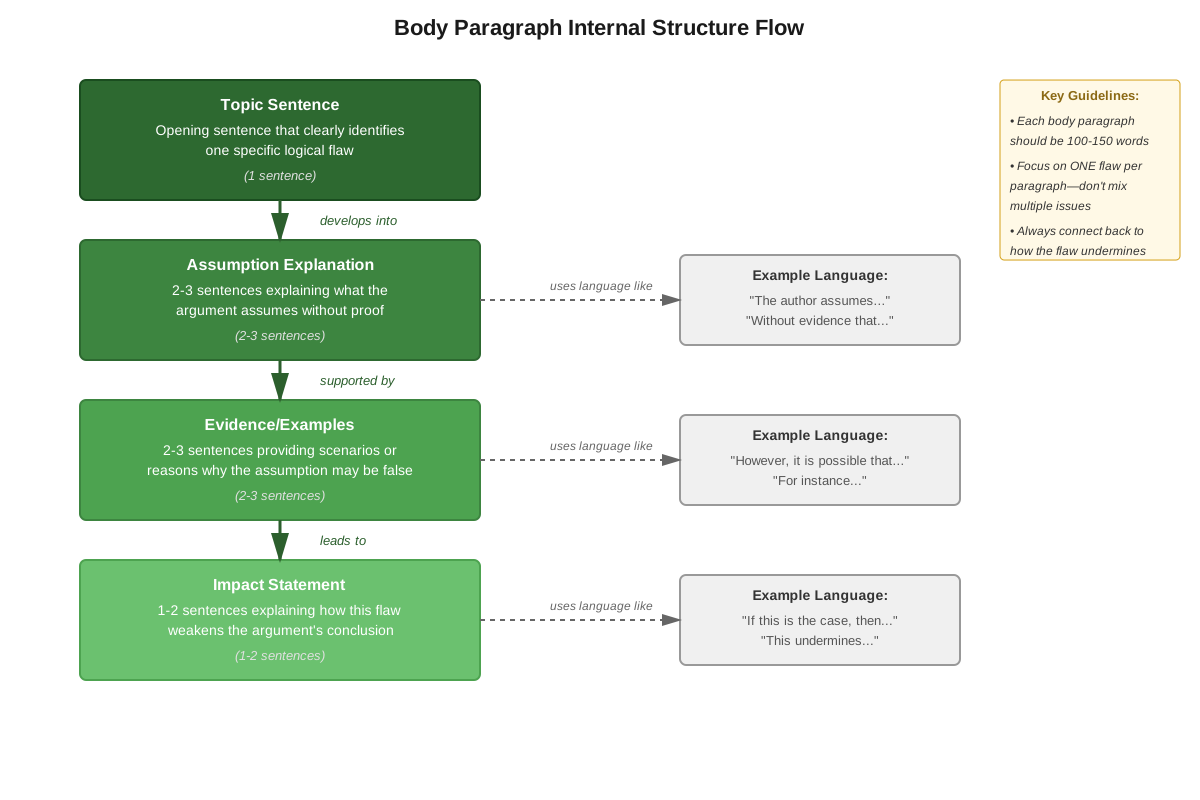
Each body paragraph in the GRE argument essay structure should focus on a single major flaw, assumption, or weakness in the argument. The internal structure of these paragraphs follows a consistent pattern: topic sentence identifying the flaw, explanation of why this constitutes a problem, discussion of what evidence would be needed to address the weakness, and analysis of how this flaw impacts the argument's overall validity.
The topic sentence serves as a mini-thesis for the paragraph, clearly stating which specific flaw will be examined. For instance: "The argument assumes without justification that downtown visitors will continue patronizing businesses even after parking becomes more expensive and less convenient." This sentence immediately orients the reader to the analytical focus.
Following the topic sentence, the writer should explain the logical problem in detail. This explanation demonstrates understanding of how arguments work and why the identified issue matters. The explanation might discuss unstated assumptions, alternative possibilities the argument ignores, or gaps between evidence and conclusion.
A sophisticated body paragraph then discusses what additional evidence would be needed to strengthen the argument or what questions must be answered to evaluate the reasoning. This demonstrates constructive critical thinking rather than mere negativity. For example: "To properly evaluate this assumption, one would need data on consumer behavior in comparable cities where parking fees were introduced, including information about whether shoppers shifted to suburban shopping centers or reduced their downtown visits."
Finally, each body paragraph should conclude with a statement about the impact of this flaw on the argument's persuasiveness. This connects the specific analytical point back to the overall thesis and helps build a cumulative case for why the argument is unpersuasive.
Conclusion Paragraph Strategy
The conclusion serves to synthesize the analysis and reinforce the essay's main evaluative claim. In the time-pressured GRE environment, a conclusion need not introduce entirely new ideas but should demonstrate that the writer has maintained control over the essay's argumentative arc from beginning to end.
An effective conclusion typically includes three elements: a restatement of the thesis in fresh language, a brief summary of the main flaws identified (without repeating body paragraph content verbatim), and a final statement about what would be needed to make the argument more convincing. This final element demonstrates balanced critical thinking—the writer isn't simply attacking the argument but rather showing what would constitute genuine improvement.
The conclusion should be proportionate to the essay's length, typically 50-75 words. Overly long conclusions suggest poor time management, while abrupt endings can make the essay feel incomplete. The goal is to provide closure while reinforcing the analytical sophistication demonstrated throughout the essay.
Transition and Coherence Elements
Effective argument essay structure requires more than just five distinct paragraphs; it demands smooth transitions and clear logical connections between ideas. Transitions serve as signposts that guide readers through the analysis and demonstrate the relationships between different flaws or weaknesses.
Between the introduction and first body paragraph, transitions can be minimal since the thesis naturally leads into the first analytical point. However, between body paragraphs, explicit transitional phrases help maintain coherence. Effective transitions might include: "Beyond this questionable assumption, the argument also fails to consider...," "Compounding this weakness, the reasoning overlooks...," or "Even if one accepts the previous assumption, the argument still suffers from..."
Within paragraphs, transitional words and phrases maintain logical flow: "furthermore," "specifically," "for instance," "consequently," and "however" all help readers follow the analytical progression. These micro-transitions are as important as macro-transitions between paragraphs because they demonstrate sophisticated thinking and prevent the essay from reading as a list of disconnected observations.
Structural Variations for Different Prompt Types
While the five-paragraph framework serves as the default GRE argument essay structure, skilled test-takers recognize when slight adaptations might be appropriate. Some argument prompts present reasoning with two major flaws that deserve extended treatment rather than three flaws of equal weight. In such cases, a four-paragraph structure (introduction, two substantial body paragraphs, conclusion) can be effective, provided each body paragraph is sufficiently developed.
Other prompts might present arguments with a clear logical chain where one assumption builds upon another. In these cases, the body paragraphs should be ordered to reflect this logical sequence, with each paragraph showing how one weakness compounds or depends upon another. This demonstrates sophisticated understanding of how arguments function as integrated systems rather than collections of isolated claims.
Regardless of variations, the core principle remains constant: the structure must serve the analysis by making the writer's critical evaluation clear, organized, and easy to follow. Structure should never feel formulaic or constraining but rather should function as a framework that enables sophisticated thinking to shine through.
Concept Relationships
The components of argument essay structure exist in a hierarchical and sequential relationship. The introduction establishes the analytical framework → which guides the selection and ordering of body paragraphs → each of which develops a specific critical point → all of which collectively support the thesis statement → which is then reinforced and synthesized in the conclusion.
Within each body paragraph, a similar hierarchical relationship exists: the topic sentence identifies the flaw → the explanation clarifies why it matters → the evidence discussion shows what's missing → the impact statement connects back to the overall argument evaluation. This nested structure creates coherence at both macro and micro levels.
The argument essay structure also connects to prerequisite knowledge in important ways. Basic paragraph structure provides the foundation for body paragraph construction, while logical reasoning skills determine what content fills that structure. Academic writing conventions inform the formality and precision of language used throughout, and reading comprehension enables the initial analysis that the structure then organizes.
Looking forward, mastering argument essay structure enables progression to more advanced Analytical Writing skills such as sophisticated evidence evaluation, nuanced assumption analysis, and complex argumentation strategies. The structure serves as a stable platform from which these higher-order skills can be deployed effectively.
High-Yield Facts
⭐ The standard GRE argument essay structure consists of five paragraphs: introduction, three body paragraphs, and conclusion
⭐ Each body paragraph should focus on a single major flaw, assumption, or weakness in the argument
⭐ The thesis statement should appear in the introduction and articulate the overall evaluation of the argument's persuasiveness
⭐ Effective body paragraphs include four elements: identification of the flaw, explanation of the problem, discussion of needed evidence, and impact on the argument
⭐ The conclusion should restate the thesis, summarize main points, and suggest what would strengthen the argument
- The introduction should be 3-5 sentences and avoid simply restating the prompt verbatim
- Topic sentences in body paragraphs function as mini-theses that guide each paragraph's analytical focus
- Transitions between paragraphs are essential for maintaining coherence and demonstrating logical progression
- The structure should be planned during the initial 5-minute outlining phase before writing begins
- Body paragraphs typically range from 5-7 sentences each, providing sufficient depth without becoming unwieldy
- The conclusion should be proportionate to essay length, typically 50-75 words
- Structural clarity is explicitly evaluated in the GRE scoring rubric under "organization and focus"
- Well-structured essays allow graders to quickly identify analytical strengths, positively influencing scores
- The five-paragraph framework can be adapted to four paragraphs when two major flaws deserve extended treatment
- Effective structure enables writers to complete the essay within the 30-minute time limit while maintaining analytical depth
Quick check — test yourself on Argument essay structure so far.
Try Flashcards →Common Misconceptions
Misconception: The argument essay requires five body paragraphs to achieve a high score → Correction: The standard structure includes three body paragraphs (five total paragraphs including introduction and conclusion). Quality of analysis matters more than quantity of paragraphs, and attempting to write five body paragraphs typically results in superficial treatment of each point.
Misconception: The introduction should extensively summarize the entire argument before presenting the thesis → Correction: The introduction should be concise (3-5 sentences), providing only enough context to frame the analysis. Lengthy summaries waste valuable time and space that should be devoted to critical analysis in body paragraphs.
Misconception: Each body paragraph must be exactly the same length to demonstrate good structure → Correction: While body paragraphs should be roughly comparable in length, slight variations are natural and acceptable. The key is that each paragraph is sufficiently developed to make its analytical point convincingly, which may require slightly different amounts of space.
Misconception: The conclusion should introduce new flaws or weaknesses not discussed in the body paragraphs → Correction: The conclusion should synthesize and reinforce the analysis already presented, not introduce new content. Introducing new ideas in the conclusion suggests poor planning and can confuse readers about the essay's main arguments.
Misconception: Using the five-paragraph structure will make the essay seem formulaic and result in a lower score → Correction: The five-paragraph structure is the expected framework for GRE argument essays. Graders evaluate the quality of analysis within that structure, not the structure itself. Attempting unconventional structures typically hinders rather than helps scoring.
Misconception: Transitions are optional stylistic flourishes that don't significantly impact scoring → Correction: Transitions are essential structural elements that demonstrate coherence and logical progression. The GRE rubric explicitly evaluates whether ideas are "clearly connected" and whether the essay maintains "coherence," both of which depend heavily on effective transitions.
Misconception: The thesis statement should present a balanced view acknowledging both strengths and weaknesses of the argument → Correction: The GRE Argument essay task specifically asks test-takers to critique the argument and discuss what questions would need to be answered to evaluate it. The thesis should clearly state that the argument has significant weaknesses, not present a balanced assessment of strengths and weaknesses.
Worked Examples
Worked Example 1: Structuring an Essay on a Business Recommendation
Prompt: "The following appeared in a memo from the director of marketing at Maxtech Corporation: 'Three years ago, we began offering our employees free memberships to the local fitness center. Since that time, employee absenteeism has decreased by 15%. Therefore, to further reduce absenteeism and increase productivity, we should now offer free memberships to all employees' family members as well.'"
Step 1 - Outline the Structure (5 minutes)
Introduction:
- Context: Maxtech's fitness program and observed absenteeism reduction
- Thesis: The recommendation to extend memberships to family members rests on questionable assumptions and insufficient evidence
Body Paragraph 1:
- Flaw: Assumes correlation between fitness memberships and reduced absenteeism equals causation
- Explanation: Other factors could explain the decrease (economic conditions, management changes, seasonal variation)
- Evidence needed: Data controlling for confounding variables; comparison with companies without fitness programs
- Impact: Without establishing causation, the recommendation lacks foundation
Body Paragraph 2:
- Flaw: Assumes family member fitness will impact employee absenteeism
- Explanation: No logical connection established between family fitness and employee attendance
- Evidence needed: Research on whether family health affects employee work patterns; data from companies with family fitness programs
- Impact: The proposed expansion may not achieve the stated goal
Body Paragraph 3:
- Flaw: Fails to consider costs versus benefits
- Explanation: Extending memberships could be expensive with uncertain returns
- Evidence needed: Cost analysis; projected absenteeism reduction; alternative uses of funds
- Impact: The recommendation may not be the most efficient way to reduce absenteeism
Conclusion:
- Restate thesis about questionable assumptions
- Summarize three main weaknesses
- Note what evidence would make the argument more convincing
Step 2 - Draft Following the Structure
Introduction: "The marketing director at Maxtech Corporation recommends extending free fitness center memberships to employees' family members based on a correlation between the original employee fitness program and reduced absenteeism. However, this recommendation relies on several unwarranted assumptions and lacks crucial evidence needed to evaluate its likely effectiveness."
Body Paragraph 1: "First, the argument assumes that the fitness center memberships caused the 15% reduction in absenteeism, but correlation does not establish causation. Numerous other factors could explain the decrease over the three-year period. For instance, broader economic improvements might have reduced stress-related absences, or new management practices unrelated to fitness could have improved workplace morale. To properly evaluate this causal claim, one would need data controlling for these confounding variables, such as absenteeism trends at comparable companies without fitness programs during the same period. Without establishing that the fitness memberships actually caused the improvement, the entire foundation for the recommendation collapses."
[Continue with Body Paragraphs 2 and 3, then Conclusion following the outlined structure]
Connection to Learning Objectives: This example demonstrates how to apply argument essay structure to a GRE-style prompt by systematically organizing the critique into distinct analytical units, each addressing a specific flaw while maintaining overall coherence.
Worked Example 2: Adapting Structure for a Complex Argument
Prompt: "The following appeared in a letter to the editor of a local newspaper: 'Over the past decade, the population of Elm City has grown by 20%, yet traffic congestion has increased by 50%. Clearly, the city's public transportation system is inadequate. The city council should immediately approve funding for a new light rail system, which will reduce traffic congestion and improve air quality.'"
Step 1 - Identify Structural Approach
This argument contains a logical chain where assumptions build upon each other:
- Population growth → traffic congestion (assumed relationship)
- Inadequate public transportation → congestion (assumed cause)
- Light rail → reduced congestion (assumed solution)
- Light rail → improved air quality (assumed additional benefit)
The structure should reflect this logical progression, with body paragraphs ordered to show how each assumption depends on or compounds previous ones.
Step 2 - Create Adapted Outline
Introduction:
- Context: Elm City's growth and congestion problem
- Thesis: The recommendation for light rail rests on a chain of questionable assumptions
Body Paragraph 1:
- Flaw: Assumes population growth caused the disproportionate congestion increase
- Alternative explanations: Economic growth, suburban development patterns, increased car ownership
- This foundational assumption affects all subsequent reasoning
Body Paragraph 2:
- Flaw: Even if population caused congestion, assumes inadequate public transportation is the problem
- Alternative causes: Road infrastructure, traffic management, parking policies
- Builds on previous paragraph by showing another logical gap
Body Paragraph 3:
- Flaw: Even if public transportation is inadequate, assumes light rail is the optimal solution
- Alternatives: Bus rapid transit, improved existing systems, congestion pricing
- Cost-benefit considerations
- Shows final leap in reasoning
Conclusion:
- Emphasize the cumulative effect of these chained assumptions
- Note that each weakness compounds the others
- Suggest comprehensive transportation study needed
Connection to Learning Objectives: This example shows how to adapt the standard structure to reflect the logical relationships within a complex argument, demonstrating sophisticated understanding of how structure serves analysis rather than constraining it.
Exam Strategy
When approaching the GRE Argument essay, allocate time strategically: 5 minutes for reading and outlining, 20 minutes for writing, and 5 minutes for revision. The outlining phase is crucial for establishing structure—resist the temptation to begin writing immediately. During these initial minutes, identify 3-4 major flaws in the argument and decide which three will form your body paragraphs. Jot down a brief structural outline using the five-paragraph framework as your template.
Trigger words in the prompt that signal structural opportunities include: "therefore," "thus," "clearly," "obviously," and "certainly." These words often indicate logical leaps where assumptions lurk—perfect material for body paragraphs. When you see these triggers, ask yourself: "What unstated assumption connects the evidence to this conclusion?" The answer becomes a body paragraph.
For process of elimination during the planning phase, if you identify more than three potential flaws, prioritize those that are most fundamental to the argument's reasoning. Flaws that affect the argument's core conclusion are more valuable than peripheral weaknesses. Also prioritize flaws where you can discuss what evidence would be needed to address them, as this demonstrates constructive critical thinking.
Time allocation within the writing phase should follow this pattern: 4-5 minutes for the introduction and first body paragraph, 5-6 minutes for the second body paragraph, 5-6 minutes for the third body paragraph, and 3-4 minutes for the conclusion. This front-loaded approach ensures that even if time runs short, you have a complete introduction and at least two well-developed body paragraphs. A slightly rushed conclusion is far less damaging than an incomplete body paragraph.
Exam Tip: If you find yourself running out of time, prioritize completing your third body paragraph over writing an elaborate conclusion. A brief 2-sentence conclusion that restates your thesis is sufficient if the body paragraphs are strong. Graders weight analytical content more heavily than conclusions.
Watch for structural red flags in your own writing: body paragraphs that exceed 10 sentences (likely unfocused), paragraphs shorter than 4 sentences (likely underdeveloped), or conclusions that introduce new analytical points (poor planning). If you notice these during your 5-minute revision period, make quick structural adjustments.
Memory Techniques
ITBBC Acronym for the five-paragraph structure:
- Introduction
- Three
- Body
- Body
- Body
- Conclusion
TEEI Method for body paragraph internal structure:
- Topic sentence (identifies the flaw)
- Explanation (why it's a problem)
- Evidence (what's needed to address it)
- Impact (how it affects the argument)
Visualization Strategy: Picture the essay as a building. The introduction is the foundation that supports everything above it. Each body paragraph is a pillar, and all three must be present and strong for the structure to stand. The conclusion is the roof that completes the structure. If any pillar is weak or missing, the entire building is compromised.
The "Three Buckets" Mental Model: During the outlining phase, imagine three empty buckets labeled "Bucket 1," "Bucket 2," and "Bucket 3." As you identify flaws in the argument, mentally place each flaw into one of the three buckets. This prevents you from trying to address too many points and helps you commit to a clear three-paragraph body structure.
Transition Phrase Bank: Memorize a set of transition phrases for different positions in the essay:
- Between introduction and first body paragraph: "First," "To begin with," "Initially"
- Between body paragraphs: "Additionally," "Furthermore," "Beyond this concern," "Compounding this weakness"
- Before conclusion: "In summary," "Ultimately," "Given these weaknesses"
Having these phrases readily available reduces cognitive load during the exam and ensures smooth structural flow.
Summary
The argument essay structure provides the organizational framework essential for effectively critiquing flawed reasoning on the GRE Analytical Writing section. The standard five-paragraph format—introduction, three body paragraphs, and conclusion—has proven optimal for the 30-minute time constraint and the analytical demands of the task. Each component serves a specific rhetorical purpose: the introduction frames the analysis and presents the thesis, body paragraphs systematically examine individual flaws while discussing needed evidence, and the conclusion synthesizes the critique. Within body paragraphs, the TEEI structure (Topic sentence, Explanation, Evidence discussion, Impact) ensures comprehensive treatment of each analytical point. Effective structure requires smooth transitions between and within paragraphs, creating coherence that allows sophisticated analysis to shine through. While the framework remains consistent across prompts, skilled test-takers adapt the structure to reflect the logical relationships within specific arguments, demonstrating that structure serves analysis rather than constraining it. Mastering this structure enables test-takers to efficiently allocate their limited time, meet grader expectations, and achieve scores that reflect their true analytical capabilities.
Key Takeaways
- The five-paragraph structure (introduction, three body paragraphs, conclusion) is the optimal framework for GRE argument essays and aligns with grader expectations
- Each body paragraph should focus on a single major flaw using the TEEI structure: Topic sentence, Explanation, Evidence needed, and Impact on the argument
- The thesis statement in the introduction must clearly articulate that the argument has significant weaknesses due to questionable assumptions or insufficient evidence
- Transitions between paragraphs and within paragraphs are essential for demonstrating coherence and logical progression, both explicitly evaluated in the scoring rubric
- Allocate 5 minutes for outlining the structure before writing, ensuring a clear organizational plan that can be executed within the 30-minute time limit
- The conclusion should synthesize the analysis and suggest what evidence would strengthen the argument, not introduce new analytical points
- Structure serves analysis—the framework should make sophisticated critical thinking clear and accessible to graders, not constrain or limit analytical depth
Related Topics
Logical Fallacy Identification: Understanding common logical fallacies (false cause, hasty generalization, false analogy) provides the content that fills the argument essay structure. Mastering structure enables more efficient deployment of fallacy recognition skills.
Evidence Evaluation: Analyzing the quality and sufficiency of evidence in arguments connects directly to the "Evidence needed" component of body paragraphs. Strong structural skills allow for more nuanced evidence critique.
Assumption Analysis: Identifying unstated assumptions is central to argument essay content. The structure provides the framework for systematically examining multiple assumptions without losing coherence.
Issue Essay Structure: While the Argument essay critiques existing reasoning, the Issue essay develops original positions. Understanding argument essay structure provides a foundation for learning the different organizational demands of Issue essays.
Analytical Writing Scoring Rubric: Deep familiarity with how GRE essays are scored illuminates why structure matters so significantly. Understanding rubric criteria helps test-takers align their structural choices with grader expectations.
Practice CTA
Now that you understand the comprehensive framework for structuring GRE argument essays, it's time to put this knowledge into practice. Attempt the practice questions to apply the five-paragraph structure to actual GRE-style prompts, and use the flashcards to reinforce key structural elements and transitions. Remember that structure is a skill that improves with deliberate practice—each essay you outline and write strengthens your ability to organize complex analysis efficiently. The structure you've learned today will serve as your reliable framework for every argument essay you encounter, freeing your mental energy to focus on the quality of your critical analysis. Start practicing now, and watch your confidence and competence grow with each structured essay you produce!
Sign up free to keep reading
Create a free AnvayaPrep account to finish this GRE guide on Argument essay structure — plus flashcards and practice questions.