Overview
Body paragraph development is the cornerstone of effective analytical writing on the GRE. While test-takers often focus on crafting compelling introductions and conclusions, the body paragraphs constitute the substantive core where arguments are analyzed, evidence is presented, and critical thinking is demonstrated. On the GRE Analytical Writing section, particularly in the Argument Essay, the quality of body paragraph development directly determines scoring outcomes. Graders evaluate how thoroughly candidates identify logical flaws, explain their significance, and support their analysis with relevant reasoning—all tasks accomplished primarily through well-constructed body paragraphs.
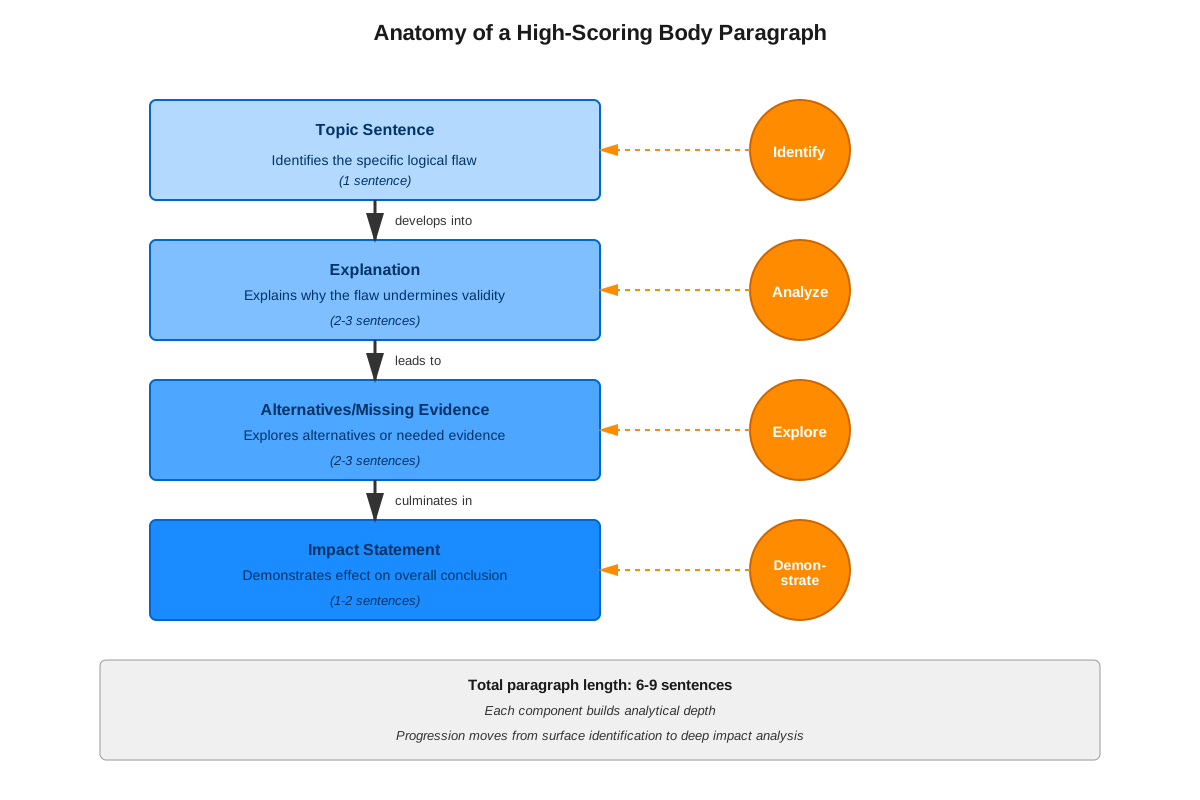
The GRE body paragraph development process involves more than simply listing flaws in an argument. Each body paragraph must function as a self-contained analytical unit that introduces a specific weakness, explains why it undermines the argument's validity, explores alternative explanations or missing evidence, and demonstrates the impact on the argument's conclusion. This structured approach to paragraph construction reflects the analytical rigor that graduate programs expect from incoming students. Strong body paragraphs showcase the writer's ability to think critically, organize complex ideas coherently, and communicate analysis persuasively—skills essential for academic success beyond the exam.
Within the broader Analytical Writing framework, body paragraph development bridges the gap between initial argument analysis and final essay scoring. The introduction establishes the essay's direction, and the conclusion synthesizes the analysis, but body paragraphs deliver the intellectual substance that earns high scores. Mastering this topic enables test-takers to transform their identification of logical flaws into compelling, well-supported critiques that demonstrate graduate-level analytical capabilities. This skill integrates closely with argument analysis, evidence evaluation, and logical reasoning—all fundamental components of the GRE Analytical Writing assessment.
Learning Objectives
- [ ] Identify when body paragraph development is being tested
- [ ] Explain the core rule or strategy behind body paragraph development
- [ ] Apply body paragraph development to GRE-style questions accurately
- [ ] Construct body paragraphs that follow a logical progression from claim to evidence to impact
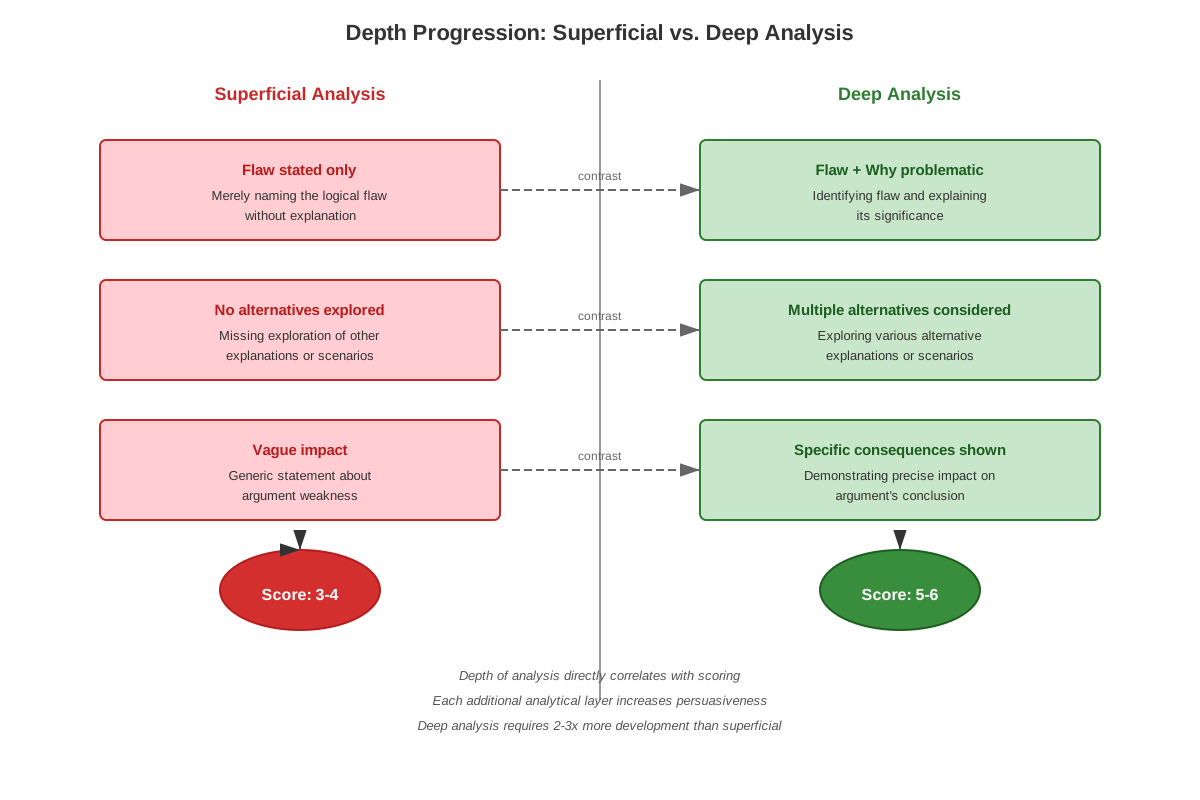
- [ ] Differentiate between superficial flaw identification and deep analytical development
- [ ] Evaluate sample body paragraphs for completeness, coherence, and persuasiveness
- [ ] Adapt body paragraph structure to address different types of logical fallacies effectively
Prerequisites
- Basic essay structure: Understanding of introduction, body, and conclusion functions provides the framework within which body paragraphs operate
- Logical fallacy recognition: Ability to identify common reasoning errors enables selection of appropriate content for body paragraph analysis
- Argument analysis fundamentals: Skill in breaking down arguments into claims, evidence, and assumptions supplies the raw material for body paragraph development
- Academic writing conventions: Familiarity with formal tone, transitions, and paragraph unity ensures professional presentation of analytical content
Why This Topic Matters
Body paragraph development represents the most heavily weighted component of GRE Analytical Writing scoring. According to ETS scoring guidelines, essays receiving scores of 5 or 6 (out of 6) consistently demonstrate "insightful analysis" and "well-developed" examination of the argument's flaws. These descriptors refer primarily to body paragraph quality. Conversely, essays scoring 3 or below typically exhibit "limited development" or "inadequate analysis"—direct references to weak body paragraphs. The difference between an average score and a top score often hinges entirely on how thoroughly and persuasively body paragraphs explore logical weaknesses.
In real-world academic and professional contexts, the ability to develop analytical paragraphs translates directly to research paper writing, policy analysis, business case development, and critical evaluation of proposals. Graduate programs across disciplines require students to construct extended arguments with well-supported claims—precisely the skill demonstrated through effective body paragraph development. Employers value professionals who can not only identify problems but also explain their implications and propose solutions, a thinking pattern mirrored in GRE body paragraph structure.
On the GRE Argument Essay, body paragraph development appears in every single prompt. Test-takers must produce 3-4 body paragraphs within 30 minutes, each addressing a distinct logical flaw. Common manifestations include paragraphs analyzing unsupported assumptions, questionable evidence, alternative explanations, and missing information. The exam specifically instructs writers to "discuss how the argument depends on assumptions for which there is no clear evidence" and to "explain what evidence could weaken or strengthen the argument"—directives that must be fulfilled through well-developed body paragraphs. Approximately 60-70% of the essay's content consists of body paragraphs, making this the most substantial component of the writing task.
Core Concepts
The Four-Part Body Paragraph Structure
Effective body paragraph development follows a predictable yet flexible structure that ensures comprehensive analysis. The four essential components are: topic sentence, explanation, development/evidence, and impact statement. The topic sentence identifies the specific logical flaw being analyzed and previews the paragraph's focus. The explanation clarifies why this element constitutes a weakness in the argument's reasoning. The development section explores alternative possibilities, missing evidence, or questionable assumptions in detail. Finally, the impact statement connects the flaw back to the argument's conclusion, demonstrating how this weakness undermines the overall validity.
This structure ensures that each paragraph moves beyond superficial observation to genuine analysis. For example, a weak paragraph might simply state: "The argument assumes all residents want the new park." A well-developed paragraph using the four-part structure would identify this assumption (topic sentence), explain why assuming universal support is problematic (explanation), discuss various resident groups who might oppose the park and why (development), and conclude by showing how this assumption's failure would invalidate the recommendation to build the park (impact).
Topic Sentences as Analytical Signposts
The topic sentence serves as the paragraph's analytical anchor, immediately signaling which logical flaw will be examined. Effective topic sentences are specific, analytical, and forward-looking. They avoid vague language like "Another problem is..." in favor of precise identification: "The argument relies on the questionable assumption that correlation between ice cream sales and drowning rates indicates causation." Strong topic sentences often incorporate analytical verbs such as "assumes," "presumes," "overlooks," "fails to consider," or "depends on the unwarranted belief that."
The topic sentence also establishes the paragraph's scope, preventing drift into tangential issues. By clearly stating the focus, the writer commits to developing that specific point thoroughly before moving to the next paragraph. This organizational clarity helps graders follow the analysis and recognize the essay's logical progression.
Explanation: The "Why It Matters" Component
After identifying a flaw, the explanation component articulates why this element weakens the argument. This section answers the implicit question: "So what?" Many test-takers identify flaws correctly but fail to explain their significance, resulting in underdeveloped paragraphs. The explanation bridges the gap between flaw identification and detailed analysis by establishing the logical connection between the weakness and the argument's validity.
For instance, if the argument assumes that past trends will continue unchanged, the explanation might state: "This assumption is problematic because it ignores the possibility of changing circumstances, market conditions, or consumer preferences that could disrupt historical patterns. Without evidence that conditions will remain stable, the prediction lacks a solid foundation." This explanation prepares the reader for the detailed development that follows.
Development: Exploring Alternatives and Missing Evidence
The development section constitutes the paragraph's analytical heart, where critical thinking becomes most visible. This component explores multiple dimensions of the identified flaw through several strategies:
- Alternative explanations: Present plausible scenarios that would explain the evidence differently
- Missing evidence: Specify what information would be needed to evaluate the assumption
- Counterexamples: Describe situations where the assumption would clearly fail
- Conditional analysis: Explain how different circumstances would affect the argument's validity
For example, if analyzing an argument that attributes increased sales to a new advertising campaign, the development section might explore alternative explanations (seasonal demand, competitor closures, economic improvement), identify missing evidence (sales data from control groups, market research, competitor analysis), and describe scenarios where the campaign might not be responsible (sales increases began before the campaign, increases occurred only in non-advertised regions).
This section typically comprises 3-5 sentences and demonstrates the depth of analytical thinking that distinguishes high-scoring essays. The development should feel exploratory and thorough, showing that the writer has considered the issue from multiple angles.
Impact Statements: Connecting Flaws to Conclusions
The impact statement closes the analytical loop by explicitly connecting the identified flaw back to the argument's main conclusion. This component answers: "How does this weakness affect the argument's overall validity?" Without impact statements, body paragraphs feel incomplete, leaving readers to infer the connection themselves—a task graders should not have to perform.
Effective impact statements use conditional language to show logical relationships: "If this assumption proves incorrect, then the recommendation to expand operations would be based on faulty reasoning and could lead to financial losses." Alternatively: "Without evidence supporting this claim, the conclusion that the policy will succeed remains unconvincing and potentially misleading." These statements demonstrate that the writer understands not just individual flaws but their cumulative effect on the argument's persuasiveness.
Transitions and Coherence
Coherence within and between body paragraphs ensures that the essay reads as a unified analysis rather than a disconnected list of flaws. Internal coherence comes from logical sentence-to-sentence progression, with each sentence building on the previous one. External coherence—connections between paragraphs—requires transitional phrases that signal relationships: "Beyond this questionable assumption, the argument also overlooks..." or "Even if the previous concern were addressed, another significant weakness remains..."
Effective transitions include: "Additionally," "Furthermore," "More critically," "Another significant flaw," "Compounding this problem," and "Perhaps most problematically." These phrases guide readers through the analysis while maintaining focus on the argument's weaknesses.
Paragraph Length and Balance
Well-developed body paragraphs typically contain 6-9 sentences or approximately 120-180 words. Shorter paragraphs suggest insufficient development, while excessively long paragraphs may indicate lack of focus or attempt to address multiple flaws simultaneously. Balance across body paragraphs demonstrates organizational control—if one paragraph is significantly longer or shorter than others, it may signal uneven analysis.
The ideal Argument Essay contains 3-4 body paragraphs, each addressing a distinct logical flaw. Three paragraphs allow for deeper development of each point, while four paragraphs demonstrate breadth of analysis. The choice depends on the argument's complexity and the writer's ability to develop each point thoroughly within time constraints.
Concept Relationships
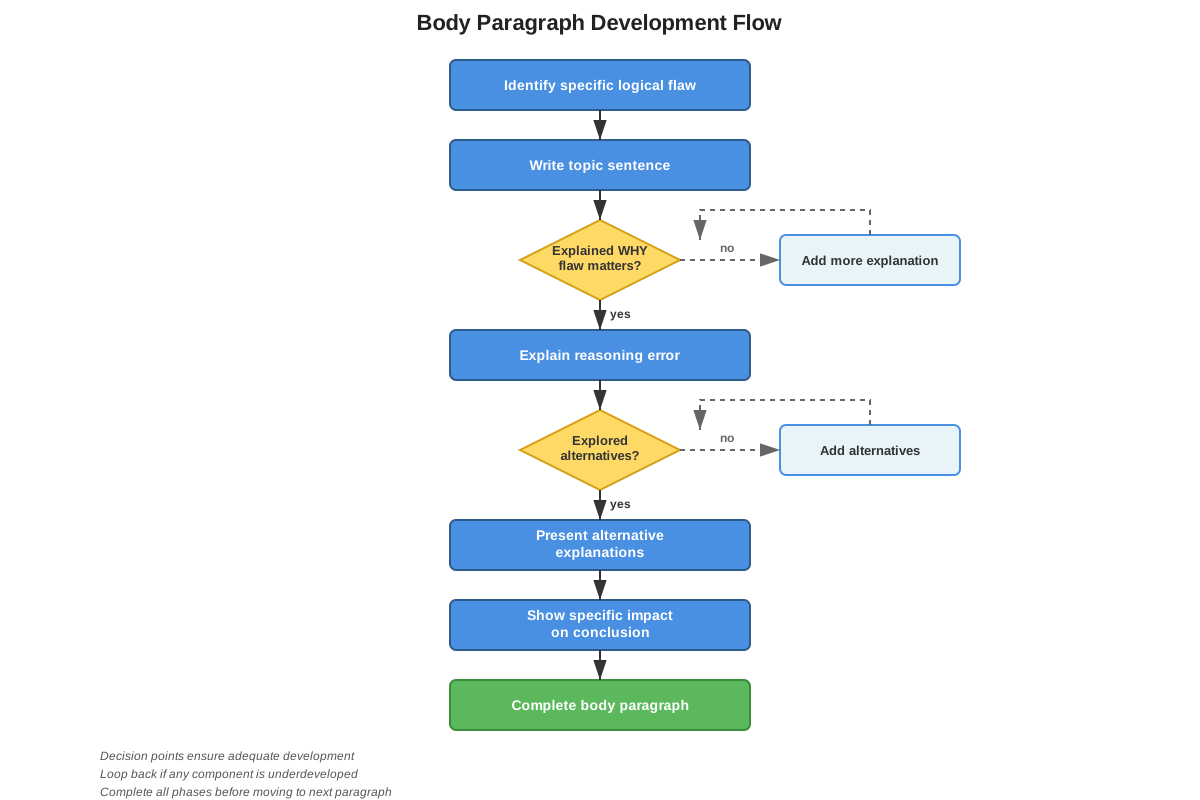
The components of body paragraph development form an integrated analytical system. The topic sentence establishes the analytical focus → which the explanation justifies as significant → enabling the development section to explore implications thoroughly → culminating in the impact statement that connects back to the argument's conclusion. This linear progression ensures logical flow and comprehensive analysis.
Body paragraph development connects directly to prerequisite skills: logical fallacy recognition provides the content for topic sentences, argument analysis supplies the framework for understanding how flaws undermine conclusions, and academic writing conventions ensure professional presentation. These foundational skills enable effective body paragraph construction.
Looking forward, mastery of body paragraph development facilitates success with related topics including essay organization, evidence evaluation, and persuasive writing. The analytical thinking practiced in body paragraph construction transfers directly to the Issue Essay, where similar developmental strategies support position arguments. The relationship map flows: Argument Analysis → Flaw Identification → Body Paragraph Development → Complete Essay Construction → High Scores.
Quick check — test yourself on Body paragraph development so far.
Try Flashcards →High-Yield Facts
⭐ Each body paragraph should address one distinct logical flaw, not multiple unrelated weaknesses
⭐ The development section (exploring alternatives and missing evidence) typically comprises 40-50% of the paragraph's length
⭐ Topic sentences must be analytical, not merely descriptive—they should identify a specific reasoning problem
⭐ Impact statements explicitly connect the flaw to the argument's conclusion using conditional language
⭐ Well-developed body paragraphs contain 6-9 sentences or approximately 120-180 words
- Transitional phrases between paragraphs signal logical progression and maintain essay coherence
- The explanation component answers "why this matters" before detailed development begins
- Alternative explanations demonstrate critical thinking more effectively than simple flaw identification
- Specifying missing evidence shows understanding of what would strengthen or weaken the argument
- Balanced paragraph length across all body paragraphs indicates organizational control and even development
- Analytical verbs (assumes, presumes, overlooks, fails to consider) strengthen topic sentences
- Body paragraphs should follow a logical order, typically from most to least significant flaw
- Each paragraph should feel complete and self-contained while contributing to the overall analysis
- Avoiding repetition across paragraphs requires careful planning of which flaw each paragraph addresses
- The four-part structure (topic, explanation, development, impact) applies regardless of the specific flaw being analyzed
Common Misconceptions
Misconception: Body paragraphs should simply list all the flaws in the argument as quickly as possible.
Correction: Effective body paragraphs prioritize depth over breadth, thoroughly developing 3-4 significant flaws rather than superficially mentioning many weaknesses. Quality of analysis matters more than quantity of flaws identified.
Misconception: The topic sentence can be vague or general, such as "The argument has several problems."
Correction: Topic sentences must specifically identify the logical flaw being analyzed in that paragraph. Precision in the topic sentence establishes clear focus and demonstrates analytical clarity.
Misconception: Once a flaw is identified, the paragraph is essentially complete.
Correction: Identification represents only the first step. The paragraph must explain why the flaw matters, explore alternatives or missing evidence, and connect the weakness back to the argument's conclusion. Development is where analytical depth becomes visible.
Misconception: All body paragraphs should be exactly the same length to show balance.
Correction: While paragraphs should be roughly similar in length (within 20-30 words of each other), slight variation is natural and acceptable. The focus should be on thorough development of each point rather than achieving identical word counts.
Misconception: Using complex vocabulary and sophisticated sentence structures is more important than clear analytical development.
Correction: Clarity and analytical depth trump stylistic complexity. Graders prioritize logical reasoning, thorough development, and clear explanation over ornate language. Simple, direct prose that develops ideas thoroughly scores higher than convoluted sentences with superficial analysis.
Misconception: The impact statement is optional or can be implied rather than explicitly stated.
Correction: Explicitly stating how each flaw undermines the argument's conclusion is essential for demonstrating complete analytical thinking. Graders should not have to infer connections—the writer must make them explicit.
Misconception: Body paragraphs should include personal opinions about the argument's topic.
Correction: GRE Argument Essays require logical analysis of reasoning flaws, not personal opinions about the subject matter. Body paragraphs should focus on evaluating the argument's logical structure, not agreeing or disagreeing with its conclusion based on personal beliefs.
Worked Examples
Example 1: Analyzing a Causal Assumption
Argument Excerpt: "Since the city installed new streetlights in the downtown area, crime rates have decreased by 15%. Therefore, the city should install similar lighting in all neighborhoods to reduce crime citywide."
Well-Developed Body Paragraph:
The argument assumes that the new streetlights caused the 15% decrease in downtown crime rates, but this causal relationship remains unsubstantiated. (Topic sentence identifying the specific flaw) This assumption is problematic because correlation does not establish causation—multiple factors could explain the crime reduction without the lighting playing any significant role. (Explanation of why this matters) For instance, the decrease might result from increased police patrols implemented simultaneously, economic improvements that reduced poverty-driven crime, demographic shifts as families moved into renovated downtown housing, or even seasonal variations in criminal activity. (Development: alternative explanations) Additionally, the argument provides no evidence that crime rates in comparable areas without new lighting remained stable or increased during the same period, making it impossible to isolate the lighting's effect. (Development: missing evidence) If any of these alternative explanations account for the crime reduction, then installing streetlights citywide would waste resources without achieving the desired safety improvements, potentially diverting funds from more effective crime prevention strategies. (Impact statement connecting flaw to conclusion)
Analysis of This Example: This paragraph demonstrates all four components working together. The topic sentence precisely identifies the causal assumption. The explanation clarifies why assuming causation is problematic. The development section explores multiple alternative explanations and identifies missing comparative data. The impact statement shows how this flaw undermines the recommendation's validity and highlights practical consequences. The paragraph flows logically from identification through analysis to conclusion.
Example 2: Analyzing Missing Evidence
Argument Excerpt: "Employee satisfaction surveys show that 80% of our staff rate their job satisfaction as 'good' or 'excellent.' This demonstrates that our company has no significant workplace problems and does not need to implement the proposed employee wellness program."
Well-Developed Body Paragraph:
The argument overlooks critical information about what the satisfaction surveys actually measured and whether they captured the issues a wellness program would address. (Topic sentence) This omission is significant because high general satisfaction ratings do not necessarily indicate absence of specific health, stress, or work-life balance problems that wellness programs target. (Explanation) The surveys might have asked only about overall job satisfaction without probing into physical health concerns, mental health support, stress management resources, or preventive care access—precisely the areas wellness programs address. (Development: missing evidence specification) Employees might rate their jobs positively based on salary, career advancement, or colleague relationships while simultaneously experiencing high stress, poor health habits, or inadequate support for wellness needs. (Development: alternative interpretation) Furthermore, the argument provides no information about response rates, survey methodology, or whether employees felt comfortable reporting problems honestly, particularly if they feared negative consequences. (Development: additional missing evidence) Without evidence that the surveys specifically assessed wellness-related concerns and that employees had no unmet needs in these areas, the conclusion that no wellness program is needed remains unconvincing and potentially harmful to employee health and long-term productivity. (Impact statement)
Analysis of This Example: This paragraph excels at identifying and exploring missing evidence. Rather than simply stating "more information is needed," it specifies exactly what evidence would be relevant and why. The development section explains how the existing evidence might be misleading and what additional data would enable proper evaluation. The impact statement emphasizes both the logical weakness and practical consequences of the flawed reasoning.
Exam Strategy
When approaching GRE Argument Essay prompts, allocate approximately 4-5 minutes per body paragraph during the 30-minute writing period. This timing allows for thorough development while ensuring completion of all essay sections. Begin by spending 5-7 minutes analyzing the argument and outlining which flaws each body paragraph will address. This planning prevents overlap and ensures balanced coverage.
Trigger words that signal opportunities for body paragraph development include: "therefore," "thus," "consequently," "because," "since," "this shows that," "clearly," "obviously," and "certainly." These words often introduce conclusions or causal claims that rest on questionable assumptions—prime targets for analytical body paragraphs. When reading the prompt, circle these trigger words and note the logical leaps they signal.
Process-of-elimination for paragraph focus: If struggling to decide which flaws to develop, prioritize those involving: (1) causal assumptions (correlation vs. causation), (2) representativeness of evidence (sampling issues), (3) temporal assumptions (past trends continuing), and (4) alternative explanations. These categories appear frequently and allow for rich development. Avoid spending entire paragraphs on minor word choice issues or tangential concerns.
Structural approach: Write topic sentences for all body paragraphs during the outline phase. This ensures each paragraph has a distinct focus and prevents redundancy. If two topic sentences seem similar, revise one to address a different aspect of the argument. Having clear topic sentences written before drafting body paragraphs maintains focus and speeds writing.
Time-saving technique: If running short on time, ensure the topic sentence, brief explanation, and impact statement are present in each paragraph, even if development is abbreviated. A paragraph with clear structure but less extensive development scores better than a paragraph that trails off without connecting back to the conclusion. Prioritize completing all planned body paragraphs over perfecting one or two.
Quality indicators to self-check: After drafting each body paragraph, quickly verify: (1) Does the topic sentence identify a specific flaw? (2) Have I explained why this matters? (3) Have I explored alternatives or specified missing evidence? (4) Have I connected this flaw back to the argument's conclusion? If any answer is no, add 1-2 sentences addressing the gap before moving to the next paragraph.
Memory Techniques
TEDI Acronym for body paragraph structure:
- Topic sentence (identify the flaw)
- Explanation (why it matters)
- Development (alternatives, missing evidence, exploration)
- Impact (connection to conclusion)
Visualize each body paragraph as a bridge: The topic sentence is the entrance ramp (where you start), the explanation and development form the span (where you travel), and the impact statement is the exit ramp (where you connect to the destination—the argument's conclusion). A bridge missing any component cannot fulfill its function.
"CAME" for development content:
- Counterexamples
- Alternative explanations
- Missing evidence
- Exploration of conditions
Mnemonic for analytical verbs: "All Professors Often Fail Remembering" = Assumes, Presumes, Overlooks, Fails to consider, Relies on. These verbs strengthen topic sentences and maintain analytical tone.
Visual memory technique: Picture each body paragraph as a tree—the topic sentence is the trunk (strong foundation), the explanation and development are branches (extending outward), and the impact statement is the roots (connecting back to the ground/conclusion). This image reinforces the need for both outward exploration and grounding connection.
Summary
Body paragraph development represents the analytical core of GRE Argument Essays, where test-takers demonstrate critical thinking through structured examination of logical flaws. Effective body paragraphs follow a four-part structure: topic sentences that precisely identify reasoning weaknesses, explanations that establish significance, development sections that explore alternatives and missing evidence, and impact statements that connect flaws to conclusions. Each paragraph should address one distinct weakness, contain 6-9 sentences, and feel complete while contributing to the overall analysis. Mastery requires moving beyond superficial flaw identification to thorough exploration of why assumptions are questionable, what evidence is missing, and how weaknesses undermine the argument's validity. The difference between average and exceptional scores lies primarily in body paragraph quality—specifically, the depth of analytical development and clarity of logical connections. Success demands balancing thoroughness with time management, maintaining coherence through transitions, and ensuring each paragraph demonstrates graduate-level critical thinking. By consistently applying the TEDI structure (Topic, Explanation, Development, Impact) and focusing on quality over quantity of flaws addressed, test-takers can construct compelling analytical essays that earn top scores.
Key Takeaways
- Body paragraphs constitute 60-70% of the Argument Essay and directly determine scoring outcomes through demonstrated analytical depth
- The four-part structure (topic sentence, explanation, development, impact statement) ensures comprehensive analysis of each logical flaw
- Development sections must explore alternatives, specify missing evidence, or present counterexamples—not merely restate the identified flaw
- Each body paragraph should address one distinct weakness thoroughly rather than superficially mentioning multiple flaws
- Impact statements explicitly connect each flaw to the argument's conclusion using conditional language, completing the analytical loop
- Effective topic sentences use analytical verbs (assumes, presumes, overlooks, fails to consider) and precisely identify the reasoning problem
- Balanced paragraph length (6-9 sentences, 120-180 words) and logical progression between paragraphs demonstrate organizational control
Related Topics
Essay Organization and Outlining: Understanding how to structure the entire Argument Essay, including introduction and conclusion development, builds on body paragraph mastery by providing the framework within which analytical paragraphs operate.
Logical Fallacy Identification: Deeper study of specific fallacy types (false causation, hasty generalization, false analogy, etc.) enhances ability to select high-yield flaws for body paragraph development.
Evidence Evaluation: Advanced analysis of how to assess the quality, relevance, and sufficiency of evidence strengthens the development sections of body paragraphs.
Transition and Coherence Techniques: Focused study of how to connect ideas within and between paragraphs improves essay flow and readability.
Issue Essay Development: The analytical and developmental skills practiced in Argument Essay body paragraphs transfer directly to constructing persuasive body paragraphs for the Issue Essay, where similar structural principles apply to supporting position arguments.
Practice CTA
Now that you understand the principles of effective body paragraph development, it's time to apply these strategies to actual GRE prompts. Complete the practice questions to test your ability to construct well-developed analytical paragraphs under timed conditions. Use the flashcards to reinforce the four-part structure and key analytical verbs. Remember: body paragraph quality is the primary differentiator between average and exceptional scores—your investment in mastering this skill will directly translate to higher Analytical Writing scores. Each practice paragraph you write strengthens your analytical thinking and builds the automaticity needed to perform confidently on test day. Start practicing now to transform your understanding into consistent, high-scoring performance!
Sign up free to keep reading
Create a free AnvayaPrep account to finish this GRE guide on Body paragraph development — plus flashcards and practice questions.