Overview
The argument essay thesis is the cornerstone of a successful GRE Argument Essay. Unlike the Issue Essay, which asks test-takers to develop their own position on a topic, the Argument Essay requires students to critique the logical soundness of a given argument. The thesis statement in this context serves as the roadmap for the entire essay, clearly articulating the writer's evaluation of the argument's flaws and setting up the analytical framework that will guide the reader through the critique.
Mastering the GRE argument essay thesis is essential because it directly impacts scoring across multiple dimensions of the Analytical Writing rubric. A strong thesis demonstrates critical thinking, organizational clarity, and analytical precision—all qualities that GRE graders explicitly evaluate. The thesis must accomplish several tasks simultaneously: acknowledge what the argument claims, identify the fundamental logical weaknesses, and preview the specific flaws that will be examined in the body paragraphs. Without a well-crafted thesis, even essays with excellent analysis of individual logical fallacies may receive lower scores due to lack of coherent structure.
Within the broader context of Analytical Writing, the argument essay thesis connects directly to skills in logical reasoning, evidence evaluation, and persuasive writing. It builds upon fundamental concepts of argumentation while requiring precise application of critical analysis techniques. The thesis serves as the bridge between reading comprehension (understanding what the prompt argues) and analytical writing (explaining why that argument is flawed). This makes it one of the highest-yield topics for GRE preparation, as a strong thesis can elevate an entire essay's effectiveness and clarity.
Learning Objectives
- [ ] Identify when Argument essay thesis is being tested
- [ ] Explain the core rule or strategy behind Argument essay thesis
- [ ] Apply Argument essay thesis to GRE-style questions accurately
- [ ] Construct a thesis statement that addresses multiple logical flaws in a given argument
- [ ] Distinguish between effective and ineffective thesis statements for GRE Argument Essays
- [ ] Adapt thesis structure to different types of argument prompts and logical fallacies
- [ ] Evaluate whether a thesis statement adequately previews the essay's analytical content
Prerequisites
- Basic understanding of logical fallacies: Recognizing common reasoning errors is essential because the thesis must identify which specific flaws will be analyzed
- Familiarity with essay structure: Knowledge of introduction-body-conclusion format helps position the thesis appropriately within the opening paragraph
- Reading comprehension skills: The ability to parse complex arguments quickly is necessary to identify the claims and assumptions that the thesis will address
- Basic persuasive writing techniques: Understanding how to make clear, assertive statements enables construction of a confident, authoritative thesis
Why This Topic Matters
The argument essay thesis directly determines the organizational coherence and analytical focus of the entire GRE Argument Essay, making it one of the most heavily weighted elements in the scoring process. According to ETS scoring guidelines, essays that demonstrate "a clear and insightful position on the issue" and maintain "a well-focused, well-organized analysis" consistently score in the 5-6 range, while those lacking clear direction typically score 3 or below. The thesis is the primary mechanism through which writers establish this focus and organization.
In real-world applications, the ability to craft a clear analytical thesis translates directly to professional and academic writing contexts. Graduate students must regularly evaluate research arguments, business professionals critique proposals and strategic plans, and legal professionals analyze the strength of cases—all tasks that require the same skills developed through GRE argument essay thesis construction. The capacity to quickly identify logical weaknesses and articulate a clear evaluative position is a transferable skill valued across disciplines.
On the GRE, the Argument Essay appears as one of two Analytical Writing tasks, and test-takers have exactly 30 minutes to read the prompt, plan their response, write the essay, and proofread. The thesis typically appears in the first 2-3 minutes of writing time and occupies 2-4 sentences within the introductory paragraph. Common prompt types include arguments about business decisions, public policy recommendations, scientific studies, and educational initiatives. Regardless of the specific content, every prompt presents an argument with identifiable logical flaws that the thesis must address. The thesis is tested implicitly in every Argument Essay, as graders specifically evaluate whether the essay maintains a clear analytical focus throughout—a quality that originates with the thesis statement.
Core Concepts
Definition and Purpose of the Argument Essay Thesis
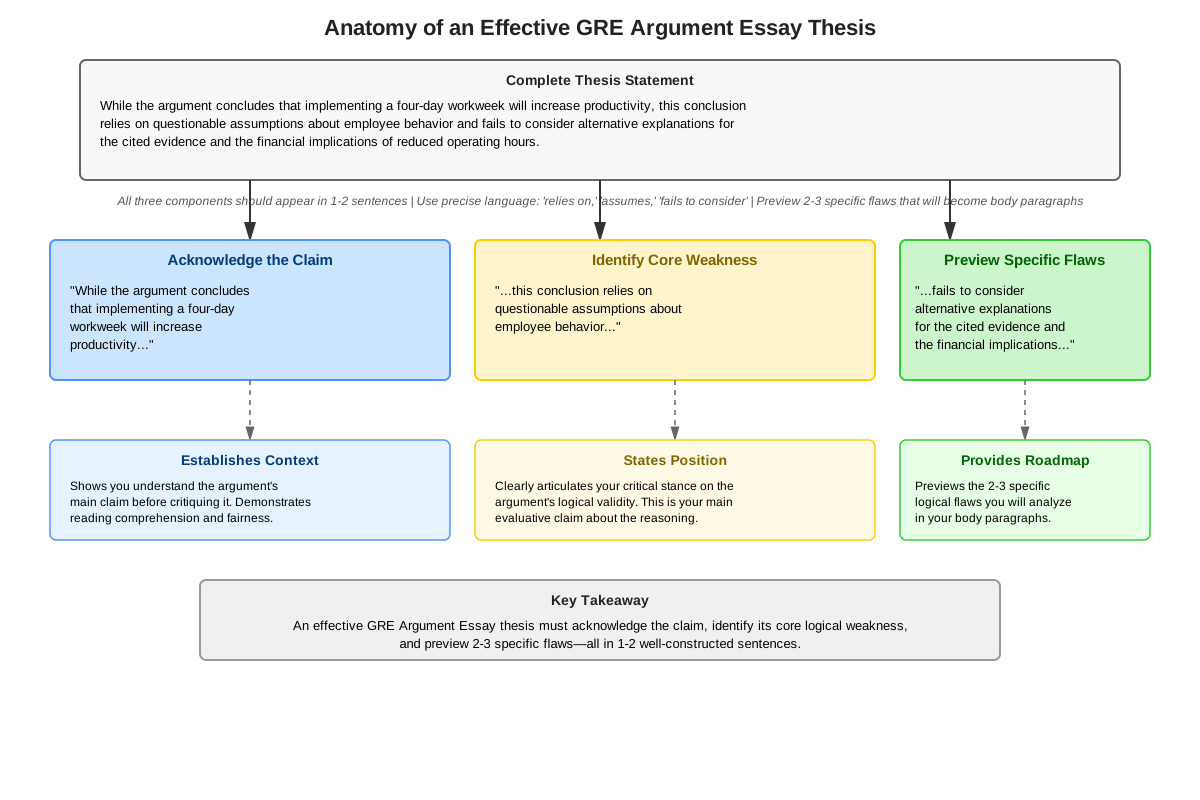
The argument essay thesis is a concise statement, typically 2-4 sentences long, that appears in the introductory paragraph and accomplishes three critical functions. First, it acknowledges the argument's conclusion—what the prompt is trying to prove. Second, it provides an overall evaluation of the argument's logical soundness (almost always identifying it as flawed or unconvincing). Third, it previews the specific logical weaknesses that will be examined in the body paragraphs. Unlike a thesis in other essay types, the GRE argument essay thesis does not state whether the conclusion itself is true or false; rather, it evaluates whether the reasoning provided adequately supports that conclusion.
The purpose of this thesis structure is to establish a clear analytical framework that guides both the writer and the reader. For the writer, the thesis serves as a planning tool that prevents tangential analysis and ensures each body paragraph connects to a pre-identified flaw. For the reader (the GRE grader), the thesis provides a roadmap that makes the essay's organization immediately apparent, facilitating higher scores in the "organization and focus" scoring dimension.
Essential Components of an Effective Thesis
An effective GRE argument essay thesis contains four essential components that work together to create analytical clarity:
- Acknowledgment of the argument's conclusion: A brief statement recognizing what the prompt argues (e.g., "The author concludes that implementing a four-day workweek will increase employee productivity")
- Overall evaluation statement: A clear assertion that the argument is flawed, unconvincing, or inadequately supported (e.g., "However, this argument relies on several questionable assumptions")
- Identification of specific flaws: A preview of 2-4 particular logical weaknesses that will be analyzed (e.g., "including unwarranted causal claims and unrepresentative evidence")
- Logical connector language: Transitional phrases that link these components smoothly (e.g., "while," "however," "because," "specifically")
The most effective theses integrate these components in a way that feels natural rather than formulaic. Advanced test-takers often embed the acknowledgment and evaluation within a single sentence, then use a second sentence to preview specific flaws. The key is ensuring all four components appear somewhere in the thesis, regardless of the exact sentence structure.
Thesis Positioning and Timing
The argument essay thesis must appear in the introductory paragraph, typically as the final 1-3 sentences after a brief contextual opening. The optimal position is after 1-2 sentences that provide context about the argument's topic or stakes, but before any detailed analysis begins. This positioning serves several strategic purposes: it gives the writer a moment to orient the reader to the argument's subject matter, it creates a natural transition from summary to analysis, and it ensures the thesis appears early enough to guide the entire essay's development.
Timing considerations are equally important. Test-takers should aim to complete their thesis within the first 3-5 minutes of the 30-minute writing period. This requires rapid identification of logical flaws during the initial reading of the prompt (approximately 2 minutes) and quick thesis construction (approximately 1-2 minutes). Spending more time on thesis development can compromise the time available for body paragraph development, while rushing the thesis often results in vague or incomplete analytical previews.
Types of Thesis Structures
Several effective thesis structures exist for GRE Argument Essays, each suited to different prompt types and personal writing styles:
| Structure Type | Format | Best Used When | Example |
|---|---|---|---|
| Two-sentence structure | Sentence 1: Acknowledge + evaluate. Sentence 2: Preview flaws. | Time is limited or argument has 2-3 clear flaws | "The author argues that City X should build a new sports stadium to boost the economy. This argument is unconvincing because it relies on questionable assumptions about economic impact and fails to consider alternative explanations for economic growth." |
| Three-sentence structure | Sentence 1: Acknowledge. Sentence 2: Evaluate. Sentence 3: Preview flaws. | Writer wants maximum clarity or argument is complex | "The memo recommends implementing a mandatory exercise program for all employees. However, this recommendation rests on flawed reasoning. Specifically, the argument makes unwarranted causal assumptions, relies on potentially unrepresentative survey data, and fails to consider alternative explanations for the observed health improvements." |
| Embedded structure | Single complex sentence with all components | Writer is confident and time-efficient | "While the author concludes that switching to organic farming methods will increase profits, this argument is undermined by unexamined assumptions about cost structures, questionable generalizations from limited data, and failure to consider market demand factors." |
| Conditional structure | Acknowledges what would be needed to strengthen the argument | Prompt explicitly asks about strengthening the argument | "The business consultant's recommendation to expand into international markets would be more convincing if it addressed concerns about cultural differences, provided evidence of sustainable demand, and examined the financial risks of rapid expansion." |
The choice among these structures should be based on personal comfort, time constraints, and the specific prompt's characteristics. However, all effective structures share the common feature of clearly previewing the analytical path the essay will follow.
Specificity and Precision in Thesis Language
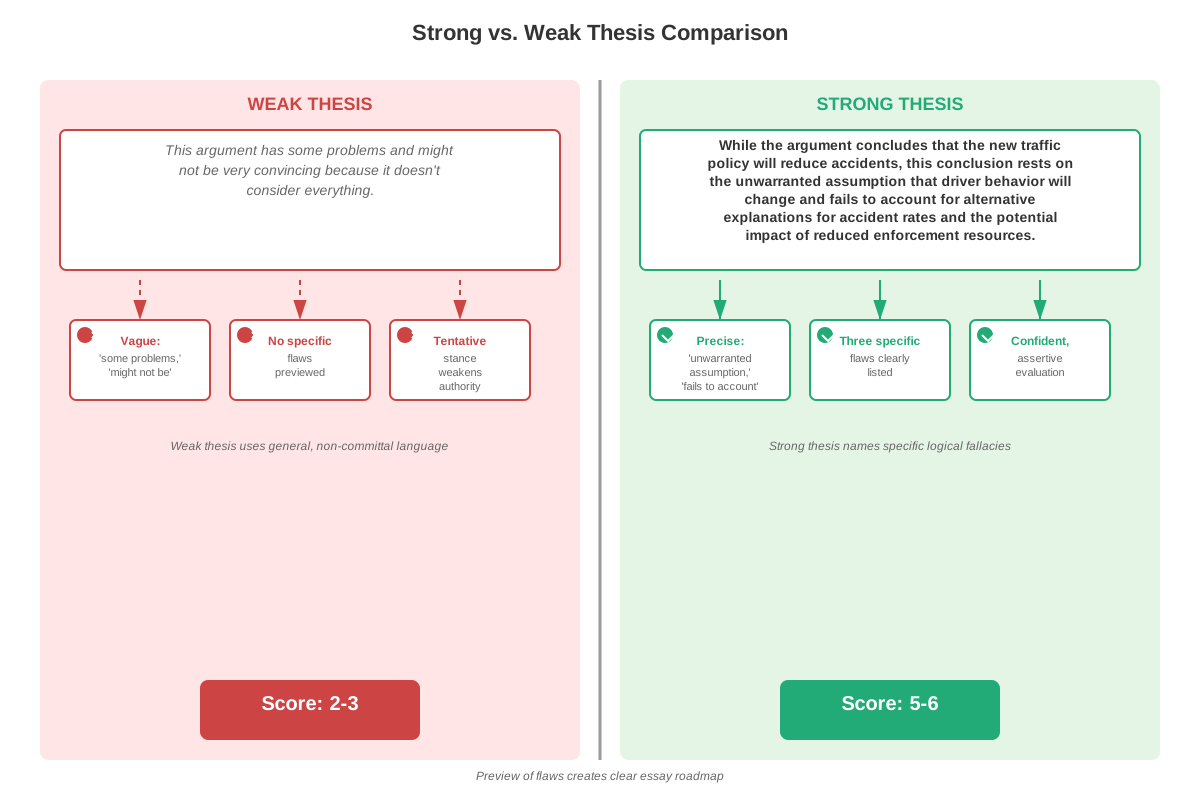
The language used in an argument essay thesis must balance specificity with efficiency. Vague thesis statements that merely assert "the argument has several flaws" without identifying what those flaws are provide insufficient guidance for the essay's development. Conversely, overly detailed thesis statements that attempt to fully explain each flaw within the introduction consume valuable time and space better used in body paragraphs.
The optimal approach uses precise categorical language to identify flaw types without fully explaining them. For example, rather than writing "the argument assumes that correlation equals causation, which is problematic because there could be other factors," an effective thesis states "the argument makes unwarranted causal assumptions." This precision signals to the grader that the writer recognizes specific logical fallacy types while reserving detailed explanation for the body paragraphs.
Key precision markers include:
- Flaw-specific terminology: "unwarranted assumptions," "insufficient evidence," "questionable generalizations," "false dichotomy," "hasty generalization"
- Evidence-related language: "unrepresentative sample," "outdated data," "ambiguous statistics," "cherry-picked examples"
- Logical relationship terms: "causal claims," "analogical reasoning," "predictive assumptions," "comparative analysis"
Adapting Thesis to Different Prompt Types
GRE Argument Essay prompts vary in their specific instructions, and the thesis must adapt accordingly while maintaining its core analytical function. The most common prompt variations include:
Standard evaluation prompts ("Discuss how well-reasoned you find this argument"): These require a straightforward thesis that identifies logical flaws and evaluates the argument's overall persuasiveness.
Question-focused prompts ("What questions would need to be answered to evaluate the argument?"): The thesis should preview the key questions that expose the argument's assumptions and evidence gaps, framing the essay as an inquiry into missing information.
Evidence-focused prompts ("What evidence would strengthen or weaken the argument?"): The thesis should identify what types of evidence are missing or problematic, setting up body paragraphs that discuss specific evidence needs.
Assumption-focused prompts ("What assumptions does the argument rely upon?"): The thesis should explicitly preview the unstated assumptions that, if false, would undermine the argument's conclusion.
Regardless of prompt variation, the thesis must maintain its fundamental purpose: providing a clear analytical roadmap that guides the essay's development and demonstrates critical thinking from the outset.
Concept Relationships
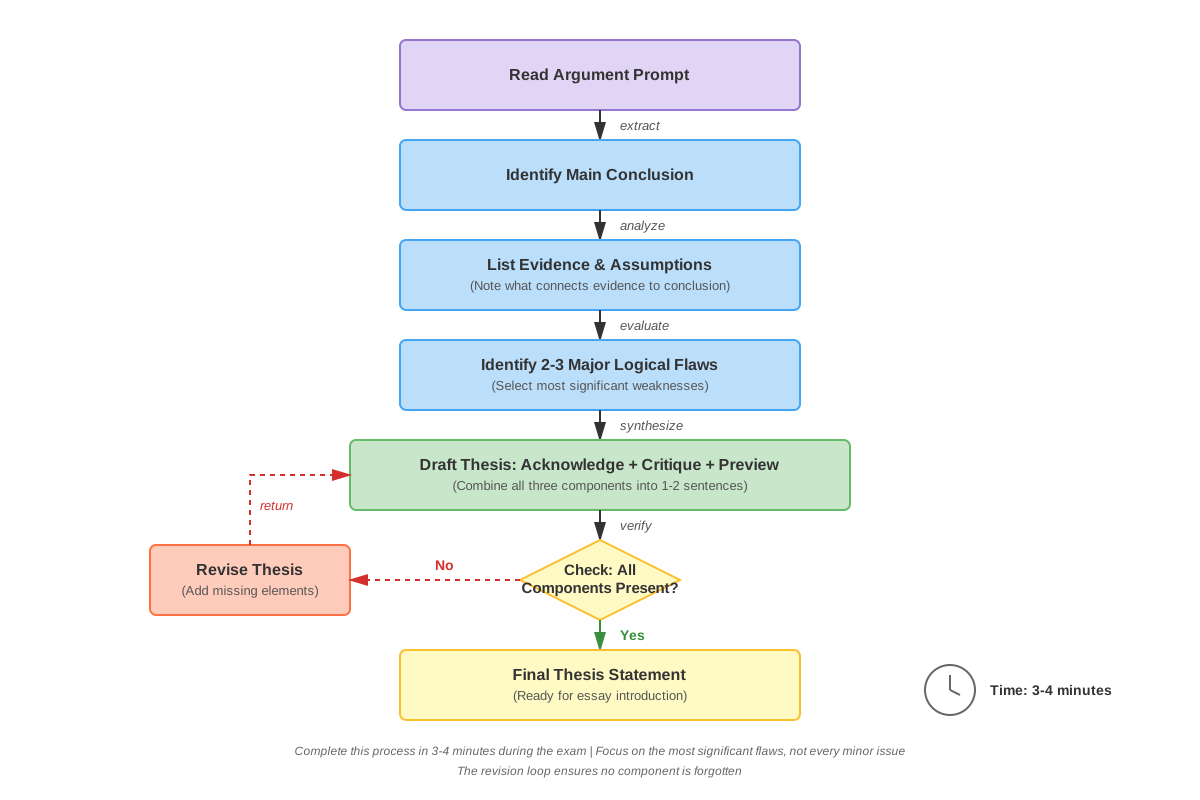
The argument essay thesis functions as the central organizing principle that connects all other elements of the GRE Argument Essay. The relationship flows in a clear sequence: Prompt reading → Flaw identification → Thesis construction → Body paragraph development → Conclusion reinforcement.
The thesis directly depends on effective flaw identification during the initial prompt reading. Without recognizing specific logical weaknesses (such as unwarranted assumptions, insufficient evidence, or faulty causal reasoning), a writer cannot construct a specific, analytical thesis. This makes flaw identification the immediate prerequisite skill that enables thesis construction.
Once constructed, the thesis governs body paragraph organization. Each body paragraph should address one of the flaws previewed in the thesis, creating a one-to-one correspondence between thesis preview and body paragraph content. This relationship ensures organizational coherence and prevents the essay from wandering into tangential analysis.
The thesis also connects to evidence evaluation and logical reasoning skills. The specific flaws identified in the thesis determine what types of evidence analysis will appear in body paragraphs. For example, a thesis that identifies "unrepresentative sampling" as a flaw signals that body paragraphs will discuss sample size, selection bias, or generalizability issues.
Finally, the thesis relates to the conclusion paragraph through reinforcement and synthesis. The conclusion should circle back to the thesis's overall evaluation, confirming that the detailed analysis in body paragraphs has substantiated the initial claim that the argument is flawed. This creates a cohesive argumentative arc: thesis states the argument is flawed → body paragraphs prove specific flaws → conclusion confirms the initial evaluation was correct.
High-Yield Facts
⭐ The argument essay thesis must appear in the introductory paragraph, typically as the final 1-3 sentences, and should be completed within the first 3-5 minutes of writing time.
⭐ An effective thesis contains four essential components: acknowledgment of the argument's conclusion, overall evaluation, identification of specific flaws, and logical connector language.
⭐ The thesis should preview 2-4 specific logical flaws that will be analyzed in body paragraphs, creating a one-to-one correspondence between thesis preview and body paragraph content.
⭐ Thesis language should use precise categorical terminology (e.g., "unwarranted assumptions," "insufficient evidence") rather than vague phrases like "several problems."
⭐ The thesis evaluates the argument's logical soundness, not whether the conclusion itself is true or false in reality.
- The most common thesis structures are two-sentence (acknowledge + evaluate, then preview flaws) and three-sentence (separate sentences for each component) formats.
- Effective theses avoid first-person language ("I think," "In my opinion") and instead use assertive, analytical language ("The argument fails to," "This reasoning is flawed because").
- The thesis must adapt to different prompt types (evaluation, questions, evidence, assumptions) while maintaining its core analytical function.
- Graders specifically evaluate whether essays maintain "a well-focused, well-organized analysis," a quality that originates with the thesis statement.
- A strong thesis can elevate an entire essay's score by establishing clear organizational structure that graders can easily follow and evaluate positively.
- The thesis should not attempt to fully explain each flaw; detailed explanation belongs in body paragraphs, while the thesis provides categorical identification only.
- Time spent crafting a clear, specific thesis (2-3 minutes) is a high-yield investment that makes body paragraph writing faster and more focused.
- The thesis works in conjunction with topic sentences: the thesis previews all flaws, while each topic sentence introduces one specific flaw that the body paragraph will analyze.
Quick check — test yourself on Argument essay thesis so far.
Try Flashcards →Common Misconceptions
Misconception: The thesis should state whether the argument's conclusion is true or false in reality.
Correction: The GRE Argument Essay evaluates logical reasoning, not factual truth. The thesis should assess whether the evidence and reasoning provided adequately support the conclusion, regardless of whether the conclusion might be true in the real world. Even a true conclusion can be supported by flawed reasoning.
Misconception: A longer, more detailed thesis is always better because it shows more analysis.
Correction: An effective thesis balances specificity with efficiency. Overly long theses that attempt to fully explain each flaw waste valuable time and space. The thesis should identify flaw categories precisely but reserve detailed explanation for body paragraphs. A concise 2-3 sentence thesis is typically more effective than a 5-6 sentence thesis.
Misconception: The thesis should agree with the argument or find it convincing if the conclusion seems reasonable.
Correction: GRE Argument Essay prompts are specifically designed to contain logical flaws. The thesis should always identify weaknesses in the reasoning, even if the conclusion seems plausible. The task is to critique the logic presented, not to evaluate whether the conclusion might be true under different circumstances.
Misconception: Using first-person language ("I believe," "In my opinion") makes the thesis stronger by showing personal engagement.
Correction: Analytical writing on the GRE should use assertive, third-person language that focuses on the argument's qualities rather than the writer's personal beliefs. Phrases like "The argument fails to consider" or "This reasoning is undermined by" are more effective than "I think the argument is weak because."
Misconception: The thesis can be written after completing the body paragraphs to ensure it accurately reflects the essay's content.
Correction: The thesis must be written first because it serves as the organizational roadmap for the entire essay. Writing body paragraphs before the thesis often results in unfocused analysis that wanders across multiple unrelated points. The thesis should guide body paragraph development, not summarize it after the fact.
Misconception: A thesis that identifies only one major flaw is sufficient if that flaw is analyzed in depth.
Correction: While depth of analysis is important, GRE graders expect essays to address multiple dimensions of an argument's weaknesses. A thesis that previews 2-4 distinct flaws demonstrates more comprehensive critical thinking and typically leads to higher scores than single-flaw analysis, even if that single analysis is detailed.
Misconception: The thesis should use complex vocabulary and sophisticated sentence structures to impress graders.
Correction: Clarity and precision are more valuable than complexity in GRE Analytical Writing. A straightforward thesis that clearly identifies specific flaws using appropriate analytical terminology will score higher than a convoluted thesis that obscures its meaning through unnecessary complexity. Graders value clear thinking expressed clearly.
Worked Examples
Worked Example 1: Business Recommendation Prompt
Prompt: "The following appeared in a memo from the director of marketing at a company that manufactures office furniture: 'During the past year, our sales of ergonomic office chairs increased by 30% in the region where we ran a social media advertising campaign, while sales remained flat in regions without such campaigns. To boost overall sales, we should expand our social media advertising to all regions where we currently sell our products.'"
Step 1: Identify the argument's conclusion
The director concludes that the company should expand social media advertising to all regions to boost overall sales.
Step 2: Identify specific logical flaws
- Assumes correlation between social media campaign and sales increase equals causation (other factors could explain the 30% increase)
- Assumes the successful region is representative of all other regions (demographic, economic, or competitive differences might exist)
- Assumes past success predicts future results (market conditions may have changed)
- Fails to consider costs versus benefits (the campaign might not be profitable even if it increases sales)
Step 3: Select 2-3 flaws to preview in thesis
For a 30-minute essay, focusing on three flaws is optimal: causal assumption, representativeness, and cost-benefit analysis.
Step 4: Construct the thesis using a three-sentence structure
"The marketing director recommends expanding social media advertising to all regions based on a 30% sales increase in one test region. However, this recommendation relies on several questionable assumptions that undermine its persuasiveness. Specifically, the argument makes an unwarranted causal claim about the advertising campaign's impact, assumes the test region is representative of all markets, and fails to consider whether the increased sales justify the advertising costs."
Analysis of this thesis:
- ✓ Acknowledges the conclusion (expand social media advertising)
- ✓ Provides overall evaluation (relies on questionable assumptions)
- ✓ Previews three specific flaws with precise terminology
- ✓ Uses logical connectors ("However," "Specifically")
- ✓ Maintains analytical focus without stating whether the conclusion is true
- ✓ Sets up clear roadmap for three body paragraphs
Worked Example 2: Public Policy Prompt
Prompt: "The following appeared in a letter to the editor of a local newspaper: 'Five years ago, the city of Grandville installed speed cameras at major intersections, and traffic accidents decreased by 25% in the following year. The neighboring city of Smalltown has seen traffic accidents increase by 15% over the past five years. Clearly, Smalltown should install speed cameras at its intersections to reduce accidents and improve public safety.'"
Step 1: Identify the argument's conclusion
The author concludes that Smalltown should install speed cameras to reduce accidents and improve public safety.
Step 2: Identify specific logical flaws
- Assumes Grandville's experience is analogous to Smalltown's situation (cities may differ in traffic patterns, driver behavior, road design)
- Relies on potentially insufficient evidence (only one year of data from Grandville; no information about long-term trends)
- Assumes correlation equals causation (other factors might have caused Grandville's accident reduction)
- Fails to consider alternative explanations for Smalltown's accident increase (population growth, weather patterns, road construction)
- Assumes speed cameras were the only change in Grandville (other safety measures might have been implemented simultaneously)
Step 3: Select 2-3 flaws to preview in thesis
For this prompt, focus on: analogical reasoning, insufficient evidence, and alternative explanations.
Step 4: Construct the thesis using a two-sentence structure
"While the author argues that Smalltown should install speed cameras based on Grandville's apparent success, this recommendation is undermined by flawed reasoning. The argument relies on a questionable analogy between two potentially dissimilar cities, draws conclusions from limited and possibly unrepresentative data, and fails to consider alternative explanations for the traffic trends in both locations."
Analysis of this thesis:
- ✓ Acknowledges the conclusion (Smalltown should install speed cameras)
- ✓ Provides overall evaluation (undermined by flawed reasoning)
- ✓ Previews three specific flaws using precise analytical language
- ✓ Uses logical connector ("While")
- ✓ Efficiently combines acknowledgment and evaluation in first sentence
- ✓ Creates clear organizational structure for body paragraphs
Alternative thesis using embedded structure:
"The recommendation that Smalltown install speed cameras would be more convincing if the argument established that the two cities face comparable traffic conditions, provided evidence that Grandville's accident reduction was sustained over multiple years and directly attributable to the cameras, and examined other potential causes for Smalltown's rising accident rate."
Analysis of alternative thesis:
- ✓ Uses conditional structure appropriate for "strengthen the argument" prompts
- ✓ Identifies same three core flaws but frames them as evidence needs
- ✓ Demonstrates sophisticated analytical thinking through complex sentence structure
- ✓ Maintains clarity despite embedding multiple components in one sentence
Exam Strategy
Rapid Flaw Identification Process
The most critical exam strategy for crafting an effective argument essay thesis is developing a systematic approach to flaw identification during the initial 2-minute prompt reading. Follow this process:
- Read the prompt once completely without stopping to analyze (30 seconds)
- Identify and underline the conclusion (what the argument is trying to prove) (15 seconds)
- Identify and mark the evidence provided to support that conclusion (30 seconds)
- Ask the critical questions: What assumptions connect the evidence to the conclusion? What alternative explanations exist? What evidence is missing? (45 seconds)
This systematic approach ensures that thesis construction is based on thorough analysis rather than superficial reading.
Trigger Words and Phrases to Watch For
Certain words and phrases in GRE Argument Essay prompts signal specific types of logical flaws that should be addressed in the thesis:
Causal language triggers: "caused by," "resulted in," "led to," "because of," "due to"
→ These signal potential unwarranted causal assumptions; the thesis should preview analysis of alternative causes
Comparative language triggers: "similar to," "like," "just as," "in the same way"
→ These signal analogical reasoning that may be flawed; the thesis should preview analysis of relevant differences
Predictive language triggers: "will," "should," "is expected to," "is likely to"
→ These signal assumptions about future outcomes; the thesis should preview analysis of changing conditions
Statistical language triggers: "survey," "study," "percentage," "increased by," "majority"
→ These signal potential evidence problems; the thesis should preview analysis of sample representativeness or data interpretation
Generalization triggers: "all," "every," "always," "never," "typical"
→ These signal potential overgeneralizations; the thesis should preview analysis of exceptions or counterexamples
Time Allocation Strategy
Effective time management for the argument essay thesis follows this breakdown within the 30-minute writing period:
- Minutes 0-2: Read prompt and identify conclusion, evidence, and assumptions
- Minutes 2-3: Select 2-3 specific flaws to address and mentally outline body paragraphs
- Minutes 3-5: Write introductory paragraph including thesis
- Minutes 5-23: Write body paragraphs (approximately 6 minutes per paragraph for 3 paragraphs)
- Minutes 23-27: Write conclusion paragraph
- Minutes 27-30: Proofread and make minor corrections
This allocation ensures the thesis receives adequate attention (3-5 minutes total including planning) without consuming time needed for body paragraph development. Test-takers who spend more than 5 minutes on the introduction often run out of time for thorough body paragraph analysis.
Process-of-Elimination for Thesis Self-Evaluation
After drafting the thesis, quickly evaluate it using this mental checklist (should take 15-20 seconds):
✓ Does it acknowledge what the argument concludes?
✓ Does it state that the argument is flawed or unconvincing?
✓ Does it identify 2-3 specific types of flaws?
✓ Can each flaw previewed become a full body paragraph?
✓ Does it avoid stating whether the conclusion is true or false in reality?
If any answer is "no," revise the thesis immediately before proceeding to body paragraphs. A flawed thesis will undermine the entire essay's effectiveness.
Template Adaptation Strategy
While formulaic writing should be avoided, having a flexible mental template helps ensure all thesis components appear under time pressure. Consider this adaptable framework:
"[Author/Source] argues/recommends/concludes that [conclusion]. However, this [argument/recommendation/conclusion] is [undermined by/based on/weakened by] [evaluation phrase]. Specifically, the argument [flaw 1], [flaw 2], and [flaw 3]."
This framework ensures all essential components appear while allowing natural language variation. Advanced test-takers internalize this structure so thoroughly that their theses sound natural rather than templated.
Memory Techniques
The "ACE-F" Mnemonic for Thesis Components
Remember the four essential thesis components using ACE-F:
- Acknowledge the argument's conclusion
- Critique or evaluate the reasoning
- Enumerate specific flaws (2-4)
- Flow with logical connectors
Visualize yourself holding four playing cards (an "ace" and three others) that you must play in sequence to win the thesis-writing game.
The "CAUSE" Framework for Flaw Identification
When reading the prompt, systematically check for flaws using CAUSE:
- Causal assumptions (does the argument assume correlation equals causation?)
- Analogies and comparisons (does it assume two things are similar without justification?)
- Unrepresentative or insufficient evidence (is the data limited, biased, or outdated?)
- Scope problems (does it overgeneralize or assume what's true in one context applies everywhere?)
- Evidence gaps (what crucial information is missing?)
This mnemonic ensures comprehensive flaw identification that leads to a well-developed thesis.
Visualization Strategy: The Thesis as a Bridge
Visualize the argument essay thesis as a bridge connecting two islands:
- Island 1 (left side): The prompt's argument with its conclusion
- Island 2 (right side): Your detailed analysis in body paragraphs
- The bridge: Your thesis, which must be strong enough (specific and clear) to support traffic (reader understanding) flowing from the argument to your analysis
If the bridge is vague or weak (poor thesis), readers can't cross from understanding the argument to following your analysis. This visualization reinforces why thesis specificity and clarity matter.
The "2-3-4" Rule
Remember the optimal thesis structure with 2-3-4:
- 2 sentences minimum (acknowledge + evaluate, then preview flaws)
- 3 specific flaws to preview (the sweet spot for 30-minute essays)
- 4 essential components (acknowledge, evaluate, enumerate, flow)
This numerical pattern is easy to recall under test pressure and ensures thesis completeness.
Summary
The argument essay thesis serves as the foundational element of a successful GRE Argument Essay, establishing the analytical framework that guides the entire response. An effective thesis must accomplish four essential tasks: acknowledge the argument's conclusion, provide an overall evaluation of its logical soundness, preview 2-4 specific flaws that will be analyzed in body paragraphs, and connect these components with clear logical transitions. The thesis should appear in the introductory paragraph, typically as the final 1-3 sentences, and should be completed within the first 3-5 minutes of the 30-minute writing period. Precision in language is critical—effective theses use specific analytical terminology like "unwarranted assumptions," "insufficient evidence," and "questionable generalizations" rather than vague phrases. The thesis must evaluate the argument's reasoning rather than the truth of its conclusion, and it must adapt to different prompt types while maintaining its core analytical function. By creating a clear one-to-one correspondence between thesis preview and body paragraph content, the thesis ensures organizational coherence that directly impacts scoring. Mastery of thesis construction requires systematic flaw identification during prompt reading, strategic time allocation, and consistent practice applying flexible thesis structures to diverse argument types.
Key Takeaways
- The argument essay thesis must contain four components: acknowledgment of conclusion, overall evaluation, preview of specific flaws, and logical connectors
- An effective thesis previews 2-4 specific flaws using precise analytical terminology, creating a roadmap for body paragraph organization
- The thesis evaluates the argument's logical reasoning, not whether the conclusion is factually true or false
- Optimal thesis positioning is the final 1-3 sentences of the introductory paragraph, completed within 3-5 minutes of starting
- Common thesis structures include two-sentence (acknowledge + evaluate, then preview), three-sentence (separate components), and embedded (single complex sentence) formats
- Systematic flaw identification using frameworks like "CAUSE" (Causal assumptions, Analogies, Unrepresentative evidence, Scope problems, Evidence gaps) ensures comprehensive analysis
- The thesis must adapt to different prompt types (evaluation, questions, evidence, assumptions) while maintaining its analytical core function
Related Topics
Body Paragraph Development for Argument Essays: Once the thesis previews specific flaws, each body paragraph must thoroughly analyze one flaw with detailed explanation and examples. Mastering thesis construction enables more focused and effective body paragraph writing.
Logical Fallacy Recognition: Understanding common logical fallacies (false cause, hasty generalization, false analogy, appeal to authority) deepens the ability to identify specific flaws that the thesis should preview.
Evidence Evaluation Techniques: Analyzing the quality, relevance, and sufficiency of evidence in arguments connects directly to thesis construction, as many thesis statements preview evidence-related flaws.
Conclusion Paragraph Strategies: The conclusion should reinforce the thesis's overall evaluation, creating a cohesive argumentative arc from introduction through body paragraphs to conclusion.
Issue Essay Thesis Construction: While the Argument Essay thesis critiques existing reasoning, the Issue Essay thesis presents an original position on a topic. Understanding both thesis types enables mastery of the complete Analytical Writing section.
Practice CTA
Now that you understand the essential components and strategies for crafting effective GRE argument essay theses, it's time to apply this knowledge through deliberate practice. Work through the practice questions to identify thesis components in sample essays, construct your own theses for various prompt types, and evaluate thesis effectiveness. Use the flashcards to reinforce key terminology and thesis structures until they become automatic. Remember that thesis construction is a skill that improves dramatically with focused practice—each prompt you analyze strengthens your ability to quickly identify flaws and articulate clear analytical frameworks. Your investment in mastering the argument essay thesis will pay dividends across your entire Analytical Writing performance, as a strong thesis elevates every essay from adequate to excellent. Start practicing now to build the confidence and competence that lead to top scores.
Sign up free to keep reading
Create a free AnvayaPrep account to finish this GRE guide on Argument essay thesis — plus flashcards and practice questions.