Overview
Absolute value inequalities represent a critical algebraic concept tested frequently on the GRE Quantitative Reasoning section. Unlike simple inequalities that involve straightforward comparisons, absolute value inequalities require students to consider distance from zero on the number line and often yield two separate solution regions. Mastering this topic demands both conceptual understanding of what absolute value represents and procedural fluency in solving compound inequalities. The GRE tests this concept both directly through pure algebra problems and indirectly through word problems involving distance, tolerance, error margins, and ranges of acceptable values.
Understanding GRE absolute value inequalities is essential because these problems appear in multiple question formats: Quantitative Comparison questions that ask students to compare expressions containing absolute values, Problem Solving questions requiring explicit solution sets, and Data Interpretation questions where absolute value represents deviation from a mean or target value. The ability to quickly visualize absolute value inequalities on a number line and translate between algebraic and geometric representations separates high-scoring test-takers from those who struggle with these medium-difficulty problems.
This topic sits at the intersection of several fundamental Quantitative Reasoning concepts. It builds directly on understanding of basic inequalities, number line representations, and the definition of absolute value itself. It connects forward to more advanced topics including systems of inequalities, optimization problems, and statistical concepts like standard deviation and confidence intervals. Students who master absolute value inequalities develop stronger algebraic reasoning skills that transfer to numerous other GRE problem types, making this a high-leverage topic for score improvement.
Learning Objectives
- [ ] Identify when Absolute value inequalities is being tested
- [ ] Explain the core rule or strategy behind Absolute value inequalities
- [ ] Apply Absolute value inequalities to GRE-style questions accurately
- [ ] Convert absolute value inequalities into compound inequalities without absolute value symbols
- [ ] Represent solution sets of absolute value inequalities graphically on a number line
- [ ] Distinguish between "less than" and "greater than" absolute value inequality structures and their solution patterns
- [ ] Solve multi-step problems involving absolute value inequalities combined with other algebraic operations
Prerequisites
- Basic inequality properties: Understanding how to solve linear inequalities (adding, subtracting, multiplying, dividing) is essential because absolute value inequalities decompose into standard inequalities
- Absolute value definition: Knowing that |x| represents the distance from zero on the number line provides the conceptual foundation for understanding why absolute value inequalities split into two cases
- Number line representation: Ability to graph solutions on a number line helps visualize solution sets and verify answers
- Compound inequalities: Familiarity with "and" versus "or" compound statements is necessary because absolute value inequalities always produce compound conditions
- Algebraic manipulation: Skills in isolating variables, combining like terms, and working with expressions are required for multi-step absolute value inequality problems
Why This Topic Matters
Absolute value inequalities appear in real-world contexts whenever situations involve acceptable ranges, tolerances, or deviations from target values. Manufacturing specifications often state that a part's dimension must be within a certain tolerance of the target measurement—expressible as an absolute value inequality. Temperature control systems, quality assurance protocols, and error analysis in scientific measurements all employ absolute value inequality reasoning. Understanding this concept enables precise mathematical modeling of "within X units of Y" scenarios that pervade engineering, science, and business applications.
On the GRE, absolute value inequalities appear in approximately 5-8% of Quantitative Reasoning questions, making them a high-yield topic relative to study time investment. These problems most commonly appear as Problem Solving questions requiring algebraic solution, but also frequently show up in Quantitative Comparison questions where test-takers must determine relationships between expressions. The GRE particularly favors questions that combine absolute value inequalities with other concepts: testing whether specific values satisfy an inequality, finding the range of possible values for an expression, or comparing the solution sets of two different absolute value conditions.
Common GRE question patterns include: asking for the number of integer solutions within a given range, presenting word problems about acceptable measurement ranges, testing understanding of how transformations affect absolute value inequalities, and requiring students to identify equivalent inequality statements. The exam also tests this concept indirectly through data sufficiency-style questions where students must determine whether given information is sufficient to establish an inequality relationship. Recognition of these patterns dramatically improves efficiency and accuracy.
Core Concepts
Definition and Geometric Interpretation
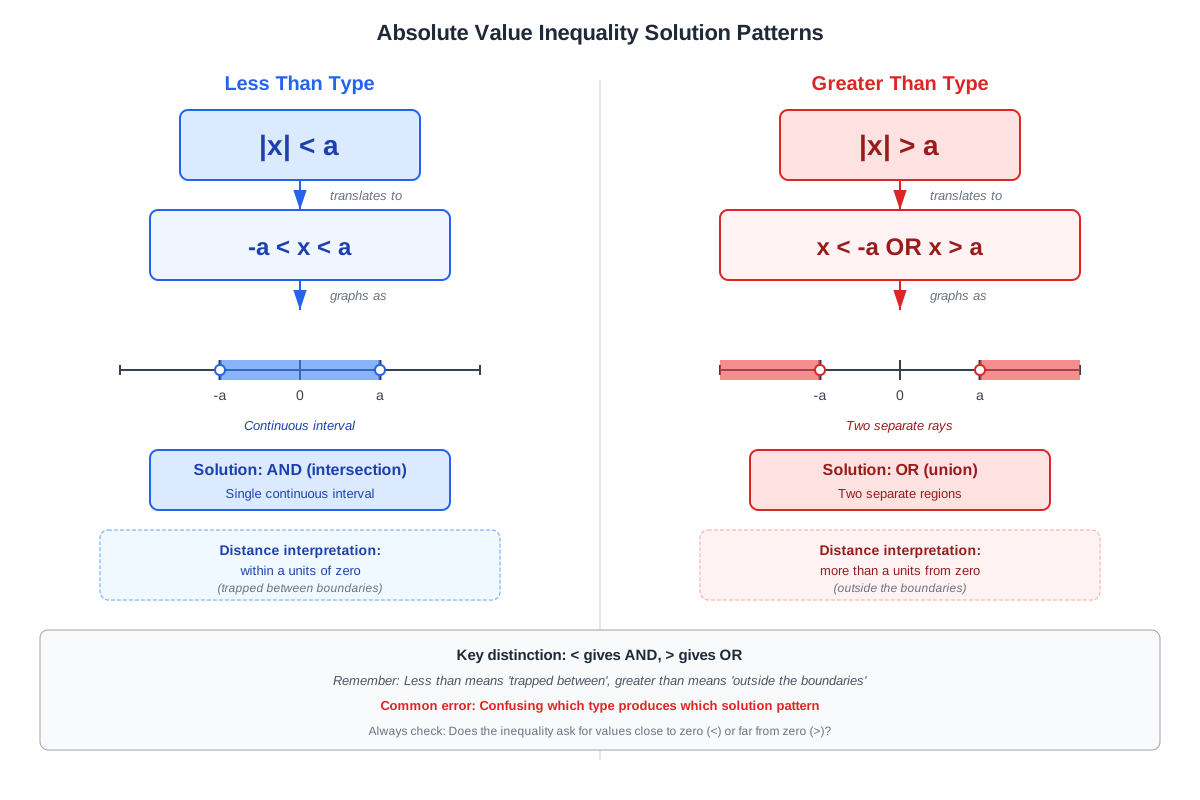
The absolute value of a number represents its distance from zero on the number line, always yielding a non-negative result. When inequalities involve absolute value, they describe ranges of distances from zero (or from another reference point after algebraic manipulation). The fundamental insight is that |x| < a (where a > 0) means "x is less than a units away from zero," which translates to x being between -a and a. Conversely, |x| > a means "x is more than a units away from zero," placing x either to the left of -a or to the right of a.
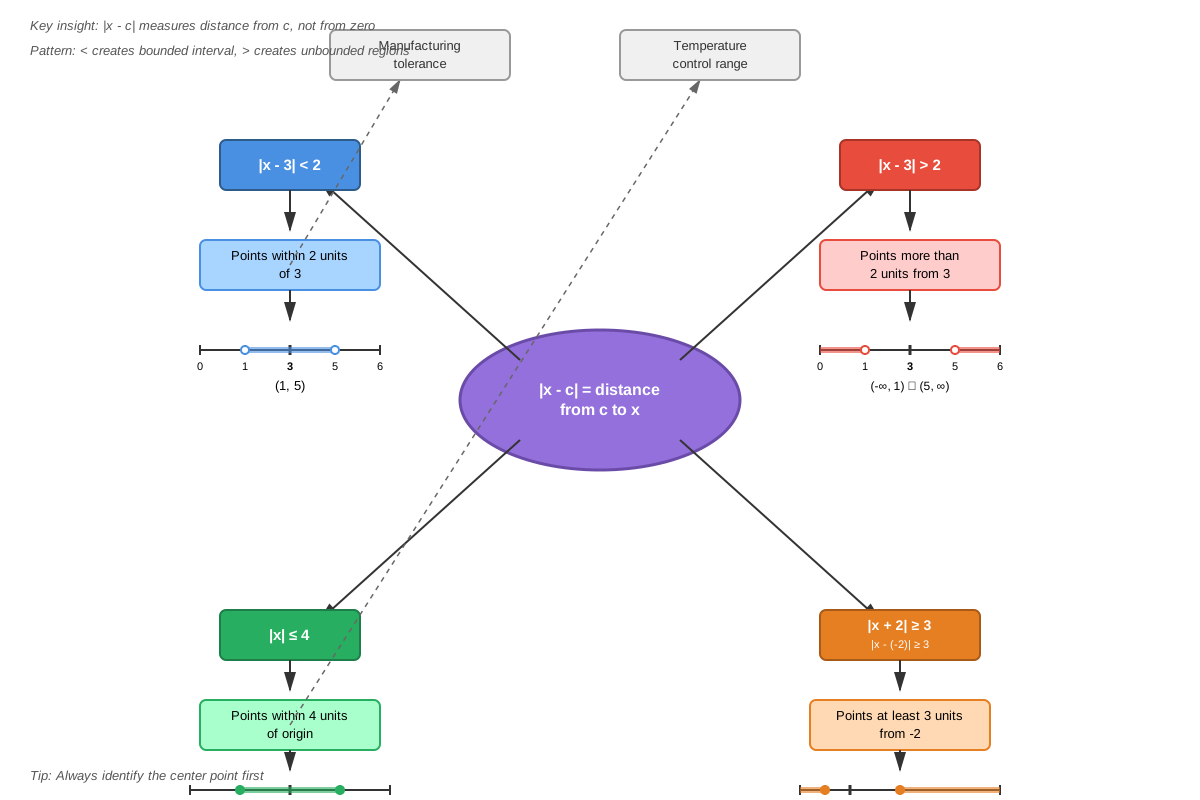
This geometric interpretation provides the conceptual foundation for all absolute value inequality solving. Rather than memorizing rules, students who visualize the number line can derive the correct compound inequality form. For instance, |x - 3| < 5 asks: "What values of x are less than 5 units away from 3?" Visualizing this on a number line immediately reveals the interval from -2 to 8.
The Two Fundamental Forms
Absolute value inequalities fall into two distinct categories with opposite solution structures:
| Inequality Type | Algebraic Form | Compound Inequality | Solution Structure | Connector Word | ||
|---|---|---|---|---|---|---|
| Less Than | \ | x\ | < a | -a < x < a | Single interval (bounded) | AND |
| Greater Than | \ | x\ | > a | x < -a OR x > a | Two separate rays (unbounded) | OR |
The "less than" form (including ≤) produces a bounded interval because values must be close to the reference point. The solution is a single continuous segment on the number line, requiring both conditions to be satisfied simultaneously (hence "AND").
The "greater than" form (including ≥) produces two separate solution regions because values must be far from the reference point. The solution consists of two rays extending toward infinity in opposite directions, requiring only one condition to be satisfied (hence "OR").
Standard Solution Procedure
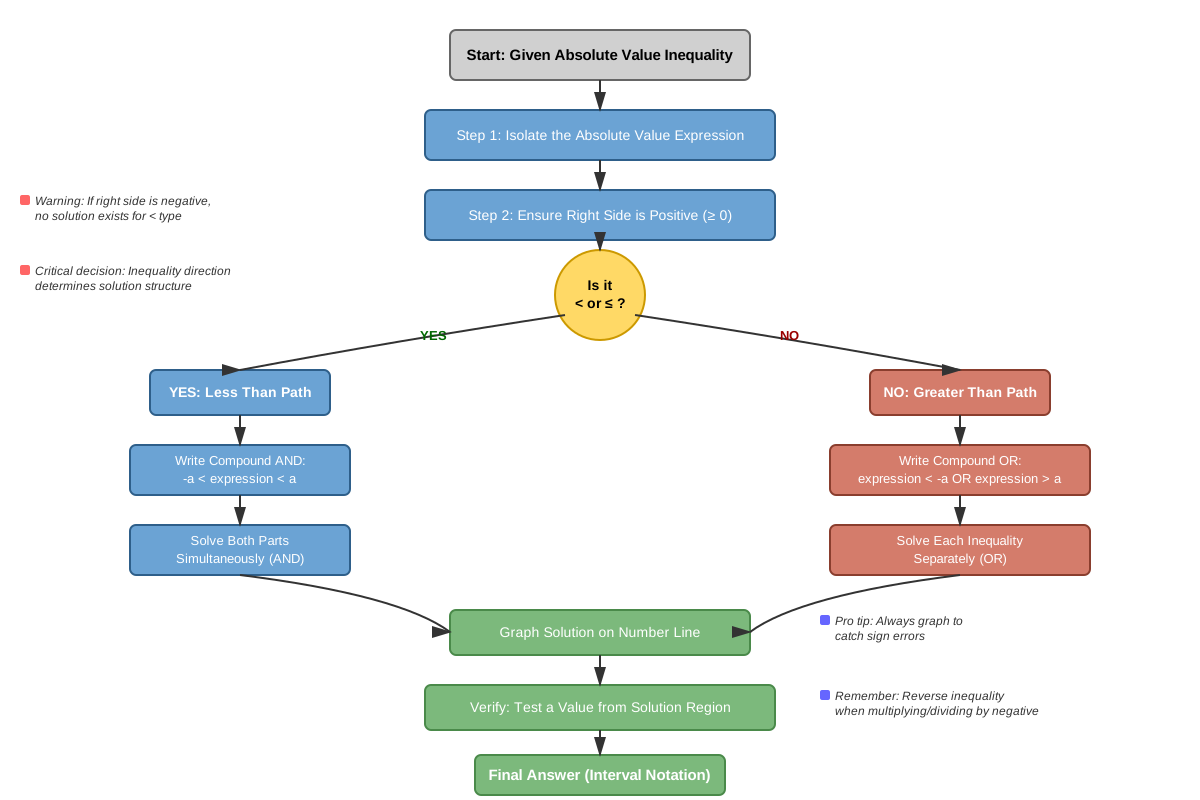
To solve any absolute value inequality, follow this systematic approach:
- Isolate the absolute value expression: Move all terms not inside the absolute value to one side, ensuring the absolute value expression stands alone
- Verify the constant is positive: If |expression| < negative number, there are no solutions; if |expression| > negative number, all real numbers are solutions
- Split into cases: Remove the absolute value bars and create the appropriate compound inequality based on the inequality symbol
- Solve each inequality: Apply standard inequality-solving techniques to each part of the compound inequality
- Express the solution: Write the solution in interval notation, inequality notation, or graph it on a number line as appropriate
Working with Modified Expressions
When the absolute value contains an expression more complex than a single variable, the same principles apply but require careful algebraic manipulation. For |ax + b| < c:
- Rewrite as: -c < ax + b < c (for "less than" type)
- Solve the compound inequality by performing the same operations to all three parts
- Divide by a, remembering to reverse inequality symbols if a is negative
For |ax + b| > c:
- Rewrite as: ax + b < -c OR ax + b > c (for "greater than" type)
- Solve each inequality separately
- Express as a union of two solution sets
Special Cases and Edge Conditions
Several special situations require particular attention:
Zero on the right side: |x| < 0 has no solutions (distance cannot be negative), while |x| > 0 includes all real numbers except zero, and |x| ≤ 0 has only x = 0 as a solution.
Negative constants: If the inequality reduces to |expression| < negative, no solutions exist. If it reduces to |expression| > negative, all real numbers satisfy it (since absolute value is always non-negative).
Absolute value on both sides: Inequalities like |x - 2| < |x + 1| require squaring both sides (valid because both sides are non-negative) or case-by-case analysis based on where each expression inside the absolute value changes sign.
Compound absolute value expressions: Problems involving |x| + |y| or |x| - |y| typically require testing critical points where expressions inside absolute values equal zero, then analyzing behavior in each resulting interval.
Testing Solution Sets
After solving, always verify solutions by:
- Testing a value from within the proposed solution region
- Testing a boundary value (if the inequality includes equality)
- Testing a value outside the proposed solution region to confirm it doesn't satisfy the inequality
This verification catches sign errors, incorrect inequality reversals, and logical mistakes in combining compound conditions.
Concept Relationships
The foundation of absolute value inequalities rests on the absolute value definition (distance from zero), which connects directly to number line geometry. This geometric understanding leads to the splitting rule: converting one absolute value inequality into two standard inequalities. The splitting rule differs fundamentally based on the inequality direction—"less than" creates an AND compound inequality (intersection), while "greater than" creates an OR compound inequality (union).
The solution process flows: isolate absolute value → identify inequality type → apply appropriate splitting rule → solve resulting compound inequality → express solution set. Each step depends on the previous one, making the procedure sequential and systematic.
Absolute value inequalities connect backward to prerequisite knowledge of basic inequalities (providing the tools to solve each piece after splitting) and compound inequalities (providing the logical framework for combining conditions). They connect forward to systems of inequalities (where absolute value inequalities might be one constraint among several) and optimization problems (where absolute value expressions appear in objective functions or constraints).
The relationship map: Absolute Value Definition → Geometric Interpretation → Splitting Rule → Compound Inequalities → Solution Set. Parallel to this main path, algebraic manipulation skills support every step, while number line visualization provides verification and intuition throughout.
Quick check — test yourself on Absolute value inequalities so far.
Try Flashcards →High-Yield Facts
- ⭐ |x| < a (where a > 0) always converts to -a < x < a (a single bounded interval using AND)
- ⭐ |x| > a (where a > 0) always converts to x < -a OR x > a (two unbounded rays using OR)
- ⭐ The inequality |x - c| < d describes all values within d units of c on the number line
- ⭐ When solving |ax + b| < c, divide the entire compound inequality by a, reversing symbols if a < 0
- ⭐ "Less than" absolute value inequalities produce bounded solution sets; "greater than" produce unbounded sets
- The solution to |x| ≤ 0 is only x = 0; the solution to |x| < 0 is the empty set
- Absolute value inequalities with negative constants on the right: |x| < -5 has no solutions; |x| > -5 includes all real numbers
- When absolute values appear on both sides, squaring both sides is valid (since both are non-negative) and often simplifies the problem
- The number of integer solutions to an absolute value inequality can be found by identifying the boundary values and counting integers in the solution interval
- Multiplying or dividing an inequality by a negative number reverses the inequality symbol—this applies to each part of a compound inequality independently
Common Misconceptions
Misconception: |x| < 5 means x < 5 only, forgetting the negative side.
Correction: |x| < 5 means -5 < x < 5. The absolute value inequality describes distance from zero in both directions, so solutions exist on both sides of zero (unless the interval doesn't extend that far).
Misconception: |x| > 3 converts to -3 > x > 3, using AND logic.
Correction: |x| > 3 converts to x < -3 OR x > 3. "Greater than" absolute value inequalities require values far from zero, creating two separate regions that cannot be connected with AND (no number can simultaneously be less than -3 and greater than 3).
Misconception: When solving |2x - 4| < 6, students split it as 2x - 4 < 6 OR 2x - 4 > -6.
Correction: The "less than" form requires AND, not OR. The correct split is -6 < 2x - 4 < 6, which solves to -1 < x < 5. The OR connector only applies to "greater than" inequalities.
Misconception: The solution to |x - 3| > -2 is x > 1 or x < 5.
Correction: Since absolute value is always non-negative, |x - 3| is always greater than any negative number. The solution is all real numbers. Whenever an absolute value is compared to a negative number with >, the solution is automatically all real numbers.
Misconception: When dividing by a negative in |3 - 2x| < 5, students forget to reverse the inequality symbols.
Correction: After splitting to -5 < 3 - 2x < 5, subtracting 3 gives -8 < -2x < 2. Dividing by -2 requires reversing both inequalities: 4 > x > -1, which should be rewritten as -1 < x < 4.
Misconception: |x| + 3 < 7 can be solved by splitting directly into cases.
Correction: First isolate the absolute value: |x| < 4. Only after isolation should you split into -4 < x < 4. Attempting to split before isolation leads to incorrect compound inequalities.
Worked Examples
Example 1: Standard "Less Than" Inequality
Problem: Solve |3x - 7| ≤ 11 and express the solution in interval notation.
Solution:
Step 1: The absolute value is already isolated, and 11 is positive, so we can proceed with splitting.
Step 2: Since this is a "less than or equal to" inequality, we use the AND form:
-11 ≤ 3x - 7 ≤ 11Step 3: Add 7 to all three parts:
-11 + 7 ≤ 3x - 7 + 7 ≤ 11 + 7
-4 ≤ 3x ≤ 18
Step 4: Divide all parts by 3 (positive, so no reversal):
-4/3 ≤ x ≤ 6Step 5: Express in interval notation: [-4/3, 6]
Verification: Test x = 0 (in the interval): |3(0) - 7| = |-7| = 7 ≤ 11 ✓
Test x = 10 (outside the interval): |3(10) - 7| = |23| = 23 ≤ 11 ✗
Connection to learning objectives: This example demonstrates applying the core splitting rule for "less than" inequalities and accurately solving a GRE-style problem.
Example 2: "Greater Than" Inequality with Negative Coefficient
Problem: Solve |5 - 2x| > 9 and graph the solution on a number line.
Solution:
Step 1: The absolute value is isolated, and 9 is positive, so proceed with splitting.
Step 2: Since this is a "greater than" inequality, we use the OR form:
5 - 2x < -9 OR 5 - 2x > 9Step 3: Solve the left inequality:
5 - 2x < -9
-2x < -14
x > 7  (inequality reverses when dividing by -2)
Step 4: Solve the right inequality:
5 - 2x > 9
-2x > 4
x < -2  (inequality reverses when dividing by -2)
Step 5: Combine with OR: x < -2 OR x > 7
Graph:
←●========○--------○========●→
      -2          7
(Shaded regions extend left from -2 and right from 7, with open circles at boundaries)
Verification: Test x = 0 (between the regions): |5 - 2(0)| = 5 > 9 ✗
Test x = -3 (in left region): |5 - 2(-3)| = |11| = 11 > 9 ✓
Test x = 10 (in right region): |5 - 2(10)| = |-15| = 15 > 9 ✓
Connection to learning objectives: This example illustrates the "greater than" splitting rule, careful handling of negative coefficients with inequality reversal, and graphical representation of solution sets.
Example 3: GRE Quantitative Comparison
Problem:
Quantity A: The number of integers satisfying |x - 4| < 3
Quantity B: The number of integers satisfying |x + 2| ≤ 3Solution:
For Quantity A:
|x - 4| < 3
-3 < x - 4 < 3
1 < x < 7
Integers in this range: 2, 3, 4, 5, 6 → 5 integers
For Quantity B:
|x + 2| ≤ 3
-3 ≤ x + 2 ≤ 3
-5 ≤ x ≤ 1
Integers in this range: -5, -4, -3, -2, -1, 0, 1 → 7 integers
Answer: Quantity B is greater.
Connection to learning objectives: This demonstrates identifying when absolute value inequalities are being tested (even in comparison format) and applying solution strategies to answer GRE-specific question types.
Exam Strategy
When approaching GRE questions involving absolute value inequalities, first scan for trigger phrases that signal this topic: "within X units of," "at most," "at least," "no more than," "no less than," "distance from," "deviation," and "tolerance." These phrases often translate directly into absolute value inequality statements.
Immediate classification is crucial: determine whether the problem involves "less than" (bounded, AND) or "greater than" (unbounded, OR) before attempting to solve. This classification prevents the most common error—using the wrong connector word. Visualize the number line immediately: sketch a quick diagram showing the reference point and the distance, which provides intuitive verification of your algebraic work.
For Quantitative Comparison questions, avoid fully solving unless necessary. Often you can determine the relationship by:
- Comparing the reference points (the value inside the absolute value that would make it zero)
- Comparing the tolerance distances (the constants on the right side)
- Testing strategic values (zero, boundary points, extreme values)
Process of elimination works particularly well when answer choices are given as intervals or inequalities. Eliminate choices by testing a single convenient value (often x = 0 or the reference point) to see which options it satisfies. For "greater than" inequalities, eliminate any answer showing a single bounded interval (the solution must be two separate regions).
Time allocation: Simple absolute value inequalities should take 45-60 seconds. If you're exceeding 90 seconds, you've likely made an error or are overcomplicating the approach. The most efficient strategy is: isolate, classify, split, solve—four steps that should flow quickly with practice.
Exam Tip: If an absolute value inequality problem seems unusually complex, check whether you can test the answer choices directly rather than solving algebraically. Substituting answer choices into the original inequality often proves faster than multi-step algebraic manipulation.
Memory Techniques
The "LESS is BEST" mnemonic:
- Less than creates a Bounded interval
- Everything Else (greater than) creates Separate regions
- Single interval uses AND; Two regions use OR
Visualization anchor: Picture absolute value as a "distance bubble" around a point. "Less than" means staying inside the bubble (bounded). "Greater than" means being outside the bubble (two separate regions on either side).
The splitting rhyme:
"Less than makes a sandwich tight (one interval, bounded left and right),
Greater than splits left and right (two rays extending toward infinite height)"
Hand gesture technique: For |x - c| < d, hold your hands close together (bounded interval). For |x - c| > d, spread your hands apart pointing in opposite directions (two separate rays). This kinesthetic memory reinforces the solution structure.
Acronym for solution steps - ICSSS:
- Isolate the absolute value
- Classify as "less than" or "greater than"
- Split using appropriate rule (AND or OR)
- Solve each resulting inequality
- State the solution clearly
Summary
Absolute value inequalities represent distance-based constraints on the number line, requiring conversion into compound inequalities for solution. The fundamental distinction between "less than" and "greater than" forms determines the entire solution structure: "less than" inequalities (|x| < a) produce single bounded intervals using AND logic (-a < x < a), while "greater than" inequalities (|x| > a) produce two unbounded rays using OR logic (x < -a OR x > a). Success requires systematic application of a five-step process: isolate the absolute value expression, verify the constant is positive, split into the appropriate compound form, solve each resulting inequality, and express the solution clearly. The geometric interpretation—visualizing distance from a reference point on the number line—provides both intuition and verification for algebraic solutions. GRE questions test this concept through direct algebraic problems, quantitative comparisons, and word problems involving ranges and tolerances, making mastery essential for achieving high Quantitative Reasoning scores.
Key Takeaways
- Absolute value inequalities split into two fundamentally different forms: "less than" creates bounded AND intervals; "greater than" creates unbounded OR regions
- Always isolate the absolute value expression completely before splitting into compound inequalities
- The inequality |x - c| < d describes all values within d units of c; |x - c| > d describes values more than d units from c
- When dividing by negative numbers during solution, reverse the inequality symbol in each affected part of the compound inequality
- Geometric visualization on a number line provides immediate intuition and serves as a powerful verification tool
- Special cases require attention: absolute value compared to zero or negative numbers often have trivial solutions (all real numbers or no solutions)
- GRE questions frequently test this concept through quantitative comparisons, integer counting problems, and word problems about acceptable ranges
Related Topics
Systems of Inequalities: After mastering single absolute value inequalities, students progress to problems involving multiple inequality constraints simultaneously, including combinations of absolute value and linear inequalities. This builds toward optimization and linear programming concepts.
Quadratic Inequalities: The techniques for solving absolute value inequalities (splitting into cases, testing intervals) transfer directly to quadratic inequalities, where sign analysis of parabolas determines solution regions.
Functions and Transformations: Understanding how absolute value affects function graphs connects to this topic, particularly when analyzing inequalities involving absolute value functions like f(x) = |x - h| + k.
Distance and Midpoint Formulas: The geometric interpretation of absolute value as distance extends to coordinate geometry, where |x₁ - x₂| represents distance between points on a number line.
Statistical Measures of Spread: Concepts like mean absolute deviation and confidence intervals employ absolute value inequality reasoning to describe data dispersion and acceptable ranges.
Practice CTA
Now that you've mastered the core concepts, solution strategies, and exam approaches for absolute value inequalities, it's time to solidify your understanding through active practice. Work through the practice questions to apply these techniques to GRE-style problems, and use the flashcards to reinforce the key rules and procedures until they become automatic. Remember: the difference between understanding absolute value inequalities conceptually and executing them flawlessly under timed conditions comes from deliberate practice. Each problem you solve strengthens your pattern recognition and builds the confidence you need to tackle these high-yield questions efficiently on test day. You've got this!
Sign up free to keep reading
Create a free AnvayaPrep account to finish this GRE guide on Absolute value inequalities — plus flashcards and practice questions.