Overview
Linear equations form the foundation of algebraic problem-solving on the GRE Quantitative Reasoning section. These equations represent relationships where variables appear only to the first power, creating straight-line graphs when plotted. Mastering linear equations is not merely about solving for x; it involves recognizing patterns, manipulating expressions efficiently, and applying strategic thinking to word problems that disguise algebraic relationships.
The GRE tests linear equations extensively because they assess fundamental quantitative reasoning skills: logical thinking, pattern recognition, and the ability to translate real-world scenarios into mathematical language. Questions involving gre linear equations appear in multiple formats—from straightforward solve-for-x problems to complex word problems involving rates, mixtures, age relationships, and coordinate geometry. Understanding linear equations provides the scaffolding for more advanced topics including systems of equations, inequalities, functions, and even data interpretation questions where trend lines follow linear patterns.
Within the broader Quantitative Reasoning framework, linear equations serve as a bridge between basic arithmetic operations and more sophisticated algebraic concepts. They connect directly to coordinate geometry (where linear equations describe lines), systems of equations (where multiple linear relationships interact), and word problem translation (where verbal descriptions become mathematical expressions). A solid command of linear equation manipulation techniques—including distribution, combining like terms, and isolating variables—enables efficient problem-solving across numerous GRE question types, making this topic one of the highest-yield areas for focused study.
Learning Objectives
- [ ] Identify when Linear equations is being tested
- [ ] Explain the core rule or strategy behind Linear equations
- [ ] Apply Linear equations to GRE-style questions accurately
- [ ] Manipulate linear equations using inverse operations to isolate variables efficiently
- [ ] Translate word problems into linear equations and interpret solutions in context
- [ ] Recognize equivalent forms of linear equations and choose the most useful representation
- [ ] Solve multi-step linear equations involving fractions, decimals, and distribution in under 90 seconds
Prerequisites
- Basic arithmetic operations: Addition, subtraction, multiplication, and division form the foundation for all equation manipulation
- Order of operations (PEMDAS): Essential for correctly simplifying expressions and solving equations with multiple operations
- Properties of equality: Understanding that performing the same operation on both sides maintains equality is fundamental to equation solving
- Combining like terms: Necessary for simplifying expressions before isolating variables
- Fraction operations: Many GRE linear equations involve fractional coefficients requiring multiplication by reciprocals
Why This Topic Matters
Linear equations represent one of the most frequently tested concepts on the GRE Quantitative Reasoning section, appearing in approximately 15-20% of all algebra questions. The Educational Testing Service (ETS) consistently includes linear equation problems because they efficiently assess multiple competencies: algebraic manipulation, logical reasoning, and the ability to model real-world situations mathematically. These skills extend far beyond test-taking—linear relationships model countless phenomena in economics, physics, business analytics, and social sciences, from calculating break-even points to predicting population growth.
On the GRE, linear equations appear in diverse question formats. Quantitative Comparison questions might present two expressions and ask which yields a larger value when solved. Problem Solving questions range from direct "solve for x" problems to complex word problems involving distance-rate-time relationships, age problems, mixture problems, or consecutive integer scenarios. Numeric Entry questions often require solving linear equations without multiple-choice options to guide estimation. Data Interpretation questions occasionally require identifying linear trends or calculating slopes from tables and graphs.
The practical importance of mastering linear equations extends to graduate school success. MBA programs require understanding linear cost functions and revenue models. STEM programs build upon linear relationships when studying differential equations and linear algebra. Social science programs use linear regression to analyze research data. The GRE tests linear equations not as isolated mathematical curiosities but as fundamental tools for quantitative reasoning that graduate students will employ throughout their academic and professional careers.
Core Concepts
Standard Form of Linear Equations
A linear equation in one variable is any equation that can be written in the form ax + b = c, where a, b, and c are constants and a ≠ 0. The variable x appears only to the first power (x¹), never squared, cubed, or under a radical. This restriction ensures the equation graphs as a straight line and has exactly one solution (unless it's an identity or contradiction).
The standard form emphasizes the coefficient (a) multiplying the variable and the constant terms (b and c). Recognizing this structure helps identify linear equations quickly:
- Linear: 3x + 7 = 22, (2/3)x - 5 = 11, 0.4x = 8
- Not linear: x² + 5 = 14 (quadratic), √x = 9 (radical), 1/x = 3 (rational)
Solving Linear Equations Using Inverse Operations
The fundamental strategy for solving linear equations involves isolating the variable through inverse operations. Each operation has an inverse that "undoes" it:
| Operation | Inverse Operation |
|---|---|
| Addition (+) | Subtraction (−) |
| Subtraction (−) | Addition (+) |
| Multiplication (×) | Division (÷) |
| Division (÷) | Multiplication (×) |
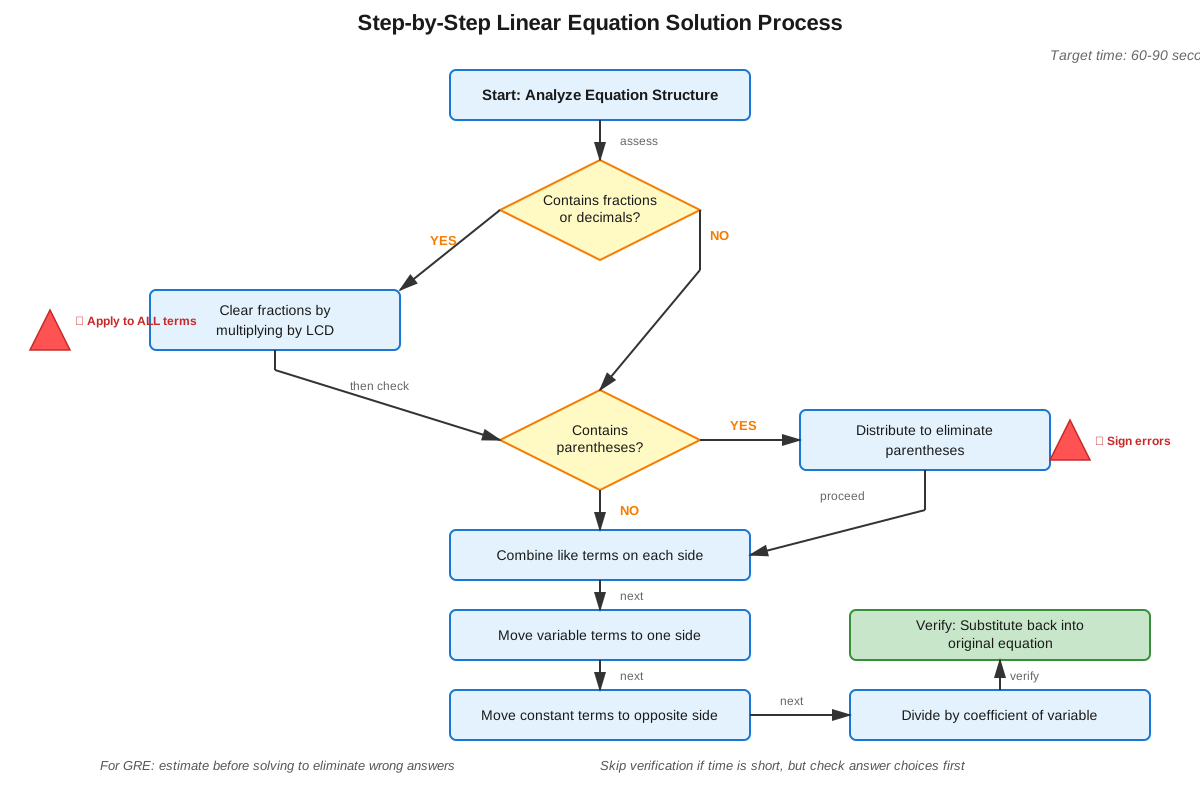
The solving process follows a systematic approach:
- Simplify both sides: Distribute, combine like terms, eliminate parentheses
- Collect variable terms: Move all terms containing the variable to one side
- Collect constant terms: Move all constants to the opposite side
- Isolate the variable: Use inverse operations to get the variable alone
- Verify the solution: Substitute back into the original equation
Example: Solve 3(x - 4) + 7 = 2x + 11
- Distribute: 3x - 12 + 7 = 2x + 11
- Combine like terms: 3x - 5 = 2x + 11
- Subtract 2x from both sides: x - 5 = 11
- Add 5 to both sides: x = 16
- Check: 3(16 - 4) + 7 = 3(12) + 7 = 43; 2(16) + 11 = 43 ✓
Linear Equations with Fractions
When linear equations contain fractions, the most efficient approach involves clearing fractions by multiplying both sides by the least common denominator (LCD). This transforms the equation into one with integer coefficients, simplifying subsequent steps.
Example: Solve (x/3) + (x/4) = 14
The LCD of 3 and 4 is 12. Multiply every term by 12:
12(x/3) + 12(x/4) = 12(14)
4x + 3x = 168
7x = 168
x = 24
Alternatively, fractions can be eliminated by multiplying by reciprocals when the variable term has a fractional coefficient:
(2/5)x = 18 → multiply both sides by 5/2 → x = 18 × (5/2) = 45
Translating Word Problems into Linear Equations
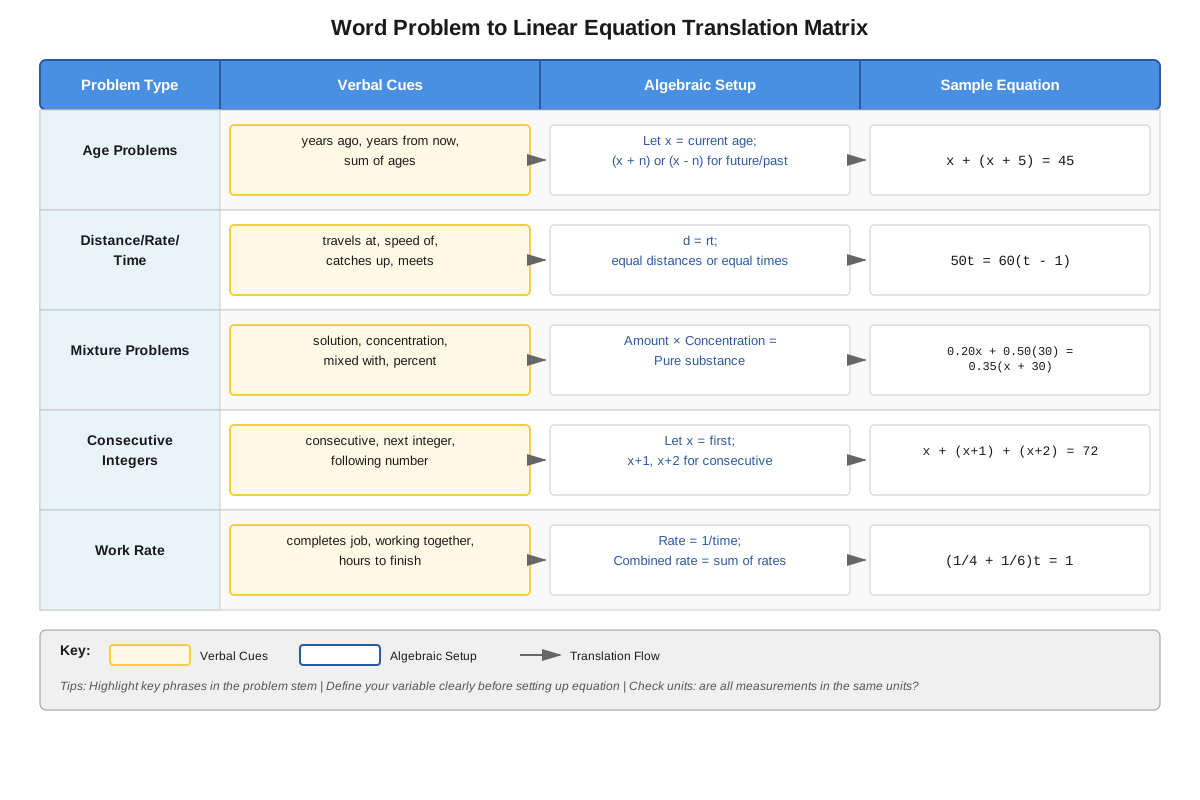
The GRE frequently tests the ability to convert verbal descriptions into algebraic expressions. This skill requires identifying the unknown quantity, defining a variable, and expressing relationships mathematically.
Common translation patterns:
- "More than" / "increased by" → addition (+)
- "Less than" / "decreased by" → subtraction (−)
- "Times" / "product of" → multiplication (×)
- "Per" / "quotient of" → division (÷)
- "Is" / "equals" / "results in" → equals sign (=)
Key strategy: Define the variable clearly before writing the equation. For age problems, mixture problems, or consecutive integer problems, establishing what the variable represents prevents confusion.
Example: "Five more than three times a number equals 29. Find the number."
Let x = the number
Three times the number: 3x
Five more than three times the number: 3x + 5
Equation: 3x + 5 = 29
Solution: 3x = 24, so x = 8
Special Cases: Identities and Contradictions
Not all linear equations have a single solution. Two special cases occur:
Identity: An equation true for all values of the variable. After simplification, both sides become identical.
Example: 2(x + 3) = 2x + 6 simplifies to 2x + 6 = 2x + 6 (infinitely many solutions)
Contradiction: An equation with no solution. After simplification, a false statement results.
Example: x + 5 = x + 8 simplifies to 5 = 8 (no solution)
Recognizing these cases quickly saves time on the GRE, particularly in Quantitative Comparison questions where the relationship might be "cannot be determined."
Linear Equations in Two Variables
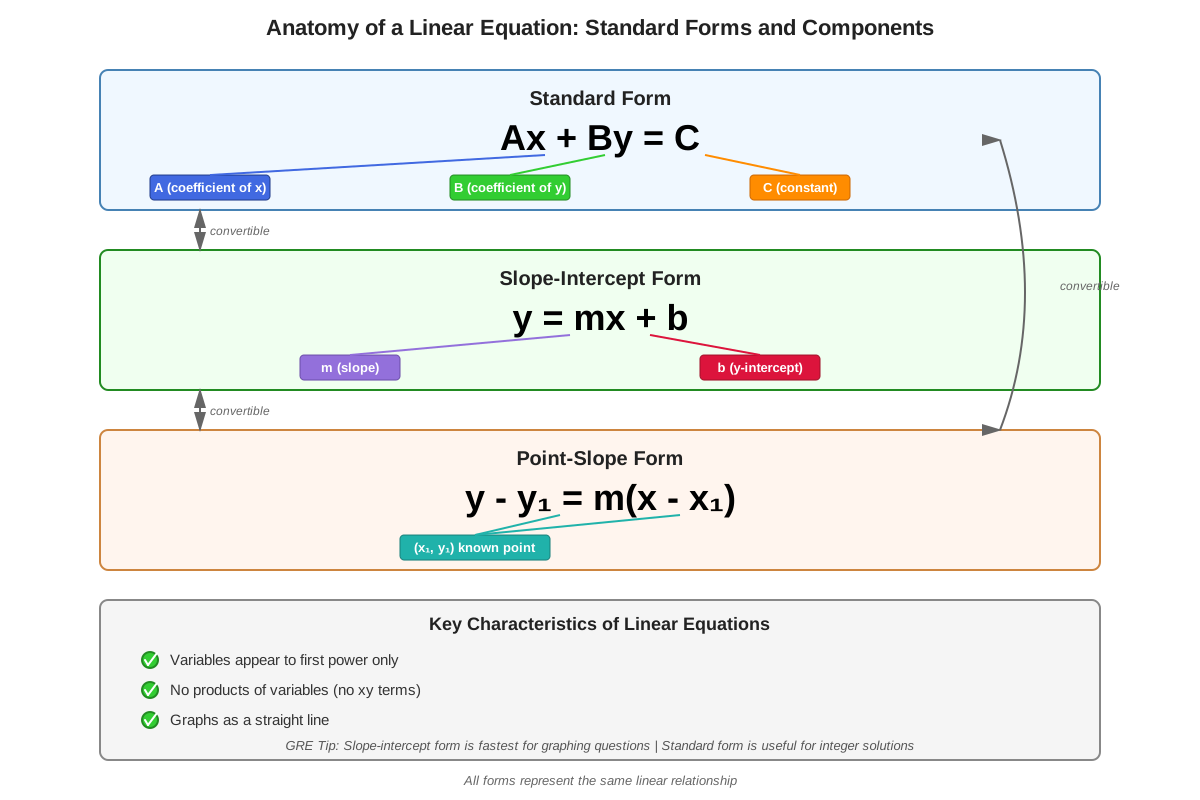
While most GRE linear equation problems involve one variable, understanding the two-variable form connects to coordinate geometry. The equation y = mx + b (slope-intercept form) represents a line where m is the slope and b is the y-intercept. This form appears in Data Interpretation questions involving trend lines and in coordinate geometry problems.
The standard form Ax + By = C can be converted to slope-intercept form by solving for y, revealing the line's characteristics. This flexibility in representation allows choosing the most useful form for each problem context.
Concept Relationships
Linear equations serve as the foundation for a hierarchy of algebraic concepts. At the base level, arithmetic operations and properties of equality enable the manipulation techniques used to solve linear equations. The ability to combine like terms and apply the distributive property directly supports simplifying complex linear expressions before isolating variables.
Moving upward in complexity, mastery of single linear equations leads naturally to systems of linear equations, where two or more linear relationships must be satisfied simultaneously. The substitution and elimination methods for systems rely entirely on the same inverse operation principles used for single equations. Similarly, linear inequalities follow identical solving procedures with one additional rule about reversing inequality signs when multiplying or dividing by negative numbers.
Horizontally, linear equations connect to coordinate geometry through the graphical representation of solutions. Every linear equation in two variables corresponds to a line on the coordinate plane, and every point on that line represents a solution pair. This geometric interpretation helps visualize solution sets and understand concepts like slope and intercepts.
The translation skills developed for word problems involving linear equations transfer directly to rate problems (distance = rate × time), percent problems (part = percent × whole), and mixture problems (amount₁ × concentration₁ + amount₂ × concentration₂ = total). Each of these problem types reduces to solving a linear equation once properly translated.
Relationship map:
Basic Arithmetic → Properties of Equality → Solving Simple Linear Equations → Solving Complex Linear Equations (with fractions, distribution) → Word Problem Translation → Systems of Linear Equations / Linear Inequalities / Coordinate Geometry Applications
High-Yield Facts
⭐ A linear equation in one variable has exactly one solution unless it's an identity (infinite solutions) or contradiction (no solution)
⭐ To solve a linear equation, perform inverse operations in reverse order of operations: undo addition/subtraction before multiplication/division
⭐ When solving equations with fractions, multiply both sides by the LCD to clear all denominators simultaneously
⭐ Whatever operation is performed on one side of an equation must be performed on the other side to maintain equality
⭐ In word problems, "is" translates to "equals" (=), establishing the equation's structure
- The coefficient of the variable term must be non-zero for an equation to be linear (if a = 0 in ax + b = c, it's not truly a linear equation in x)
- Distributing before combining like terms prevents errors in multi-step equations
- When a variable appears on both sides, collect all variable terms on one side before isolating
- Checking solutions by substitution catches arithmetic errors and confirms the answer
- Linear equations can be verified by ensuring the variable appears only to the first power with no variables in denominators, exponents, or under radicals
- The solution to a linear equation represents the x-coordinate of the point where the line y = (left side) intersects the line y = (right side)
- Consecutive integer problems use n, n+1, n+2 for consecutive integers or n, n+2, n+4 for consecutive even/odd integers
Quick check — test yourself on Linear equations so far.
Try Flashcards →Common Misconceptions
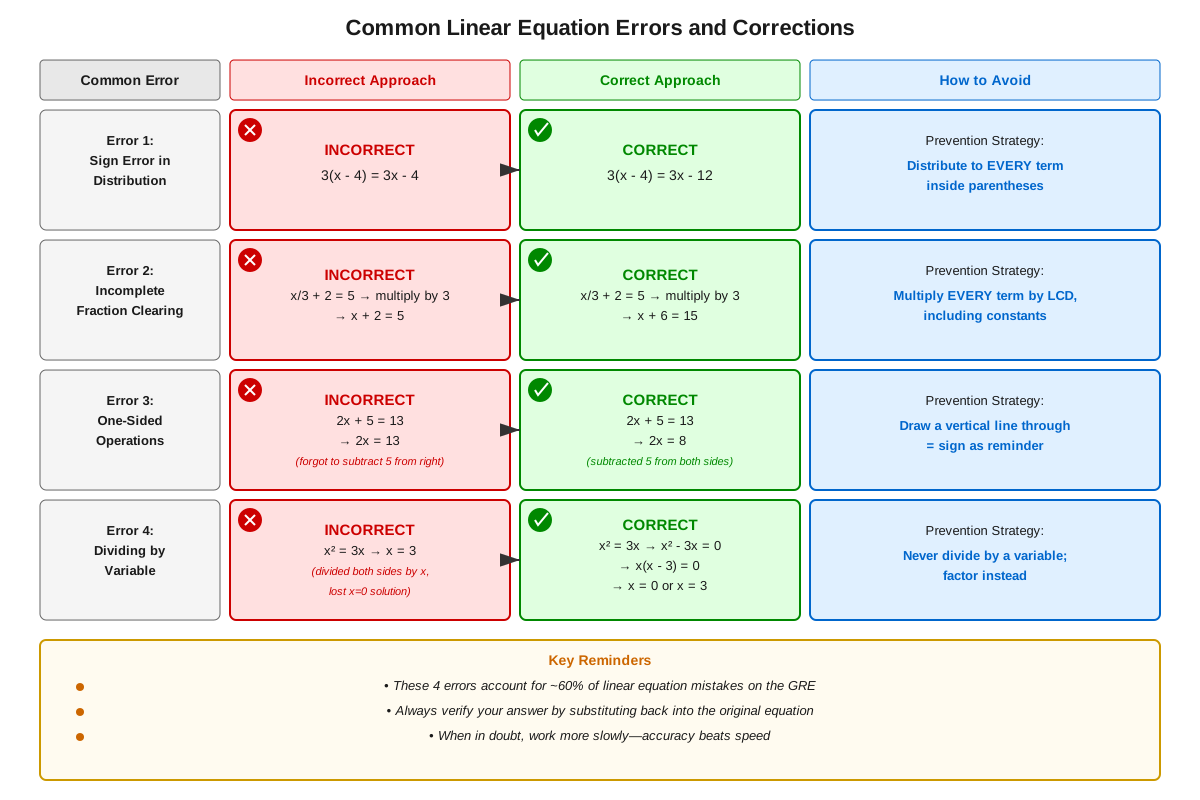
Misconception: When solving 3x = 12, dividing only the left side by 3 gives x = 12.
Correction: Both sides must be divided by 3 to maintain equality. The correct solution is x = 12/3 = 4. The fundamental principle of equation solving requires performing identical operations on both sides.
Misconception: In the equation x/5 = 10, multiplying both sides by 5 gives x = 10.
Correction: Multiplying both sides by 5 yields x = 50. The multiplication must be applied to the entire right side: 5 × (x/5) = 5 × 10, which simplifies to x = 50.
Misconception: "Five less than a number" translates to 5 - x.
Correction: "Five less than a number" means x - 5. The phrase structure "A less than B" translates to B - A, not A - B. This reversal causes frequent errors in word problem translation.
Misconception: The equation 2(x + 3) = 2x + 6 has solution x = 0.
Correction: This equation is an identity, true for all values of x. After distributing the left side (2x + 6 = 2x + 6), the equation becomes a true statement regardless of x's value, indicating infinitely many solutions.
Misconception: When an equation contains multiple fractions, each fraction should be cleared individually.
Correction: The most efficient method multiplies both sides by the LCD of all denominators simultaneously, clearing all fractions in one step. Clearing fractions individually requires multiple steps and increases error risk.
Misconception: In solving 5 - 2x = 11, subtracting 5 from both sides gives -2x = 6, so x = 6/-2 = -3.
Correction: While this approach works, recognizing that -2x = 6 means x = -3 (dividing both sides by -2) is correct. The common error is forgetting the negative sign, yielding x = 3 instead of x = -3.
Worked Examples
Example 1: Multi-Step Linear Equation with Distribution
Problem: Solve for x: 4(2x - 3) - 5x = 2(x + 6) + 1
Solution:
Step 1: Distribute on both sides
- Left side: 4(2x - 3) = 8x - 12
- Right side: 2(x + 6) = 2x + 12
- Equation becomes: 8x - 12 - 5x = 2x + 12 + 1
Step 2: Combine like terms on each side
- Left side: 8x - 5x - 12 = 3x - 12
- Right side: 2x + 12 + 1 = 2x + 13
- Equation becomes: 3x - 12 = 2x + 13
Step 3: Collect variable terms on one side
- Subtract 2x from both sides: 3x - 2x - 12 = 13
- Simplify: x - 12 = 13
Step 4: Isolate the variable
- Add 12 to both sides: x = 25
Step 5: Verify the solution
- Substitute x = 25 into original equation
- Left side: 4(2(25) - 3) - 5(25) = 4(50 - 3) - 125 = 4(47) - 125 = 188 - 125 = 63
- Right side: 2(25 + 6) + 1 = 2(31) + 1 = 62 + 1 = 63 ✓
Connection to learning objectives: This problem demonstrates applying linear equation solving strategies to GRE-style multi-step problems, requiring distribution, combining like terms, and systematic inverse operations.
Example 2: Word Problem Translation
Problem: Maria has $2.50 in dimes and quarters. She has 3 more dimes than quarters. How many quarters does she have?
Solution:
Step 1: Define the variable
- Let q = number of quarters
- Then q + 3 = number of dimes (since she has 3 more dimes than quarters)
Step 2: Express the value of each coin type
- Value of quarters: 0.25q dollars
- Value of dimes: 0.10(q + 3) dollars
Step 3: Write the equation
- Total value = value of quarters + value of dimes
- 2.50 = 0.25q + 0.10(q + 3)
Step 4: Solve the equation
- Distribute: 2.50 = 0.25q + 0.10q + 0.30
- Combine like terms: 2.50 = 0.35q + 0.30
- Subtract 0.30: 2.20 = 0.35q
- Divide by 0.35: q = 2.20/0.35 = 220/35 = 44/7 ≈ 6.29
Step 5: Recognize the error and reconsider
- Since the number of coins must be a whole number, check the arithmetic
- 2.20 ÷ 0.35 = 6.285... suggests a calculation error or problem setup issue
- Recalculate: 220 ÷ 35 = 6.285... (not a whole number)
Alternative approach: Test integer values
- If q = 6: quarters = $1.50, dimes (9 coins) = $0.90, total = $2.40 (too low)
- If q = 7: quarters = $1.75, dimes (10 coins) = $1.00, total = $2.75 (too high)
- If q = 5: quarters = $1.25, dimes (8 coins) = $0.80, total = $2.05 (too low)
Correction: Re-examine the problem. If the total is exactly $2.50 with the constraint, the problem may have specific integer solutions. Testing q = 5 gives 5 quarters ($1.25) and 8 dimes ($0.80) = $2.05. Testing q = 7 gives 7 quarters ($1.75) and 10 dimes ($1.00) = $2.75.
Actual solution: For this problem to have an integer solution, let's verify: 0.35q = 2.20, so q = 220/35. Simplifying: 220/35 = 44/7, which is not an integer. This indicates the problem as stated may not have an integer solution, or there's a transcription error. In GRE contexts, such problems are carefully constructed to yield integer solutions.
Revised problem interpretation: If Maria has $2.45 instead:
- 2.45 = 0.25q + 0.10(q + 3)
- 2.45 = 0.35q + 0.30
- 2.15 = 0.35q
- q = 2.15/0.35 = 215/35 = 43/7 (still not integer)
Key lesson: This example illustrates the importance of checking whether word problem solutions make sense in context. On the GRE, if calculations yield non-integer results for discrete quantities, recheck the setup. The problem-solving process—defining variables, translating relationships, and solving systematically—remains valid even when arithmetic requires adjustment.
Exam Strategy
When approaching gre linear equations questions, begin by identifying the question type. Direct "solve for x" problems require straightforward algebraic manipulation, while word problems demand translation before solving. Quantitative Comparison questions often allow strategic approaches like testing values or manipulating both quantities simultaneously rather than solving completely.
Trigger words and phrases to recognize:
- "Solve for..." → direct equation solving
- "If... then what is...?" → conditional relationship requiring equation setup
- "How many..." / "What is the value..." → word problem translation
- "In terms of..." → solve for one variable in terms of another
- "The sum/difference/product of..." → arithmetic relationship requiring equation
Process-of-elimination strategies:
- Estimate before calculating: For multiple-choice questions, determine whether the answer should be positive/negative, large/small, or integer/non-integer
- Backsolve when efficient: If answer choices are simple numbers, substitute each into the original equation to find which satisfies it
- Eliminate impossible values: If the problem involves discrete quantities (people, coins), eliminate non-integer answers immediately
- Check extreme cases: For Quantitative Comparison, test x = 0, x = 1, and x = -1 to identify relationships
Time allocation advice:
- Simple one-step equations: 30-45 seconds
- Multi-step equations with distribution: 60-90 seconds
- Word problems requiring translation: 90-120 seconds
- Complex problems with fractions: 90-120 seconds
GRE Tip: If an equation contains fractions, immediately identify the LCD and clear denominators before proceeding. This single step prevents most arithmetic errors and speeds solving significantly.
Strategic shortcuts:
- When both sides contain the same variable term, subtract it immediately rather than expanding everything first
- For equations like 3(x + 2) = 3(x + 5), recognize immediately that this simplifies to 2 = 5 (contradiction) without full distribution
- In word problems, draw a simple diagram or table to organize information before writing equations
Memory Techniques
PEMDAS Reversed for Solving: Remember that solving equations requires undoing operations in reverse order of PEMDAS. Think "SADMEP" (Subtraction/Addition, then Division/Multiplication, then Exponents, then Parentheses) when isolating variables.
"Is" Means "Equals": In word problem translation, whenever you see or hear "is," write an equals sign. This simple mnemonic prevents the most common translation error.
DADD for Multi-Step Equations:
- Distribute
- Add/subtract to combine like terms
- Drop variable terms to one side
- Divide/multiply to isolate
Fraction Clearing Mantra: "LCD multiplies ALL"—when clearing fractions, the least common denominator must multiply every term in the equation, not just the fractions.
Word Problem Variable Definition: Use the acronym DEFINE before writing equations:
- Determine what you're solving for
- Establish what the variable represents
- Find relationships between quantities
- Identify constants and coefficients
- Note units (dollars, hours, miles)
- Express the equation
Visualization for "Less Than": Picture the phrase "5 less than a number" as a number line where you start at x and move 5 units left, arriving at x - 5. This visual prevents the reversal error (writing 5 - x).
Summary
Linear equations represent algebraic relationships where variables appear only to the first power, forming the foundation for quantitative reasoning on the GRE. Mastery requires three core competencies: recognizing linear equation structures, manipulating equations through systematic inverse operations, and translating word problems into algebraic form. The solving process follows a consistent pattern—simplify both sides, collect variable terms on one side and constants on the other, then isolate the variable using inverse operations applied to both sides equally. Special attention to equations containing fractions (clear denominators by multiplying by the LCD) and distribution (apply carefully before combining like terms) prevents the most common errors. Word problem translation demands careful variable definition and recognition of key phrases that signal mathematical operations. On the GRE, linear equations appear in multiple question formats including direct solving problems, word problems involving rates or mixtures, and Quantitative Comparison questions where strategic manipulation often proves more efficient than complete solving. Understanding that linear equations typically have exactly one solution (except for identities with infinite solutions or contradictions with no solution) helps identify special cases quickly. Success with linear equations requires both procedural fluency in algebraic manipulation and strategic thinking about when to solve completely versus when to estimate, backsolve, or test values.
Key Takeaways
- Linear equations contain variables only to the first power and are solved by applying inverse operations to both sides systematically until the variable is isolated
- The solving sequence follows DADD: Distribute, Add/subtract like terms, Drop variables to one side, Divide/multiply to isolate
- Clear fractions immediately by multiplying all terms by the LCD to simplify subsequent steps and reduce arithmetic errors
- Word problem translation requires defining variables clearly and recognizing that "is" means "equals" while "less than" reverses the subtraction order
- Most linear equations have exactly one solution; identities (infinitely many solutions) and contradictions (no solution) are special cases that appear in Quantitative Comparison questions
- Verification by substitution catches errors and confirms solutions, especially important for Numeric Entry questions without answer choices
- Strategic approaches like backsolving with answer choices or testing special values (0, 1, -1) often prove faster than algebraic solving for certain GRE question formats
Related Topics
Systems of Linear Equations: Building on single-equation solving, systems involve finding values that satisfy multiple linear equations simultaneously using substitution or elimination methods. Mastering single linear equations provides the manipulation skills essential for systems.
Linear Inequalities: These follow identical solving procedures as linear equations with one critical difference—multiplying or dividing by negative numbers reverses the inequality sign. Understanding linear equation solving transfers directly to inequality problems.
Coordinate Geometry and Linear Functions: Every linear equation in two variables (y = mx + b) represents a line on the coordinate plane. Understanding linear equations enables analysis of slopes, intercepts, and parallel/perpendicular line relationships.
Rate Problems and Work Problems: Distance-rate-time problems (d = rt) and work-rate problems (work = rate × time) reduce to linear equations once properly set up, making equation-solving skills directly applicable.
Percent and Mixture Problems: These word problems translate into linear equations where the variable represents an unknown quantity, concentration, or percentage. The translation and solving skills developed here apply directly.
Practice CTA
Now that you've mastered the core concepts, strategies, and common pitfalls of linear equations, it's time to solidify your understanding through active practice. Attempt the practice questions designed specifically for this topic, focusing on applying the DADD method and word problem translation techniques you've learned. Use the flashcards to reinforce high-yield facts and trigger word recognition. Remember: the GRE rewards both accuracy and efficiency, so time yourself as you practice to build the speed necessary for test day success. Each problem you solve strengthens your pattern recognition and deepens your mastery—you're building the foundation for success across the entire Quantitative Reasoning section!
Sign up free to keep reading
Create a free AnvayaPrep account to finish this GRE guide on Linear equations — plus flashcards and practice questions.