Overview
Multi-step equations form the backbone of algebraic problem-solving on the GRE Quantitative Reasoning section. These equations require students to perform multiple operations—such as distributing, combining like terms, and isolating variables—to arrive at a solution. Unlike simple one-step equations where a single operation reveals the answer, multi-step equations demand systematic thinking and careful execution of algebraic principles in sequence. Mastery of this topic is non-negotiable for GRE success, as these equations appear both as standalone problems and as components within more complex quantitative comparison, data interpretation, and word problem questions.
The GRE tests multi-step equations frequently because they efficiently assess multiple mathematical competencies simultaneously: order of operations, distributive property application, fraction manipulation, and logical sequencing. Questions may present equations directly or embed them within real-world scenarios involving rates, mixtures, ages, or geometric relationships. The ability to recognize when a problem requires setting up and solving a multi-step equation—and then executing that solution accurately under time pressure—distinguishes high-scoring test-takers from average performers.
Within the broader Quantitative Reasoning framework, GRE multi-step equations serve as a bridge between basic arithmetic operations and advanced algebraic concepts like systems of equations, quadratic equations, and function notation. They reinforce fundamental properties of equality while building the procedural fluency necessary for tackling the most challenging algebra problems. Students who develop strong multi-step equation-solving skills find that word problems become more approachable, quantitative comparisons become faster to evaluate, and complex algebraic manipulations become more intuitive.
Learning Objectives
- [ ] Identify when Multi-step equations is being tested
- [ ] Explain the core rule or strategy behind Multi-step equations
- [ ] Apply Multi-step equations to GRE-style questions accurately
- [ ] Systematically solve equations involving parentheses, fractions, and multiple variable terms
- [ ] Verify solutions by substitution and identify extraneous solutions when applicable
- [ ] Translate word problems into multi-step equations and solve them efficiently
- [ ] Recognize and avoid common algebraic errors that lead to incorrect solutions
Prerequisites
- Basic arithmetic operations: Addition, subtraction, multiplication, and division form the foundation for all algebraic manipulations in multi-step equations
- Order of operations (PEMDAS): Understanding the correct sequence of operations prevents errors when simplifying expressions
- Properties of equality: Knowledge that performing the same operation on both sides maintains equality is essential for isolating variables
- Combining like terms: The ability to simplify expressions by adding or subtracting similar terms streamlines the solution process
- Distributive property: Expanding expressions like 3(x + 4) is frequently required before solving multi-step equations
- Fraction operations: Many GRE equations involve fractional coefficients or require finding common denominators
Why This Topic Matters
Multi-step equations appear in approximately 15-20% of GRE Quantitative Reasoning questions, making them one of the most frequently tested algebraic concepts. They serve as the mathematical foundation for solving real-world problems involving proportions, percentages, rates, work problems, mixture problems, and geometric relationships. In professional contexts, the logical thinking required to solve multi-step equations translates directly to analytical problem-solving in fields ranging from business analytics to scientific research.
On the GRE, multi-step equations appear in multiple question formats. They may be presented as straightforward "solve for x" problems in quantitative comparison questions, where students must determine whether Quantity A or Quantity B is greater. They frequently appear embedded within word problems that require translation from English to mathematical notation. Data interpretation questions may require setting up and solving equations based on information presented in tables or graphs. Even geometry problems often require solving multi-step equations to find missing side lengths or angle measures.
The GRE specifically designs questions to test whether students can maintain accuracy through multiple steps while working under time pressure. Common question variations include equations with variables on both sides, equations requiring distribution before combining like terms, equations with fractional coefficients, and equations nested within word problems about ages, distances, or mixtures. The test-makers intentionally include answer choices that represent common errors at various steps in the solution process, rewarding careful, systematic work.
Core Concepts
Definition and Structure
A multi-step equation is an algebraic equation that requires two or more operations to isolate the variable and determine its value. Unlike simple equations such as x + 5 = 12, which require only one operation (subtracting 5), multi-step equations involve combinations of operations that must be performed in a strategic sequence. The fundamental principle underlying all multi-step equation solving is the properties of equality: whatever operation is performed on one side of the equation must be performed on the other side to maintain balance.
The general structure of multi-step equations on the GRE includes:
- Equations with variables on both sides: 3x + 7 = 5x - 11
- Equations requiring distribution: 4(2x - 3) = 20
- Equations with multiple terms: 2x + 5 - 3x = 14 - x
- Equations with fractions: (x/3) + 4 = (2x/5) - 1
Systematic Solution Process
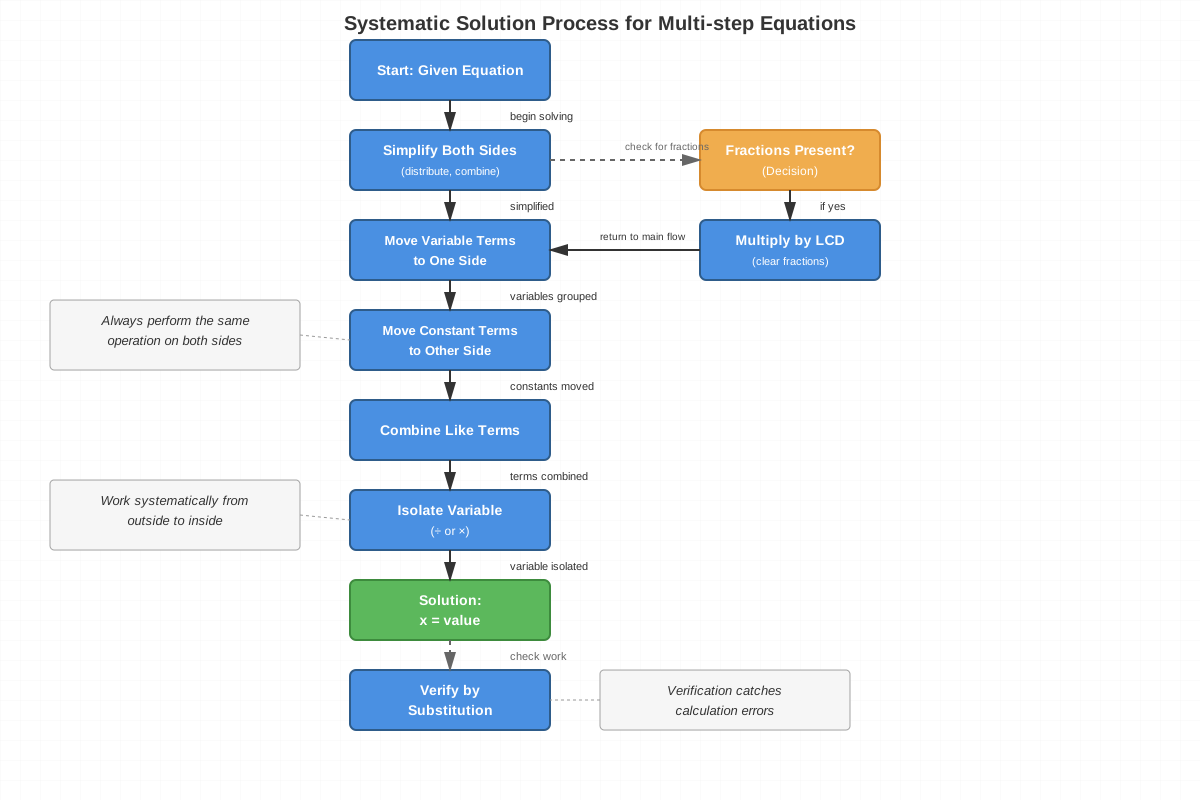
The most reliable approach to solving multi-step equations follows a consistent sequence:
- Simplify both sides independently: Combine like terms and apply the distributive property before attempting to isolate the variable
- Eliminate variable terms from one side: Use addition or subtraction to collect all variable terms on one side of the equation
- Eliminate constant terms from the variable side: Use addition or subtraction to move all constants to the opposite side
- Isolate the variable: Use multiplication or division to make the coefficient of the variable equal to 1
- Verify the solution: Substitute the answer back into the original equation to confirm accuracy
This systematic approach minimizes errors and provides a clear roadmap even for complex equations. The key insight is that solving equations is essentially "undoing" operations in reverse order—working backward from the final result to the original variable.
Working with Variables on Both Sides
When variables appear on both sides of an equation, the goal is to consolidate all variable terms on one side. The strategic choice of which side to collect variables on can simplify calculations:
For the equation 5x - 8 = 2x + 13:
- Subtract 2x from both sides: 3x - 8 = 13
- Add 8 to both sides: 3x = 21
- Divide both sides by 3: x = 7
Best practice: Move variables to the side where they have the larger coefficient to avoid negative coefficients when possible, as this reduces arithmetic errors.
Distribution and Parentheses
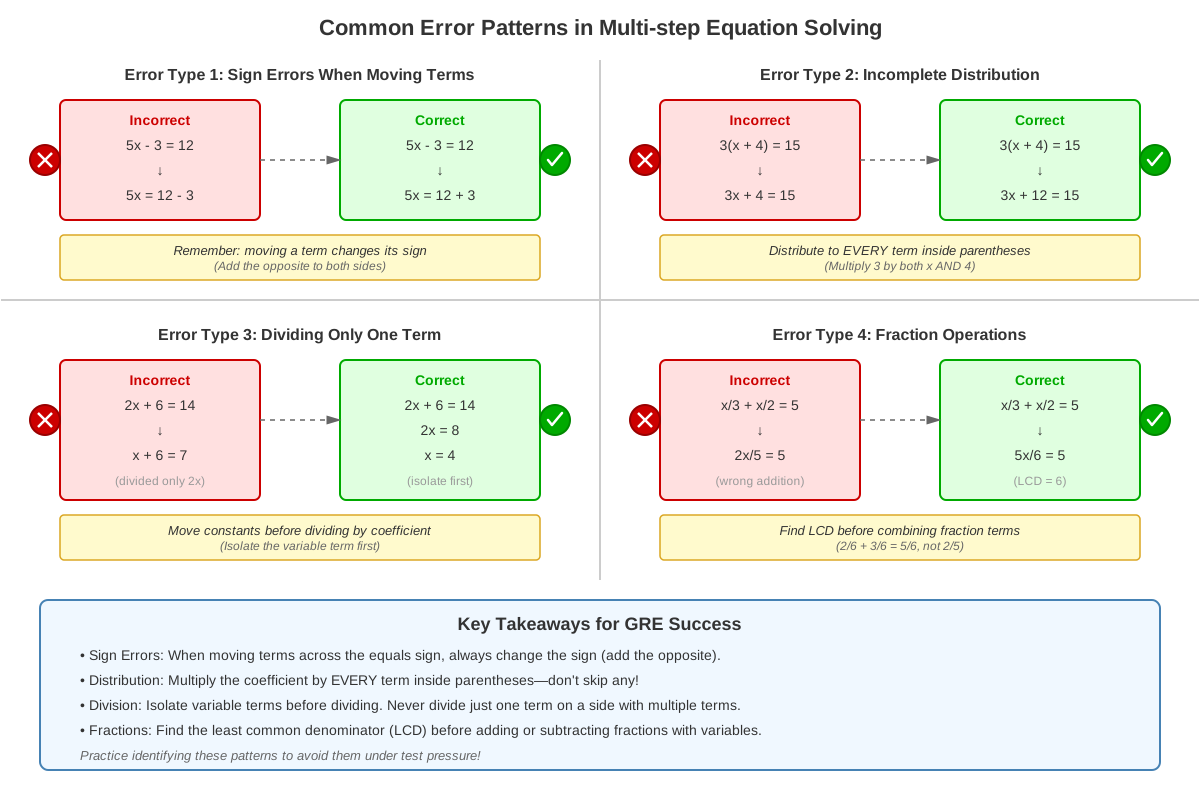
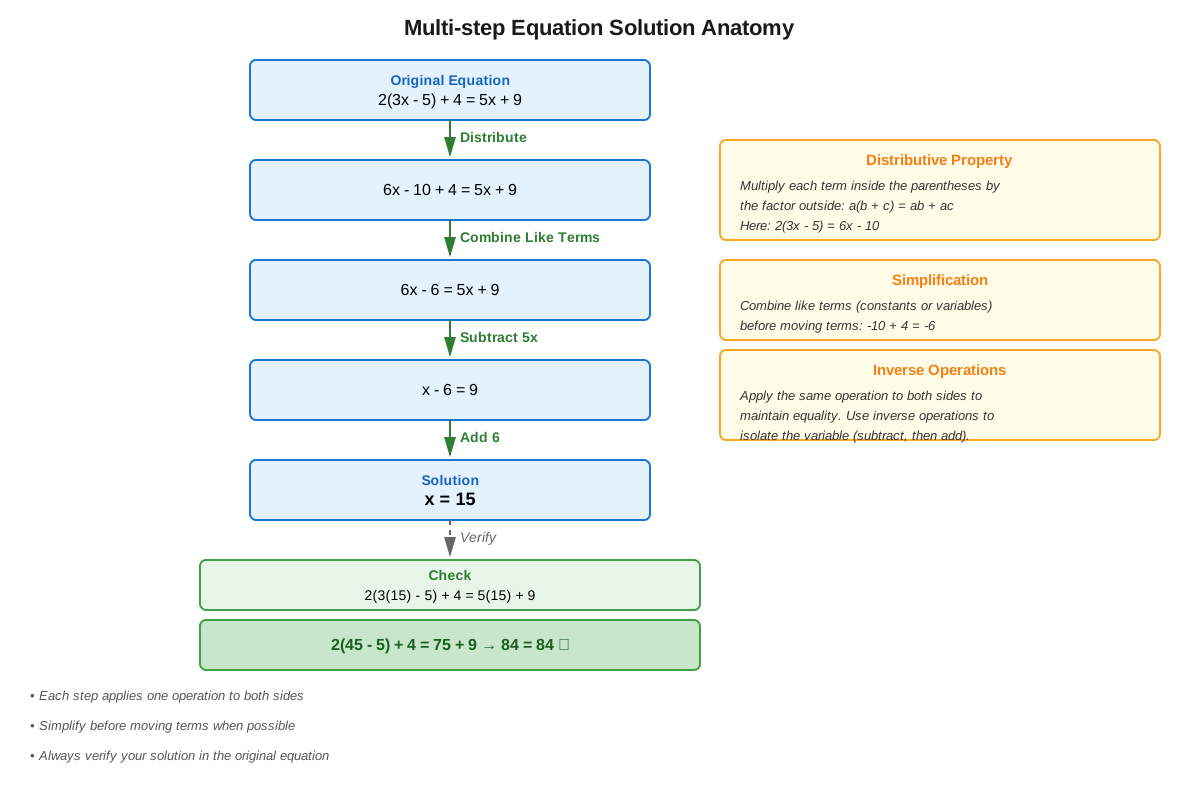
Many GRE multi-step equations require applying the distributive property before other operations. The distributive property states that a(b + c) = ab + ac. Failing to distribute correctly is one of the most common errors on the GRE.
For the equation 3(x - 4) + 2x = 18:
- Distribute: 3x - 12 + 2x = 18
- Combine like terms: 5x - 12 = 18
- Add 12 to both sides: 5x = 30
- Divide by 5: x = 6
When multiple sets of parentheses appear, distribute each separately before combining like terms.
Equations with Fractions
Equations involving fractions can be solved using two approaches:
Method 1: Clear fractions by multiplying by the LCD (Least Common Denominator)
For (x/3) + 2 = (x/4) + 5:
- LCD is 12
- Multiply every term by 12: 4x + 24 = 3x + 60
- Subtract 3x: x + 24 = 60
- Subtract 24: x = 36
Method 2: Work with fractions throughout
This method is sometimes faster for simple equations but requires careful fraction arithmetic.
| Approach | Advantages | Disadvantages |
|---|---|---|
| Clear fractions first | Eliminates fraction arithmetic; reduces errors | Requires finding LCD; creates larger numbers |
| Keep fractions | Works with smaller numbers initially | More opportunities for fraction arithmetic errors |
Combining Multiple Concepts
The most challenging GRE multi-step equations combine several concepts simultaneously. Consider:
2(3x - 5) - 4x = (x/2) + 7
Solution process:
- Distribute: 6x - 10 - 4x = (x/2) + 7
- Combine like terms on left: 2x - 10 = (x/2) + 7
- Multiply everything by 2 to clear fraction: 4x - 20 = x + 14
- Subtract x from both sides: 3x - 20 = 14
- Add 20 to both sides: 3x = 34
- Divide by 3: x = 34/3
Special Cases and Verification
Some equations have no solution (contradictions like 2x + 3 = 2x + 5) or infinite solutions (identities like 2x + 4 = 2(x + 2)). The GRE occasionally tests recognition of these special cases.
Verification is crucial, especially when fractions or distribution are involved. Substitute the solution back into the original equation to confirm:
- If the equation balances, the solution is correct
- If the equation doesn't balance, an error occurred in the solution process
- For equations with restrictions (like denominators that can't be zero), check that the solution doesn't violate these restrictions
Concept Relationships
Multi-step equations build directly on fundamental arithmetic operations and the properties of equality. The distributive property connects to multi-step equations by requiring expansion of parenthetical expressions before variables can be isolated. Combining like terms serves as a prerequisite skill that simplifies equations before the isolation process begins.
Within the topic itself, concepts flow logically: simplification → variable consolidation → constant elimination → coefficient division → verification. Each step depends on the previous step being completed correctly, creating a chain of dependencies where early errors propagate through to incorrect final answers.
Multi-step equations connect forward to more advanced topics. Systems of equations require solving multiple multi-step equations simultaneously. Quadratic equations often require multi-step manipulation before factoring or applying the quadratic formula. Word problems across all GRE math topics require translating verbal descriptions into multi-step equations. Function problems frequently involve solving multi-step equations to find input values that produce specific outputs.
The relationship map: Basic Operations → Properties of Equality → One-Step Equations → Multi-Step Equations → Systems of Equations / Word Problems / Quadratic Equations
High-Yield Facts
⭐ Always perform the same operation on both sides of the equation to maintain equality
⭐ Combine like terms and distribute before attempting to isolate the variable
⭐ When variables appear on both sides, consolidate them on one side first
⭐ To eliminate fractions, multiply every term by the least common denominator
⭐ The solution process follows the reverse order of operations: undo addition/subtraction before multiplication/division
- Verify solutions by substituting back into the original equation, not the simplified version
- Moving a term to the opposite side of the equation changes its sign
- Dividing or multiplying both sides by a negative number reverses inequality signs (important for related problems)
- Equations with the same variable term on both sides after simplification have either no solution or infinite solutions
- Parentheses must be distributed before combining like terms
- When clearing fractions, multiply every term including constants by the LCD
- The coefficient of the variable must equal 1 for the equation to be fully solved
- Common errors occur when distributing negative signs: -(x - 3) = -x + 3, not -x - 3
- Solutions can be integers, fractions, or decimals—don't assume integer answers
- Time spent on careful setup and simplification prevents errors that cost more time to fix
Quick check — test yourself on Multi-step equations so far.
Try Flashcards →Common Misconceptions
Misconception: Only the term with the variable needs to be multiplied when clearing fractions → Correction: Every term in the equation must be multiplied by the LCD, including constants on both sides of the equation. For (x/2) + 3 = 5, multiplying by 2 gives x + 6 = 10, not x + 3 = 10.
Misconception: Subtracting a term from one side means subtracting it from just one term on the other side → Correction: Operations apply to entire sides of equations, not individual terms. When subtracting 2x from both sides of 5x + 3 = 2x + 9, the result is 3x + 3 = 9, not 3x + 3 = 2x + 7.
Misconception: Distribution applies only to the first term in parentheses → Correction: The distributive property requires multiplying the outside term by every term inside the parentheses. For 3(x - 4), the result is 3x - 12, not 3x - 4.
Misconception: Moving a term to the other side of the equation doesn't change its sign → Correction: Moving a term across the equals sign is equivalent to adding or subtracting it from both sides, which changes its sign. Moving +7 from the left side to the right side makes it -7.
Misconception: The equation is solved when the variable appears alone, regardless of its coefficient → Correction: The equation is solved only when the coefficient of the variable equals 1. The equation 3x = 12 requires one more step (dividing by 3) to reach the solution x = 4.
Misconception: Negative signs outside parentheses only affect the first term → Correction: A negative sign before parentheses must be distributed to every term inside. For -(2x - 5), the result is -2x + 5, not -2x - 5.
Misconception: Solutions must always be positive integers → Correction: Solutions can be negative, fractional, or decimal values. The GRE frequently includes non-integer solutions to test whether students complete all steps correctly.
Worked Examples
Example 1: Equation with Variables on Both Sides and Distribution
Problem: Solve for x: 4(x - 3) + 2x = 3x + 6
Solution:
Step 1: Distribute the 4 on the left side
- 4(x - 3) = 4x - 12
- Equation becomes: 4x - 12 + 2x = 3x + 6
Step 2: Combine like terms on the left side
- 4x + 2x = 6x
- Equation becomes: 6x - 12 = 3x + 6
Step 3: Subtract 3x from both sides to consolidate variables
- 6x - 3x - 12 = 3x - 3x + 6
- Equation becomes: 3x - 12 = 6
Step 4: Add 12 to both sides to isolate the variable term
- 3x - 12 + 12 = 6 + 12
- Equation becomes: 3x = 18
Step 5: Divide both sides by 3
- x = 6
Step 6: Verify by substituting x = 6 into the original equation
- Left side: 4(6 - 3) + 2(6) = 4(3) + 12 = 12 + 12 = 24
- Right side: 3(6) + 6 = 18 + 6 = 24
- Both sides equal 24 ✓
Connection to Learning Objectives: This example demonstrates the systematic application of distribution, combining like terms, and variable isolation—core strategies for multi-step equations. It shows how to identify when multiple concepts must be applied in sequence.
Example 2: Equation with Fractions
Problem: Solve for x: (x/4) + 3 = (x/6) + 5
Solution:
Step 1: Identify the LCD of the fractions (4 and 6)
- LCD = 12
Step 2: Multiply every term by 12 to clear fractions
- 12 · (x/4) + 12 · 3 = 12 · (x/6) + 12 · 5
- 3x + 36 = 2x + 60
Step 3: Subtract 2x from both sides
- 3x - 2x + 36 = 2x - 2x + 60
- x + 36 = 60
Step 4: Subtract 36 from both sides
- x = 24
Step 5: Verify by substituting x = 24 into the original equation
- Left side: (24/4) + 3 = 6 + 3 = 9
- Right side: (24/6) + 5 = 4 + 5 = 9
- Both sides equal 9 ✓
Connection to Learning Objectives: This example illustrates the strategy of clearing fractions by multiplying by the LCD, a high-yield technique for GRE multi-step equations. It demonstrates how to apply multi-step equations accurately when fractions are involved, addressing the learning objective of applying these concepts to GRE-style questions.
Example 3: Word Problem Application
Problem: Maria has three times as many books as John. If Maria gives 12 books to John, they will have the same number of books. How many books does Maria currently have?
Solution:
Step 1: Define variables
- Let J = number of books John has
- Then 3J = number of books Maria has
Step 2: Set up equation based on the condition
- After Maria gives 12 books to John:
- Maria has: 3J - 12
- John has: J + 12
- They're equal: 3J - 12 = J + 12
Step 3: Solve the multi-step equation
- Subtract J from both sides: 2J - 12 = 12
- Add 12 to both sides: 2J = 24
- Divide by 2: J = 12
Step 4: Answer the question asked
- Maria has 3J = 3(12) = 36 books
Step 5: Verify the solution
- Maria starts with 36, gives away 12, has 24 remaining
- John starts with 12, receives 12, has 24 total
- They have equal amounts ✓
Connection to Learning Objectives: This example shows how to identify when a word problem requires a multi-step equation, translate the verbal description into mathematical notation, and solve systematically—all critical skills for GRE success.
Exam Strategy
When approaching GRE questions involving multi-step equations, begin by identifying trigger phrases that signal equation-solving is required: "solve for," "find the value of," "what is x when," or "if [condition], then what is [variable]." In quantitative comparison questions, look for algebraic expressions that can be simplified through equation-solving techniques.
Time management is crucial: allocate approximately 1.5-2 minutes for straightforward multi-step equation problems. If a problem requires more than 2 minutes, consider whether there's a more efficient approach or whether strategic guessing might be appropriate. Practice the systematic solution process until it becomes automatic, as this reduces cognitive load and speeds up execution.
Process of elimination strategies specific to multi-step equations:
- Eliminate answer choices that would result from common errors (forgetting to distribute, sign errors, stopping before fully isolating the variable)
- When answer choices are numerical, substitute them back into the original equation—the correct answer will satisfy the equation
- For quantitative comparison questions, consider whether you can determine the relationship without fully solving (e.g., if both quantities contain the same variable term, you might be able to subtract it from both sides)
Work systematically on scratch paper: Write each step on a new line, maintaining clear equals signs vertically aligned. This organization prevents transcription errors and makes it easier to check work if time permits. Circle or box the final answer to distinguish it from intermediate steps.
GRE Tip: When equations involve fractions, quickly assess whether clearing fractions or working with them directly will be faster. For simple fractions with small denominators, clearing is usually more efficient. For complex fractions, sometimes isolating the fractional term first is faster.
Watch for trap answers that represent:
- The value of a different variable than the one asked for
- The result after completing only some of the required steps
- The result of common sign errors or distribution mistakes
- The negative of the correct answer
Strategic guessing: If time is running short, eliminate obviously incorrect answers first. For equations with positive coefficients and positive constants, negative solutions are often (but not always) incorrect. Use logical reasoning about the relative sizes of terms to eliminate unreasonable answers.
Memory Techniques
SADMEP - The reverse order of operations for solving equations:
- Subtraction/Addition (eliminate constants)
- Division/Multiplication (eliminate coefficients)
- Multiply out (distribute)
- Eliminate (combine like terms)
- Parentheses (simplify within parentheses first)
Note: This is PEMDAS in reverse, reflecting that solving equations "undoes" the operations that created them.
"Change the Side, Change the Sign" - When moving terms across the equals sign, remember they switch from positive to negative or vice versa. Visualize the equals sign as a mirror that reflects terms with opposite signs.
"LCD for All" - When clearing fractions, create a mental image of the LCD raining down on every term in the equation, not just the fractions. This prevents the common error of forgetting to multiply constants by the LCD.
The Balance Scale Visualization - Picture the equation as a balance scale with the equals sign as the fulcrum. Whatever you do to one side must be done to the other to keep the scale balanced. This mental image reinforces the properties of equality.
DISC - The four-step process for most multi-step equations:
- Distribute and simplify
- Isolate variable terms on one side
- Separate constants to the other side
- Coefficient becomes 1 (divide or multiply)
"Verify to Certify" - Rhyme to remember that substituting your answer back into the original equation certifies its correctness. Make this a habit for every practice problem.
Summary
Multi-step equations represent a fundamental algebraic skill that appears throughout the GRE Quantitative Reasoning section, both as direct problems and embedded within word problems, quantitative comparisons, and data interpretation questions. Success requires mastering a systematic approach: simplify both sides independently through distribution and combining like terms, consolidate all variable terms on one side of the equation, move constants to the opposite side, eliminate the variable's coefficient through division or multiplication, and verify the solution through substitution. The most common challenges involve correctly distributing negative signs and terms outside parentheses, clearing fractions by multiplying every term by the LCD, and maintaining accuracy when variables appear on both sides of the equation. Students who develop procedural fluency with multi-step equations—practicing until the solution process becomes automatic—gain significant advantages in speed and accuracy across multiple GRE question types. The key to mastery is recognizing that equation-solving follows a logical sequence where each step builds on the previous one, and errors at any stage propagate through to incorrect final answers.
Key Takeaways
- Multi-step equations require performing operations in systematic sequence: simplify, consolidate variables, eliminate constants, isolate the variable, and verify
- Always perform the same operation on both sides of the equation to maintain equality—this is the fundamental principle underlying all equation-solving
- Distribution must be applied to every term inside parentheses, and negative signs outside parentheses affect all terms within
- When fractions appear, multiply every term (including constants) by the LCD to clear denominators efficiently
- Variables on both sides should be consolidated on one side before attempting to isolate them; choose the side that avoids negative coefficients when possible
- Verification through substitution catches errors and confirms solutions, especially important for equations involving fractions or multiple distributions
- Common GRE traps include answer choices representing incomplete solutions, sign errors, and incorrect distribution—systematic work prevents these errors
Related Topics
Systems of Linear Equations: Building on multi-step equation skills, systems require solving two or more equations simultaneously using substitution or elimination methods. Mastery of multi-step equations makes systems more approachable since each equation in the system may itself require multi-step solving.
Quadratic Equations: These equations involve variables raised to the second power and often require multi-step manipulation before factoring or applying the quadratic formula. The simplification and distribution skills from multi-step equations transfer directly.
Word Problems and Applications: Age problems, mixture problems, distance-rate-time problems, and work problems all require translating verbal descriptions into multi-step equations. Strong equation-solving skills allow focus on the translation process rather than the mechanics of solving.
Inequalities: Multi-step inequalities follow the same solution process as equations with one critical difference: multiplying or dividing by negative numbers reverses the inequality sign. The systematic approach learned here applies directly.
Functions and Function Notation: Finding input values that produce specific outputs often requires setting up and solving multi-step equations. Understanding equation-solving mechanics makes function problems more intuitive.
Practice CTA
Now that you've mastered the concepts, strategies, and common pitfalls of multi-step equations, it's time to solidify your understanding through active practice. Work through the practice questions to apply these techniques under test-like conditions, and use the flashcards to reinforce high-yield facts and common error patterns. Remember: procedural fluency comes from deliberate practice. Each problem you solve correctly strengthens the neural pathways that will serve you on test day. Approach practice systematically, verify every solution, and learn from mistakes—this is how good test-takers become great ones. You've built the foundation; now build the speed and confidence that lead to top scores!
Sign up free to keep reading
Create a free AnvayaPrep account to finish this GRE guide on Multi-step equations — plus flashcards and practice questions.