Overview
Systems of equations represent one of the most frequently tested algebraic concepts on the GRE Quantitative Reasoning section. A system of equations consists of two or more equations with two or more variables that must be solved simultaneously to find values that satisfy all equations at once. On the GRE, these problems test not only algebraic manipulation skills but also logical reasoning and the ability to recognize when sufficient information exists to solve for unknown variables.
Understanding gre systems of equations is crucial because these questions appear in multiple formats: traditional problem-solving questions, quantitative comparison questions, and data interpretation scenarios. The GRE typically presents systems involving two equations with two unknowns, though occasionally three-variable systems appear. Mastery of this topic directly impacts performance on approximately 10-15% of Quantitative Reasoning questions, making it a high-yield area for focused study.
Systems of equations connect fundamentally to broader algebraic reasoning skills tested throughout the GRE. They build upon foundational concepts like linear equations, substitution, and algebraic manipulation while serving as prerequisites for more complex topics such as coordinate geometry, functions, and optimization problems. The ability to quickly determine whether a system has one solution, no solution, or infinitely many solutions demonstrates the mathematical maturity that distinguishes high scorers from average test-takers.
Learning Objectives
- [ ] Identify when Systems of equations is being tested
- [ ] Explain the core rule or strategy behind Systems of equations
- [ ] Apply Systems of equations to GRE-style questions accurately
- [ ] Determine whether a system of equations has a unique solution, no solution, or infinitely many solutions
- [ ] Select the most efficient solution method (substitution, elimination, or inspection) based on equation structure
- [ ] Recognize when the GRE provides insufficient information to solve a system completely
Prerequisites
- Linear equations in one variable: Essential for understanding how to isolate variables and perform algebraic manipulations that form the foundation of solving systems
- Basic algebraic manipulation: Required for rearranging equations, combining like terms, and simplifying expressions during the solution process
- Understanding of variables and constants: Necessary to distinguish between unknowns to solve for and fixed values in equations
- Fraction and decimal operations: Frequently needed when coefficients or solutions involve non-integer values
Why This Topic Matters
Systems of equations appear throughout real-world applications, from business optimization problems (finding break-even points where cost equals revenue) to mixture problems (determining concentrations when combining solutions) to rate problems (calculating speeds or work rates). Engineers use systems to model complex relationships, economists employ them to find market equilibrium, and scientists apply them to balance chemical equations. This practical relevance makes systems of equations a fundamental mathematical literacy skill beyond test preparation.
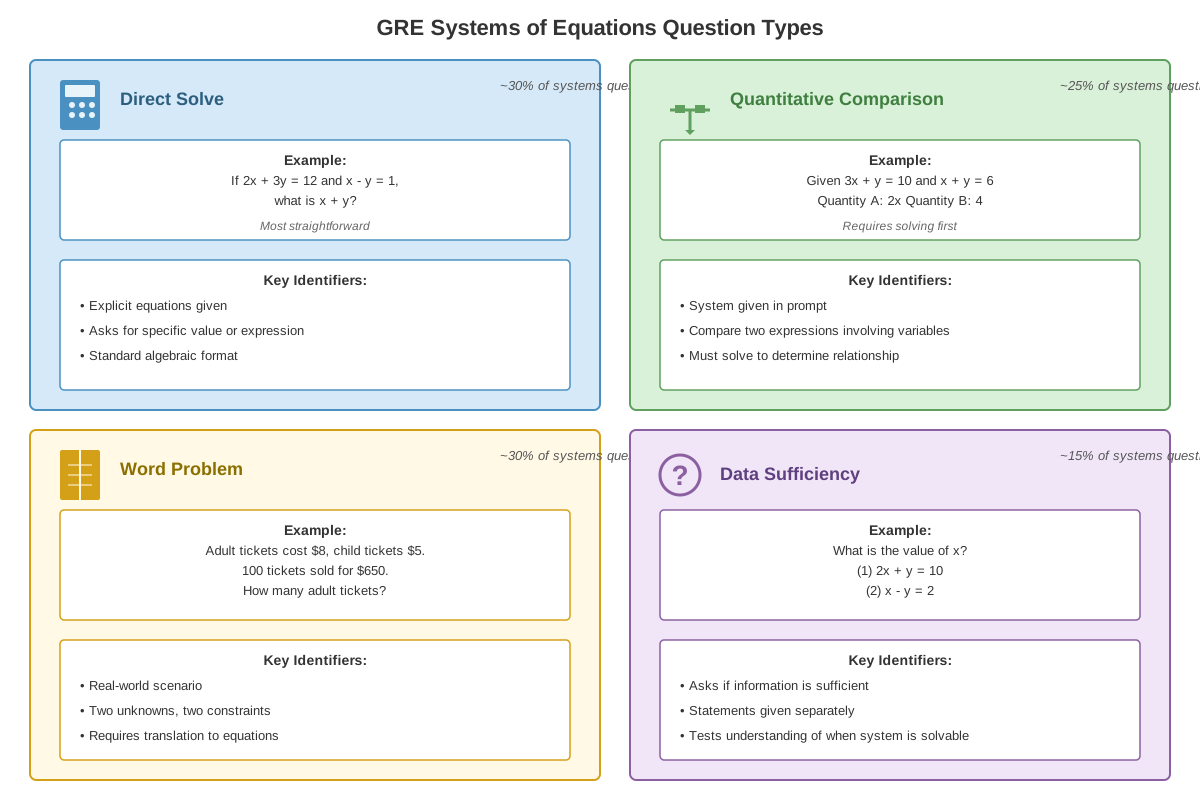
On the GRE specifically, systems of equations questions appear in approximately 2-3 questions per Quantitative Reasoning section, representing roughly 10-15% of algebra questions. These problems manifest in several distinct formats: direct "solve for x and y" questions, quantitative comparisons asking students to compare expressions involving variables from a system, word problems that require translating scenarios into equations, and data sufficiency-style questions testing whether given information is adequate to determine unique values.
The GRE frequently embeds systems of equations within more complex scenarios rather than presenting them in isolation. Common appearances include: coordinate geometry problems where students must find intersection points of lines; word problems involving age, distance, or mixture scenarios; questions about relationships between quantities where multiple constraints exist simultaneously; and quantitative comparison questions where the relationship between quantities depends on solving a system. Recognizing these disguised presentations is as important as mastering solution techniques.
Core Concepts
Definition and Structure
A system of equations consists of two or more equations containing two or more variables, where the goal is to find values for all variables that simultaneously satisfy every equation in the system. The most common form on the GRE involves linear systems—systems where each equation represents a straight line when graphed. For example:
2x + 3y = 12
x - y = 1
This system has two equations and two unknowns (x and y). A solution to this system is an ordered pair (x, y) that makes both equations true simultaneously.
Types of Solutions
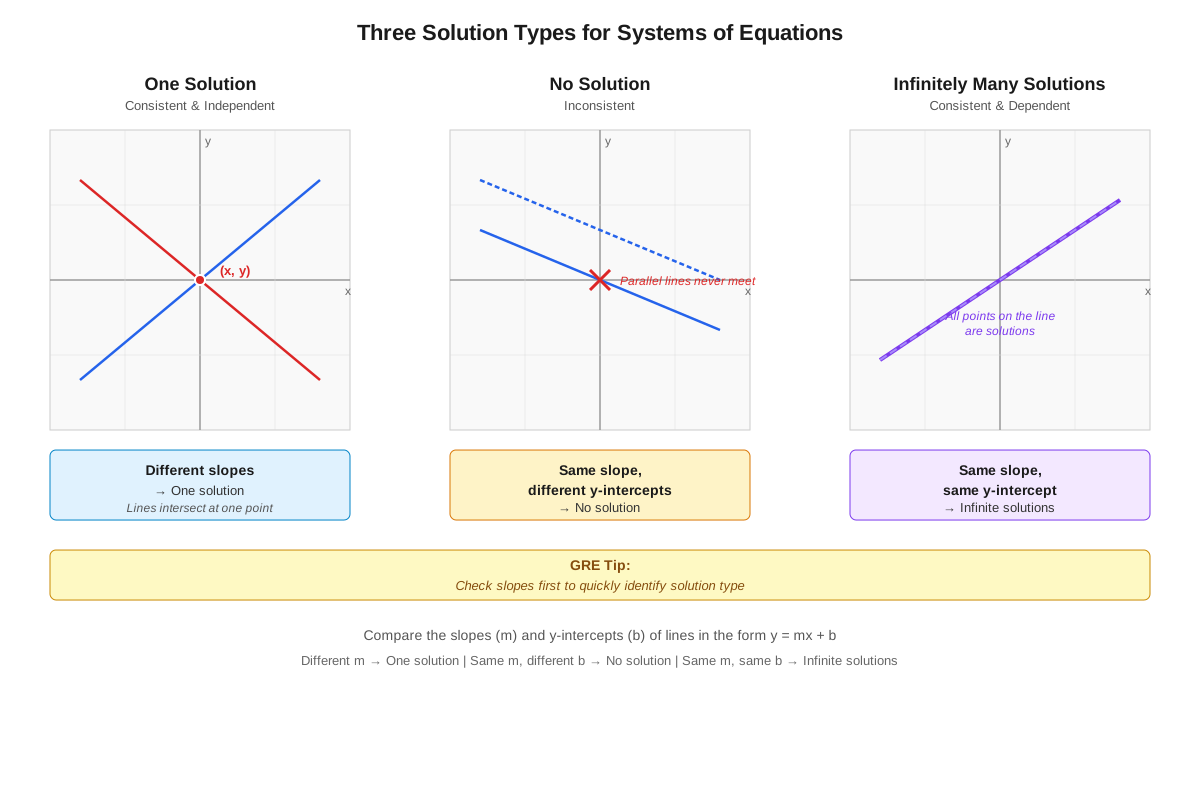
Systems of equations can have three possible outcomes:
| Solution Type | Characteristics | Graphical Interpretation | Example |
|---|---|---|---|
| Unique solution | Exactly one set of values satisfies all equations | Lines intersect at one point | 2x + y = 5 and x - y = 1 |
| No solution | No values satisfy all equations simultaneously | Parallel lines (never intersect) | 2x + y = 5 and 2x + y = 8 |
| Infinitely many solutions | Countless sets of values satisfy the equations | Same line (coincident lines) | 2x + y = 5 and 4x + 2y = 10 |
Understanding which type of solution exists is crucial for GRE quantitative comparison questions, where the answer may be "the relationship cannot be determined" if the system lacks a unique solution.
The Substitution Method
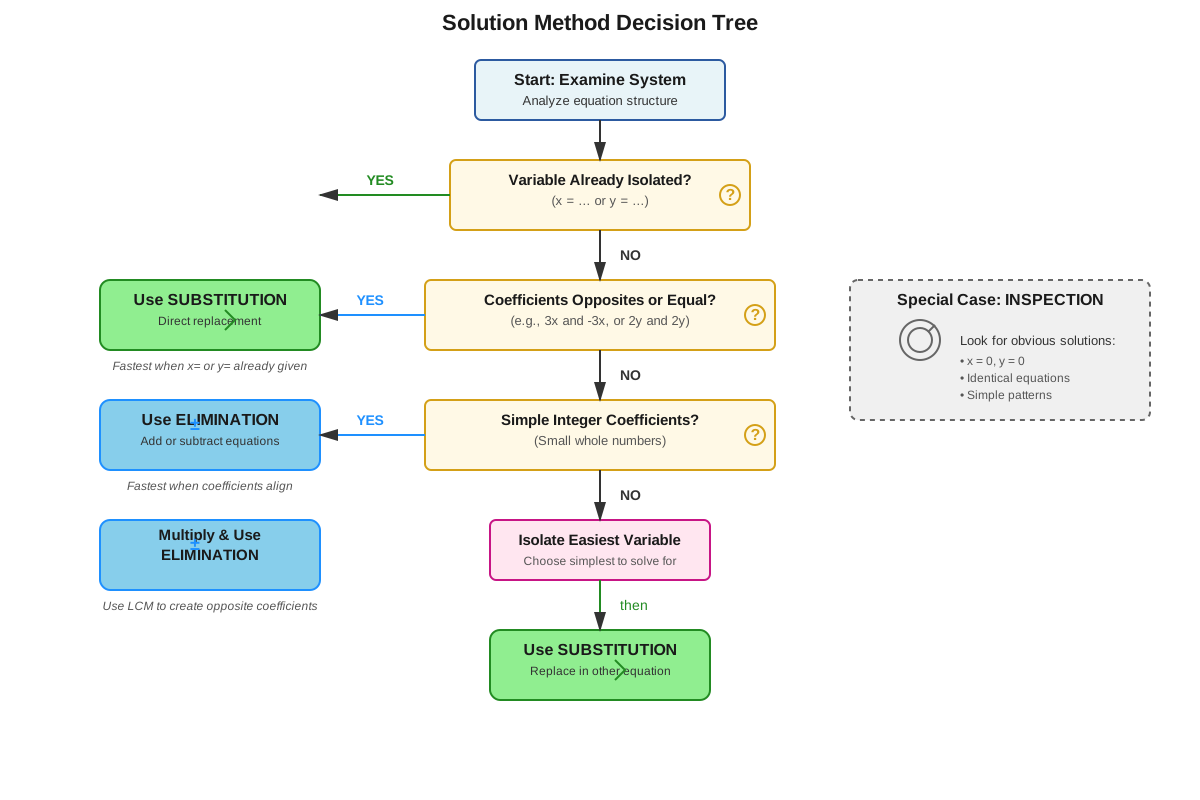
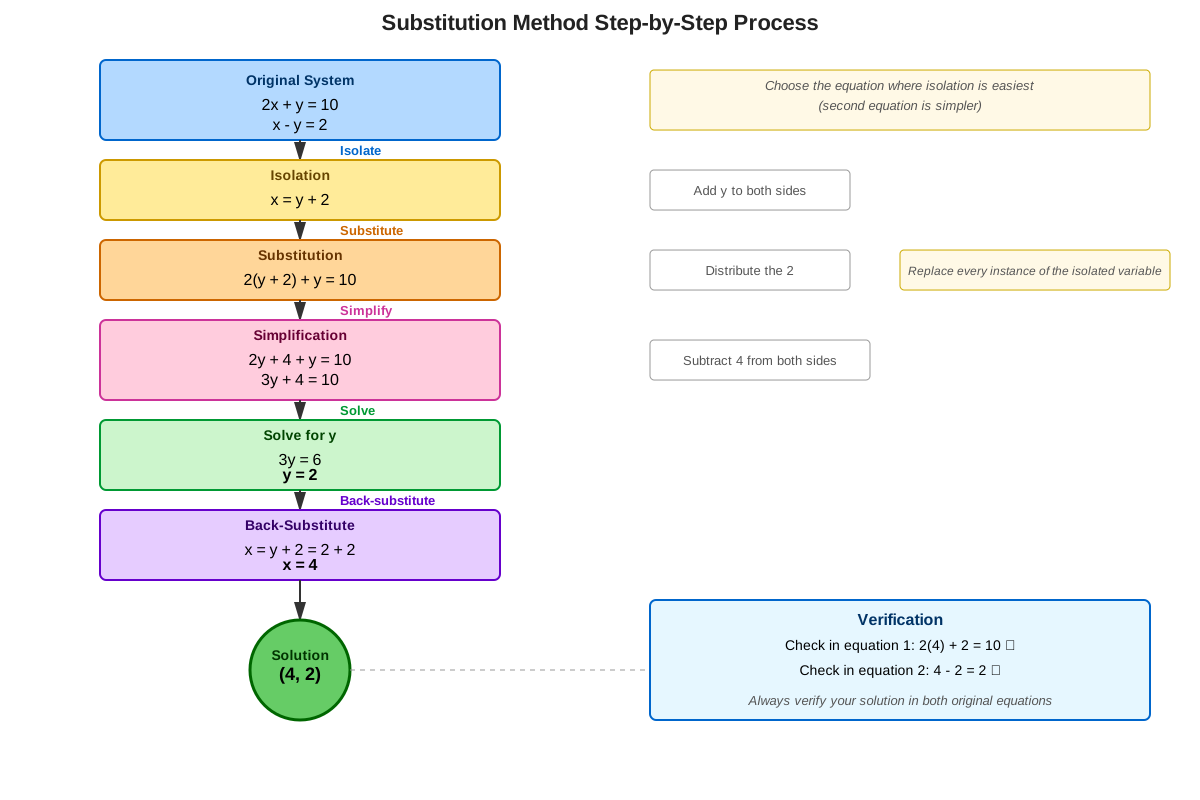
The substitution method involves solving one equation for one variable in terms of the others, then substituting that expression into the remaining equations. This method works particularly well when one equation is already solved for a variable or can be easily manipulated to isolate a variable.
Step-by-step process:
- Choose one equation and solve for one variable in terms of the other(s)
- Substitute this expression into the other equation(s)
- Solve the resulting equation for the remaining variable
- Back-substitute to find the other variable(s)
- Verify the solution in both original equations
For example, with the system:
y = 2x - 3
3x + 2y = 16
Since the first equation already expresses y in terms of x, substitute (2x - 3) for y in the second equation:
3x + 2(2x - 3) = 16
3x + 4x - 6 = 16
7x = 22
x = 22/7
Then substitute back: y = 2(22/7) - 3 = 44/7 - 21/7 = 23/7
The Elimination Method
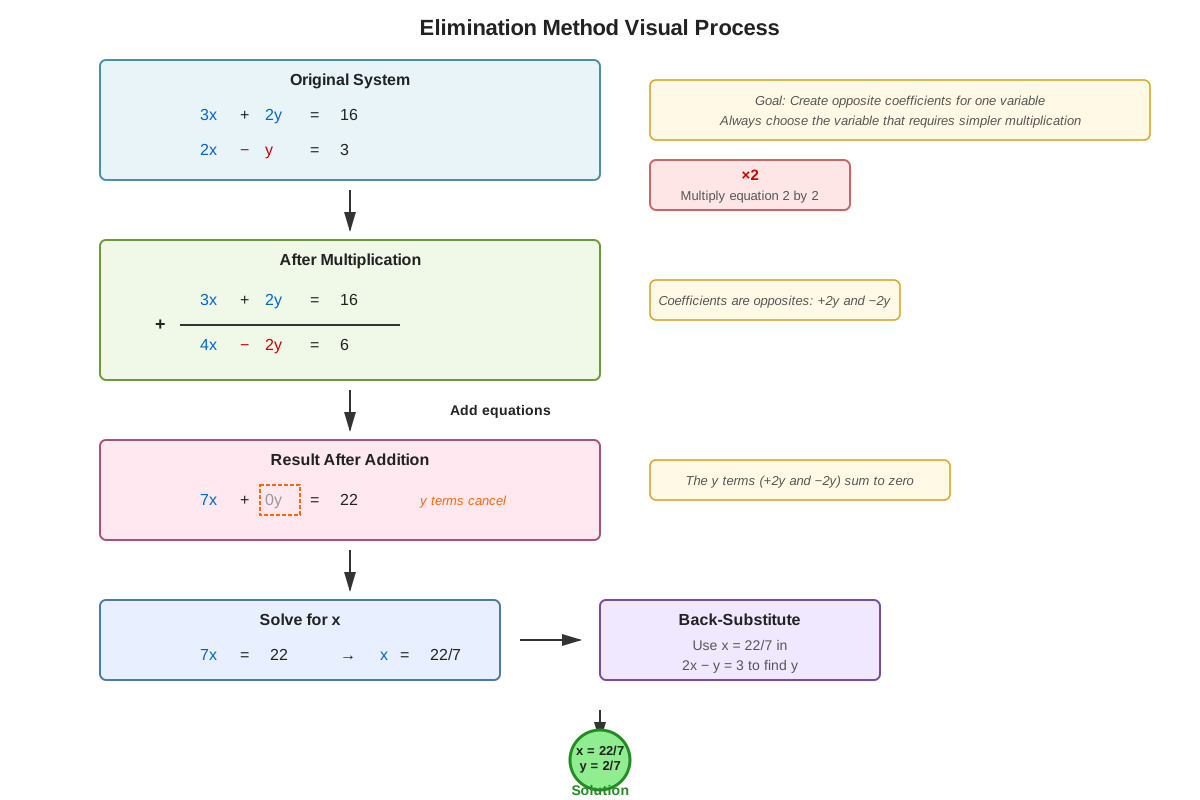
The elimination method (also called the addition method) involves adding or subtracting equations to eliminate one variable, creating a simpler equation with fewer variables. This method is particularly efficient when coefficients of one variable are already opposites or can be made opposites through multiplication.
Step-by-step process:
- Arrange equations in standard form (variables on left, constant on right)
- Multiply one or both equations by constants to make coefficients of one variable opposites
- Add the equations to eliminate that variable
- Solve for the remaining variable
- Substitute back to find the eliminated variable
- Verify the solution
For example:
3x + 2y = 16
2x - 2y = 4
Since the y-coefficients are already opposites (+2 and -2), add the equations directly:
(3x + 2y) + (2x - 2y) = 16 + 4
5x = 20
x = 4
Substitute x = 4 into either original equation: 3(4) + 2y = 16, so 2y = 4, thus y = 2.
Determining Solution Existence
For a system of two linear equations with two variables, the relationship between coefficients determines the solution type. Consider the general form:
a₁x + b₁y = c₁
a₂x + b₂y = c₂- Unique solution: The ratios of coefficients differ: a₁/a₂ ≠ b₁/b₂
- No solution: Coefficient ratios equal but constant ratios differ: a₁/a₂ = b₁/b₂ ≠ c₁/c₂ (parallel lines)
- Infinitely many solutions: All ratios equal: a₁/a₂ = b₁/b₂ = c₁/c₂ (same line)
This analysis is particularly valuable for GRE quantitative comparison questions where determining whether sufficient information exists is more important than calculating exact values.
Special GRE Considerations
The GRE often tests systems of equations in ways that don't require complete solutions. Key scenarios include:
Asking for expressions rather than individual variables: A question might ask for the value of 2x + y rather than x and y separately. Sometimes this can be determined even when individual values cannot.
Providing more information than necessary: The GRE may give three equations with two unknowns to test whether students recognize redundancy or inconsistency.
Testing conceptual understanding: Questions may ask how many solutions exist or whether given information is sufficient, rather than requesting actual solutions.
Non-linear systems: Occasionally, the GRE presents systems involving quadratic equations or other non-linear relationships, requiring different solution strategies.
Concept Relationships
The core concepts within systems of equations form a logical progression: understanding the definition and structure of systems provides the foundation for recognizing when multiple equations must be solved simultaneously. This leads directly to analyzing types of solutions, which determines whether a unique answer exists. The substitution method and elimination method represent alternative solution strategies, with method selection depending on equation structure. Both methods rely on the principle of determining solution existence, which connects back to understanding solution types.
Systems of equations build upon prerequisite knowledge of linear equations by extending single-equation solving to multi-equation scenarios. They connect forward to coordinate geometry (where systems represent line intersections), functions (where systems find points satisfying multiple functional relationships), and inequalities (where systems of inequalities define feasible regions). The logical reasoning required for systems of equations also supports data sufficiency questions throughout the GRE.
Relationship map:
Linear equations → Systems definition → Solution type analysis → Method selection (Substitution OR Elimination) → Solution verification → Application to coordinate geometry and word problems
Quick check — test yourself on Systems of equations so far.
Try Flashcards →High-Yield Facts
⭐ A system of two linear equations with two unknowns has a unique solution if and only if the lines represented by the equations are not parallel (have different slopes).
⭐ When using elimination, multiply equations by constants to create matching coefficients with opposite signs for the variable you want to eliminate.
⭐ If two equations in a system are multiples of each other, the system has either infinitely many solutions (if they're equivalent) or no solution (if the constants don't match the multiple).
⭐ On quantitative comparison questions, if a system doesn't have a unique solution, the answer is typically (D) "the relationship cannot be determined."
⭐ The GRE frequently asks for the value of an expression like x + y or 2x - y, which can sometimes be found by adding or subtracting equations without solving for individual variables.
- Substitution works best when one variable already has a coefficient of 1 or -1 in at least one equation.
- Elimination works best when coefficients are already opposites or can be made opposites with simple multiplication.
- Always verify solutions by substituting back into both original equations to catch arithmetic errors.
- If solving a system yields a contradiction (like 0 = 5), the system has no solution.
- If solving a system yields an identity (like 0 = 0), the system has infinitely many solutions.
- Three equations with two unknowns may be inconsistent (no solution), redundant (effectively only two independent equations), or overdetermined (providing confirmation).
- Word problems requiring systems typically involve two different relationships between the same two quantities.
- The number of independent equations needed equals the number of unknowns for a unique solution.
Common Misconceptions
Misconception: If a system has two equations, it can always be solved for unique values of both variables.
Correction: A system needs two independent equations (not multiples of each other) to have a unique solution. Parallel lines (no solution) and coincident lines (infinitely many solutions) are common scenarios.
Misconception: The substitution and elimination methods will give different answers for the same system.
Correction: Both methods, when applied correctly, yield identical solutions. They are simply different algebraic paths to the same result. If they give different answers, an arithmetic error occurred.
Misconception: When using elimination, you must always eliminate x first.
Correction: You can eliminate whichever variable is more convenient based on the coefficients. Choose the variable that requires simpler multiplication to create opposite coefficients.
Misconception: If you can't solve for individual variables, you can't answer the question.
Correction: The GRE often asks for expressions involving both variables (like x + y) that can be determined by adding or manipulating equations without finding individual values. Always check what the question actually asks for.
Misconception: More equations always means more information and easier solving.
Correction: Additional equations can be redundant (providing no new information) or contradictory (making the system inconsistent). Three equations with two unknowns doesn't guarantee a unique solution.
Misconception: Systems of equations always involve only addition, subtraction, and multiplication.
Correction: While linear systems use these operations, the GRE occasionally presents systems with quadratic equations, requiring factoring or the quadratic formula in addition to substitution or elimination.
Worked Examples
Example 1: Standard Two-Equation System
Problem: Solve the system:
3x + 4y = 18
2x - y = 1Solution:
Step 1: Choose a method. The second equation has y with coefficient -1, making it easy to isolate. Use substitution.
Step 2: Solve the second equation for y:
2x - y = 1
-y = 1 - 2x
y = 2x - 1
Step 3: Substitute into the first equation:
3x + 4(2x - 1) = 18
3x + 8x - 4 = 18
11x = 22
x = 2
Step 4: Back-substitute to find y:
y = 2(2) - 1 = 4 - 1 = 3Step 5: Verify in both original equations:
- First equation: 3(2) + 4(3) = 6 + 12 = 18 ✓
- Second equation: 2(2) - 3 = 4 - 3 = 1 ✓
Answer: x = 2, y = 3
Connection to learning objectives: This example demonstrates applying systems of equations to solve for unique values using the substitution method, addressing the core strategy of choosing the most efficient approach based on equation structure.
Example 2: GRE-Style Expression Question
Problem: If 2x + 3y = 15 and 4x + 5y = 27, what is the value of 2x + y?
Solution:
Step 1: Recognize the question asks for an expression, not individual variables. Look for ways to manipulate the equations to get 2x + y directly.
Step 2: Use elimination to find a useful relationship. Notice that if we subtract the first equation from the second:
(4x + 5y) - (2x + 3y) = 27 - 15
2x + 2y = 12
Step 3: This gives us 2x + 2y = 12, but we need 2x + y. We need another relationship.
Alternative approach using elimination: Multiply the first equation by -2:
-4x - 6y = -30
4x + 5y = 27
Adding these:
-y = -3
y = 3
Step 4: Substitute y = 3 into the first equation:
2x + 3(3) = 15
2x + 9 = 15
2x = 6
Step 5: Calculate the requested expression:
2x + y = 6 + 3 = 9Answer: 9
Connection to learning objectives: This example illustrates identifying when systems of equations are being tested in non-obvious ways and applying efficient strategies specific to GRE question formats that ask for expressions rather than individual variables.
Exam Strategy
Recognition Triggers
Watch for these trigger words and phrases that signal systems of equations:
- "Two equations" or "the following system"
- Word problems with two unknowns and two different relationships (e.g., "the sum is 10 and the difference is 4")
- "Find the value of x and y" or "what is x + y?"
- Quantitative comparison questions presenting two equations with variables in both columns
- "How many solutions" or "is there sufficient information"
- Coordinate geometry problems asking for intersection points
Approach Strategy
For problem-solving questions:
- Identify the system structure (2 equations/2 unknowns, 3 equations/2 unknowns, etc.)
- Determine what's being asked (individual variables, an expression, or solution existence)
- Choose your method: Use substitution if one variable is isolated or has coefficient ±1; use elimination if coefficients are already convenient
- Execute efficiently: Don't solve for variables you don't need
- Verify when time permits: Substitute solutions back into original equations
For quantitative comparison questions:
- Assess whether the system has a unique solution before attempting to solve
- Look for shortcuts: Can you compare expressions by adding/subtracting equations without solving?
- Consider special cases: If the system might not have a unique solution, the answer is likely (D)
- Test simple values if the system has infinitely many solutions to see if the relationship holds for all valid values
Time Management
Exam Tip: Allocate approximately 1.5-2 minutes for straightforward systems of equations problems. If you're not making progress after 30 seconds, verify you've chosen the most efficient method or consider whether the question asks for something simpler than complete solution.
Process of Elimination
- Eliminate answer choices that don't satisfy one of the equations (plug in and check)
- For "how many solutions" questions, eliminate based on coefficient relationships: if slopes differ, eliminate "no solution" and "infinitely many"; if equations are identical, eliminate "no solution" and "unique solution"
- In quantitative comparison, if you determine the system lacks a unique solution, immediately select (D) without further calculation
Common Traps to Avoid
- Don't assume you must solve for both variables if the question only asks for one or an expression
- Don't forget to check whether equations are multiples of each other (indicating no unique solution)
- Don't make sign errors when using elimination—carefully track positive and negative coefficients
- Don't skip verification on problems where you have time—arithmetic errors are common under test pressure
Memory Techniques
SIEVE Method for choosing solution approach:
- Substitution when Isolated or coefficient is Equal to one
- Elimination when coefficients are Very similar or opposite
- Evaluate what's asked before solving everything
"COIN" for solution types:
- Coefficients Opposite ratios → Infinitely many or No solution
- If a₁/a₂ = b₁/b₂ = c₁/c₂ → Infinitely many (same line)
- If a₁/a₂ = b₁/b₂ ≠ c₁/c₂ → No solution (parallel lines)
Visualization strategy: Picture systems of equations as lines on a graph:
- Intersecting lines (different slopes) = unique solution at the intersection point
- Parallel lines (same slope, different y-intercepts) = no solution (never meet)
- Coincident lines (same line) = infinitely many solutions (every point on the line)
Acronym for elimination steps - MACE:
- Multiply equations to match coefficients
- Add or subtract to eliminate a variable
- Calculate the remaining variable
- Evaluate by back-substitution
Summary
Systems of equations represent a critical GRE Quantitative Reasoning topic that tests both algebraic manipulation skills and logical reasoning about relationships between variables. A system consists of multiple equations with multiple unknowns that must be solved simultaneously, with the most common GRE format involving two linear equations with two variables. The three possible solution types—unique solution, no solution, and infinitely many solutions—depend on whether the equations represent intersecting, parallel, or coincident lines. The two primary solution methods are substitution (solving one equation for a variable and substituting into others) and elimination (adding or subtracting equations to eliminate variables). Success on GRE systems questions requires recognizing when systems are being tested, selecting the most efficient solution method, understanding when sufficient information exists for a unique solution, and often finding values of expressions rather than individual variables. Mastery involves both computational accuracy and strategic thinking about what information is actually needed to answer each question.
Key Takeaways
- Systems of equations appear in 10-15% of GRE Quantitative Reasoning questions, making them high-yield for focused study
- A system of two linear equations has a unique solution only when the lines have different slopes (coefficient ratios differ)
- Choose substitution when a variable is isolated or has coefficient ±1; choose elimination when coefficients are convenient for matching
- The GRE frequently asks for expressions (like x + y) rather than individual variables—look for shortcuts that avoid complete solution
- On quantitative comparison questions, if a system lacks a unique solution, the answer is typically (D) "cannot be determined"
- Always verify what the question asks before solving—you may not need to find all variables
- Parallel lines mean no solution; coincident lines mean infinitely many solutions; intersecting lines mean one unique solution
Related Topics
Linear Equations in Two Variables: Understanding how to graph and interpret individual linear equations provides the geometric foundation for visualizing systems as intersecting lines. Mastering systems of equations builds directly on single-equation solving skills.
Coordinate Geometry: Systems of equations are essential for finding intersection points of lines and curves in the coordinate plane. Many coordinate geometry problems reduce to solving systems.
Inequalities and Systems of Inequalities: The logical reasoning developed through systems of equations extends naturally to systems of inequalities, which define regions rather than points.
Functions: Understanding systems prepares students for analyzing where different functions have equal values, a common question type involving setting two function expressions equal.
Word Problems and Applications: Many GRE word problems involving rates, mixtures, ages, or money translate into systems of equations, making this topic essential for applied problem-solving.
Practice CTA
Now that you've mastered the core concepts, solution methods, and strategic approaches for systems of equations, it's time to solidify your understanding through active practice. Attempt the practice questions to apply these techniques to GRE-style problems, and use the flashcards to reinforce high-yield facts and common patterns. Remember: systems of equations questions reward both computational accuracy and strategic thinking—practice identifying the most efficient approach before diving into calculations. Each practice problem you complete builds the pattern recognition and confidence needed to excel on test day. You've got this!
Sign up free to keep reading
Create a free AnvayaPrep account to finish this GRE guide on Systems of equations — plus flashcards and practice questions.