Overview
Simplifying expressions is a foundational algebraic skill that appears throughout the GRE Quantitative Reasoning section, both as a standalone concept and as a critical step in solving more complex problems. This topic involves reducing algebraic expressions to their most compact and manageable form by combining like terms, applying the distributive property, factoring, and using exponent rules. Mastery of expression simplification enables test-takers to work efficiently through multi-step problems, recognize equivalent forms of expressions, and avoid computational errors that can derail otherwise sound problem-solving approaches.
On the GRE, gre simplifying expressions questions test not only mechanical proficiency but also conceptual understanding of algebraic structure. Students must recognize when two expressions are equivalent despite appearing different, identify the most efficient path to simplification, and apply these skills under time pressure. The ability to simplify expressions quickly and accurately creates a competitive advantage, as it reduces cognitive load and frees mental resources for higher-order reasoning required in quantitative comparison and data interpretation questions.
This topic serves as a bridge between basic arithmetic operations and advanced algebraic problem-solving. It connects directly to solving equations, working with functions, manipulating inequalities, and analyzing polynomial expressions. Without solid simplification skills, students struggle with factoring quadratics, rationalizing denominators, and simplifying rational expressions—all of which appear regularly on the GRE. Furthermore, simplification techniques underpin coordinate geometry problems, exponential growth questions, and even some word problems where setting up and reducing algebraic models determines success.
Learning Objectives
- [ ] Identify when Simplifying expressions is being tested
- [ ] Explain the core rule or strategy behind Simplifying expressions
- [ ] Apply Simplifying expressions to GRE-style questions accurately
- [ ] Recognize equivalent expressions in different forms without full simplification
- [ ] Determine the most efficient simplification strategy for a given expression type
- [ ] Evaluate simplified expressions for specific variable values to verify correctness
Prerequisites
- Basic arithmetic operations: Addition, subtraction, multiplication, and division form the computational foundation for combining terms and applying operations to algebraic expressions
- Order of operations (PEMDAS): Understanding the correct sequence of operations ensures accurate simplification and prevents common errors when working with nested operations
- Properties of exponents: Rules for multiplying, dividing, and raising powers to powers are essential for simplifying expressions containing exponential terms
- Distributive property: The ability to expand products and factor common terms is central to most simplification tasks
- Concept of variables: Understanding that variables represent unknown quantities and can be manipulated according to algebraic rules enables meaningful work with expressions
Why This Topic Matters
Simplifying expressions represents one of the most frequently tested algebraic skills on the GRE, appearing in approximately 15-20% of Quantitative Reasoning questions either directly or as an intermediate step. This skill transcends specific question types, manifesting in quantitative comparison questions where recognizing equivalent forms determines the correct answer, in problem-solving questions where simplification reveals solution paths, and in data interpretation questions where algebraic models must be manipulated.
In real-world applications, expression simplification underlies financial modeling (simplifying compound interest formulas), engineering calculations (reducing complex physical relationships), computer science (optimizing algorithms), and data science (streamlining statistical formulas). The logical thinking developed through systematic simplification transfers to any field requiring analytical problem-solving and pattern recognition.
On the GRE specifically, simplification questions appear in several distinct formats: direct simplification problems asking for the reduced form of an expression, quantitative comparison questions presenting two expressions that must be simplified to determine their relationship, word problems requiring translation into algebraic expressions followed by simplification, and questions involving substitution where simplification before substitution saves significant time. The test-makers deliberately design problems where the unsimplified form obscures the answer while the simplified form makes it obvious, rewarding students who have mastered these techniques.
Core Concepts
Combining Like Terms
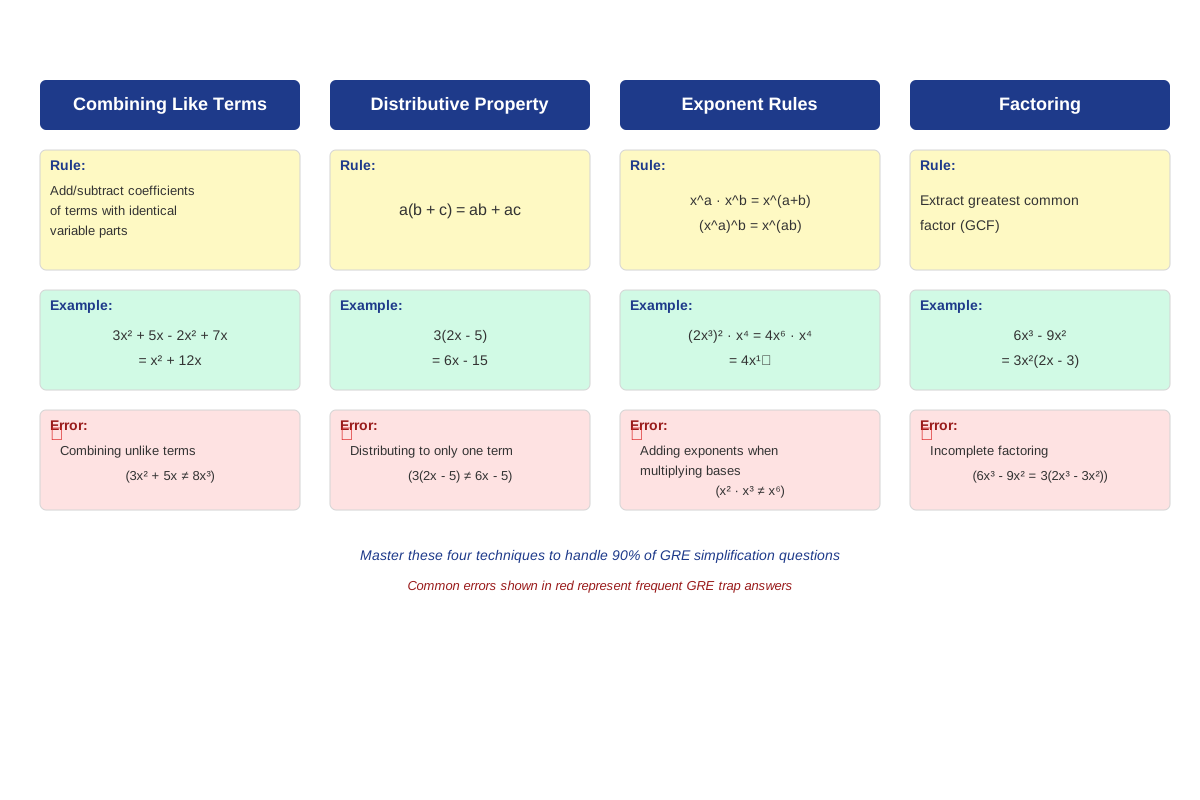
Like terms are terms that contain identical variable parts raised to the same powers. The fundamental principle of combining like terms states that only the coefficients of like terms can be added or subtracted, while the variable part remains unchanged. For example, 3x² and 5x² are like terms (both contain x²), but 3x² and 5x³ are not like terms because the exponents differ.
The process involves:
- Identifying all like terms in the expression
- Adding or subtracting their coefficients
- Attaching the result to the common variable part
Example: 4x + 7y - 2x + 3y = (4x - 2x) + (7y + 3y) = 2x + 10y
Constants (terms without variables) are like terms with each other and should be combined separately from variable terms.
The Distributive Property
The distributive property states that a(b + c) = ab + ac, allowing multiplication to be distributed across addition or subtraction within parentheses. This property works in both directions: expanding (distributing) and factoring (reverse distributing).
Expanding involves multiplying a term outside parentheses by each term inside:
- 3(2x + 5) = 6x + 15
- -2(4a - 3b + 7) = -8a + 6b - 14
Factoring involves identifying a common factor and extracting it:
- 6x + 15 = 3(2x + 5)
- 12a²b - 8ab² = 4ab(3a - 2b)
When multiple sets of parentheses are multiplied, apply the distributive property systematically:
- (x + 3)(x + 5) = x(x + 5) + 3(x + 5) = x² + 5x + 3x + 15 = x² + 8x + 15
Exponent Rules for Simplification
When simplifying expressions with exponents, several key rules apply:
| Rule | Formula | Example |
|---|---|---|
| Product of Powers | x^a · x^b = x^(a+b) | x³ · x⁵ = x⁸ |
| Quotient of Powers | x^a ÷ x^b = x^(a-b) | x⁷ ÷ x² = x⁵ |
| Power of a Power | (x^a)^b = x^(ab) | (x³)⁴ = x¹² |
| Power of a Product | (xy)^a = x^a · y^a | (2x)³ = 8x³ |
| Power of a Quotient | (x/y)^a = x^a / y^a | (x/3)² = x²/9 |
| Negative Exponent | x^(-a) = 1/x^a | x^(-3) = 1/x³ |
| Zero Exponent | x⁰ = 1 (x ≠ 0) | 5⁰ = 1 |
These rules enable simplification of complex exponential expressions: (2x³y²)² ÷ (4xy⁴) = 4x⁶y⁴ ÷ 4xy⁴ = x⁵
Simplifying Rational Expressions
Rational expressions are fractions containing polynomials in the numerator, denominator, or both. Simplification requires factoring both parts and canceling common factors:
- Factor the numerator completely
- Factor the denominator completely
- Cancel factors that appear in both (noting restrictions where denominators equal zero)
Example: (x² - 9)/(x² + 5x + 6) = (x + 3)(x - 3)/(x + 2)(x + 3) = (x - 3)/(x + 2), where x ≠ -3, -2
When adding or subtracting rational expressions, find a common denominator first, then combine numerators and simplify.
Removing Parentheses and Grouping Symbols
Nested parentheses, brackets, and braces require systematic removal from innermost to outermost:
- Work from the inside out
- Apply the distributive property at each level
- Pay careful attention to negative signs, which distribute to all terms
Example: 2[3x - (4 - x)] = 2[3x - 4 + x] = 2[4x - 4] = 8x - 8
A negative sign or subtraction before parentheses changes the sign of every term inside when the parentheses are removed:
- -(3x - 5) = -3x + 5
- 7 - (2x + 3) = 7 - 2x - 3 = 4 - 2x
Simplifying Radical Expressions
Radical expressions simplify by factoring out perfect squares (or perfect cubes for cube roots):
- √(50) = √(25 · 2) = 5√2
- √(x⁶) = x³ (assuming x ≥ 0)
Combining radicals requires identical radicands (the expression under the radical):
- 3√5 + 7√5 = 10√5
- 2√3 + 4√2 cannot be combined
Rationalizing denominators eliminates radicals from denominators by multiplying by a strategic form of 1:
- 1/√3 = 1/√3 · √3/√3 = √3/3
Concept Relationships
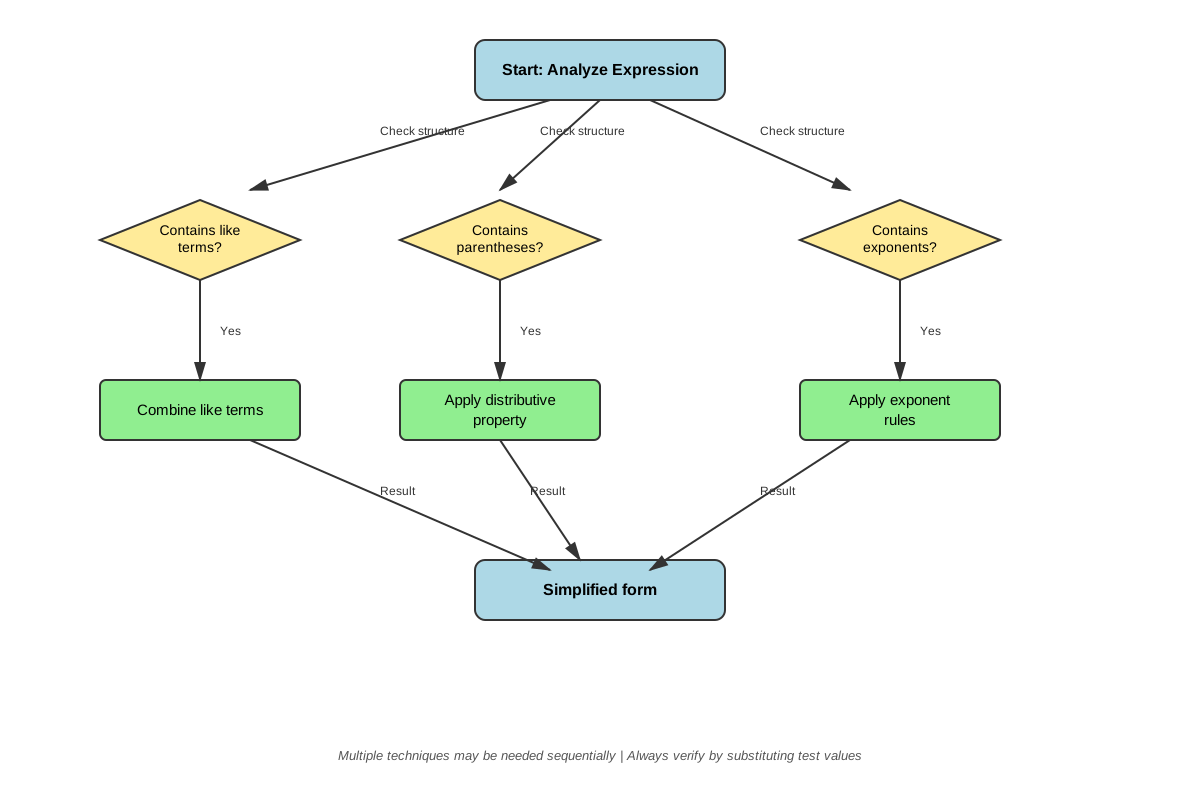
The core concepts of simplifying expressions form an interconnected hierarchy. Combining like terms serves as the foundation, requiring recognition of term structure and application of basic arithmetic. This skill directly supports distributive property applications, as expanding expressions creates terms that must then be combined. The distributive property, in turn, enables both expansion and factoring, which are inverse operations that transform expressions between different forms.
Exponent rules operate independently but frequently combine with like terms and the distributive property in complex expressions. For instance, expanding (2x³)² requires exponent rules, then the result may need to be combined with other terms. Rational expression simplification synthesizes all previous concepts: it requires factoring (distributive property in reverse), canceling (division), and often combining like terms in numerators or denominators.
Radical simplification connects to exponent rules through the relationship between radicals and fractional exponents (√x = x^(1/2)), and also requires factoring skills to identify perfect squares. All these concepts flow toward the ultimate goal: transforming any expression into its simplest equivalent form.
The relationship map: Basic Operations → Combining Like Terms → Distributive Property ⇄ Factoring → Rational Expressions; parallel to this: Exponent Rules → Radical Simplification → Integration with all other concepts.
High-Yield Facts
⭐ Like terms must have identical variable parts with identical exponents; only coefficients are combined
⭐ The distributive property works in both directions: expanding a(b + c) = ab + ac and factoring ab + ac = a(b + c)
⭐ When multiplying powers with the same base, add exponents: x^a · x^b = x^(a+b)
⭐ A negative sign before parentheses changes the sign of every term inside when distributing
⭐ To simplify rational expressions, factor completely then cancel only common factors, never common terms
- When dividing powers with the same base, subtract exponents: x^a ÷ x^b = x^(a-b)
- Any nonzero number raised to the zero power equals 1: x⁰ = 1
- Negative exponents indicate reciprocals: x^(-n) = 1/x^n
- Perfect square factors can be extracted from under square root symbols: √(a²b) = a√b
- The order of operations (PEMDAS) must be followed when simplifying: parentheses, exponents, multiplication/division, addition/subtraction
- Coefficients of 1 are typically not written but must be considered when combining terms: x = 1x
- Constants are like terms with each other regardless of their values
- When simplifying (x^a)^b, multiply exponents: (x^a)^b = x^(ab)
- Radicals with different radicands cannot be combined even if they have the same index
- Factoring is often the key first step in simplifying complex expressions, revealing cancellation opportunities
Quick check — test yourself on Simplifying expressions so far.
Try Flashcards →Common Misconceptions
Misconception: Terms with different exponents can be combined (e.g., 3x² + 5x³ = 8x⁵)
Correction: Only like terms with identical variable parts and exponents can be combined. 3x² + 5x³ cannot be simplified further because x² and x³ are different terms.
Misconception: When distributing a negative sign, only the first term inside parentheses becomes negative
Correction: A negative sign or subtraction before parentheses affects every term inside. -(3x - 5) = -3x + 5, not -3x - 5.
Misconception: When multiplying powers, multiply the exponents (e.g., x² · x³ = x⁶)
Correction: When multiplying powers with the same base, add the exponents: x² · x³ = x^(2+3) = x⁵. Multiplying exponents occurs when raising a power to a power: (x²)³ = x⁶.
Misconception: Common terms in a fraction can be canceled (e.g., (x + 3)/(x + 5) = 3/5)
Correction: Only common factors can be canceled, not common terms. The expression (x + 3)/(x + 5) cannot be simplified by canceling x because x is a term, not a factor. Factoring must reveal common factors: (x² - 9)/(x + 3) = (x + 3)(x - 3)/(x + 3) = x - 3.
Misconception: √(a + b) = √a + √b
Correction: The square root of a sum does not equal the sum of square roots. √(9 + 16) = √25 = 5, but √9 + √16 = 3 + 4 = 7. Radicals cannot be distributed over addition or subtraction.
Misconception: (a + b)² = a² + b²
Correction: When squaring a binomial, the middle term must be included: (a + b)² = a² + 2ab + b². This is a specific application of the distributive property: (a + b)(a + b) = a² + ab + ab + b² = a² + 2ab + b².
Misconception: Simplification always makes expressions shorter
Correction: Sometimes simplification involves expanding expressions to reveal structure or enable further operations. For example, simplifying (x - 3)² might require expanding to x² - 6x + 9 depending on the problem context.
Worked Examples
Example 1: Multi-Step Simplification with Multiple Concepts
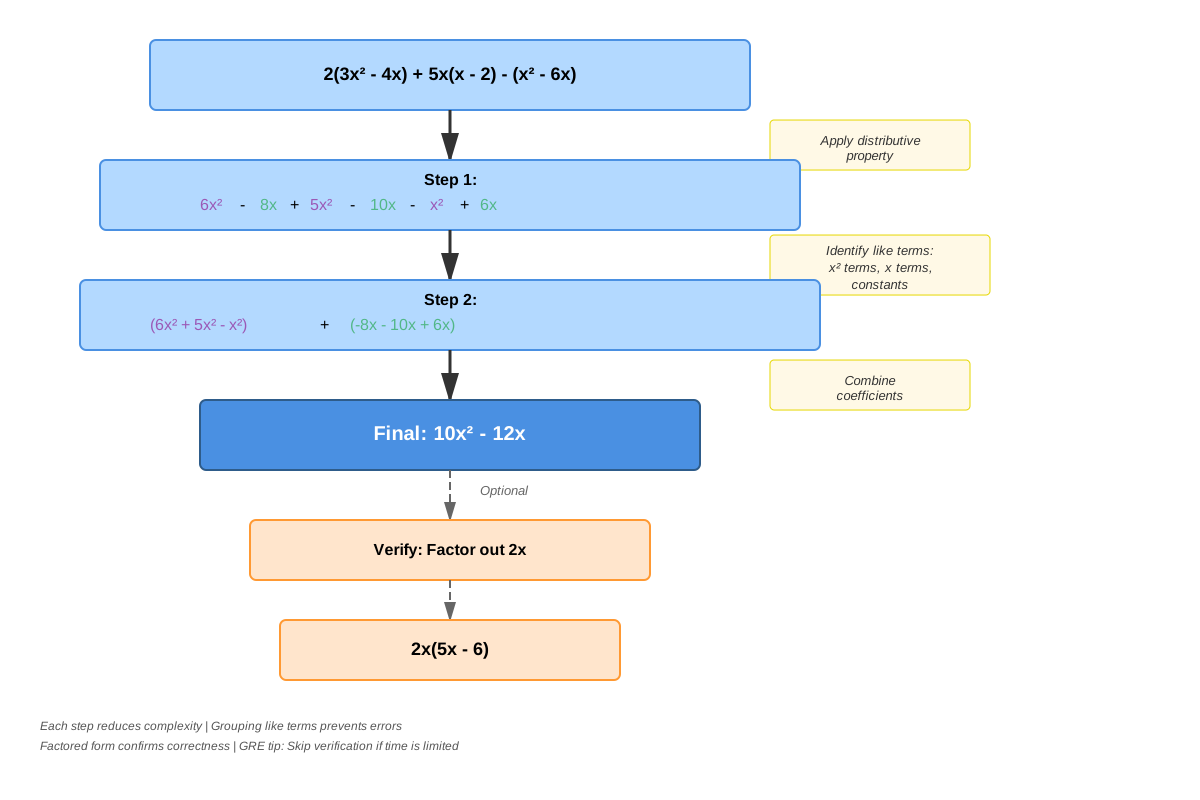
Problem: Simplify the expression 3(2x - 4) - 2(x² - 3x + 5) + x²
Solution:
Step 1: Apply the distributive property to each set of parentheses
- 3(2x - 4) = 6x - 12
- -2(x² - 3x + 5) = -2x² + 6x - 10
Step 2: Rewrite the expression with distributed terms
- 6x - 12 - 2x² + 6x - 10 + x²
Step 3: Rearrange terms by degree (highest power first) and type
- -2x² + x² + 6x + 6x - 12 - 10
Step 4: Combine like terms
- x² terms: -2x² + x² = -x²
- x terms: 6x + 6x = 12x
- Constants: -12 - 10 = -22
Final Answer: -x² + 12x - 22
This problem demonstrates the integration of the distributive property (Learning Objective 2) with combining like terms, requiring careful attention to negative signs and systematic organization of terms.
Example 2: Simplifying a Rational Expression
Problem: Simplify (x² - 5x + 6)/(x² - 4)
Solution:
Step 1: Factor the numerator
- x² - 5x + 6 requires two numbers that multiply to 6 and add to -5
- These numbers are -2 and -3
- x² - 5x + 6 = (x - 2)(x - 3)
Step 2: Factor the denominator
- x² - 4 is a difference of squares: a² - b² = (a + b)(a - b)
- x² - 4 = (x + 2)(x - 2)
Step 3: Rewrite with factored forms
- (x - 2)(x - 3)/(x + 2)(x - 2)
Step 4: Cancel common factors
- The factor (x - 2) appears in both numerator and denominator
- (x - 2)(x - 3)/(x + 2)(x - 2) = (x - 3)/(x + 2)
Step 5: State restrictions
- x ≠ 2 (makes original denominator zero)
- x ≠ -2 (makes simplified denominator zero)
Final Answer: (x - 3)/(x + 2), where x ≠ ±2
This example illustrates the importance of factoring in simplification (Learning Objective 2) and demonstrates how recognizing expression structure enables efficient simplification (Learning Objective 4).
Example 3: Simplifying with Exponents
Problem: Simplify (3x²y³)² · (2x³y)/(6x⁴y⁵)
Solution:
Step 1: Apply the power of a product rule to (3x²y³)²
- (3x²y³)² = 3² · (x²)² · (y³)² = 9x⁴y⁶
Step 2: Multiply the numerator terms
- 9x⁴y⁶ · 2x³y = 18x⁷y⁷ (add exponents when multiplying like bases)
Step 3: Write as a single fraction
- 18x⁷y⁷/(6x⁴y⁵)
Step 4: Simplify the coefficient
- 18/6 = 3
Step 5: Apply the quotient rule to variables
- x⁷/x⁴ = x^(7-4) = x³
- y⁷/y⁵ = y^(7-5) = y²
Final Answer: 3x³y²
This problem requires systematic application of multiple exponent rules (Learning Objective 3) and demonstrates how proper sequencing of operations leads to correct simplification.
Exam Strategy
When approaching GRE questions involving simplifying expressions, begin by identifying the trigger words that signal simplification is required: "simplify," "reduce," "equivalent to," "which of the following equals," or "express in terms of." In quantitative comparison questions, expressions in Quantity A and Quantity B often require simplification before their relationship becomes apparent.
Strategic approach sequence:
- Scan the expression for the dominant feature (parentheses, exponents, fractions, radicals)
- Determine whether expanding or factoring will be more efficient
- Apply operations systematically, working from innermost groupings outward
- Combine like terms continuously throughout the process rather than waiting until the end
- Check answer choices to determine how simplified the final form needs to be
Time-saving techniques: If answer choices are in factored form, factor rather than expand. If they're expanded, expand rather than factor. When expressions appear complex, look for common factors immediately—factoring often reveals dramatic simplifications. In quantitative comparison questions, sometimes simplifying the difference (Quantity A - Quantity B) is faster than simplifying each quantity separately.
Process of elimination: Eliminate answer choices that have different degrees (highest power) than the original expression after proper simplification. Check the coefficient of the highest-degree term first—it's often the easiest to verify. If the original expression has no constant term, eliminate choices with constants (unless operations could introduce them).
Time allocation: Straightforward simplification should take 30-45 seconds. If approaching one minute without progress, verify you're using the most efficient strategy. Complex rational expressions may justify 60-90 seconds. Practice recognizing when an expression is already in simplest form to avoid wasting time on unnecessary manipulation.
Memory Techniques
PEMDAS (Please Excuse My Dear Aunt Sally): Parentheses, Exponents, Multiplication/Division, Addition/Subtraction—the order of operations that governs all simplification.
FOIL for binomial multiplication: First, Outer, Inner, Last terms—(a + b)(c + d) = ac + ad + bc + bd. While FOIL is specific to binomials, it reinforces the systematic application of the distributive property.
"Same Base, Add Exponents" for multiplication: When multiplying powers, the bases must match, then add exponents. Visualize x³ · x² as (x·x·x) · (x·x) = x⁵.
"Negative Sign = Opposite Day": When a negative sign precedes parentheses, everything inside becomes its opposite. Visualize flipping all signs as you remove the parentheses.
"Factor Before You Cancel": For rational expressions, remember this sequence: Factor → Cancel → Celebrate. Never cancel terms, only factors.
The "Perfect Square Extraction" visualization: For radicals, imagine √50 as a box containing 25 (a perfect square) and 2 (what's left). The perfect square escapes the radical: 5√2.
"MADSPM" for exponent rules: Multiply-Add, Divide-Subtract, Power-Multiply. When multiplying powers, add exponents; when dividing, subtract; when raising to a power, multiply.
Summary
Simplifying expressions is a fundamental algebraic skill that requires systematic application of multiple interconnected rules: combining like terms, distributing multiplication over addition/subtraction, applying exponent rules, factoring, and simplifying rational and radical expressions. Success depends on recognizing expression structure, choosing efficient strategies, and executing operations with careful attention to signs and order of operations. The GRE tests this skill both directly and as an essential component of more complex problems, making mastery critical for achieving high Quantitative Reasoning scores. Students must develop fluency in recognizing when expressions are equivalent despite different appearances, as this insight often provides the key to solving quantitative comparison questions efficiently. The ability to simplify expressions accurately and quickly creates a foundation for success across all algebraic topics on the exam, from solving equations to analyzing functions and working with coordinate geometry.
Key Takeaways
- Like terms must have identical variable parts with identical exponents; only their coefficients combine through addition or subtraction
- The distributive property enables both expansion and factoring, working bidirectionally to transform expressions between equivalent forms
- Exponent rules (add when multiplying, subtract when dividing, multiply when raising to powers) must be applied systematically and only to terms with matching bases
- Negative signs before parentheses distribute to every term inside, changing all signs when parentheses are removed
- Rational expressions simplify through factoring followed by canceling common factors (never common terms)
- Strategic choice between expanding and factoring depends on the problem context and answer choice format
- Simplification is complete when no like terms remain uncombined, no common factors exist in rational expressions, and no perfect squares remain under radicals
Related Topics
Solving Linear Equations: Mastering simplification enables efficient equation solving, as most equations require simplification before isolation of variables. The techniques learned here apply directly to combining terms on each side of an equation and simplifying after applying inverse operations.
Factoring Polynomials: This topic extends simplification skills to more complex expressions, including factoring quadratics, difference of squares, and sum/difference of cubes. Strong simplification skills make pattern recognition in factoring significantly easier.
Working with Functions: Function notation and composition require simplification when substituting expressions for variables. The ability to simplify f(g(x)) expressions depends entirely on the foundational skills developed in this topic.
Rational Equations and Inequalities: These advanced topics require simplifying complex rational expressions, finding common denominators, and recognizing equivalent forms—all direct applications of simplification techniques.
Coordinate Geometry: Simplifying expressions for slopes, distances, and midpoints streamlines geometric problem-solving and reveals relationships between points and lines.
Practice CTA
Now that you've mastered the core concepts and strategies for simplifying expressions, it's time to solidify your understanding through deliberate practice. Work through the practice questions systematically, applying the techniques and strategies outlined in this guide. Use the flashcards to reinforce high-yield facts and build automatic recall of key rules. Remember that simplification skills improve dramatically with consistent practice—each problem you solve strengthens your pattern recognition and strategic decision-making. Your investment in mastering this foundational topic will pay dividends across every area of GRE Quantitative Reasoning. Start practicing now to transform these concepts into reflexive skills that serve you under exam pressure!
Sign up free to keep reading
Create a free AnvayaPrep account to finish this GRE guide on Simplifying expressions — plus flashcards and practice questions.