Overview
Algebraic expressions form the foundation of problem-solving in GRE Quantitative Reasoning, appearing in approximately 25-30% of all algebra-related questions on the exam. An algebraic expression is a mathematical phrase that combines numbers, variables, and operations (addition, subtraction, multiplication, division, and exponentiation) without an equals sign. Mastering algebraic expressions means understanding how to simplify, evaluate, factor, and manipulate these mathematical statements efficiently and accurately under timed conditions.
The GRE tests algebraic expressions in multiple contexts: simplifying complex expressions, substituting values for variables, factoring and expanding polynomials, working with rational expressions, and recognizing equivalent forms. Unlike basic arithmetic, gre algebraic expressions require abstract reasoning and pattern recognition—skills that distinguish high scorers from average performers. Questions may appear standalone in Quantitative Comparison format, embedded within word problems, or integrated into data interpretation scenarios.
Understanding algebraic expressions connects directly to nearly every other algebra topic on the GRE, including equations, inequalities, functions, and coordinate geometry. Strong facility with manipulating expressions enables faster problem-solving across the entire Quantitative Reasoning section, making this topic one of the highest-yield areas for focused study. The concepts covered here serve as building blocks for more advanced mathematical reasoning and are prerequisite knowledge for tackling complex multi-step problems that combine multiple algebraic concepts.
Learning Objectives
- [ ] Identify when Algebraic expressions is being tested
- [ ] Explain the core rule or strategy behind Algebraic expressions
- [ ] Apply Algebraic expressions to GRE-style questions accurately
- [ ] Simplify complex algebraic expressions using order of operations and combining like terms
- [ ] Factor and expand polynomial expressions using standard techniques
- [ ] Evaluate algebraic expressions by substituting numerical values for variables
- [ ] Recognize equivalent forms of the same algebraic expression
Prerequisites
- Basic arithmetic operations: Understanding addition, subtraction, multiplication, and division is essential for manipulating terms within expressions
- Order of operations (PEMDAS): Required for correctly simplifying expressions with multiple operations
- Properties of exponents: Necessary for working with polynomial expressions and simplifying terms with powers
- Distributive property: Fundamental for expanding and factoring expressions
- Concept of variables: Understanding that letters represent unknown or variable quantities is the foundation of all algebraic work
Why This Topic Matters
Algebraic expressions appear throughout the GRE Quantitative Reasoning section with remarkable frequency. Research on GRE question distributions indicates that approximately 15-20% of all quantitative questions directly test expression manipulation, while another 20-30% require these skills as intermediate steps in solving more complex problems. This means nearly half of all quantitative questions benefit from strong algebraic expression skills.
In real-world applications, algebraic expressions model relationships in economics, physics, engineering, and data science. Business professionals use expressions to represent cost functions, revenue models, and optimization problems. Scientists employ them to describe physical laws and experimental relationships. The abstract reasoning developed through working with expressions transfers directly to logical thinking in graduate-level coursework across disciplines.
On the GRE, algebraic expressions commonly appear in several question formats: Quantitative Comparison questions asking which expression is larger, Problem Solving questions requiring simplification or evaluation, and Data Interpretation questions where expressions represent relationships between variables in charts or tables. The exam frequently tests whether students can recognize that two different-looking expressions are actually equivalent—a skill that requires both computational facility and conceptual understanding. Questions may also embed expression manipulation within word problems, requiring translation from verbal descriptions to algebraic form before simplification.
Core Concepts
Components of Algebraic Expressions
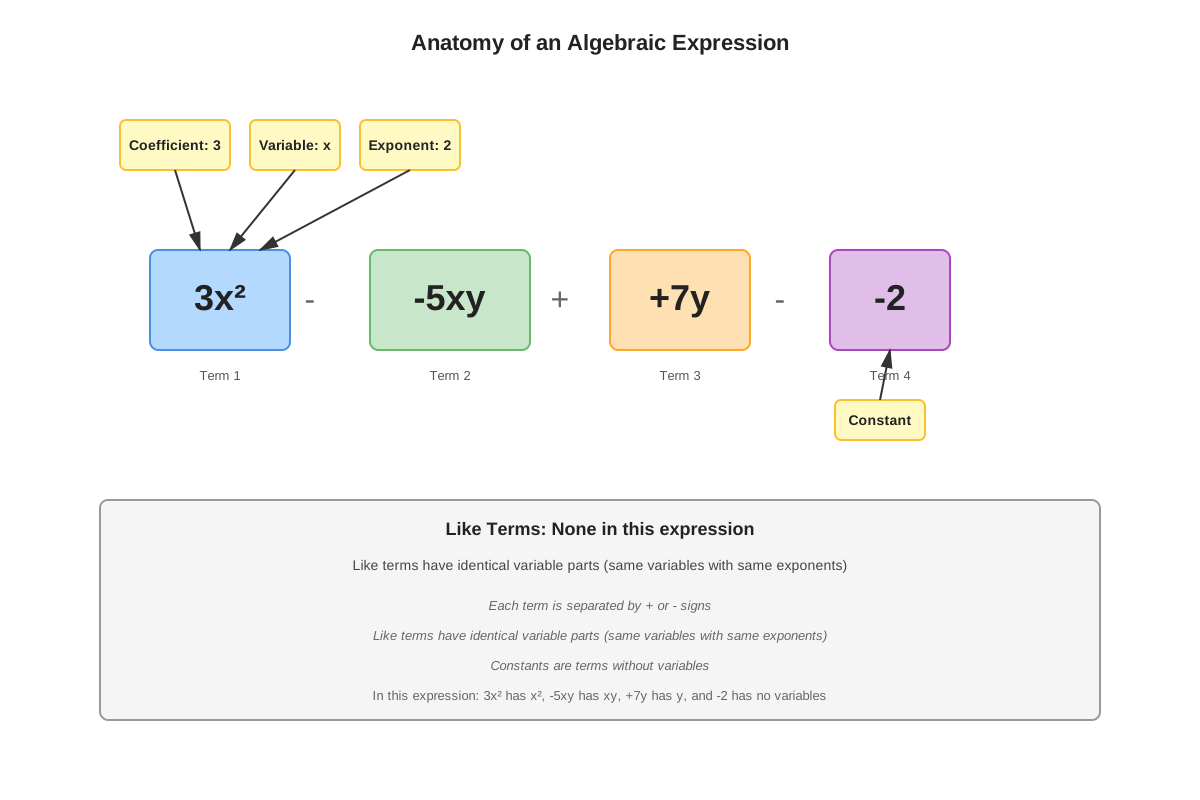
An algebraic expression consists of several key components that must be clearly understood. A term is a single number, variable, or product of numbers and variables separated by addition or subtraction signs. For example, in the expression 3x² + 5x - 7, there are three terms: 3x², 5x, and -7. Each term has a coefficient (the numerical factor) and may contain one or more variables (letters representing unknown values) raised to various exponents (powers).
Like terms are terms that contain exactly the same variables raised to the same powers. Only like terms can be combined through addition or subtraction. For instance, 3x² and 5x² are like terms, but 3x² and 5x are not. A constant is a term without any variables, representing a fixed numerical value. Understanding these components is essential because the GRE frequently tests whether students can identify which terms can be combined and which cannot.
Simplifying Algebraic Expressions
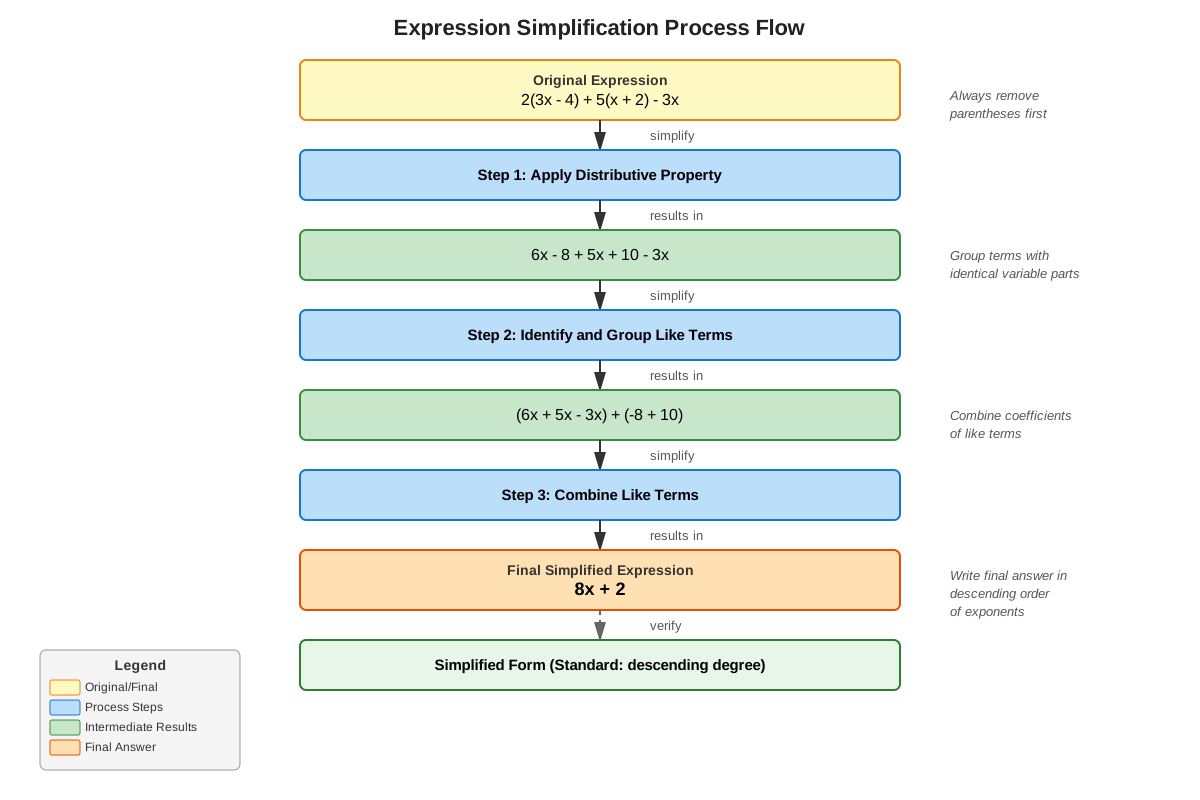
Simplification involves reducing an expression to its most compact form by combining like terms and applying arithmetic operations. The process follows a systematic approach:
- Remove parentheses using the distributive property: a(b + c) = ab + ac
- Apply exponent rules to simplify powers and products
- Combine like terms by adding or subtracting their coefficients
- Arrange terms in standard form (typically descending order of exponents)
For example, simplifying 3(2x + 4) - 5x + 7:
- Distribute: 6x + 12 - 5x + 7
- Combine like terms: (6x - 5x) + (12 + 7)
- Final result: x + 19
The GRE often presents expressions that appear complex but simplify dramatically, testing whether students can recognize opportunities for simplification rather than attempting lengthy calculations.
Evaluating Algebraic Expressions
Evaluation means finding the numerical value of an expression when specific values are substituted for the variables. This process requires careful attention to order of operations and sign conventions:
- Substitute the given values for each variable
- Evaluate exponents first
- Perform multiplication and division from left to right
- Perform addition and subtraction from left to right
For the expression 2x² - 3xy + y² when x = 3 and y = -2:
- Substitute: 2(3)² - 3(3)(-2) + (-2)²
- Evaluate exponents: 2(9) - 3(3)(-2) + 4
- Multiply: 18 + 18 + 4
- Add: 40
Common GRE traps include negative signs, especially when substituting negative values into expressions with exponents, and forgetting to apply exponents before multiplication.
Factoring Algebraic Expressions
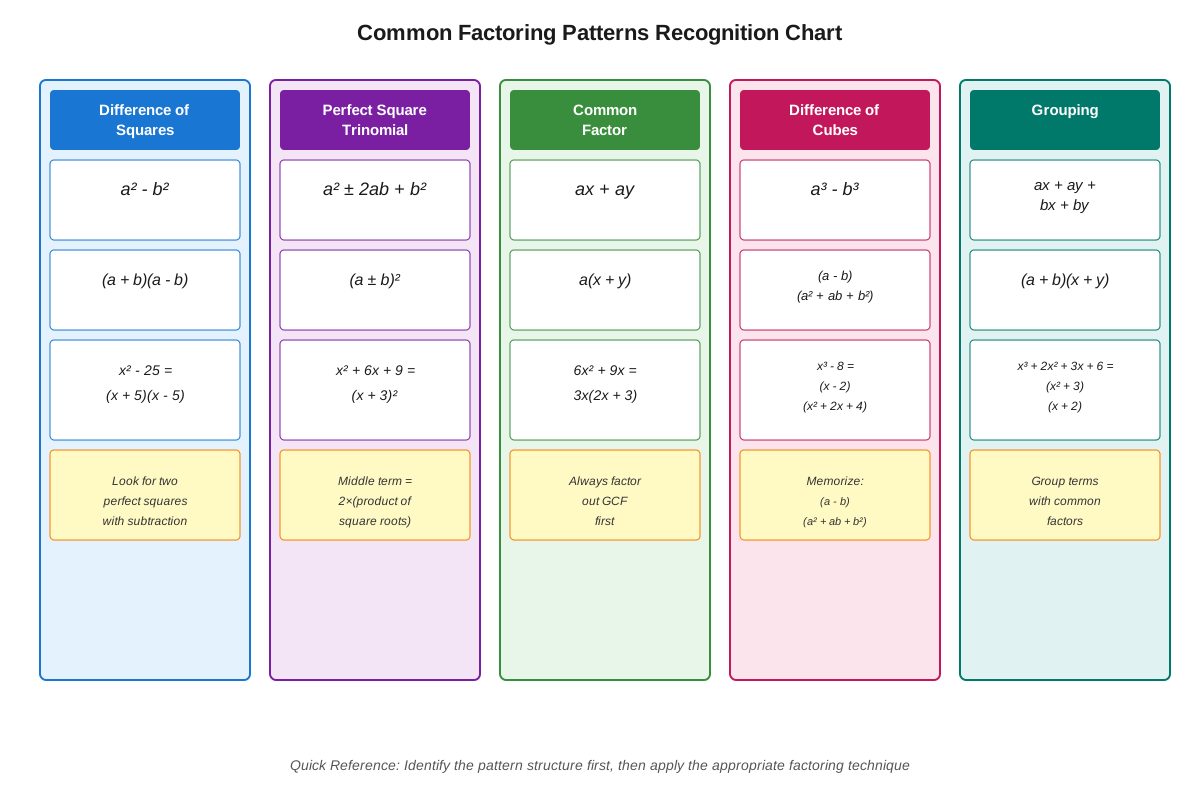
Factoring is the process of rewriting an expression as a product of simpler expressions. This skill is crucial for simplifying complex expressions and solving equations. Key factoring patterns include:
| Pattern | Factored Form | Example |
|---|---|---|
| Common factor | a(b + c) | 6x + 9 = 3(2x + 3) |
| Difference of squares | (a + b)(a - b) | x² - 16 = (x + 4)(x - 4) |
| Perfect square trinomial | (a ± b)² | x² + 6x + 9 = (x + 3)² |
| General trinomial | (ax + b)(cx + d) | x² + 5x + 6 = (x + 2)(x + 3) |
The GRE frequently tests recognition of these patterns, particularly the difference of squares, which students often overlook. Factoring enables simplification of rational expressions and is essential for solving quadratic equations.
Expanding Algebraic Expressions
Expanding is the reverse of factoring—multiplying out products to write expressions in standard polynomial form. The most important expansion patterns are:
- FOIL method for binomial products: (a + b)(c + d) = ac + ad + bc + bd
- Square of a binomial: (a + b)² = a² + 2ab + b² and (a - b)² = a² - 2ab + b²
- Difference of squares: (a + b)(a - b) = a² - b²
A critical GRE trap involves the incorrect expansion (a + b)² = a² + b², which omits the middle term 2ab. Questions are specifically designed to catch students who make this error.
Rational Expressions
Rational expressions are fractions where the numerator and denominator are polynomials. Simplifying rational expressions requires factoring both numerator and denominator, then canceling common factors:
For (x² - 4)/(x² + 4x + 4):
- Factor numerator: (x + 2)(x - 2)
- Factor denominator: (x + 2)(x + 2)
- Cancel common factor: (x - 2)/(x + 2)
The GRE tests whether students recognize that cancellation is only valid for factors (terms connected by multiplication), not for terms connected by addition or subtraction. A common error is attempting to cancel terms across addition: (x + 2)/(x + 3) ≠ 2/3.
Special Products and Patterns
Recognizing special algebraic patterns saves significant time on the GRE:
- Sum and difference: (a + b)(a - b) = a² - b²
- Cube formulas: (a + b)³ = a³ + 3a²b + 3ab² + b³
- Difference of cubes: a³ - b³ = (a - b)(a² + ab + b²)
- Sum of cubes: a³ + b³ = (a + b)(a² - ab + b²)
While cube formulas appear less frequently, the difference of squares is among the most tested patterns on the GRE. Questions often disguise this pattern by using complex expressions for a and b.
Concept Relationships
The concepts within algebraic expressions form an interconnected web of skills. Simplification serves as the foundation, requiring mastery of combining like terms and order of operations. This skill directly enables evaluation, where simplification often precedes substitution to reduce computational complexity. Factoring and expanding represent inverse operations—factoring breaks expressions into products while expanding multiplies them out—and both rely on recognizing standard patterns.
The relationship flow follows this pattern: Basic term identification → Combining like terms → Simplification → Factoring/Expanding → Working with rational expressions. Each level builds upon previous skills, with rational expressions representing the most complex application requiring all prior knowledge.
Connections to prerequisite topics are essential: Order of operations governs every simplification and evaluation step. Exponent properties enable manipulation of polynomial terms. The distributive property underlies both expansion and factoring. Looking forward, algebraic expression skills connect directly to solving equations (which requires isolating variables through expression manipulation), inequalities (which follow similar manipulation rules), functions (which are expressions with specific input-output relationships), and coordinate geometry (where expressions represent curves and lines).
Quick check — test yourself on Algebraic expressions so far.
Try Flashcards →High-Yield Facts
⭐ Like terms must have identical variables raised to identical powers to be combined
⭐ The difference of squares pattern a² - b² = (a + b)(a - b) is one of the most frequently tested factoring patterns
⭐ (a + b)² = a² + 2ab + b², NOT a² + b²—the middle term 2ab is essential
⭐ When substituting negative values, parentheses are critical: (-3)² = 9, but -3² = -9
⭐ Only factors (terms connected by multiplication) can be canceled in rational expressions, never terms connected by addition
- The coefficient of a term includes its sign; -5x has coefficient -5, not 5
- Exponents apply only to their immediate base unless parentheses indicate otherwise: 2x² means 2·x², not (2x)²
- The distributive property works with subtraction: a(b - c) = ab - ac
- When factoring out a negative, all signs inside the parentheses change
- Zero as an exponent always equals one: x⁰ = 1 (for x ≠ 0)
- The sum of squares a² + b² cannot be factored using real numbers
- Combining fractions with algebraic denominators requires finding a common denominator
- The order of terms in addition doesn't matter (commutative property), but order matters in subtraction
- Multiplying expressions with the same base requires adding exponents: x³ · x⁴ = x⁷
Common Misconceptions
Misconception: Terms with different variables can be combined if they have the same coefficient
Correction: Only like terms (identical variables with identical exponents) can be combined. The expression 3x + 3y cannot be simplified to 6xy or any other single term; it remains 3x + 3y.
Misconception: (a + b)² equals a² + b²
Correction: The correct expansion is (a + b)² = a² + 2ab + b². The middle term 2ab is essential and frequently appears in GRE trap answers. For example, (x + 3)² = x² + 6x + 9, not x² + 9.
Misconception: Canceling terms across addition is valid: (x + 3)/(x + 5) = 3/5
Correction: Cancellation only works with factors (multiplication), never with terms connected by addition or subtraction. The expression (x + 3)/(x + 5) cannot be simplified further unless both numerator and denominator can be factored.
Misconception: -x² and (-x)² are equivalent
Correction: These expressions have opposite signs. -x² means -(x²), so -3² = -9. However, (-x)² means the entire quantity -x is squared, so (-3)² = 9. Parentheses determine what the exponent applies to.
Misconception: Distributing a negative sign doesn't affect all terms inside parentheses
Correction: When distributing a negative sign or subtracting an entire expression, every term inside changes sign. For example, -(3x - 5) = -3x + 5, not -3x - 5. The subtraction affects both terms.
Misconception: Exponents distribute over addition: (x + y)² = x² + y²
Correction: Exponents do not distribute over addition or subtraction. They only distribute over multiplication: (xy)² = x²y². The expression (x + y)² must be expanded using FOIL or the binomial square formula.
Misconception: All algebraic expressions can be simplified to a single term
Correction: Many expressions are already in simplest form. The expression x² + 3x + 1 cannot be simplified further because the terms are not like terms and the expression doesn't factor nicely. Recognizing when an expression is already simplified saves time.
Worked Examples
Example 1: Simplification and Evaluation
Problem: Simplify the expression 3(2x - 4) - 2(x + 5) + 7x, then evaluate when x = -2.
Solution:
Step 1: Distribute the coefficients
- 3(2x - 4) = 6x - 12
- -2(x + 5) = -2x - 10
- Expression becomes: 6x - 12 - 2x - 10 + 7x
Step 2: Combine like terms
- Combine x terms: 6x - 2x + 7x = 11x
- Combine constants: -12 - 10 = -22
- Simplified expression: 11x - 22
Step 3: Evaluate at x = -2
- Substitute: 11(-2) - 22
- Multiply: -22 - 22
- Final answer: -44
Connection to learning objectives: This problem demonstrates identifying when expression manipulation is needed (multiple terms with parentheses), applying core strategies (distributive property and combining like terms), and accurately executing the simplification and evaluation process.
Example 2: Factoring and Recognizing Equivalent Forms
Problem: Which of the following is equivalent to 4x² - 25?
(A) (2x - 5)²
(B) (2x + 5)(2x - 5)
(C) (4x + 5)(x - 5)
(D) 4(x² - 25)
(E) (2x - 5)(2x + 5)
Solution:
Step 1: Recognize the pattern
- The expression 4x² - 25 is a difference of squares
- Pattern: a² - b² = (a + b)(a - b)
- Here: a = 2x (since (2x)² = 4x²) and b = 5 (since 5² = 25)
Step 2: Apply the difference of squares formula
- 4x² - 25 = (2x)² - 5² = (2x + 5)(2x - 5)
Step 3: Verify by expanding
- (2x + 5)(2x - 5) = 4x² - 10x + 10x - 25 = 4x² - 25 ✓
Step 4: Eliminate wrong answers
- (A) (2x - 5)² = 4x² - 20x + 25 ✗ (includes middle term)
- (B) and (E) are identical and correct ✓
- (C) (4x + 5)(x - 5) = 4x² - 20x + 5x - 25 = 4x² - 15x - 25 ✗
- (D) 4(x² - 25) = 4x² - 100 ✗
Answer: (B) or (E) (both are equivalent and correct)
Connection to learning objectives: This problem tests recognizing when factoring is being tested (difference of squares pattern), explaining the core strategy (identifying a² - b² structure), and applying it accurately to identify equivalent forms—a high-yield GRE skill.
Exam Strategy
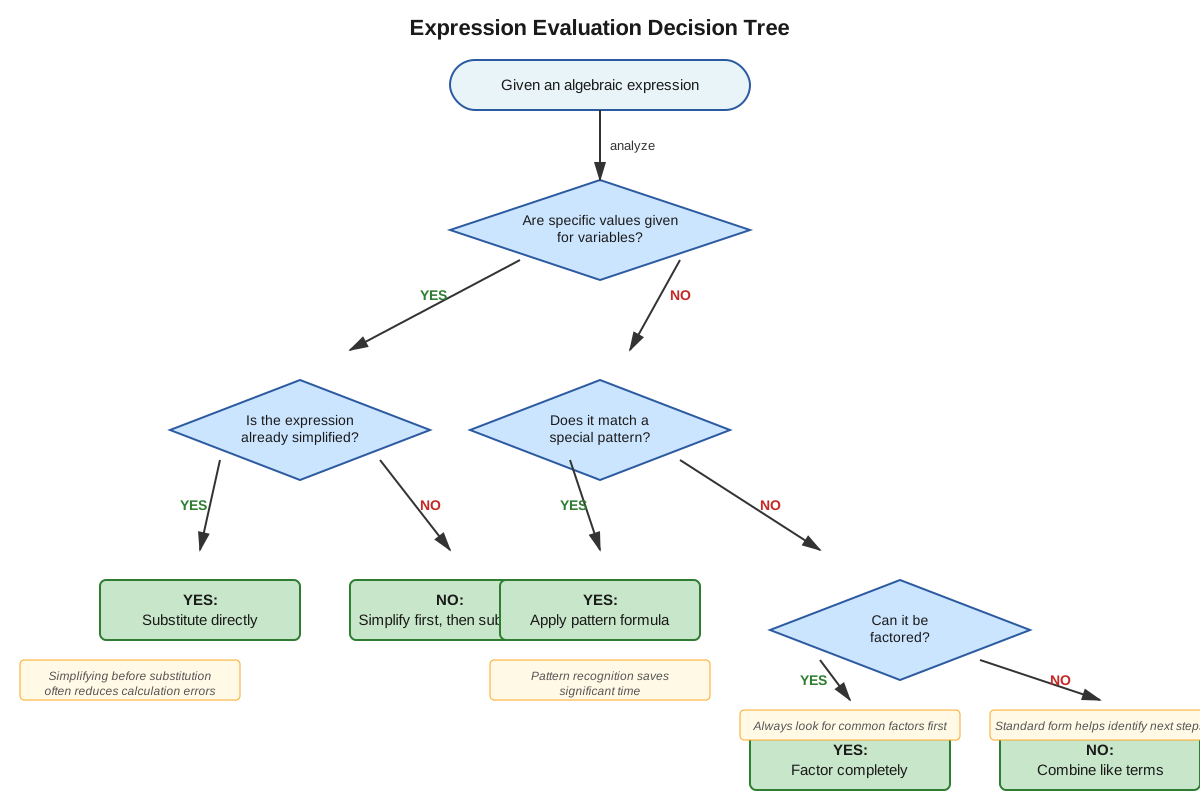
When approaching GRE questions involving algebraic expressions, begin by identifying the question type. Quantitative Comparison questions often test whether students can recognize equivalent expressions or determine which is larger without full simplification. Problem Solving questions typically require complete simplification or evaluation. Look for these trigger phrases: "simplify," "factor," "equivalent to," "evaluate when," "which expression," and "in terms of."
Before diving into calculations, scan for recognizable patterns. The GRE rewards pattern recognition over brute-force computation. Check for difference of squares, perfect square trinomials, common factors, and opportunities to factor before expanding. If an expression looks complicated, there's usually a shortcut—the GRE rarely requires extensive computation.
For process of elimination, use strategic substitution. If asked which expression is equivalent to a given expression, pick a simple value (like x = 2 or x = 0) and evaluate both the original and each answer choice. Eliminate any that give different results. This strategy is particularly effective when algebraic manipulation seems complex or time-consuming. However, be cautious: test at least two different values to avoid coincidental matches, and avoid values that might make denominators zero or create other undefined situations.
Time allocation for expression problems should average 1-2 minutes. If a problem requires more than 2 minutes of calculation, there's likely a faster approach being missed. Consider whether factoring before expanding might simplify the work, or whether the question can be answered without complete simplification. For example, if asked whether x² + 6x + 9 is positive when x > 0, recognizing it as (x + 3)² immediately shows it's always positive without full evaluation.
Watch for negative sign traps, especially when substituting negative values or distributing across parentheses. Write out substitutions with parentheses: if x = -3 and the expression is x², write (-3)² to avoid sign errors. When distributing a negative, mark each term to ensure all signs change. The GRE specifically designs wrong answer choices to catch these common errors.
Memory Techniques
FOIL for multiplying binomials: First, Outer, Inner, Last terms
- (a + b)(c + d): First = ac, Outer = ad, Inner = bc, Last = bd
DOS for Difference Of Squares: (a + b)(a - b) = a² - b²
- Visualize: "DOS" → "Difference Of Squares" → "Opposite Signs"
PEMDAS for order of operations: Parentheses, Exponents, Multiplication/Division, Addition/Subtraction
- Alternative: "Please Excuse My Dear Aunt Sally"
For remembering (a + b)² = a² + 2ab + b², visualize a square with side length (a + b). The area consists of four regions: a², ab, ab, and b², which combines to a² + 2ab + b².
"FACT before you ACT": Always check if you can FACTor before you expand or perform other operations. Factoring often reveals simplifications that aren't obvious in expanded form.
The "Parentheses Protection" rule: When substituting negative values, always wrap them in parentheses. This visual cue prevents sign errors: x² when x = -3 becomes (-3)², not -3².
"Like attracts Like": Only like terms (same variables, same exponents) can be combined. Visualize terms as magnets that only attract identical terms.
Summary
Algebraic expressions form the computational backbone of GRE Quantitative Reasoning, requiring fluency in simplification, evaluation, factoring, and expansion. Mastery involves recognizing that expressions are mathematical phrases without equals signs, composed of terms that can be manipulated using systematic rules. The core skills—combining like terms, applying the distributive property, recognizing special patterns like difference of squares, and working with rational expressions—appear throughout the exam in various disguises. Success requires both computational accuracy and strategic pattern recognition, knowing when to factor versus expand, when to simplify versus substitute, and when to use algebraic manipulation versus numerical testing. The most common pitfalls involve sign errors (especially with negative substitutions and distribution), incorrectly expanding (a + b)², and attempting to cancel terms instead of factors in rational expressions. High scorers distinguish themselves by recognizing equivalent forms quickly, avoiding calculation-heavy approaches when patterns offer shortcuts, and maintaining precision with negative signs and exponents. These skills connect to virtually every other algebra topic and enable efficient problem-solving across the entire Quantitative section.
Key Takeaways
- Algebraic expressions are mathematical phrases combining numbers, variables, and operations without an equals sign; mastering their manipulation is essential for 40-50% of GRE quantitative questions
- Only like terms (identical variables with identical exponents) can be combined through addition or subtraction
- The difference of squares pattern a² - b² = (a + b)(a - b) is among the most frequently tested factoring patterns on the GRE
- (a + b)² = a² + 2ab + b², not a² + b²—forgetting the middle term 2ab is a common trap built into wrong answer choices
- Cancellation in rational expressions only works with factors (multiplication), never with terms connected by addition or subtraction
- When substituting negative values, always use parentheses to avoid sign errors: (-3)² = 9, but -3² = -9
- Pattern recognition trumps brute-force calculation—the GRE rewards identifying shortcuts like factoring before expanding
Related Topics
Solving Linear Equations: Building on expression manipulation, equation-solving adds the equals sign and requires isolating variables through inverse operations. Mastering algebraic expressions provides the foundation for efficiently solving equations.
Quadratic Equations and Factoring: Advanced factoring techniques and the quadratic formula extend expression manipulation to solving second-degree equations, a high-frequency GRE topic.
Functions: Functions are special algebraic expressions that map inputs to outputs. Understanding expression evaluation directly enables function evaluation and composition.
Inequalities: Similar to equations but with inequality symbols, requiring the same expression manipulation skills with additional rules about reversing inequality signs.
Coordinate Geometry: Algebraic expressions represent lines, parabolas, and other curves in the coordinate plane, connecting algebra to visual/spatial reasoning.
Practice CTA
Now that you've mastered the core concepts of algebraic expressions, it's time to solidify your understanding through active practice. Attempt the practice questions associated with this topic, focusing on recognizing patterns quickly and avoiding common traps. Use the flashcards to drill high-yield facts until they become automatic. Remember: the GRE rewards both accuracy and speed, and that combination only comes through deliberate practice. Each problem you solve strengthens your pattern recognition and builds the confidence you need to excel on test day. You've built a strong foundation—now put it to work!
Sign up free to keep reading
Create a free AnvayaPrep account to finish this GRE guide on Algebraic expressions — plus flashcards and practice questions.