Overview
The distributive property is one of the most fundamental algebraic principles tested on the GRE Quantitative Reasoning section. This property describes how multiplication interacts with addition and subtraction, allowing test-takers to expand expressions, factor polynomials, simplify complex equations, and solve problems more efficiently. Mastery of the distributive property is not merely about memorizing a formula—it's about recognizing when and how to apply this principle across diverse problem types, from basic algebraic manipulation to complex word problems involving multiple variables.
On the GRE, the GRE distributive property appears in approximately 15-20% of Quantitative Reasoning questions, either as the primary concept being tested or as a necessary step in solving more complex problems. Questions may directly test whether students can expand expressions like 3(x + 5) or factor expressions such as 6x + 9. More commonly, however, the distributive property appears embedded within multi-step problems involving equations, inequalities, word problems, and data interpretation scenarios. Students who can quickly and accurately apply this property gain significant time advantages and reduce computational errors.
The distributive property serves as a bridge between arithmetic and algebra, connecting basic multiplication concepts to more advanced topics like polynomial operations, quadratic equations, and algebraic simplification. It underlies many other algebraic techniques tested on the GRE, including combining like terms, solving linear equations, factoring, and working with rational expressions. Without solid command of this property, students struggle with efficiency and accuracy across the entire Algebra unit and beyond into Quantitative Comparison and Data Interpretation questions.
Learning Objectives
- [ ] Identify when Distributive property is being tested
- [ ] Explain the core rule or strategy behind Distributive property
- [ ] Apply Distributive property to GRE-style questions accurately
- [ ] Recognize and correct common errors in distributive property applications
- [ ] Factor expressions using the reverse application of the distributive property
- [ ] Apply the distributive property with negative numbers, fractions, and variables efficiently
- [ ] Combine the distributive property with other algebraic operations in multi-step problems
Prerequisites
- Basic multiplication and addition operations: The distributive property fundamentally describes the relationship between these two operations
- Understanding of variables and algebraic expressions: Students must be comfortable with symbolic notation and the concept of variables representing unknown quantities
- Order of operations (PEMDAS): Knowing when to apply the distributive property versus other operations is essential for correct problem-solving
- Combining like terms: This skill works hand-in-hand with the distributive property when simplifying expressions
- Negative number operations: The distributive property frequently involves negative coefficients and terms
Why This Topic Matters
The distributive property appears throughout mathematics and has practical applications in everyday problem-solving. In real-world contexts, it helps calculate costs (e.g., finding the total cost of multiple items with tax: 3 items × ($10 + $1 tax) = 3 × $10 + 3 × $1), determine areas of composite shapes, and solve proportional reasoning problems in business and science contexts.
On the GRE specifically, the distributive property appears in multiple question formats. Approximately 3-5 questions per test directly or indirectly require its application. It appears most frequently in:
- Quantitative Comparison questions where expressions must be simplified before comparison
- Problem Solving questions involving algebraic manipulation and equation solving
- Word problems requiring translation from verbal descriptions to algebraic expressions
- Data Interpretation questions where formulas must be expanded or factored
The GRE often disguises distributive property questions by embedding them within more complex scenarios. A question might appear to test geometry or word problem skills, but the efficient solution path requires recognizing that factoring or expanding an expression will simplify the calculation. Students who miss these opportunities often resort to time-consuming arithmetic or algebraic manipulation that increases error risk.
Core Concepts
The Fundamental Distributive Property
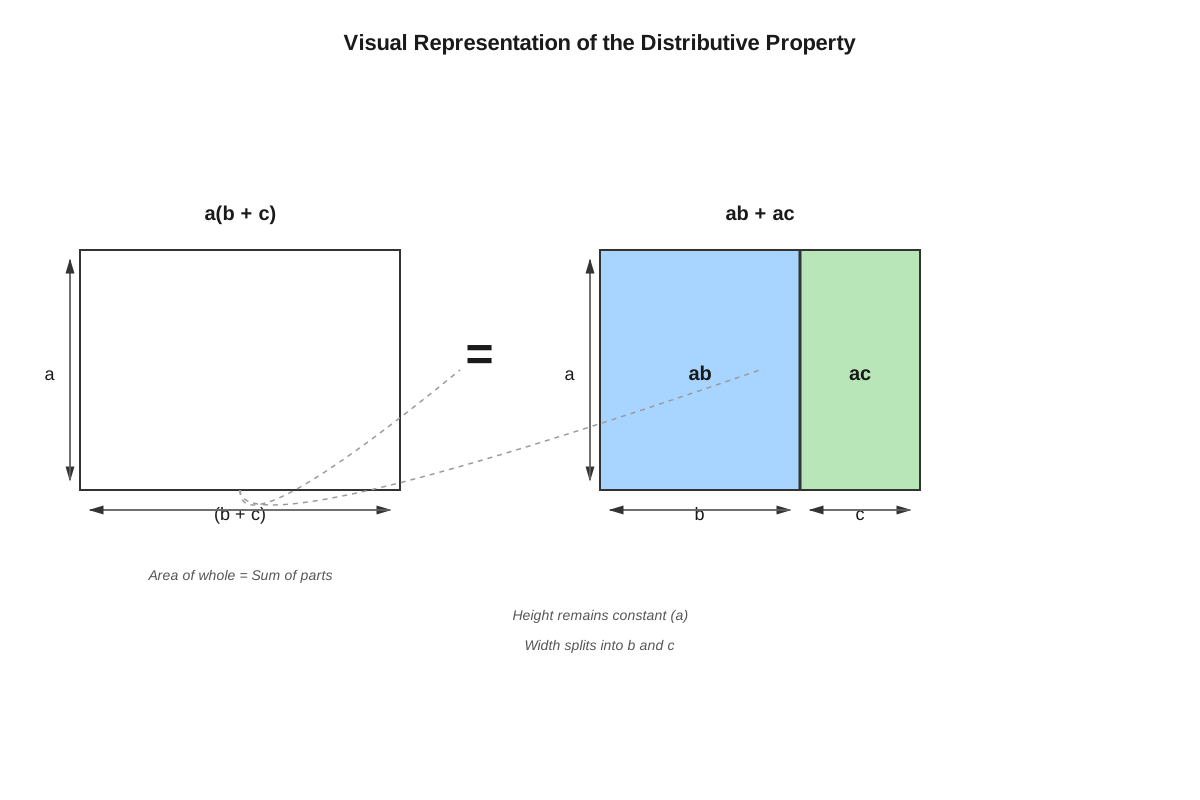
The distributive property states that for any numbers or variables a, b, and c:
a(b + c) = ab + acThis property describes how multiplication "distributes" over addition. When a number or variable multiplies a sum (or difference), it multiplies each term inside the parentheses separately. The property works identically with subtraction:
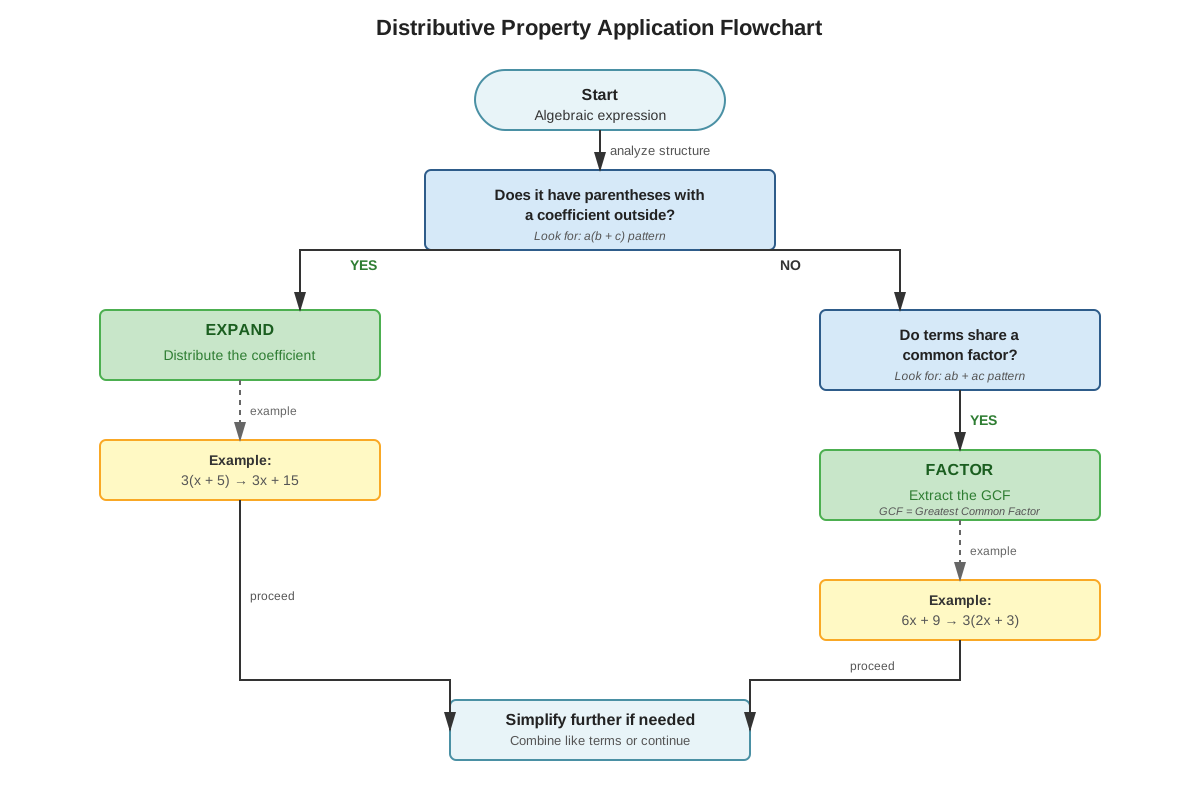
a(b - c) = ab - acThe distributive property is bidirectional—it can be applied in both directions. Moving from left to right (a(b + c) → ab + ac) is called expanding or distributing. Moving from right to left (ab + ac → a(b + c)) is called factoring or factoring out the common factor.
Expanding Expressions
Expanding involves taking a factored expression and writing it as a sum or difference of terms. This process requires multiplying the term outside the parentheses by each term inside:
Example: Expand 5(x + 3)
- Multiply 5 by x: 5x
- Multiply 5 by 3: 15
- Result: 5x + 15
Example with subtraction: Expand -2(4y - 7)
- Multiply -2 by 4y: -8y
- Multiply -2 by -7: +14
- Result: -8y + 14
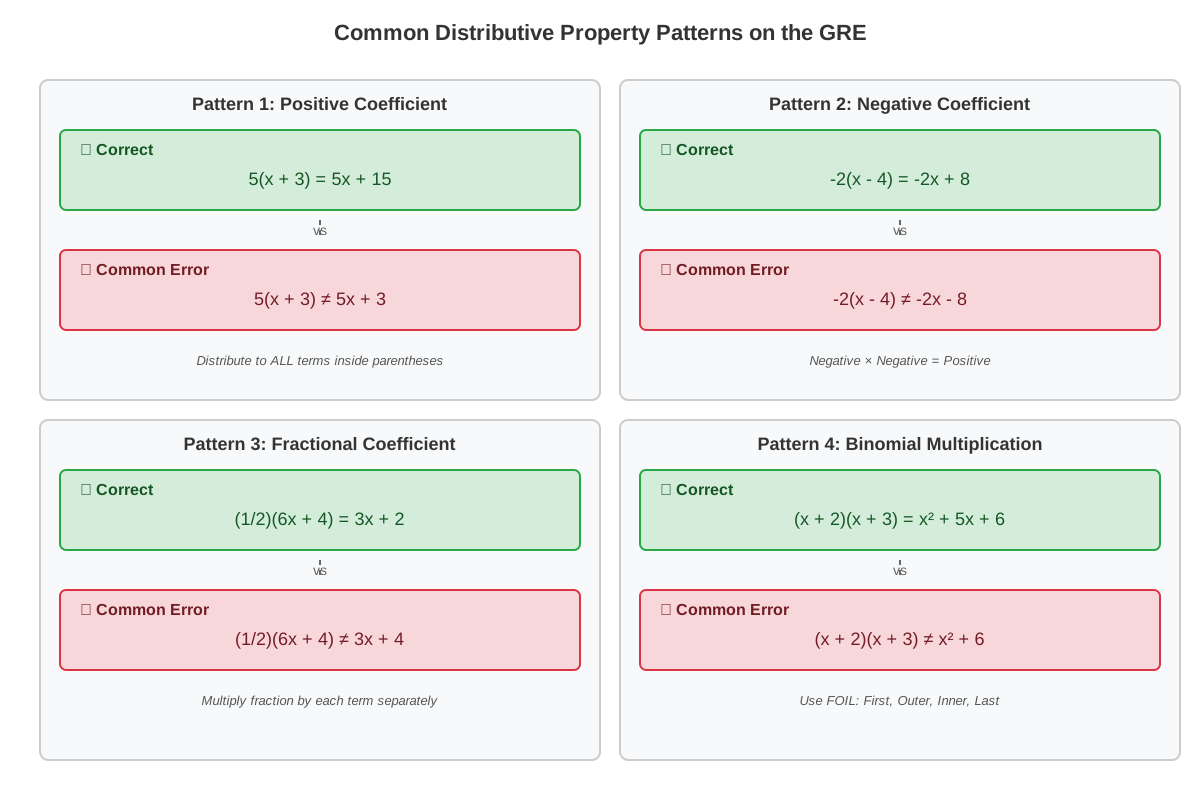
Notice that when distributing a negative number, the signs of all terms inside the parentheses change. This is a critical detail that generates many errors on the GRE.
Factoring Using the Distributive Property
Factoring is the reverse process—identifying a common factor in multiple terms and "pulling it out" using parentheses. This technique simplifies expressions and is essential for solving equations efficiently.
Example: Factor 12x + 18
- Identify the greatest common factor (GCF) of 12 and 18: 6
- Divide each term by 6: 12x ÷ 6 = 2x and 18 ÷ 6 = 3
- Write in factored form: 6(2x + 3)
Example with variables: Factor 15a² + 10a
- GCF of 15 and 10: 5
- Both terms contain at least one factor of a
- Common factor: 5a
- Result: 5a(3a + 2)
Distributing with Multiple Terms
The distributive property extends to expressions with more than two terms inside parentheses:
a(b + c + d) = ab + ac + adExample: Expand 3(2x + 5y - 4z)
- Result: 6x + 15y - 12z
Double Distribution (FOIL and Beyond)
When two binomials multiply, the distributive property must be applied twice. Each term in the first binomial multiplies each term in the second:
(a + b)(c + d) = ac + ad + bc + bdThe acronym FOIL (First, Outer, Inner, Last) helps remember this pattern for binomials:
Example: Expand (x + 3)(x + 5)
- First: x × x = x²
- Outer: x × 5 = 5x
- Inner: 3 × x = 3x
- Last: 3 × 5 = 15
- Combine like terms: x² + 8x + 15
Distributive Property with Fractions and Decimals
The distributive property applies identically with fractions and decimals:
Example: Expand (1/2)(6x + 10)
- Result: 3x + 5
Example: Expand 0.25(8y - 12)
- Result: 2y - 3
Nested Distribution
Some GRE problems involve multiple layers of parentheses requiring sequential application of the distributive property:
Example: Simplify 2[3(x + 4) - 5]
- First distribute the 3: 2[3x + 12 - 5]
- Simplify inside brackets: 2[3x + 7]
- Distribute the 2: 6x + 14
Comparison Table: Expanding vs. Factoring
| Operation | Starting Form | Ending Form | When to Use |
|---|---|---|---|
| Expanding | a(b + c) | ab + ac | Simplifying equations, eliminating parentheses, preparing to combine like terms |
| Factoring | ab + ac | a(b + c) | Solving equations, simplifying fractions, identifying common patterns |
Concept Relationships
The distributive property serves as a foundational concept that connects to numerous other algebraic principles. Understanding these relationships helps students recognize when to apply the property and how it fits into broader problem-solving strategies.
Within the topic: Expanding and factoring are inverse operations connected by the distributive property. Mastering expansion enables students to simplify complex expressions, while factoring allows them to identify patterns and solve equations efficiently. Double distribution builds upon single distribution, extending the same principle to more complex scenarios.
Connection to prerequisites: The distributive property directly applies the order of operations (PEMDAS), specifically clarifying when multiplication occurs relative to addition and subtraction. It requires fluency with combining like terms, as expanded expressions often need simplification. Negative number operations become critical when distributing negative coefficients.
Connection to related topics: The distributive property → enables → solving linear equations (by expanding and simplifying both sides) → leads to → solving systems of equations. It also → enables → polynomial operations (adding, subtracting, multiplying polynomials) → leads to → factoring quadratics and solving quadratic equations. Additionally, it → supports → simplifying rational expressions and → facilitates → algebraic word problem translation.
Relationship map:
Basic arithmetic → Distributive property → Combining like terms → Solving equations → Systems of equations
Distributive property → Polynomial multiplication → Factoring techniques → Quadratic equations
Distributive property → Expression simplification → Quantitative comparisons → Data interpretation
High-Yield Facts
⭐ The distributive property states: a(b + c) = ab + ac and works identically with subtraction: a(b - c) = ab - ac
⭐ Distributing a negative number changes the sign of every term inside the parentheses: -3(x - 5) = -3x + 15
⭐ Factoring is the reverse of expanding: if you can write ab + ac, you can factor it as a(b + c)
⭐ When multiplying two binomials, use FOIL (First, Outer, Inner, Last) or apply the distributive property twice: (a + b)(c + d) = ac + ad + bc + bd
⭐ The greatest common factor (GCF) should be factored out completely, including both numerical coefficients and variable factors
- The distributive property applies to all real numbers, including fractions, decimals, and irrational numbers
- Distributing before combining like terms often simplifies complex expressions more efficiently
- In nested parentheses, work from the innermost parentheses outward
- The distributive property is commutative: (b + c)a = ba + ca produces the same result as a(b + c) = ab + ac
- Factoring expressions can reveal common factors that simplify fractions or solve equations more easily
- When distributing with exponents, only the coefficient distributes, not the exponent: 3(x²) = 3x², not 3x⁶
- The distributive property extends to any number of terms: a(b + c + d + e) = ab + ac + ad + ae
Quick check — test yourself on Distributive property so far.
Try Flashcards →Common Misconceptions
Misconception: When distributing a(b + c), only the first term gets multiplied: a(b + c) = ab + c
Correction: The term outside the parentheses must multiply EVERY term inside. The correct expansion is a(b + c) = ab + ac. Both b and c must be multiplied by a.
Misconception: Distributing a negative sign doesn't affect addition/subtraction signs inside parentheses: -(x + 5) = -x + 5
Correction: A negative sign (which is really -1) distributes to all terms and changes their signs: -(x + 5) = -x - 5. Think of it as -1(x + 5) = -1(x) + -1(5) = -x - 5.
Misconception: The distributive property applies to exponents: (x + y)² = x² + y²
Correction: Exponents do NOT distribute over addition. (x + y)² means (x + y)(x + y), which must be expanded using FOIL or double distribution: (x + y)² = x² + 2xy + y². The distributive property only applies to multiplication over addition/subtraction.
Misconception: When factoring, any common number can be factored out: 12x + 18 = 2(6x + 9) is fully factored
Correction: While 2 is a common factor, it's not the GREATEST common factor. The GCF of 12 and 18 is 6, so the fully factored form is 6(2x + 3). On the GRE, "factor completely" means factor out the GCF.
Misconception: Division distributes over addition the same way multiplication does: (a + b)/c = a/c + b/c is the same as c/(a + b) = c/a + c/b
Correction: Division distributes over addition only when the sum is in the numerator: (a + b)/c = a/c + b/c is CORRECT. However, when the sum is in the denominator, division does NOT distribute: c/(a + b) ≠ c/a + c/b. This is a critical distinction that frequently appears in GRE trap answers.
Misconception: Factoring and expanding are the same operation
Correction: Factoring and expanding are inverse operations. Expanding takes a(b + c) and produces ab + ac (removing parentheses). Factoring takes ab + ac and produces a(b + c) (creating parentheses by pulling out common factors). Recognizing which operation is needed is essential for efficient problem-solving.
Misconception: The distributive property only works with addition
Correction: The distributive property works with both addition AND subtraction: a(b - c) = ab - ac. It also extends to combinations: a(b + c - d) = ab + ac - ad. The key is that multiplication distributes over all terms being added or subtracted.
Worked Examples
Example 1: Multi-Step Equation Solving
Problem: Solve for x: 3(2x - 5) + 4 = 2(x + 3) - 1
Solution:
Step 1: Apply the distributive property to both sides
- Left side: 3(2x - 5) = 6x - 15
- Right side: 2(x + 3) = 2x + 6
- Equation becomes: 6x - 15 + 4 = 2x + 6 - 1
Step 2: Combine like terms on each side
- Left side: 6x - 15 + 4 = 6x - 11
- Right side: 2x + 6 - 1 = 2x + 5
- Equation becomes: 6x - 11 = 2x + 5
Step 3: Isolate variable terms on one side
- Subtract 2x from both sides: 4x - 11 = 5
Step 4: Isolate the constant
- Add 11 to both sides: 4x = 16
Step 5: Solve for x
- Divide both sides by 4: x = 4
Verification: Substitute x = 4 back into the original equation:
- Left: 3(2(4) - 5) + 4 = 3(8 - 5) + 4 = 3(3) + 4 = 9 + 4 = 13
- Right: 2(4 + 3) - 1 = 2(7) - 1 = 14 - 1 = 13 ✓
Connection to learning objectives: This example demonstrates identifying when the distributive property is needed (Step 1), applying the core rule accurately (expanding both sides), and using it within a multi-step GRE-style problem.
Example 2: Quantitative Comparison with Factoring
Problem:
Column A: 47 × 23 + 47 × 77
Column B: 4700
Naive approach (time-consuming and error-prone):
Calculate 47 × 23 = 1,081, then 47 × 77 = 3,619, then add: 1,081 + 3,619 = 4,700
Efficient approach using the distributive property:
Step 1: Recognize the common factor
- Both terms in Column A contain the factor 47
- This signals an opportunity to factor using the distributive property in reverse
Step 2: Factor out the common factor
- 47 × 23 + 47 × 77 = 47(23 + 77)
Step 3: Simplify inside the parentheses
- 23 + 77 = 100
- Expression becomes: 47(100)
Step 4: Calculate
- 47 × 100 = 4,700
Step 5: Compare
- Column A = 4,700
- Column B = 4,700
- Answer: The two quantities are equal (C)
Key insight: Recognizing when to factor (reverse distribution) rather than expand can save significant time and reduce calculation errors. The GRE frequently includes problems where factoring reveals simple arithmetic that would otherwise require complex multiplication.
Connection to learning objectives: This example shows identifying when the distributive property is being tested (recognizing the common factor pattern), explaining the strategy (factoring to simplify), and applying it accurately to a GRE Quantitative Comparison question.
Exam Strategy
Recognition Triggers
Watch for these signals that the distributive property is being tested:
- Parentheses with a coefficient: Any expression like 5(x + 3) or -2(4y - 7) requires distribution
- Common factors in addition/subtraction: Expressions like 6x + 9 or 15a² + 10a suggest factoring opportunities
- Word problems with "each" or "per": Phrases like "3 items each costing $(x + 5)" translate to 3(x + 5)
- Equations with parentheses on both sides: These require distributing before solving
- Quantitative Comparison with repeated factors: Look for opportunities to factor rather than calculate
Approach Strategy
- Scan for parentheses first: Before attempting any calculation, identify all parentheses and determine whether expanding or factoring will simplify the problem
- Check for common factors: In addition/subtraction expressions, look for GCF opportunities before performing arithmetic
- Distribute carefully with negatives: When distributing negative numbers, change the sign of EVERY term inside parentheses
- Verify by substitution: For equation-solving problems, substitute your answer back into the original equation to catch distribution errors
Process of Elimination Tips
- Eliminate answers with sign errors: If distributing a negative, eliminate any answer choices that don't change all signs
- Check the number of terms: After distributing (a + b)(c + d), you should have 4 terms before combining like terms; eliminate answers with wrong term counts
- Verify GCF in factored answers: If a question asks to "factor completely," eliminate answers that haven't factored out the greatest common factor
- Test with simple numbers: If unsure whether an answer is correct, substitute simple values (like x = 1) into both the original expression and the answer choices
Time Allocation
- Simple distribution (one set of parentheses): 15-30 seconds
- Double distribution (FOIL): 30-45 seconds
- Multi-step equations with distribution: 60-90 seconds
- Factoring problems: 30-60 seconds
Exam Tip: If a problem seems to require tedious multiplication, pause and check whether factoring would simplify the calculation. The GRE rewards strategic thinking over computational brute force.
Memory Techniques
Mnemonic for Distribution Direction
"DISTRIBUTE = Deliver Items Separately To Recipients Inside Building Using Truck Entrance"
- When you distribute, you deliver (multiply) to each recipient (term) inside the building (parentheses)
Visualization for Sign Changes
Picture a negative sign as a "sign flipper" that walks through parentheses and flips every sign it encounters:
- -(x + 5 - 3y) → The flipper changes + to - and - to +: -x - 5 + 3y
FOIL Acronym
First, Outer, Inner, Last for multiplying binomials:
- (a + b)(c + d)
- First: a × c
- Outer: a × d
- Inner: b × c
- Last: b × d
Factoring Checklist: "GCF-GPS"
When factoring, follow the GPS:
- Greatest Common Factor first
- Group terms if needed
- Pull out common factors
- Simplify what remains inside parentheses
The "Reverse Distribution" Reminder
Think of factoring as "un-distributing" or "putting the genie back in the bottle":
- Expanded form (genie out): ab + ac
- Factored form (genie in bottle): a(b + c)
Summary
The distributive property is a fundamental algebraic principle stating that a(b + c) = ab + ac, describing how multiplication distributes over addition and subtraction. This bidirectional property enables both expanding expressions (removing parentheses by distributing) and factoring expressions (creating parentheses by pulling out common factors). On the GRE, the distributive property appears in 15-20% of Quantitative Reasoning questions, either directly or as a necessary step in solving equations, simplifying expressions, and solving word problems. Mastery requires recognizing when to expand versus factor, handling negative numbers correctly (which change all signs when distributed), and applying the property efficiently in multi-step problems. The property extends to multiple terms, fractions, decimals, and nested parentheses. Common errors include forgetting to distribute to all terms, mishandling negative signs, and incorrectly assuming the property applies to exponents. Strategic application of the distributive property—particularly recognizing factoring opportunities—can dramatically reduce calculation time and error rates on the GRE. Students must be fluent in both directions of the property and able to combine it seamlessly with other algebraic operations like combining like terms and solving equations.
Key Takeaways
- The distributive property a(b + c) = ab + ac works in both directions: expanding (left to right) and factoring (right to left)
- Distributing a negative number changes the sign of every term inside the parentheses: -a(b - c) = -ab + ac
- Factoring out the greatest common factor (GCF) simplifies expressions and often reveals easier calculation paths on the GRE
- The property extends to multiple terms and double distribution (FOIL for binomials): (a + b)(c + d) = ac + ad + bc + bd
- Recognition triggers include parentheses with coefficients, common factors in sums, and word problems with "each" or "per"
- The distributive property does NOT apply to exponents: (x + y)² ≠ x² + y²
- Strategic factoring before calculating can save significant time on Quantitative Comparison and Problem Solving questions
Related Topics
Combining Like Terms: After applying the distributive property, expressions often contain like terms that must be combined. This topic builds directly on distribution skills and is essential for simplifying algebraic expressions efficiently.
Solving Linear Equations: The distributive property is frequently the first step in solving equations with parentheses. Mastering distribution enables students to isolate variables and solve single-variable and multi-variable equations.
Factoring Quadratics: Advanced factoring techniques for expressions like x² + 5x + 6 build on the reverse distributive property, extending it to more complex polynomial patterns.
Polynomial Operations: Adding, subtracting, and especially multiplying polynomials requires repeated application of the distributive property across multiple terms.
Rational Expressions: Simplifying algebraic fractions often requires factoring numerators and denominators using the distributive property to identify and cancel common factors.
Practice CTA
Now that you've mastered the core concepts, recognition strategies, and common pitfalls of the distributive property, it's time to solidify your understanding through active practice. Attempt the practice questions to test your ability to identify, explain, and apply this essential property under timed conditions. Use the flashcards to reinforce high-yield facts and build automatic recognition of distribution patterns. Remember: the GRE rewards both accuracy and efficiency—strategic application of the distributive property will help you achieve both. Every practice problem you solve strengthens your pattern recognition and builds the confidence you need to excel on test day!
Sign up free to keep reading
Create a free AnvayaPrep account to finish this GRE guide on Distributive property — plus flashcards and practice questions.