Overview
Literal equations are algebraic equations in which the variables represent known quantities or parameters rather than unknown values to be solved. In the context of the GRE, literal equations typically involve manipulating formulas to isolate a specific variable in terms of other variables. This skill is fundamental to success on the Quantitative Reasoning section, as it tests a student's ability to work abstractly with algebraic relationships without substituting numerical values.
The GRE frequently tests literal equations through questions that require rearranging formulas from geometry, physics, finance, or other applied contexts. Rather than asking for a numerical answer, these questions assess whether students can perform algebraic manipulations symbolically—treating letters as quantities and applying inverse operations systematically. This type of problem appears in both Quantitative Comparison and Problem Solving formats, often embedded within word problems or data interpretation scenarios.
Understanding gre literal equations connects directly to broader algebraic competencies including equation solving, function manipulation, and proportional reasoning. Mastery of this topic strengthens the foundation for tackling complex multi-step problems, systems of equations, and applied mathematics questions. The ability to "solve for" any variable in a formula demonstrates algebraic fluency that the GRE values highly, making this a high-yield topic for focused study.
Learning Objectives
- [ ] Identify when Literal equations is being tested
- [ ] Explain the core rule or strategy behind Literal equations
- [ ] Apply Literal equations to GRE-style questions accurately
- [ ] Manipulate complex formulas involving multiple variables to isolate any specified variable
- [ ] Recognize equivalent forms of literal equations and identify algebraically equivalent expressions
- [ ] Solve literal equations that require factoring, distributing, or combining like terms
- [ ] Apply literal equation techniques to real-world formulas commonly appearing on the GRE
Prerequisites
- Basic algebraic operations: Addition, subtraction, multiplication, and division with variables are essential for performing the inverse operations required to isolate variables in literal equations
- Order of operations (PEMDAS): Understanding the hierarchy of operations ensures correct sequencing when undoing operations to solve for a variable
- Properties of equality: The ability to perform the same operation on both sides of an equation maintains equality and forms the foundation of all equation manipulation
- Fraction operations: Many literal equations involve fractional coefficients or require clearing denominators, making fraction fluency critical
- Distributive property: Expanding and factoring expressions is frequently necessary when variables appear in multiple terms
Why This Topic Matters
Literal equations represent a critical bridge between abstract algebra and practical problem-solving. In real-world applications, professionals regularly manipulate formulas to suit their needs: engineers rearranging physics equations, financial analysts solving for interest rates, and scientists isolating experimental variables. The ability to work with formulas symbolically demonstrates mathematical maturity and flexibility.
On the GRE, literal equations appear in approximately 10-15% of Quantitative Reasoning questions, making them a high-frequency topic. These questions typically appear as medium to hard difficulty problems, often serving as discriminators between average and high-scoring test-takers. The GRE tests literal equations through multiple formats: direct "solve for x in terms of y" questions, Quantitative Comparison problems requiring formula manipulation, word problems where formula rearrangement simplifies calculation, and data interpretation questions involving rate, work, or mixture formulas.
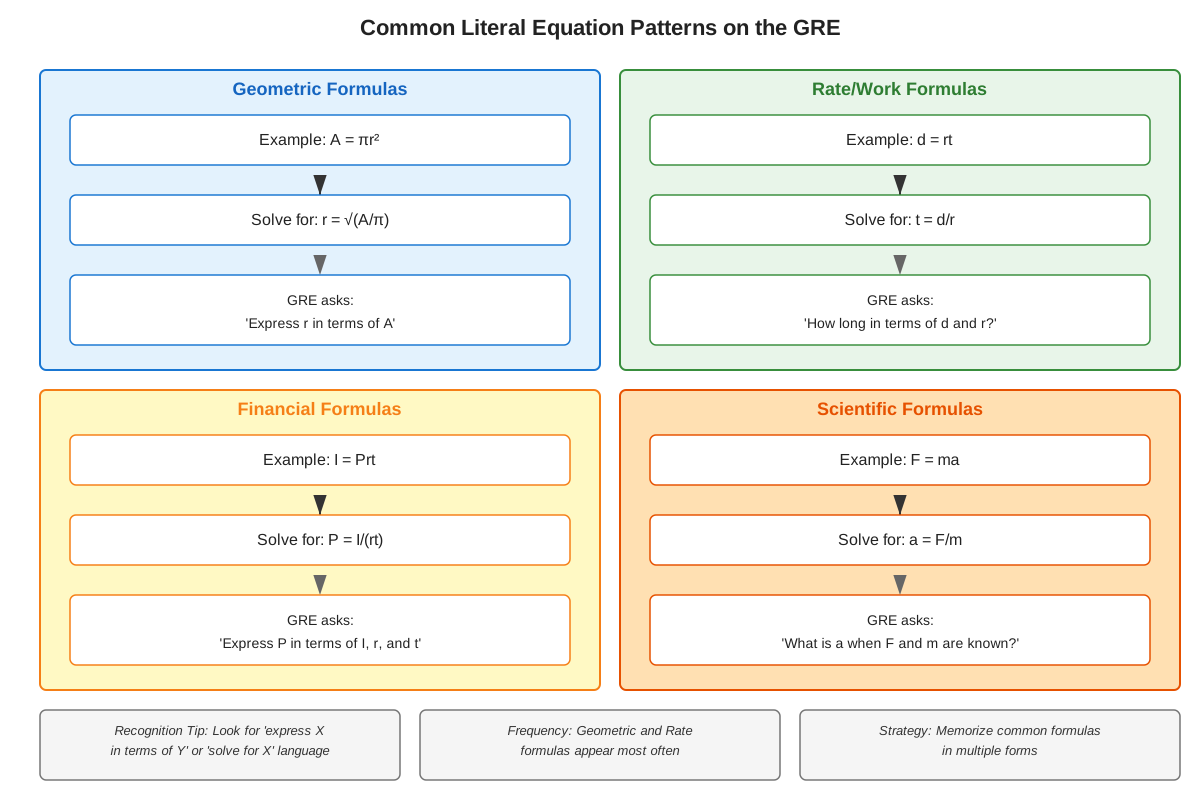
Common exam scenarios include rearranging geometric formulas (solving for radius given surface area), manipulating rate-time-distance relationships, working with percent change formulas, adjusting financial formulas for different variables, and transforming scientific or statistical formulas. The GRE favors these questions because they efficiently test multiple skills simultaneously: algebraic manipulation, abstract reasoning, and the ability to work systematically under time pressure.
Core Concepts
Definition and Structure of Literal Equations
A literal equation is an equation containing two or more variables, where the goal is to express one variable explicitly in terms of the others. Unlike standard algebraic equations where variables represent unknown numbers to be found, literal equations treat all variables as parameters or known quantities. The objective is to rearrange the equation to isolate a specified variable on one side of the equals sign.
For example, the formula for the area of a rectangle, A = lw, is a literal equation. While typically used to find area given length and width, it can be rearranged to solve for length (l = A/w) or width (w = A/l). Each form is equally valid and useful depending on which quantity is unknown in a particular problem.
The Fundamental Strategy: Inverse Operations
The core strategy for solving literal equations mirrors the approach for numerical equations: apply inverse operations systematically to isolate the target variable. The key difference is maintaining variables throughout the process rather than simplifying to a number.
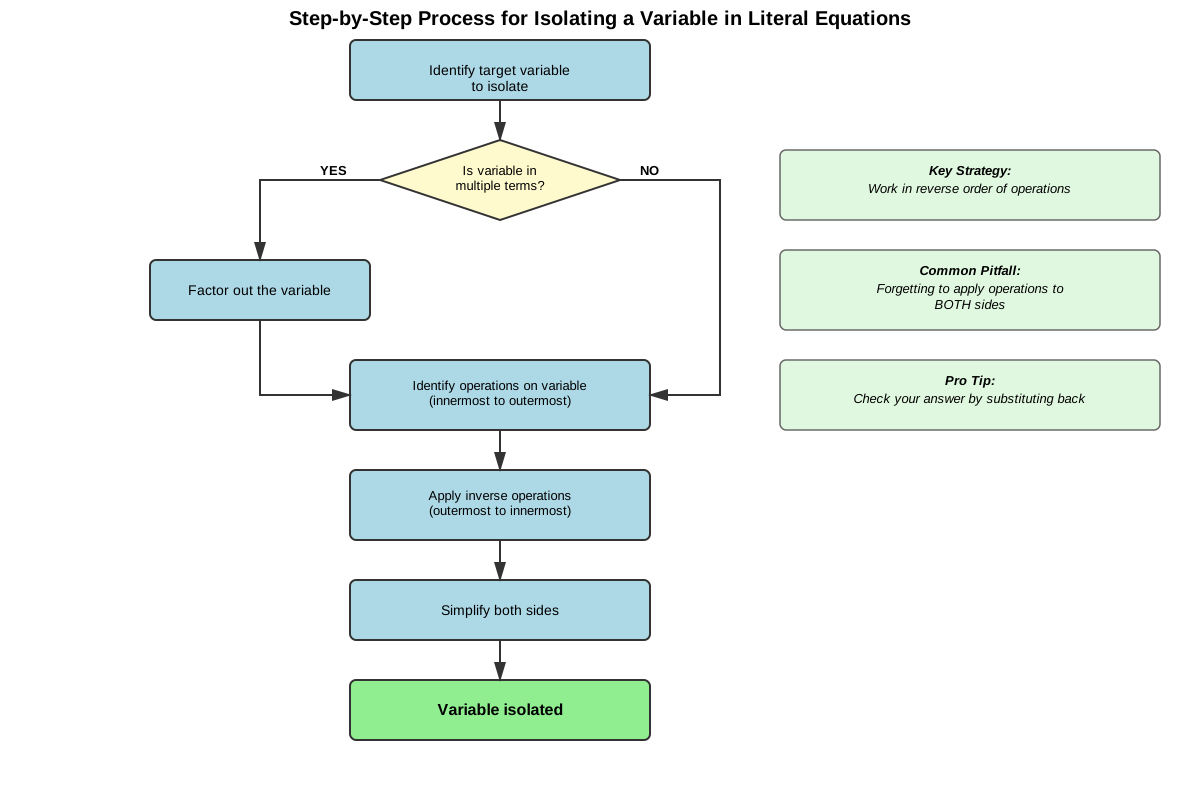
Step-by-step process:
- Identify the variable to isolate (the "target variable")
- Determine which operations are being performed on the target variable
- Apply inverse operations in reverse order of operations (opposite of PEMDAS)
- Perform the same operation to both sides of the equation
- Simplify the result, combining like terms if necessary
- Verify that the target variable appears alone on one side
Working with Addition and Subtraction
When the target variable is part of a sum or difference, use addition or subtraction to isolate it.
Example: Solve for b in the equation a + b = c
To isolate b, subtract a from both sides:
- a + b = c
- a + b - a = c - a
- b = c - a
Example: Solve for x in the equation 2x - y = z
Add y to both sides, then divide by 2:
- 2x - y + y = z + y
- 2x = z + y
- x = (z + y)/2
Working with Multiplication and Division
When the target variable is multiplied or divided by other terms, use division or multiplication as inverse operations.
Example: Solve for h in the equation V = πr²h
Divide both sides by πr²:
- V/(πr²) = (πr²h)/(πr²)
- h = V/(πr²)
Example: Solve for r in the equation C = 2πr
Divide both sides by 2π:
- C/(2π) = (2πr)/(2π)
- r = C/(2π)
Handling Variables in Denominators
When the target variable appears in a denominator, multiply both sides by that denominator to clear it, then continue isolating the variable.
Example: Solve for t in the equation d = r/t
Multiply both sides by t:
- dt = (r/t) × t
- dt = r
- t = r/d
Example: Solve for b in the equation 1/a + 1/b = 1/c
This requires multiple steps:
- Subtract 1/a from both sides: 1/b = 1/c - 1/a
- Find common denominator on right side: 1/b = (a - c)/(ac)
- Take reciprocal of both sides: b = ac/(a - c)
Dealing with Variables in Multiple Terms
When the target variable appears in multiple terms, factor it out or collect all terms containing it on one side.
Example: Solve for x in the equation ax + bx = c
Factor x from the left side:
- x(a + b) = c
- x = c/(a + b)
Example: Solve for y in the equation ay - b = cy + d
Collect y terms on one side:
- ay - cy = b + d
- y(a - c) = b + d
- y = (b + d)/(a - c)
Complex Manipulations Involving Distribution and Factoring
Some literal equations require expanding expressions or factoring to isolate the target variable effectively.
Example: Solve for w in the equation P = 2(l + w)
Distribute first:
- P = 2l + 2w
- P - 2l = 2w
- w = (P - 2l)/2 or w = P/2 - l
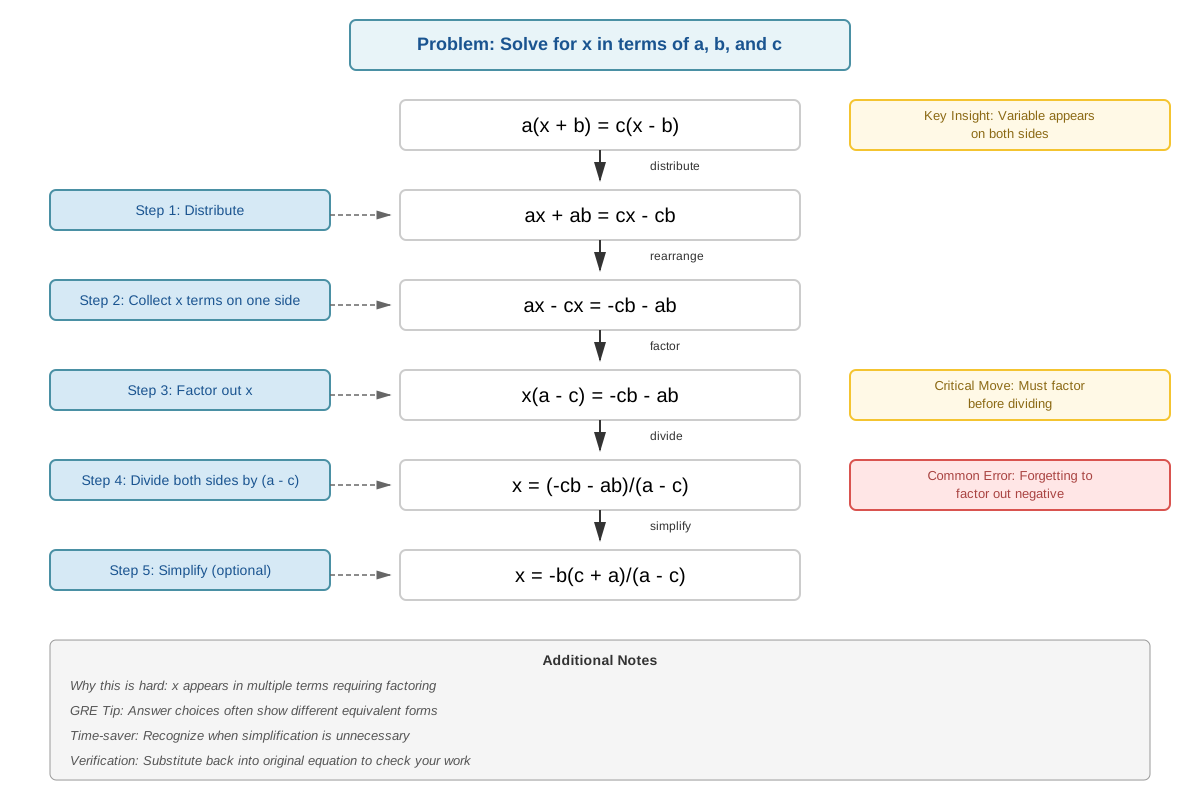
Example: Solve for x in the equation a(x + b) = c(x - d)
Distribute both sides:
- ax + ab = cx - cd
- ax - cx = -cd - ab
- x(a - c) = -cd - ab
- x = (-cd - ab)/(a - c) or x = (cd + ab)/(c - a)
Recognizing Equivalent Forms
The GRE often presents answer choices in different algebraically equivalent forms. Recognizing these equivalences is crucial for selecting correct answers efficiently.
| Original Form | Equivalent Form 1 | Equivalent Form 2 |
|---|---|---|
| x = (a + b)/c | x = a/c + b/c | cx = a + b |
| y = a/(b - c) | y(b - c) = a | yb - yc = a |
| z = (a - b)/2 | 2z = a - b | z = a/2 - b/2 |
Concept Relationships
The concepts within literal equations build systematically upon one another. Basic inverse operations (addition/subtraction, multiplication/division) form the foundation → these enable clearing denominators and isolating variables in simple equations → which then support factoring techniques for variables appearing in multiple terms → culminating in complex multi-step manipulations involving distribution, combining like terms, and strategic rearrangement.
Literal equations connect directly to prerequisite topics: properties of equality justify every manipulation step, order of operations determines the sequence of inverse operations to apply, and fraction operations enable clearing denominators and simplifying complex expressions. The distributive property bridges literal equations to factoring and expanding expressions.
Looking forward, mastery of literal equations enables progression to systems of equations (where multiple literal equations must be manipulated simultaneously), function notation and transformation (which involves expressing one variable in terms of another), and applied word problems (where recognizing and rearranging standard formulas accelerates problem-solving). The abstract reasoning developed through literal equations also strengthens performance on algebraic inequalities and quadratic equations.
High-Yield Facts
- ⭐ The fundamental principle: whatever operation is performed on one side of an equation must be performed on the other side to maintain equality
- ⭐ To isolate a variable, apply inverse operations in the reverse order of PEMDAS (undo addition/subtraction last, exponents/roots first)
- ⭐ When a variable appears in multiple terms, factor it out or collect all terms containing it on one side before isolating
- ⭐ Multiplying both sides by a denominator clears fractions and is often the first step when variables appear in denominators
- ⭐ The GRE frequently presents answer choices in different equivalent forms; algebraic manipulation skills help recognize correct answers
- When solving for a variable that appears in a denominator, expect the final answer to have other variables in its denominator
- Distributing before collecting like terms often simplifies equations where variables appear within parentheses
- Factoring is the inverse of distribution; recognizing when to factor versus when to distribute is crucial for efficiency
- Common formulas tested include: distance = rate × time, area and perimeter formulas, percent change formulas, and work rate equations
- Negative signs require careful attention when subtracting terms or factoring; sign errors are the most common mistake in literal equations
- When a variable appears squared or with an exponent, taking roots is necessary, but remember to consider both positive and negative roots when appropriate
Quick check — test yourself on Literal equations so far.
Try Flashcards →Common Misconceptions
Misconception: Only the variable being solved for needs to follow algebraic rules; other variables can be treated differently.
Correction: All variables must be treated as algebraic quantities following the same rules. Every variable represents a number, even if its value is unknown, and must be manipulated using proper algebraic operations.
Misconception: When dividing both sides by an expression containing variables, the expression can be canceled completely without considering whether it might equal zero.
Correction: Division by zero is undefined. When dividing by an expression containing variables, technically the solution is valid only when that expression is non-zero. The GRE typically avoids this complication by stating constraints or choosing problems where division by zero isn't an issue, but awareness of this limitation demonstrates mathematical maturity.
Misconception: The answer must be simplified to a single fraction; leaving an answer as a sum of fractions is incorrect.
Correction: Multiple equivalent forms are algebraically valid. The expression x = a/c + b/c is exactly equivalent to x = (a + b)/c. The GRE may present the correct answer in either form, so recognizing equivalence is essential.
Misconception: When a variable appears on both sides of an equation, the equation cannot be solved.
Correction: Variables appearing on both sides simply require collecting all terms containing the target variable on one side through addition or subtraction, then factoring out the variable. This is a standard technique for literal equations.
Misconception: Literal equations always have one correct form as the answer.
Correction: Literal equations can be expressed in multiple equivalent forms. For example, solving for r in C = 2πr yields r = C/(2π), which could also be written as r = C/2π or r = (1/2π)C. All forms are mathematically correct.
Misconception: The order of operations doesn't matter when working with variables.
Correction: The order of operations applies universally to all algebraic expressions, whether they contain numbers, variables, or both. Violating PEMDAS leads to incorrect manipulations and wrong answers.
Worked Examples
Example 1: Multi-Step Literal Equation with Distribution
Problem: The formula for the surface area of a cylinder is S = 2πr² + 2πrh. Solve for h in terms of S, r, and π.
Solution:
Step 1: Identify the target variable (h) and observe that it appears in only one term (2πrh).
Step 2: Isolate the term containing h by subtracting 2πr² from both sides:
- S - 2πr² = 2πr² + 2πrh - 2πr²
- S - 2πr² = 2πrh
Step 3: Divide both sides by the coefficient of h, which is 2πr:
- (S - 2πr²)/(2πr) = (2πrh)/(2πr)
- (S - 2πr²)/(2πr) = h
Step 4: Simplify if possible. The answer can be left as h = (S - 2πr²)/(2πr), or distributed:
- h = S/(2πr) - 2πr²/(2πr)
- h = S/(2πr) - r
Final answer: h = (S - 2πr²)/(2πr) or h = S/(2πr) - r
Both forms are correct. This problem demonstrates the learning objective of applying literal equations to formulas with multiple terms and recognizing equivalent answer forms.
Example 2: Variable in Denominator with Multiple Steps
Problem: The lens equation in physics is 1/f = 1/p + 1/q. Solve for q in terms of f and p.
Solution:
Step 1: Isolate the term containing q by subtracting 1/p from both sides:
- 1/f - 1/p = 1/q
Step 2: Find a common denominator for the left side (fp):
- p/(fp) - f/(fp) = 1/q
- (p - f)/(fp) = 1/q
Step 3: Take the reciprocal of both sides (or cross-multiply):
- q = fp/(p - f)
Step 4: Verify by checking dimensions and considering whether the answer makes physical sense.
Final answer: q = fp/(p - f)
This problem illustrates handling variables in denominators and combining fractions—both high-yield skills for GRE literal equations. It also demonstrates the strategy of finding common denominators before taking reciprocals.
Example 3: Variable Appearing in Multiple Terms
Problem: Solve for x in the equation: ax + b = cx - d
Solution:
Step 1: Collect all terms containing x on the left side by subtracting cx from both sides:
- ax - cx + b = cx - cx - d
- ax - cx + b = -d
Step 2: Isolate terms with x by subtracting b from both sides:
- ax - cx = -d - b
Step 3: Factor x from the left side:
- x(a - c) = -d - b
Step 4: Divide both sides by (a - c):
- x = (-d - b)/(a - c)
Step 5: Simplify by factoring out -1 from numerator (optional):
- x = -(d + b)/(a - c) or x = (d + b)/(c - a)
Final answer: x = (-d - b)/(a - c) or equivalently x = (d + b)/(c - a)
This example demonstrates the critical technique of factoring when a variable appears in multiple terms, addressing a core learning objective for literal equations.
Exam Strategy
When approaching GRE questions involving literal equations, begin by identifying trigger phrases such as "solve for," "express in terms of," "which equation correctly represents," or "isolate the variable." These phrases signal that algebraic manipulation rather than numerical calculation is required.
Strategic approach:
- Read carefully to identify the target variable: The question will specify which variable to isolate. Circle or mentally note this variable to maintain focus.
- Assess the complexity: Quickly scan the equation to determine whether the target variable appears once or multiple times, whether it's in a denominator, and whether distribution or factoring will be necessary.
- Work systematically: Apply inverse operations one at a time, showing work mentally or on scratch paper. Rushing leads to sign errors and algebraic mistakes.
- Check answer choices early: If answer choices are given, compare them after each major step. Sometimes recognizing the form of the answer helps guide the manipulation strategy.
- Use process of elimination: If stuck, eliminate answer choices by substituting simple values for variables. While this doesn't prove an answer correct, it can eliminate wrong answers efficiently.
Time management: Allocate 1.5-2 minutes for straightforward literal equation problems, up to 2.5 minutes for complex multi-step problems. If a problem requires more than three major algebraic steps, double-check that a simpler approach isn't available.
Common trigger words and phrases:
- "In terms of" → signals literal equation manipulation
- "Which expression represents" → requires isolating a variable
- "Solve for" → direct instruction to isolate a specific variable
- "Express [variable] as" → rearrange to isolate the specified variable
- "If [formula], then [variable] equals" → manipulate the given formula
Quantitative Comparison strategy: When literal equations appear in QC format, often the most efficient approach is to manipulate the given equation to directly compare the quantities rather than fully solving for a variable.
Memory Techniques
DARC Method for solving literal equations:
- Determine the target variable
- Apply inverse operations systematically
- Reverse the order of operations (undo PEMDAS backwards)
- Check by substituting or comparing to answer choices
"Clear the Clutter" visualization: Imagine the target variable trapped inside a box surrounded by other terms and operations. Each inverse operation removes one layer of the box, progressively freeing the variable until it stands alone.
FIDO acronym for variables in multiple terms:
- Find all terms containing the target variable
- Isolate these terms on one side
- Distribute or factor to extract the variable
- Operate (divide) to solve completely
Reciprocal reminder: "Flip to free" - when a variable is stuck in a denominator alone (like 1/x = expression), flip both sides to free it.
Sign awareness mnemonic: "Subtract Carefully, Signs Switch" - when moving terms across the equals sign, remember that signs change (addition becomes subtraction and vice versa).
Summary
Literal equations represent a fundamental algebraic skill tested frequently on the GRE Quantitative Reasoning section. These equations involve manipulating formulas to isolate a specified variable in terms of other variables, requiring systematic application of inverse operations while maintaining algebraic relationships. Success with literal equations demands fluency in basic algebraic operations, careful attention to signs and order of operations, and the ability to recognize equivalent algebraic forms. The core strategy involves identifying the target variable, applying inverse operations in reverse order of PEMDAS, and simplifying the result. Common challenges include handling variables in denominators, dealing with variables appearing in multiple terms (requiring factoring), and recognizing when to distribute versus when to factor. The GRE tests this skill through direct "solve for" questions, Quantitative Comparisons requiring formula manipulation, and applied problems involving standard formulas from geometry, physics, and finance. Mastery of literal equations strengthens overall algebraic reasoning and enables efficient problem-solving across multiple Quantitative Reasoning question types.
Key Takeaways
- Literal equations require isolating one variable in terms of others using systematic inverse operations applied to both sides of the equation
- The fundamental strategy mirrors solving numerical equations: undo operations in reverse order of PEMDAS while treating all variables as algebraic quantities
- When a variable appears in multiple terms, factor it out after collecting all such terms on one side of the equation
- Variables in denominators require multiplying both sides by the denominator to clear fractions before continuing isolation
- The GRE presents correct answers in various equivalent algebraic forms; recognizing these equivalences is essential for efficient answer selection
- Common errors include sign mistakes when moving terms across the equals sign and forgetting to apply operations to all terms on both sides
- Literal equations appear in 10-15% of GRE Quantitative Reasoning questions, making them a high-yield topic for focused preparation
Related Topics
Systems of Equations: Building on literal equation skills, systems involve manipulating multiple equations simultaneously to solve for multiple variables. Mastery of literal equations provides the algebraic fluency needed for substitution and elimination methods.
Function Notation and Transformation: Functions are essentially literal equations expressing one variable (output) in terms of another (input). Understanding literal equations enables manipulation of function expressions and solving for inverse functions.
Quadratic Equations: Many quadratic problems require rearranging equations into standard form or isolating variables—skills developed through literal equation practice. The quadratic formula itself is a literal equation.
Rate, Work, and Mixture Problems: These applied problems rely heavily on standard formulas (d = rt, combined work rates, mixture equations) that frequently require rearrangement to solve efficiently.
Geometric Formulas: The GRE tests numerous geometric formulas for area, volume, and surface area. Literal equation skills enable solving for any dimension given other measurements, expanding problem-solving flexibility.
Practice CTA
Now that you've mastered the core concepts and strategies for literal equations, reinforce your learning by attempting the practice questions designed specifically for this topic. These problems mirror actual GRE question formats and difficulty levels, providing essential hands-on experience with the techniques covered in this guide. Additionally, use the flashcards to drill high-yield facts and formulas until they become automatic. Remember: algebraic fluency develops through consistent practice. Each problem you solve strengthens your pattern recognition and builds the confidence needed to tackle literal equations efficiently under test conditions. Your investment in mastering this high-yield topic will pay dividends across multiple question types on test day!
Sign up free to keep reading
Create a free AnvayaPrep account to finish this GRE guide on Literal equations — plus flashcards and practice questions.