Overview
Solving for a variable is one of the most fundamental and frequently tested skills in GRE Quantitative Reasoning. This algebraic technique involves manipulating equations to isolate an unknown quantity, allowing test-takers to determine its value or express it in terms of other variables. Mastery of this skill is not merely important—it is essential, as it appears directly in approximately 20-25% of all GRE Quantitative questions and indirectly supports solving nearly every mathematical problem on the exam.
The ability to solve for a variable extends far beyond simple linear equations. On the GRE, this skill encompasses working with multi-step equations, systems of equations, equations with multiple variables, fractional and radical expressions, and equations embedded within word problems. Test-makers deliberately design questions that require strategic thinking about which operations to apply, in what order, and how to recognize when a variable has been successfully isolated. Understanding the principles behind GRE solving for a variable questions enables students to approach complex problems systematically rather than relying on trial-and-error.
This topic serves as the foundation for virtually all algebraic reasoning on the GRE. It connects directly to functions, inequalities, coordinate geometry, word problems, and even data interpretation questions that require setting up and solving equations. Without fluency in solving for variables, students will struggle with higher-level quantitative concepts and waste precious time on questions that should be straightforward. The techniques covered here represent the algebraic toolkit that unlocks success across the entire Quantitative Reasoning section.
Learning Objectives
- [ ] Identify when solving for a variable is being tested
- [ ] Explain the core rule or strategy behind solving for a variable
- [ ] Apply solving for a variable to GRE-style questions accurately
- [ ] Manipulate equations involving fractions, radicals, and exponents to isolate variables
- [ ] Recognize when to solve for a variable in terms of other variables rather than finding a numerical value
- [ ] Determine when multiple solution methods exist and select the most efficient approach
- [ ] Verify solutions by substitution and identify extraneous solutions
Prerequisites
- Basic arithmetic operations: Addition, subtraction, multiplication, and division form the foundation of all equation manipulation
- Order of operations (PEMDAS): Understanding operation hierarchy is essential for correctly reversing operations when isolating variables
- Properties of equality: Knowing that performing the same operation on both sides of an equation maintains equality is fundamental to all solving techniques
- Fraction operations: Many GRE equations involve fractional coefficients or variables in denominators, requiring comfort with fraction manipulation
- Exponent rules: Equations frequently involve powers and roots, necessitating fluency with exponent properties
Why This Topic Matters
Solving for a variable represents the most practical application of algebra in both academic and real-world contexts. Engineers use these techniques to derive formulas for physical quantities, economists solve for equilibrium prices, and data scientists manipulate equations to isolate parameters in statistical models. The logical thinking required to systematically isolate a variable—determining which operations to apply and in what sequence—develops problem-solving skills that transfer to countless professional and personal situations.
On the GRE specifically, solving for a variable appears in multiple question formats with remarkable frequency. Approximately 4-6 questions per Quantitative section directly test this skill through straightforward equation-solving, while another 6-8 questions embed it within word problems, function questions, or quantitative comparison formats. The skill appears in both Quantitative Comparison questions (where you might need to solve for a variable to compare two quantities) and Problem Solving questions (both multiple-choice and numeric entry). Questions testing this concept typically appear at all difficulty levels, from easy warm-up questions to challenging problems that combine multiple algebraic techniques.
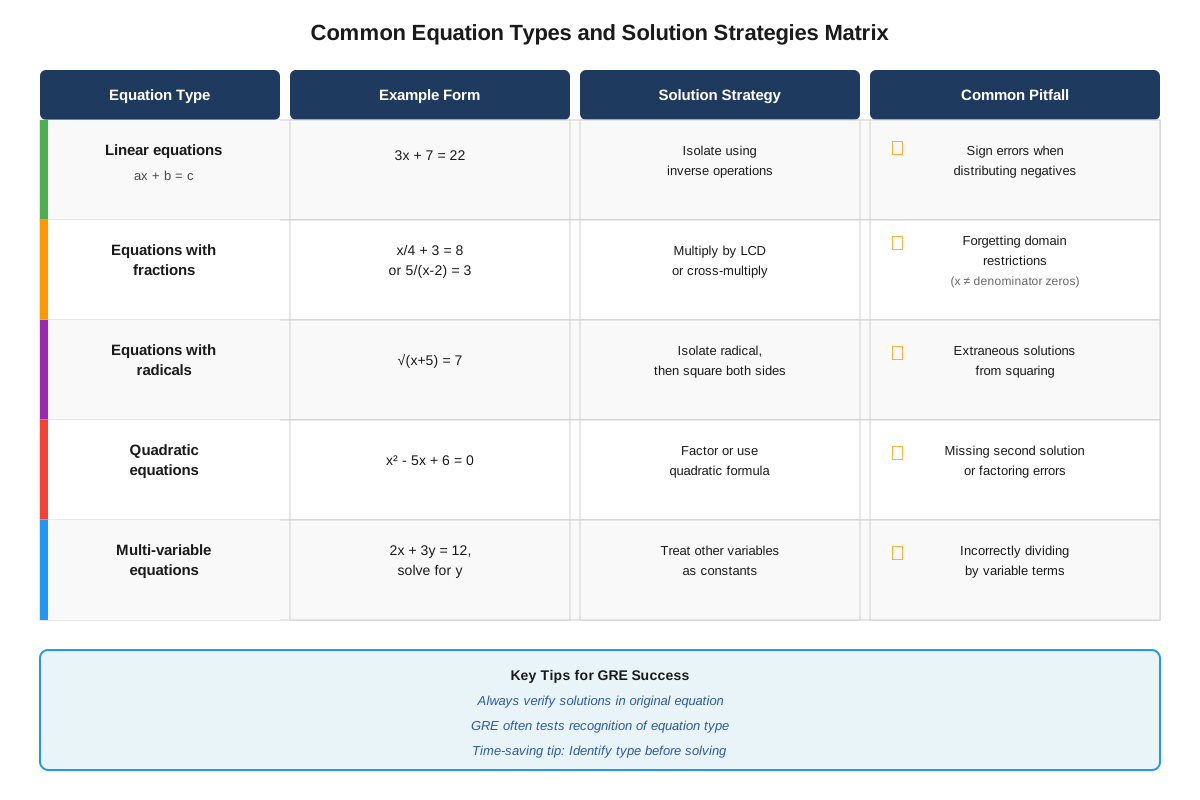
Common GRE question patterns include: solving linear equations with one variable; solving for one variable in terms of others in multi-variable equations; manipulating formulas to isolate a specific variable; solving equations involving fractions where the variable appears in a denominator; working with equations containing radicals or absolute values; and setting up and solving equations from word problem descriptions. Recognizing these patterns allows students to quickly identify the underlying skill being tested and apply the appropriate solution strategy.
Core Concepts
The Fundamental Principle: Maintaining Equality
The cornerstone of solving for a variable is the principle that performing the same operation on both sides of an equation preserves equality. If two expressions are equal, they remain equal after adding, subtracting, multiplying, or dividing both sides by the same non-zero value. This principle allows systematic manipulation of equations to isolate the desired variable.
When solving for a variable, the goal is to have the variable alone on one side of the equation (typically the left side) with a coefficient of 1, while all other terms appear on the opposite side. This process requires "undoing" the operations that have been applied to the variable by performing inverse operations in reverse order of the standard order of operations.
Inverse Operations Strategy
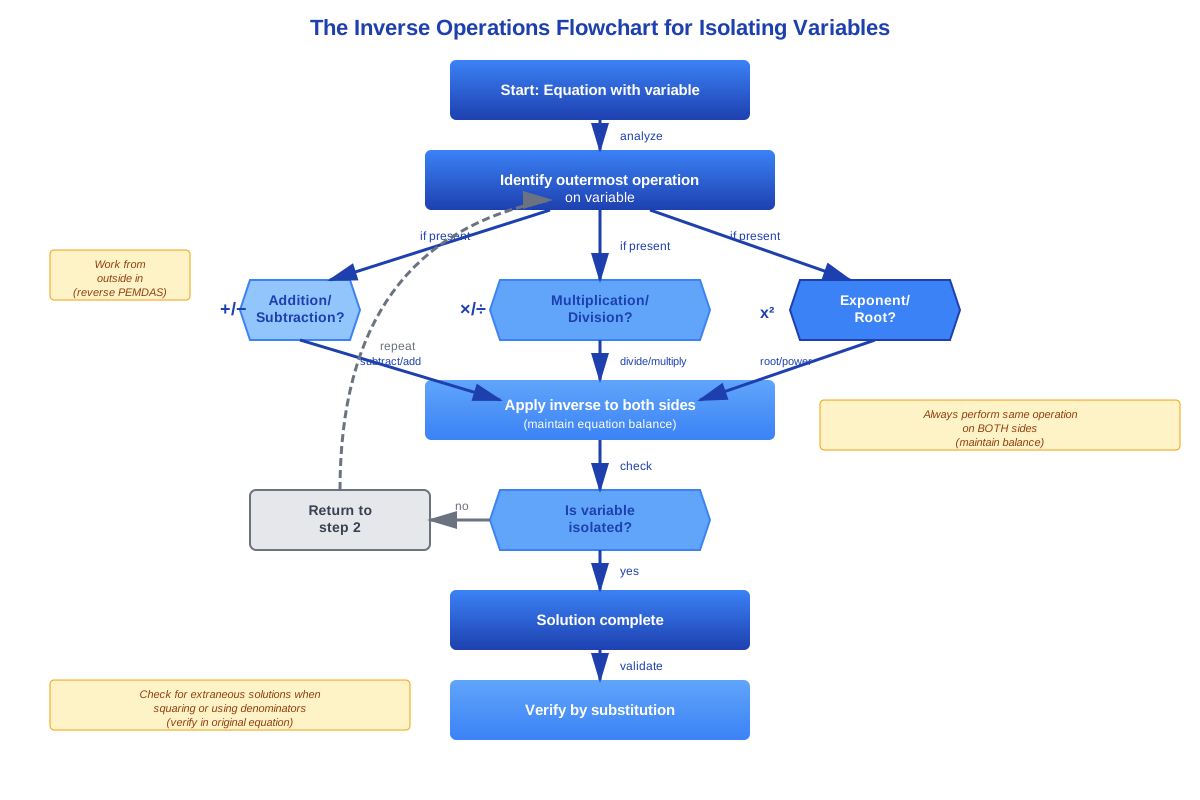
To isolate a variable, apply inverse operations in this sequence:
- Eliminate addition/subtraction: Remove constants or variable terms added to or subtracted from the expression containing the target variable
- Eliminate multiplication/division: Remove coefficients multiplying the variable or divisors in denominators
- Eliminate exponents/roots: Apply inverse operations for powers (taking roots) or roots (raising to powers)
- Simplify nested operations: Work from the outside in when the variable appears in nested expressions
This sequence reverses PEMDAS, working backward from the final operations applied to the variable to the first operations.
Linear Equations with One Variable
The most basic form involves equations where the variable appears to the first power only:
ax + b = cSolution process:
- Subtract b from both sides: ax = c - b
- Divide both sides by a: x = (c - b)/a
Example: Solve for x: 3x + 7 = 22
- Subtract 7: 3x = 15
- Divide by 3: x = 5
Multi-Step Equations with Distribution and Combining Like Terms
Many GRE equations require simplification before applying inverse operations:
2(x + 3) - 5 = 3x + 1Solution process:
- Distribute: 2x + 6 - 5 = 3x + 1
- Combine like terms: 2x + 1 = 3x + 1
- Subtract 2x from both sides: 1 = x + 1
- Subtract 1 from both sides: 0 = x, so x = 0
Equations with Variables on Both Sides
When the variable appears on both sides, collect all variable terms on one side and all constants on the other:
5x - 3 = 2x + 9Solution process:
- Subtract 2x from both sides: 3x - 3 = 9
- Add 3 to both sides: 3x = 12
- Divide by 3: x = 4
Fractional Equations
When variables appear in fractions, two main approaches exist:
Method 1: Clear fractions by multiplying by the LCD (Least Common Denominator)
x/3 + x/4 = 14Multiply all terms by 12 (LCD of 3 and 4):
- 4x + 3x = 168
- 7x = 168
- x = 24
Method 2: Isolate the fraction first, then clear the denominator
(x + 2)/5 = 6Multiply both sides by 5:
- x + 2 = 30
- x = 28
Variables in Denominators
When the variable appears in a denominator, multiply both sides by the denominator (noting restrictions on the variable):
12/x = 3Multiply both sides by x:
- 12 = 3x
- x = 4
Critical note: The solution x = 0 would be excluded even if it satisfied the equation algebraically, since division by zero is undefined.
Solving for One Variable in Terms of Others
GRE questions frequently ask to solve for one variable without finding a numerical value, expressing it instead in terms of other variables:
2x + 3y = 12, solve for xSolution process:
- Subtract 3y from both sides: 2x = 12 - 3y
- Divide by 2: x = (12 - 3y)/2 or x = 6 - (3y/2)
This skill is essential for formula manipulation questions and quantitative comparison problems.
Equations with Radicals
When a variable appears under a radical, isolate the radical first, then raise both sides to the appropriate power:
√(x + 5) = 7Solution process:
- Square both sides: x + 5 = 49
- Subtract 5: x = 44
Important: Always check solutions in the original equation, as squaring can introduce extraneous solutions.
Equations with Absolute Values
Absolute value equations require considering both positive and negative cases:
|x - 3| = 5This means either:
- x - 3 = 5, giving x = 8, or
- x - 3 = -5, giving x = -2
Both solutions are valid unless additional constraints exist.
Concept Relationships
The concepts within solving for a variable build hierarchically. Linear equations with one variable form the foundation, establishing the inverse operations principle. This leads directly to multi-step equations, which simply require applying multiple inverse operations in sequence. Equations with variables on both sides extend the basic principle by requiring collection of like terms before applying inverse operations.
Fractional equations and variables in denominators represent applications of the multiplication principle, while solving for one variable in terms of others demonstrates that the same techniques work whether solving for a number or an expression. Radical and absolute value equations introduce the concept that some operations (squaring, considering multiple cases) may require verification steps.
The relationship map flows as follows:
Basic Equality Principle → Linear Equations → Multi-Step Equations → Variables on Both Sides → Fractional Equations → Variables in Denominators → Solving in Terms of Other Variables → Special Cases (Radicals, Absolute Values)
This topic connects to prerequisite knowledge by applying arithmetic operations and order of operations in reverse. It enables progression to systems of equations (solving multiple equations simultaneously), inequalities (similar techniques with modified rules), functions (solving for inputs or outputs), and word problems (translating scenarios into equations to solve).
Quick check — test yourself on Solving for a variable so far.
Try Flashcards →High-Yield Facts
⭐ The fundamental principle: Whatever operation you perform on one side of an equation must be performed on the other side to maintain equality
⭐ Inverse operations sequence: Undo operations in reverse order of PEMDAS—address addition/subtraction first, then multiplication/division, then exponents/roots
⭐ Combining like terms: Before solving, simplify each side of the equation by combining terms with the same variable and power
⭐ Clearing fractions: Multiply all terms by the LCD to eliminate fractions before solving
⭐ Variables on both sides: Collect all variable terms on one side and all constants on the other before isolating the variable
- Distribution before combining: Always distribute multiplication over addition/subtraction before attempting to combine like terms
- Division by zero restriction: Solutions that make any denominator zero must be excluded
- Checking radical solutions: Always substitute solutions back into the original equation when radicals are involved, as squaring can create extraneous solutions
- Absolute value splits: Equations with absolute values typically yield two cases to consider (positive and negative)
- Coefficient of 1: The variable is fully isolated only when its coefficient equals 1 (or -1, which can be corrected by multiplying by -1)
- Formula manipulation: The same techniques apply whether solving for a numerical value or expressing one variable in terms of others
- Order matters with subtraction and division: When moving terms across the equals sign, subtraction becomes addition and division becomes multiplication
Common Misconceptions
Misconception: You can add or subtract different amounts from each side of an equation as long as you "balance it out" later.
→ Correction: Every operation must be performed identically on both sides simultaneously. There is no "balancing out" step—equality must be maintained at every stage.
Misconception: When solving 2x = 10, you can "move the 2 to the other side" and it becomes 10/2.
→ Correction: You don't "move" numbers; you perform the inverse operation (dividing both sides by 2). While the result is the same, understanding the actual operation prevents errors in more complex equations.
Misconception: In the equation x/3 = 5, you can "cross-multiply" to get x = 5/3.
→ Correction: Cross-multiplication only applies to proportions (two fractions set equal). Here, multiply both sides by 3 to get x = 15.
Misconception: When you have √x = -4, you can square both sides to get x = 16.
→ Correction: While x = 16 satisfies x = (-4)², it doesn't satisfy the original equation because √16 = 4, not -4. The principal square root is always non-negative, so √x = -4 has no solution.
Misconception: In solving |x| = -3, both x = 3 and x = -3 are solutions.
→ Correction: Absolute value represents distance from zero and is always non-negative. The equation |x| = -3 has no solution because absolute value cannot equal a negative number.
Misconception: When solving for x in terms of y from the equation xy = 10, the answer is y = 10/x.
→ Correction: The question asks to solve for x, not y. The correct answer is x = 10/y. Always isolate the variable specified in the question.
Misconception: If 2x + 3 = 11, then 2x = 11 - 3 = 8, so x = 8 - 2 = 6.
→ Correction: After finding 2x = 8, you must divide by 2 (not subtract 2) to get x = 4. Subtraction was already used to eliminate the 3; now division is needed to eliminate the coefficient.
Worked Examples
Example 1: Multi-Step Equation with Distribution
Problem: Solve for x: 3(2x - 5) + 4 = 2(x + 3) + 9
Solution:
Step 1: Distribute on both sides
- Left side: 6x - 15 + 4
- Right side: 2x + 6 + 9
- Equation becomes: 6x - 15 + 4 = 2x + 6 + 9
Step 2: Combine like terms on each side
- Left side: 6x - 11
- Right side: 2x + 15
- Equation becomes: 6x - 11 = 2x + 15
Step 3: Collect variable terms on the left, constants on the right
- Subtract 2x from both sides: 4x - 11 = 15
- Add 11 to both sides: 4x = 26
Step 4: Isolate x
- Divide both sides by 4: x = 26/4 = 13/2 or 6.5
Step 5: Verify by substitution
- Left side: 3(2(6.5) - 5) + 4 = 3(13 - 5) + 4 = 3(8) + 4 = 28
- Right side: 2(6.5 + 3) + 9 = 2(9.5) + 9 = 19 + 9 = 28 ✓
Connection to learning objectives: This example demonstrates applying solving for a variable to a GRE-style question that requires multiple steps and careful attention to order of operations. It shows the core strategy of systematically undoing operations to isolate the variable.
Example 2: Solving for a Variable in Terms of Others
Problem: The formula for the volume of a cylinder is V = πr²h. Solve for h in terms of V and r.
Solution:
Step 1: Identify the target variable
- We need to isolate h on one side of the equation
Step 2: Analyze what operations are applied to h
- h is multiplied by πr²
Step 3: Apply the inverse operation
- Divide both sides by πr²: V/(πr²) = h
Step 4: Write in standard form
- h = V/(πr²)
Alternative acceptable forms:
- h = V/πr²
- h = (1/πr²)V
GRE application: This type of question appears frequently in quantitative comparison and problem-solving formats. The GRE might give you specific values for V and r and ask you to find h, or might ask you to identify which expression correctly represents h. Understanding formula manipulation is essential for geometry and physics-based word problems.
Connection to learning objectives: This example shows how to identify when solving for a variable is being tested (formula manipulation questions) and demonstrates solving for a variable in terms of other variables rather than finding a numerical answer—a key GRE skill.
Exam Strategy
Recognizing Solving for a Variable Questions
Trigger phrases that indicate this skill is being tested:
- "Solve for x"
- "What is the value of y?"
- "If [equation], then x = ?"
- "Express h in terms of..."
- "Which of the following equals x?"
- "Find the value of the variable"
Systematic Approach
- Read carefully: Identify which variable to solve for (especially important when multiple variables are present)
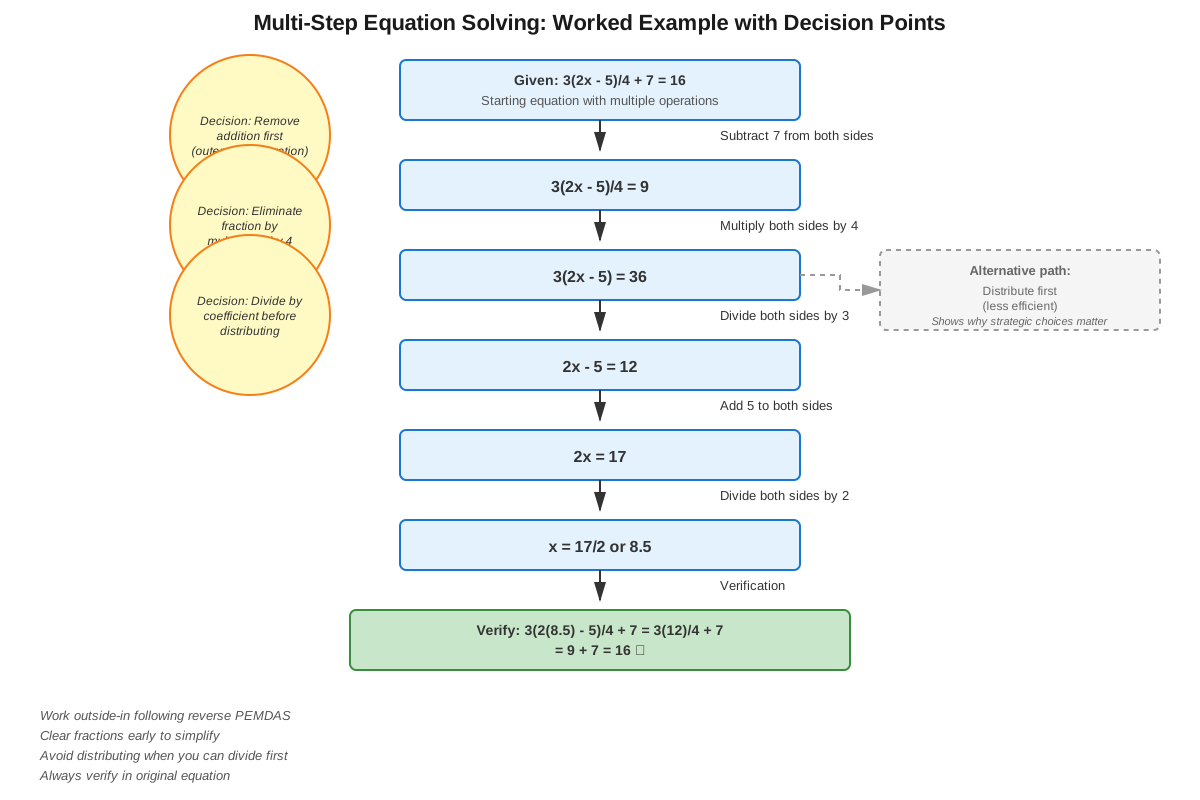
- Simplify first: Distribute, combine like terms, and clear fractions before attempting to isolate the variable
- Work systematically: Apply inverse operations in the correct sequence (reverse PEMDAS)
- Show your work: Even on computer-based tests, use scratch paper to track each step and avoid careless errors
- Verify when possible: If time permits, substitute your answer back into the original equation
Time Management
- Simple linear equations: Allocate 30-45 seconds
- Multi-step equations with distribution: Allocate 60-90 seconds
- Equations with fractions or radicals: Allocate 90-120 seconds
- Formula manipulation questions: Allocate 45-60 seconds
If a problem is taking significantly longer, mark it for review and move on. Many solving for a variable questions are designed to be straightforward—if you're stuck, you may be overcomplicating the approach.
Process of Elimination Tips
When answer choices are given:
- Substitute answer choices: For complex equations, plugging in answer choices may be faster than algebraic solving
- Eliminate by sign: If your equation manipulation shows the answer must be positive, eliminate negative choices immediately
- Eliminate by magnitude: Use estimation to eliminate answers that are clearly too large or too small
- Check units: In word problems, ensure your answer has the correct units
Common Traps to Avoid
- Sign errors: The most common mistake is dropping or incorrectly changing signs when moving terms
- Coefficient confusion: Forgetting to divide by a coefficient after isolating the variable term
- Fraction errors: Incorrectly clearing fractions or making arithmetic mistakes with fractional coefficients
- Incomplete solutions: Stopping before the variable is fully isolated (e.g., finding 2x = 10 but forgetting to divide by 2)
GRE Tip: When solving for a variable in quantitative comparison questions, you often don't need to find the exact value—just determine whether it's positive, negative, or zero, or compare its magnitude to another quantity. This can save significant time.
Memory Techniques
DARC Mnemonic for Solution Steps
Distribute and simplify
Add/subtract to collect like terms
Remove coefficients (multiply/divide)
Check your solution
The "Opposite Operations" Visualization
Imagine the equation as a balance scale. Whatever you do to one side, you must do to the other to keep it balanced. The operations you perform are always opposite to what's being done to the variable:
- Variable is added to something → subtract from both sides
- Variable is multiplied by something → divide both sides
- Variable is squared → take the square root of both sides
The "Unwrapping" Analogy
Think of the variable as a gift wrapped in layers. Each operation applied to the variable is a layer of wrapping paper. To get to the gift (the isolated variable), unwrap the layers in reverse order from how they were applied—the outermost layer (last operation applied) comes off first.
PEMDAS Reversed = SADMEP
When isolating a variable, work in reverse order:
- Subtraction/Addition first
- Division/Multiplication second
- Exponents/Roots last
- Parentheses (innermost operations) last
Summary
Solving for a variable is the foundational algebraic skill that enables success across the entire GRE Quantitative Reasoning section. The core principle—performing identical operations on both sides of an equation to maintain equality—allows systematic isolation of any variable through inverse operations applied in reverse order of PEMDAS. Mastery requires fluency with multiple equation types: linear equations, multi-step equations with distribution, equations with variables on both sides, fractional equations, and equations involving radicals or absolute values. GRE questions test this skill both directly (straightforward equation-solving) and indirectly (embedded within word problems, formula manipulation, and quantitative comparisons). Success depends on recognizing which variable to isolate, simplifying before solving, working systematically through inverse operations, and verifying solutions when time permits. The ability to solve for variables in terms of other variables—not just numerical values—is particularly important for GRE success, as many questions require formula manipulation or algebraic comparison rather than arithmetic calculation.
Key Takeaways
- Maintain equality: Whatever operation you perform on one side must be performed identically on the other side
- Reverse PEMDAS: Undo operations in reverse order—address addition/subtraction first, then multiplication/division, then exponents/roots
- Simplify before solving: Always distribute and combine like terms before attempting to isolate the variable
- Clear fractions early: Multiply by the LCD to eliminate fractions and simplify the solving process
- Verify special cases: Check solutions for radical and absolute value equations, as these can produce extraneous solutions
- Solve for what's asked: Pay careful attention to which variable you need to isolate, especially in multi-variable equations
- Use strategic substitution: When answer choices are provided, substituting them may be faster than algebraic manipulation
Related Topics
Systems of Equations: Building on single-variable solving, systems require solving multiple equations simultaneously using substitution or elimination methods. Mastering solving for a variable is essential before tackling systems.
Inequalities: The techniques for solving inequalities mirror those for equations, with the critical addition that multiplying or dividing by negative numbers reverses the inequality sign.
Functions: Function problems frequently require solving equations to find input values that produce specific outputs, or manipulating function definitions to isolate variables.
Quadratic Equations: These extend solving for a variable to equations where the variable appears to the second power, requiring factoring, completing the square, or the quadratic formula.
Word Problems: Nearly all algebraic word problems require translating verbal descriptions into equations, then solving for the requested variable—making this skill foundational for applied mathematics questions.
Practice CTA
Now that you've mastered the core concepts and strategies for solving for a variable, it's time to cement your understanding through practice. Work through the practice questions to apply these techniques to authentic GRE-style problems, and use the flashcards to reinforce the key principles and common patterns. Remember: solving for a variable is a skill that improves dramatically with deliberate practice. Each problem you solve strengthens your pattern recognition and increases your speed, giving you a significant advantage on test day. You've built the foundation—now build the fluency that leads to a top score!
Sign up free to keep reading
Create a free AnvayaPrep account to finish this GRE guide on Solving for a variable — plus flashcards and practice questions.