Overview
Absolute value equations represent a critical category of algebraic problems that appear frequently on the GRE Quantitative Reasoning section. The absolute value of a number describes its distance from zero on the number line, regardless of direction. When this concept is embedded within equations, it creates unique solving challenges because absolute value expressions can yield two possible scenarios: one where the expression inside is positive or zero, and another where it is negative. Mastering absolute value equations requires understanding this dual nature and systematically considering both cases to find all valid solutions.
The GRE tests absolute value equations both as standalone algebra problems and as components of more complex quantitative comparison questions, data interpretation scenarios, and word problems. Students who can quickly recognize absolute value patterns and apply systematic solution strategies gain significant advantages in both speed and accuracy. These questions typically appear at medium to medium-hard difficulty levels, making them essential for students targeting scores above the 160 mark on the Quantitative section.
Understanding absolute value equations connects directly to broader algebraic reasoning skills tested throughout the GRE. The logical framework used to solve these equations—considering multiple cases, testing solutions, and eliminating extraneous answers—mirrors the analytical thinking required for inequalities, systems of equations, and function problems. Additionally, the number line visualization skills developed through absolute value work strengthen spatial reasoning abilities that prove valuable across geometry and data interpretation questions.
Learning Objectives
- [ ] Identify when Absolute value equations is being tested
- [ ] Explain the core rule or strategy behind Absolute value equations
- [ ] Apply Absolute value equations to GRE-style questions accurately
- [ ] Distinguish between absolute value equations that yield two solutions, one solution, or no solutions
- [ ] Verify solutions by substitution to eliminate extraneous roots
- [ ] Translate word problems involving distance or magnitude into absolute value equations
- [ ] Solve compound absolute value equations involving multiple absolute value expressions
Prerequisites
- Basic algebraic manipulation: Ability to isolate variables, combine like terms, and solve linear equations is essential since absolute value equations reduce to linear equations once cases are separated
- Understanding of inequalities: Familiarity with inequality notation and solution sets helps when working with the range of possible values in absolute value contexts
- Number line concepts: Visualization of positive and negative numbers on a number line provides the geometric intuition underlying absolute value as distance
- Order of operations: Correct sequencing of mathematical operations ensures proper isolation of absolute value expressions before case analysis
Why This Topic Matters
Absolute value equations appear in approximately 5-8% of GRE Quantitative Reasoning questions, making them a high-yield topic for focused study. These questions serve as efficient discriminators between mid-range and high-scoring test-takers because they require both conceptual understanding and procedural accuracy. The GRE particularly favors questions that combine absolute value with other algebraic concepts, such as systems of equations or quadratic expressions, testing multiple skills simultaneously.
Beyond standardized testing, absolute value concepts model real-world situations involving distance, error margins, tolerance levels, and magnitude measurements. Engineers use absolute value when calculating deviations from specifications, economists employ it when measuring economic indicators regardless of direction, and scientists apply it when determining measurement uncertainties. This practical relevance makes absolute value a fundamental mathematical tool across quantitative disciplines.
On the GRE, gre absolute value equations typically appear in several formats: direct algebraic equations requiring solution sets, quantitative comparison questions asking students to compare expressions containing absolute values, word problems describing distance or difference scenarios, and data sufficiency-style questions where students must determine whether given information sufficiently constrains absolute value expressions. Recognizing these patterns allows for rapid question classification and strategy selection.
Core Concepts
Definition of Absolute Value
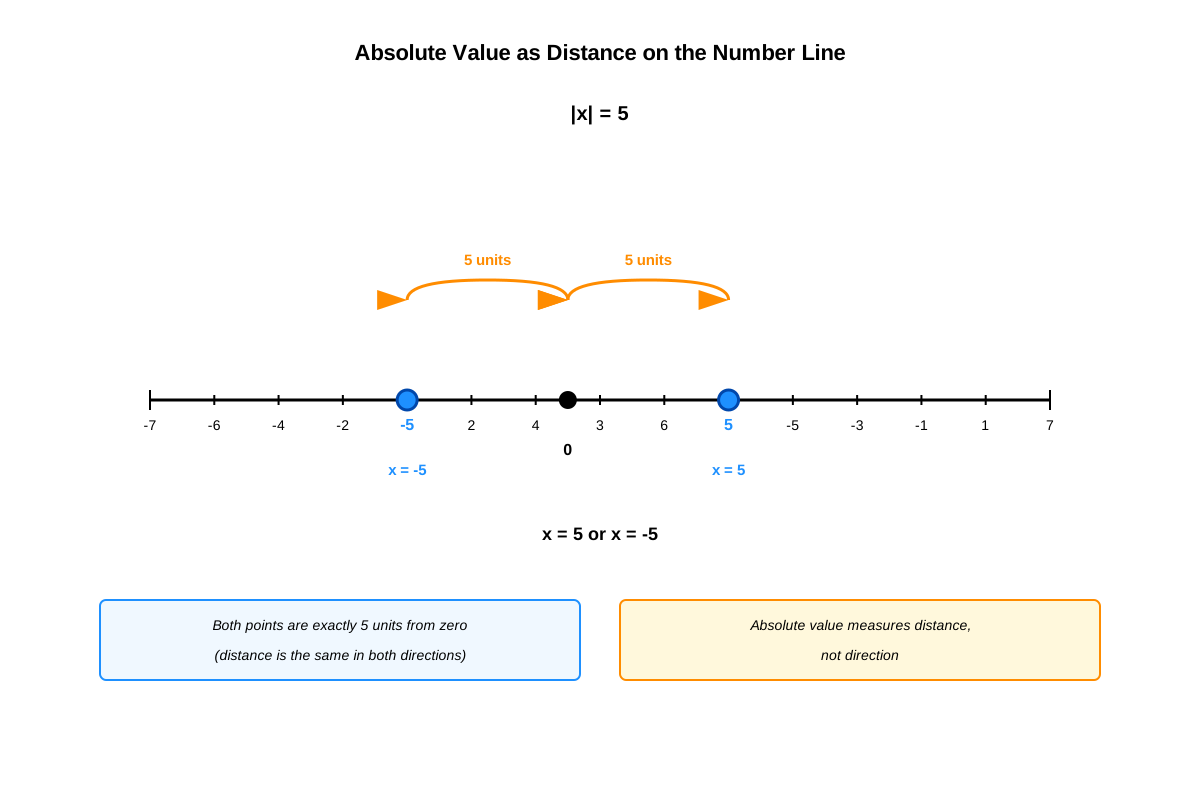
The absolute value of a number x, denoted |x|, represents the distance between x and zero on the number line. By definition:
|x| = x if x ≥ 0
|x| = -x if x < 0
This piecewise definition captures the essential property that absolute value always produces a non-negative result. For example, |5| = 5 and |-5| = 5, because both 5 and -5 are five units away from zero. The absolute value function essentially "strips away" the negative sign from negative numbers while leaving positive numbers unchanged.
Basic Absolute Value Equation Structure
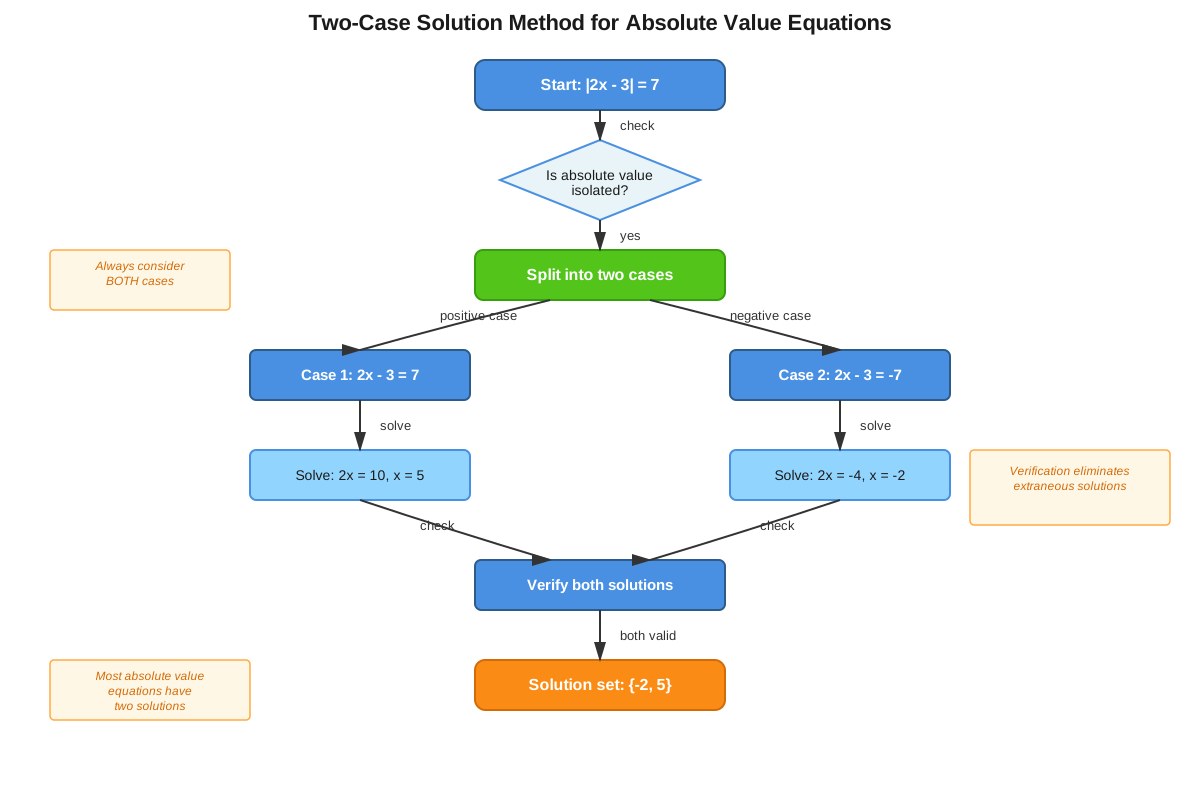
An absolute value equation takes the form |expression| = value, where the expression inside the absolute value bars can be any algebraic expression. The fundamental principle for solving these equations stems from the definition: if |A| = B where B ≥ 0, then either A = B or A = -B. This creates two cases to investigate:
Case 1: The expression inside equals the positive value
Case 2: The expression inside equals the negative value
For example, with |x - 3| = 7:
- Case 1: x - 3 = 7, yielding x = 10
- Case 2: x - 3 = -7, yielding x = -4
Both solutions must be verified by substitution into the original equation.
Systematic Solution Process
The standard procedure for solving absolute value equations follows these steps:
- Isolate the absolute value expression: Manipulate the equation so the absolute value term stands alone on one side
- Check for validity: Ensure the value on the other side is non-negative (if negative, no solution exists)
- Set up two cases: Create two separate equations by setting the inside expression equal to both the positive and negative values
- Solve each case: Use standard algebraic techniques to solve both equations
- Verify solutions: Substitute each solution back into the original equation to confirm validity
Equations with No Solution
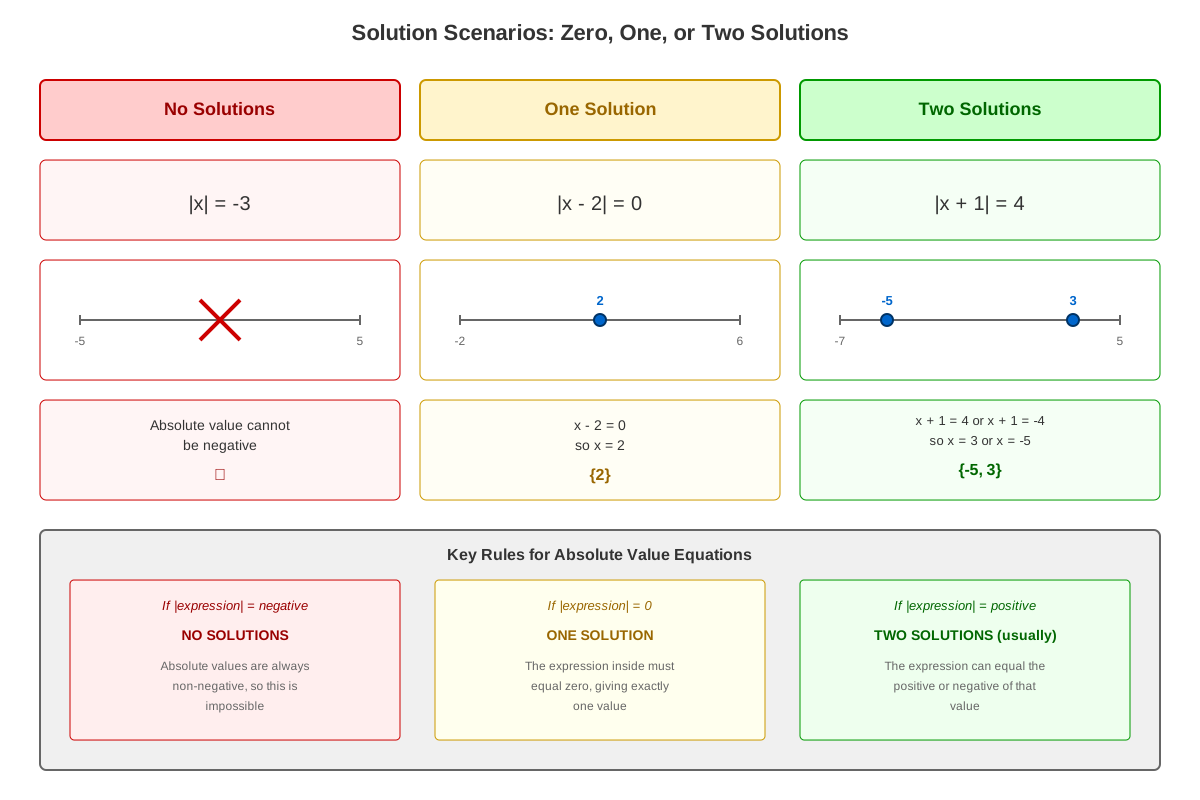
When an absolute value expression is set equal to a negative number, no solution exists because absolute values cannot be negative. For example, |2x + 5| = -3 has no solution. This represents a critical check that students must perform before investing time in case analysis. Similarly, equations like |x| + 5 = 2 simplify to |x| = -3, which also has no solution.
Equations with One Solution
Certain absolute value equations yield only one solution rather than two. This occurs when the expression inside the absolute value equals zero in one of the cases. For example, |x - 4| = 0 has only x = 4 as a solution. Another scenario producing a single solution involves equations where both cases yield the same answer, though this is less common.
Compound Absolute Value Equations
More complex problems involve multiple absolute value expressions, such as |x - 2| = |x + 5|. These require a different approach:
Method 1 - Case Analysis: Consider all combinations of positive and negative cases for each absolute value expression
Method 2 - Geometric Interpretation: Recognize that |x - a| = |x - b| means x is equidistant from a and b, so x is the midpoint
For |x - 2| = |x + 5|:
- The solution is the point equidistant from 2 and -5
- Midpoint: x = (2 + (-5))/2 = -3/2 = -1.5
Absolute Value Equations with Variables on Both Sides
Equations like |3x - 1| = 2x + 5 require careful case analysis:
Case 1: 3x - 1 = 2x + 5
- x = 6
- Verification: |3(6) - 1| = |17| = 17, and 2(6) + 5 = 17 ✓
Case 2: 3x - 1 = -(2x + 5)
- 3x - 1 = -2x - 5
- 5x = -4
- x = -4/5
- Verification: |3(-4/5) - 1| = |-17/5| = 17/5, and 2(-4/5) + 5 = 17/5 ✓
Both solutions are valid.
Extraneous Solutions
Not all algebraic solutions to the case equations satisfy the original absolute value equation. Extraneous solutions arise when the algebraic manipulation introduces solutions that don't work in the original context. This is why verification through substitution is mandatory. For example, in |x| = x - 2:
Case 1: x = x - 2 (leads to 0 = -2, impossible)
Case 2: -x = x - 2, so x = 1
Checking x = 1: |1| = 1, and 1 - 2 = -1. Since 1 ≠ -1, even this solution fails. The equation has no solution.
Absolute Value in Quantitative Comparisons
GRE quantitative comparison questions frequently test absolute value understanding by asking students to compare expressions. Key strategies include:
- Recognizing that |x| ≥ 0 always
- Understanding that |x| = |-x|
- Knowing that |xy| = |x||y|
- Applying the triangle inequality: |x + y| ≤ |x| + |y|
Concept Relationships
The foundation of absolute value equations rests on the definition of absolute value as distance, which connects directly to number line visualization skills. This geometric interpretation → enables → the two-case solution method, recognizing that a point at a fixed distance from zero can lie in either the positive or negative direction.
The two-case method → requires → algebraic manipulation skills to solve the resulting linear equations in each case. These solutions → must undergo → verification through substitution to eliminate extraneous solutions, connecting to the broader algebraic principle that transformations can introduce invalid solutions.
When multiple absolute value expressions appear in a single equation, the problem → extends to → compound absolute value equations, which → can be approached through → either systematic case analysis or geometric midpoint interpretation. This geometric approach → links back to → the distance interpretation of absolute value, creating a conceptual loop.
Absolute value equations → serve as prerequisites for → absolute value inequalities, which introduce solution intervals rather than discrete points. Both concepts → connect to → piecewise functions, where different rules apply in different domains. The logical framework of case analysis → transfers to → other GRE topics including systems of equations, optimization problems, and conditional probability.
Quick check — test yourself on Absolute value equations so far.
Try Flashcards →High-Yield Facts
⭐ The equation |x| = a has two solutions (x = a and x = -a) when a > 0, one solution (x = 0) when a = 0, and no solution when a < 0
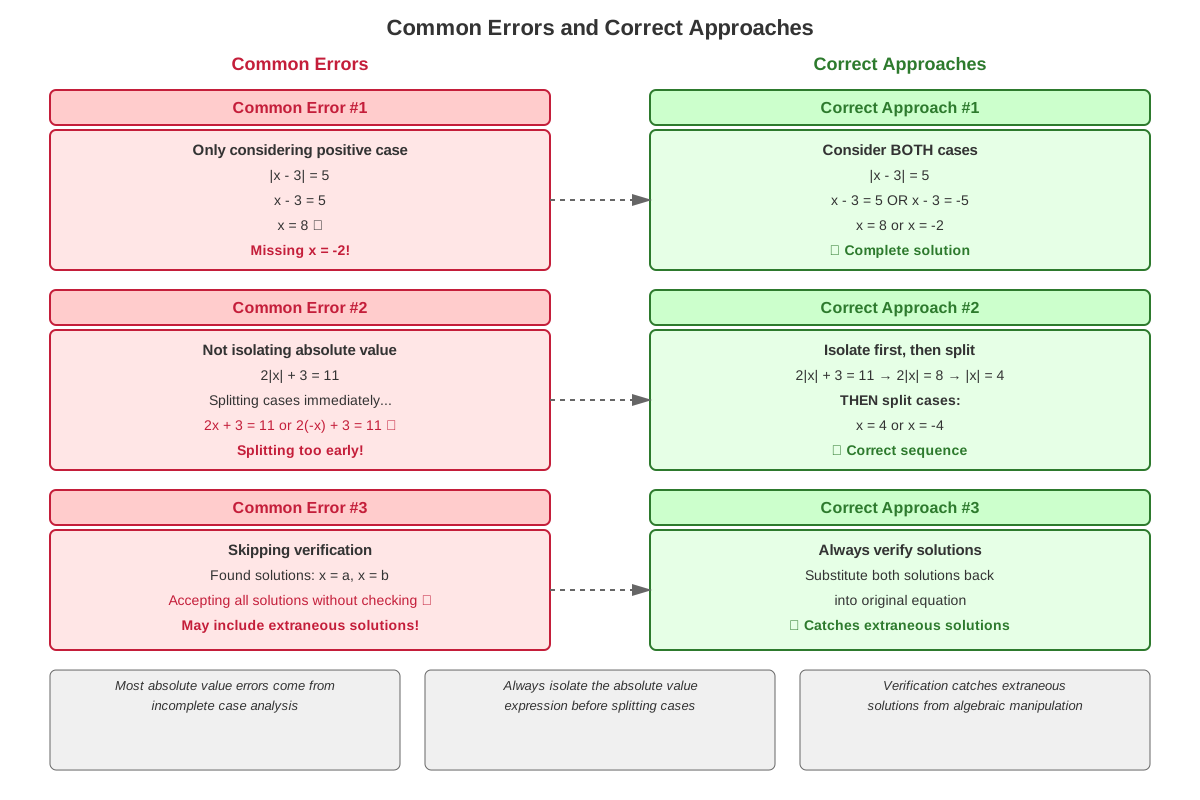
⭐ Always isolate the absolute value expression before setting up cases
⭐ Every solution obtained algebraically must be verified by substitution into the original equation
⭐ For |A| = |B|, either A = B or A = -B, creating two cases to investigate
⭐ If an absolute value expression equals a negative number, the equation has no solution
- The absolute value of a product equals the product of absolute values: |xy| = |x||y|
- The absolute value of a quotient equals the quotient of absolute values: |x/y| = |x|/|y| (when y ≠ 0)
- Absolute value equations can be visualized as finding points at a specific distance from a reference point on the number line
- When solving |ax + b| = c, the two cases are ax + b = c and ax + b = -c
- Compound equations with multiple absolute values may have 0, 1, 2, or more solutions depending on the specific expressions
- The equation |x - a| = d asks "what values of x are exactly d units away from a?"
- Absolute value cannot be distributed over addition: |x + y| ≠ |x| + |y| in general
Common Misconceptions
Misconception: |x| = -x means x is negative → Correction: The equation |x| = -x is satisfied when x ≤ 0, including x = 0. When x is negative, -x is positive, so |x| (which is positive) equals -x (which is also positive). For example, if x = -3, then |x| = 3 and -x = 3.
Misconception: Absolute value equations always have two solutions → Correction: Absolute value equations can have zero, one, or two solutions depending on the equation structure. |x| = -5 has no solutions, |x| = 0 has one solution, and |x| = 5 has two solutions.
Misconception: You can square both sides to eliminate absolute value without considering cases → Correction: While squaring both sides of |A| = B to get A² = B² is mathematically valid, it can introduce extraneous solutions and doesn't provide insight into the case structure. The case method is more reliable and transparent.
Misconception: |x + 3| = 5 means x + 3 = 5 only → Correction: This equation requires considering both x + 3 = 5 AND x + 3 = -5, yielding solutions x = 2 and x = -8. Forgetting the negative case loses half the solutions.
Misconception: If |x| = |y|, then x = y → Correction: The equation |x| = |y| means x and y have the same absolute value, so either x = y OR x = -y. For example, |3| = |-3| but 3 ≠ -3.
Misconception: Absolute value can be distributed over addition like multiplication → Correction: Unlike multiplication where |xy| = |x||y|, the expression |x + y| does NOT equal |x| + |y| in general. For example, |-3 + 5| = |2| = 2, but |-3| + |5| = 3 + 5 = 8.
Misconception: All algebraically derived solutions are valid → Correction: The case-splitting process can introduce extraneous solutions that don't satisfy the original equation. Every solution must be verified through substitution.
Worked Examples
Example 1: Standard Absolute Value Equation
Problem: Solve |2x - 7| = 11
Solution:
Step 1: The absolute value expression is already isolated.
Step 2: Check validity: 11 > 0, so solutions may exist.
Step 3: Set up two cases:
- Case 1: 2x - 7 = 11
- Case 2: 2x - 7 = -11
Step 4: Solve Case 1:
2x - 7 = 11
2x = 18
x = 9
Solve Case 2:
2x - 7 = -11
2x = -4
x = -2
Step 5: Verify x = 9:
|2(9) - 7| = |18 - 7| = |11| = 11 ✓Verify x = -2:
|2(-2) - 7| = |-4 - 7| = |-11| = 11 ✓Answer: x = 9 or x = -2
This example demonstrates the standard two-case approach and emphasizes the importance of verification. Both solutions are valid, which is the typical outcome for absolute value equations where the right side is positive.
Example 2: Compound Absolute Value Equation
Problem: Solve |x + 4| = |2x - 1|
Solution:
Method 1 - Case Analysis:
Since we have two absolute value expressions, we need to consider when each expression is positive or negative.
Case 1: Both expressions are positive (or the expressions are equal)
x + 4 = 2x - 1
4 + 1 = 2x - x
5 = x
Case 2: The expressions are opposites
x + 4 = -(2x - 1)
x + 4 = -2x + 1
3x = -3
x = -1
Verification for x = 5:
|5 + 4| = |9| = 9
|2(5) - 1| = |9| = 9 ✓
Verification for x = -1:
|-1 + 4| = |3| = 3
|2(-1) - 1| = |-3| = 3 ✓
Method 2 - Geometric Interpretation:
The equation |x + 4| = |2x - 1| can be rewritten as |x - (-4)| = |2x - 1|. However, this approach is more complex with coefficients other than 1, so the case method is preferable here.
Answer: x = 5 or x = -1
This example illustrates how compound absolute value equations require systematic case analysis and how both algebraic solutions should be verified to ensure they satisfy the original equation.
Exam Strategy
When approaching GRE absolute value equations, implement this strategic framework:
Recognition triggers: Watch for vertical bars (| |), phrases like "distance from," "how far from," "magnitude," or "regardless of direction." Questions asking for "all possible values" or "the sum of all solutions" signal absolute value scenarios.
Initial assessment (5-10 seconds): Before solving, quickly determine:
- Is the absolute value expression isolated? If not, isolate it first.
- Is the right side negative? If yes, mark "no solution" immediately.
- Are there multiple absolute value expressions? If yes, prepare for case analysis.
Solution pathway selection:
- For simple equations like |x - a| = b: Use the two-case method (fastest)
- For compound equations like |A| = |B|: Consider geometric interpretation if coefficients allow, otherwise use systematic cases
- For equations with variables on both sides: Set up cases carefully and verify thoroughly
Time management: Allocate approximately 1.5-2 minutes for standard absolute value equations. If a problem requires more than 2.5 minutes, consider whether you've missed a shortcut or should strategically guess and move forward.
Process of elimination in multiple choice:
- Eliminate any answer choices that would make the absolute value expression negative
- Test remaining choices by substitution rather than solving algebraically if only 2-3 options remain
- For "which of the following could be x" questions, remember that absolute value equations typically have two solutions
Quantitative comparison strategy: When comparing expressions with absolute values:
- Test x = 0 first (often reveals patterns)
- Test positive and negative values
- Consider extreme cases
- Remember that |x| ≥ 0 always, and |x| ≥ x for all x
Exam Tip: If you're unsure about your algebraic solution, substitute your answer back into the original equation. This verification step takes only 10-15 seconds and can save you from careless errors that cost points.
Memory Techniques
The "Two Roads" Mnemonic: Think of absolute value as standing at a crossroads. When |x - 3| = 7, you're asking "what's 7 units away from 3?" There are always TWO ROADS: one going right (+7) and one going left (-7). This visualization reinforces the two-case structure.
VINE for Solution Steps:
- Verify the right side is non-negative
- Isolate the absolute value
- Negate to create two cases
- Evaluate and verify solutions
The "Distance Detective" Framework: Remember that |x - a| represents the distance from x to a. When solving |x - a| = d, you're a detective finding all points exactly d units from location a. This geometric thinking prevents algebraic errors.
"Bars Mean Barriers": The absolute value bars act as barriers that prevent negative results from escaping. Whatever goes in might be negative, but what comes out is always non-negative. This reinforces why |expression| = negative number has no solution.
The Three-Outcome Rule: Absolute value equations have three possible outcomes—memorize "0, 1, or 2" for the number of solutions. Zero solutions (negative right side), one solution (right side is zero), or two solutions (positive right side).
Summary
Absolute value equations represent a high-yield GRE topic that tests both conceptual understanding and procedural accuracy. The fundamental principle underlying all absolute value equations is that |x| represents distance from zero, which geometrically explains why equations like |A| = B generate two cases: A = B and A = -B. Successful solution requires a systematic five-step process: isolate the absolute value expression, verify the right side is non-negative, set up two cases, solve each case algebraically, and verify all solutions through substitution. Students must recognize that absolute value equations can yield zero, one, or two solutions depending on the structure, and that extraneous solutions can arise during algebraic manipulation. Compound equations with multiple absolute value expressions require careful case analysis or geometric interpretation. The key to GRE success with this topic lies in rapid pattern recognition, systematic case setup, and disciplined verification of all solutions.
Key Takeaways
- Absolute value equations require two-case analysis because |A| = B means A = B or A = -B when B ≥ 0
- Always isolate the absolute value expression before setting up cases, and verify that the right side is non-negative
- Every algebraically derived solution must be verified through substitution to eliminate extraneous solutions
- Absolute value equations can have zero solutions (when equal to negative), one solution (when equal to zero), or two solutions (when equal to positive)
- Geometric interpretation of absolute value as distance provides intuitive understanding and alternative solution methods
- Compound equations with multiple absolute values require systematic case analysis considering all combinations
- Recognition triggers include vertical bars, distance language, and questions asking for "all possible values"
Related Topics
Absolute Value Inequalities: Building directly on absolute value equations, inequalities like |x - 3| < 5 introduce solution intervals rather than discrete points. Mastering equations provides the foundation for understanding the more complex case analysis required for inequalities.
Piecewise Functions: Absolute value functions are special cases of piecewise functions, where different rules apply in different domains. Understanding how to work with absolute value prepares students for more general piecewise function analysis.
Systems of Equations: Compound absolute value equations connect to systems of equations, as both require considering multiple conditions simultaneously and finding values that satisfy all constraints.
Quadratic Equations: Some absolute value equations, when squared to eliminate the absolute value, transform into quadratic equations. Understanding both topics enables flexible problem-solving approaches.
Number Line and Inequalities: The geometric interpretation of absolute value as distance strengthens number line visualization skills essential for inequality problems and understanding solution sets.
Practice CTA
Now that you've mastered the core concepts, solution strategies, and exam approaches for absolute value equations, it's time to solidify your understanding through active practice. Work through the practice questions to apply the two-case method, verify solutions, and build the pattern recognition skills that lead to rapid, accurate performance on test day. Use the flashcards to reinforce key definitions and high-yield facts until they become automatic. Remember: absolute value equations appear frequently on the GRE, and the systematic approach you've learned here will serve you across multiple questions. Your investment in mastering this topic will directly translate to points on exam day!
Sign up free to keep reading
Create a free AnvayaPrep account to finish this GRE guide on Absolute value equations — plus flashcards and practice questions.