Overview
Combining like terms is one of the most fundamental algebraic skills tested on the GRE Quantitative Reasoning section. This technique involves simplifying algebraic expressions by merging terms that share identical variable components and exponents. While the concept may seem elementary, the GRE frequently embeds this skill within more complex problems involving equations, inequalities, functions, and word problems. Mastery of combining like terms enables test-takers to simplify expressions quickly, reduce calculation errors, and reveal solution pathways that might otherwise remain obscured.
On the GRE, GRE combining like terms appears both as a standalone skill and as an essential intermediate step in multi-part problems. Questions may present expressions with multiple variables, fractional coefficients, or nested parentheses that require careful distribution before combining. The ability to recognize when terms can be combined—and when they cannot—directly impacts accuracy and speed. Many students lose points not because they lack algebraic knowledge, but because they incorrectly combine unlike terms or overlook opportunities to simplify before solving.
Understanding combining like terms creates a foundation for virtually all algebraic manipulation on the GRE. This skill connects directly to solving linear equations, factoring polynomials, working with quadratic expressions, and manipulating inequalities. It also supports higher-level quantitative comparison questions where simplification reveals relationships between quantities. Because the GRE emphasizes efficiency and pattern recognition, the automatic ability to combine like terms frees cognitive resources for tackling the conceptual challenges that distinguish high scorers from average performers.
Learning Objectives
- [ ] Identify when combining like terms is being tested in GRE questions
- [ ] Explain the core rule or strategy behind combining like terms
- [ ] Apply combining like terms to GRE-style questions accurately
- [ ] Distinguish between like terms and unlike terms in expressions with multiple variables
- [ ] Simplify complex expressions involving distribution, parentheses, and multiple operations before combining like terms
- [ ] Recognize common GRE traps related to incorrectly combining unlike terms
- [ ] Execute multi-step algebraic simplifications that require combining like terms as an intermediate step
Prerequisites
- Basic arithmetic operations: Addition, subtraction, multiplication, and division with integers, fractions, and decimals are necessary for calculating coefficients when combining terms
- Understanding of variables: Recognition that letters represent unknown quantities and that the same letter in different terms represents the same value
- Exponent rules: Knowledge that x² and x are different terms because they have different exponents, which prevents incorrect combination
- Order of operations (PEMDAS): Essential for knowing when to distribute before combining and how to handle expressions with parentheses
- Coefficient identification: Ability to recognize that in 5x, the number 5 is the coefficient and x is the variable component
Why This Topic Matters
Combining like terms appears in approximately 15-20% of GRE Quantitative Reasoning questions, either directly or as a necessary step toward the solution. This frequency makes it one of the highest-yield algebra skills for test preparation. The skill appears across multiple question formats: Problem Solving questions that require simplification before solving, Quantitative Comparison questions where simplification reveals which quantity is larger, and Data Interpretation questions where algebraic expressions model relationships in tables or graphs.
In real-world applications, combining like terms represents the mathematical foundation for budgeting (combining similar expense categories), physics (adding force vectors with the same direction), and data analysis (aggregating similar variables in statistical models). For graduate students, this skill underpins more advanced mathematics used in economics, engineering, and scientific research.
On the GRE specifically, combining like terms commonly appears in these contexts: simplifying expressions before solving for a variable, reducing complex fractions with algebraic numerators or denominators, working with perimeter and area formulas that generate algebraic expressions, and manipulating inequalities where simplification determines the solution set. The GRE also tests this skill indirectly through word problems that require translating verbal descriptions into algebraic expressions that must then be simplified. Test-makers deliberately create expressions with multiple terms that can be combined, knowing that students who skip this simplification step will face unnecessarily complex calculations or may select distractor answer choices designed to catch this specific error.
Core Concepts
Definition of Like Terms
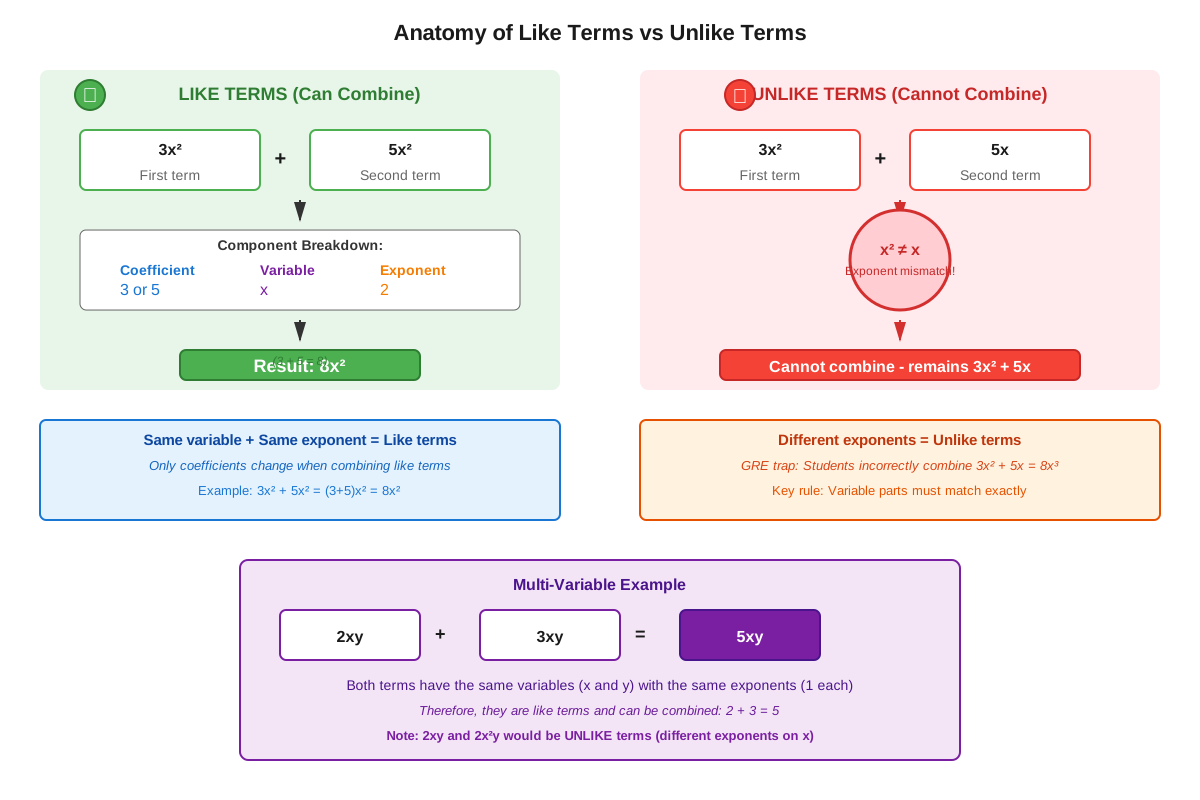
Like terms are terms in an algebraic expression that have identical variable parts, including both the variables themselves and their exponents. The coefficients (numerical multipliers) may differ, but the variable component must match exactly. For example, 3x and 7x are like terms because both contain the variable x raised to the first power. Similarly, 4x²y and -2x²y are like terms because both contain x² and y with the same exponents.
Unlike terms cannot be combined through addition or subtraction. For instance, 5x and 5y are unlike terms because they contain different variables. Likewise, 3x² and 3x are unlike terms because the exponents differ (2 versus 1). The term 8 (a constant) and 8x are also unlike terms—constants can only be combined with other constants.
The Core Rule for Combining Like Terms
When combining like terms, add or subtract only the coefficients while keeping the variable part unchanged. This rule derives from the distributive property of multiplication over addition: ax + bx = (a + b)x. The variable component factors out, leaving only the coefficients to be combined.
Step-by-step process:
- Identify all terms in the expression
- Group terms with identical variable parts (including exponents)
- Add or subtract the coefficients of like terms
- Attach the common variable part to the result
- Write the simplified expression with all remaining terms
For example, to simplify 5x + 3y - 2x + 7y:
- Group x terms: 5x and -2x
- Group y terms: 3y and 7y
- Combine x terms: 5x - 2x = 3x
- Combine y terms: 3y + 7y = 10y
- Final result: 3x + 10y
Working with Multiple Variables
Expressions with multiple variables require careful attention to which terms can be combined. Consider the expression: 4a + 3b - 2a + 5c + b - 3c
| Variable | Terms Present | Combination | Result |
|---|---|---|---|
| a | 4a, -2a | 4a - 2a | 2a |
| b | 3b, b | 3b + 1b | 4b |
| c | 5c, -3c | 5c - 3c | 2c |
The simplified expression is: 2a + 4b + 2c
Notice that terms with different variables remain separate in the final answer. This is a critical concept: simplification through combining like terms reduces the number of terms but does not eliminate variables.
Handling Exponents and Powers
Terms are like only when their variable parts are identical, which includes matching exponents. The expression 2x³ + 5x² - x³ + 3x contains three different types of terms:
- x³ terms: 2x³ and -x³ combine to give x³
- x² terms: only 5x² (cannot be combined with anything)
- x terms: only 3x (cannot be combined with anything)
Final simplified form: x³ + 5x² + 3x
A common error is attempting to combine x² and x, which violates the fundamental rule. These represent fundamentally different quantities: x² means x multiplied by itself, while x stands alone.
Combining Terms with Coefficients of Different Types
Like terms can have coefficients that are integers, fractions, or decimals. The combining process remains the same—add or subtract the coefficients:
Example: (1/2)x + (3/4)x - (1/4)x
To combine, find a common denominator:
- (2/4)x + (3/4)x - (1/4)x = (2 + 3 - 1)/4 · x = (4/4)x = x
Example with decimals: 0.5y + 1.3y - 0.8y = (0.5 + 1.3 - 0.8)y = 1.0y = y
Distribution Before Combining
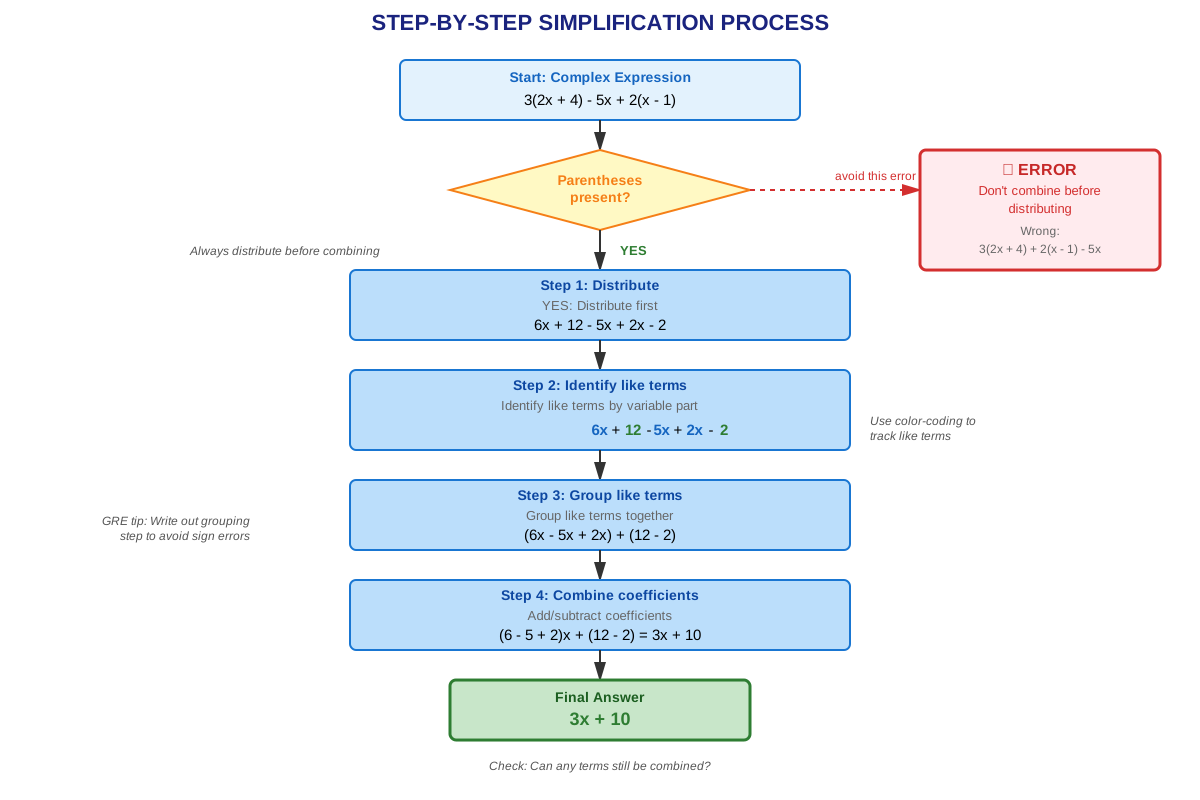
Many GRE problems require distribution (applying the distributive property) before like terms become apparent. Consider: 3(2x + 4) - 2(x - 5)
First distribute:
- 3(2x + 4) = 6x + 12
- -2(x - 5) = -2x + 10
Now the expression is: 6x + 12 - 2x + 10
Combine like terms:
- x terms: 6x - 2x = 4x
- Constants: 12 + 10 = 22
Final result: 4x + 22
Combining Terms with Multiple Variables in Each Term
When terms contain products of multiple variables, all variable factors must match for terms to be like. Consider: 3xy + 2x²y - 5xy + 4xy²
Analysis:
- xy terms: 3xy and -5xy combine to give -2xy
- x²y terms: only 2x²y (different from xy because of the x² factor)
- xy² terms: only 4xy² (different from xy because of the y² factor)
Final form: -2xy + 2x²y + 4xy²
Note that xy and yx are the same (commutative property of multiplication), so 3xy and 2yx would be like terms that combine to 5xy.
Concept Relationships
The skill of combining like terms serves as a foundational node in the network of algebraic concepts tested on the GRE. Variable recognition (prerequisite) → Identifying like terms → Combining like terms → Simplifying expressions represents the basic progression. This simplified expression then enables solving equations, where combining like terms on each side of an equation often precedes isolating the variable.
The relationship extends to factoring, which can be viewed as the reverse process: while combining like terms takes 3x + 5x and produces 8x, factoring takes 8x and expresses it as 8(x) or 4(2x). Understanding this bidirectional relationship deepens algebraic fluency.
Distribution (applying the distributive property) frequently precedes combining like terms in multi-step problems. The sequence Distribution → Combining like terms → Solving appears in countless GRE questions. Similarly, order of operations governs when combining can occur—terms within parentheses must be addressed before combining with terms outside.
Combining like terms also connects horizontally to working with polynomials, where expressions like 3x² + 5x - 2 + 4x² - 3x + 7 require combining like terms to achieve standard form (7x² + 2x + 5). This skill then supports polynomial operations such as addition, subtraction, and multiplication of polynomials.
The concept extends to inequalities, where combining like terms on each side before isolating the variable follows the same rules as with equations. It also appears in systems of equations, where adding or subtracting equations often creates opportunities to combine like terms before solving.
Quick check — test yourself on Combining like terms so far.
Try Flashcards →High-Yield Facts
⭐ Like terms must have identical variable parts, including the same variables with the same exponents
⭐ When combining like terms, add or subtract only the coefficients; the variable part remains unchanged
⭐ Constants (numbers without variables) can only be combined with other constants
⭐ The terms 3x and 3x² are NOT like terms and cannot be combined
⭐ Distribution must be completed before identifying and combining like terms
- The order of terms in the final simplified expression does not affect correctness (3x + 5y equals 5y + 3x)
- Terms with different variables (like 4x and 4y) cannot be combined, even if coefficients are identical
- The coefficient 1 is often invisible: x means 1x, so x + 3x = 4x
- Negative signs belong to the term that follows: in 5x - 3x, the second term is -3x
- Terms like xy and yx are like terms because multiplication is commutative (xy = yx)
- When subtracting expressions in parentheses, distribute the negative sign to all terms inside: -(3x + 2) = -3x - 2
- Zero coefficients eliminate terms: if 5x - 5x = 0x, the term disappears from the expression
- Fractional coefficients combine using common denominators: (1/3)x + (1/2)x = (5/6)x
Common Misconceptions
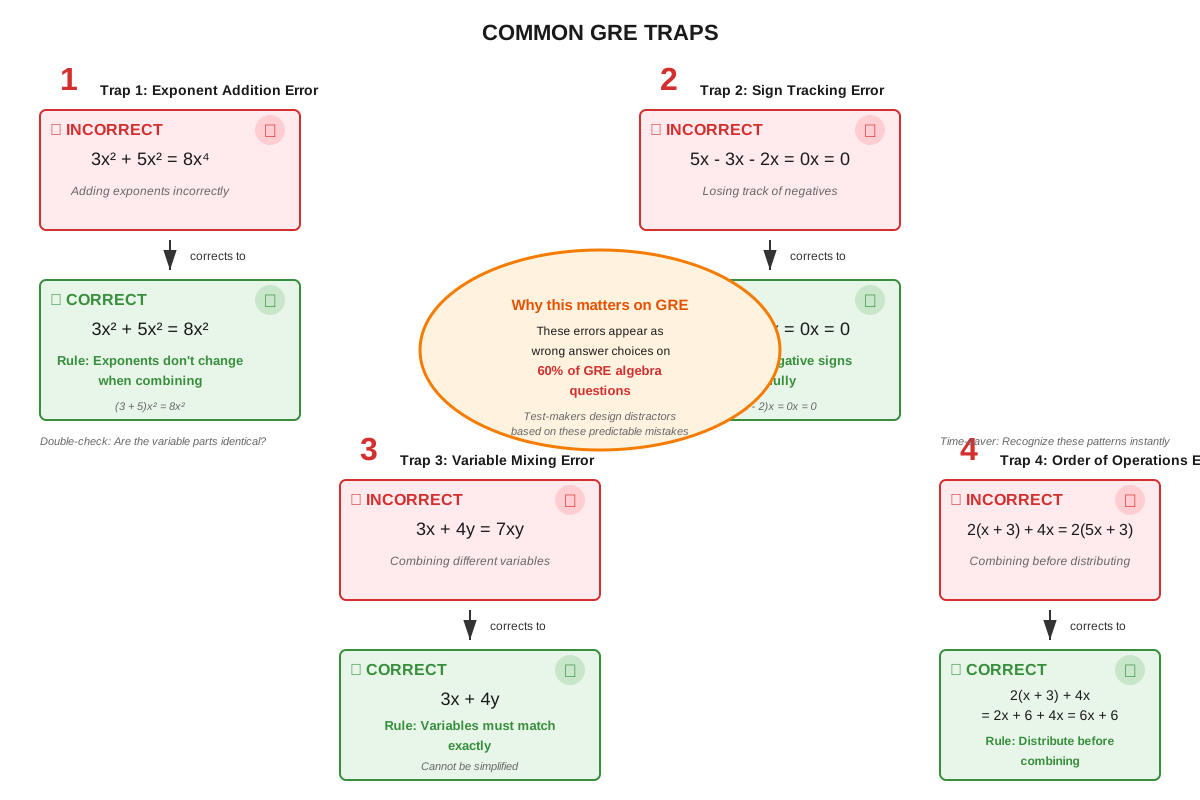
Misconception: Terms with the same coefficient are like terms → Correction: Like terms require identical variable parts, not identical coefficients. The terms 5x and 5y have the same coefficient (5) but different variables, making them unlike terms that cannot be combined.
Misconception: x² and x can be combined because they both contain x → Correction: The exponents must match exactly. x² represents x·x while x represents x¹, making these fundamentally different quantities. Attempting to combine them (incorrectly writing x² + x = x³) is a serious algebraic error.
Misconception: When combining 3x + 5x, multiply the coefficients to get 15x → Correction: Combining like terms requires adding (or subtracting) coefficients, not multiplying them. The correct result is 3x + 5x = 8x. Multiplication of terms creates a different operation entirely: (3x)(5x) = 15x².
Misconception: The expression 4xy + 3x cannot be simplified → Correction: This is actually correct—these are unlike terms. However, students sometimes incorrectly believe they should combine them, writing something like 7x²y. The misconception here is thinking that all terms in an expression must be combined; many expressions are already in simplest form with unlike terms remaining separate.
Misconception: After distributing -(2x - 5), the result is -2x - 5 → Correction: The negative sign must distribute to both terms inside the parentheses. The correct result is -2x + 5. This error stems from forgetting that subtracting a negative gives a positive: -1(2x - 5) = -2x - (-5) = -2x + 5.
Misconception: In the expression 3 + 5x, the 3 and 5 can be combined to get 8x → Correction: The number 3 is a constant term while 5x contains a variable. These are unlike terms. The constant 3 can only be combined with other constants, and 5x can only be combined with other terms containing x to the first power.
Misconception: Simplifying 2x + 3y means finding a numerical answer → Correction: Simplification means reducing an expression to its most compact form, which often still contains variables. Unless values are given for x and y, the expression 2x + 3y is already simplified and represents the final answer.
Worked Examples
Example 1: Multi-Variable Expression with Distribution
Problem: Simplify the expression: 4(2x - 3y) - 3(x - 4y) + 5x
Solution:
Step 1: Distribute the coefficients to terms inside parentheses
- 4(2x - 3y) = 8x - 12y
- -3(x - 4y) = -3x + 12y (note: negative times negative gives positive)
- The 5x remains as is
Step 2: Rewrite the entire expression with distributed terms
8x - 12y - 3x + 12y + 5x
Step 3: Identify and group like terms
- Terms with x: 8x, -3x, 5x
- Terms with y: -12y, 12y
Step 4: Combine coefficients of like terms
- x terms: 8x - 3x + 5x = (8 - 3 + 5)x = 10x
- y terms: -12y + 12y = 0y = 0 (this term disappears)
Step 5: Write the final simplified expression
10x
Connection to learning objectives: This problem demonstrates identifying when combining like terms is needed (after distribution), applying the core strategy (combining coefficients of identical variable parts), and executing the process accurately in a GRE-style multi-step problem.
Example 2: Expression with Multiple Variables and Exponents
Problem: Simplify: 3a²b - 2ab² + 5ab - 4a²b + 3ab² - 2ab + 7
Solution:
Step 1: Identify all distinct types of terms by their variable parts
- a²b terms: 3a²b and -4a²b
- ab² terms: -2ab² and 3ab²
- ab terms: 5ab and -2ab
- Constant terms: 7
Step 2: Combine each group of like terms
For a²b terms:
3a²b - 4a²b = (3 - 4)a²b = -1a²b = -a²b
For ab² terms:
-2ab² + 3ab² = (-2 + 3)ab² = 1ab² = ab²
For ab terms:
5ab - 2ab = (5 - 2)ab = 3ab
For constant terms:
Only 7 (nothing to combine)
Step 3: Write all terms in the simplified expression
-a²b + ab² + 3ab + 7
Alternative acceptable form: 7 + 3ab + ab² - a²b (order doesn't matter, though descending exponent order is conventional)
Connection to learning objectives: This example shows how to distinguish between like and unlike terms when multiple variables and exponents are present—a common GRE challenge. Terms like a²b and ab² appear similar but are unlike terms because the exponents on different variables don't match. This problem also reinforces that simplification doesn't always reduce the number of terms dramatically; sometimes expressions are already relatively simple.
Exam Strategy
When approaching GRE questions involving combining like terms, begin by scanning the expression for opportunities to simplify before attempting any calculations. Many test-takers waste time working with unnecessarily complex expressions because they skip this crucial first step. If the question asks you to solve an equation or compare quantities, simplifying through combining like terms should be your first move.
Trigger words and phrases that signal combining like terms may be needed:
- "Simplify the expression"
- "Which of the following is equivalent to..."
- "If the expression is simplified..."
- "Reduce to simplest form"
- Questions presenting long expressions with multiple similar-looking terms
- Quantitative comparison questions with algebraic expressions in both columns
Process-of-elimination strategy: When answer choices are given, look for options that violate the rules of combining like terms. Eliminate any choice that:
- Combines unlike terms (e.g., adds x² and x to get x³)
- Multiplies coefficients instead of adding them
- Loses or gains variables that should remain
- Has an incorrect number of terms (if you know 3 types of unlike terms exist, the answer must have 3 terms)
Time allocation: Combining like terms should take 15-30 seconds for straightforward expressions and up to 60 seconds for complex expressions requiring distribution. If you find yourself spending more time, you may be making the problem harder than necessary. Consider whether you've correctly identified like terms or whether you're attempting to combine terms that should remain separate.
Common GRE traps specific to this topic:
- Presenting answer choices where one option incorrectly combines unlike terms (designed to catch students who aren't careful about matching exponents)
- Including negative signs before parentheses to test whether students correctly distribute the negative
- Using fractional or decimal coefficients to slow down students who aren't comfortable with these operations
- Creating expressions where some terms combine to zero, testing whether students recognize that 0x = 0 and disappears
Strategic approach for Quantitative Comparison questions: When both columns contain algebraic expressions, immediately look for opportunities to simplify each side by combining like terms. Often, simplification reveals that the expressions are identical (answer: C) or makes the comparison obvious. You can also subtract the same terms from both columns—this is essentially combining like terms across the comparison.
Memory Techniques
SAVE mnemonic for the combining process:
- Same variables? Check that variables match exactly
- Add/subtract coefficients only
- Variable part stays the same
- Exponents must match
Visualization strategy: Picture like terms as similar objects that can be grouped together. If 3x represents 3 red boxes and 5x represents 5 red boxes, combining them gives 8 red boxes (8x). But 3x (red boxes) and 3y (blue boxes) cannot be combined because they're different types of objects, even though you have 3 of each.
The "Fruit Salad" analogy: You can combine 3 apples + 5 apples = 8 apples, but you cannot combine 3 apples + 5 oranges into "8 apple-oranges." The fruits must be the same type, just as variables must match exactly.
Coefficient Rule reminder: "Coefficients combine, variables survive unchanged." This rhyme reinforces that only the numbers change when combining like terms.
Exponent matching check: Before combining, ask "Same variable, same power?" If the answer to both is yes, the terms can combine. If either answer is no, they cannot.
Distribution reminder: "Distribute before you consolidate." Always complete distribution (multiplying through parentheses) before attempting to identify and combine like terms.
Summary
Combining like terms is an essential algebraic simplification technique that appears throughout the GRE Quantitative Reasoning section. The core principle requires identifying terms with identical variable components (including matching exponents) and then adding or subtracting only their coefficients while keeping the variable part unchanged. This skill serves as a foundational step in solving equations, simplifying expressions, and comparing algebraic quantities. Success requires careful attention to which terms are truly "like"—terms must match in both variables and exponents, not just coefficients. Distribution often precedes combining like terms in multi-step problems, and recognizing when terms cannot be combined is equally important as knowing when they can. Mastery of this topic directly impacts speed and accuracy across numerous GRE question types, making it a high-yield area for focused practice.
Key Takeaways
- Like terms have identical variable parts with matching exponents; only their coefficients may differ
- Combine like terms by adding or subtracting coefficients while keeping the variable component unchanged
- Terms with different variables (3x and 3y) or different exponents (x² and x) cannot be combined
- Always distribute before attempting to identify and combine like terms in expressions with parentheses
- Constants can only be combined with other constants, not with variable terms
- Combining like terms is a critical first step in solving equations and simplifying expressions on the GRE
- Recognizing when terms cannot be combined prevents common errors and saves time on test day
Related Topics
Solving Linear Equations: After mastering combining like terms, the next progression involves using this skill to isolate variables and solve for unknown values. Combining like terms on each side of an equation before moving terms across the equals sign is standard procedure.
Factoring Algebraic Expressions: Factoring represents the inverse operation of combining like terms. Understanding how terms combine helps recognize common factors that can be extracted from expressions.
Polynomial Operations: Adding, subtracting, and multiplying polynomials all require combining like terms as a final simplification step. This topic extends the basic skill to more complex expressions.
Systems of Equations: When solving systems using elimination or substitution, combining like terms often appears when adding or subtracting equations or when simplifying substituted expressions.
Quadratic Equations: Working with quadratic expressions in standard form (ax² + bx + c) requires combining like terms to consolidate x² terms, x terms, and constants before solving or factoring.
Practice CTA
Now that you understand the principles and strategies for combining like terms, it's time to reinforce your learning through active practice. Attempt the practice questions designed for this topic, focusing on accuracy first and speed second. Use the flashcards to drill the key concepts until identifying and combining like terms becomes automatic. Remember that this foundational skill appears in countless GRE problems, so time invested in mastering it now will pay dividends throughout your preparation. Each practice problem you complete strengthens your pattern recognition and builds the confidence needed to tackle algebraic expressions efficiently on test day. You've got this!
Sign up free to keep reading
Create a free AnvayaPrep account to finish this GRE guide on Combining like terms — plus flashcards and practice questions.