Overview
Completing the square is a fundamental algebraic technique that transforms quadratic expressions into a perfect square trinomial plus or minus a constant. This method serves as a bridge between standard form quadratic equations and their vertex form, revealing critical information about parabolas including their vertex coordinates, axis of symmetry, and minimum or maximum values. On the GRE, this technique appears both directly—where test-takers must manipulate expressions—and indirectly, as the underlying mechanism for understanding quadratic relationships, circle equations, and optimization problems.
The importance of GRE completing the square extends beyond simple algebraic manipulation. This technique underpins multiple high-yield question types in the Quantitative Reasoning section, including coordinate geometry problems involving circles and parabolas, word problems requiring optimization, and data interpretation questions where understanding the vertex of a quadratic function provides the key to finding maximum or minimum values. Mastery of this topic enables efficient problem-solving and often reveals elegant shortcuts that save precious time during the exam.
Within the broader landscape of GRE Quantitative Reasoning, completing the square connects algebraic manipulation skills with geometric interpretation. It builds upon foundational knowledge of polynomial operations and factoring while serving as a gateway to more advanced topics like conic sections and function transformations. Students who master this technique gain a powerful tool that enhances their ability to tackle complex multi-step problems and recognize patterns that lead to rapid solutions.
Learning Objectives
- [ ] Identify when completing the square is being tested in GRE questions
- [ ] Explain the core rule or strategy behind completing the square
- [ ] Apply completing the square to GRE-style questions accurately
- [ ] Convert quadratic expressions from standard form to vertex form using completing the square
- [ ] Determine the vertex, axis of symmetry, and extreme values of quadratic functions
- [ ] Recognize and manipulate circle equations using completing the square techniques
- [ ] Solve optimization problems that require completing the square as an intermediate step
Prerequisites
- Polynomial operations (addition, subtraction, multiplication): Essential for manipulating terms when rearranging quadratic expressions and expanding perfect square trinomials
- Factoring techniques: Understanding how to recognize and create perfect square trinomials forms the conceptual foundation for completing the square
- Properties of exponents: Necessary for working with squared terms and understanding why certain algebraic manipulations preserve equality
- Basic equation solving: Required to isolate variables and maintain equation balance throughout the completing the square process
- Understanding of quadratic functions: Provides context for why completing the square reveals useful information about parabolas and their properties
Why This Topic Matters
Completing the square represents one of the most versatile algebraic techniques tested on the GRE, appearing in approximately 8-12% of Quantitative Reasoning questions either directly or as a necessary intermediate step. This frequency makes it a high-yield topic worthy of thorough mastery. Beyond its direct applications, the technique demonstrates mathematical reasoning skills that the GRE values: the ability to transform expressions strategically, recognize underlying patterns, and connect algebraic and geometric representations.
In real-world applications, completing the square enables professionals to optimize functions in business (maximizing profit, minimizing cost), physics (analyzing projectile motion), and engineering (designing parabolic structures). The vertex form obtained through completing the square immediately reveals the optimal value of a quadratic function—information that would require calculus or graphing technology to obtain otherwise.
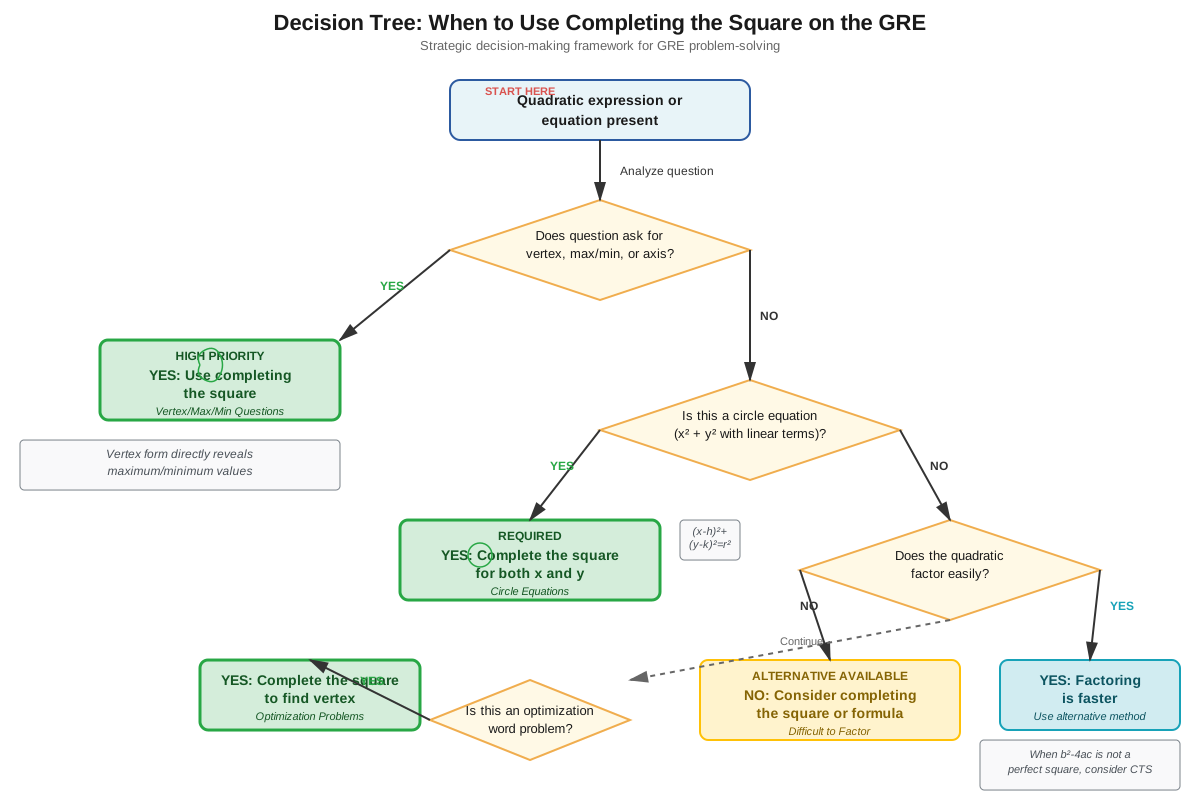
On the GRE, this topic commonly appears in several question formats: Quantitative Comparison questions asking students to compare expressions or function values; Problem Solving questions requiring identification of maximum or minimum values; Data Interpretation questions where understanding the vertex of a parabolic trend line aids analysis; and Coordinate Geometry questions involving circles or parabolas. The technique also appears implicitly in questions about the quadratic formula, since the formula itself derives from completing the square. Test-makers favor this topic because it efficiently assesses multiple competencies: algebraic manipulation, strategic thinking, and the ability to connect symbolic and graphical representations.
Core Concepts
The Perfect Square Trinomial Foundation
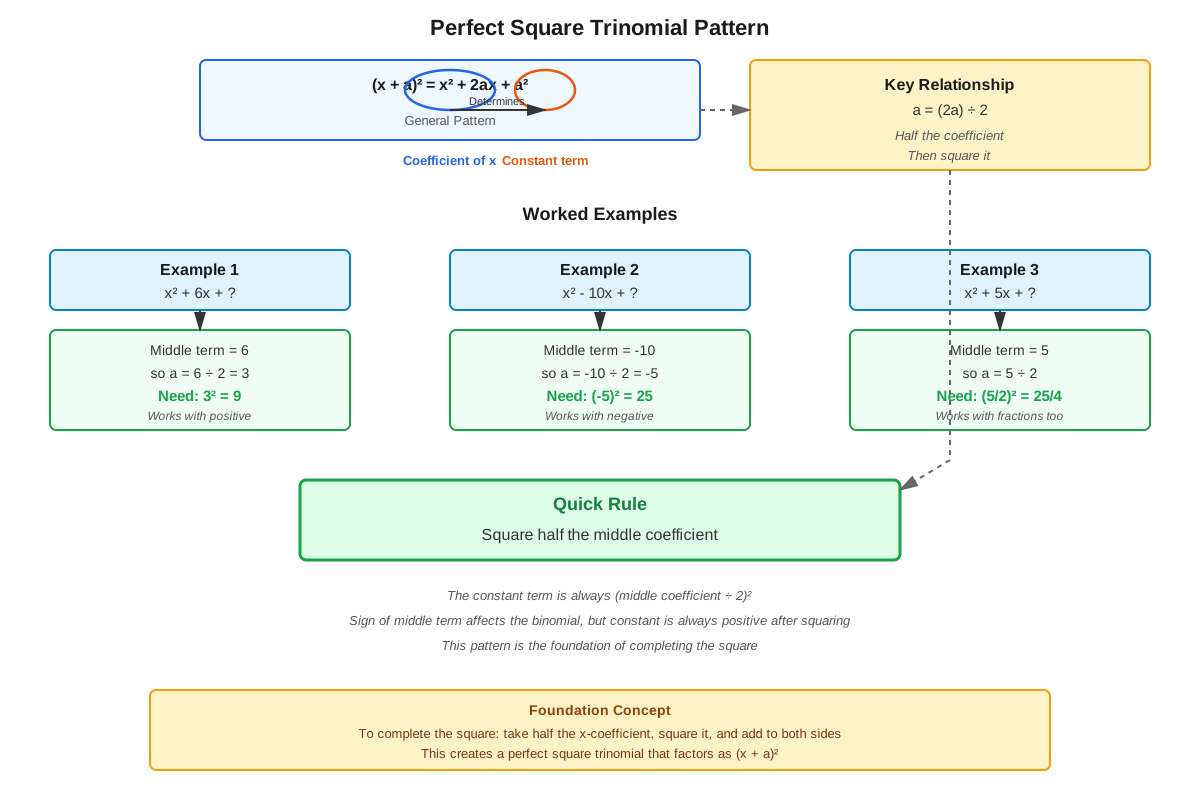
The technique of completing the square relies on recognizing and creating perfect square trinomials—expressions that can be written as the square of a binomial. The fundamental pattern is:
(x + a)² = x² + 2ax + a²This expansion reveals the critical relationship: in any perfect square trinomial, the constant term equals the square of half the coefficient of the linear term. Specifically, if the coefficient of x is b, then the constant needed to complete the square is (b/2)². This relationship forms the algorithmic core of the technique.
Understanding this pattern enables recognition of when an expression is already a perfect square and, more importantly, what term must be added to make an incomplete expression into a perfect square. For example, x² + 10x requires adding (10/2)² = 25 to become the perfect square trinomial x² + 10x + 25 = (x + 5)².
The Standard Algorithm for Completing the Square
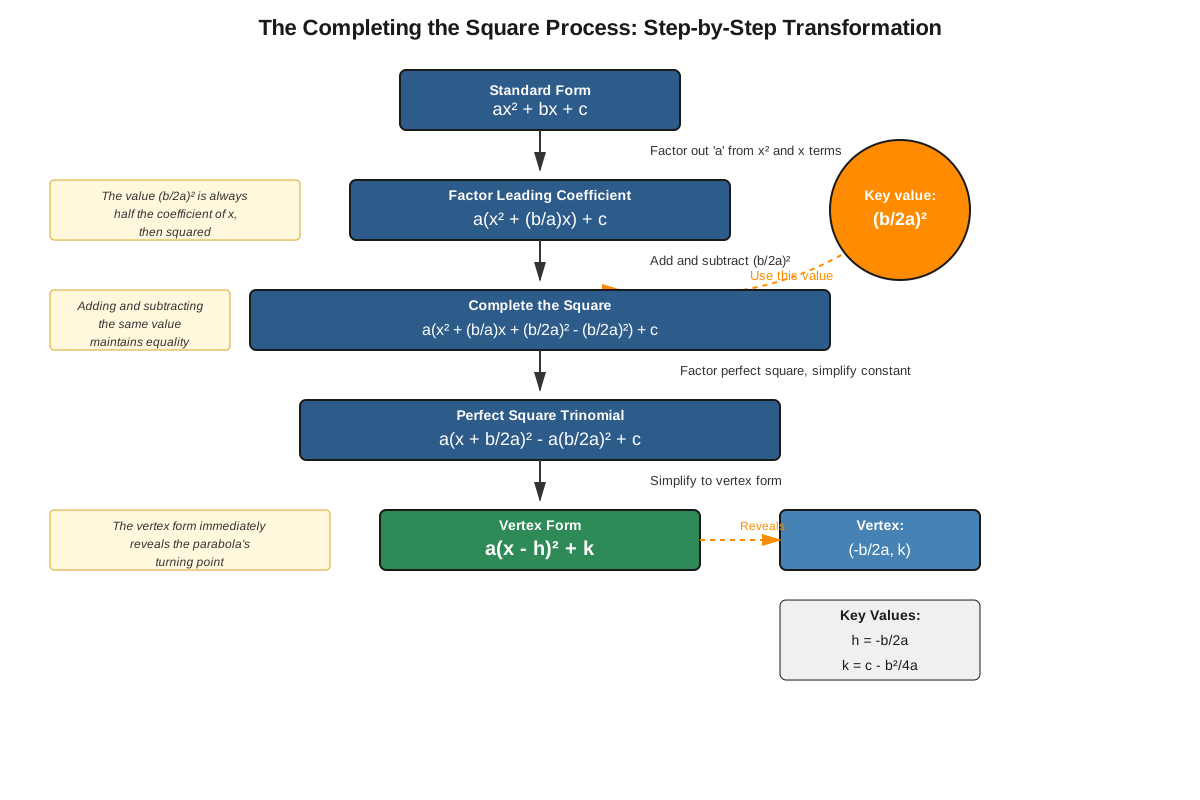
The systematic process for completing the square on a quadratic expression ax² + bx + c follows these steps:
- Ensure the leading coefficient is 1: If a ≠ 1, factor out the coefficient from the x² and x terms (but not from the constant term initially)
- Identify the coefficient of x: Call this value b
- Calculate (b/2)²: This is the term needed to complete the square
- Add and subtract (b/2)²: This maintains equality while creating a perfect square trinomial
- Factor the perfect square trinomial: Write it as (x + b/2)²
- Simplify the remaining constant terms: Combine any constants outside the squared term
For example, to complete the square on x² + 8x + 3:
x² + 8x + 3
= x² + 8x + (8/2)² - (8/2)² + 3
= x² + 8x + 16 - 16 + 3
= (x + 4)² - 13
This vertex form immediately reveals that the expression has a minimum value of -13, occurring when x = -4.
Handling Non-Unit Leading Coefficients
When the coefficient of x² is not 1, an additional step is required. Consider 2x² + 12x + 7:
- Factor out the leading coefficient from only the x² and x terms:
`math
2(x² + 6x) + 7
`
- Complete the square inside the parentheses:
`math
2(x² + 6x + 9 - 9) + 7
= 2((x + 3)² - 9) + 7
`
- Distribute and simplify:
`math
= 2(x + 3)² - 18 + 7
= 2(x + 3)² - 11
`
The critical insight here is that when you add a value inside parentheses that are multiplied by a coefficient, you're actually adding that coefficient times that value to the entire expression. This is why we must subtract 2(9) = 18 outside the parentheses to maintain equality.
Converting to Vertex Form
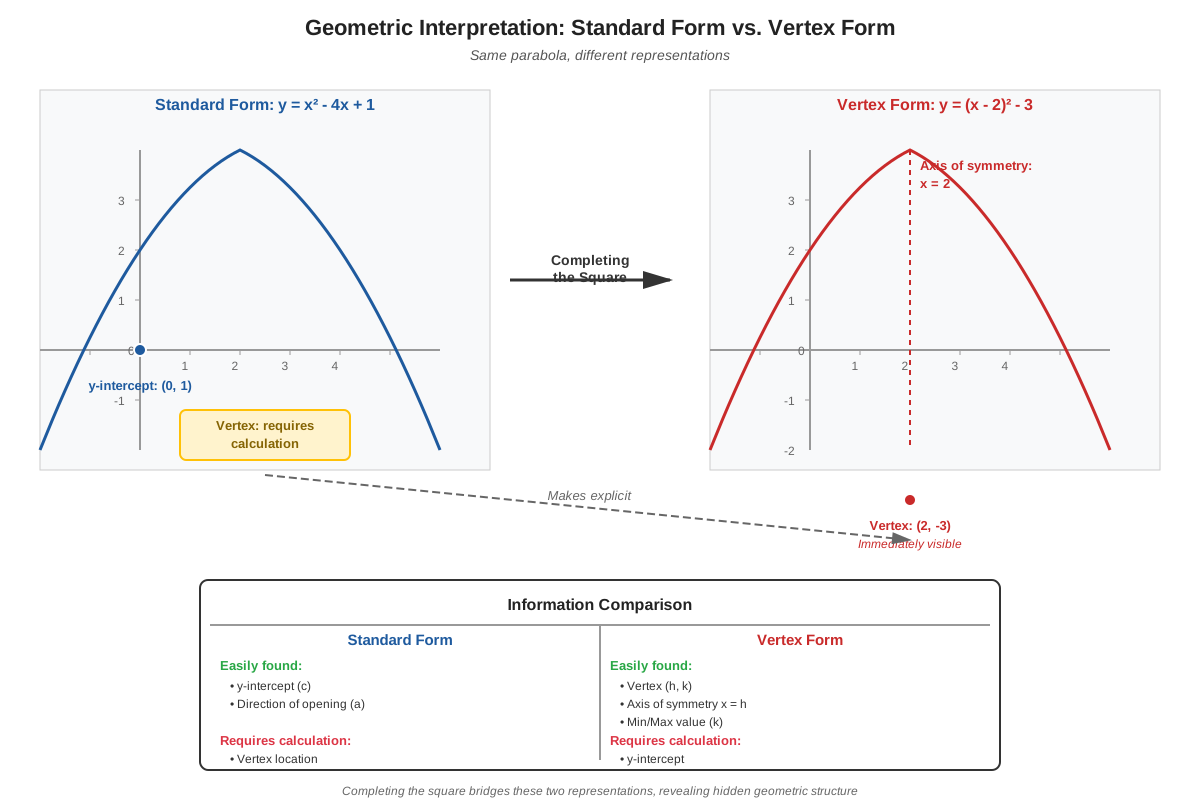
The primary application of completing the square is converting quadratic functions from standard form (f(x) = ax² + bx + c) to vertex form (f(x) = a(x - h)² + k), where (h, k) represents the vertex of the parabola. The vertex form immediately reveals:
- The vertex coordinates: (h, k)
- The axis of symmetry: x = h
- The minimum value (if a > 0) or maximum value (if a < 0): k
- The direction of opening: upward if a > 0, downward if a < 0
| Form | Expression | Information Revealed |
|---|---|---|
| Standard | ax² + bx + c | y-intercept (c), general shape |
| Vertex | a(x - h)² + k | Vertex (h, k), extreme value, axis of symmetry |
| Factored | a(x - r₁)(x - r₂) | x-intercepts (roots) |
Application to Circle Equations
Completing the square extends beyond parabolas to circle equations. The general form of a circle equation is:
x² + y² + Dx + Ey + F = 0To find the center and radius, complete the square for both x and y terms:
For x² + y² + 6x - 8y + 9 = 0:
- Group x terms and y terms:
`math
(x² + 6x) + (y² - 8y) + 9 = 0
`
- Complete the square for each variable:
`math
(x² + 6x + 9) + (y² - 8y + 16) + 9 - 9 - 16 = 0
`
- Factor and simplify:
`math
(x + 3)² + (y - 4)² = 16
`
This reveals a circle with center (-3, 4) and radius 4.
Solving Quadratic Equations
Completing the square provides an alternative method for solving quadratic equations, particularly useful when factoring is difficult or impossible. To solve x² + 6x - 2 = 0:
- Move the constant to the right side:
`math
x² + 6x = 2
`
- Complete the square on the left:
`math
x² + 6x + 9 = 2 + 9
(x + 3)² = 11
`
- Take the square root of both sides:
`math
x + 3 = ±√11
x = -3 ± √11
`
This method always works and demonstrates why the quadratic formula has the form it does—the formula is simply the result of completing the square on the general quadratic equation ax² + bx + c = 0.
Concept Relationships
The concepts within completing the square form a hierarchical structure. The foundation—recognizing perfect square trinomials—enables the algorithmic process of completing the square. This algorithm then branches into multiple applications: converting to vertex form for parabola analysis, manipulating circle equations for geometric interpretation, and solving quadratic equations algebraically.
The relationship flows as follows:
Perfect Square Trinomial Recognition → Completing the Square Algorithm → Three Primary Applications:
- Vertex Form Conversion → Parabola Analysis (vertex, axis of symmetry, extreme values)
- Circle Equation Manipulation → Center and Radius Identification
- Equation Solving → Finding Roots of Quadratics
These concepts connect to prerequisite topics through polynomial operations (required for manipulation), factoring (the inverse process that helps recognize patterns), and equation solving (the broader context for applications). They connect forward to conic sections (circles, parabolas, ellipses all use completing the square), optimization problems (finding maxima and minima), and function transformations (understanding how vertex form relates to graph shifts).
The technique also bridges algebraic and geometric thinking: the algebraic manipulation of completing the square produces geometric information (vertex location, circle center). This dual representation exemplifies the GRE's emphasis on connecting multiple mathematical domains.
High-Yield Facts
⭐ The term needed to complete the square for x² + bx is always (b/2)²
⭐ Vertex form a(x - h)² + k immediately reveals the vertex at (h, k) and extreme value k
⭐ When completing the square with a leading coefficient a ≠ 1, factor out a from only the x² and x terms first
⭐ For circle equations, complete the square separately for x terms and y terms to find center and radius
⭐ The axis of symmetry of a parabola in vertex form a(x - h)² + k is the vertical line x = h
- Adding and subtracting the same value (b/2)² maintains equation equality while creating a perfect square
- The sign in vertex form (x - h)² is opposite the sign of the x-coordinate of the vertex
- Completing the square works for any quadratic expression, even when factoring is impossible
- The minimum or maximum value of a quadratic function occurs at the vertex
- When a > 0, the parabola opens upward and k is the minimum value; when a < 0, it opens downward and k is the maximum value
- The quadratic formula derives from completing the square on ax² + bx + c = 0
- For x² + bx + c, completing the square yields (x + b/2)² + (c - b²/4)
- Circle equation in standard form (x - h)² + (y - k)² = r² shows center (h, k) and radius r directly
Quick check — test yourself on Completing the square so far.
Try Flashcards →Common Misconceptions
Misconception: When completing the square on 2x² + 8x + 5, add (8/2)² = 16 directly to get 2x² + 8x + 21.
Correction: First factor out the leading coefficient from the x² and x terms: 2(x² + 4x) + 5. Then complete the square inside the parentheses: 2(x² + 4x + 4 - 4) + 5 = 2(x + 2)² - 8 + 5 = 2(x + 2)² - 3. Adding 4 inside parentheses multiplied by 2 actually adds 8 to the expression, so you must subtract 8 outside.
Misconception: The vertex form (x + 3)² - 7 has vertex at (3, -7).
Correction: The vertex is at (-3, -7). The vertex form is a(x - h)² + k, so (x + 3)² = (x - (-3))², meaning h = -3. The sign in the binomial is opposite the x-coordinate of the vertex.
Misconception: Completing the square only works when the quadratic expression can be factored.
Correction: Completing the square works for all quadratic expressions, including those with irrational or complex roots. It's actually most useful when factoring is difficult or impossible, such as with x² + 6x + 3.
Misconception: When solving x² + 6x + 2 = 0 by completing the square, after getting (x + 3)² = 7, the solution is x + 3 = 7, so x = 4.
Correction: Taking the square root of both sides requires considering both positive and negative roots: x + 3 = ±√7, giving x = -3 + √7 or x = -3 - √7. Forgetting the ± leads to missing half the solutions.
Misconception: For the circle equation x² + y² + 4x - 6y + 9 = 0, completing the square for x gives (x + 2)² and for y gives (y - 3)², so the equation becomes (x + 2)² + (y - 3)² + 9 = 0.
Correction: When completing the square, you must account for the constants added. (x² + 4x + 4) + (y² - 6y + 9) + 9 - 4 - 9 = 0, which simplifies to (x + 2)² + (y - 3)² = 4. The added constants (4 and 9) must be subtracted from the original constant term.
Misconception: The expression x² - 10x needs (10/2)² = 25 added to complete the square, giving x² - 10x + 25 = (x - 5)².
Correction: This is actually correct! However, students often forget that when the coefficient is negative, (b/2)² is still positive. For x² - 10x, b = -10, so (b/2)² = (-10/2)² = (-5)² = 25, and the result is (x - 5)², not (x + 5)².
Misconception: Completing the square changes the value of the expression.
Correction: Completing the square is an algebraic identity that transforms the form of an expression without changing its value. By adding and subtracting the same quantity, or by factoring and distributing correctly, the expression remains equivalent to the original for all values of the variable.
Worked Examples
Example 1: Converting to Vertex Form and Finding Extreme Values
Problem: Find the maximum value of the function f(x) = -2x² + 12x - 10 and the x-value at which it occurs.
Solution:
Step 1: Recognize that this is a downward-opening parabola (a = -2 < 0), so it has a maximum value at its vertex. We'll complete the square to find vertex form.
Step 2: Factor out the leading coefficient from the x² and x terms only:
f(x) = -2(x² - 6x) - 10Step 3: Complete the square inside the parentheses. The coefficient of x is -6, so we need (-6/2)² = 9:
f(x) = -2(x² - 6x + 9 - 9) - 10Step 4: Separate the perfect square trinomial from the constant:
f(x) = -2((x - 3)² - 9) - 10Step 5: Distribute the -2 and simplify:
f(x) = -2(x - 3)² + 18 - 10
f(x) = -2(x - 3)² + 8
Step 6: Interpret the vertex form. The vertex is at (3, 8), meaning the maximum value is 8, occurring at x = 3.
Connection to Learning Objectives: This example demonstrates applying completing the square to find extreme values, converting standard form to vertex form, and interpreting the geometric meaning of the algebraic result—all key GRE skills.
Example 2: Circle Equation Analysis
Problem: Find the center and radius of the circle with equation x² + y² - 8x + 6y + 16 = 0. Determine whether the point (2, 1) lies inside, on, or outside the circle.
Solution:
Step 1: Group the x terms and y terms:
(x² - 8x) + (y² + 6y) + 16 = 0Step 2: Complete the square for x terms. Coefficient is -8, so add and subtract (-8/2)² = 16:
(x² - 8x + 16 - 16) + (y² + 6y) + 16 = 0Step 3: Complete the square for y terms. Coefficient is 6, so add and subtract (6/2)² = 9:
(x² - 8x + 16) + (y² + 6y + 9) - 16 - 9 + 16 = 0Step 4: Factor the perfect squares and simplify:
(x - 4)² + (y + 3)² - 9 = 0
(x - 4)² + (y + 3)² = 9
Step 5: Identify the center and radius. The standard form (x - h)² + (y - k)² = r² shows:
- Center: (h, k) = (4, -3)
- Radius: r = √9 = 3
Step 6: Determine the position of point (2, 1). Calculate the distance from (2, 1) to the center (4, -3):
d = √[(2-4)² + (1-(-3))²] = √[4 + 16] = √20 ≈ 4.47Since 4.47 > 3 (the radius), the point (2, 1) lies outside the circle.
Connection to Learning Objectives: This example shows how completing the square applies to circle equations, demonstrates the technique with two variables simultaneously, and connects algebraic manipulation to geometric interpretation—a common GRE question pattern.
Exam Strategy
When approaching GRE questions involving completing the square, first identify trigger phrases and contexts that signal this technique is needed:
Trigger Words and Phrases:
- "Find the maximum/minimum value"
- "Vertex of the parabola"
- "Center and radius of the circle"
- "Express in the form..."
- "For what value of x is the expression smallest/largest?"
- Questions presenting quadratic expressions in standard form when vertex information is needed
Strategic Approach:
- Recognize the question type: Determine whether you need the vertex, extreme value, circle properties, or equation solutions. This guides whether completing the square is the most efficient method.
- Check for shortcuts first: Sometimes the GRE provides answer choices that allow you to work backwards or use the vertex formula h = -b/(2a) directly without full completion. Evaluate whether completing the square is necessary or if a faster method exists.
- Work systematically: Follow the algorithm precisely, especially when handling leading coefficients other than 1. Write out each step to avoid arithmetic errors under time pressure.
- Verify the sign: The most common error is misinterpreting the sign in vertex form (x - h)². Double-check that you correctly identify h as the opposite of what appears in the binomial.
Process of Elimination Tips:
- In Quantitative Comparison questions, if one quantity involves a quadratic expression and the other involves a specific number, completing the square to find the extreme value often reveals the comparison immediately.
- For multiple-choice questions asking for maximum or minimum values, eliminate answers that don't respect the parabola's direction (upward-opening parabolas can't have maximum values, downward-opening can't have minimum values).
- When answer choices are in different forms (some in standard form, some in vertex form), the question likely tests your ability to convert between forms—a clear signal to complete the square.
Time Allocation:
Completing the square typically requires 60-90 seconds for straightforward problems. Budget up to 2 minutes for complex problems involving non-unit leading coefficients or circle equations with both variables. If a problem seems to require more time, consider whether an alternative approach (graphing, using the vertex formula, or strategic answer choice testing) might be faster.
Memory Techniques
Mnemonic for the Algorithm: "HALF-SQUARE-FACTOR-SIMPLIFY"
- HALF: Take half of the x coefficient
- SQUARE: Square that result
- FACTOR: Factor the perfect square trinomial
- SIMPLIFY: Combine remaining constants
Visualization Strategy: Picture a parabola on a coordinate plane. The vertex form a(x - h)² + k literally describes transformations:
- h shifts the parabola horizontally (opposite sign!)
- k shifts it vertically (same sign)
- a stretches/compresses and flips it
Visualizing these transformations helps remember that (x - 3)² moves the vertex to x = 3 (right), not x = -3 (left).
Acronym for Circle Equations: "BOTH-COMPLETE-STANDARD"
- BOTH: Complete the square for both x and y
- COMPLETE: Add the completing values, subtract them from the constant
- STANDARD: Write in standard form (x - h)² + (y - k)² = r²
Pattern Recognition: Remember that perfect square trinomials always have the pattern "square, twice the product, square": x² + 2ax + a². The middle term is always twice the product of the terms being squared. This helps verify your work.
Sign Memory Aid: "Vertex form has a minus sign, but the vertex x-coordinate has the opposite sign." So (x - 5)² has vertex at x = 5, and (x + 5)² has vertex at x = -5.
Summary
Completing the square is an essential algebraic technique that transforms quadratic expressions from standard form into vertex form, revealing critical information about parabolas and circles. The core algorithm involves taking half the coefficient of the linear term, squaring it, and adding/subtracting this value to create a perfect square trinomial. When the leading coefficient is not 1, factor it out first from only the quadratic and linear terms. This technique enables immediate identification of a parabola's vertex, axis of symmetry, and extreme values, making it invaluable for optimization problems. For circle equations, applying completing the square to both x and y terms converts the general form into standard form, revealing the center and radius. The GRE tests this concept both directly through algebraic manipulation questions and indirectly through problems requiring vertex identification or circle analysis. Mastery requires understanding the underlying pattern of perfect square trinomials, executing the algorithm precisely with attention to signs and coefficients, and connecting the algebraic result to geometric interpretation.
Key Takeaways
- The term needed to complete the square for x² + bx is always (b/2)², and this creates the perfect square trinomial (x + b/2)²
- Vertex form a(x - h)² + k immediately reveals the vertex at (h, k), with k representing the extreme value of the quadratic function
- When the leading coefficient a ≠ 1, factor it out from only the x² and x terms before completing the square, then account for it when distributing back
- The sign in vertex form (x - h)² is opposite the x-coordinate of the vertex: (x - 5)² has vertex at x = 5, while (x + 5)² has vertex at x = -5
- For circle equations, complete the square separately for x and y terms to convert from general form to standard form (x - h)² + (y - k)² = r²
- Completing the square works for all quadratic expressions and provides an alternative to factoring for solving quadratic equations
- The technique bridges algebraic manipulation and geometric interpretation, a connection the GRE frequently tests through multi-step problems
Related Topics
Quadratic Formula and Discriminant: Completing the square on the general quadratic equation ax² + bx + c = 0 derives the quadratic formula. Understanding this connection deepens comprehension of why the formula works and when quadratics have real versus complex solutions.
Function Transformations: Vertex form directly shows how parabolas shift, stretch, and reflect. Mastering completing the square enables analysis of how changing parameters affects graph position and shape.
Conic Sections: Beyond circles and parabolas, completing the square applies to ellipses and hyperbolas. This topic extends the technique to more complex geometric figures.
Optimization Problems: Many real-world GRE problems involve maximizing or minimizing quadratic functions. Completing the square provides the algebraic foundation for these applications.
Inequalities with Quadratics: Understanding vertex form helps solve quadratic inequalities by identifying where the function is positive or negative relative to its extreme value.
Practice CTA
Now that you've mastered the concepts, strategies, and applications of completing the square, it's time to solidify your understanding through practice. Attempt the practice questions to test your ability to recognize when this technique is needed, execute the algorithm accurately under time pressure, and interpret results in context. Use the flashcards to reinforce the key patterns, formulas, and common pitfalls. Remember: completing the square is a high-yield GRE topic that appears frequently in multiple question types. Your investment in mastering this technique will pay dividends across numerous problems on test day. Approach each practice problem systematically, verify your signs carefully, and connect your algebraic work to geometric meaning. You've got this!
Sign up free to keep reading
Create a free AnvayaPrep account to finish this GRE guide on Completing the square — plus flashcards and practice questions.