Overview
Polynomial expressions form a cornerstone of algebraic reasoning on the GRE Quantitative section. These mathematical expressions, consisting of variables and coefficients combined through addition, subtraction, and multiplication operations, appear in approximately 15-20% of all algebra questions. Mastery of polynomial manipulation is not merely about memorizing formulas—it requires understanding structural patterns, recognizing factorization opportunities, and efficiently simplifying complex expressions under time pressure. The GRE tests polynomial concepts both directly through simplification and factoring problems, and indirectly through word problems, function questions, and coordinate geometry scenarios where polynomial manipulation becomes the gateway to finding solutions.
Understanding gre polynomial expressions extends beyond isolated calculation skills. Polynomials connect intimately with functions, graphing, inequalities, and systems of equations—all high-frequency GRE topics. When students encounter questions about parabolas, they're working with quadratic polynomials. When solving for unknown quantities in word problems, they're often setting up and manipulating polynomial equations. The ability to recognize polynomial structure, factor efficiently, expand products correctly, and simplify rational expressions involving polynomials directly impacts performance across multiple question types.
The GRE's approach to testing polynomials emphasizes conceptual understanding over rote computation. Rather than asking students to perform lengthy polynomial division, the exam presents scenarios requiring pattern recognition, strategic factoring, and the ability to work backward from answer choices. This guide provides the comprehensive framework needed to identify polynomial questions quickly, apply the most efficient solution strategies, and avoid the common traps that test-makers deliberately embed in answer choices.
Learning Objectives
- [ ] Identify when Polynomial expressions is being tested
- [ ] Explain the core rule or strategy behind Polynomial expressions
- [ ] Apply Polynomial expressions to GRE-style questions accurately
- [ ] Factor polynomial expressions using multiple techniques (common factors, difference of squares, trinomial factoring)
- [ ] Expand polynomial products efficiently using FOIL and distributive properties
- [ ] Simplify complex polynomial expressions by combining like terms and reducing fractions
- [ ] Recognize special polynomial patterns and apply them to accelerate problem-solving
Prerequisites
- Basic algebraic operations: Essential for manipulating terms, combining like terms, and understanding variable behavior—the foundation of all polynomial work
- Order of operations (PEMDAS): Required to correctly evaluate and simplify polynomial expressions without making sequencing errors
- Exponent rules: Critical for multiplying and dividing polynomial terms, as polynomials are defined by variable terms raised to whole number powers
- Distributive property: The fundamental mechanism for expanding polynomial products and factoring out common terms
- Integer arithmetic: Necessary for working with coefficients and constants that appear throughout polynomial expressions
Why This Topic Matters
Polynomial expressions represent one of the most versatile mathematical tools tested on the GRE. In real-world applications, polynomials model countless phenomena: projectile motion follows quadratic polynomial paths, economic cost functions often involve polynomial relationships, and engineering stress-strain curves frequently require polynomial approximations. For graduate students across disciplines—from economics to engineering to social sciences—polynomial reasoning provides the mathematical language for describing complex relationships.
On the GRE specifically, polynomial questions appear in multiple formats: Quantitative Comparison questions asking students to compare polynomial values, Problem Solving questions requiring factorization or simplification, and Data Interpretation questions where polynomial relationships underlie graphical representations. Statistical analysis reveals that approximately 3-5 questions per GRE Quantitative section directly test polynomial manipulation, with another 2-4 questions incorporating polynomials as intermediate steps. This represents roughly 15-20% of the algebra content and 8-12% of the entire Quantitative Reasoning section.
The exam commonly embeds polynomial concepts within: word problems requiring equation setup and solving; function questions asking about polynomial behavior at specific values; coordinate geometry problems involving parabolas and other polynomial curves; and inequality questions where polynomial factoring reveals critical solution intervals. Test-makers favor polynomial questions because they efficiently assess multiple skills simultaneously: algebraic manipulation, pattern recognition, strategic thinking, and computational accuracy.
Core Concepts
Definition and Structure of Polynomials
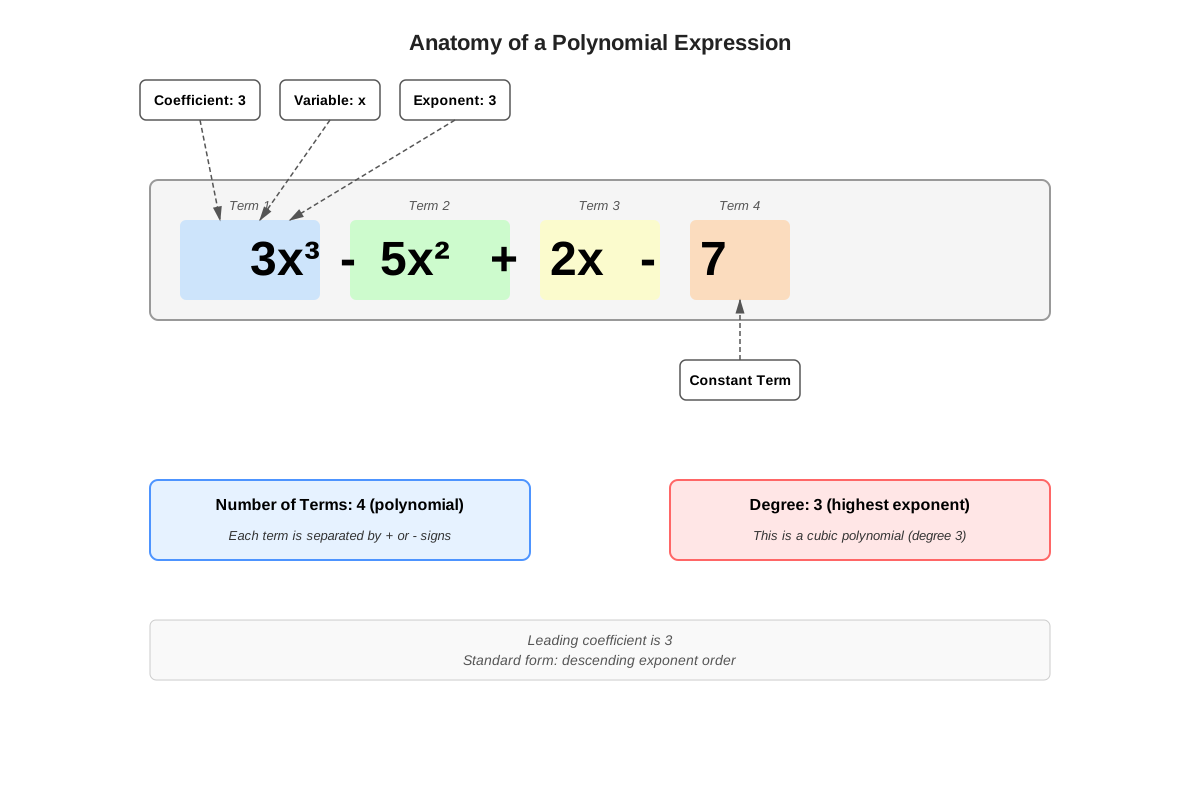
A polynomial expression is a mathematical expression consisting of variables (typically x, y, or other letters) and coefficients combined using addition, subtraction, and multiplication, where variables are raised only to non-negative integer exponents. The general form of a polynomial in one variable is:
a_n x^n + a_(n-1) x^(n-1) + ... + a_2 x^2 + a_1 x + a_0Each component separated by addition or subtraction is called a term. The coefficient is the numerical factor multiplying the variable, while the degree of a term is the exponent on the variable. The degree of the polynomial is the highest degree among all terms. For example, in the polynomial 3x³ - 5x² + 2x - 7, the degree is 3, making this a cubic polynomial.
Polynomials are classified by degree:
- Constant (degree 0): 5, -3, π
- Linear (degree 1): 2x + 3, -x + 7
- Quadratic (degree 2): x² - 4x + 4, 3x² + 2x - 1
- Cubic (degree 3): x³ + 2x² - x + 5
- Quartic (degree 4): 2x⁴ - 3x² + 1
The leading coefficient is the coefficient of the term with the highest degree. Understanding polynomial structure allows immediate recognition of what operations are possible and which factoring techniques might apply.
Adding and Subtracting Polynomials
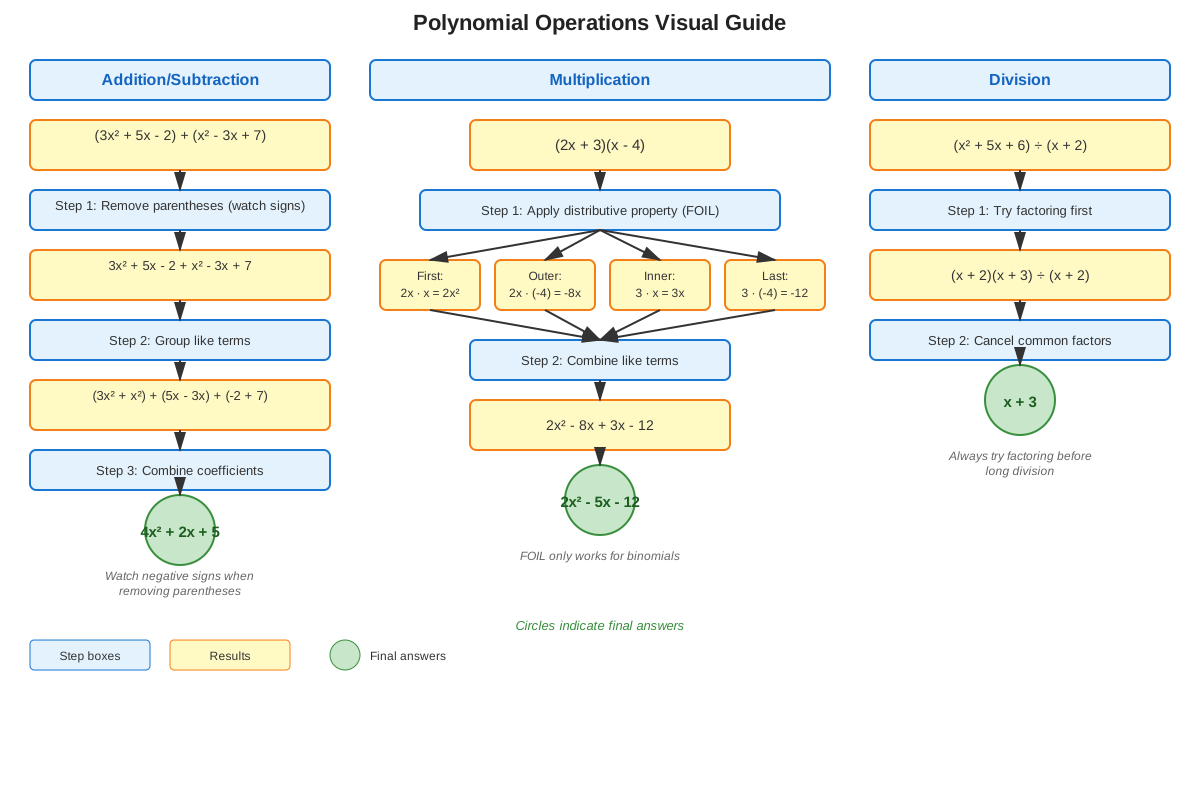
Polynomial addition and subtraction rely on the fundamental principle of combining like terms—terms with identical variable parts (same variable raised to the same power). The process involves:
- Identify terms with matching variable components
- Add or subtract their coefficients
- Maintain the variable part unchanged
- Arrange terms in descending order of degree (standard form)
Example: (3x² + 5x - 2) + (2x² - 3x + 7)
- Combine x² terms: 3x² + 2x² = 5x²
- Combine x terms: 5x + (-3x) = 2x
- Combine constants: -2 + 7 = 5
- Result: 5x² + 2x + 5
For subtraction, distribute the negative sign to all terms in the second polynomial before combining: (4x² + 3x - 1) - (2x² - x + 5) = 4x² + 3x - 1 - 2x² + x - 5 = 2x² + 4x - 6
Multiplying Polynomials
Polynomial multiplication applies the distributive property repeatedly, ensuring every term in the first polynomial multiplies every term in the second. For binomials (two-term polynomials), the FOIL method provides a systematic approach:
FOIL: First, Outer, Inner, Last
(a + b)(c + d) = ac + ad + bc + bd
Example: (2x + 3)(x - 4)
- First: 2x · x = 2x²
- Outer: 2x · (-4) = -8x
- Inner: 3 · x = 3x
- Last: 3 · (-4) = -12
- Combine: 2x² - 8x + 3x - 12 = 2x² - 5x - 12
For multiplying polynomials with more terms, use the distributive property systematically or arrange vertically like traditional multiplication:
    x² + 3x + 2
  ×     x + 4
  ___________
   4x² + 12x + 8    (multiply by 4)
x³ + 3x² + 2x       (multiply by x)
___________________
x³ + 7x² + 14x + 8  (combine like terms)
Special Polynomial Products
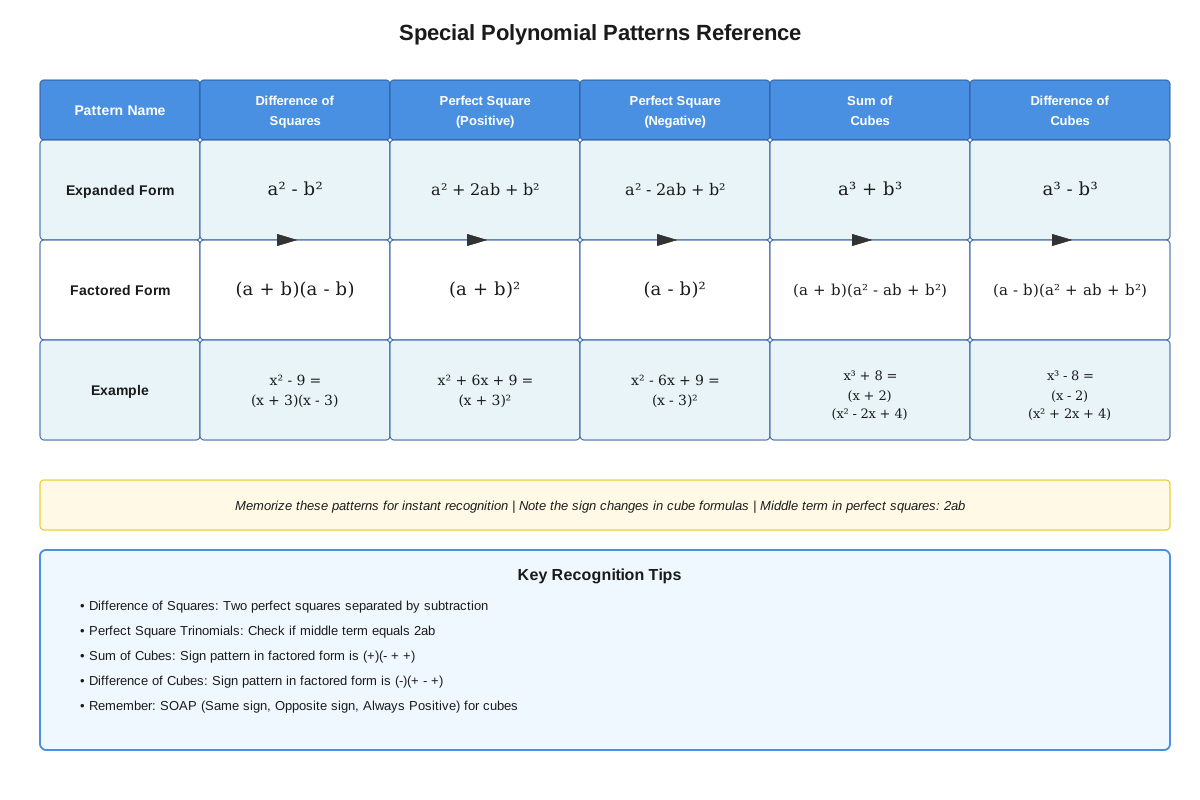
Certain polynomial multiplication patterns appear so frequently on the GRE that recognizing them instantly saves significant time:
| Pattern Name | Formula | Example |
|---|---|---|
| Difference of Squares | (a + b)(a - b) = a² - b² | (x + 5)(x - 5) = x² - 25 |
| Perfect Square Trinomial | (a + b)² = a² + 2ab + b² | (x + 3)² = x² + 6x + 9 |
| Perfect Square Trinomial | (a - b)² = a² - 2ab + b² | (2x - 1)² = 4x² - 4x + 1 |
| Sum of Cubes | a³ + b³ = (a + b)(a² - ab + b²) | x³ + 8 = (x + 2)(x² - 2x + 4) |
| Difference of Cubes | a³ - b³ = (a - b)(a² + ab + b²) | x³ - 27 = (x - 3)(x² + 3x + 9) |
These patterns work in both directions: recognizing a² - b² immediately factors to (a + b)(a - b), while seeing (a + b)(a - b) immediately simplifies to a² - b². The GRE frequently tests whether students can recognize these patterns in disguised forms, such as 4x² - 49 = (2x)² - 7² = (2x + 7)(2x - 7).
Factoring Polynomials
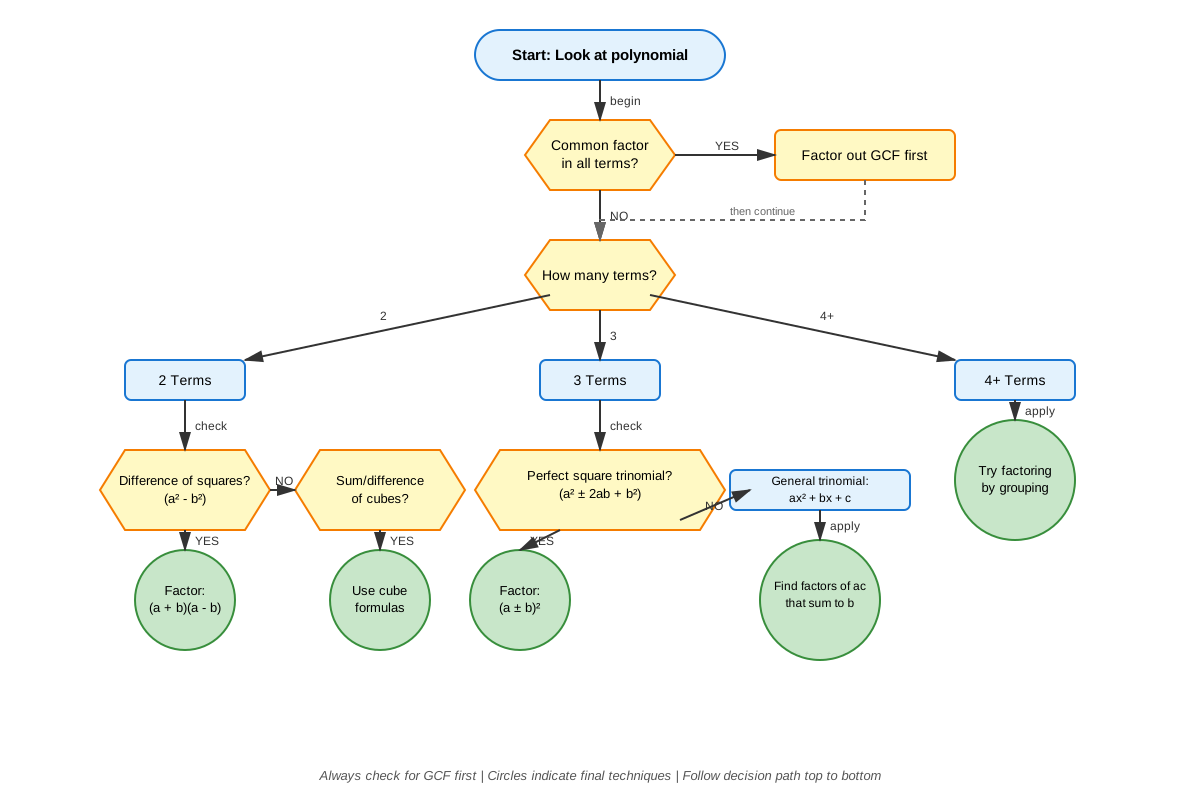
Factoring is the process of expressing a polynomial as a product of simpler polynomials. This reverse operation of multiplication is crucial for solving polynomial equations and simplifying rational expressions. The GRE tests multiple factoring techniques:
Greatest Common Factor (GCF)
Always begin by identifying the largest expression that divides all terms:
6x³ + 9x² - 3x = 3x(2x² + 3x - 1)
Factoring Trinomials (ax² + bx + c)
For quadratic trinomials where a = 1:
- Find two numbers that multiply to c and add to b
- Express as (x + m)(x + n)
Example: x² + 7x + 12
- Need two numbers multiplying to 12 and adding to 7
- Numbers: 3 and 4
- Factored form: (x + 3)(x + 4)
For trinomials where a ≠ 1, use the AC method:
- Multiply a and c
- Find two numbers multiplying to ac and adding to b
- Split the middle term using these numbers
- Factor by grouping
Example: 2x² + 7x + 3
- ac = 2(3) = 6
- Numbers multiplying to 6 and adding to 7: 6 and 1
- Rewrite: 2x² + 6x + x + 3
- Group: (2x² + 6x) + (x + 3) = 2x(x + 3) + 1(x + 3)
- Factor: (2x + 1)(x + 3)
Factoring by Grouping
For four-term polynomials, group terms in pairs and factor each pair:
x³ + 3x² + 2x + 6
= (x³ + 3x²) + (2x + 6)
= x²(x + 3) + 2(x + 3)
= (x² + 2)(x + 3)
Simplifying Rational Expressions with Polynomials
Rational expressions are fractions with polynomial numerators and denominators. Simplification requires factoring both parts and canceling common factors:
(x² - 9)/(x² + 5x + 6) = [(x + 3)(x - 3)]/[(x + 2)(x + 3)] = (x - 3)/(x + 2)Critical restriction: The canceled factor (x + 3) means x ≠ -3 in the original expression, even though it doesn't appear in the simplified form.
Evaluating Polynomials
Evaluating a polynomial means finding its value when the variable equals a specific number. Substitute the value and calculate using order of operations:
If P(x) = 2x³ - 5x² + 3x - 1, find P(2):
P(2) = 2(2)³ - 5(2)² + 3(2) - 1
= 2(8) - 5(4) + 6 - 1
= 16 - 20 + 6 - 1
= 1
The GRE often tests this concept by asking for polynomial values at specific points or comparing polynomial expressions at different values.
Concept Relationships
Polynomial expressions serve as the foundation connecting multiple algebraic concepts. Basic polynomial structure (understanding terms, coefficients, and degrees) → enables polynomial operations (addition, subtraction, multiplication) → which lead to factoring skills (recognizing patterns and reversing multiplication) → allowing simplification of rational expressions and solving polynomial equations.
The relationship between multiplication and factoring is inverse: multiplying (x + 3)(x - 2) produces x² + x - 6, while factoring x² + x - 6 returns (x + 3)(x - 2). This bidirectional relationship means mastering one operation strengthens the other.
Special products (difference of squares, perfect square trinomials) connect directly to factoring techniques—recognizing x² - 16 as a difference of squares immediately reveals the factored form (x + 4)(x - 4) without trial-and-error methods. These patterns also connect to graphing concepts: perfect square trinomials like (x - 3)² represent parabolas with vertices on the x-axis.
Polynomial evaluation connects to function notation: evaluating P(x) at x = 2 is identical to finding P(2) in function terminology. This bridges polynomial algebra to the broader function concepts tested on the GRE.
Prerequisite concepts integrate throughout: exponent rules govern how terms multiply (x² · x³ = x⁵), the distributive property underlies all polynomial multiplication and factoring, and combining like terms relies on understanding variable structure. These foundational skills don't just support polynomial work—they're inseparable from it.
Quick check — test yourself on Polynomial expressions so far.
Try Flashcards →High-Yield Facts
⭐ The degree of a polynomial is the highest exponent appearing on any variable term
⭐ Difference of squares: a² - b² = (a + b)(a - b) works instantly in both directions
⭐ Perfect square trinomials follow the pattern a² ± 2ab + b² = (a ± b)²
⭐ When multiplying polynomials, every term in the first must multiply every term in the second
⭐ Always factor out the greatest common factor (GCF) before attempting other factoring methods
- Like terms must have identical variable parts with identical exponents to be combined
- The FOIL method applies specifically to multiplying two binomials
- Factoring trinomials (ax² + bx + c) when a = 1 requires finding two numbers that multiply to c and add to b
- When simplifying rational expressions, factor completely before canceling common factors
- Polynomial addition/subtraction never changes the degree of individual terms—only their coefficients
- The product of two binomials always produces at most four terms before combining like terms
- Difference of cubes and sum of cubes factor into a binomial times a trinomial
- Substituting a value into a polynomial requires careful attention to order of operations and negative signs
- Factoring by grouping works best with four-term polynomials arranged in strategic pairs
- The leading coefficient is the coefficient of the term with the highest degree
Common Misconceptions
Misconception: When squaring a binomial, simply square each term: (x + 3)² = x² + 9
Correction: Squaring a binomial requires the full expansion (x + 3)² = (x + 3)(x + 3) = x² + 6x + 9. The middle term 2ab is essential and comes from the outer and inner products in FOIL.
Misconception: The terms 3x² and 5x are like terms and can be combined to get 8x²
Correction: Like terms must have identical variable parts with identical exponents. Since 3x² has x² and 5x has x¹, they cannot be combined. The expression 3x² + 5x remains in that form.
Misconception: Factoring x² - 25 gives (x - 5)(x - 5) or (x - 5)²
Correction: The expression x² - 25 is a difference of squares, factoring to (x + 5)(x - 5). The pattern a² - b² always produces one sum and one difference: (a + b)(a - b).
Misconception: When distributing a negative sign, only the first term changes: -(3x² - 2x + 5) = -3x² - 2x + 5
Correction: The negative sign must distribute to every term: -(3x² - 2x + 5) = -3x² + 2x - 5. Each term's sign changes.
Misconception: Canceling terms in a rational expression works like this: (x² + 3x)/(x² + 5) = 3x/5 by canceling x²
Correction: Only common factors can be canceled, not terms connected by addition. The expression (x² + 3x)/(x² + 5) must first be factored: x(x + 3)/(x² + 5). Since x² + 5 doesn't factor further and shares no common factors with the numerator, this expression cannot be simplified.
Misconception: The degree of 5x² + 3x⁴ - 2x is 2 because that's the first term
Correction: The degree of a polynomial is the highest exponent among all terms, regardless of order. This polynomial has degree 4 from the term 3x⁴.
Misconception: Multiplying (x + 2)(x + 3)(x + 4) requires multiplying all three binomials simultaneously
Correction: Multiply two binomials first to get a trinomial, then multiply that result by the third binomial: (x + 2)(x + 3) = x² + 5x + 6, then (x² + 5x + 6)(x + 4).
Worked Examples
Example 1: Factoring and Simplifying a Rational Expression
Problem: Simplify the expression (x² - 4x - 12)/(x² - 36)
Solution:
Step 1: Factor the numerator (x² - 4x - 12)
- Need two numbers that multiply to -12 and add to -4
- Numbers: -6 and +2
- Factored form: (x - 6)(x + 2)
Step 2: Factor the denominator (x² - 36)
- Recognize difference of squares: x² - 6²
- Factored form: (x + 6)(x - 6)
Step 3: Write the expression with factored forms
(x - 6)(x + 2) / (x + 6)(x - 6)
Step 4: Cancel common factors
The factor (x - 6) appears in both numerator and denominator
Result: (x + 2)/(x + 6)
Step 5: State restrictions
The original denominator equals zero when x = 6 or x = -6, so x ≠ ±6
Final Answer: (x + 2)/(x + 6), where x ≠ ±6
Connection to Learning Objectives: This example demonstrates identifying polynomial structure (quadratic trinomials and difference of squares), applying factoring strategies (trinomial factoring and special products), and simplifying rational expressions—core skills for GRE polynomial questions.
Example 2: Comparing Polynomial Values (Quantitative Comparison Style)
Problem:
Quantity A: (x + 3)² - (x - 3)²
Quantity B: 12x
Determine the relationship between Quantity A and Quantity B.
Solution:
Step 1: Recognize the structure in Quantity A
This involves two perfect square trinomials. Rather than expanding each separately, look for a pattern.
Step 2: Apply difference of squares
Notice that (x + 3)² - (x - 3)² fits the pattern a² - b² where a = (x + 3) and b = (x - 3)
Using a² - b² = (a + b)(a - b):
= [(x + 3) + (x - 3)][(x + 3) - (x - 3)]
Step 3: Simplify each factor
First factor: (x + 3) + (x - 3) = x + 3 + x - 3 = 2x
Second factor: (x + 3) - (x - 3) = x + 3 - x + 3 = 6
Step 4: Multiply the simplified factors
Quantity A = (2x)(6) = 12x
Step 5: Compare
Quantity A = 12x
Quantity B = 12x
Final Answer: The two quantities are equal (Choice C)
Connection to Learning Objectives: This example shows how recognizing special polynomial patterns (perfect squares and difference of squares) enables efficient problem-solving without tedious expansion. It demonstrates the strategic thinking the GRE rewards—working smarter rather than harder by identifying structural patterns.
Exam Strategy
Recognition Triggers
Watch for these phrases and structures that signal polynomial questions:
- "Factor the expression..."
- "Simplify..." (especially with fractions containing variables)
- "If x² + bx + c = (x + m)(x + n)..."
- "Expand..." or "Multiply..."
- Questions presenting expressions with x², x³, or higher powers
- "For all values of x..." (suggesting algebraic manipulation rather than substitution)
Strategic Approach Framework
- Identify the operation required: Is the question asking you to expand, factor, simplify, or evaluate?
- Scan for special patterns first: Before attempting general methods, check for difference of squares, perfect square trinomials, or sum/difference of cubes. These patterns solve problems in seconds.
- Factor completely: When factoring, don't stop at the first factorization. Check if factors can be factored further. For example, x⁴ - 16 = (x² + 4)(x² - 4) = (x² + 4)(x + 2)(x - 2).
- Use answer choices strategically: In Problem Solving questions, you can often work backward by expanding answer choices or substituting simple values like x = 0, x = 1, or x = -1 to eliminate options.
- Substitute strategic values: When comparing polynomial expressions, try x = 0 first (simplest), then x = 1, then x = -1. If these don't determine the relationship, try x = 2 or consider algebraic manipulation.
Time Management
Exam Tip: Spend no more than 30 seconds deciding your approach. If factoring isn't immediately obvious, try substitution or working backward from answers.
For straightforward expansion or combining like terms: 30-45 seconds
For factoring trinomials: 45-90 seconds
For complex rational expression simplification: 90-120 seconds
If a factoring approach isn't revealing itself within 20 seconds, switch to substitution or answer elimination strategies.
Process of Elimination Tactics
- Degree checking: The degree of a product equals the sum of the degrees being multiplied. If multiplying a degree-2 and degree-3 polynomial, the result must be degree 5. Eliminate any answer with different degree.
- Leading coefficient verification: When multiplying polynomials, the leading coefficient of the product equals the product of the leading coefficients. Quick verification eliminates wrong answers.
- Constant term checking: The constant term in a product comes from multiplying the constant terms of the factors. Verify this matches before checking middle terms.
- Sign pattern recognition: In factored form (x + a)(x + b), if both a and b are positive, the expanded form has all positive coefficients (for positive x terms). Use sign patterns to eliminate impossible answers.
Memory Techniques
FOIL Mnemonic: "Friends Often Invite Laughter" reminds you to multiply First, Outer, Inner, Last terms when expanding binomials.
Difference of Squares Visualization: Picture a square with side length a, then remove a smaller square with side length b from one corner. The remaining area can be rearranged into a rectangle with dimensions (a + b) by (a - b), proving a² - b² = (a + b)(a - b).
Perfect Square Trinomial Pattern: Remember "Square the First, Twice the product, Square the Last" (SFTSL) for (a ± b)² = a² ± 2ab + b².
Factoring Trinomials Acronym: "Multiply And Add" (MAA) reminds you that for x² + bx + c, you need two numbers that Multiply to c And Add to b.
Special Products Rhyme:
"Sum and difference, product's a snap,
Square the first, square the last, middle terms zap!"
(For difference of squares pattern)
GCF First Rule: "Greatest Comes First" reminds you to always factor out the greatest common factor before attempting other factoring methods.
Summary
Polynomial expressions represent a fundamental algebra skill tested extensively on the GRE Quantitative Reasoning section. Mastery requires understanding polynomial structure (terms, coefficients, degrees), fluency with operations (addition, subtraction, multiplication), and strategic factoring abilities. The most efficient test-takers recognize special patterns—difference of squares, perfect square trinomials, and sum/difference of cubes—that enable instant factorization without trial-and-error methods. Success on GRE polynomial questions depends on three core competencies: accurately expanding products using the distributive property and FOIL method, factoring expressions through multiple techniques (GCF extraction, trinomial factoring, grouping, and special patterns), and simplifying rational expressions by factoring and canceling common factors. The exam rewards strategic thinking over computational endurance—recognizing when to factor, when to expand, and when to substitute values. Students must avoid common errors like incorrectly squaring binomials, combining unlike terms, and canceling terms instead of factors. With these skills integrated, polynomial questions transform from time-consuming obstacles into opportunities for quick, confident points.
Key Takeaways
- Polynomial structure matters: Identify degree, leading coefficient, and term count to determine which operations and factoring methods apply
- Special patterns save time: Memorize and instantly recognize difference of squares (a² - b²), perfect square trinomials (a² ± 2ab + b²), and cube formulas
- Factor completely and systematically: Always extract GCF first, then apply appropriate techniques based on the number of terms and polynomial structure
- Like terms require identical variable parts: Only terms with matching variables and exponents can be combined through addition or subtraction
- FOIL applies to binomial multiplication: Every term in the first binomial multiplies every term in the second, producing up to four terms before simplification
- Strategic substitution accelerates solutions: When algebraic manipulation seems complex, try x = 0, 1, or -1 to compare expressions or eliminate answer choices
- Rational expression simplification requires factoring: Only common factors (not terms) can be canceled between numerator and denominator
Related Topics
Quadratic Equations: Mastering polynomial factoring directly enables solving quadratic equations by setting factored expressions equal to zero and applying the zero product property.
Functions and Function Notation: Polynomial expressions form the foundation of polynomial functions, where P(x) notation represents evaluating polynomials at specific values.
Coordinate Geometry and Parabolas: Quadratic polynomials in the form y = ax² + bx + c represent parabolas, connecting algebraic manipulation to graphical interpretation.
Inequalities: Factoring polynomials becomes essential for solving polynomial inequalities, where sign analysis of factored forms reveals solution intervals.
Systems of Equations: Polynomial manipulation skills enable solving systems through substitution and elimination methods, particularly when equations are nonlinear.
Practice CTA
Now that you've mastered the core concepts, patterns, and strategies for polynomial expressions, reinforce your learning through active practice. Attempt the accompanying practice questions to apply factoring techniques, test your pattern recognition, and build speed with GRE-style problems. Use the flashcards to drill special products and factoring formulas until recognition becomes automatic. Remember: polynomial mastery isn't about memorizing every possible problem type—it's about recognizing structural patterns and applying strategic approaches efficiently. Each practice problem strengthens your ability to identify what the GRE is testing and execute the optimal solution path. Your investment in deliberate practice now translates directly to points on test day.
Sign up free to keep reading
Create a free AnvayaPrep account to finish this GRE guide on Polynomial expressions — plus flashcards and practice questions.