Overview
The quadratic formula is one of the most powerful and frequently tested algebraic tools on the GRE Quantitative Reasoning section. This formula provides a systematic method for finding the roots (solutions) of any quadratic equation, regardless of whether the equation can be easily factored. While many students are familiar with the formula from high school mathematics, the GRE tests not only computational accuracy but also conceptual understanding, strategic application, and the ability to recognize when this approach is most efficient compared to alternative methods like factoring or completing the square.
Mastery of the gre quadratic formula is essential because quadratic equations appear across multiple question types, including Problem Solving, Quantitative Comparison, and Data Interpretation questions. These problems may directly ask for solutions to quadratic equations, or they may embed quadratic relationships within word problems involving area, projectile motion, optimization, or number theory. Understanding when and how to apply the quadratic formula efficiently can save valuable time and prevent careless errors that cost points.
The quadratic formula connects to broader algebraic concepts including polynomial functions, graphing parabolas, understanding the discriminant, and analyzing the nature of solutions. It serves as a bridge between basic equation-solving techniques and more advanced mathematical reasoning required for higher-level GRE problems. Students who develop fluency with this formula gain confidence in tackling complex algebraic manipulations and can more readily identify patterns in mathematical relationships.
Learning Objectives
- [ ] Identify when Quadratic formula is being tested
- [ ] Explain the core rule or strategy behind Quadratic formula
- [ ] Apply Quadratic formula to GRE-style questions accurately
- [ ] Determine the nature of solutions using the discriminant without fully solving
- [ ] Choose efficiently between the quadratic formula, factoring, and other solution methods
- [ ] Recognize and simplify radical expressions that result from applying the formula
- [ ] Interpret the meaning of quadratic solutions in context-based word problems
Prerequisites
- Basic algebraic manipulation: Ability to rearrange equations, combine like terms, and isolate variables is essential for setting up quadratic equations in standard form
- Exponent rules and radical simplification: Understanding square roots, simplifying radicals, and working with fractional expressions is necessary for interpreting formula results
- Factoring techniques: Knowledge of factoring helps determine when alternative methods might be faster than the quadratic formula
- Understanding of equation structure: Recognition of polynomial degree and standard form enables quick identification of quadratic equations
Why This Topic Matters
The quadratic formula appears in approximately 10-15% of GRE Quantitative Reasoning questions, either directly or as a component of more complex problems. This high frequency makes it one of the most important algebraic tools to master. Questions involving quadratic equations span multiple difficulty levels, from straightforward computational problems to sophisticated applications requiring conceptual understanding of solution properties.
In real-world contexts, quadratic relationships model countless phenomena including projectile trajectories, profit optimization in business, area and perimeter problems in geometry, and compound interest calculations in finance. The GRE frequently embeds quadratic equations within these practical scenarios, testing whether students can translate word problems into mathematical expressions and interpret solutions meaningfully.
Common exam appearances include: finding the dimensions of rectangles given area and perimeter constraints; determining break-even points in business scenarios; solving age problems with squared relationships; analyzing parabolic paths; comparing the number or nature of solutions in Quantitative Comparison questions; and identifying maximum or minimum values of quadratic functions. The formula also appears in coordinate geometry when finding x-intercepts of parabolas and in problems involving the sum and product of roots.
Core Concepts
The Quadratic Formula Defined
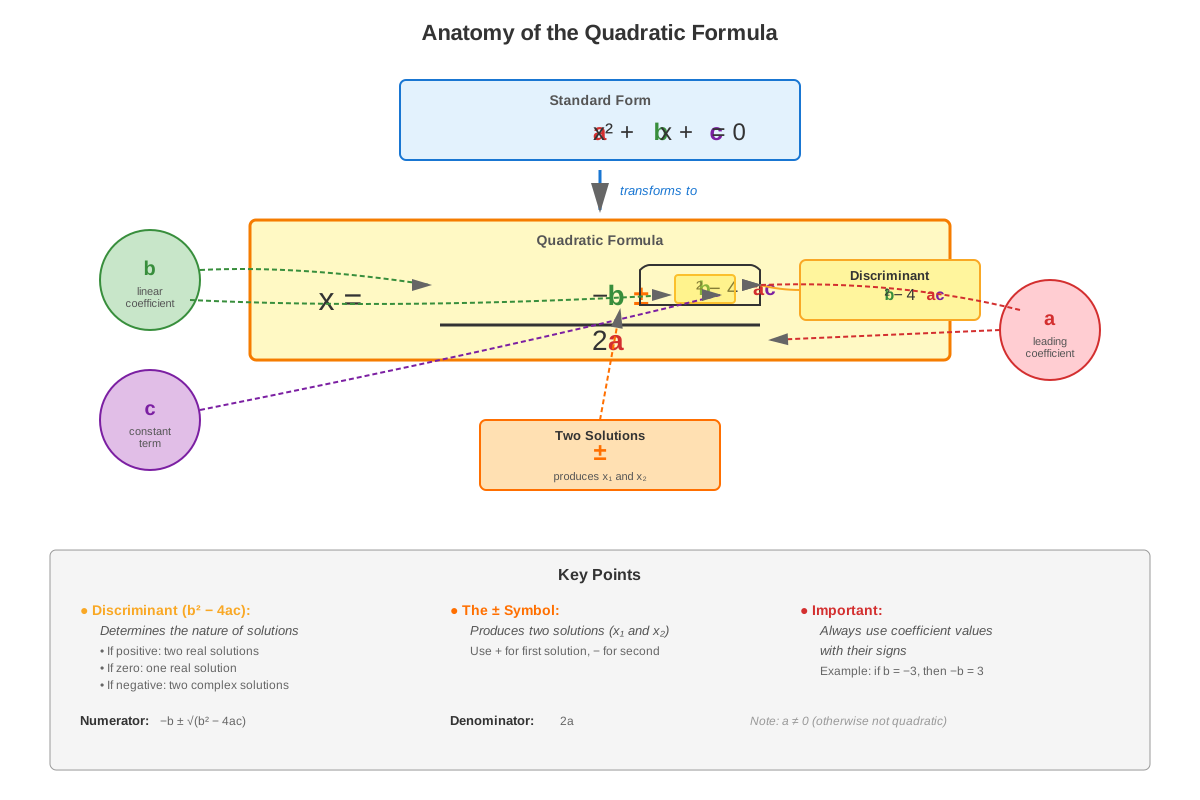
The quadratic formula is the solution method for any quadratic equation written in standard form: ax² + bx + c = 0, where a ≠ 0. The formula states:
x = [-b ± √(b² - 4ac)] / (2a)This formula provides both solutions (roots) of the quadratic equation simultaneously through the ± symbol. The expression under the square root, b² - 4ac, is called the discriminant and determines the nature of the solutions.
Components and Their Roles
Understanding each component of the formula is crucial for accurate application:
| Component | Name | Role | Common Errors |
|---|---|---|---|
| a | Leading coefficient | Coefficient of x² term; determines parabola direction | Forgetting to include when a = 1 |
| b | Linear coefficient | Coefficient of x term; affects vertex position | Sign errors when b is negative |
| c | Constant term | y-intercept of parabola | Confusing with the solution x |
| b² - 4ac | Discriminant | Determines number and type of solutions | Calculation errors with negatives |
Standard Form Requirement
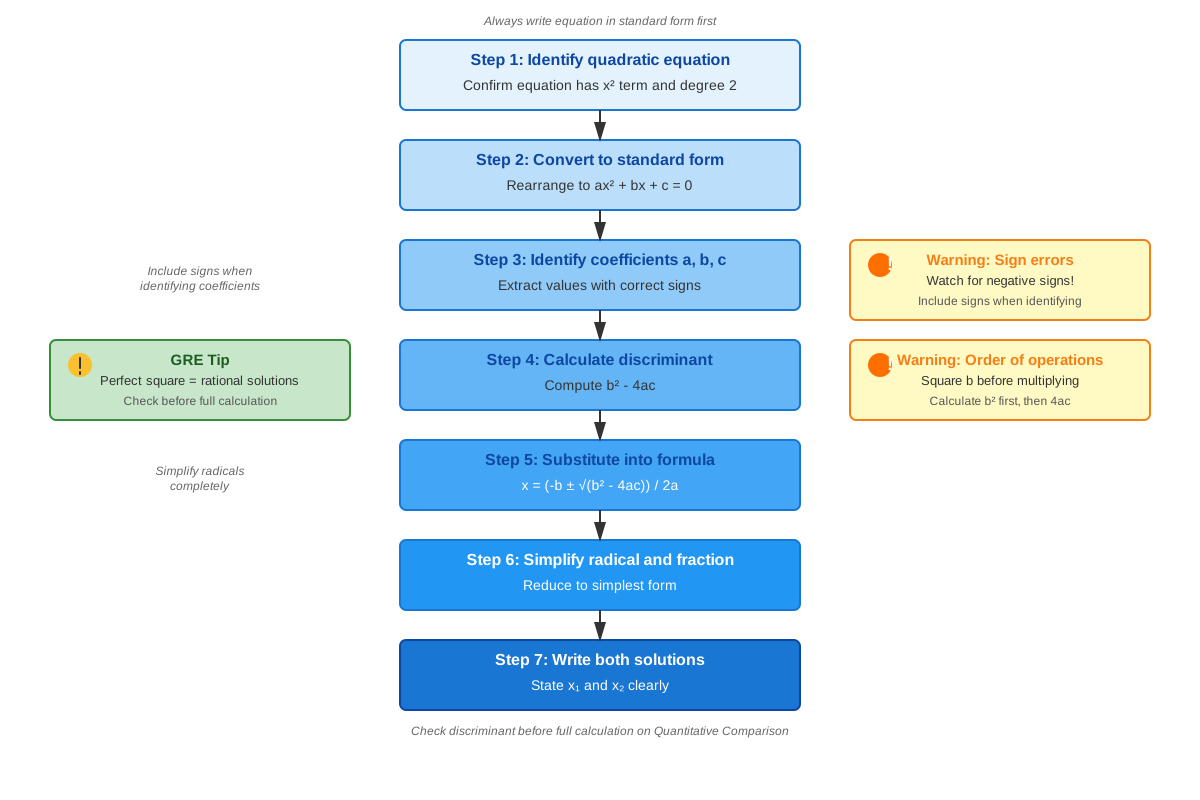
Before applying the quadratic formula, equations must be rearranged into standard form with all terms on one side equal to zero. This critical step involves:
- Moving all terms to one side of the equation
- Combining like terms
- Arranging in descending order of exponents (x², then x, then constant)
- Identifying coefficients a, b, and c (including their signs)
For example, transforming 3x² = 5x - 2 requires adding -5x and +2 to both sides, yielding 3x² - 5x + 2 = 0, where a = 3, b = -5, and c = 2.
The Discriminant and Solution Types
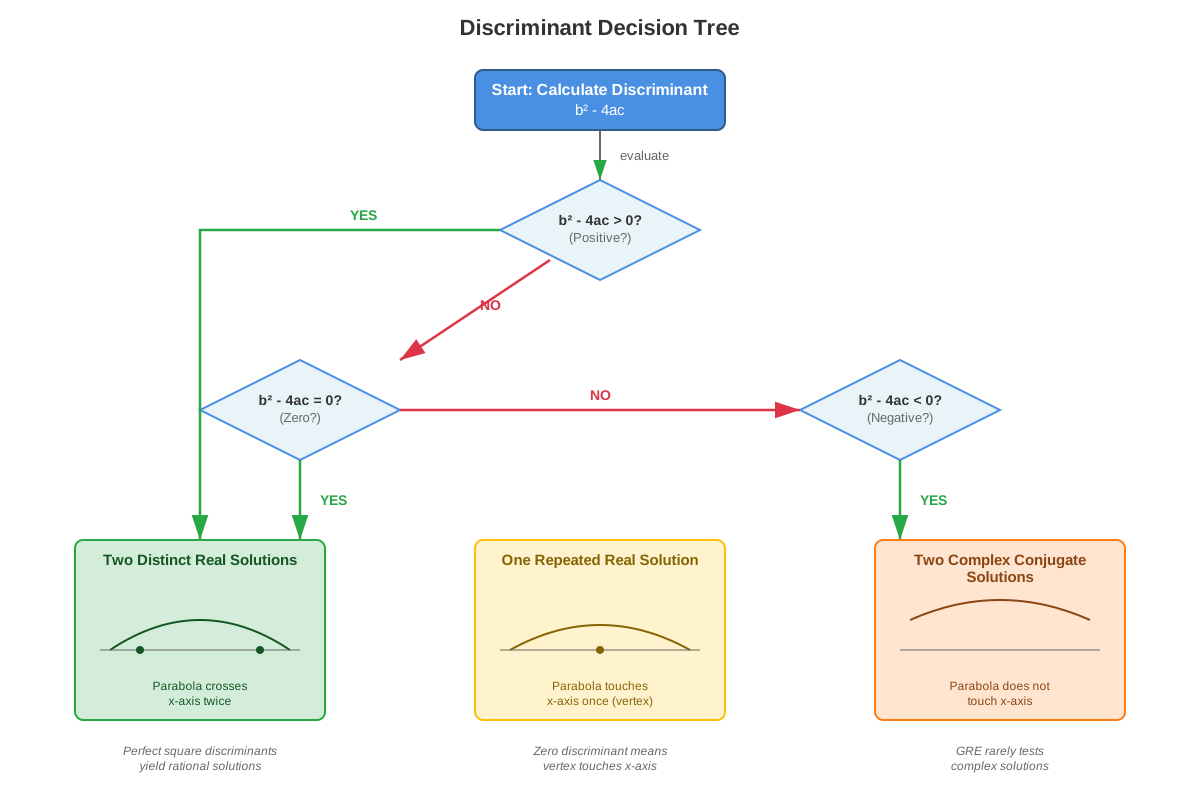
The discriminant (Δ = b² - 4ac) reveals critical information about solutions without complete calculation:
- Δ > 0: Two distinct real solutions (parabola crosses x-axis twice)
- Δ = 0: One repeated real solution (parabola touches x-axis at vertex)
- Δ < 0: No real solutions; two complex solutions (parabola doesn't cross x-axis)
For GRE purposes, when the discriminant is negative, the answer is typically "no real solutions" or the question may ask about the number of solutions. Understanding this relationship allows rapid elimination of answer choices in Quantitative Comparison questions.
Perfect Square Discriminants
When the discriminant is a perfect square (1, 4, 9, 16, 25, etc.), the solutions are rational numbers. This indicates the original equation could have been factored, though the quadratic formula still works efficiently. When the discriminant is positive but not a perfect square, solutions are irrational and involve simplified radicals.
Simplifying Radical Results
After substituting into the formula, solutions often require radical simplification:
- Calculate the discriminant value
- Simplify the square root by factoring out perfect squares
- Simplify the entire fraction by factoring common terms from numerator
- Reduce the fraction to lowest terms
For example, if x = [-6 ± √(36 - 16)] / 4 = [-6 ± √20] / 4 = [-6 ± 2√5] / 4 = [-3 ± √5] / 2.
Strategic Application
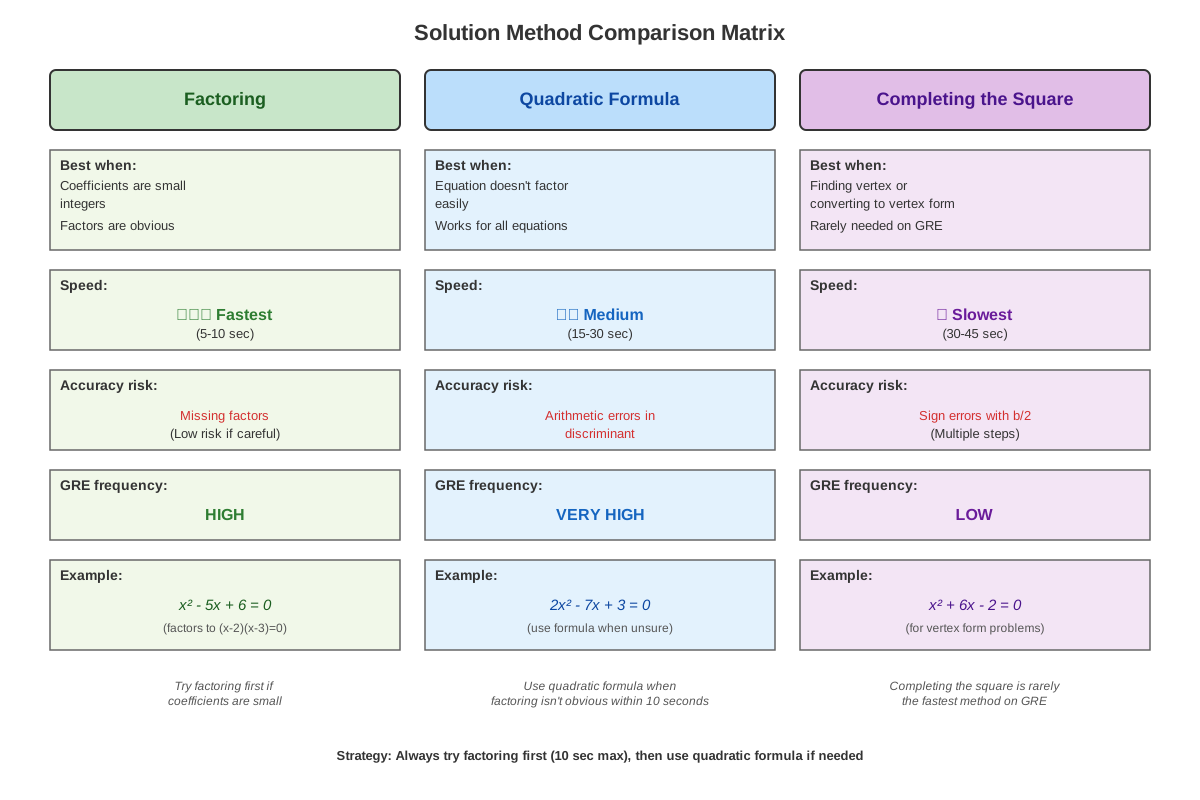
The quadratic formula is most efficient when:
- The equation doesn't factor easily or obviously
- Coefficients are large or involve fractions
- Time pressure makes trial-and-error factoring risky
- The discriminant needs to be analyzed
- Exact irrational solutions are required
Alternative methods may be faster when equations factor simply (x² + 5x + 6 = 0) or when only the nature of solutions matters, not their exact values.
Concept Relationships
The quadratic formula serves as the central hub connecting multiple algebraic concepts. It derives from the technique of completing the square, which transforms any quadratic equation into a form where solutions can be extracted directly. This derivation explains why the formula works universally for all quadratic equations.
The formula connects directly to graphing parabolas because the solutions represent x-intercepts (zeros) of the quadratic function y = ax² + bx + c. The discriminant determines whether the parabola crosses, touches, or misses the x-axis entirely. The axis of symmetry of the parabola occurs at x = -b/(2a), which is the midpoint between the two solutions.
Factoring relates inversely to the quadratic formula: when an equation factors easily, the solutions can be found more quickly through factoring, but the quadratic formula always works regardless of factorability. The relationship flows: Standard Form → Attempt Factoring → If difficult, apply Quadratic Formula → Simplify Solutions.
The sum and product of roots connect through Vieta's formulas: for ax² + bx + c = 0, the sum of roots equals -b/a and the product equals c/a. These relationships allow verification of solutions and enable solving certain GRE problems without finding individual roots.
Connection to inequalities: Understanding where a quadratic expression is positive or negative requires finding the roots first, then analyzing intervals between them. This extends quadratic formula applications beyond simple equation-solving.
High-Yield Facts
⭐ The quadratic formula is x = [-b ± √(b² - 4ac)] / (2a) for equations in form ax² + bx + c = 0
⭐ The discriminant b² - 4ac determines the number and type of solutions without complete calculation
⭐ When the discriminant equals zero, there is exactly one solution (a repeated root)
⭐ When the discriminant is negative, there are no real solutions
⭐ When the discriminant is positive, there are two distinct real solutions
- The equation must be in standard form (ax² + bx + c = 0) before identifying coefficients
- The ± symbol in the formula indicates two separate solutions must be calculated
- Sign errors with coefficient b are the most common mistake; -b means the opposite sign of b
- Perfect square discriminants indicate the equation could have been factored
- The sum of the two solutions always equals -b/a (Vieta's formula)
- The product of the two solutions always equals c/a (Vieta's formula)
- Simplifying radical expressions in the final answer is essential for matching answer choices
- The denominator 2a applies to the entire numerator, including both terms
- When a = 1, the formula simplifies but all steps remain the same
- Rational solutions occur only when the discriminant is a perfect square (including zero)
Quick check — test yourself on Quadratic formula so far.
Try Flashcards →Common Misconceptions
Misconception: The quadratic formula only works for equations that cannot be factored.
Correction: The quadratic formula works for ALL quadratic equations, regardless of whether they can be factored. It's a universal method, though factoring may be faster for simple equations.
Misconception: When b is negative, use its negative value in the formula (making it positive).
Correction: Use the actual value of b including its sign, then apply the -b in the formula. If b = -5, then -b = -(-5) = +5. The formula already accounts for the sign change.
Misconception: The ± symbol means you can choose either addition or subtraction based on which gives a "nicer" answer.
Correction: The ± symbol indicates two separate solutions that must both be calculated. One uses addition, the other uses subtraction, and both are valid solutions to the equation.
Misconception: When the discriminant is negative, the answer is zero or undefined.
Correction: A negative discriminant means there are no real number solutions. The equation has two complex solutions, but for GRE purposes, the answer is "no real solutions" or the question asks about solution count.
Misconception: The denominator 2a only applies to the square root term, not the -b term.
Correction: The entire numerator [-b ± √(b² - 4ac)] must be divided by 2a. This is a fraction with a two-term numerator, not two separate fractions.
Misconception: If a quadratic equation has no real solutions, it has no solutions at all.
Correction: The equation has two complex (imaginary) solutions, but the GRE focuses on real number solutions. The correct interpretation is "no real solutions," not "no solutions."
Misconception: You can ignore the coefficient a if it equals 1.
Correction: While a = 1 simplifies calculations, you must still include it in the formula. The denominator becomes 2(1) = 2, and 4ac becomes 4(1)c = 4c. Skipping this step leads to errors.
Worked Examples
Example 1: Standard Application with Simplification
Problem: Solve for x: 2x² - 7x + 3 = 0
Solution:
Step 1: Identify the equation is in standard form with a = 2, b = -7, c = 3
Step 2: Apply the quadratic formula:
x = [-b ± √(b² - 4ac)] / (2a)
x = [-(-7) ± √((-7)² - 4(2)(3))] / (2(2))
x = [7 ± √(49 - 24)] / 4
x = [7 ± √25] / 4
x = [7 ± 5] / 4
Step 3: Calculate both solutions:
- First solution: x = (7 + 5)/4 = 12/4 = 3
- Second solution: x = (7 - 5)/4 = 2/4 = 1/2
Step 4: Verify by substitution (optional but recommended):
- For x = 3: 2(3)² - 7(3) + 3 = 18 - 21 + 3 = 0 ✓
- For x = 1/2: 2(1/4) - 7(1/2) + 3 = 1/2 - 7/2 + 6/2 = 0 ✓
Connection to Learning Objectives: This example demonstrates accurate application of the formula and proper simplification of results, addressing the objective of applying the quadratic formula to GRE-style questions.
Example 2: Using the Discriminant for Quantitative Comparison
Problem:
Column A: The number of real solutions to x² + 6x + 9 = 0
Column B: The number of real solutions to x² + 6x + 10 = 0
Solution:
Step 1: Rather than solving completely, analyze discriminants
For Column A (x² + 6x + 9 = 0):
- a = 1, b = 6, c = 9
- Discriminant = b² - 4ac = (6)² - 4(1)(9) = 36 - 36 = 0
- When discriminant = 0, there is exactly 1 real solution
- Column A = 1
For Column B (x² + 6x + 10 = 0):
- a = 1, b = 6, c = 10
- Discriminant = b² - 4ac = (6)² - 4(1)(10) = 36 - 40 = -4
- When discriminant < 0, there are 0 real solutions
- Column B = 0
Step 2: Compare: Column A (1) > Column B (0)
Answer: Column A is greater
Connection to Learning Objectives: This example demonstrates identifying when the quadratic formula is being tested (through discriminant analysis) and choosing efficient strategies rather than complete calculation, addressing multiple learning objectives simultaneously.
Exam Strategy
When approaching GRE questions involving quadratic equations, follow this strategic framework:
Recognition Triggers: Watch for these phrases and structures that signal quadratic formula application:
- "Solve for x" with an x² term present
- "Find the values of x that satisfy..."
- "How many solutions does the equation have?"
- "What are the x-intercepts of the parabola?"
- Word problems involving area (length × width), projectile motion, or optimization
- Quantitative Comparison questions comparing solution counts or properties
Decision Tree for Method Selection:
- First, check if the equation is already factored or factors obviously (within 5-10 seconds)
- If factoring isn't immediate, check if the discriminant alone answers the question
- If exact solutions are needed and factoring is unclear, apply the quadratic formula
- For Quantitative Comparison, often only the discriminant or solution properties matter
Time Management: Allocate approximately 1.5-2 minutes for straightforward quadratic formula problems. If calculation becomes complex, verify you've correctly identified coefficients and haven't made sign errors. Don't spend more than 2.5 minutes on a single quadratic problem—mark it and return if needed.
Process of Elimination Tips:
- Eliminate answer choices that aren't in simplified form when your calculation yields radicals
- If the discriminant is positive, eliminate "no solution" options immediately
- If the discriminant is a perfect square, eliminate irrational answer choices
- Check if answer choices sum to -b/a or multiply to c/a as a verification method
- In Quantitative Comparison, if one equation has a negative discriminant and the other doesn't, you can often determine the answer without complete calculation
Common Trap Avoidance:
- Always write out a = ?, b = ?, c = ? before substituting to catch sign errors
- Remember that -b means the opposite of b's sign, not automatically positive
- Don't forget the denominator 2a applies to the entire numerator
- Simplify radicals completely before comparing to answer choices
- When equations aren't in standard form, rearrange first before identifying coefficients
Memory Techniques
Formula Memorization Mnemonic: "Negative Boy, Plus or Minus Square Root, Boy Squared Minus Four Alpha Charlie, Over Two Alpha"
This corresponds to: -b ± √(b² - 4ac) / 2a
Discriminant Decision Mnemonic: "Positive = Pair, Zero = Zing (one), Negative = None"
- Positive discriminant = Pair of solutions (2 real solutions)
- Zero discriminant = Zing/single solution (1 real solution)
- Negative discriminant = None (0 real solutions)
Visualization Strategy: Picture a parabola and the x-axis:
- Two intersections = positive discriminant = two solutions
- One touch point = zero discriminant = one solution
- No intersection = negative discriminant = no real solutions
Sign Error Prevention: Create a mental checkpoint: "Before Substituting, Check Signs" (BSCS). Always write coefficients with their signs explicitly before substituting into the formula.
Standard Form Acronym: ZERO - "Zero on one side, Everything else combined, Rearrange by degree, Organize coefficients"
Summary
The quadratic formula provides a universal method for solving any quadratic equation of the form ax² + bx + c = 0, yielding solutions x = [-b ± √(b² - 4ac)] / (2a). Mastery requires not only accurate calculation but also strategic decision-making about when to apply the formula versus alternative methods like factoring. The discriminant (b² - 4ac) serves as a powerful analytical tool, revealing the number and nature of solutions without complete calculation—a critical skill for time-efficient GRE performance. Success with quadratic formula questions demands careful attention to signs, proper equation setup in standard form, and thorough simplification of radical expressions. Understanding the connections between the formula, parabola graphs, and solution properties enables students to tackle diverse question types ranging from straightforward computation to sophisticated Quantitative Comparison problems. The formula's high frequency on the GRE makes it an essential tool that, when mastered, significantly improves overall Quantitative Reasoning performance.
Key Takeaways
- The quadratic formula x = [-b ± √(b² - 4ac)] / (2a) solves any quadratic equation in standard form ax² + bx + c = 0
- Always rearrange equations into standard form and explicitly identify a, b, and c (including signs) before applying the formula
- The discriminant b² - 4ac determines solution count: positive gives 2 solutions, zero gives 1 solution, negative gives 0 real solutions
- Sign errors with coefficient b are the most common mistake; remember -b means the opposite sign of b
- The denominator 2a applies to the entire numerator [-b ± √(b² - 4ac)], not just the radical term
- Strategic use of the discriminant alone can answer many GRE questions without complete calculation, saving valuable time
- Perfect square discriminants indicate rational solutions and suggest the equation could have been factored
Related Topics
Factoring Quadratic Expressions: Understanding various factoring techniques (difference of squares, trinomial factoring, grouping) provides faster solution methods for many quadratic equations and complements quadratic formula knowledge.
Completing the Square: This technique not only provides an alternative solution method but also reveals the derivation of the quadratic formula and connects to vertex form of parabolas.
Graphing Parabolas and Quadratic Functions: Visualizing quadratic relationships through graphs deepens understanding of how solutions relate to x-intercepts and how the discriminant affects graph behavior.
Vieta's Formulas and Root Relationships: Advanced applications involving the sum and product of roots enable solving complex GRE problems without finding individual solutions.
Systems of Equations with Quadratics: Combining linear and quadratic equations extends problem-solving capabilities to intersection problems and more sophisticated algebraic scenarios.
Inequalities Involving Quadratics: Determining where quadratic expressions are positive or negative builds on root-finding skills and appears in advanced GRE problems.
Practice CTA
Now that you've mastered the core concepts, strategies, and common pitfalls of the quadratic formula, it's time to solidify your understanding through active practice. Attempt the practice questions designed specifically for this topic, focusing on applying the strategic decision-making framework you've learned. Use the flashcards to reinforce formula memorization and discriminant interpretation until recall becomes automatic. Remember, the difference between knowing the quadratic formula and mastering it for the GRE lies in repeated, deliberate practice under timed conditions. Each problem you solve builds the pattern recognition and computational fluency that will serve you on test day. You've invested the time to understand—now invest the practice to excel!
Sign up free to keep reading
Create a free AnvayaPrep account to finish this GRE guide on Quadratic formula — plus flashcards and practice questions.