Overview
Compound inequalities represent one of the most frequently tested algebraic concepts on the GRE Quantitative Reasoning section. These mathematical expressions involve two or more inequalities joined together, requiring test-takers to find solution sets that satisfy multiple conditions simultaneously. Unlike simple inequalities that establish a single relationship between variables, compound inequalities demand careful attention to logical connectors (AND/OR) and the ability to visualize solution sets on number lines or coordinate planes.
Mastering compound inequalities is essential for GRE success because they appear not only as standalone algebra problems but also embedded within word problems, data interpretation questions, and quantitative comparison formats. The GRE frequently tests whether students can correctly manipulate inequality symbols, understand the intersection and union of solution sets, and translate verbal descriptions into mathematical notation. Questions involving compound inequalities often serve as medium-to-hard difficulty discriminators, separating high scorers from average performers.
Within the broader landscape of Quantitative Reasoning, compound inequalities bridge fundamental algebra skills with more advanced topics like absolute value equations, systems of inequalities, and optimization problems. They require fluency with number properties, operations with negative numbers, and the critical understanding that multiplying or dividing by negative values reverses inequality signs. This topic builds directly on simple inequality manipulation while preparing students for complex problem-solving scenarios that involve multiple constraints—a skill pattern that appears throughout the quantitative section.
Learning Objectives
- [ ] Identify when compound inequalities is being tested in GRE questions
- [ ] Explain the core rule or strategy behind compound inequalities
- [ ] Apply compound inequalities to GRE-style questions accurately
- [ ] Distinguish between "AND" (intersection) and "OR" (union) compound inequalities and solve each type correctly
- [ ] Convert between inequality notation, interval notation, and number line representations
- [ ] Recognize and avoid common algebraic errors when manipulating compound inequalities, particularly with negative coefficients
- [ ] Solve multi-step compound inequalities involving absolute values and complex expressions
Prerequisites
- Simple inequality manipulation: Understanding how to solve single inequalities (e.g., 2x + 3 < 7) is foundational, as compound inequalities involve solving multiple such expressions
- Number line representation: Visualizing solutions on number lines helps conceptualize the intersection and union of solution sets
- Properties of real numbers: Knowledge of how operations affect inequality relationships, especially multiplication/division by negative numbers
- Set theory basics: Familiarity with intersection (∩) and union (∪) concepts enables understanding of how multiple conditions combine
- Algebraic manipulation: Proficiency in isolating variables, combining like terms, and working with fractions and negative coefficients
Why This Topic Matters
GRE compound inequalities appear with remarkable frequency on the exam, showing up in approximately 10-15% of Quantitative Reasoning questions either directly or as components of more complex problems. The Educational Testing Service (ETS) favors this topic because it efficiently tests multiple skills simultaneously: algebraic manipulation, logical reasoning, number sense, and attention to detail. Questions may appear as Problem Solving items requiring explicit solutions, Quantitative Comparison questions asking students to evaluate expressions within constrained ranges, or Data Interpretation problems where inequalities define boundaries for acceptable values.
In real-world applications, compound inequalities model countless practical scenarios: acceptable temperature ranges for chemical reactions, safe dosage ranges for medications, profit margins bounded by minimum and maximum constraints, or eligibility criteria requiring multiple conditions to be met simultaneously. Engineers use compound inequalities to specify tolerance ranges; economists employ them to define feasible regions in optimization problems; and data scientists apply them when filtering datasets based on multiple criteria.
On the GRE specifically, compound inequalities commonly appear disguised within word problems about age relationships ("John is older than 25 but younger than 40"), budget constraints ("The cost must be at least $500 but cannot exceed $800"), or measurement specifications. They also frequently appear in questions involving absolute values, where |x - 3| < 5 translates to the compound inequality -5 < x - 3 < 5. Recognizing these patterns allows test-takers to quickly identify the underlying mathematical structure and apply systematic solution strategies.
Core Concepts
Definition and Types of Compound Inequalities
A compound inequality consists of two or more simple inequalities connected by the logical operators "AND" or "OR." The type of connector fundamentally changes the solution set and solving approach.
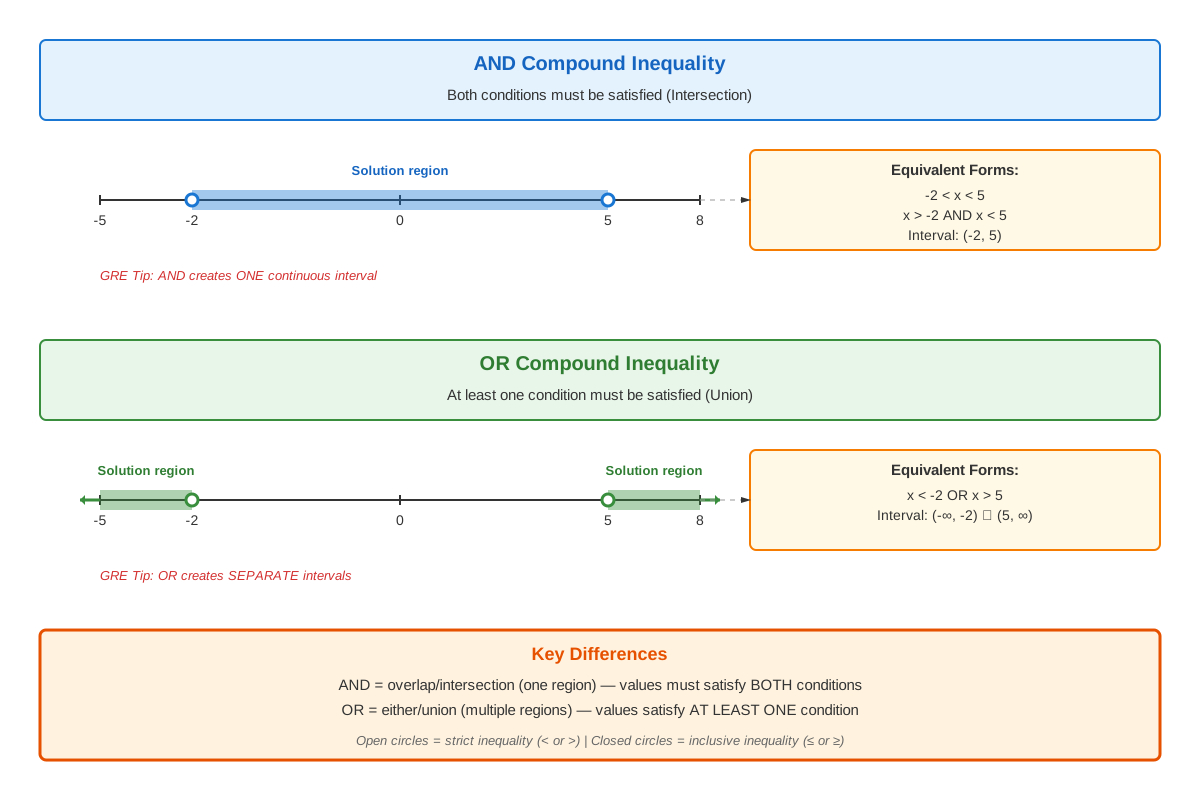
AND compound inequalities (also called conjunctions) require both conditions to be true simultaneously. These are typically written in one of two equivalent forms:
- Separate form: x > 2 AND x < 7
- Compact form: 2 < x < 7
The solution set represents the intersection of individual solution sets—only values satisfying all conditions qualify. On a number line, this appears as a single continuous interval where all conditions overlap.
OR compound inequalities (also called disjunctions) require at least one condition to be true. These are written as:
- x < 2 OR x > 7
The solution set represents the union of individual solution sets—any value satisfying at least one condition qualifies. On a number line, this typically appears as two or more separate intervals.
Solving AND Compound Inequalities
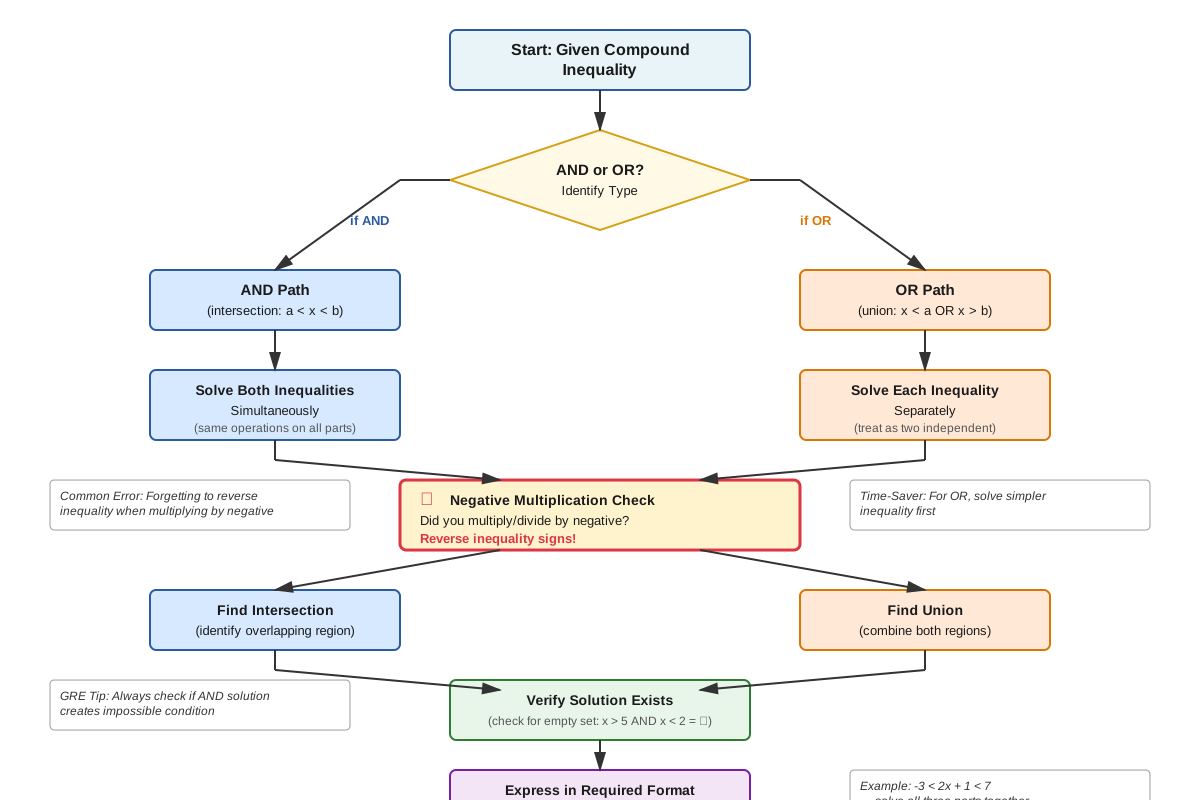
The systematic approach for solving AND compound inequalities involves these steps:
- Separate the compound inequality into individual inequalities if not already in compact form
- Solve each inequality independently using standard algebraic techniques
- Find the intersection of solution sets—the overlap region where both conditions hold
- Express the solution in inequality notation, interval notation, or graphically
For compact notation like 5 < 2x + 1 < 13, perform identical operations on all three parts simultaneously:
5 < 2x + 1 < 13
5 - 1 < 2x + 1 - 1 < 13 - 1    (subtract 1 from all parts)
4 < 2x < 12
4/2 < 2x/2 < 12/2              (divide all parts by 2)
2 < x < 6
Critical rule: When multiplying or dividing all parts by a negative number, reverse all inequality signs simultaneously.
Solving OR Compound Inequalities
OR compound inequalities require a different approach:
- Solve each inequality separately as independent problems
- Combine the solution sets using union—include all values satisfying either condition
- Express the final solution clearly, noting that solutions may be disjoint intervals
Example: Solve x - 3 < -2 OR x + 4 > 10
First inequality: x - 3 < -2
                  x < 1

Second inequality: x + 4 > 10
                   x > 6

Solution: x < 1 OR x > 6
This creates two separate regions on the number line with a gap between them (1 ≤ x ≤ 6 contains no solutions).
Notation Systems
Understanding multiple representation systems is crucial for gre compound inequalities:
| Inequality Notation | Interval Notation | Number Line Description |
|---|---|---|
| 2 < x < 7 | (2, 7) | Open circles at 2 and 7, shaded between |
| 2 ≤ x ≤ 7 | [2, 7] | Closed circles at 2 and 7, shaded between |
| x < 2 OR x > 7 | (-∞, 2) ∪ (7, ∞) | Shaded left of 2 and right of 7 |
| x ≤ 2 OR x ≥ 7 | (-∞, 2] ∪ [7, ∞) | Includes endpoints 2 and 7 |
Parentheses ( ) indicate strict inequalities (< or >) where endpoints are excluded. Brackets [ ] indicate inclusive inequalities (≤ or ≥) where endpoints are included.
Special Cases and Complex Scenarios
Absolute value inequalities frequently generate compound inequalities:
- |x - a| < b translates to -b < x - a < b (AND compound inequality)
- |x - a| > b translates to x - a < -b OR x - a > b (OR compound inequality)
No solution scenarios occur when conditions contradict each other:
- x > 5 AND x < 3 has no solution (impossible to satisfy both)
- The solution set is the empty set: ∅
All real numbers scenarios occur when conditions are always satisfied:
- x > 3 OR x < 10 includes all real numbers (every number satisfies at least one condition)
- The solution set is (-∞, ∞) or ℝ
Algebraic Manipulation Rules
When solving compound inequalities, these rules are essential:
- Addition/Subtraction Property: Adding or subtracting the same value to all parts preserves inequality direction
- Multiplication/Division by Positive: Multiplying or dividing all parts by a positive number preserves inequality direction
- Multiplication/Division by Negative: Multiplying or dividing all parts by a negative number reverses all inequality signs
- Transitive Property: If a < b and b < c, then a < c
- Preservation under functions: Applying strictly increasing functions (like adding constants) preserves order; strictly decreasing functions reverse order
Concept Relationships
The internal structure of compound inequalities follows this logical flow: Simple inequalities → Logical connectors (AND/OR) → Compound inequalities → Solution sets (intersection/union) → Multiple representations (notation/graphs).
Within compound inequalities themselves, the relationship between AND and OR types creates complementary problem structures. AND inequalities produce bounded, continuous solution regions (intervals), while OR inequalities typically produce unbounded or disjoint regions. This distinction connects directly to set theory concepts of intersection and union.
Compound inequalities build upon prerequisite knowledge of simple inequalities by adding the complexity of multiple simultaneous conditions. They extend to more advanced topics including:
- Systems of inequalities (multiple variables with multiple constraints)
- Linear programming (optimization with inequality constraints)
- Absolute value equations (which decompose into compound inequalities)
- Piecewise functions (defined over different intervals using inequalities)
The connection to number line visualization is bidirectional: compound inequalities can be graphed on number lines, and number line diagrams can be translated back into compound inequality notation. This visual-symbolic relationship reinforces conceptual understanding and provides error-checking mechanisms during problem-solving.
Quick check — test yourself on Compound inequalities so far.
Try Flashcards →High-Yield Facts
⭐ AND compound inequalities (a < x < b) require the solution to satisfy both conditions simultaneously, producing an intersection of solution sets
⭐ OR compound inequalities (x < a OR x > b) require the solution to satisfy at least one condition, producing a union of solution sets
⭐ When multiplying or dividing all parts of a compound inequality by a negative number, all inequality signs must be reversed
⭐ The absolute value inequality |x - a| < b translates to the AND compound inequality -b < x - a < b
⭐ The absolute value inequality |x - a| > b translates to the OR compound inequality x - a < -b OR x - a > b
- Compact notation (a < x < b) can only be used for AND compound inequalities, never for OR inequalities
- Interval notation uses parentheses ( ) for strict inequalities and brackets [ ] for inclusive inequalities
- The intersection of x > 5 AND x < 3 is the empty set (no solution exists)
- When solving 2 < 3x - 1 < 11, perform identical operations on all three parts simultaneously
- OR compound inequalities typically produce two or more disjoint intervals on the number line
- The solution to x < 5 OR x > 2 is all real numbers because every number satisfies at least one condition
- Converting between inequality notation and interval notation is a common GRE task requiring precision with parentheses and brackets
Common Misconceptions
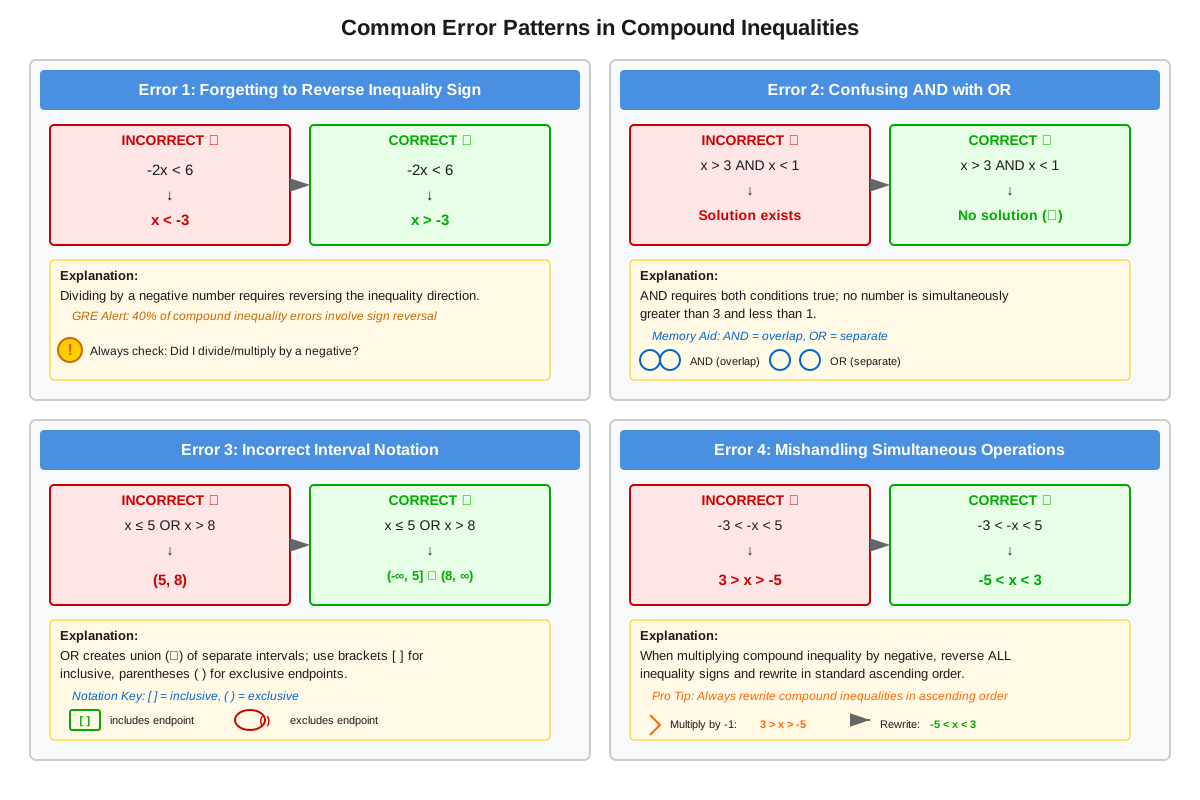
Misconception: When solving -3 < -2x < 6, students divide by -2 without reversing the inequality signs, getting 3/2 < x < -3.
Correction: Dividing by a negative number reverses both inequality signs. The correct solution is 3/2 > x > -3, which should be rewritten in standard form as -3 < x < 3/2.
Misconception: Students treat OR compound inequalities like AND inequalities, writing x < 2 OR x > 7 in compact form as 2 < x < 7.
Correction: Compact notation (a < x < b) is only valid for AND compound inequalities. OR inequalities must remain in separate form or use interval notation with union: (-∞, 2) ∪ (7, ∞).
Misconception: When solving |x - 3| > 5, students incorrectly write -5 < x - 3 < 5.
Correction: The "greater than" absolute value inequality translates to an OR compound inequality: x - 3 < -5 OR x - 3 > 5, which simplifies to x < -2 OR x > 8.
Misconception: Students believe that x > 5 AND x > 3 has no solution because it contains two conditions.
Correction: Both conditions can be satisfied simultaneously. The solution is x > 5 (the more restrictive condition). The intersection of "greater than 3" and "greater than 5" is "greater than 5."
Misconception: When graphing compound inequalities, students use closed circles for strict inequalities (< or >) and open circles for inclusive inequalities (≤ or ≥).
Correction: The convention is reversed: open circles represent strict inequalities (endpoints not included), while closed circles represent inclusive inequalities (endpoints included).
Misconception: Students assume that all compound inequalities have solutions.
Correction: Some compound inequalities have no solution (empty set), such as x > 10 AND x < 5, while others have all real numbers as solutions, such as x < 10 OR x > 5.
Worked Examples
Example 1: AND Compound Inequality with Negative Coefficient
Problem: Solve -4 ≤ -2x + 6 < 10 and express the solution in interval notation.
Solution:
Step 1: Identify this as an AND compound inequality in compact form requiring simultaneous operations on all three parts.
Step 2: Isolate the variable term by subtracting 6 from all parts:
-4 - 6 ≤ -2x + 6 - 6 < 10 - 6
-10 ≤ -2x < 4
Step 3: Divide all parts by -2, remembering to reverse both inequality signs:
-10/-2 ≥ -2x/-2 > 4/-2
5 ≥ x > -2
Step 4: Rewrite in standard form (smaller value on left):
-2 < x ≤ 5Step 5: Convert to interval notation, using parenthesis for strict inequality at -2 and bracket for inclusive inequality at 5:
(-2, 5]Connection to learning objectives: This example demonstrates applying compound inequalities to GRE-style questions accurately, particularly the critical rule about reversing inequality signs when dividing by negative numbers.
Example 2: OR Compound Inequality from Absolute Value
Problem: A manufacturing process requires that the diameter of a bolt be within 0.3 mm of the target diameter of 12 mm. If a bolt's diameter is x mm, write and solve a compound inequality representing unacceptable diameters (those outside the tolerance range).
Solution:
Step 1: Translate the problem. Acceptable diameters satisfy |x - 12| ≤ 0.3. We need unacceptable diameters, so we want |x - 12| > 0.3.
Step 2: Recognize this as an absolute value inequality with "greater than," which translates to an OR compound inequality:
x - 12 < -0.3 OR x - 12 > 0.3Step 3: Solve each inequality separately:
First inequality:
x - 12 < -0.3
x < 11.7
Second inequality:
x - 12 > 0.3
x > 12.3
Step 4: Combine using OR (union):
x < 11.7 OR x > 12.3Step 5: Express in interval notation:
(-∞, 11.7) ∪ (12.3, ∞)Interpretation: Bolts with diameters less than 11.7 mm or greater than 12.3 mm are rejected as outside tolerance specifications.
Connection to learning objectives: This example shows identifying when compound inequalities is being tested (disguised as a word problem about tolerance ranges), explaining the core strategy (converting absolute value to OR compound inequality), and applying the concept to a realistic scenario.
Exam Strategy
When approaching gre compound inequalities questions on test day, employ this systematic strategy:
Recognition triggers: Watch for these phrases and formats that signal compound inequality problems:
- "Between" (usually AND: "x is between 5 and 10" means 5 < x < 10)
- "At least... but no more than" (AND with inclusive bounds)
- "Either... or" (OR compound inequality)
- "Outside the range" (OR compound inequality)
- Absolute value expressions with inequalities
- Questions asking about solution sets or valid ranges
Solution approach:
- Identify the type (AND vs. OR) before solving—this determines whether you're finding intersection or union
- Check for absolute values that need conversion to compound inequalities
- Solve systematically, performing identical operations on all parts for AND inequalities
- Watch for negative coefficients and reverse signs when multiplying/dividing by negatives
- Verify your solution by testing a value from your solution set in the original inequality
Process of elimination for Quantitative Comparison:
When compound inequalities appear in Quantity A vs. Quantity B format:
- Test boundary values from the inequality constraints
- Check whether the relationship holds for all values in the solution set
- If the relationship changes for different valid values, choose (D) "Cannot be determined"
- Pay special attention to whether endpoints are included (≤, ≥) or excluded (<, >)
Time management: Allocate approximately 1.5-2 minutes for straightforward compound inequality problems. If a question requires more than 2.5 minutes, consider whether you've missed a shortcut or should strategically guess and move forward. Complex problems combining compound inequalities with other concepts (like systems of equations) may warrant 3 minutes.
Exam Tip: Always rewrite your final answer in standard form with the smaller value on the left (e.g., -3 < x < 5, not 5 > x > -3). This reduces errors when matching to answer choices and makes verification easier.
Memory Techniques
AND vs. OR Mnemonic: "AND means All conditions, OR means One condition"
- AND requires ALL conditions satisfied (intersection, overlap)
- OR requires ONE or more conditions satisfied (union, either/or)
Absolute Value Translation Acronym - "LONG":
- Less than (|x| < a) → AND compound inequality (-a < x < a)
- Or for greater (|x| > a) → OR compound inequality (x < -a OR x > a)
- Negative reverses signs when dividing
- Graph to verify your solution
Visualization Strategy: Picture compound inequalities as regions on a number line:
- AND inequalities create a "sandwich" with the solution trapped between two values
- OR inequalities create "wings" extending outward from a gap in the middle
- This mental image helps distinguish between the two types and prevents mixing them up
Sign Reversal Reminder: "Negative Division Reverses Direction"
- When you divide by a negative, the direction of inequality arrows flips
- Visualize the inequality symbols as arrows that physically flip when negative division occurs
Parentheses vs. Brackets: "Parentheses for Pointed (strict), Brackets for Bold (inclusive)"
- Parentheses ( ) look pointed and exclude endpoints (< or >)
- Brackets [ ] look bold/solid and include endpoints (≤ or ≥)
Summary
Compound inequalities represent a high-yield GRE topic that tests algebraic manipulation, logical reasoning, and attention to detail simultaneously. The fundamental distinction between AND compound inequalities (requiring all conditions to be satisfied, producing intersections) and OR compound inequalities (requiring at least one condition to be satisfied, producing unions) forms the conceptual foundation. Solving these problems requires systematic application of algebraic operations while carefully tracking inequality directions, especially when multiplying or dividing by negative values. The GRE frequently embeds compound inequalities within absolute value problems, word problems about ranges and constraints, and quantitative comparison questions. Mastery requires fluency in converting between inequality notation, interval notation, and graphical representations, as well as recognizing the various disguises these problems wear on test day. Success depends on methodical problem-solving, careful sign tracking, and the ability to visualize solution sets as regions on the number line.
Key Takeaways
- Compound inequalities combine two or more simple inequalities using AND (intersection) or OR (union) logical connectors, fundamentally changing solution approaches
- AND compound inequalities can be written in compact form (a < x < b) and require simultaneous operations on all parts; OR inequalities must remain separate
- Multiplying or dividing all parts of a compound inequality by a negative number reverses all inequality signs—this is the most common source of errors
- Absolute value inequalities translate predictably: |x - a| < b becomes an AND compound inequality, while |x - a| > b becomes an OR compound inequality
- Interval notation precisely communicates solutions: parentheses ( ) for strict inequalities, brackets [ ] for inclusive inequalities, and ∪ for unions
- Visual representation on number lines provides powerful error-checking: AND creates continuous intervals, OR creates disjoint regions
- Recognition of trigger words ("between," "outside," "at least... but no more than") enables quick identification of compound inequality problems on the GRE
Related Topics
Systems of Linear Inequalities: Extends compound inequalities to two variables, creating solution regions in the coordinate plane rather than on number lines. Mastering compound inequalities provides the foundation for understanding how multiple constraints interact graphically.
Absolute Value Equations and Inequalities: Directly builds on compound inequalities, as absolute value inequalities decompose into compound inequality forms. The translation skills developed here are essential for this related topic.
Optimization and Linear Programming: Advanced applications where compound inequalities define feasible regions for maximizing or minimizing objective functions. Understanding compound inequalities is prerequisite knowledge for these business and economics applications.
Quadratic Inequalities: Extends inequality concepts to polynomial expressions, requiring sign analysis and interval testing. The solution set notation and graphical representation skills transfer directly from compound inequalities.
Set Theory and Logic: The mathematical foundation underlying AND (intersection) and OR (union) operations in compound inequalities. Deeper study reveals the formal logical structure behind these problem types.
Practice CTA
Now that you've mastered the core concepts, notation systems, and solution strategies for compound inequalities, it's time to solidify your understanding through active practice. Attempt the practice questions designed specifically for this topic, focusing on recognizing problem types quickly and executing solutions systematically. Use the flashcards to drill the critical rules—especially sign reversal with negative coefficients and absolute value translations—until they become automatic. Remember that compound inequalities appear frequently on the GRE, often as discriminators between good and excellent scores. Your investment in mastering this topic will pay dividends across multiple question types on test day. Approach each practice problem methodically, check your work by testing values from your solution set, and learn from any mistakes. You're building the precision and confidence that lead to top quantitative scores!
Sign up free to keep reading
Create a free AnvayaPrep account to finish this GRE guide on Compound inequalities — plus flashcards and practice questions.