Overview
Linear inequalities represent one of the most fundamental and frequently tested concepts in GRE Quantitative Reasoning. Unlike equations that express exact equality between two expressions, inequalities describe relationships where one expression is greater than, less than, greater than or equal to, or less than or equal to another. Mastering linear inequalities is essential because they appear not only as standalone problems but also as components of more complex algebraic questions, word problems, and quantitative comparison questions—one of the GRE's signature question formats.
The ability to solve and manipulate gre linear inequalities efficiently separates high-scoring test-takers from average performers. These problems test both computational skills and conceptual understanding, particularly regarding how operations affect inequality signs. Students must recognize when multiplying or dividing by negative numbers reverses the inequality direction, understand how to represent solution sets on number lines, and interpret compound inequalities that involve multiple constraints simultaneously.
Within the broader landscape of GRE Quantitative Reasoning, linear inequalities connect directly to coordinate geometry (graphing inequality regions), absolute value problems (which often generate compound inequalities), and optimization word problems. They also form the foundation for understanding systems of inequalities and constraint-based reasoning that appears in data interpretation questions. The topic bridges pure algebraic manipulation with logical reasoning—a combination the GRE tests extensively across multiple question types.
Learning Objectives
- [ ] Identify when Linear inequalities is being tested
- [ ] Explain the core rule or strategy behind Linear inequalities
- [ ] Apply Linear inequalities to GRE-style questions accurately
- [ ] Determine when to reverse inequality signs during algebraic manipulation
- [ ] Solve compound inequalities and express solutions in interval notation
- [ ] Translate word problems involving constraints into linear inequality expressions
- [ ] Evaluate quantitative comparison questions involving inequalities with strategic substitution
Prerequisites
- Basic algebraic manipulation: Adding, subtracting, multiplying, and dividing algebraic expressions is essential for isolating variables in inequalities
- Understanding of number properties: Recognizing positive, negative, and zero values determines when inequality signs reverse
- Number line representation: Visualizing solutions on a number line helps verify answers and understand solution sets
- Order of operations: Correctly sequencing mathematical operations ensures accurate inequality solving
Why This Topic Matters
Linear inequalities appear in approximately 10-15% of GRE Quantitative Reasoning questions, making them a high-yield topic for focused study. They manifest across multiple question formats: problem-solving questions requiring direct computation, quantitative comparison questions where inequality relationships determine the answer, and data interpretation questions where constraints define feasible regions. Understanding inequalities is particularly crucial for the quantitative comparison format, where determining relative magnitude without exact calculation often provides the fastest path to the correct answer.
In real-world applications, linear inequalities model constraints in business (budget limitations, minimum production requirements), science (acceptable ranges for experimental conditions), and everyday decision-making (time and resource allocation). This practical relevance means GRE questions often embed inequalities within word problems about pricing, scheduling, or capacity planning.
The GRE specifically tests whether students understand the conceptual differences between equations and inequalities, particularly the critical rule about reversing inequality signs. Test-makers deliberately create problems where this rule determines the correct answer, making it a high-frequency trap for unprepared students. Additionally, compound inequalities (involving "and" or "or" logic) appear regularly in questions about ranges and acceptable values, requiring students to combine multiple constraints accurately.
Core Concepts
Definition and Notation
A linear inequality is a mathematical statement comparing two expressions using inequality symbols rather than an equals sign. The four primary inequality symbols are:
<(less than): indicates the left expression is strictly smaller>(greater than): indicates the left expression is strictly larger≤(less than or equal to): includes the boundary value≥(greater than or equal to): includes the boundary value
A linear inequality in one variable takes the form ax + b < c, ax + b > c, ax + b ≤ c, or ax + b ≥ c, where a, b, and c are constants and x is the variable. The solution to a linear inequality is typically a range of values (an interval) rather than a single number.
Fundamental Properties of Inequalities
Understanding how inequalities behave under various operations is crucial for solving them correctly:
- Addition and Subtraction Property: Adding or subtracting the same value to both sides preserves the inequality direction
- If a < b, then a + c < b + c and a - c < b - c
- Example: If x + 5 < 12, then x < 7
- Multiplication and Division by Positive Numbers: Multiplying or dividing both sides by a positive number preserves the inequality direction
- If a < b and c > 0, then ac < bc and a/c < b/c
- Example: If 3x < 15, then x < 5
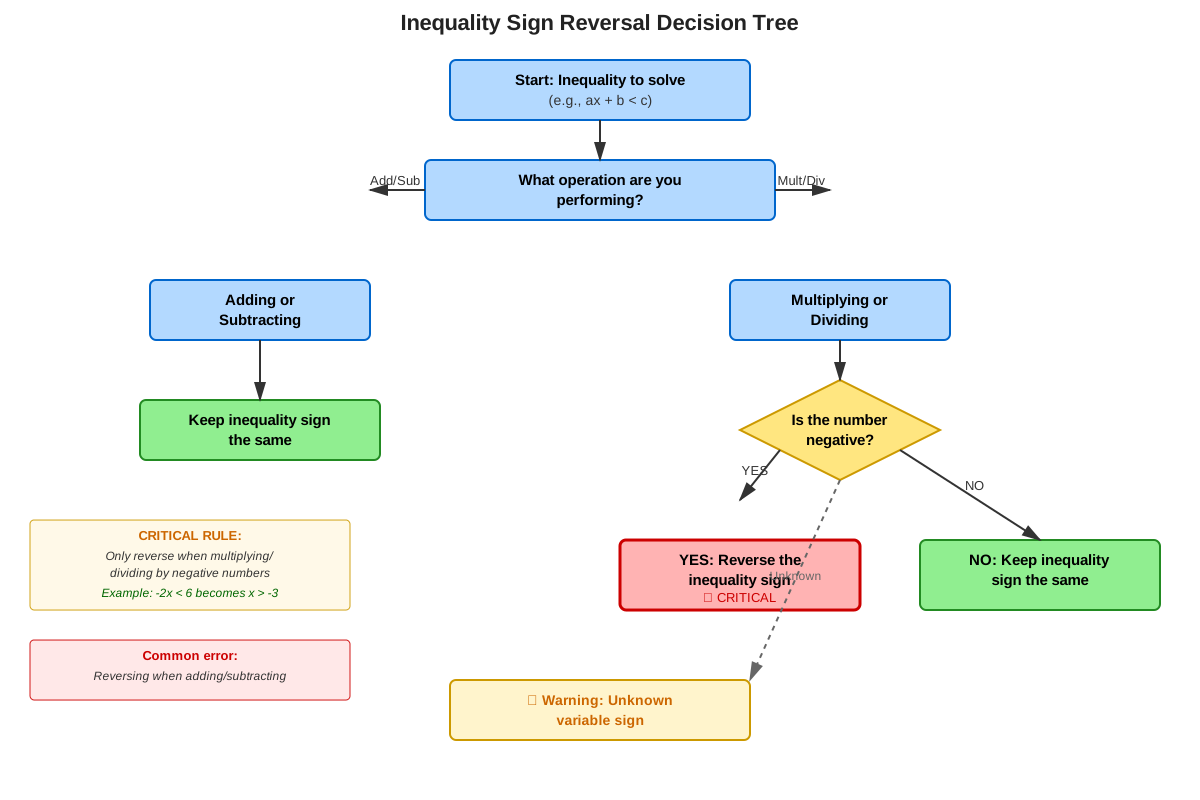
- Multiplication and Division by Negative Numbers: This is the critical rule that distinguishes inequalities from equations—multiplying or dividing both sides by a negative number reverses the inequality sign
- If a < b and c < 0, then ac > bc and a/c > b/c
- Example: If -2x < 10, then x > -5 (dividing by -2 reverses < to >)
- Transitive Property: If
a < bandb < c, thena < c
- This property enables chaining inequalities and is frequently tested in quantitative comparison questions
Solving Linear Inequalities
The process for solving linear inequalities mirrors equation-solving with one critical difference—tracking when to reverse the inequality sign:
- Simplify both sides by combining like terms
- Use addition or subtraction to isolate the variable term
- Use multiplication or division to isolate the variable
- Reverse the inequality sign if multiplying or dividing by a negative number
- Express the solution in interval notation or on a number line
Example: Solve 5 - 3x ≥ 14
5 - 3x ≥ 14
-3x ≥ 9          (subtract 5 from both sides)
x ≤ -3           (divide by -3, REVERSE the sign)
The solution set is all real numbers less than or equal to -3, written as (-∞, -3] in interval notation.
Compound Inequalities
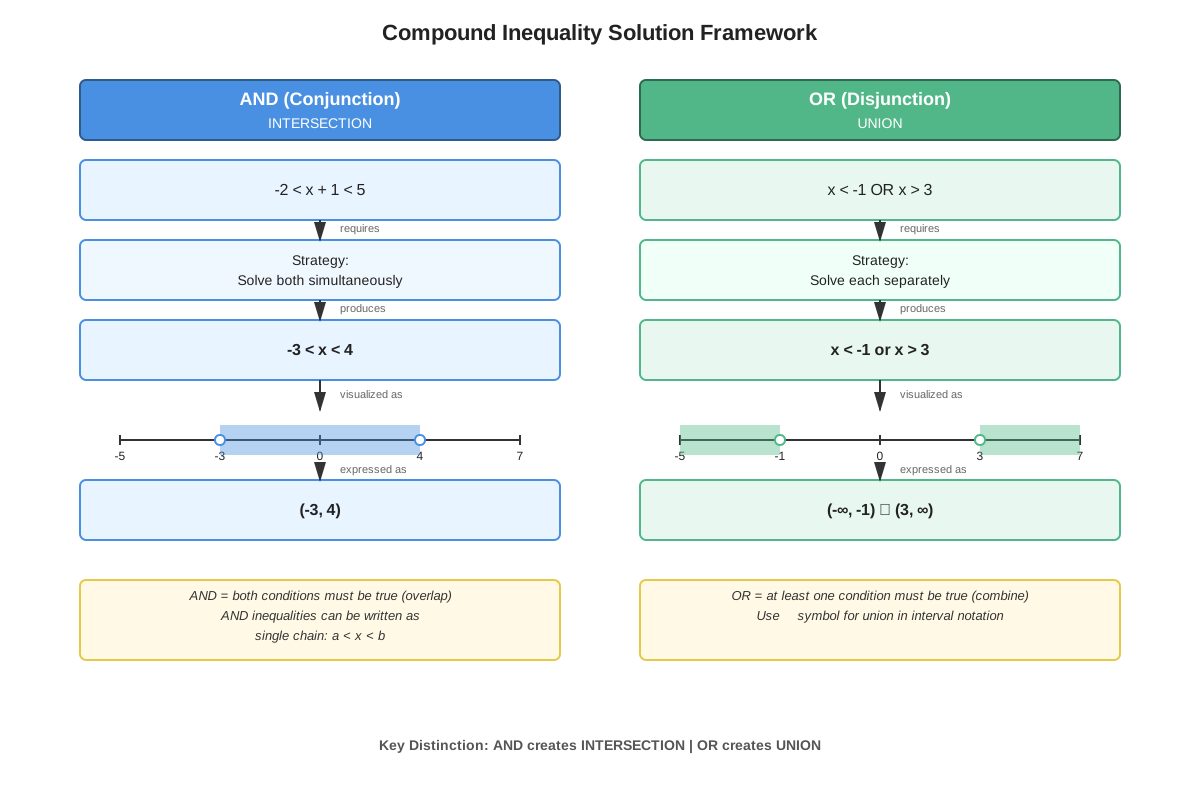
Compound inequalities involve two inequality statements connected by "and" or "or" logic:
Conjunction (AND): Both conditions must be satisfied simultaneously
- Written as
a < x < bora < x AND x < b - Solution is the intersection of individual solution sets
- Example:
2 < x + 3 < 7meansx + 3 > 2ANDx + 3 < 7, which simplifies to-1 < x < 4
Disjunction (OR): At least one condition must be satisfied
- Written as
x < a OR x > b - Solution is the union of individual solution sets
- Example:
x - 2 < -5 OR x - 2 > 5meansx < -3 OR x > 7
| Type | Connector | Solution Set | Example |
|---|---|---|---|
| Conjunction | AND | Intersection (overlap) | -1 < x < 4 |
| Disjunction | OR | Union (combined) | x < -3 or x > 7 |
Graphing Solutions on a Number Line
Visual representation helps verify solutions and understand solution sets:
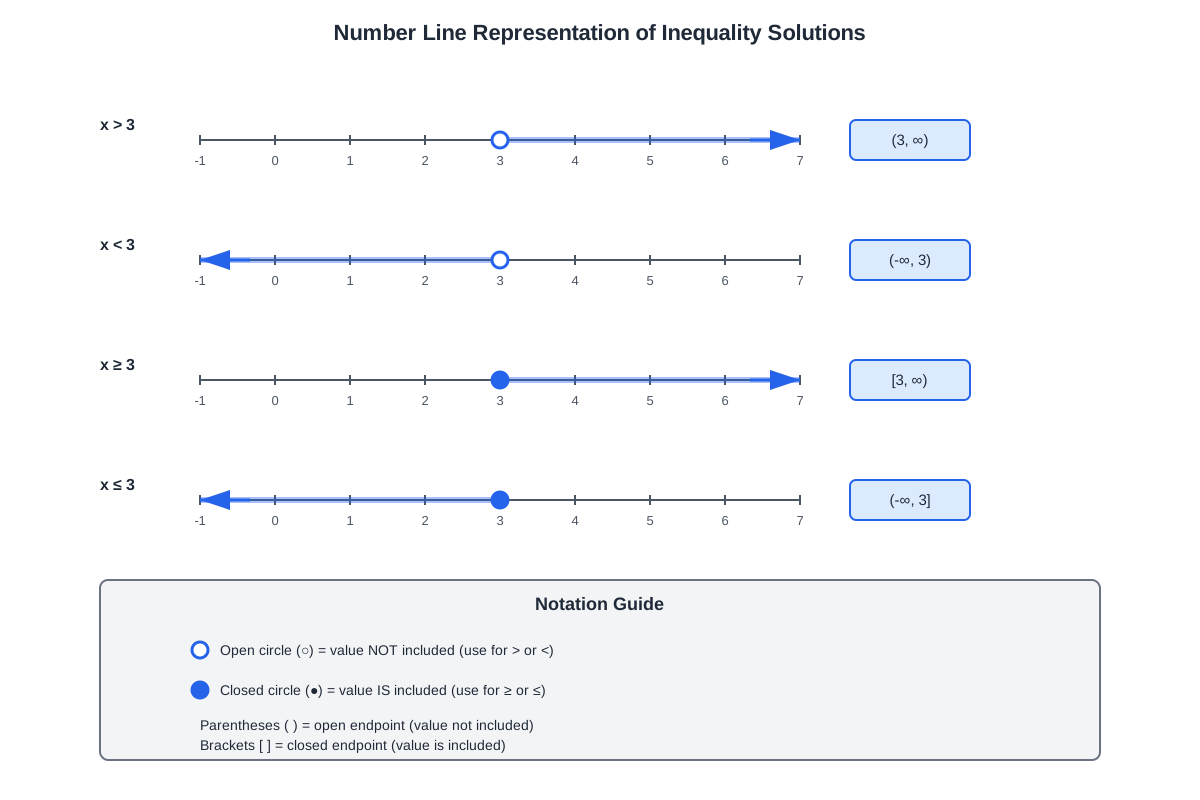
- Open circle (○): Use for strict inequalities (
<or>) to show the boundary point is NOT included - Closed circle (●): Use for inclusive inequalities (
≤or≥) to show the boundary point IS included - Shading: Shade the region containing all solution values
For x ≤ -3: Place a closed circle at -3 and shade left (toward negative infinity)
For -1 < x < 4: Place open circles at -1 and 4, shade the region between them
Special Cases and Edge Conditions
Always True Inequalities: Some manipulations yield statements like 5 > 2 (always true), meaning the original inequality is true for all real numbers.
Never True Inequalities: Statements like 3 < -1 (always false) indicate the original inequality has no solution.
Boundary Analysis: When inequalities include the boundary (≤ or ≥), test the boundary value separately to confirm inclusion in the solution set.
Concept Relationships
The concepts within linear inequalities build hierarchically: understanding basic inequality notation and properties → mastering the sign-reversal rule → solving single inequalities → handling compound inequalities → applying to word problems and quantitative comparisons.
The sign-reversal rule serves as the central concept connecting to all solving procedures. Every manipulation must be evaluated through this lens: "Am I multiplying or dividing by a negative value?" This connects directly to prerequisite knowledge of number properties (positive vs. negative values).
Compound inequalities extend single inequalities by introducing logical connectors, bridging to set theory concepts (intersection and union). This relationship appears when: Single inequality solutions → Combined using AND/OR logic → Compound inequality solution sets.
Linear inequalities connect to prerequisite topics through algebraic manipulation techniques (isolating variables, combining like terms) and extend to advanced topics like systems of inequalities (multiple constraints simultaneously), absolute value inequalities (which split into compound inequalities), and quadratic inequalities (requiring factoring and sign analysis).
The relationship map: Basic Properties → Sign-Reversal Rule → Single Inequality Solutions → Compound Inequalities → Word Problem Translation → Quantitative Comparison Strategy
Quick check — test yourself on Linear inequalities so far.
Try Flashcards →High-Yield Facts
⭐ Multiplying or dividing both sides of an inequality by a negative number reverses the inequality sign (e.g., if -2x < 6, then x > -3)
⭐ Adding or subtracting the same value to both sides never changes the inequality direction
⭐ The solution to a linear inequality is typically an interval (range of values), not a single number
⭐ Compound inequalities with AND require both conditions to be true simultaneously; the solution is the intersection
⭐ Compound inequalities with OR require at least one condition to be true; the solution is the union
- Multiplying both sides by a positive number preserves the inequality direction
- The inequality
a < b < cis equivalent toa < b AND b < c
- Strict inequalities (
<,>) use open circles on number lines; inclusive inequalities (≤,≥) use closed circles
- If an inequality simplifies to a statement like
5 > 2(always true), the solution is all real numbers
- If an inequality simplifies to a statement like
3 < -1(always false), there is no solution
- When solving
a < x < b, subtract the same value from all three parts to maintain the relationship
- Inequalities cannot be "cross-multiplied" like proportions unless the signs of all terms are known
Common Misconceptions
Misconception: The inequality sign always stays the same when solving, just like the equals sign in equations.
Correction: The inequality sign reverses when multiplying or dividing both sides by a negative number. This is the fundamental difference between equations and inequalities and is heavily tested on the GRE.
Misconception: For compound inequalities like 2 < x + 3 < 7, solve each inequality separately and then combine.
Correction: Treat the compound inequality as a single unit. Subtract 3 from all three parts simultaneously: 2 - 3 < x + 3 - 3 < 7 - 3, yielding -1 < x < 4. This maintains the relationship and prevents errors.
Misconception: The solution to x > 5 OR x < 2 is 2 < x < 5.
Correction: OR means union, not intersection. The solution includes all values less than 2 OR greater than 5, which is x < 2 or x > 5. The region between 2 and 5 is NOT part of the solution.
Misconception: When dividing by a variable in an inequality, treat it like dividing by a number.
Correction: Never divide by a variable unless you know its sign. If the variable could be positive or negative, you must consider both cases separately, as the inequality direction depends on the variable's sign.
Misconception: x ≤ 5 and x < 5 have essentially the same solution set.
Correction: While similar, x ≤ 5 includes the value 5 in the solution set, while x < 5 does not. This distinction matters in quantitative comparison questions and when determining whether boundary values satisfy constraints.
Worked Examples
Example 1: Single Linear Inequality with Sign Reversal
Problem: Solve for x: 7 - 4x ≥ 19
Solution:
Step 1: Isolate the term containing x by subtracting 7 from both sides
7 - 4x ≥ 19
-4x ≥ 12
Step 2: Divide both sides by -4 to isolate x. Critical: Since we're dividing by a negative number, reverse the inequality sign from ≥ to ≤
x ≤ -3Step 3: Express the solution
The solution set is all real numbers less than or equal to -3, written as (-∞, -3] in interval notation.
Verification: Test a value in the solution set, such as x = -4:
7 - 4(-4) = 7 + 16 = 23
23 ≥ 19 ✓ (True)
Test a value outside the solution set, such as x = 0:
7 - 4(0) = 7
7 ≥ 19 ✗ (False)
Connection to Learning Objectives: This example demonstrates identifying when sign reversal is necessary (dividing by -4) and applying the core strategy accurately to reach the correct solution.
Example 2: Compound Inequality (GRE Quantitative Comparison Style)
Problem:
Column A: The smallest integer value of x satisfying -3 ≤ 2x - 5 < 7
Column B: -1Solution:
Step 1: Solve the compound inequality by performing the same operations on all three parts
-3 ≤ 2x - 5 < 7Add 5 to all three parts:
-3 + 5 ≤ 2x - 5 + 5 < 7 + 5
2 ≤ 2x < 12
Divide all three parts by 2 (positive number, so no sign reversal):
1 ≤ x < 6Step 2: Identify the smallest integer in the solution set
The solution set includes all values from 1 (inclusive) to 6 (exclusive). The smallest integer satisfying this is x = 1.
Step 3: Compare to Column B
Column A: 1
Column B: -1
Since 1 > -1, Column A is greater.
Connection to Learning Objectives: This example shows how to identify compound inequality testing in quantitative comparison format, apply the solving strategy while maintaining the compound structure, and extract the specific information requested (smallest integer value).
Exam Strategy
Trigger Words: Watch for phrases like "at least," "at most," "no more than," "no less than," "between," "exceeds," "minimum," and "maximum"—these signal inequality relationships rather than exact equations.
Approach for Problem-Solving Questions:
- Translate word problems into mathematical inequalities by identifying the constraint type
- Before manipulating, scan for operations involving negative numbers and flag where sign reversal will occur
- Solve systematically, writing each step to avoid mental errors with sign changes
- Verify your solution by testing a value from your solution set in the original inequality
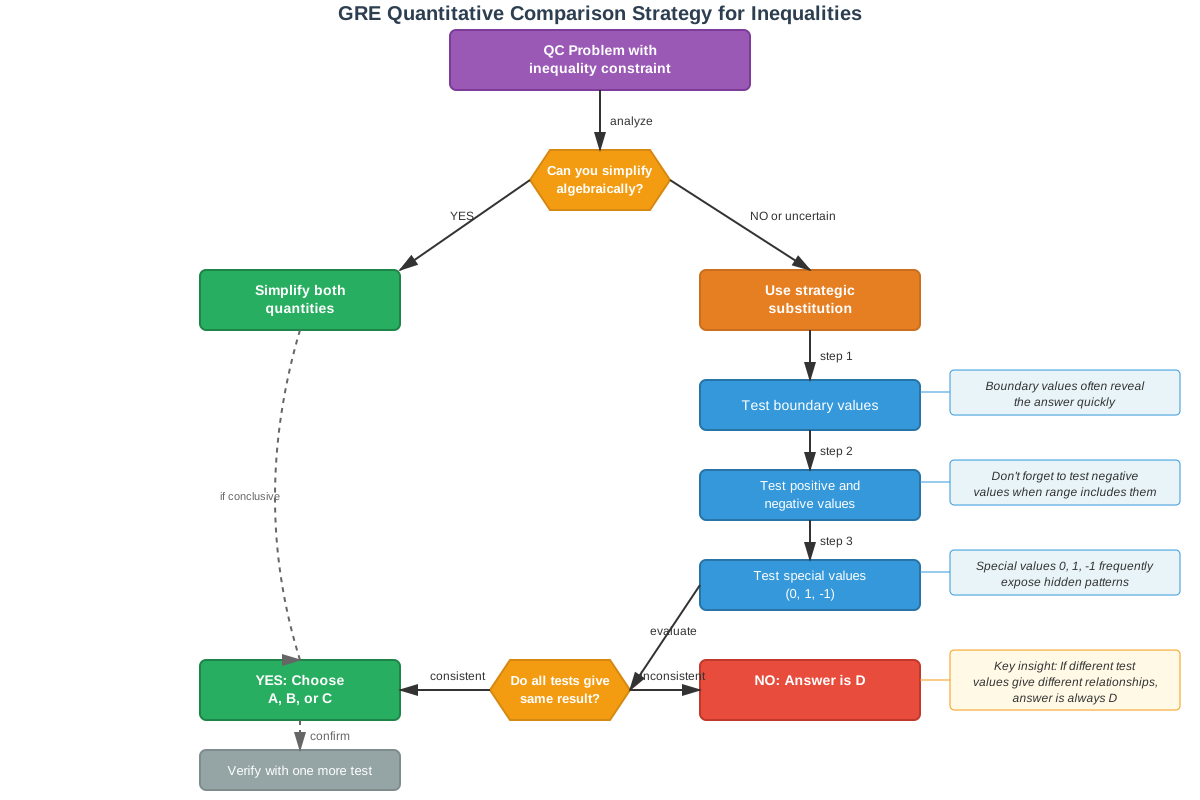
Approach for Quantitative Comparison Questions:
- Don't always solve completely; sometimes comparing expressions directly is faster
- Test strategic values (positive, negative, zero, fractions) when variables are present
- If the relationship depends on the variable's value, the answer is "Cannot be determined"
- Look for opportunities to add or subtract the same expression from both columns to simplify
Process of Elimination Tips:
- If a problem involves dividing by a negative and an answer choice doesn't reverse the sign, eliminate it
- For compound inequalities with AND, eliminate answer choices that extend beyond the intersection
- For compound inequalities with OR, eliminate answer choices showing only a single interval when two are needed
Time Allocation:
- Simple single inequalities: 30-45 seconds
- Compound inequalities: 60-90 seconds
- Word problems requiring translation: 90-120 seconds
- If you're spending more than 2 minutes, make an educated guess and move on
Memory Techniques
Mnemonic for Sign Reversal: "Negative Flips It" (NFI)
- When you multiply or divide by a Negative number, Flip the Inequality sign
Visualization for Compound Inequalities:
- AND = "Area of overlap" (intersection, the middle region)
- OR = "Outside Regions" (union, the combined outer regions)
Circle Memory Device:
- Open circle = Omit the boundary (strict inequality:
<or>) - Closed circle = Contains the boundary (inclusive inequality:
≤or≥)
Acronym for Solving Steps: SIAM
- Simplify both sides
- Isolate the variable term
- Apply multiplication/division
- Mind the sign (reverse if negative)
Summary
Linear inequalities form a cornerstone of GRE Quantitative Reasoning, testing both computational accuracy and conceptual understanding of how inequalities differ from equations. The critical distinction lies in the sign-reversal rule: multiplying or dividing by negative numbers reverses the inequality direction, while addition and subtraction never affect the sign. Solutions to linear inequalities are typically intervals rather than single values, requiring students to think in terms of ranges and constraints. Compound inequalities introduce logical connectors (AND/OR), where AND produces intersections (overlapping regions) and OR produces unions (combined regions). Success on GRE inequality questions demands recognizing trigger words in word problems, systematically applying algebraic manipulation while tracking sign changes, and strategically approaching quantitative comparison questions without over-solving. Mastery of linear inequalities enables progression to more complex topics like systems of inequalities, absolute value problems, and optimization questions that appear throughout the GRE Quantitative section.
Key Takeaways
- The sign-reversal rule is non-negotiable: Always reverse the inequality sign when multiplying or dividing by a negative number
- Linear inequality solutions are intervals (ranges), not single points—think in terms of "all values that satisfy" rather than "the value"
- Compound inequalities with AND require both conditions simultaneously (intersection); OR requires at least one condition (union)
- Verify solutions by testing values from your solution set in the original inequality
- In quantitative comparison questions, strategic value testing often beats complete algebraic solving
- Translate word problem constraints carefully: "at least" means
≥, "at most" means≤, "between" typically means a compound inequality - Never divide by a variable in an inequality unless you know whether it's positive or negative
Related Topics
Systems of Linear Inequalities: Extends single inequalities to multiple constraints simultaneously, requiring graphical interpretation of feasible regions. Mastering linear inequalities provides the foundation for understanding how multiple constraints interact.
Absolute Value Inequalities: Combines absolute value concepts with inequalities, typically splitting into compound inequalities. Understanding linear inequality solving is essential before tackling the additional complexity of absolute values.
Quadratic Inequalities: Involves inequalities with squared terms, requiring factoring and sign analysis across intervals. Linear inequalities provide the logical framework for understanding solution sets that extends to quadratic cases.
Optimization Problems: Real-world applications where inequalities represent constraints and the goal is to maximize or minimize an objective function. Linear inequality mastery enables interpretation of constraint-based scenarios.
Coordinate Geometry with Inequalities: Graphing inequality regions in the xy-plane, often appearing in data interpretation questions. Understanding linear inequalities in one variable extends naturally to two-variable cases.
Practice CTA
Now that you've mastered the core concepts, properties, and strategies for linear inequalities, it's time to solidify your understanding through active practice. Attempt the practice questions designed specifically for this topic, focusing on applying the sign-reversal rule accurately and recognizing compound inequality patterns. Use the flashcards to reinforce high-yield facts and common trap scenarios. Remember: the difference between knowing the concept and scoring points is consistent, timed practice under exam-like conditions. You've built the foundation—now strengthen it through application!
Sign up free to keep reading
Create a free AnvayaPrep account to finish this GRE guide on Linear inequalities — plus flashcards and practice questions.