Overview
Evaluating functions is a fundamental algebraic skill that appears frequently throughout the GRE Quantitative Reasoning section. This topic involves substituting specific values into a function's formula and computing the result—a process that may seem straightforward but becomes significantly more complex when combined with other mathematical concepts. On the GRE, function evaluation questions test not only computational accuracy but also conceptual understanding of how functions behave, how they transform inputs into outputs, and how multiple functions can interact through composition or nested operations.
The importance of mastering gre evaluating functions cannot be overstated. Function problems appear in approximately 10-15% of GRE Quantitative questions, either as standalone problems or embedded within more complex algebraic scenarios. These questions frequently combine function evaluation with other topics such as coordinate geometry, sequences, inequalities, and word problems. A solid grasp of function evaluation serves as the foundation for understanding more advanced concepts like function composition, inverse functions, and transformations—all of which may appear on the exam.
Within the broader landscape of GRE Quantitative Reasoning, function evaluation bridges arithmetic computation and abstract algebraic thinking. It requires students to move fluidly between symbolic notation and numerical calculation, to recognize patterns in function behavior, and to apply systematic problem-solving approaches. Success with this topic demonstrates mathematical maturity and the ability to work with abstract representations—skills that the GRE specifically targets across multiple question formats including Quantitative Comparison, Multiple Choice, and Numeric Entry questions.
Learning Objectives
- [ ] Identify when Evaluating functions is being tested in GRE questions
- [ ] Explain the core rule or strategy behind Evaluating functions
- [ ] Apply Evaluating functions to GRE-style questions accurately
- [ ] Evaluate composite functions involving two or more function operations
- [ ] Determine function values when the input is an algebraic expression rather than a number
- [ ] Recognize and avoid common computational errors when substituting negative numbers or fractions
- [ ] Solve equations where the output of a function is given and the input must be determined
Prerequisites
- Basic algebraic manipulation: Essential for simplifying expressions after substitution and combining like terms
- Order of operations (PEMDAS): Required to correctly evaluate complex expressions with multiple operations
- Working with negative numbers and fractions: Necessary because function inputs frequently involve these values
- Understanding of function notation: Must recognize that f(x) represents a function named f with input variable x
- Exponent rules: Critical when evaluating functions containing powers, especially with negative bases
Why This Topic Matters
Function evaluation appears across numerous real-world applications, from calculating compound interest (where time is the input variable) to determining medication dosages based on patient weight, to modeling population growth over time. In computer science and data analysis, functions form the backbone of algorithms and data transformations. Understanding how to evaluate functions develops logical thinking and the ability to follow multi-step procedures accurately—skills valuable far beyond standardized testing.
On the GRE specifically, function evaluation questions appear in approximately 2-4 questions per exam, making this a high-yield topic for focused study. These questions typically appear in the following formats: direct evaluation problems where a function is defined and students must find f(a) for a specific value; composite function problems requiring evaluation of f(g(x)) or similar nested operations; word problems where real-world scenarios are modeled by functions; and Quantitative Comparison questions asking students to compare function values at different inputs. The GRE particularly favors questions that combine function evaluation with other concepts, such as evaluating a function at a point and then using that result in an inequality or geometric calculation.
Function problems on the GRE often appear deceptively simple but contain computational traps designed to catch careless errors. Test-makers frequently use negative inputs, fractional inputs, or expressions as inputs specifically to test whether students can maintain accuracy through multiple calculation steps. Additionally, the GRE uses function notation in non-standard ways, sometimes defining functions with unusual symbols or multiple variables, testing whether students truly understand the underlying concept rather than just memorizing f(x) notation.
Core Concepts
Basic Function Notation and Evaluation
A function is a mathematical relationship that assigns exactly one output value to each input value. The standard notation f(x) represents a function named f with x as the input variable. The expression to the right of the equals sign shows how to transform the input into the output. For example, if f(x) = 2x + 3, this function takes any input, multiplies it by 2, and adds 3.
To evaluate a function at a specific value means to substitute that value for every occurrence of the input variable and compute the result. For f(x) = 2x + 3, evaluating f(5) requires replacing every x with 5:
f(5) = 2(5) + 3 = 10 + 3 = 13The critical principle is that the input value completely replaces the variable throughout the entire expression. This becomes especially important with more complex functions.
Evaluating Functions with Negative Inputs
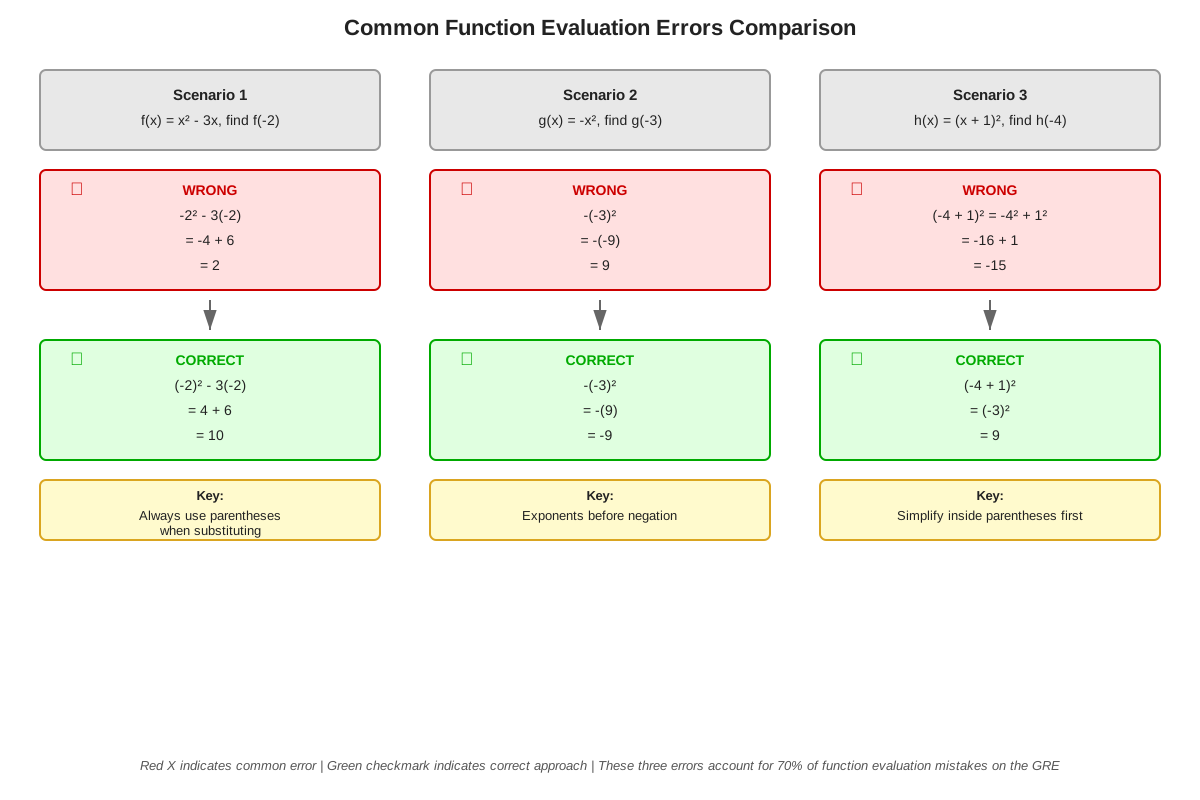
When the input is negative, parentheses become essential for maintaining accuracy. Consider f(x) = x² - 4x + 1. To evaluate f(-3):
f(-3) = (-3)² - 4(-3) + 1
f(-3) = 9 + 12 + 1
f(-3) = 22
Notice that (-3)² equals positive 9, while -4(-3) equals positive 12. The parentheses ensure that the negative sign is properly incorporated into each operation. A common error is writing -3² = -9 instead of (-3)² = 9.
Evaluating Functions with Algebraic Expressions as Inputs
Functions can accept not just numbers but entire algebraic expressions as inputs. If f(x) = x² + 2x and we need to find f(a + 1), we substitute the entire expression (a + 1) for every x:
f(a + 1) = (a + 1)² + 2(a + 1)
f(a + 1) = a² + 2a + 1 + 2a + 2
f(a + 1) = a² + 4a + 3
This requires careful expansion of squared binomials and distribution of coefficients. The GRE frequently tests this skill because it combines multiple algebraic operations.
Composite Functions
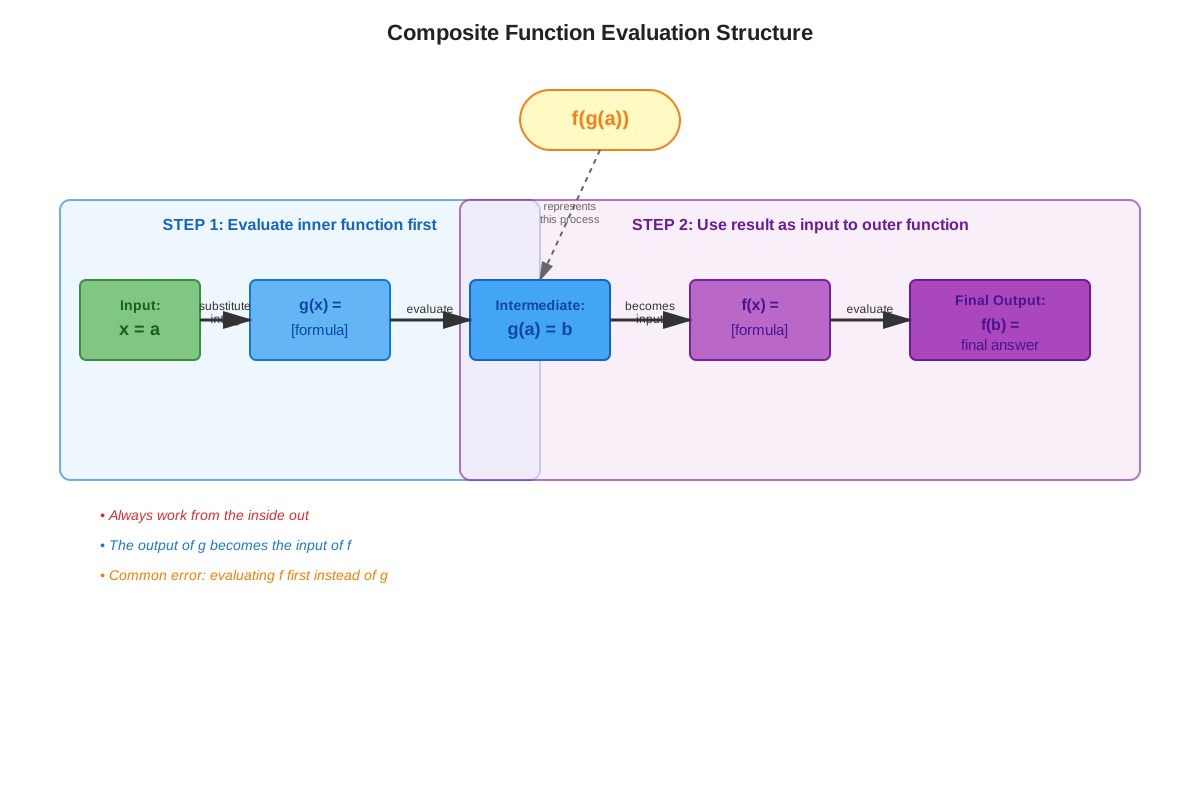
Composite functions involve evaluating one function and using that result as the input for another function. The notation f(g(x)) means "first evaluate g(x), then use that result as the input for f." This is also written as (f ∘ g)(x).
For example, if f(x) = 2x + 1 and g(x) = x² - 3, to find f(g(2)):
Step 1: Evaluate g(2) = (2)² - 3 = 4 - 3 = 1
Step 2: Evaluate f(1) = 2(1) + 1 = 3
Therefore, f(g(2)) = 3
The order matters critically: f(g(x)) generally does not equal g(f(x)). Always work from the inside out, evaluating the innermost function first.
Piecewise Functions
Piecewise functions use different formulas depending on the input value. These are defined with conditions:
f(x) = { x² if x < 0
       { 2x + 1 if x ≥ 0
To evaluate a piecewise function, first determine which condition the input satisfies, then use the corresponding formula. For f(-2), since -2 < 0, use the first formula: f(-2) = (-2)² = 4. For f(3), since 3 ≥ 0, use the second formula: f(3) = 2(3) + 1 = 7.
Finding Input Values Given Output Values
Sometimes the GRE provides the function's output and asks for the input. If f(x) = 3x - 5 and f(a) = 10, solve for a:
3a - 5 = 10
3a = 15
a = 5
This reverses the typical evaluation process and requires equation-solving skills. More complex versions might involve quadratic functions, requiring the quadratic formula or factoring.
Non-Standard Function Notation
The GRE occasionally uses unconventional symbols to define functions, testing conceptual understanding. For example: a ⊕ b = 2a + b². To evaluate 3 ⊕ 4, substitute 3 for a and 4 for b:
3 ⊕ 4 = 2(3) + (4)² = 6 + 16 = 22The symbol ⊕ is simply notation; the process remains identical to standard function evaluation.
Concept Relationships
Function evaluation serves as the foundation for all function-related topics. The basic skill of substituting values into expressions connects directly to prerequisite knowledge of algebraic manipulation and order of operations. Each evaluation requires applying PEMDAS systematically, making this prior knowledge essential.
Within the topic itself, concepts build progressively: Basic evaluation → Evaluation with negative/fractional inputs → Evaluation with algebraic expressions → Composite functions → Piecewise functions. Each level adds complexity while relying on the previous skills. Composite functions, for instance, are simply multiple basic evaluations performed in sequence.
Function evaluation connects forward to numerous advanced topics. Understanding how to evaluate functions is prerequisite for graphing functions (each point on a graph represents an evaluation), analyzing function transformations (which require comparing evaluations at corresponding points), and working with inverse functions (which reverse the evaluation process). Additionally, function evaluation appears within calculus concepts that occasionally surface on the GRE, such as understanding rates of change.
The relationship to other algebra topics is extensive. Function evaluation combines with solving equations when finding inputs from outputs, with inequalities when determining where f(x) > k, and with coordinate geometry when functions represent geometric relationships. Word problems frequently embed function evaluation within real-world contexts, requiring translation between verbal descriptions and mathematical operations.
High-Yield Facts
- ⭐ When evaluating f(x) at a specific value, substitute that value for every occurrence of x in the function's formula
- ⭐ Always use parentheses when substituting negative numbers: f(-2) requires writing (-2) everywhere x appears
- ⭐ For composite functions f(g(x)), always evaluate the inner function first, then use that result in the outer function
- ⭐ The order of composition matters: f(g(x)) ≠ g(f(x)) in most cases
- ⭐ When the input is an algebraic expression like (a + 1), substitute the entire expression and expand carefully
- For piecewise functions, first determine which condition applies, then use only that piece's formula
- When f(a) is given and a must be found, set up and solve an equation
- Squaring a negative number yields a positive result: (-3)² = 9, not -9
- Function notation f(x) does not mean multiplication; it indicates the output when x is the input
- Non-standard symbols (⊕, ⊗, etc.) follow the same evaluation process as standard f(x) notation
- When evaluating at x = 0, any term with x as a factor becomes zero
- Fractional inputs require careful arithmetic with fraction operations throughout the evaluation
- If a function contains multiple variables like f(x, y) = x² + y, all specified values must be substituted
- The domain of a function restricts which inputs are valid; always check if an input is in the domain
Quick check — test yourself on Evaluating functions so far.
Try Flashcards →Common Misconceptions
Misconception: f(x + 2) equals f(x) + 2
Correction: f(x + 2) means substitute (x + 2) for every x in the function's formula. If f(x) = x², then f(x + 2) = (x + 2)² = x² + 4x + 4, which is not equal to f(x) + 2 = x² + 2.
Misconception: -x² equals (-x)² for any value of x
Correction: These expressions are different. -x² means -(x²), the negative of x squared. For x = 3, -x² = -9. However, (-x)² means the square of negative x, which equals x². For x = 3, (-x)² = (-3)² = 9. The placement of parentheses is critical.
Misconception: f(g(x)) and g(f(x)) always give the same result
Correction: Composite functions are generally not commutative. If f(x) = 2x and g(x) = x + 1, then f(g(x)) = 2(x + 1) = 2x + 2, while g(f(x)) = 2x + 1. These are different functions. Only in special cases do they coincide.
Misconception: When evaluating f(2x), simply multiply f(x) by 2
Correction: f(2x) means substitute 2x for every occurrence of x in the function. If f(x) = x² + 1, then f(2x) = (2x)² + 1 = 4x² + 1, not 2(x² + 1) = 2x² + 2. The input is doubled before applying the function's operations.
Misconception: For piecewise functions, all pieces must be evaluated and then combined
Correction: Only one piece of a piecewise function applies for any given input. Determine which condition the input satisfies, then use only that formula. The other pieces are irrelevant for that particular evaluation.
Misconception: Function notation f(x) represents f times x
Correction: The notation f(x) does not indicate multiplication. It represents the output of function f when the input is x. This is fundamentally different from algebraic notation where adjacent symbols typically indicate multiplication.
Worked Examples
Example 1: Multi-Step Evaluation with Negative Input
Problem: If f(x) = 2x² - 3x + 5, find f(-4).
Solution:
Step 1: Identify the function and the input value. We have f(x) = 2x² - 3x + 5 and need to evaluate at x = -4.
Step 2: Substitute -4 for every x, using parentheses to preserve the negative sign:
f(-4) = 2(-4)² - 3(-4) + 5Step 3: Evaluate the exponent first (order of operations):
f(-4) = 2(16) - 3(-4) + 5Step 4: Perform multiplication:
f(-4) = 32 + 12 + 5Step 5: Add from left to right:
f(-4) = 49Key Insight: This problem tests careful handling of negative inputs and order of operations. The term 2(-4)² equals 2(16) = 32, not 2(-16) = -32, because the exponent applies only to the -4, not to the coefficient 2. The term -3(-4) equals +12 because multiplying two negatives yields a positive. This example addresses Learning Objective 3 (applying function evaluation accurately) and demonstrates why prerequisite knowledge of negative number operations is essential.
Example 2: Composite Function Evaluation
Problem: Given f(x) = x² + 1 and g(x) = 2x - 3, find f(g(5)).
Solution:
Step 1: Recognize this as a composite function. The notation f(g(5)) means evaluate g(5) first, then use that result as the input for f.
Step 2: Evaluate the inner function g(5):
g(5) = 2(5) - 3 = 10 - 3 = 7Step 3: Now evaluate f at the result from Step 2. We need f(7):
f(7) = (7)² + 1 = 49 + 1 = 50Step 4: Therefore, f(g(5)) = 50.
Alternative approach (finding the general composite function first):
Step 1: Find f(g(x)) by substituting the entire expression for g(x) into f:
f(g(x)) = f(2x - 3) = (2x - 3)² + 1Step 2: Expand the squared binomial:
f(g(x)) = 4x² - 12x + 9 + 1 = 4x² - 12x + 10Step 3: Now evaluate at x = 5:
f(g(5)) = 4(5)² - 12(5) + 10 = 4(25) - 60 + 10 = 100 - 60 + 10 = 50Key Insight: Both methods yield the same answer, but the first is more efficient for evaluating at a specific number, while the second is better when the general form of the composite function is needed. This example directly addresses Learning Objective 4 (evaluating composite functions) and demonstrates the importance of working from the inside out. The GRE frequently tests whether students understand that f(g(x)) requires sequential evaluation rather than simultaneous application of both functions.
Exam Strategy
When approaching GRE questions involving function evaluation, begin by identifying the trigger phrases: "if f(x) = ..., find f(a)," "given the function," "for the operation ⊕ defined by," or any problem presenting an equation with function notation. These signals indicate that systematic substitution will be required.
Exam Tip: Before substituting, quickly scan the function for potential computational traps. Note whether the input will be negative (requiring careful sign management), whether the function contains exponents (where negative bases need parentheses), or whether the function is piecewise (requiring condition checking first).
For Quantitative Comparison questions involving functions, avoid computing both quantities fully if possible. Instead, look for relationships. If comparing f(3) and f(5) where f(x) = x² + 2x, recognize that since both terms increase as x increases (for positive x), f(5) must be larger without calculating exact values. This saves valuable time.
Process of elimination strategies specific to function evaluation:
- If answer choices differ significantly in sign (some positive, some negative), evaluate just the sign of your result first to eliminate half the options
- For composite functions, if you can determine whether the inner function produces a positive or negative result, you may eliminate answers based on how the outer function behaves with that sign
- When functions involve even exponents, remember outputs cannot be negative (unless other terms make them so), eliminating negative answer choices in some contexts
Time allocation: Simple direct evaluation should take 30-45 seconds. Composite functions typically require 60-90 seconds. Piecewise functions or problems requiring algebraic manipulation may need up to 2 minutes. If a function problem is taking longer, mark it for review and move on—these problems can become time sinks if computational errors require rechecking.
Watch for these specific trigger words: "evaluate" (direct substitution), "compose" or "f of g" (composite functions), "defined by" (often introduces non-standard notation), "for all x such that" (may indicate piecewise or domain restrictions), and "if f(a) = k, find a" (reverse evaluation requiring equation solving).
Memory Techniques
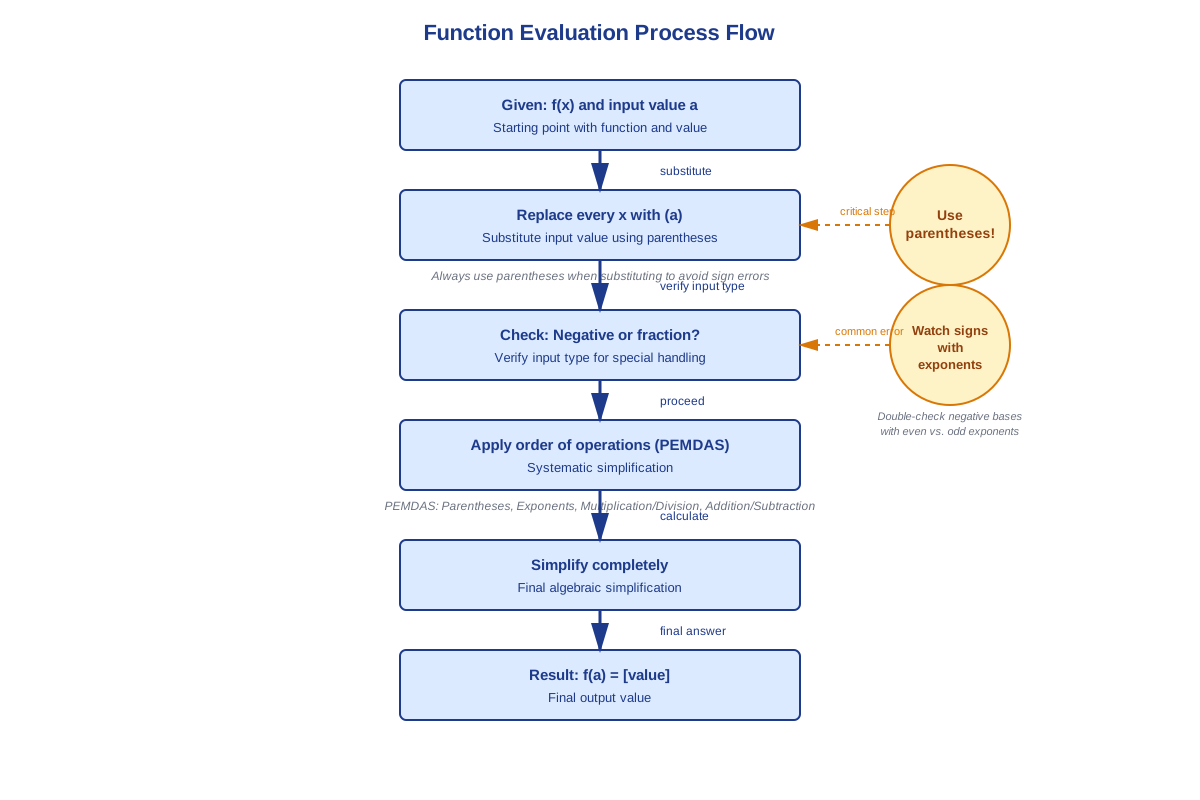
SUPE - The four-step process for evaluating any function:
- Substitute the input value for the variable
- Use parentheses around negative or complex inputs
- Perform operations following PEMDAS
- Evaluate completely and simplify
"Inside Out, Bottom Up" - For composite functions, always work from the innermost function outward, just as you'd read nested parentheses from the inside out.
The Parentheses Protection Rule - Visualize wrapping every substituted value in a protective bubble (parentheses) to prevent sign errors. This mental image helps remember to write f(-3) as (-3)² not -3².
COIN - For composite functions, remember the order:
- Check which function is inside
- Operate on the inside function first
- Insert the result into the outside function
- Now evaluate the outside function
Piecewise Checkpoint - Before evaluating a piecewise function, visualize a checkpoint gate: "Which condition does my input pass through?" Only after passing through the correct gate do you use that piece's formula.
For remembering that f(x + a) ≠ f(x) + a, use the phrase: "Functions aren't friendly to addition—they transform the whole input, not just add to the output."
Summary
Evaluating functions is a cornerstone skill in GRE Quantitative Reasoning that requires systematic substitution of input values into function formulas and accurate computation of results. The core process involves replacing every occurrence of the input variable with the specified value, using parentheses to protect negative or complex inputs, and applying order of operations carefully. Beyond basic evaluation, the GRE tests composite functions (where one function's output becomes another's input), evaluation with algebraic expressions as inputs, piecewise functions with conditional formulas, and reverse problems where outputs are given and inputs must be found. Success requires not just computational accuracy but also conceptual understanding of functions as input-output relationships. Common pitfalls include sign errors with negative inputs, incorrect handling of exponents, confusion about composite function order, and misunderstanding function notation as multiplication. Mastery of function evaluation enables progression to more advanced topics including function graphing, transformations, and inverse functions, while also appearing embedded within word problems, inequalities, and geometric contexts throughout the GRE.
Key Takeaways
- Function evaluation requires substituting the input value for every occurrence of the variable and computing the result using proper order of operations
- Always use parentheses when substituting negative numbers or algebraic expressions to prevent sign and grouping errors
- For composite functions f(g(x)), evaluate the inner function g first, then use that result as the input for the outer function f
- The order of composition matters: f(g(x)) and g(f(x)) typically produce different results
- Piecewise functions require first determining which condition applies, then using only that piece's formula
- Function notation f(x) represents the output of function f for input x, not multiplication of f and x
- Common GRE traps include negative inputs with exponents, algebraic expressions as inputs requiring expansion, and non-standard notation testing conceptual understanding
Related Topics
Function Composition and Inverse Functions: Building on basic evaluation, this topic explores how functions can be combined and reversed, including finding f⁻¹(x) and understanding the relationship between a function and its inverse.
Graphing Functions and Transformations: Mastering evaluation enables understanding function graphs, where each point (x, f(x)) represents an evaluation, and transformations like f(x + 2) or 2f(x) that shift or stretch graphs.
Domain and Range: Extends function evaluation by determining which inputs are valid (domain) and which outputs are possible (range), often requiring evaluation at boundary points.
Sequences and Series: Many sequence problems can be viewed as function evaluation where the input is the term number, connecting discrete functions to continuous ones.
Word Problems with Functions: Real-world scenarios modeled by functions require translating verbal descriptions into function notation and then evaluating to answer practical questions.
Practice CTA
Now that you've mastered the core concepts of evaluating functions, it's time to solidify your understanding through active practice. Attempt the practice questions designed specifically for this topic, focusing on applying the SUPE method and watching for the common traps discussed above. Use the flashcards to reinforce high-yield facts and build automatic recall of key principles. Remember, function evaluation appears throughout the GRE in various disguises—the more you practice recognizing and solving these problems efficiently, the more points you'll secure on test day. Approach each practice problem as an opportunity to refine your technique and build the confidence that comes from true mastery!
Sign up free to keep reading
Create a free AnvayaPrep account to finish this GRE guide on Evaluating functions — plus flashcards and practice questions.