Overview
Function notation is a fundamental algebraic concept that appears frequently on the GRE Quantitative Reasoning section. At its core, function notation provides a standardized way to express mathematical relationships where one quantity depends on another. Rather than writing equations in traditional form, function notation uses symbols like f(x), g(t), or h(n) to represent the output of a function when given a specific input. This compact notation allows test-makers to create sophisticated problems that test multiple algebraic skills simultaneously, making it a high-yield topic for exam preparation.
Understanding gre function notation is essential because it serves as the foundation for more complex mathematical concepts tested on the exam, including composite functions, inverse functions, and functional relationships in word problems. The GRE frequently embeds function notation within algebra problems, coordinate geometry questions, and data interpretation scenarios. Students who master this topic gain a significant advantage because they can quickly decode what appears to be complex notation and translate it into straightforward computational steps.
Function notation connects directly to core algebraic principles including variable substitution, order of operations, and equation solving. It also bridges to coordinate geometry, where functions represent relationships between x and y coordinates on a graph. The ability to work fluently with function notation enables students to tackle approximately 15-20% of GRE Quantitative questions more efficiently, making it one of the highest-return topics for focused study time.
Learning Objectives
- [ ] Identify when Function notation is being tested
- [ ] Explain the core rule or strategy behind Function notation
- [ ] Apply Function notation to GRE-style questions accurately
- [ ] Evaluate composite functions by correctly substituting one function into another
- [ ] Determine function values for non-standard inputs including expressions and other functions
- [ ] Recognize and solve problems involving piecewise functions and conditional definitions
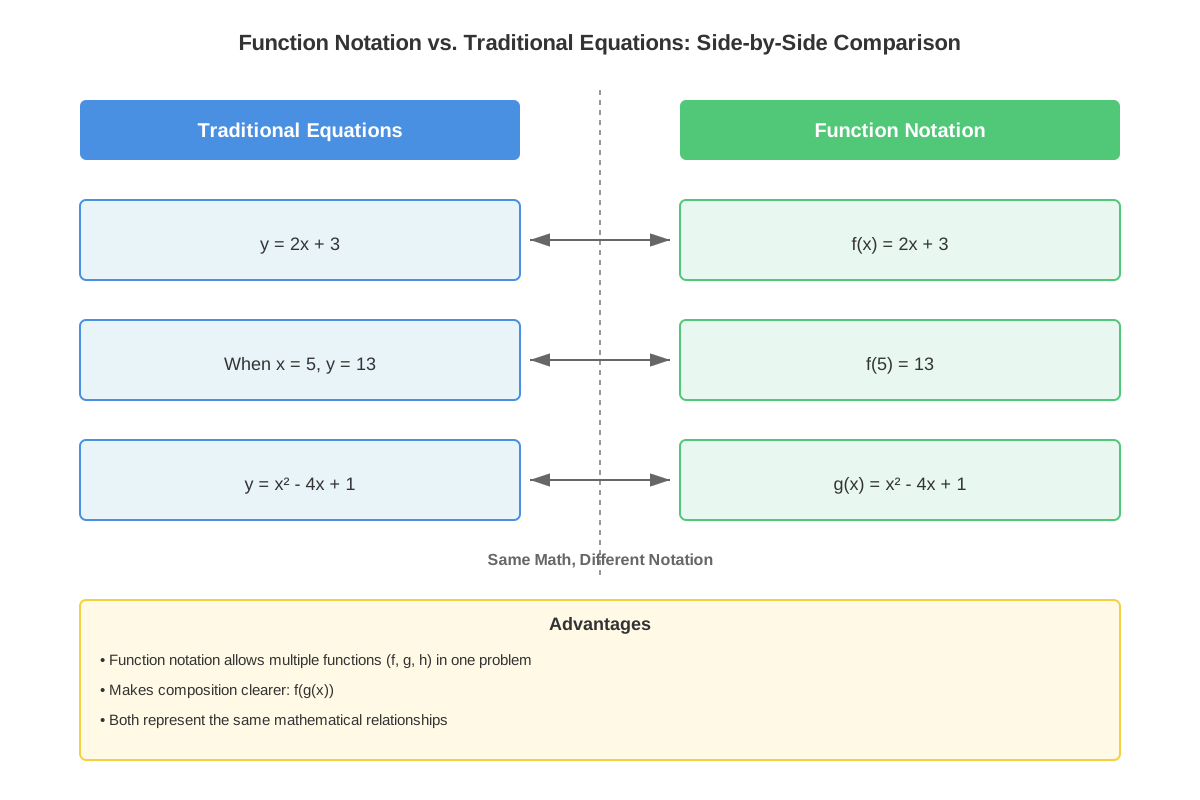
- [ ] Translate between function notation and traditional equation formats
Prerequisites
- Basic algebraic manipulation: Essential for substituting values into functions and simplifying the resulting expressions
- Order of operations (PEMDAS): Required to correctly evaluate multi-step function expressions without errors
- Variable substitution: The fundamental skill underlying all function notation work, as functions are essentially formalized substitution rules
- Equation solving: Necessary when working backward from a function output to determine the input value
- Exponent rules: Frequently needed since many GRE functions involve squared terms, powers, or exponential expressions
Why This Topic Matters
Function notation appears in approximately 3-5 questions per GRE Quantitative section, making it one of the most frequently tested algebra topics. Beyond direct function notation questions, this concept underlies many word problems, sequence questions, and coordinate geometry scenarios. Students who struggle with function notation often lose points not because the underlying mathematics is difficult, but because they misinterpret the notation itself.
In real-world applications, function notation represents any situation where one quantity depends on another: the cost of a taxi ride as a function of distance traveled, the population of a city as a function of time, or the profit of a business as a function of units sold. This mathematical framework is fundamental to economics, engineering, computer science, and data analysis—fields that many GRE test-takers pursue in graduate school.
On the GRE, function notation appears in several distinct question formats: direct evaluation problems (find f(3) given a function definition), composition problems (find f(g(x))), inverse problems (find x when f(x) equals a specific value), and application problems where students must construct or interpret a function from a word problem. The test also frequently combines function notation with other topics, such as asking students to find the slope of a line given two points defined by function notation, or to solve inequalities involving functions.
Core Concepts
Definition and Basic Structure
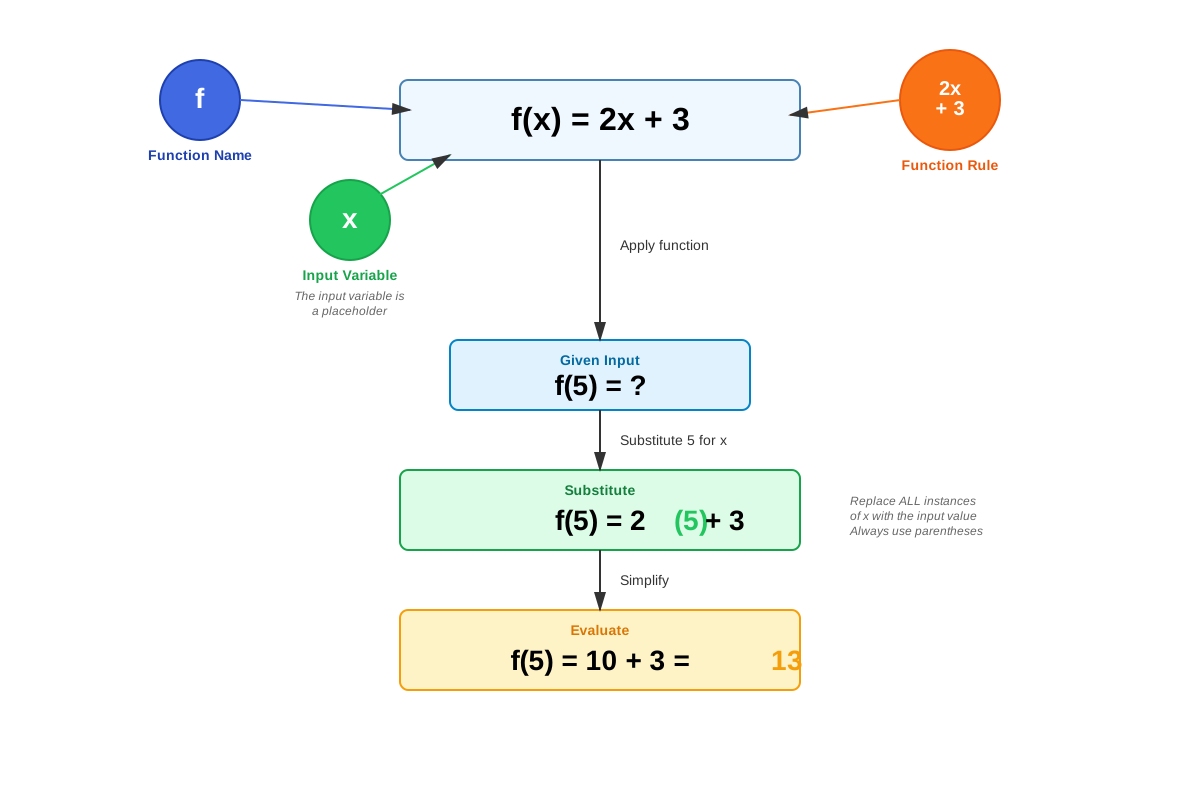
Function notation uses the format f(x) to represent a rule that transforms an input value (x) into an output value. The letter f is simply a name for the function—other common letters include g, h, F, or any letter that makes sense in context. The variable in parentheses represents the input, and the entire expression f(x) represents the output.
For example, if f(x) = 2x + 5, this notation means "the function f transforms any input x by doubling it and adding 5." The expression f(3) asks "what output does function f produce when the input is 3?" To evaluate this, substitute 3 everywhere x appears: f(3) = 2(3) + 5 = 6 + 5 = 11.
The key insight is that the variable in parentheses is a placeholder. Whatever appears in the parentheses gets substituted into the function definition everywhere the variable appears. This means f(7), f(a), f(x+2), and f(g(x)) all follow the same substitution rule—just with different inputs.
Evaluating Functions with Numeric Inputs
The most straightforward function notation problems provide a function definition and ask for the value when a specific number is input. The process follows three steps:
- Identify the function definition and note which variable is the input
- Substitute the given number for every instance of that variable
- Simplify using order of operations
Consider g(t) = t² - 3t + 7. To find g(4):
- Replace every t with 4: g(4) = (4)² - 3(4) + 7
- Evaluate: g(4) = 16 - 12 + 7 = 11
A critical detail: when substituting negative numbers, always use parentheses. For g(-2):
- g(-2) = (-2)² - 3(-2) + 7
- g(-2) = 4 + 6 + 7 = 17
Without parentheses, students often make sign errors, calculating (-2)² incorrectly as -4 instead of 4.
Evaluating Functions with Algebraic Inputs
The GRE frequently tests whether students understand that the input to a function can be an expression, not just a number. The substitution process remains identical: replace the input variable with the entire expression, using parentheses to maintain proper order of operations.
If h(x) = x² + 2x, find h(x + 1):
- Substitute (x + 1) for every x: h(x + 1) = (x + 1)² + 2(x + 1)
- Expand: h(x + 1) = x² + 2x + 1 + 2x + 2
- Simplify: h(x + 1) = x² + 4x + 3
This type of problem tests whether students can correctly expand binomials and combine like terms while maintaining the function notation framework.
Composite Functions
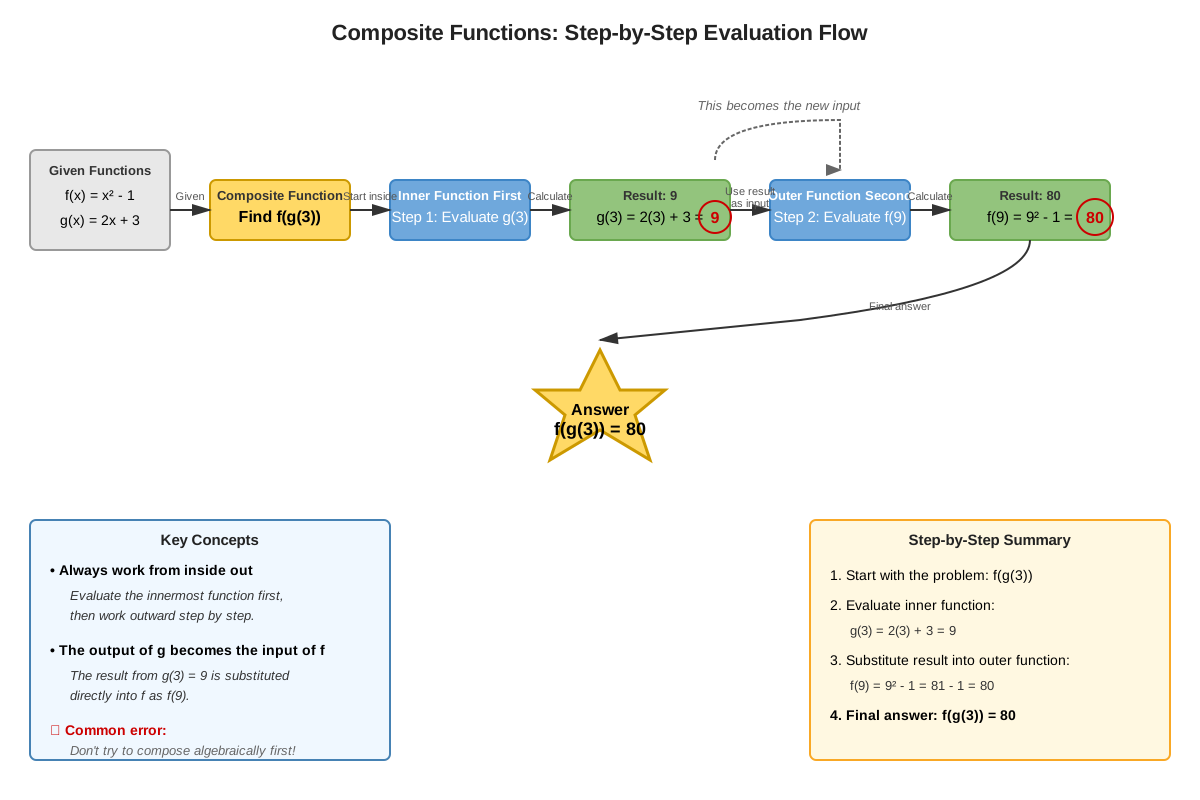
Composite functions involve using the output of one function as the input to another function. The notation f(g(x)) means "first apply function g to x, then apply function f to that result." This is read as "f of g of x" or "f composed with g."
The evaluation process works from the inside out:
- Evaluate the inner function first
- Use that result as the input to the outer function
Given f(x) = 2x + 1 and g(x) = x² - 3, find f(g(2)):
- First find g(2): g(2) = (2)² - 3 = 4 - 3 = 1
- Then find f(1): f(1) = 2(1) + 1 = 3
- Therefore, f(g(2)) = 3
For algebraic compositions, substitute the entire inner function into the outer function:
- f(g(x)) means substitute g(x) into f
- f(g(x)) = 2(x² - 3) + 1 = 2x² - 6 + 1 = 2x² - 5
Note that f(g(x)) and g(f(x)) are generally different. Order matters in composition.
Solving for Input Values
Some problems provide the function output and ask students to find the input that produces it. This requires setting up and solving an equation.
If f(x) = 3x - 7 and f(a) = 14, find a:
- Set up the equation: 3a - 7 = 14
- Solve: 3a = 21
- Therefore: a = 7
These problems test whether students understand that f(x) represents a value (the output), not just a notation symbol. The equation f(a) = 14 means "when we input a into function f, we get 14 as output."
Piecewise Functions
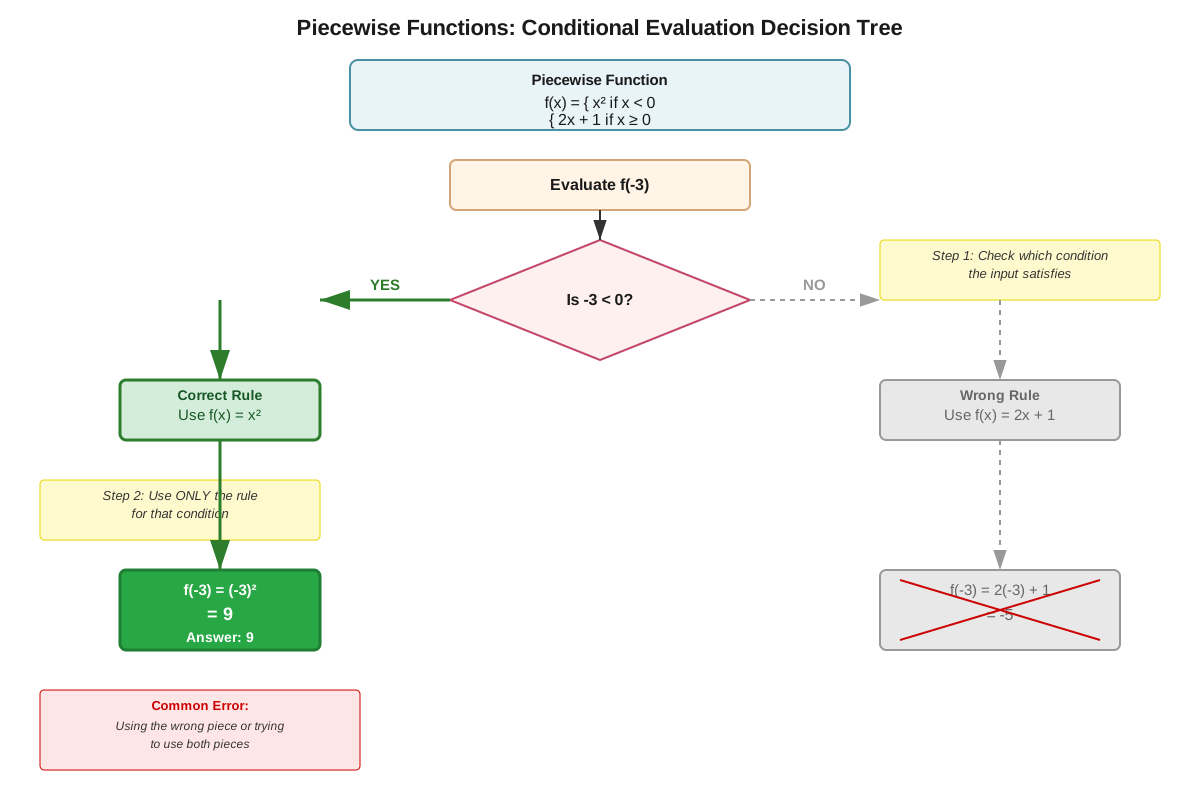
Piecewise functions have different definitions depending on the input value. These are written with conditions that specify which rule to use for different input ranges.
Example:
f(x) = { 2x + 1,  if x < 0
       { x²,      if x ≥ 0
To evaluate f(-3): Since -3 < 0, use the first rule: f(-3) = 2(-3) + 1 = -5
To evaluate f(4): Since 4 ≥ 0, use the second rule: f(4) = (4)² = 16
The key is carefully checking which condition the input satisfies before applying the corresponding rule.
Function Notation in Word Problems
The GRE often presents functions in context, requiring students to interpret what the function represents. A problem might state "The cost C(n) of producing n widgets is given by C(n) = 50 + 3n." Here, C(n) represents cost in dollars, n represents the number of widgets, 50 represents fixed costs, and 3 represents the variable cost per widget.
Understanding the context helps answer questions like "What does C(100) - C(50) represent?" This expression represents the additional cost of producing 50 more widgets (from 50 to 100 widgets).
Concept Relationships
Function notation serves as the central organizing principle connecting multiple algebraic concepts. At its foundation, function notation relies on variable substitution—the input variable acts as a placeholder that gets replaced with specific values or expressions. This substitution process requires fluency with order of operations to correctly evaluate the resulting expressions.
The relationship flows as follows: Basic function evaluation → Algebraic input evaluation → Composite functions → Inverse functions. Each level builds on the previous, with composite functions requiring mastery of basic evaluation applied twice in sequence.
Function notation connects horizontally to coordinate geometry because every function can be graphed, with f(x) representing the y-coordinate for a given x-coordinate. The expression f(3) = 7 corresponds to the point (3, 7) on the function's graph. This connection enables GRE problems that ask about function properties using graphical representations.
Function notation also enables sequence notation, where a_n represents the nth term of a sequence—essentially a function where the input is restricted to positive integers. Additionally, function notation underlies rate problems and modeling scenarios, where relationships between quantities are formalized as functions.
The concept map: Variable Substitution → Basic Function Evaluation → Algebraic Inputs → Composite Functions → Applications (graphing, sequences, word problems). Piecewise functions branch off as a special case requiring conditional logic in addition to standard evaluation.
Quick check — test yourself on Function notation so far.
Try Flashcards →High-Yield Facts
- ⭐ The variable in parentheses is a placeholder—f(x), f(3), f(a+2), and f(g(x)) all use the same substitution rule with different inputs
- ⭐ When substituting negative numbers or expressions, always use parentheses to avoid sign and order of operation errors
- ⭐ For composite functions f(g(x)), always evaluate the inner function g(x) first, then use that result as input to f
- ⭐ f(a + b) does NOT generally equal f(a) + f(b)—each input must be substituted separately into the complete function definition
- ⭐ The notation f(x) represents a value (the output), not a multiplication of f times x
- Function composition is not commutative: f(g(x)) ≠ g(f(x)) in most cases
- When solving for an input given an output, set the function expression equal to the output value and solve the resulting equation
- Piecewise functions require checking which condition the input satisfies before applying the corresponding rule
- The domain of a function is the set of all possible inputs; the range is the set of all possible outputs
- In word problems, the input variable typically represents the independent variable (what you control), and the function output represents the dependent variable (what results)
- Multiple functions can be defined in a single problem—carefully track which function name corresponds to which definition
- Function notation can represent sequences: f(n) for the nth term is equivalent to a_n notation
Common Misconceptions
Misconception: f(x) means f multiplied by x → Correction: The notation f(x) represents the output value of function f when x is the input. It is not multiplication. The parentheses indicate function application, not grouping for multiplication.
Misconception: f(a + b) = f(a) + f(b) → Correction: Functions do not generally distribute over addition. To find f(a + b), substitute the entire expression (a + b) into the function. For example, if f(x) = x², then f(3 + 2) = (3 + 2)² = 25, but f(3) + f(2) = 9 + 4 = 13. These are different values.
Misconception: When evaluating f(g(x)), multiply the two functions together → Correction: Composite function notation f(g(x)) means substitute the entire function g(x) into function f as the input. It is not multiplication. If f(x) = 2x and g(x) = x + 1, then f(g(x)) = 2(x + 1) = 2x + 2, not 2x(x + 1).
Misconception: The letter f is special and always represents functions → Correction: Any letter can name a function. The GRE uses f, g, h, F, G, and context-specific letters like C for cost or P for profit. The letter is just a label; the structure (letter followed by input in parentheses) defines it as function notation.
Misconception: In piecewise functions, you can use any rule you want → Correction: For piecewise functions, you must check which condition the input satisfies and use only the corresponding rule. Using the wrong piece leads to incorrect answers. Always verify which inequality or condition the input value meets.
Misconception: f(x²) and [f(x)]² are the same thing → Correction: These represent different operations. f(x²) means input x² into the function, while [f(x)]² means evaluate f(x) first, then square the result. If f(x) = x + 1, then f(4²) = f(16) = 17, but [f(4)]² = 5² = 25.
Worked Examples
Example 1: Multi-Step Function Evaluation with Algebraic Input
Problem: Given f(x) = 2x² - 3x + 1, find the value of f(x + 2) - f(x).
Solution:
Step 1: Find f(x + 2) by substituting (x + 2) for every x in the function definition.
- f(x + 2) = 2(x + 2)² - 3(x + 2) + 1
Step 2: Expand (x + 2)² carefully.
- (x + 2)² = x² + 4x + 4
- f(x + 2) = 2(x² + 4x + 4) - 3(x + 2) + 1
Step 3: Distribute and simplify.
- f(x + 2) = 2x² + 8x + 8 - 3x - 6 + 1
- f(x + 2) = 2x² + 5x + 3
Step 4: We already know f(x) = 2x² - 3x + 1 from the problem.
Step 5: Calculate f(x + 2) - f(x).
- f(x + 2) - f(x) = (2x² + 5x + 3) - (2x² - 3x + 1)
- = 2x² + 5x + 3 - 2x² + 3x - 1
- = 8x + 2
Answer: f(x + 2) - f(x) = 8x + 2
Connection to Learning Objectives: This problem demonstrates applying function notation with algebraic inputs (Objective 3) and requires careful substitution and simplification. It tests whether students understand that the input can be an expression and that function notation problems often require multiple steps of algebraic manipulation.
Example 2: Composite Function with Numeric Evaluation
Problem: Let g(x) = x² - 4 and h(x) = 2x + 3. If g(h(a)) = 12, what is the value of a?
Solution:
Step 1: Understand what g(h(a)) means—we need to find h(a) first, then input that result into g.
Step 2: Express g(h(a)) algebraically by substituting h(a) into g.
- Since h(a) = 2a + 3, we substitute this entire expression for x in g(x)
- g(h(a)) = g(2a + 3) = (2a + 3)² - 4
Step 3: Set this expression equal to 12 (given in the problem).
- (2a + 3)² - 4 = 12
Step 4: Solve for a.
- (2a + 3)² = 16
- Take the square root of both sides: 2a + 3 = ±4
- This gives two cases: 2a + 3 = 4 or 2a + 3 = -4
Step 5: Solve each case.
- Case 1: 2a + 3 = 4 → 2a = 1 → a = 0.5
- Case 2: 2a + 3 = -4 → 2a = -7 → a = -3.5
Step 6: Verify both solutions work (both are valid).
- For a = 0.5: h(0.5) = 2(0.5) + 3 = 4, and g(4) = 16 - 4 = 12 ✓
- For a = -3.5: h(-3.5) = 2(-3.5) + 3 = -4, and g(-4) = 16 - 4 = 12 ✓
Answer: a = 0.5 or a = -3.5
Connection to Learning Objectives: This problem tests composite function evaluation (Objective 4) and solving for input values (Objective 5). It demonstrates that GRE problems often combine multiple function notation concepts and may have multiple valid solutions.
Exam Strategy
When approaching GRE function notation questions, first identify the question type: direct evaluation, composition, solving for input, or application. This determines your solution strategy.
Trigger words and phrases that signal function notation problems include: "Let f(x) be defined as," "If g(n) =," "Find the value of h(a)," "What is f(g(x))?", and "For what value of x does f(x) = ?" Any time you see a letter followed by parentheses with a variable or number inside, function notation is being tested.
For direct evaluation problems, use the three-step process: identify the function definition, substitute the input (using parentheses), and simplify carefully. Double-check that you've substituted into every instance of the variable.
For composite functions, always work inside-out. Circle the innermost function, evaluate it first, then use that result for the next layer. If the problem asks for f(g(h(x))), evaluate h(x) first, then g of that result, then f of that result.
When solving for inputs, remember that f(x) is just a value—treat it like any other number in an equation. Set the function expression equal to the given output and solve. Watch for quadratic equations that may have two solutions.
Process of elimination tips: If answer choices are numbers and you need to find f(a) for some value a, you can substitute each answer choice into the function and see which produces the correct result. This is especially useful for composite functions where algebraic manipulation is complex. For questions asking "for what value of x does f(x) = 10?", substitute each answer choice for x and see which makes f(x) equal 10.
Time allocation: Simple evaluation problems should take 30-45 seconds. Composite functions or problems requiring equation solving may take 90-120 seconds. If a problem requires extensive algebraic manipulation and you're running short on time, consider whether substituting answer choices would be faster.
Always write out your substitution step explicitly, even if it seems simple. The most common errors occur when students try to evaluate functions mentally and lose track of negative signs or forget to apply operations to all terms.
Memory Techniques
SUBS - The four-step process for function evaluation:
- See the function definition
- Underline what goes in parentheses (the input)
- Bracket it when you substitute (use parentheses)
- Simplify using order of operations
"Inside Out, Bottom Up" - For composite functions, always evaluate from the inside out (innermost function first). When written as f(g(h(x))), work from the bottom of the "stack" upward.
"Parentheses are Protection" - Always put parentheses around whatever you're substituting, especially negative numbers and expressions. This protects against sign errors and order of operations mistakes.
"Same Rule, Different Input" - Visualize the function definition as a machine. The machine's rule never changes, but you can feed it different inputs: numbers, variables, expressions, or even other functions. The process is always the same: substitute and simplify.
"f(x) is a Y" - Remember that f(x) represents the output value, which corresponds to the y-coordinate on a graph. This helps connect function notation to coordinate geometry and reminds you that f(x) is a value, not multiplication.
For piecewise functions, use "Check Before You Choose" - Always verify which condition your input satisfies before selecting which piece of the function to use.
Summary
Function notation is a standardized mathematical language for expressing relationships where one quantity depends on another. The notation f(x) represents the output of function f when given input x, with the key principle being substitution: whatever appears in parentheses replaces the variable throughout the function definition. Mastery requires understanding that inputs can be numbers, variables, expressions, or other functions, and that the substitution process remains consistent regardless of input type. Composite functions f(g(x)) require inside-out evaluation, first finding g(x) then using that result as input to f. Common pitfalls include treating f(x) as multiplication, incorrectly distributing functions over addition, and making sign errors when substituting negative values. The GRE tests function notation through direct evaluation, composition, solving for inputs, and contextual applications. Success depends on careful substitution with proper use of parentheses, systematic simplification following order of operations, and recognition that function notation problems often combine multiple algebraic skills. Students who master this topic gain efficiency across numerous question types, as function notation appears both explicitly and embedded within other quantitative reasoning problems.
Key Takeaways
- Function notation f(x) means "substitute x into function f"—the variable in parentheses is a placeholder for any input
- Always use parentheses when substituting negative numbers or expressions to avoid sign and order of operations errors
- Composite functions f(g(x)) must be evaluated inside-out: find g(x) first, then substitute that result into f
- f(a + b) does not equal f(a) + f(b)—functions do not distribute over addition; substitute the complete expression
- When solving for an input value, treat f(x) as the output value and set up an equation with the function expression
- Piecewise functions require checking which condition applies before selecting the appropriate rule
- Function notation connects to coordinate geometry: f(x) represents the y-value for a given x-value on the function's graph
Related Topics
Inverse Functions: Building on function notation, inverse functions reverse the input-output relationship. If f(3) = 7, then f⁻¹(7) = 3. Mastering basic function notation is essential before tackling inverse function problems.
Domain and Range: These concepts specify which inputs are valid for a function (domain) and which outputs are possible (range). Understanding function notation enables analysis of domain restrictions and range determination.
Coordinate Geometry and Graphing: Every function can be visualized as a graph where f(x) represents the y-coordinate. Function notation provides the algebraic foundation for analyzing slopes, intercepts, and curve behavior.
Sequences and Series: Sequence notation a_n is essentially function notation where the input is restricted to positive integers. The skills developed with general function notation transfer directly to sequence problems.
Systems of Equations: Function notation enables elegant representation of systems, such as finding where f(x) = g(x), which means finding inputs that produce the same output from two different functions.
Practice CTA
Now that you've mastered the core concepts of function notation, it's time to solidify your understanding through active practice. Attempt the practice questions to test your ability to evaluate functions, work with composite functions, and solve for input values. Use the flashcards to reinforce key definitions and common problem patterns. Remember, function notation appears in approximately 15-20% of GRE Quantitative questions, making your investment in this topic one of the highest-yield uses of your study time. Approach each practice problem systematically, write out your substitution steps, and check your work carefully. With focused practice, you'll develop the speed and accuracy needed to handle any function notation question the GRE presents!
Sign up free to keep reading
Create a free AnvayaPrep account to finish this GRE guide on Function notation — plus flashcards and practice questions.