Overview
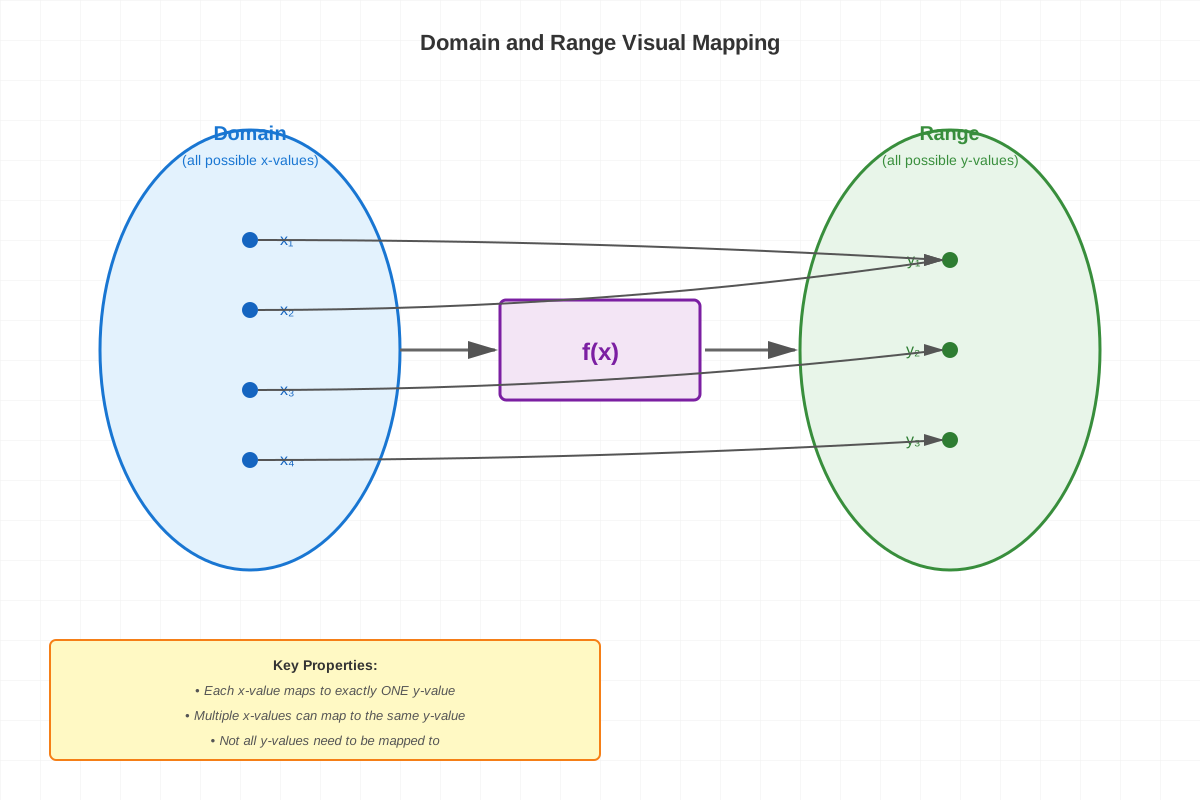
Domain and range are fundamental concepts in algebra that describe the input and output values of functions. The domain refers to all possible input values (x-values) for which a function is defined, while the range refers to all possible output values (y-values) that a function can produce. Understanding these concepts is critical for the GRE Quantitative Reasoning section, as they appear frequently in questions involving functions, graphs, and algebraic expressions.
On the GRE, GRE domain and range questions test a student's ability to analyze functions systematically, identify restrictions on variables, and interpret graphical representations. These questions often appear in both Quantitative Comparison and Problem Solving formats, requiring students to quickly determine valid input-output relationships. Mastery of domain and range enables students to tackle more complex function problems, including composite functions, inverse functions, and transformations.
Domain and range concepts connect directly to broader algebraic topics such as function notation, coordinate geometry, and inequalities. They serve as foundational tools for understanding how mathematical relationships behave under various constraints. Students who master domain and range develop stronger analytical skills for interpreting graphs, solving equations with restrictions, and recognizing when certain operations are undefined—all essential competencies for achieving high scores on the GRE Quantitative section.
Learning Objectives
- [ ] Identify when Domain and range is being tested
- [ ] Explain the core rule or strategy behind Domain and range
- [ ] Apply Domain and range to GRE-style questions accurately
- [ ] Determine domain restrictions from algebraic expressions involving fractions, radicals, and logarithms
- [ ] Identify the range of a function from its graph or equation
- [ ] Recognize how transformations affect domain and range of parent functions
Prerequisites
- Function notation and evaluation: Understanding f(x) notation is essential because domain and range describe the behavior of functions
- Basic algebraic operations: Manipulating expressions helps identify when functions become undefined
- Coordinate plane interpretation: Reading graphs is necessary for visually determining domain and range
- Inequality notation: Domain and range are often expressed using interval notation and inequalities
- Square roots and rational expressions: These create common domain restrictions that appear frequently on the GRE
Why This Topic Matters
Domain and range concepts have practical applications in fields ranging from economics (where functions model supply and demand with realistic constraints) to engineering (where physical limitations restrict input and output values). In data science and statistics, understanding valid input ranges prevents computational errors and ensures meaningful interpretations of models.
On the GRE, domain and range questions appear in approximately 8-12% of Quantitative Reasoning sections, making them high-yield topics for test preparation. These questions typically appear as:
- Quantitative Comparison problems asking students to compare domains or ranges of different functions
- Multiple-choice questions requiring identification of domain restrictions
- Graph interpretation problems where students must determine range from visual representations
- Word problems where real-world constraints define the domain
The GRE frequently embeds domain and range concepts within more complex problems involving function composition, transformations, or systems of equations. Recognizing when domain restrictions apply can prevent careless errors and help eliminate incorrect answer choices efficiently. Students who master this topic gain a significant advantage in function-related questions, which constitute a substantial portion of the algebra content tested.
Core Concepts
Definition of Domain
The domain of a function consists of all possible input values (typically x-values) for which the function produces a valid output. Mathematically, the domain represents the set of all real numbers that can be substituted into the function without creating undefined expressions or violating mathematical rules.
For a function f(x), the domain is written as: {x | x satisfies all conditions for f(x) to be defined}
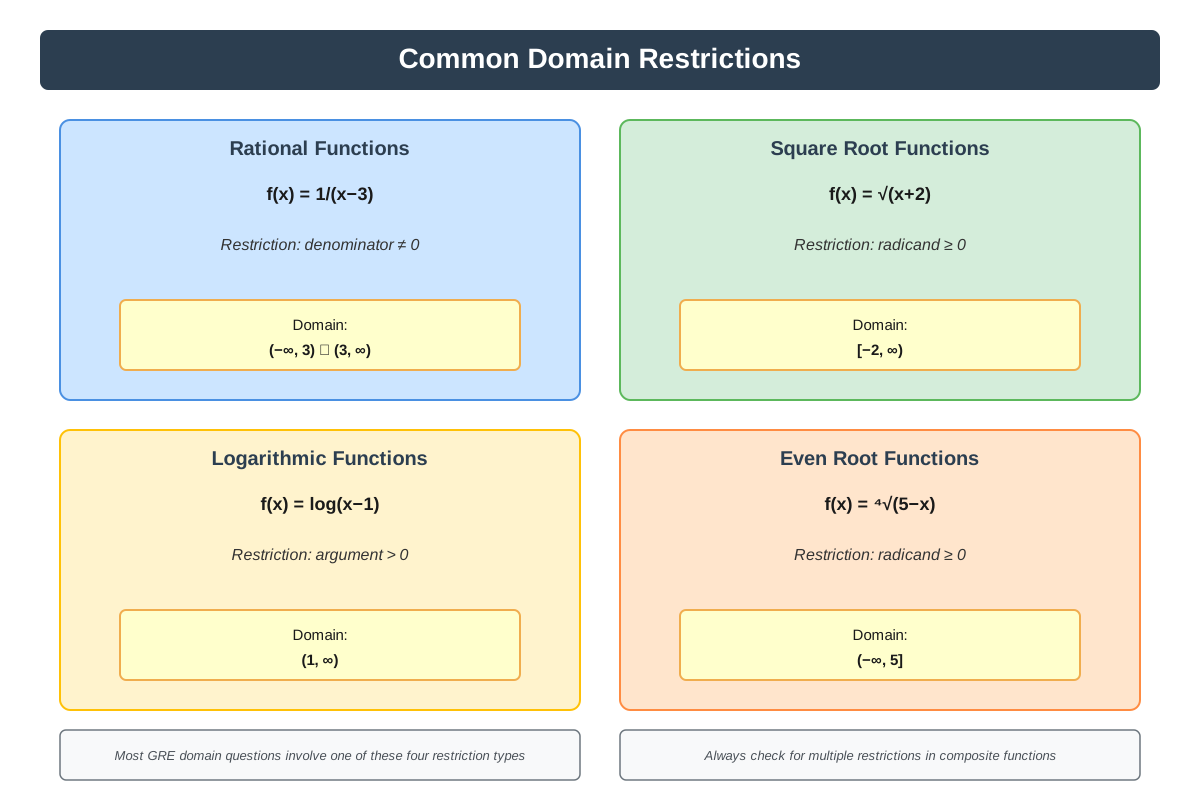
Common domain restrictions arise from:
- Division by zero: Denominators cannot equal zero
- Even roots of negative numbers: Square roots (and other even roots) require non-negative radicands in the real number system
- Logarithms of non-positive numbers: Logarithmic functions require positive arguments
- Practical constraints: Real-world contexts may impose additional limitations
Definition of Range
The range of a function consists of all possible output values (typically y-values) that the function can produce. The range depends on both the domain and the function's behavior across that domain.
For a function f(x), the range is written as: {y | y = f(x) for some x in the domain}
Determining range often requires:
- Analyzing the function's behavior (increasing, decreasing, maximum, minimum)
- Identifying horizontal asymptotes
- Examining the graph
- Using calculus techniques (beyond GRE scope, but conceptual understanding helps)
Finding Domain from Algebraic Expressions
Step-by-step process for determining domain:
- Identify potential restrictions: Look for fractions, radicals, logarithms
- Set up inequalities or equations: Create conditions that must be satisfied
- Solve for x: Determine which values are excluded or required
- Express in interval notation: Write the final domain clearly
Example restrictions:
| Expression Type | Restriction | Domain Condition |
|---|---|---|
| f(x) = 1/(x-3) | Denominator ≠ 0 | x ≠ 3 |
| f(x) = √(x-2) | Radicand ≥ 0 | x ≥ 2 |
| f(x) = ln(x+1) | Argument > 0 | x > -1 |
| f(x) = 1/√(x-4) | Radicand > 0 | x > 4 |
Finding Range from Functions
Methods for determining range:
Method 1: Algebraic manipulation
- Solve y = f(x) for x in terms of y
- Identify restrictions on y that make x undefined
- The valid y-values constitute the range
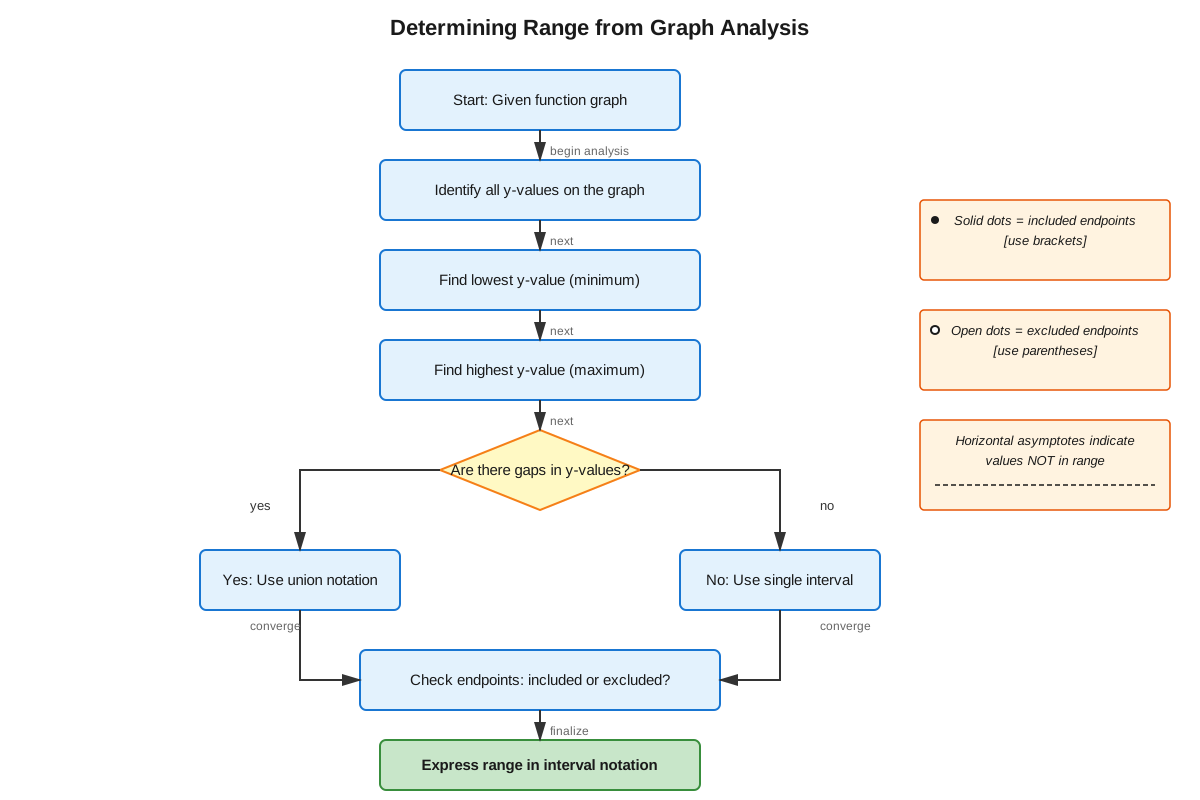
Method 2: Graphical analysis
- Sketch or visualize the function's graph
- Identify the lowest and highest y-values
- Note any horizontal asymptotes or gaps
Method 3: Function behavior analysis
- Determine if the function has maximum or minimum values
- Check end behavior as x approaches infinity or negative infinity
- Identify any y-values the function cannot reach
Common Function Types and Their Domains/Ranges
Linear functions: f(x) = mx + b
- Domain: All real numbers (-∞, ∞)
- Range: All real numbers (-∞, ∞) when m ≠ 0
Quadratic functions: f(x) = ax² + bx + c
- Domain: All real numbers (-∞, ∞)
- Range: [k, ∞) if a > 0, or (-∞, k] if a < 0, where k is the vertex y-coordinate
Rational functions: f(x) = p(x)/q(x)
- Domain: All real numbers except where q(x) = 0
- Range: Varies; often all real numbers except certain values
Square root functions: f(x) = √(x-h) + k
- Domain: [h, ∞)
- Range: [k, ∞)
Absolute value functions: f(x) = |x-h| + k
- Domain: All real numbers (-∞, ∞)
- Range: [k, ∞)
Interval Notation
Domain and range are typically expressed using interval notation:
- (a, b): All numbers between a and b, excluding endpoints (open interval)
- [a, b]: All numbers between a and b, including endpoints (closed interval)
- [a, b): Includes a but excludes b (half-open interval)
- (a, ∞): All numbers greater than a
- (-∞, b]: All numbers less than or equal to b
- (-∞, ∞): All real numbers
Union notation (∪) combines multiple intervals: (-∞, 2) ∪ (2, ∞) represents all real numbers except 2.
Concept Relationships
The relationship between domain and range is hierarchical: the domain determines what inputs are valid → which then determines what outputs are possible → thereby defining the range. This unidirectional flow means domain must be established before range can be accurately determined.
Domain and range connect to function notation as the formal language for expressing input-output relationships. Understanding f(x) notation is prerequisite to identifying which variable represents the domain (x) and which represents the range (f(x) or y).
These concepts link to inequalities because domain restrictions are often expressed as inequality conditions (x ≥ 0, x ≠ 3). Solving these inequalities requires fluency with algebraic manipulation and number line representations.
Graphical interpretation serves as both a tool for finding domain and range and a visual confirmation of algebraic findings. The domain corresponds to the horizontal extent of a graph (left-to-right coverage), while range corresponds to vertical extent (bottom-to-top coverage).
Domain and range enable understanding of function composition: when composing f(g(x)), the range of g must be compatible with the domain of f. This connection becomes critical in advanced GRE problems involving multiple function operations.
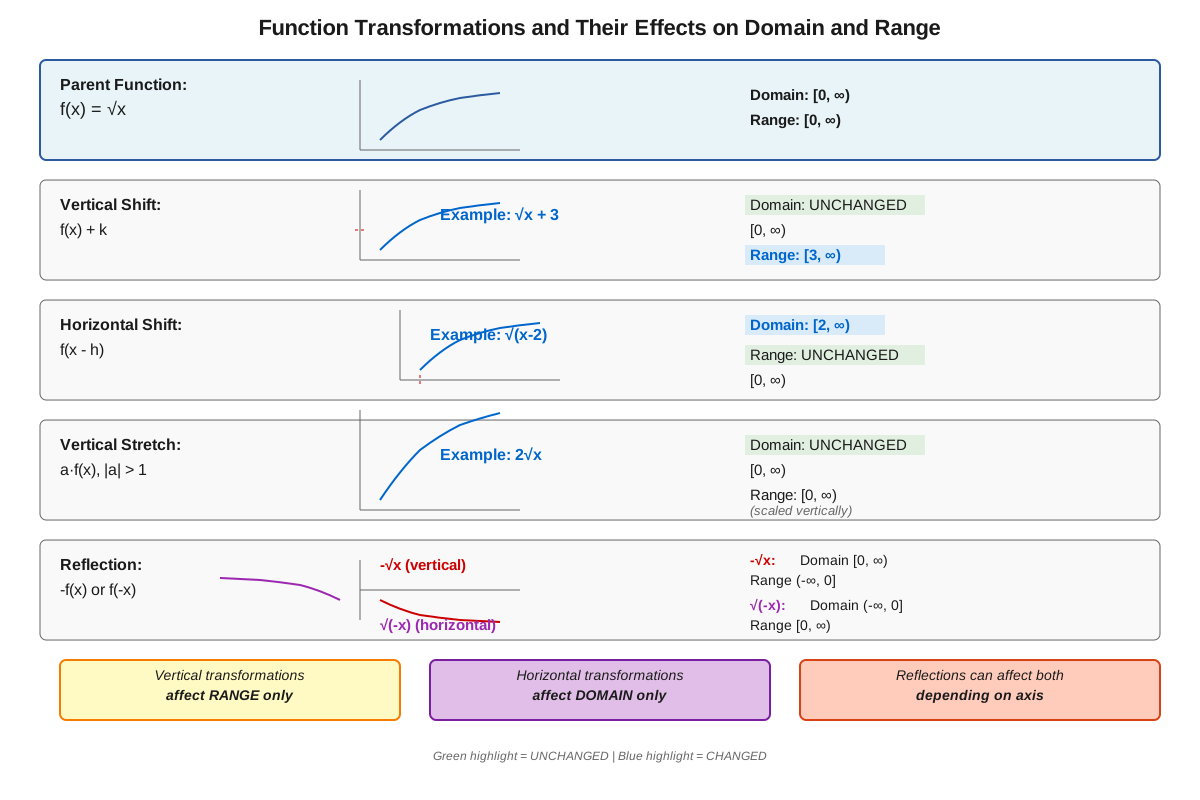
Transformations (shifts, stretches, reflections) affect domain and range predictably: horizontal transformations alter domain, while vertical transformations alter range. This relationship helps students quickly determine domain and range of transformed functions without complete re-analysis.
High-Yield Facts
⭐ The domain of a rational function excludes all values that make the denominator equal to zero
⭐ For even-indexed radicals (√, ∜, etc.), the radicand must be greater than or equal to zero in the real number system
⭐ The range of f(x) = x² is [0, ∞), not all real numbers, because squared values cannot be negative
⭐ Logarithmic functions require strictly positive arguments: for log(x-a), the domain is x > a
⭐ The domain of a function composition f(g(x)) is restricted by both the domain of g and the requirement that g(x) must be in the domain of f
- Absolute value functions have range [k, ∞) where k is the minimum value of the function
- The range of exponential functions f(x) = aˣ (where a > 0, a ≠ 1) is (0, ∞), never including zero or negative values
- When a square root appears in a denominator, the radicand must be strictly greater than zero (not just non-negative)
- Linear functions with non-zero slope have both domain and range equal to all real numbers
- The domain of a piecewise function is the union of the domains of all pieces
- Horizontal lines (f(x) = c) have range consisting of a single value: {c}
- Vertical asymptotes in rational functions indicate values excluded from the domain
Quick check — test yourself on Domain and range so far.
Try Flashcards →Common Misconceptions
Misconception: The domain of f(x) = √x² is x ≥ 0 → Correction: The domain is all real numbers because x² is always non-negative regardless of whether x is positive or negative. The expression √x² simplifies to |x|, which is defined for all real x.
Misconception: If a function's graph extends infinitely upward, its range is all real numbers → Correction: The range depends on where the graph starts vertically. For example, f(x) = x² + 3 extends infinitely upward but has range [3, ∞), not (-∞, ∞), because the minimum y-value is 3.
Misconception: Domain restrictions only come from fractions and square roots → Correction: Logarithms, even-indexed roots, inverse trigonometric functions, and real-world contexts all create domain restrictions. Additionally, explicitly stated restrictions (like "for x > 0") must be honored.
Misconception: The range of f(x) = 1/x is all real numbers except zero → Correction: This is correct, but students often forget that the domain is also all real numbers except zero. Both domain and range exclude zero for this function, but for different mathematical reasons.
Misconception: To find range, simply substitute the domain values into the function → Correction: This approach works for discrete domains but fails for continuous functions. Range requires analyzing the function's behavior across the entire domain, including identifying maximum/minimum values and asymptotic behavior.
Misconception: Interval notation (2, 5) includes the endpoints 2 and 5 → Correction: Parentheses indicate open intervals that exclude endpoints. Square brackets [2, 5] are required to include endpoints. This distinction is critical for correctly expressing domain and range.
Misconception: If f(x) has domain [0, 10], then f(x) + 3 has domain [3, 13] → Correction: Vertical shifts (adding constants to the function) affect range, not domain. The domain of f(x) + 3 remains [0, 10], but the range shifts upward by 3 units.
Worked Examples
Example 1: Finding Domain with Multiple Restrictions
Problem: Determine the domain of f(x) = √(x+2)/(x²-9)
Solution:
Step 1: Identify all restrictions
- The numerator contains √(x+2), requiring x + 2 ≥ 0
- The denominator is x² - 9, which cannot equal zero
Step 2: Solve the radical restriction
- x + 2 ≥ 0
- x ≥ -2
Step 3: Solve the denominator restriction
- x² - 9 ≠ 0
- x² ≠ 9
- x ≠ 3 and x ≠ -3
Step 4: Combine restrictions
- From the radical: x ≥ -2
- From the denominator: x ≠ 3 and x ≠ -3
- Since x ≥ -2, the restriction x ≠ -3 is automatically satisfied (because -3 < -2)
- We must exclude x = 3 from the interval [−2, ∞)
Step 5: Express in interval notation
- Domain: [-2, 3) ∪ (3, ∞)
Connection to learning objectives: This example demonstrates identifying domain restrictions (objective 1), applying the core strategy of finding where functions are undefined (objective 2), and using the systematic approach needed for GRE questions (objective 3).
Example 2: Determining Range from a Graph Description
Problem: A function g(x) is graphed on the coordinate plane. The graph is a parabola opening downward with vertex at (2, 5). What is the range of g(x)?
Solution:
Step 1: Understand parabola behavior
- Parabolas opening downward have a maximum value at the vertex
- The function decreases without bound as x moves away from the vertex in either direction
Step 2: Identify the maximum y-value
- The vertex is at (2, 5), so the maximum y-value is 5
- The function never produces output values greater than 5
Step 3: Identify the minimum y-value
- As x → ∞ or x → -∞, the parabola extends downward indefinitely
- There is no minimum y-value; the function approaches -∞
Step 4: Express the range
- Range: (-∞, 5]
- The square bracket indicates that 5 is included (the function actually reaches this value)
- The parenthesis indicates that -∞ is a concept, not an actual value
Connection to learning objectives: This example shows how to identify range from graphical information (objective 5) and demonstrates the relationship between function behavior and range restrictions.
Example 3: GRE-Style Quantitative Comparison
Problem:
Quantity A: The number of values excluded from the domain of f(x) = 1/(x²-4x+3)
Quantity B: The number of values excluded from the domain of g(x) = √(x²-4x+3)Solution:
Analyze Quantity A:
- Domain restriction: x² - 4x + 3 ≠ 0
- Factor: (x-3)(x-1) ≠ 0
- Excluded values: x = 3 and x = 1
- Number of excluded values: 2
Analyze Quantity B:
- Domain restriction: x² - 4x + 3 ≥ 0
- Factor: (x-3)(x-1) ≥ 0
- This inequality is satisfied when both factors are non-negative or both are non-positive
- Solution: x ≤ 1 or x ≥ 3
- Excluded values: all x in the interval (1, 3)
- Number of excluded values: infinitely many
Comparison:
- Quantity A = 2
- Quantity B = infinitely many
- Answer: Quantity B is greater
Key insight: Rational functions exclude discrete points, while radical functions often exclude entire intervals. This distinction is frequently tested on the GRE.
Exam Strategy
Trigger words and phrases that indicate domain and range questions:
- "For which values is the function defined?"
- "What is the set of all possible outputs?"
- "The function is undefined when..."
- "For all real numbers except..."
- "The maximum/minimum value of the function is..."
Systematic approach for GRE domain questions:
- Scan for restriction types (5 seconds): Quickly identify fractions, radicals, logarithms
- Set up conditions (10 seconds): Write inequalities or equations for each restriction
- Solve systematically (20 seconds): Work through each condition
- Check answer choices (10 seconds): Eliminate options that don't match your restrictions
- Verify edge cases (5 seconds): Test boundary values if time permits
Process of elimination tips:
If an answer choice includes values that make a denominator zero, eliminate it immediately
For square root functions, eliminate any domain that includes negative radicands
When comparing domains in Quantitative Comparison, test the boundary values first—they often determine the relationship
Time allocation advice:
- Simple domain questions (single restriction): 30-45 seconds
- Complex domain questions (multiple restrictions): 60-90 seconds
- Range questions requiring graphical analysis: 45-75 seconds
- Function composition domain questions: 90-120 seconds
Strategic shortcuts:
- For polynomial functions, immediately recognize domain is all real numbers
- For rational functions, factor denominators quickly to find excluded values
- When graphs are provided, use visual inspection for range before algebraic verification
- In Quantitative Comparison, sometimes determining whether restrictions are discrete points or intervals is sufficient without finding exact values
Memory Techniques
FRED mnemonic for domain restrictions:
- Fractions: denominator ≠ 0
- Radicals (even): radicand ≥ 0
- Exponents: generally no restrictions (for real exponents)
- Denominator radicals: radicand > 0 (strictly positive)
Visualization strategy for range:
Imagine walking along the graph from left to right while tracking your vertical position. The lowest and highest points you reach (including where you approach but never reach) define the range boundaries.
"Domain is horizontal, Range is vertical"
When looking at a graph, sweep your eyes horizontally to see domain extent, then vertically to see range extent.
Acronym for interval notation: PIES
- Parentheses: exclude endpoints
- Infinity: always uses parentheses
- Equal: square brackets include the value
- Square brackets: include endpoints
Memory aid for common ranges:
- "Squares are never negative" → x² has range [0, ∞)
- "Exponentials are always positive" → eˣ has range (0, ∞)
- "Absolute values are never negative" → |x| has range [0, ∞)
Summary
Domain and range are essential concepts for understanding function behavior on the GRE. The domain encompasses all valid input values, determined by identifying restrictions from fractions (denominators ≠ 0), even radicals (radicands ≥ 0), logarithms (arguments > 0), and contextual constraints. The range encompasses all possible output values, determined through graphical analysis, algebraic manipulation, or examining function behavior. Successful GRE performance requires quickly recognizing restriction types, systematically applying conditions, and expressing answers in proper interval notation. Students must distinguish between discrete excluded values (common in rational functions) and excluded intervals (common in radical functions), as this distinction frequently appears in Quantitative Comparison questions. Mastery involves both mechanical skill in finding restrictions and conceptual understanding of how domain and range relate to function graphs and transformations.
Key Takeaways
- Domain restrictions arise primarily from three sources: division by zero, even roots of negative numbers, and logarithms of non-positive numbers
- Always check denominators, radicands, and logarithmic arguments when determining domain
- Range is determined by analyzing function behavior across the entire domain, including maximum/minimum values and asymptotic behavior
- Interval notation uses parentheses for excluded values and square brackets for included values; infinity always takes parentheses
- In Quantitative Comparison questions, focus on whether restrictions exclude discrete points or entire intervals
- Graphical interpretation provides quick verification: domain is horizontal extent, range is vertical extent
- Common function types have predictable domains and ranges that should be memorized for efficiency
Related Topics
Function Composition: Understanding domain and range is prerequisite for analyzing f(g(x)), where the range of g must be compatible with the domain of f. Mastering domain and range enables quick identification of composition restrictions.
Function Transformations: Horizontal shifts affect domain while vertical shifts affect range. This topic builds directly on domain and range concepts to predict how transformations modify function behavior.
Inverse Functions: The domain of a function becomes the range of its inverse, and vice versa. Strong domain and range skills make inverse function problems significantly more manageable.
Inequalities and Absolute Value: Solving domain restrictions requires proficiency with inequalities. These topics reinforce each other through repeated application of similar algebraic techniques.
Coordinate Geometry: Graphical representations of domain and range connect to broader coordinate plane skills, including identifying intercepts, asymptotes, and regions of validity.
Practice CTA
Now that you've mastered the core concepts of domain and range, it's time to solidify your understanding through active practice. Attempt the practice questions to test your ability to identify restrictions, determine valid input-output sets, and apply these concepts to GRE-style problems. Use the flashcards to reinforce high-yield facts and common function types. Remember: domain and range questions reward systematic thinking and careful attention to mathematical restrictions—skills that improve rapidly with focused practice. Your investment in mastering this high-yield topic will pay dividends across multiple question types on test day!
Sign up free to keep reading
Create a free AnvayaPrep account to finish this GRE guide on Domain and range — plus flashcards and practice questions.