Overview
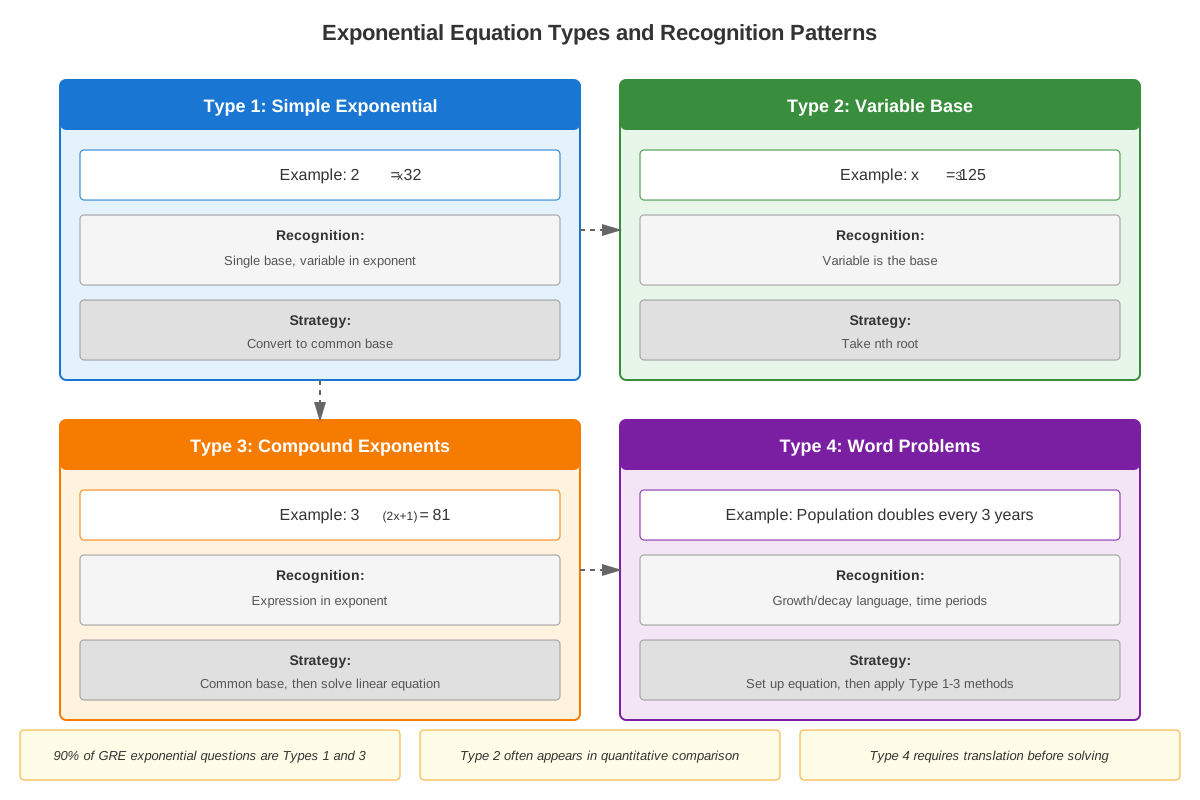
Exponential equations are algebraic expressions in which variables appear in the exponent, such as 2^x = 16 or 3^(2x+1) = 27. These equations form a critical component of the GRE Quantitative Reasoning section, appearing regularly in both discrete quantitative comparison questions and problem-solving items. Mastering exponential equations requires understanding the fundamental properties of exponents, recognizing when bases can be made equal, and applying logarithmic thinking when necessary. The GRE tests exponential equations at a medium difficulty level, expecting students to solve them efficiently under time pressure while avoiding common algebraic pitfalls.
The importance of gre exponential equations extends beyond isolated algebra problems. These equations frequently appear embedded within word problems involving exponential growth and decay, compound interest calculations, population modeling, and scientific notation. The GRE particularly favors questions that test whether students can recognize equivalent exponential forms and manipulate exponents using fundamental properties. Unlike more advanced mathematics exams, the GRE typically designs exponential equation problems that can be solved without calculators by recognizing patterns and applying strategic algebraic manipulation.
Understanding exponential equations strengthens broader quantitative reasoning skills by reinforcing the relationship between exponents and roots, connecting to logarithmic functions, and building fluency with algebraic manipulation. This topic serves as a bridge between basic arithmetic operations and more complex algebraic concepts, making it essential for achieving competitive scores on the GRE Quantitative section. Students who master exponential equations gain confidence in tackling multi-step algebra problems and develop pattern recognition skills that accelerate problem-solving across various mathematical domains.
Learning Objectives
- [ ] Identify when exponential equations are being tested in GRE questions
- [ ] Explain the core rule or strategy behind solving exponential equations
- [ ] Apply exponential equations to GRE-style questions accurately
- [ ] Convert exponential expressions to equivalent forms with common bases
- [ ] Recognize when to apply logarithmic reasoning versus direct algebraic manipulation
- [ ] Solve multi-step exponential equations involving compound exponents
- [ ] Distinguish between exponential growth and decay scenarios in word problems
Prerequisites
- Exponent rules and properties: Understanding laws of exponents (product rule, quotient rule, power rule) is essential for manipulating exponential equations algebraically
- Integer operations: Facility with positive and negative integers enables recognition of equivalent exponential forms and simplification of expressions
- Basic algebra: Solving linear equations and isolating variables provides the foundation for the algebraic steps required in exponential equation solutions
- Prime factorization: Recognizing prime factors allows conversion of numbers to exponential form with common bases, the most critical technique for GRE exponential equations
Why This Topic Matters
Exponential equations appear in approximately 8-12% of GRE Quantitative Reasoning questions, making them a high-yield topic for focused study. The GRE tests this concept through multiple question formats: quantitative comparison questions asking students to compare exponential expressions, discrete problem-solving questions requiring explicit solutions, and data interpretation questions involving exponential growth patterns. Understanding exponential equations is particularly valuable because these questions often serve as medium-difficulty items that separate average scorers from high performers.
In real-world applications, exponential equations model phenomena across diverse fields including finance (compound interest, investment growth), biology (population dynamics, bacterial growth), physics (radioactive decay, heat dissipation), and computer science (algorithm complexity, data storage). The GRE recognizes this practical importance by embedding exponential equations within contextual word problems that require students to translate verbal descriptions into mathematical expressions before solving.
Common exam presentations include: comparing the values of different exponential expressions without calculation; solving for an unknown exponent; determining the value of a base given exponential equation constraints; and applying exponential equations to growth/decay scenarios with specific initial conditions and rates. The GRE particularly favors questions where recognizing that different numbers share common prime factors enables elegant solutions, rewarding mathematical insight over brute-force calculation.
Core Concepts
Fundamental Structure of Exponential Equations
An exponential equation is any equation in which the variable appears in an exponent position. The general form is b^x = c, where b is the base (a positive number not equal to 1), x is the exponent containing the variable, and c is a constant. The defining characteristic that distinguishes exponential equations from polynomial equations is the variable's location: in exponential equations, variables occupy exponent positions rather than base positions.
The most fundamental principle for solving exponential equations on the GRE is the Equal Bases Principle: if b^x = b^y, then x = y (assuming b > 0 and b ≠ 1). This principle allows direct comparison of exponents once both sides of an equation are expressed with the same base. The GRE heavily favors questions designed to be solved using this principle, making base conversion the primary strategy for exponential equations.
Converting to Common Bases
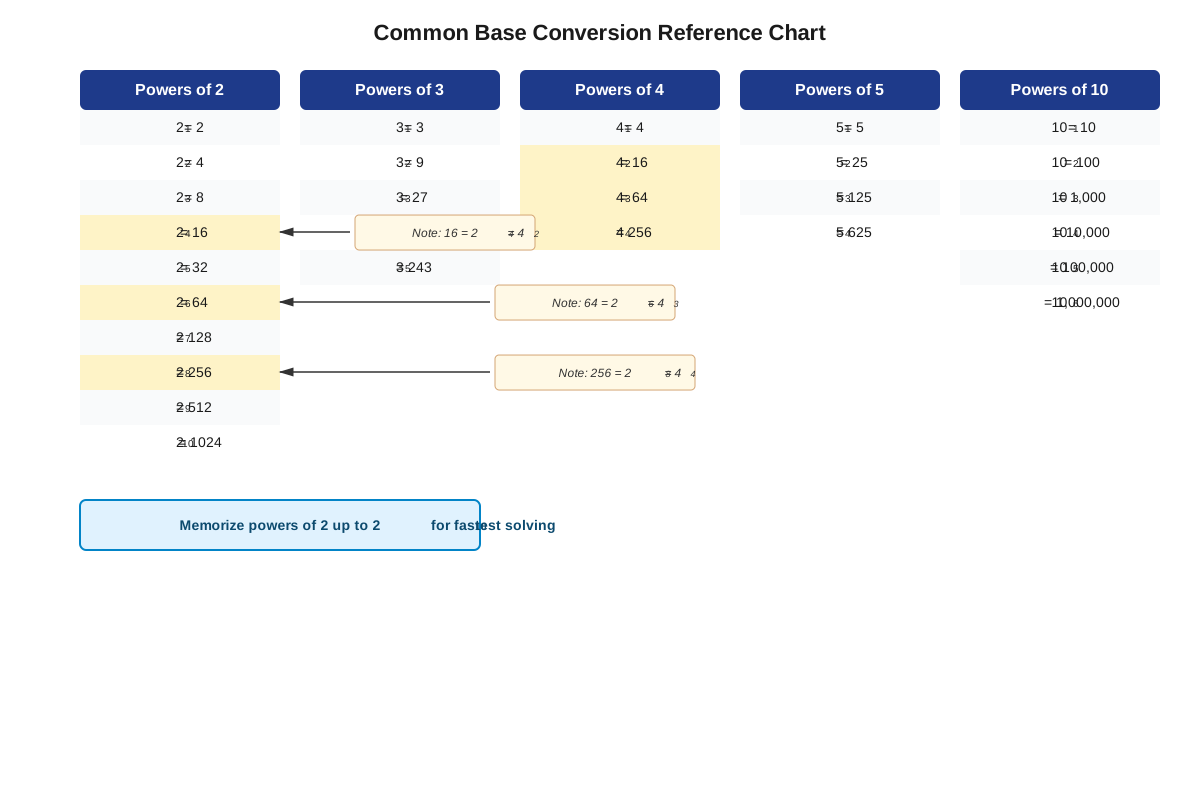
The critical skill for GRE exponential equations is recognizing when numbers can be expressed as powers of a common base. This requires facility with prime factorization and knowledge of common exponential equivalences:
| Number | Common Base Representations |
|---|---|
| 4 | 2² |
| 8 | 2³ |
| 9 | 3² |
| 16 | 2⁴ or 4² |
| 27 | 3³ |
| 32 | 2⁵ |
| 64 | 2⁶ or 4³ or 8² |
| 81 | 3⁴ or 9² |
| 125 | 5³ |
| 243 | 3⁵ |
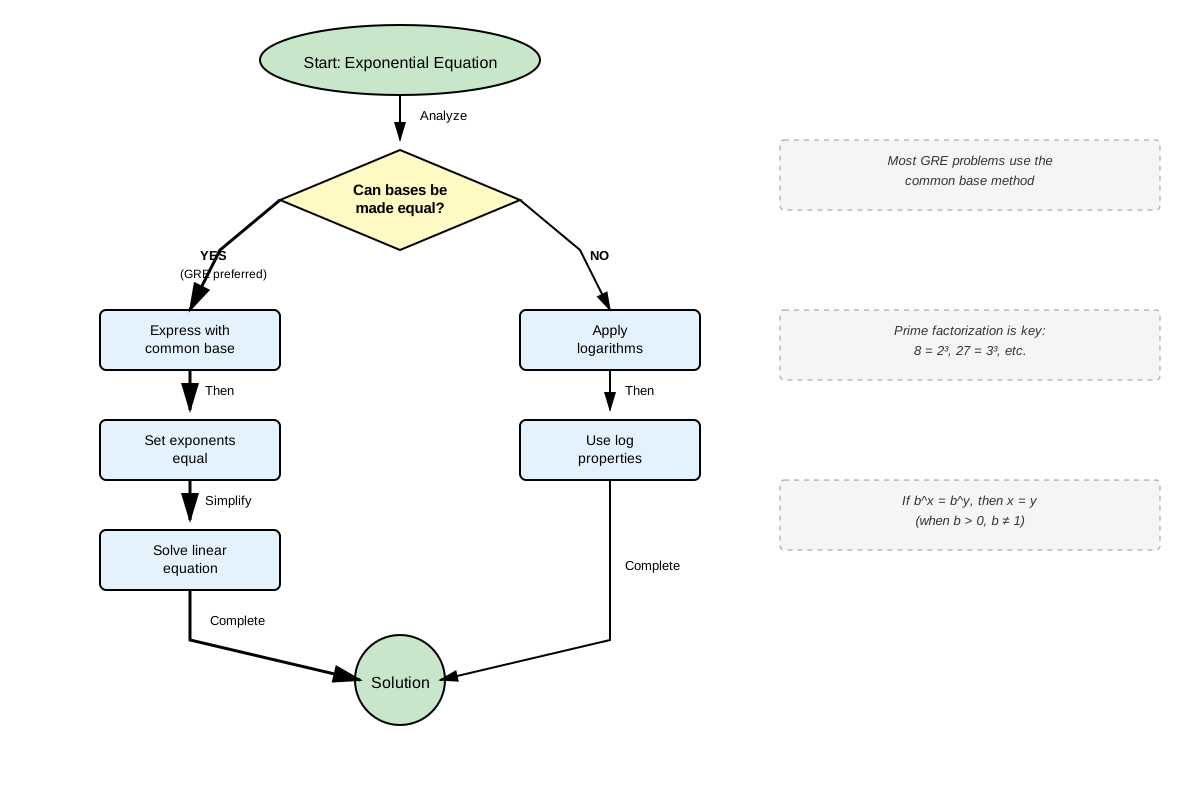
When solving an exponential equation, follow these steps:
- Identify the bases on both sides of the equation
- Factor each base into prime factors if not already in simplest form
- Rewrite both sides using the same base
- Apply the Equal Bases Principle to equate exponents
- Solve the resulting algebraic equation for the variable
Exponent Properties Essential for Exponential Equations
Manipulating exponential equations requires fluent application of exponent rules:
- Product Rule: b^m · b^n = b^(m+n)
- Quotient Rule: b^m ÷ b^n = b^(m-n)
- Power Rule: (b^m)^n = b^(mn)
- Negative Exponent Rule: b^(-n) = 1/b^n
- Zero Exponent Rule: b^0 = 1 (for b ≠ 0)
- Fractional Exponent Rule: b^(m/n) = ⁿ√(b^m)
These properties enable transformation of complex exponential expressions into simpler equivalent forms. The GRE frequently tests whether students can recognize when to apply these rules in combination.
Special Cases and Patterns
Several special patterns appear repeatedly on the GRE:
Equations with fractional or negative exponents: When encountering equations like 4^x = 1/8, recognize that 1/8 = 8^(-1) = (2³)^(-1) = 2^(-3). Converting 4 to 2²: (2²)^x = 2^(-3), so 2^(2x) = 2^(-3), yielding 2x = -3 and x = -3/2.
Equations with compound exponents: For equations like (2^x)^3 = 64, apply the power rule first: 2^(3x) = 64. Then convert 64 to base 2: 2^(3x) = 2^6, so 3x = 6 and x = 2.
Equations with exponential expressions on both sides: When solving 2^(x+1) = 4^(x-2), convert to common base: 2^(x+1) = (2²)^(x-2) = 2^(2x-4). Equating exponents: x + 1 = 2x - 4, which gives x = 5.
When Direct Base Conversion Isn't Possible
Occasionally, the GRE presents exponential equations where bases cannot easily be made equal, such as 2^x = 10. For these questions, the GRE typically:
- Provides answer choices that can be tested by substitution
- Asks for approximate values or comparisons rather than exact solutions
- Embeds the equation in a context where estimation suffices
The GRE does not require knowledge of logarithms for solving exponential equations, though understanding that logarithms are the inverse operation of exponentiation provides conceptual clarity. When exact solutions aren't accessible through base conversion, strategic answer choice testing becomes the primary approach.
Exponential Growth and Decay Applications
Word problems involving exponential equations typically follow the form A = A₀ · b^t, where:
- A is the final amount
- A₀ is the initial amount
- b is the growth factor (b > 1 for growth, 0 < b < 1 for decay)
- t is time
For compound interest specifically, the formula becomes A = P(1 + r)^t, where P is principal, r is the interest rate, and t is time in periods. The GRE tests whether students can set up these equations correctly and solve for unknown variables.
Concept Relationships
The core concepts within exponential equations form a logical progression: understanding the fundamental structure of exponential equations → recognizing the Equal Bases Principle → developing facility with base conversion through prime factorization → applying exponent properties to simplify expressions → solving the resulting algebraic equations. Each step depends on the previous one, making this a hierarchical rather than parallel concept structure.
Exponential equations connect directly to prerequisite knowledge of exponent rules, as every manipulation of exponential expressions relies on these fundamental properties. The relationship to prime factorization is particularly strong: recognizing that 32 = 2⁵ and 8 = 2³ immediately transforms the equation 32^x = 8 into (2⁵)^x = 2³, making the solution accessible. Without this connection, students resort to inefficient trial-and-error approaches.
The relationship map flows as follows:
Prime Factorization → enables → Base Conversion → activates → Equal Bases Principle → requires → Exponent Properties → produces → Simplified Algebraic Equation → yields → Solution
This topic also connects forward to logarithmic functions (the inverse of exponential functions), sequences and series (particularly geometric sequences), and functions and graphs (exponential function behavior). Understanding exponential equations provides the algebraic foundation necessary for these more advanced topics.
High-Yield Facts
⭐ If b^x = b^y, then x = y (Equal Bases Principle) — the most fundamental solving strategy for GRE exponential equations
⭐ Any number can be expressed as a power of its prime factors — enables base conversion, the primary technique for solving exponential equations
⭐ Common conversions: 4 = 2², 8 = 2³, 9 = 3², 16 = 2⁴, 27 = 3³, 32 = 2⁵, 64 = 2⁶, 81 = 3⁴
⭐ When bases are equal, exponents can be directly compared or equated — this principle allows solving without logarithms
⭐ (b^m)^n = b^(mn) — the power rule is essential for handling compound exponents
- b^(-n) = 1/b^n — negative exponents indicate reciprocals, frequently tested in GRE questions
- b^0 = 1 for any b ≠ 0 — zero exponents always equal one, useful for simplification
- b^(1/n) = ⁿ√b — fractional exponents represent roots
- b^m · b^n = b^(m+n) — when multiplying like bases, add exponents
- b^m ÷ b^n = b^(m-n) — when dividing like bases, subtract exponents
- Exponential growth formula: A = A₀ · b^t where b > 1 — models population growth, compound interest, and similar phenomena
- If 2^x = 32, then x = 5 because 32 = 2⁵ — recognizing powers of 2 up to 2¹⁰ = 1024 accelerates problem-solving
- If bases cannot be made equal, test answer choices — the GRE designs questions to be solvable within time constraints
Quick check — test yourself on Exponential equations so far.
Try Flashcards →Common Misconceptions
Misconception: When solving 2^x = 8, students can divide both sides by 2 to get x = 4.
Correction: Division doesn't work with exponential equations the same way it does with linear equations. Instead, convert 8 to base 2: 8 = 2³, so 2^x = 2³, therefore x = 3. The variable is in the exponent, not the base, requiring different algebraic operations.
Misconception: The equation 3^x = 9^2 means x = 2.
Correction: This confuses the exponent on the right side with the solution. Convert 9 to base 3: 9 = 3², so 9² = (3²)² = 3⁴. Therefore 3^x = 3⁴, giving x = 4, not 2. Always convert to common bases before equating exponents.
Misconception: In the equation 2^(2x) = 16, students can "cancel" the 2s to get 2x = 16, so x = 8.
Correction: There's no cancellation operation for exponential equations. Convert 16 to base 2: 16 = 2⁴, so 2^(2x) = 2⁴. Equating exponents: 2x = 4, therefore x = 2. The Equal Bases Principle applies to exponents, not bases.
Misconception: Negative exponents make the entire expression negative.
Correction: Negative exponents create reciprocals, not negative numbers. For example, 2^(-3) = 1/2³ = 1/8, which is positive. The expression 2^(-3) equals 0.125, not -8. Negative exponents affect the position (numerator vs. denominator) but not the sign of the result when the base is positive.
Misconception: When solving (4^x)² = 64, students might think 4^x = 32.
Correction: Taking the square root of both sides gives 4^x = ±8, but since 4^x must be positive for all real x, only 4^x = 8 is valid. Converting: 4^x = 8 means (2²)^x = 2³, so 2^(2x) = 2³, giving 2x = 3 and x = 3/2. Remember that exponential expressions with positive bases are always positive.
Misconception: The equation 2^x · 3^x = 6^x is always true.
Correction: This is actually correct! When multiplying exponential expressions with the same exponent but different bases, the bases multiply: 2^x · 3^x = (2·3)^x = 6^x. However, students sometimes incorrectly apply this in reverse, thinking 6^x can always be split into 2^x · 3^x, which is true, but they forget to apply it correctly in equations.
Misconception: Exponential equations can be solved by taking the exponent of both sides.
Correction: There's no operation called "taking the exponent." Students confusing this with logarithms (taking the log of both sides) create nonsensical steps. For GRE purposes, convert to common bases and equate exponents, or test answer choices.
Worked Examples
Example 1: Basic Exponential Equation with Base Conversion
Problem: Solve for x: 4^(x+1) = 32
Solution:
Step 1: Identify that both 4 and 32 can be expressed as powers of 2.
- 4 = 2²
- 32 = 2⁵
Step 2: Rewrite the equation using base 2.
- (2²)^(x+1) = 2⁵
Step 3: Apply the power rule (b^m)^n = b^(mn) to the left side.
- 2^(2(x+1)) = 2⁵
- 2^(2x+2) = 2⁵
Step 4: Apply the Equal Bases Principle by equating exponents.
- 2x + 2 = 5
Step 5: Solve the linear equation.
- 2x = 3
- x = 3/2 or 1.5
Connection to learning objectives: This example demonstrates identifying exponential equations (objective 1), applying the core strategy of base conversion and the Equal Bases Principle (objective 2), and accurately solving a GRE-style problem (objective 3).
Example 2: Exponential Equation with Negative Exponents
Problem: If 9^x = 1/27, what is the value of x?
Solution:
Step 1: Recognize that both 9 and 27 are powers of 3.
- 9 = 3²
- 27 = 3³
Step 2: Express the right side using the negative exponent rule.
- 1/27 = 27^(-1) = (3³)^(-1) = 3^(-3)
Step 3: Rewrite the equation with base 3.
- (3²)^x = 3^(-3)
Step 4: Apply the power rule to the left side.
- 3^(2x) = 3^(-3)
Step 5: Equate exponents using the Equal Bases Principle.
- 2x = -3
Step 6: Solve for x.
- x = -3/2 or -1.5
Verification: Check by substituting back: 9^(-3/2) = (3²)^(-3/2) = 3^(-3) = 1/27 ✓
Connection to learning objectives: This example shows how to handle negative exponents in exponential equations, reinforcing the core strategy while demonstrating a common GRE variation that tests whether students understand reciprocal relationships.
Example 3: Quantitative Comparison with Exponential Expressions
Problem:
Quantity A: The value of x when 2^(3x) = 64
Quantity B: The value of y when 4^y = 16
Which quantity is greater?
Solution:
For Quantity A:
- Convert 64 to base 2: 64 = 2⁶
- Equation becomes: 2^(3x) = 2⁶
- Equate exponents: 3x = 6
- Solve: x = 2
For Quantity B:
- Convert both to base 2: 4 = 2² and 16 = 2⁴
- Equation becomes: (2²)^y = 2⁴
- Simplify: 2^(2y) = 2⁴
- Equate exponents: 2y = 4
- Solve: y = 2
Comparison: Quantity A = 2 and Quantity B = 2, so the quantities are equal.
Connection to learning objectives: This example demonstrates the quantitative comparison format common on the GRE, requiring efficient solving of multiple exponential equations and direct comparison of results.
Exam Strategy
Recognizing Exponential Equation Questions
Trigger phrases that signal exponential equations include:
- "If 2^x equals..."
- "What is the value of the exponent..."
- "Solve for x in the equation..."
- "A population doubles every..."
- "Compound interest at a rate of..."
- "Which of the following is equivalent to..."
When you see variables in exponent positions or questions asking about growth/decay over time periods, immediately activate exponential equation strategies.
Strategic Approach Sequence
- Scan for common bases (2, 3, 5) before attempting complex factorization
- Convert all numbers to prime factorization if common bases aren't immediately obvious
- Rewrite using the same base on both sides of the equation
- Apply exponent properties to simplify before equating exponents
- Solve the resulting algebraic equation using standard techniques
Time Management
Allocate approximately 1.5-2 minutes for exponential equation problems. If base conversion isn't apparent within 30 seconds, consider:
- Testing answer choices by substitution (particularly effective for discrete multiple-choice questions)
- Estimating relative magnitudes for quantitative comparison questions
- Checking whether the question asks for an approximation rather than exact value
Process of Elimination Tips
For multiple-choice exponential equation questions:
- Eliminate answers with wrong signs: If the equation involves positive bases and the solution should be positive, eliminate negative answer choices
- Test extreme values: If x = 0 or x = 1 can be easily evaluated, check which answer choices satisfy these special cases
- Check magnitude reasonableness: If 2^x = 100, x must be between 6 and 7 (since 2⁶ = 64 and 2⁷ = 128), eliminating answers outside this range
- Verify using exponent properties: If an answer seems correct, quickly verify by substituting back into the original equation
Common Traps to Avoid
The GRE designs wrong answer choices to catch specific errors:
- Answers that result from incorrectly "canceling" bases
- Answers that confuse the exponent on one side with the solution
- Answers that forget to apply the power rule to compound exponents
- Answers that treat negative exponents as creating negative results
Exam Tip: When stuck, remember that the GRE designs exponential equation problems to be solvable through base conversion about 90% of the time. If you can't find a common base quickly, you may have misidentified the prime factors—double-check your factorization.
Memory Techniques
Mnemonic for Common Powers of 2
"Two Four Eight, Sixteen's Great, Thirty-Two, Sixty-Four, More!"
- 2¹ = 2
- 2² = 4
- 2³ = 8
- 2⁴ = 16
- 2⁵ = 32
- 2⁶ = 64
- 2⁷ = 128
- 2⁸ = 256
- 2⁹ = 512
- 2¹⁰ = 1024
Mnemonic for Common Powers of 3
"Three Nine, Twenty-Seven Fine, Eighty-One Divine"
- 3¹ = 3
- 3² = 9
- 3³ = 27
- 3⁴ = 81
- 3⁵ = 243
Visualization Strategy: The Base Conversion Bridge
Visualize exponential equations as two towers that need to be connected by a bridge. The towers are the two sides of the equation, and the bridge is the common base. You can only walk across (equate exponents) once both towers are built from the same material (same base). This mental image reinforces that base conversion must happen before applying the Equal Bases Principle.
Acronym for Solving Steps: BRACE
Bases identified
Rewrite with common base
Apply exponent properties
Compare exponents (Equal Bases Principle)
Evaluate the resulting equation
This acronym provides a memorable sequence for approaching any exponential equation systematically.
Memory Palace Technique
Associate each exponent property with a room in a familiar building:
- Front door (entrance): Equal Bases Principle (the way "in" to solving)
- Living room (where things multiply): Product Rule (b^m · b^n = b^(m+n))
- Kitchen (where things divide): Quotient Rule (b^m ÷ b^n = b^(m-n))
- Bedroom (power nap): Power Rule ((b^m)^n = b^(mn))
- Basement (below ground): Negative Exponent Rule (b^(-n) = 1/b^n)
Summary
Exponential equations, where variables appear in exponent positions, represent a high-yield GRE Quantitative Reasoning topic that rewards strategic thinking over computational complexity. The fundamental approach centers on the Equal Bases Principle: when both sides of an equation can be expressed using the same base, the exponents can be directly equated and solved using standard algebraic techniques. Success requires fluency with prime factorization to enable base conversion, mastery of exponent properties to simplify complex expressions, and recognition of common exponential equivalences (particularly powers of 2 and 3). The GRE designs exponential equation problems to be solved efficiently through pattern recognition rather than advanced techniques like logarithms, making this topic accessible to students who develop systematic problem-solving approaches. Understanding exponential equations also provides the foundation for growth and decay applications, compound interest problems, and other real-world scenarios frequently tested on the exam.
Key Takeaways
- The Equal Bases Principle (if b^x = b^y, then x = y) is the foundation for solving exponential equations on the GRE
- Base conversion through prime factorization is the primary technique—memorize common powers of 2, 3, and 5
- Apply exponent properties systematically: product rule, quotient rule, power rule, and negative exponent rule
- Exponential equations appear in 8-12% of GRE Quantitative questions, making them high-yield for focused study
- When bases cannot be made equal, test answer choices by substitution rather than attempting complex algebraic manipulation
- Negative exponents create reciprocals (not negative numbers), and zero exponents always equal one
- The GRE favors questions where elegant base conversion leads to simple solutions, rewarding mathematical insight over calculation
Related Topics
Logarithmic Functions: Logarithms are the inverse operations of exponential functions. While the GRE doesn't require logarithms for solving exponential equations, understanding this relationship provides conceptual depth and enables solving more complex exponential problems in advanced mathematics.
Sequences and Series: Geometric sequences are defined by exponential relationships between terms (each term is the previous term multiplied by a constant ratio). Mastering exponential equations provides the algebraic foundation for understanding geometric sequence formulas and sum calculations.
Functions and Graphs: Exponential functions (f(x) = b^x) exhibit distinctive growth patterns and graphical characteristics. Understanding exponential equations algebraically enables analysis of exponential function behavior, asymptotes, and transformations.
Compound Interest and Growth Models: Real-world applications of exponential equations appear in finance, biology, and physics. These word problems require translating verbal descriptions into exponential equation form before solving.
Rational Exponents and Radicals: Fractional exponents connect exponential expressions to radical notation. Mastering exponential equations with integer exponents prepares students for problems involving roots and rational exponents.
Practice CTA
Now that you've mastered the core concepts, strategies, and common patterns for exponential equations, it's time to solidify your understanding through active practice. Attempt the practice questions designed specifically for this topic, focusing on applying the Equal Bases Principle and base conversion techniques systematically. Use the flashcards to reinforce memorization of common exponential equivalences and exponent properties. Remember: exponential equations reward pattern recognition and strategic thinking—the more problems you solve, the faster you'll recognize the optimal approach. Your investment in mastering this high-yield topic will pay dividends across multiple GRE Quantitative questions. You've got this!
Sign up free to keep reading
Create a free AnvayaPrep account to finish this GRE guide on Exponential equations — plus flashcards and practice questions.