Overview
Radical equations are algebraic equations in which the variable appears under a radical sign (most commonly a square root, but also cube roots or higher-order roots). These equations require specific solution techniques that distinguish them from standard linear or quadratic equations. On the GRE, gre radical equations appear frequently in both Quantitative Comparison and Problem Solving formats, testing not only algebraic manipulation skills but also conceptual understanding of when solutions are valid and when extraneous solutions must be rejected.
Mastering radical equations is essential for GRE success because they integrate multiple algebraic concepts: understanding properties of radicals, manipulating equations through isolation and squaring, solving resulting polynomial equations, and critically evaluating solutions. The GRE often embeds radical equations within word problems, geometry contexts, or data interpretation scenarios, making them a high-yield topic that connects to broader quantitative reasoning skills. Questions involving radical equations typically appear in the medium-to-hard difficulty range, making them crucial for students aiming for scores above the 160 threshold.
Within the broader Quantitative Reasoning framework, radical equations bridge foundational algebra with more advanced problem-solving. They require fluency with exponent rules (since radicals are fractional exponents), polynomial equations (since solving often produces quadratics), and inequality reasoning (since radical expressions have domain restrictions). Understanding radical equations also supports work with functions, coordinate geometry, and even some data analysis problems where square root relationships model real-world phenomena.
Learning Objectives
- [ ] Identify when Radical equations is being tested
- [ ] Explain the core rule or strategy behind Radical equations
- [ ] Apply Radical equations to GRE-style questions accurately
- [ ] Recognize and eliminate extraneous solutions that arise from squaring both sides
- [ ] Determine domain restrictions before solving radical equations
- [ ] Solve equations containing multiple radicals or nested radicals efficiently
Prerequisites
- Properties of radicals and exponents: Understanding that √x = x^(1/2) and rules for simplifying radical expressions is fundamental to manipulating radical equations
- Solving quadratic equations: After isolating and eliminating radicals, the resulting equation is often quadratic, requiring factoring or the quadratic formula
- Basic equation-solving techniques: Isolating variables, performing inverse operations, and maintaining equation balance are essential skills
- Domain and range concepts: Recognizing that even-indexed radicals require non-negative radicands prevents errors in solution verification
Why This Topic Matters
Radical equations appear in approximately 8-12% of GRE Quantitative Reasoning questions, making them a high-frequency topic that directly impacts scores. They commonly appear in Problem Solving questions worth one point, Quantitative Comparison questions requiring conceptual understanding rather than complete solutions, and occasionally in Data Interpretation sets where relationships involve square roots or other radicals.
Beyond the exam, radical equations model numerous real-world phenomena: the relationship between the area of a square and its side length, the period of a pendulum as a function of its length, the relationship between distance and time in physics problems, and compound interest calculations. This practical relevance means GRE questions often embed radical equations in applied contexts rather than presenting them as pure algebraic exercises.
The GRE specifically tests radical equations in several characteristic ways: verifying whether given values satisfy radical equations, comparing quantities where one or both involve radical expressions, solving for variables in geometric contexts (especially with the Pythagorean theorem), and identifying the number of valid solutions. The test-makers deliberately include answer choices representing common errors—particularly extraneous solutions that students fail to check—making strategic solution verification essential.
Core Concepts
Definition and Structure of Radical Equations
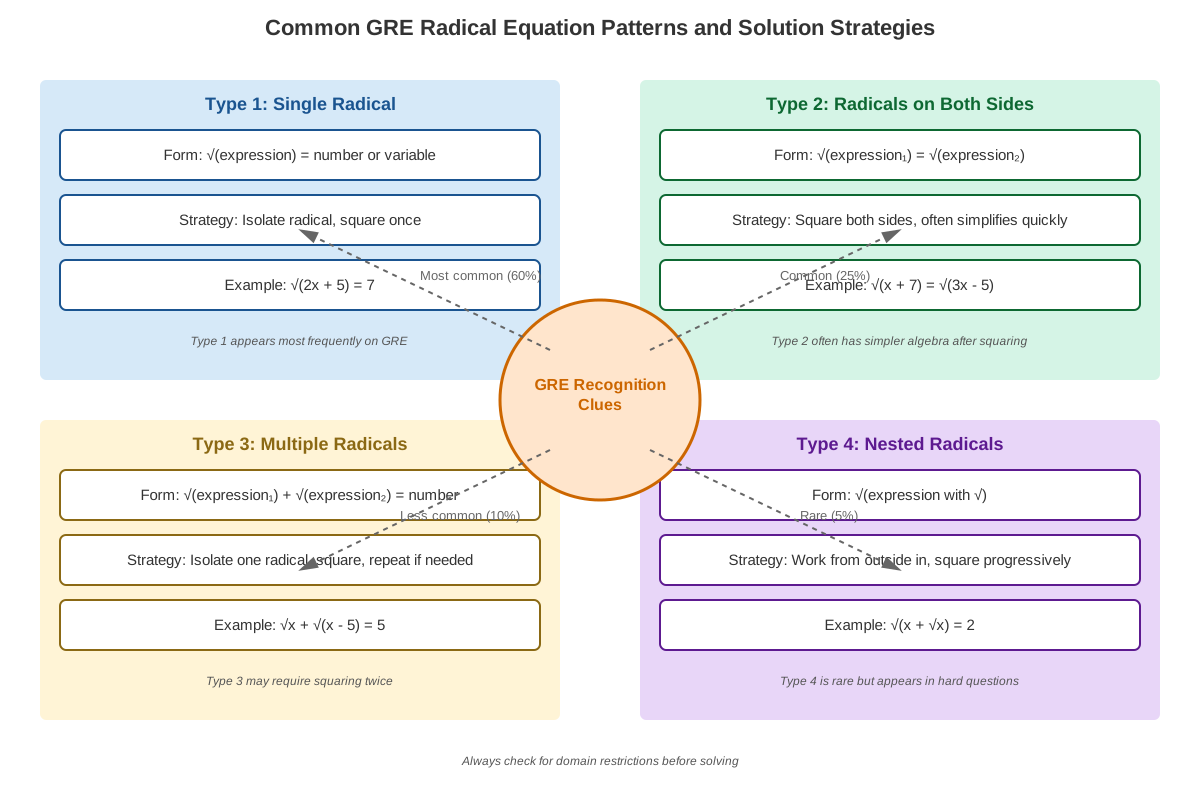
A radical equation is any equation containing a variable within a radical expression. The most common form involves square roots: √(expression with x) = some value. However, GRE questions may also feature cube roots (∛x), fourth roots (⁴√x), or even more complex nested radicals like √(x + √x).
The fundamental challenge with radical equations is that the variable is "trapped" inside the radical, requiring specific techniques to isolate it. Unlike linear equations where straightforward inverse operations suffice, radical equations demand a multi-step process that introduces potential complications.
The Standard Solution Process
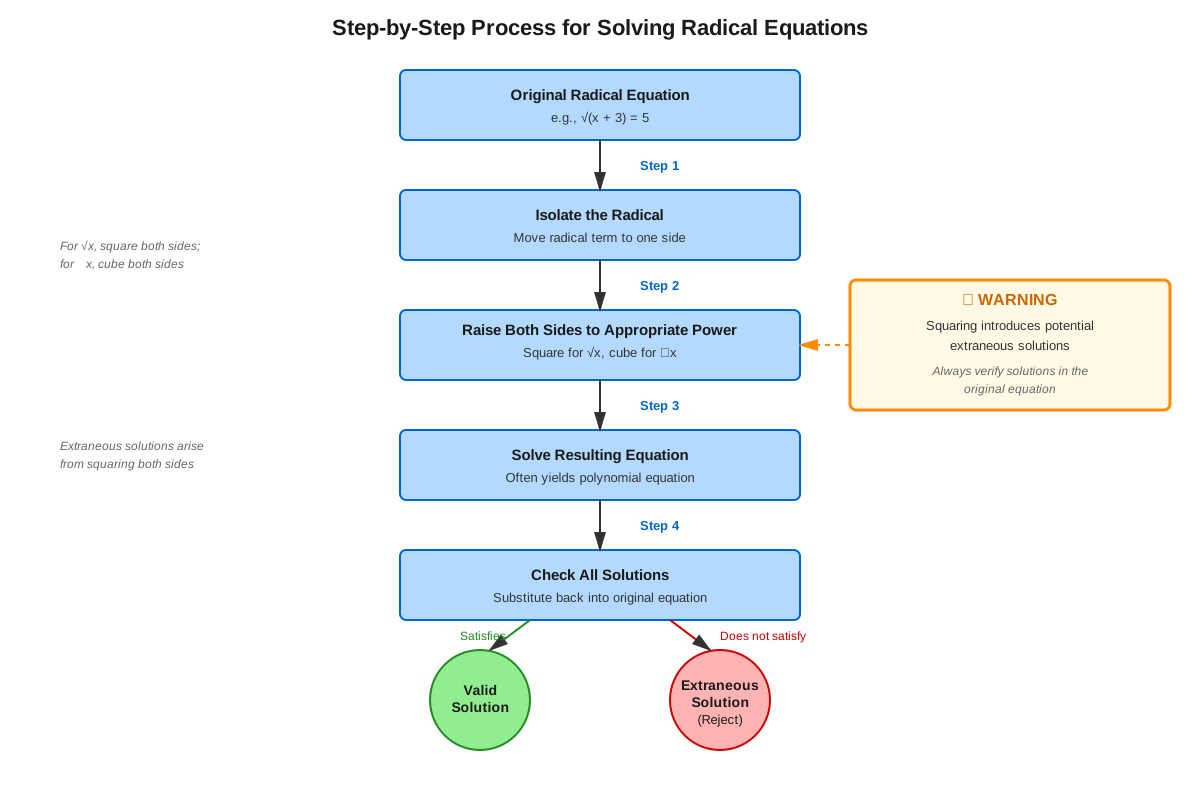
Solving radical equations follows a systematic five-step process:
- Isolate the radical expression on one side of the equation
- Raise both sides to the appropriate power to eliminate the radical (square both sides for square roots, cube both sides for cube roots, etc.)
- Solve the resulting equation (which may be linear, quadratic, or higher-order)
- Check all solutions in the original equation
- Reject extraneous solutions that don't satisfy the original equation
This process is critical because step 2—raising both sides to a power—is not a reversible operation in the same way that addition, subtraction, multiplication, and division are. Squaring both sides can introduce solutions that satisfy the squared equation but not the original equation.
Why Extraneous Solutions Occur
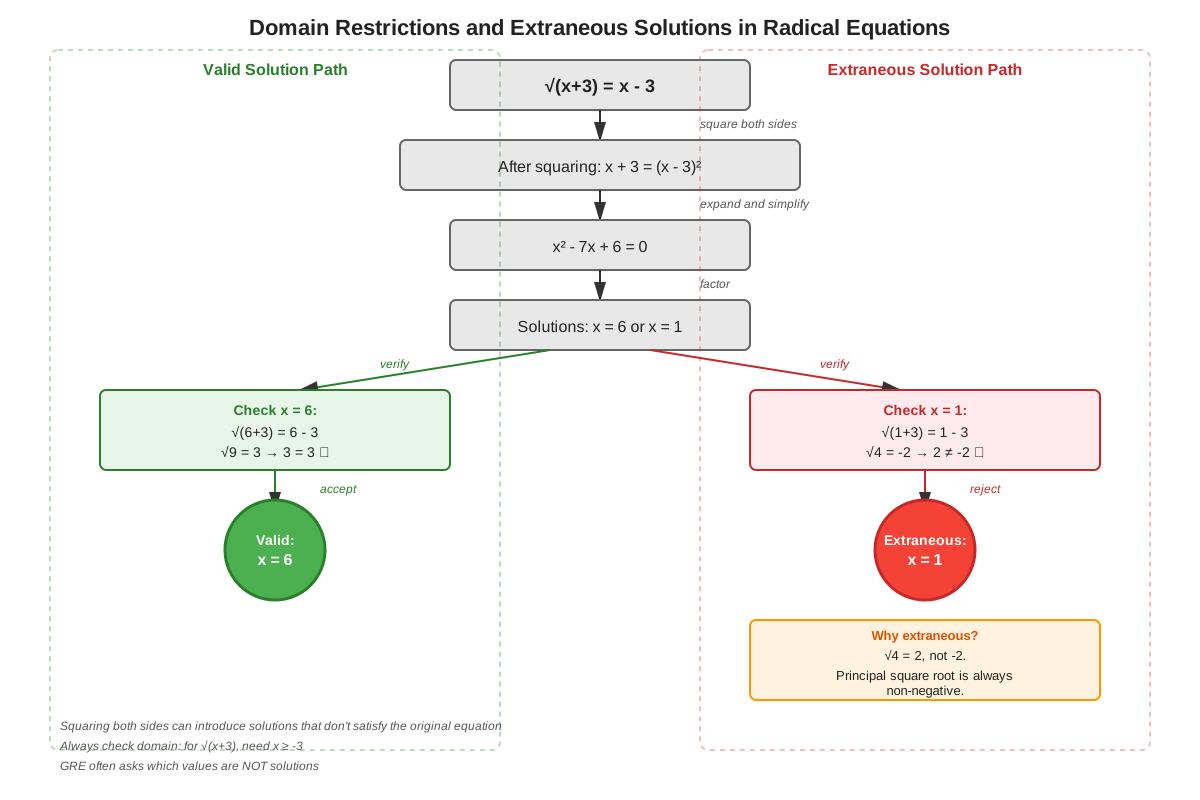
When both sides of an equation are squared, the operation creates a new equation that is less restrictive than the original. Consider the simple equation x = 3. Squaring both sides gives x² = 9, which has two solutions: x = 3 and x = -3. The negative solution is extraneous—it satisfies the squared equation but not the original.
For radical equations, this phenomenon occurs because √x is defined to be the non-negative square root. When we square √(expression) = value, we're essentially solving (expression) = value², but we've lost the information that the original radical expression must be non-negative.
Domain Considerations
Before solving, identify domain restrictions: the values of x for which the equation is defined. For square roots and even-indexed radicals, the radicand (expression under the radical) must be non-negative. For example, in √(x - 3) = 5, we require x - 3 ≥ 0, so x ≥ 3.
Domain restrictions serve two purposes:
- They eliminate impossible answer choices before calculation
- They help identify extraneous solutions after solving
Equations with Multiple Radicals
When an equation contains two or more radical terms, the solution process requires strategic isolation. The general approach:
- Isolate one radical on one side
- Square both sides (this may leave another radical in the equation)
- If radicals remain, isolate one again and square again
- Solve the resulting polynomial equation
- Check all solutions rigorously
For example, √(x + 5) = √(2x - 3) can be solved by squaring both sides immediately since each radical is already isolated on opposite sides.
Special Cases and Shortcuts
| Equation Type | Example | Shortcut |
|---|---|---|
| Radical equals radical | √(x + 5) = √(2x - 3) | Square both sides immediately; radicands must be equal |
| Radical equals zero | √(3x - 7) = 0 | Radicand must equal zero; 3x - 7 = 0 |
| Radical equals negative | √(x + 2) = -4 | No solution (square roots are non-negative) |
| Both sides are perfect squares | √(x² - 9) = x - 3 | Be cautious; must check domain carefully |
Nested Radicals
Occasionally, the GRE presents nested radicals like √(x + √x) = 6. These require working from the outside in:
- Square both sides: x + √x = 36
- Isolate the remaining radical: √x = 36 - x
- Square again: x = (36 - x)²
- Expand and solve the resulting quadratic
- Check both solutions in the original equation
Concept Relationships
The solution of radical equations builds directly on prerequisite knowledge of exponent properties, since radicals are fractional exponents (√x = x^(1/2)). This connection enables alternative solution methods and helps students recognize equivalent forms.
The isolation step connects to fundamental equation-solving principles: performing inverse operations while maintaining balance. The squaring step introduces polynomial equations, most commonly quadratics, creating a direct link to factoring, the quadratic formula, and completing the square.
Domain restrictions for radical equations connect to function concepts, particularly domain and range. Understanding that √x is only defined for x ≥ 0 parallels understanding the domain of the square root function. This relationship extends to graphical interpretation: the solutions to √x = k correspond to the x-coordinates where the graph of y = √x intersects the horizontal line y = k.
The concept of extraneous solutions connects to the broader mathematical principle that not all algebraic operations are reversible. This same principle appears in rational equations (where multiplying by a variable expression can introduce extraneous solutions) and logarithmic equations (where taking exponentials can do the same).
Relationship map: Domain restrictions → Isolation of radical → Squaring both sides → Polynomial equation → Candidate solutions → Verification in original equation → Valid solutions (with extraneous solutions rejected)
High-Yield Facts
⭐ Squaring both sides of an equation can introduce extraneous solutions that must be checked in the original equation
⭐ For square root equations, if the radical equals a negative number, there is no real solution
⭐ The radicand of a square root must be non-negative; this creates domain restrictions
⭐ When √(expression) = k where k ≥ 0, squaring gives expression = k²
⭐ Always isolate one radical before squaring; never square an equation with radicals on both sides plus additional terms
- Cube roots and odd-indexed radicals can have negative radicands and negative values
- If both sides of a radical equation are already isolated radicals, squaring immediately is efficient
- The equation √x = x has solutions x = 0 and x = 1 only
- When checking solutions, substitute into the original equation, not the squared version
- Multiple squaring operations (for equations with multiple radicals) increase the likelihood of extraneous solutions
- The GRE often includes extraneous solutions as trap answer choices
- Domain restrictions can sometimes eliminate answer choices without full calculation
Quick check — test yourself on Radical equations so far.
Try Flashcards →Common Misconceptions
Misconception: After squaring both sides, any solution to the resulting equation is valid for the original equation. → Correction: Squaring can introduce extraneous solutions. Every solution must be verified by substituting back into the original radical equation. If a solution makes the original equation false, it must be rejected.
Misconception: √(x²) = x for all values of x. → Correction: √(x²) = |x|, the absolute value of x. For example, √((-3)²) = √9 = 3, not -3. This distinction is crucial when solving equations like √(x²) = 5, which has solutions x = 5 and x = -5.
Misconception: You can square an equation like √x + 3 = 5 by squaring each term separately: x + 9 = 25. → Correction: You must square the entire side as a unit. First isolate the radical (√x = 2), then square both sides (x = 4). Squaring term-by-term violates algebraic rules.
Misconception: If √(x - 2) = -3, then squaring gives x - 2 = 9, so x = 11. → Correction: Before squaring, recognize that square roots cannot equal negative numbers. The equation √(x - 2) = -3 has no real solution. The value x = 11 is extraneous.
Misconception: Equations with two radicals like √(x + 1) + √(x - 1) = 4 can be solved by squaring both sides immediately. → Correction: Squaring with two radicals on the same side creates a cross-term: (√(x + 1))² + 2√(x + 1)√(x - 1) + (√(x - 1))² = 16. This introduces a product of radicals, complicating the solution. Instead, isolate one radical first: √(x + 1) = 4 - √(x - 1), then square.
Misconception: The domain restriction for √(x - 3) = 5 is x ≥ 3, so any solution x ≥ 3 is automatically valid. → Correction: Domain restrictions are necessary but not sufficient. A solution must satisfy both the domain restriction AND the original equation. For this example, x = 28 satisfies x ≥ 3 and the equation, but if the equation were √(x - 3) = -5, no solution would exist despite the domain restriction being satisfiable.
Worked Examples
Example 1: Standard Square Root Equation
Problem: Solve √(2x + 5) = 7
Solution:
Step 1: Check if the radical is isolated.
Yes, √(2x + 5) is already isolated on the left side.
Step 2: Square both sides to eliminate the radical.
(√(2x + 5))² = 7²
2x + 5 = 49
Step 3: Solve the resulting linear equation.
2x = 49 - 5
2x = 44
x = 22
Step 4: Check the solution in the original equation.
√(2(22) + 5) = √(44 + 5) = √49 = 7 ✓
The solution checks, so x = 22 is valid.
Connection to learning objectives: This example demonstrates the core strategy of isolating the radical, squaring both sides, solving the resulting equation, and verifying the solution—addressing the objective to explain and apply the core rule.
Example 2: Equation Producing an Extraneous Solution
Problem: Solve √(3x + 4) = x - 2
Solution:
Step 1: The radical is isolated, so square both sides.
(√(3x + 4))² = (x - 2)²
3x + 4 = x² - 4x + 4
Step 2: Rearrange into standard quadratic form.
0 = x² - 4x - 3x + 4 - 4
0 = x² - 7x
0 = x(x - 7)
Step 3: Solve the quadratic.
x = 0 or x = 7
Step 4: Check both solutions in the original equation.
For x = 0:
√(3(0) + 4) = 0 - 2
√4 = -2
2 = -2 ✗
This is false, so x = 0 is extraneous.
For x = 7:
√(3(7) + 4) = 7 - 2
√(21 + 4) = 5
√25 = 5
5 = 5 ✓
This is true, so x = 7 is the only valid solution.
Connection to learning objectives: This example illustrates why checking solutions is essential and demonstrates how to recognize and eliminate extraneous solutions, directly addressing the objective to identify when solutions must be rejected.
Example 3: Equation with Two Radicals
Problem: Solve √(x + 7) = √(2x - 5)
Solution:
Step 1: Both radicals are already isolated on opposite sides, so square both sides.
(√(x + 7))² = (√(2x - 5))²
x + 7 = 2x - 5
Step 2: Solve the linear equation.
7 + 5 = 2x - x
12 = x
Step 3: Check the solution.
√(12 + 7) = √(2(12) - 5)
√19 = √(24 - 5)
√19 = √19 ✓
The solution x = 12 is valid.
Step 4: Verify domain restrictions.
For √(x + 7): x + 7 ≥ 0, so x ≥ -7 ✓ (12 satisfies this)
For √(2x - 5): 2x - 5 ≥ 0, so x ≥ 2.5 ✓ (12 satisfies this)
Connection to learning objectives: This demonstrates efficient handling of equations with multiple radicals and reinforces the importance of domain considerations.
Exam Strategy
When approaching GRE questions involving radical equations, begin by identifying the question type. Quantitative Comparison questions often don't require complete solutions—sometimes comparing domains or recognizing that one quantity must be positive while another could be negative suffices. For Problem Solving questions, always check whether the question asks for the solution, the number of solutions, or which values satisfy the equation.
Trigger words and phrases that signal radical equation problems include: "square root," "√" symbol, "radical," "solve for," "what value of x," and geometric contexts mentioning "the side of a square with area" or "the length of a side when the area is." In word problems, phrases like "varies as the square root of" or "is proportional to the square root of" indicate radical relationships.
Process-of-elimination strategies:
- Immediately eliminate negative answer choices if the equation shows a square root equal to a positive number
- Check domain restrictions to eliminate impossible values before solving
- If answer choices are numerical, substitute them into the original equation rather than solving algebraically—this is often faster and avoids extraneous solutions
- Be suspicious of answer choices that would make the radicand negative
- The GRE frequently includes extraneous solutions as trap answers; if you see your algebraic solution among the choices but haven't checked it, be cautious
Time allocation: Budget 1.5-2 minutes for straightforward radical equations, but allow up to 2.5 minutes for equations with multiple radicals or those embedded in complex word problems. If a problem requires squaring twice, consider whether substituting answer choices might be faster.
Exam Tip: On Quantitative Comparison questions, if one quantity involves √x and the other involves x, test x = 0, x = 1, and x = 4 to see if the relationship changes. These values often reveal whether the answer is "The relationship cannot be determined."
Memory Techniques
ISSC Mnemonic for the solution process:
- Isolate the radical
- Square both sides
- Solve the resulting equation
- Check all solutions
Visualization: Picture the radical sign as a "cage" trapping the variable. Squaring both sides is like using a key to open the cage, but sometimes the key opens other cages too (extraneous solutions), so you must check which variables were actually in the original cage.
Domain Restriction Reminder: "Even roots need positive roots" (even-indexed radicals require non-negative radicands)
Extraneous Solution Alert: "Square with care, check what's there" (squaring requires verification)
Acronym for checking solutions - VOTE:
- Verify by substitution
- Original equation only (not the squared version)
- Test all candidate solutions
- Eliminate extraneous results
Summary
Radical equations are algebraic equations with variables under radical signs, most commonly square roots. Solving them requires a systematic approach: isolate the radical, raise both sides to the appropriate power to eliminate the radical, solve the resulting polynomial equation, and critically check all solutions in the original equation. The checking step is non-negotiable because squaring both sides can introduce extraneous solutions that satisfy the squared equation but not the original. Domain restrictions—particularly that even-indexed radicals require non-negative radicands—provide additional constraints that help identify valid solutions. The GRE tests radical equations frequently, often embedding them in applied contexts or including extraneous solutions as trap answers. Success requires both procedural fluency with the solution algorithm and conceptual understanding of why extraneous solutions occur and how domain restrictions limit possible answers. Mastery of radical equations integrates skills with exponents, polynomial equations, and logical verification, making it a high-yield topic that connects to broader algebraic reasoning.
Key Takeaways
- Always check solutions in the original equation; squaring both sides can introduce extraneous solutions that must be rejected
- Isolate one radical completely before squaring; never square an equation with multiple terms including radicals on the same side
- Square roots cannot equal negative numbers; if √(expression) = negative, there is no real solution
- Domain restrictions (radicand ≥ 0 for square roots) can eliminate answer choices before solving
- For equations with two radicals, if both are isolated on opposite sides, square immediately; otherwise, isolate one first
- The GRE frequently includes extraneous solutions as trap answer choices
- Substituting numerical answer choices into the original equation is often faster and more reliable than algebraic solution
Related Topics
Rational Equations: Like radical equations, rational equations can produce extraneous solutions when both sides are multiplied by variable expressions. Mastering radical equations builds the verification skills needed for rational equations.
Quadratic Equations: After eliminating radicals through squaring, the resulting equation is often quadratic. Strong quadratic-solving skills (factoring, quadratic formula, completing the square) are essential for efficiently solving radical equations.
Functions and Graphs: Understanding radical equations supports work with radical functions like f(x) = √x. Solutions to radical equations correspond to intersection points on graphs, connecting algebraic and geometric reasoning.
Inequalities with Radicals: The techniques for solving radical equations extend to radical inequalities, though the direction of inequality signs requires additional care when squaring.
Systems of Equations: Radical equations can appear within systems, requiring integration of substitution or elimination methods with radical-solving techniques.
Practice CTA
Now that you've mastered the core concepts, solution strategies, and common pitfalls of radical equations, it's time to solidify your understanding through practice. Attempt the practice questions to apply these techniques to GRE-style problems, and use the flashcards to reinforce high-yield facts and procedures. Remember: the difference between knowing how to solve radical equations and consistently getting them right on test day is deliberate practice with immediate feedback. Each practice problem you work through builds the pattern recognition and procedural fluency that will make you faster and more accurate on exam day. You've got this!
Sign up free to keep reading
Create a free AnvayaPrep account to finish this GRE guide on Radical equations — plus flashcards and practice questions.