Overview
Approximation is a critical quantitative reasoning skill that enables test-takers to solve complex GRE problems efficiently by estimating values rather than calculating exact answers. This strategic approach involves rounding numbers, simplifying expressions, and making intelligent estimates that lead to correct answer choices without performing tedious calculations. On the GRE, where time management is paramount and many questions are designed to be solved in under two minutes, mastering GRE approximation techniques can mean the difference between completing the section confidently and running out of time on the final questions.
The GRE Quantitative Reasoning section frequently presents problems where exact calculation would consume valuable minutes, but strategic approximation yields the correct answer in seconds. Test designers intentionally create answer choices with sufficient separation that approximation leads directly to the right option. Understanding when and how to approximate requires recognizing specific question patterns, assessing answer choice spacing, and developing confidence in estimation techniques. This skill becomes particularly valuable in problems involving percentages, fractions, square roots, and complex arithmetic operations where precise calculation offers no advantage over intelligent estimation.
Approximation connects fundamentally to other Quantitative Reasoning concepts including number properties, arithmetic operations, and data interpretation. It serves as a meta-strategy that enhances efficiency across multiple question types, from quantitative comparison to data interpretation charts. Students who master approximation techniques not only solve individual problems faster but also conserve mental energy for more challenging questions, ultimately improving overall section performance and scores.
Learning Objectives
- [ ] Identify when Approximation is being tested
- [ ] Explain the core rule or strategy behind Approximation
- [ ] Apply Approximation to GRE-style questions accurately
- [ ] Determine appropriate rounding strategies based on answer choice spacing
- [ ] Recognize when exact calculation is necessary versus when approximation suffices
- [ ] Combine multiple approximation techniques to solve multi-step problems efficiently
- [ ] Estimate the magnitude of results before performing calculations to catch errors
Prerequisites
- Basic arithmetic operations (addition, subtraction, multiplication, division): Essential for understanding what calculations are being approximated and how rounding affects results
- Understanding of place value and decimal notation: Necessary for determining appropriate rounding precision and maintaining accuracy in estimates
- Fraction and percentage fundamentals: Required since many approximation problems involve converting between these forms and estimating their values
- Order of operations: Critical for knowing which parts of complex expressions to approximate first and how approximations compound through calculations
Why This Topic Matters
Approximation represents one of the most practical mathematical skills tested on the GRE, mirroring real-world decision-making where exact precision is often unnecessary or impossible. Professionals across fields—from business analysts estimating market sizes to scientists conducting order-of-magnitude calculations—rely on approximation to make rapid, informed judgments. The GRE tests this skill because it reflects genuine quantitative reasoning ability rather than mere computational accuracy.
On the GRE Quantitative Reasoning section, approximation-friendly questions appear with remarkable frequency. Approximately 30-40% of questions can be solved more efficiently using approximation rather than exact calculation. These questions span multiple formats: quantitative comparison problems where relative magnitude matters more than precise values, multiple-choice questions with widely spaced answer choices, and data interpretation questions where chart values cannot be read with perfect precision. The test explicitly designs many problems to reward strategic approximation, making answer choices sufficiently distinct that reasonable estimates lead unambiguously to the correct option.
Common manifestations include percentage increase/decrease problems where rounding to convenient benchmarks (10%, 25%, 50%) simplifies calculations; fraction operations where converting to approximate decimals enables mental math; square root estimations where knowing perfect squares allows bracketing unknown values; and compound calculations where small rounding errors in early steps don't affect final answer choice selection. Recognizing these patterns allows test-takers to shift from laborious calculation to efficient estimation, often reducing solution time by 50% or more.
Core Concepts
Understanding When to Approximate
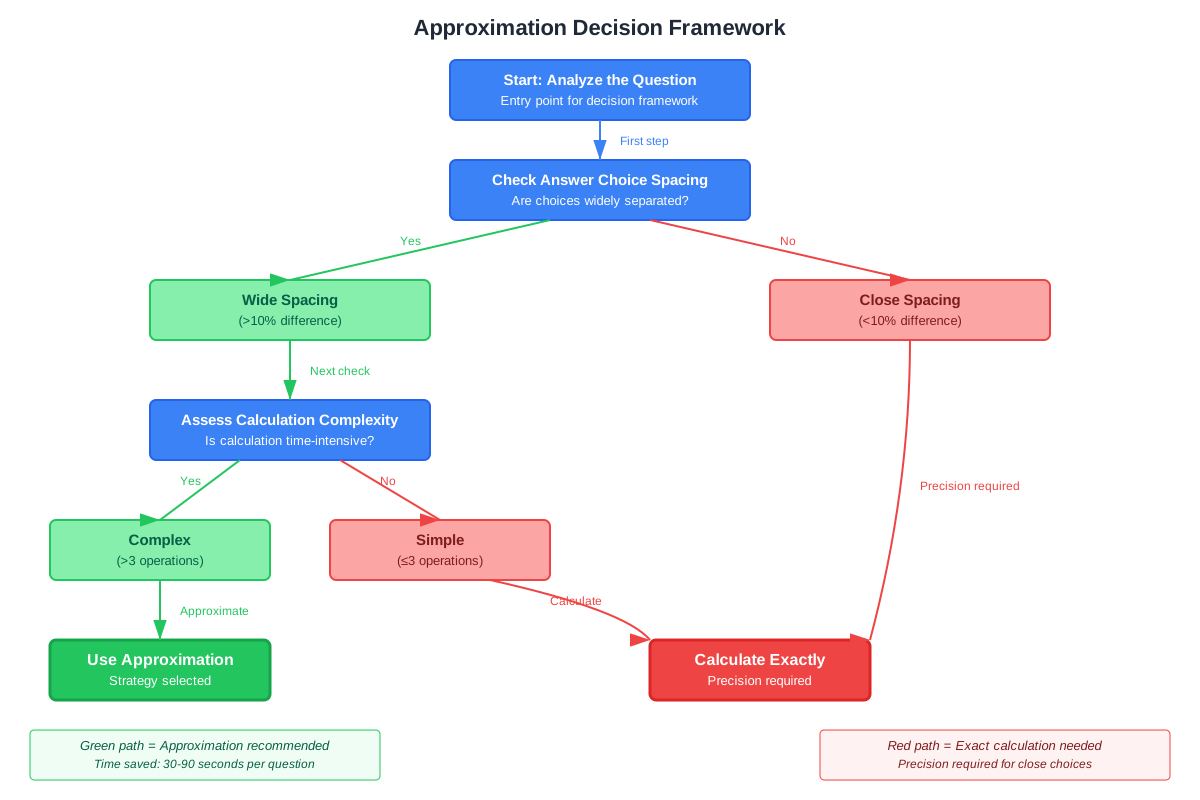
The decision to approximate rather than calculate exactly represents the first critical skill in mastering this technique. Several indicators signal that approximation is the intended solution strategy. First, examine the answer choices: if they differ by 10% or more, approximation will almost certainly lead to the correct answer. For example, if choices are 45, 60, 75, 90, and 105, rounding intermediate calculations to the nearest 5 or 10 will preserve enough accuracy to distinguish among options.
Second, assess the complexity of exact calculation. If a problem requires multiplying 47 × 23, exact calculation demands significant time, but recognizing this as approximately 50 × 20 = 1,000 (actual: 1,081) may suffice depending on answer spacing. Third, consider the question format: quantitative comparison questions often require only determining which quantity is larger, not calculating exact values. Finally, data interpretation questions frequently present charts where values cannot be read precisely, signaling that approximation is not just acceptable but necessary.
Strategic Rounding Techniques
Effective rounding requires balancing simplicity against accuracy. The strategic rounding approach involves several principles:
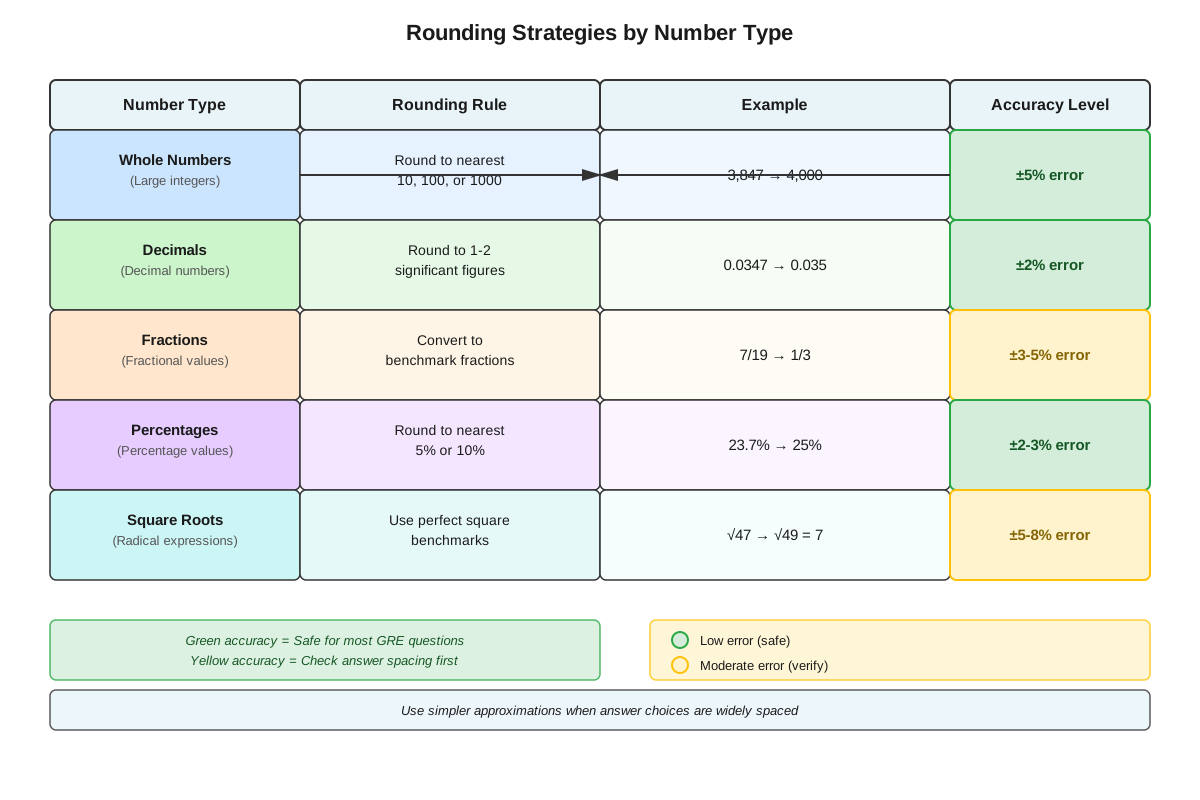
Round to convenient numbers: Convert values to numbers that enable mental calculation. For instance, 48 becomes 50, 0.52 becomes 0.5, and 3.14 becomes 3. The key is selecting round numbers that simplify subsequent operations—round to multiples of 5 or 10 for addition/subtraction, and to factors of the other number for multiplication/division.
Compensating rounding: When rounding multiple numbers, alternate between rounding up and down to balance errors. If calculating 48 × 23, rounding both up (50 × 25 = 1,250) overestimates significantly, while rounding one up and one down (50 × 20 = 1,000) provides a more accurate estimate of the actual value (1,104).
Precision matching: Match rounding precision to answer choice spacing. If answers differ by hundreds, round to the nearest ten; if they differ by thousands, round to the nearest hundred. Over-precision wastes time while under-precision risks ambiguity.
Benchmark Values and Reference Points
Memorizing key benchmark values accelerates approximation dramatically. These reference points allow rapid estimation without calculation:
| Fraction | Approximate Decimal | Approximate Percentage |
|---|---|---|
| 1/8 | 0.125 | 12.5% |
| 1/6 | 0.167 | 16.7% |
| 1/5 | 0.20 | 20% |
| 1/4 | 0.25 | 25% |
| 1/3 | 0.333 | 33.3% |
| 2/5 | 0.40 | 40% |
| 1/2 | 0.50 | 50% |
| 3/5 | 0.60 | 60% |
| 2/3 | 0.667 | 66.7% |
| 3/4 | 0.75 | 75% |
Similarly, knowing perfect squares (1, 4, 9, 16, 25, 36, 49, 64, 81, 100, 121, 144, 169, 196, 225) enables rapid square root approximation. To estimate √50, recognize it falls between √49 = 7 and √64 = 8, closer to 7 (actual: 7.07).
Magnitude Estimation
Magnitude estimation involves determining the order of magnitude (powers of 10) of a result before detailed calculation. This technique catches errors and guides approximation precision. For example, when calculating (4,832 × 0.0047) ÷ 0.23, first estimate magnitude: (5,000 × 0.005) ÷ 0.2 = 25 ÷ 0.2 = 125. This tells us the answer should be in the hundreds, immediately eliminating answer choices in the tens or thousands.
This approach proves particularly valuable for division and multiplication involving decimals, where misplacing a decimal point is common. Always ask: "Should this answer be in the ones, tens, hundreds, or thousands?" before calculating.
Percentage Approximation Strategies
Percentage problems frequently benefit from approximation. Key strategies include:
The 10% method: Calculate 10% by moving the decimal point, then scale to other percentages. To find 15% of 240, calculate 10% = 24, then 5% = 12, so 15% = 36.
Benchmark percentage approximation: Round percentages to 10%, 25%, 50%, or 75% when answer choices permit. Finding 23% of 180 becomes approximately 25% of 180 = 45 (actual 23% = 41.4).
Successive percentage changes: When calculating compound percentage changes, approximate each step. A 15% increase followed by 20% decrease on $100 becomes: $100 → $115 → approximately $92 (exact: $92).
Fraction Operations Through Approximation
Complex fraction operations often simplify dramatically through decimal approximation. Rather than calculating (7/12 × 5/8) ÷ 3/4 exactly, convert to approximate decimals: (0.58 × 0.625) ÷ 0.75 ≈ (0.6 × 0.6) ÷ 0.75 ≈ 0.36 ÷ 0.75 ≈ 0.5. This approach trades minor precision loss for major speed gain.
When adding or subtracting fractions with different denominators, approximate using benchmark fractions rather than finding exact common denominators. For 5/12 + 7/15, recognize these are approximately 0.42 + 0.47 ≈ 0.9, avoiding the tedious calculation of 25/60 + 28/60 = 53/60.
Concept Relationships
The concepts within approximation form a hierarchical decision framework. Understanding when to approximate serves as the foundation, determining whether approximation applies to a given problem. This decision depends on analyzing answer choice spacing and calculation complexity. Once approximation is selected, strategic rounding techniques provide the tactical approach, with the specific method chosen based on the operations involved. Benchmark values support both rounding decisions and direct estimation, serving as reference points throughout the process.
Magnitude estimation functions as both a preliminary check (before calculation) and a verification tool (after calculation), connecting to all other approximation concepts by providing a reality check on results. Percentage approximation strategies and fraction operations through approximation represent specialized applications of the general principles, demonstrating how core approximation concepts adapt to specific mathematical contexts.
These approximation concepts connect to prerequisite knowledge of arithmetic operations by providing efficiency layers atop basic calculation skills. Rather than replacing exact calculation, approximation enhances it by adding strategic judgment about when precision matters. The relationship flows: Basic arithmetic → Recognition of calculation complexity → Decision to approximate → Selection of appropriate approximation technique → Execution with benchmark values → Verification through magnitude estimation.
Approximation also connects forward to more advanced GRE topics. In data interpretation, approximation becomes essential for reading graph values. In word problems, it enables rapid elimination of unreasonable answer choices. In geometry, it facilitates estimation of areas and volumes when exact formulas prove cumbersome. This topic thus serves as a force multiplier across the entire Quantitative Reasoning section.
High-Yield Facts
⭐ Answer choices differing by 10% or more signal that approximation will lead to the correct answer without exact calculation
⭐ In quantitative comparison questions, approximation often suffices since only relative magnitude matters, not exact values
⭐ Rounding one factor up and another down (compensating rounding) produces more accurate estimates than rounding all factors in the same direction
⭐ Knowing that 1/3 ≈ 0.33, 1/6 ≈ 0.17, and 1/8 ≈ 0.125 enables rapid fraction-to-decimal conversion for estimation
⭐ Magnitude estimation (determining whether an answer should be in tens, hundreds, or thousands) catches decimal point errors and guides approximation precision
- Perfect squares up to 225 (15²) enable rapid square root approximation by bracketing unknown values between known squares
- The 10% method (finding 10% then scaling) provides the fastest approach for most percentage calculations
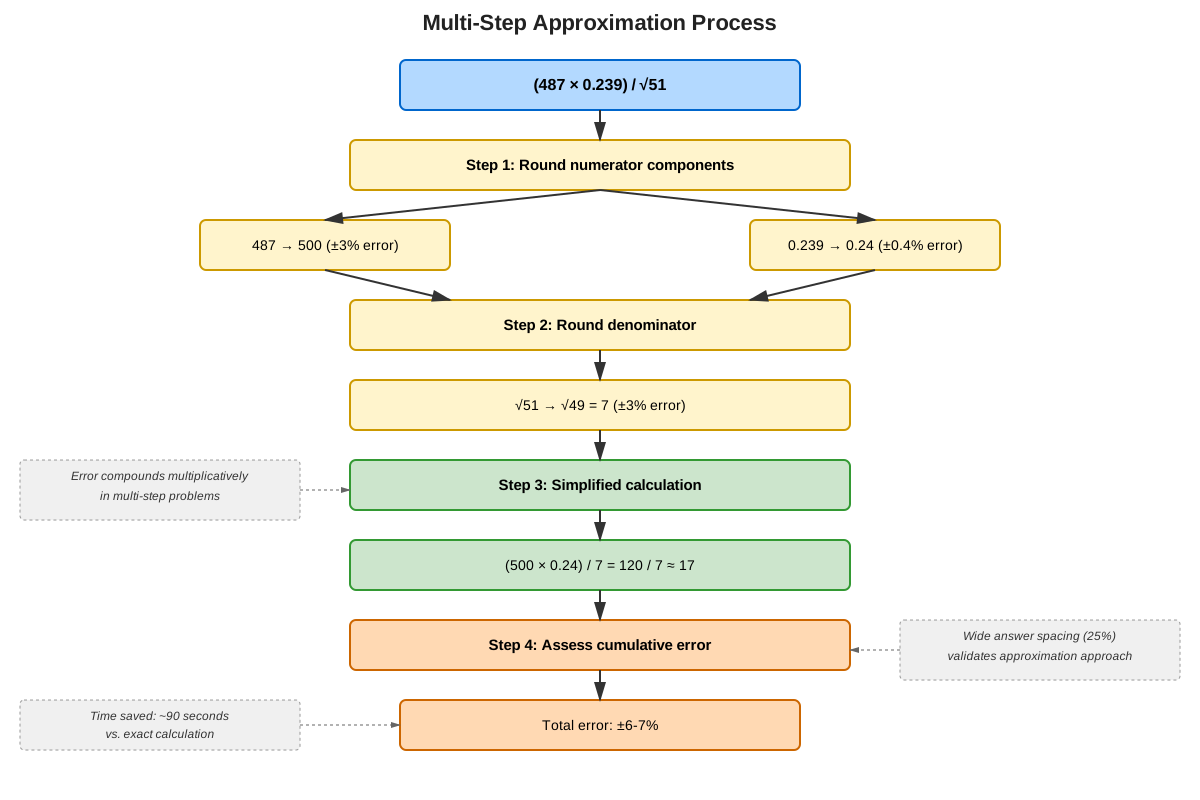
- When approximating multi-step calculations, round intermediate results but maintain one extra digit of precision until the final step
- Data interpretation questions inherently require approximation since chart values cannot be read with perfect precision
- Converting complex fractions to approximate decimals (e.g., 7/12 ≈ 0.6) dramatically simplifies operations while maintaining sufficient accuracy
- Approximation saves an average of 30-45 seconds per problem when applied appropriately, creating significant time advantages
- The GRE never requires calculations beyond basic arithmetic when approximation is applied strategically
Quick check — test yourself on Approximation so far.
Try Flashcards →Common Misconceptions
Misconception: Approximation means guessing randomly or being careless with calculations → Correction: Approximation is a strategic, systematic approach that involves deliberate rounding decisions based on answer choice analysis and calculation complexity. It requires understanding which digits matter and which can be simplified without affecting the final answer selection.
Misconception: Always round to the nearest whole number for simplicity → Correction: Rounding precision must match answer choice spacing. If answers differ by 0.1, rounding to whole numbers loses necessary precision. Conversely, if answers differ by 100, maintaining decimal precision wastes time. The appropriate rounding level depends on the specific problem context.
Misconception: Approximation only works for simple, single-step problems → Correction: Multi-step problems often benefit most from approximation since small rounding errors in early steps rarely compound enough to affect final answer choice selection when choices are reasonably spaced. Complex calculations are precisely where approximation provides the greatest time savings.
Misconception: Rounding always introduces error that makes answers wrong → Correction: When answer choices are sufficiently separated (typically 10% or more), strategic rounding maintains enough accuracy to identify the correct answer unambiguously. The GRE designs problems with this principle in mind, making approximation not just acceptable but often the intended solution method.
Misconception: Exact calculation is always safer and more reliable than approximation → Correction: Exact calculation of complex expressions increases the risk of arithmetic errors and consumes valuable time. Approximation, when applied appropriately, reduces both error risk (through simpler calculations) and time investment. The "safest" approach is the one that balances accuracy with efficiency based on problem requirements.
Misconception: You should approximate every number in a calculation → Correction: Strategic approximation involves identifying which numbers most benefit from rounding. Sometimes keeping one value exact while approximating others produces optimal results. For example, when calculating 25% of 47, keeping 25% exact (as 1/4) while rounding 47 to 48 yields a cleaner calculation than approximating both values.
Worked Examples
Example 1: Percentage Increase with Multiple Steps
Problem: A store increases prices by 18%, then offers a 15% discount on the new prices. If an item originally cost $80, approximately what is the final price?
Solution:
Step 1: Recognize that exact calculation would require: $80 × 1.18 × 0.85, which involves multiplying decimals—time-consuming and error-prone.
Step 2: Examine answer choices (assume they are: $75, $80, $85, $90, $95). They differ by $5, or about 6% of the base value, indicating approximation will work.
Step 3: Approximate the 18% increase as 20% for easier calculation:
- 20% of $80 = $16
- New price ≈ $80 + $16 = $96
Step 4: Approximate the 15% discount as 15% of $96:
- 10% of $96 = $9.60 ≈ $10
- 5% of $96 = $4.80 ≈ $5
- 15% discount ≈ $15
- Final price ≈ $96 - $15 = $81
Step 5: Verify magnitude: We increased by slightly less than 20% then decreased by 15%, so ending near the original price makes sense. The answer is approximately $80-$85.
Connection to learning objectives: This example demonstrates identifying when approximation is appropriate (widely spaced answer choices), applying strategic rounding (20% instead of 18%, rounding intermediate values), and using the 10% method for percentage calculations.
Example 2: Fraction Multiplication and Division
Problem: Calculate (5/12 × 8/15) ÷ 2/9 and select the closest answer from: 0.5, 1.0, 1.5, 2.0, 2.5
Solution:
Step 1: Recognize that finding common denominators and performing exact fraction operations would be extremely time-consuming.
Step 2: Note that answer choices differ by 0.5 (50% of each value), providing substantial room for approximation.
Step 3: Convert fractions to approximate decimals using benchmark values:
- 5/12 ≈ 0.4 (slightly less than 1/2)
- 8/15 ≈ 0.5 (slightly more than 1/2)
- 2/9 ≈ 0.2 (slightly more than 1/5)
Step 4: Perform operations with approximate decimals:
- 0.4 × 0.5 = 0.2
- 0.2 ÷ 0.2 = 1.0
Step 5: Verify using magnitude estimation: We multiplied two numbers each around 0.5 (product ≈ 0.25), then divided by a number around 0.2 (quotient ≈ 1.25). Our approximation of 1.0 is reasonable.
Step 6: Check if our approximations might have pushed us toward a different answer. Since 5/12 is slightly less than 0.5 and 8/15 is slightly more than 0.5, these errors partially cancel. The answer 1.0 is most likely correct.
Exact calculation verification (for learning purposes): (5/12 × 8/15) ÷ 2/9 = (40/180) ÷ 2/9 = (2/9) ÷ (2/9) = 1.0. Our approximation was exactly correct, but even if it had been 0.9 or 1.1, we would have selected 1.0 from the available choices.
Connection to learning objectives: This example shows applying approximation to complex fraction operations, using benchmark decimal values, and verifying results through magnitude estimation. It demonstrates how approximation can reduce a multi-step fraction problem to simple mental arithmetic.
Exam Strategy
When approaching GRE approximation questions, implement a systematic decision framework. First, spend 5-10 seconds analyzing answer choices before calculating anything. Calculate the percentage difference between adjacent choices: if they differ by 10% or more, approximation is almost certainly the intended approach. If they differ by less than 5%, exact calculation may be necessary.
Trigger words and phrases that signal approximation opportunities include: "approximately," "closest to," "about," "estimate," and "nearly." In quantitative comparison questions, phrases like "which is greater" or "compare the quantities" indicate that exact values are unnecessary—only relative magnitude matters. Data interpretation questions with phrases like "according to the graph" inherently require approximation since graph values cannot be read with perfect precision.
Process-of-elimination strategies specific to approximation:
- Magnitude elimination: Before detailed calculation, estimate the order of magnitude. If calculating 4,832 ÷ 0.047, recognize the answer should be around 100,000 (5,000 ÷ 0.05). Immediately eliminate any answer choices in the thousands or millions.
- Benchmark comparison: Compare the problem values to convenient benchmarks. If asked for 23% of 180, recognize this must be less than 25% of 180 (45) but more than 20% of 180 (36). Eliminate choices outside this range.
- Reasonableness check: After approximating, verify the answer makes logical sense. If calculating a 15% increase on $100 and getting $200, recognize this is unreasonable—a 15% increase should yield approximately $115.
Time allocation advice: Allocate 15-20 seconds to decide whether to approximate, then 30-45 seconds for the approximation itself. If approximation leads to ambiguity between two answer choices, invest an additional 20-30 seconds refining the calculation rather than starting over with exact computation. The total time for an approximation-friendly problem should be 60-90 seconds, compared to 120-180 seconds for exact calculation.
Develop confidence in approximation through practice. Many students initially feel uncomfortable with estimation, fearing they'll select wrong answers. However, the GRE is specifically designed to reward strategic approximation. Trust that when answer choices are appropriately spaced and you've applied systematic rounding, your approximation will lead to the correct answer.
Memory Techniques
SPACE mnemonic for deciding when to approximate:
- Spacing: Are answer choices spaced 10%+ apart?
- Precision: Does the question ask for "approximately" or "closest to"?
- Arithmetic: Would exact calculation be time-consuming?
- Comparison: Is this a quantitative comparison needing only relative values?
- Elimination: Can approximation eliminate 3+ answer choices?
If you answer "yes" to two or more SPACE criteria, approximation is likely the optimal strategy.
Benchmark fraction visualization: Picture a number line from 0 to 1 divided into sections:
- 0 — 1/8 (0.125) — 1/6 (0.167) — 1/5 (0.20) — 1/4 (0.25) — 1/3 (0.33) — 1/2 (0.50) — 2/3 (0.67) — 3/4 (0.75) — 1
Visualizing this number line helps quickly place any fraction in context and select the nearest benchmark for approximation.
Perfect squares song: Memorize perfect squares by creating a rhythm: "One-four-nine, sixteen-twenty-five, thirty-six-forty-nine, sixty-four-eighty-one, one-hundred-twenty-one, one-forty-four, one-sixty-nine, one-ninety-six, two-twenty-five." Rhythmic memorization aids rapid recall during timed tests.
The "Round and Compensate" rule: Remember "Up-Down, Down-Up" when rounding multiple numbers. If you round one factor up, round the other down to balance errors. This compensating approach maintains accuracy while simplifying calculations.
10% anchor technique: Always start percentage problems by finding 10% (move decimal left one place), then scale. This provides an anchor point for all other percentage calculations: 5% is half of 10%, 20% is double, 15% is 10% + 5%, etc.
Summary
Approximation represents a strategic approach to GRE Quantitative Reasoning problems that prioritizes efficiency without sacrificing accuracy. By recognizing when answer choices are sufficiently spaced, test-takers can employ systematic rounding techniques, benchmark values, and magnitude estimation to solve complex problems in a fraction of the time required for exact calculation. The key to successful approximation lies in the decision framework: analyzing answer choice spacing, assessing calculation complexity, and selecting appropriate rounding precision. Strategic rounding involves balancing simplicity against accuracy, often using compensating rounding where one value rounds up while another rounds down. Benchmark values for common fractions, percentages, and perfect squares enable rapid estimation without calculation. Magnitude estimation provides both preliminary guidance and verification, ensuring approximations remain reasonable. The GRE explicitly designs many problems to reward approximation, making this skill essential for achieving top scores while managing time effectively across the section.
Key Takeaways
- Answer choices spaced 10% or more apart signal that strategic approximation will lead unambiguously to the correct answer
- The decision to approximate should precede any calculation, based on analyzing answer choice spacing and assessing calculation complexity
- Compensating rounding (rounding one factor up and another down) produces more accurate estimates than rounding all values in the same direction
- Benchmark values for common fractions (1/3 ≈ 0.33, 1/4 = 0.25, 1/5 = 0.20) and perfect squares (up to 225) enable rapid estimation across problem types
- Magnitude estimation serves as both a planning tool (determining expected order of magnitude) and verification check (confirming reasonableness of results)
- Approximation saves 30-45 seconds per problem when applied appropriately, creating cumulative time advantages that enable completion of more questions
- Mastering approximation requires practice to build confidence, but the GRE consistently rewards strategic estimation over laborious exact calculation
Related Topics
Quantitative Comparison Strategies: Approximation skills directly enhance quantitative comparison performance, where determining relative magnitude matters more than calculating exact values. Mastering approximation enables rapid comparison without full calculation.
Data Interpretation: Charts and graphs inherently require approximation since values cannot be read with perfect precision. The approximation techniques learned here apply directly to extracting and manipulating data from visual representations.
Percentage Problems: While covered within approximation, percentage calculations represent a broader topic including percentage change, compound percentages, and percentage point differences. Approximation strategies provide the foundation for efficient percentage problem-solving.
Fraction Operations: Beyond approximation, comprehensive fraction mastery includes finding common denominators, simplifying complex fractions, and converting between mixed numbers and improper fractions. Approximation offers an alternative approach when exact fraction manipulation proves cumbersome.
Mental Math Techniques: Approximation represents one component of broader mental math skills including multiplication shortcuts, divisibility rules, and rapid calculation strategies that collectively enhance Quantitative Reasoning efficiency.
Practice CTA
Now that you've mastered the concepts and strategies behind approximation, it's time to put your knowledge into practice. Attempt the practice questions to reinforce these techniques and build the confidence needed to recognize approximation opportunities instantly on test day. Work through the flashcards to internalize benchmark values and perfect squares until they become automatic. Remember, approximation is a skill that improves dramatically with practice—each problem you solve using these techniques strengthens your ability to work efficiently under timed conditions. Your investment in mastering approximation will pay dividends across the entire Quantitative Reasoning section, enabling you to solve more problems accurately in less time. Start practicing now and watch your speed and confidence soar!
Sign up free to keep reading
Create a free AnvayaPrep account to finish this GRE guide on Approximation — plus flashcards and practice questions.