Overview
Rounding is a fundamental arithmetic operation that appears frequently throughout the GRE Quantitative Reasoning section, both as a direct testing point and as a practical tool for estimation and efficient problem-solving. Understanding when and how to round numbers correctly is essential for achieving accuracy on questions that explicitly test this skill, while also enabling test-takers to work more efficiently on complex calculations where exact precision isn't required.
On the GRE, rounding questions test a student's ability to approximate values systematically according to standard mathematical conventions. These questions may ask students to round to the nearest integer, tenth, hundredth, or to a specific number of significant figures. Beyond direct rounding questions, this skill becomes invaluable when estimating answers to eliminate obviously incorrect choices, checking whether calculated answers are reasonable, or simplifying complex arithmetic operations under time pressure. The ability to round strategically can save precious seconds on calculation-heavy problems while maintaining sufficient accuracy to identify the correct answer.
GRE rounding questions connect to broader Quantitative Reasoning concepts including place value, decimals, significant figures, estimation strategies, and data interpretation. Mastery of rounding enhances performance across multiple question types, from basic arithmetic problems to complex word problems involving percentages, ratios, and data analysis. This topic serves as a bridge between foundational number sense and advanced problem-solving techniques, making it a high-yield area for focused study.
Learning Objectives
- [ ] Identify when Rounding is being tested in GRE questions
- [ ] Explain the core rule or strategy behind Rounding
- [ ] Apply Rounding to GRE-style questions accurately
- [ ] Determine the appropriate level of precision required for different question types
- [ ] Use rounding strategically for estimation and answer elimination
- [ ] Recognize when rounding errors might compound in multi-step problems
- [ ] Distinguish between rounding up, rounding down, and rounding to nearest value
Prerequisites
- Place value understanding: Recognizing the value of digits in different positions (ones, tens, tenths, hundredths) is essential for identifying which digit to examine when rounding
- Basic decimal operations: Comfort with decimal notation enables quick identification of the relevant digit and understanding of how rounding affects numerical magnitude
- Number comparison: The ability to determine which of two numbers is larger forms the foundation for deciding whether to round up or down
- Integer operations: Since rounding often produces integers or simpler decimals, fluency with whole number arithmetic supports efficient calculation after rounding
Why This Topic Matters
Rounding appears in approximately 5-8% of GRE Quantitative Reasoning questions either as the primary skill being tested or as a necessary component of solving more complex problems. This frequency, combined with the topic's applicability across multiple question formats, makes it a high-yield study area. Questions may directly ask students to round a given number to a specified place value, or they may require rounding as an intermediate step in word problems, data interpretation questions, or quantitative comparison problems.
In real-world applications, rounding is ubiquitous in financial calculations, scientific measurements, statistical reporting, and everyday estimation. Professionals across fields—from finance to engineering to healthcare—use rounding to communicate numerical information at appropriate levels of precision. Understanding when to round and how much precision to maintain is a critical quantitative literacy skill that extends far beyond standardized testing.
On the GRE specifically, rounding appears in several distinct contexts: (1) direct rounding questions that ask for a number rounded to a specific place; (2) data interpretation questions where graphs or tables present rounded values; (3) word problems where answers must be rounded to make practical sense (e.g., "how many complete boxes"); (4) estimation scenarios where strategic rounding enables faster calculation; and (5) questions testing understanding of significant figures and measurement precision. Recognizing these patterns helps students identify when rounding skills are being assessed and respond appropriately.
Core Concepts
The Fundamental Rounding Rule
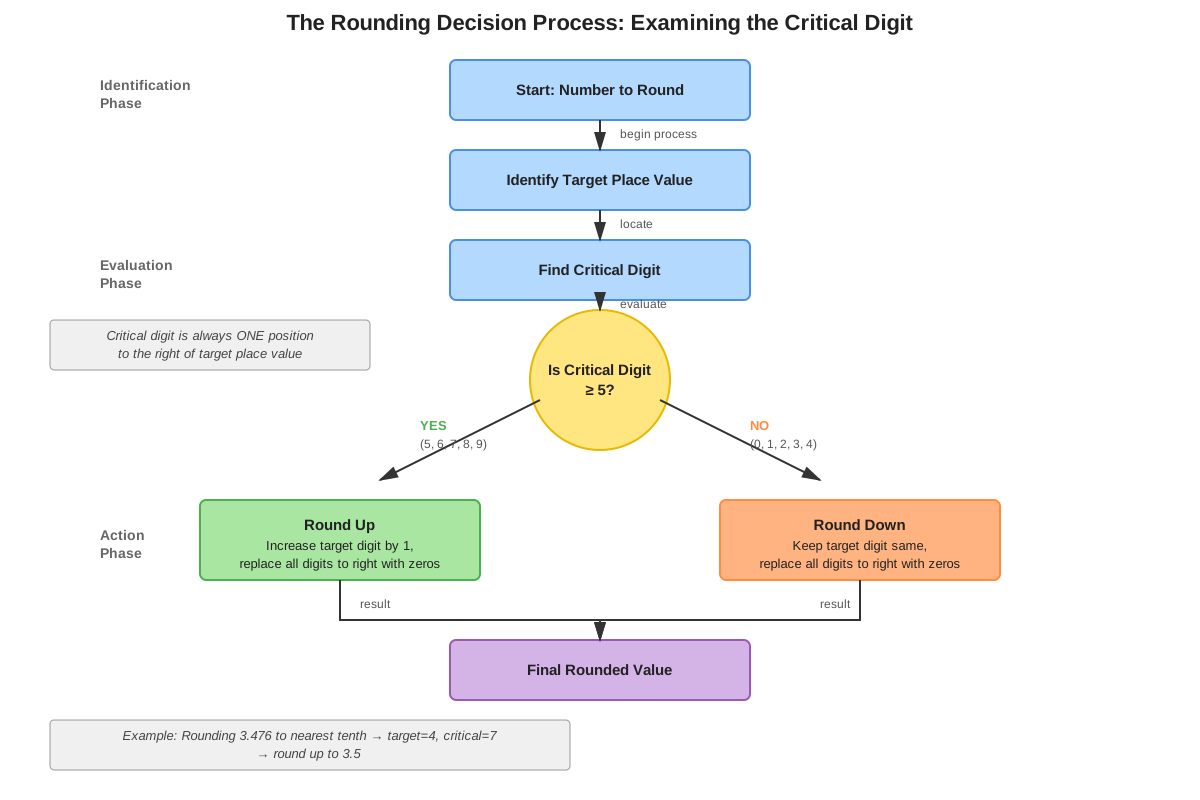
The standard rounding convention follows a simple rule based on the digit immediately to the right of the target place value. When rounding a number to a specific place value:
- Identify the digit in the target place value position
- Examine the digit immediately to the right (the "decision digit")
- If the decision digit is 5 or greater (5, 6, 7, 8, 9), round up by adding 1 to the target digit
- If the decision digit is less than 5 (0, 1, 2, 3, 4), round down by keeping the target digit unchanged
- Replace all digits to the right of the target position with zeros (for whole numbers) or remove them (for decimals)
For example, when rounding 47.36 to the nearest tenth, the target digit is 3 (in the tenths place), and the decision digit is 6 (in the hundredths place). Since 6 ≥ 5, round up: 47.36 → 47.4.
Place Value and Rounding Positions
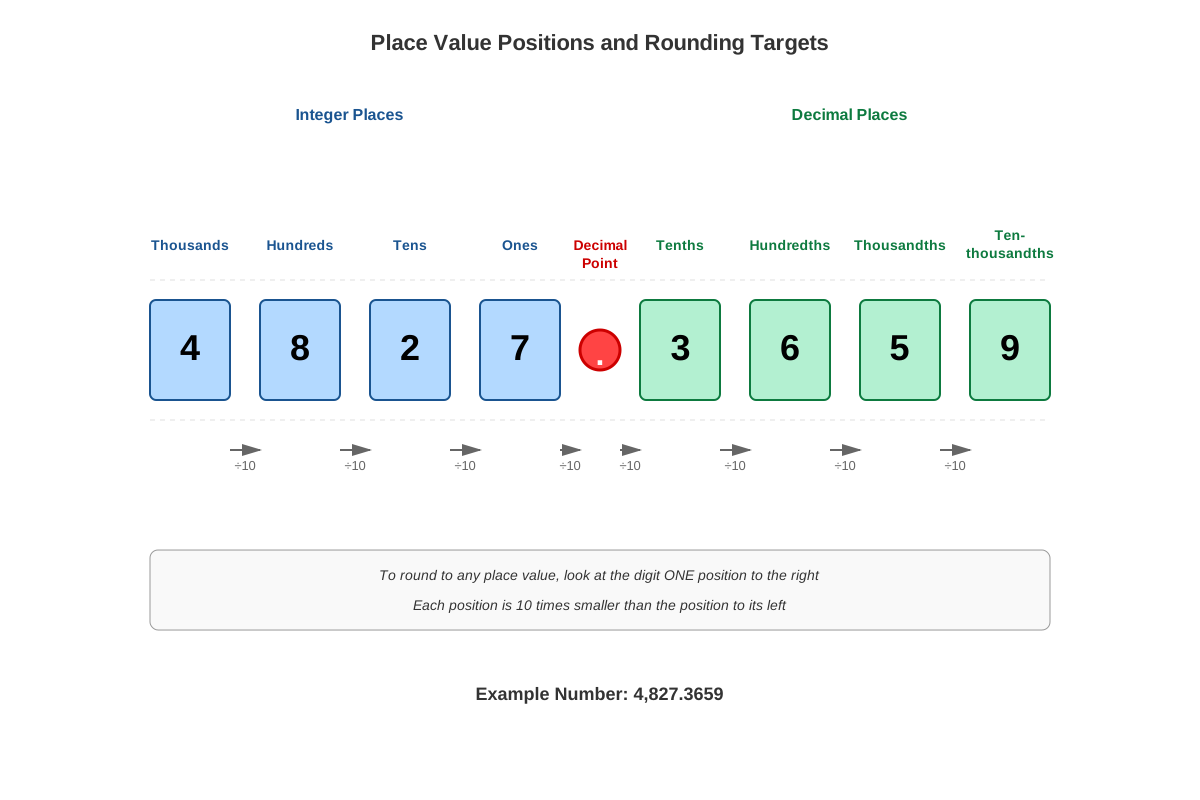
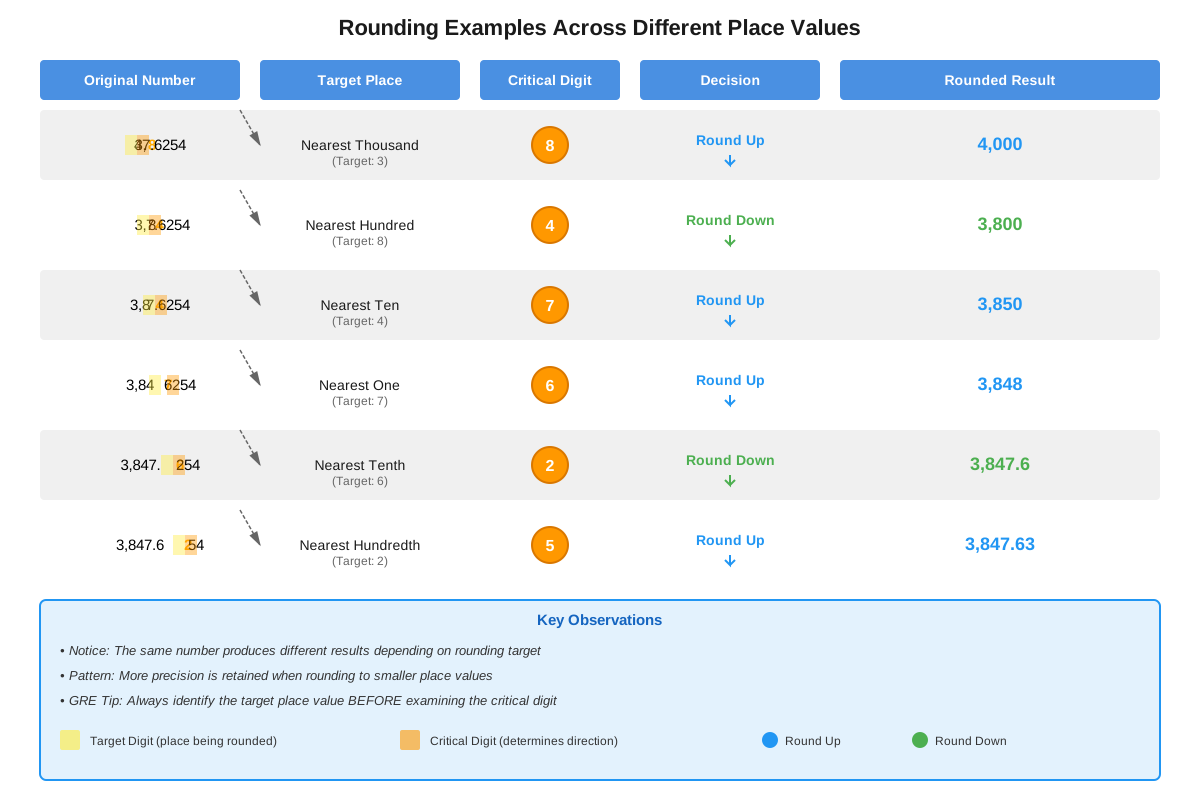
Understanding place value is crucial for accurate rounding. The most common rounding positions on the GRE include:
| Place Value | Position Example (in 3,456.789) | Rounded Value |
|---|---|---|
| Thousands | 3 | 3,000 |
| Hundreds | 4 | 3,500 |
| Tens | 5 | 3,460 |
| Ones (Units) | 6 | 3,457 |
| Tenths | 7 | 3,456.8 |
| Hundredths | 8 | 3,456.79 |
| Thousandths | 9 | 3,456.789 |
When a question asks to round "to the nearest integer" or "to the nearest whole number," this means rounding to the ones place. "To the nearest tenth" means one decimal place, "to the nearest hundredth" means two decimal places, and so forth.
Rounding Up vs. Rounding Down
While the standard rule determines whether to round up or down based on the decision digit, certain GRE questions specifically require always rounding up or always rounding down regardless of the decision digit. This typically occurs in practical word problems:
- Rounding up (ceiling function): Used when you need at least a certain amount. Example: "How many buses are needed to transport 157 students if each bus holds 40 students?" Answer: 157 ÷ 40 = 3.925, which rounds up to 4 buses (you can't have 0.925 of a bus).
- Rounding down (floor function): Used when you can't exceed a limit or when dealing with complete units only. Example: "How many complete $15 items can be purchased with $100?" Answer: 100 ÷ 15 = 6.67, which rounds down to 6 items (you can't buy 0.67 of an item).
The Special Case of 5
When the decision digit is exactly 5 with no digits following it, the standard convention is to round up. For example, 2.5 rounds to 3, and 7.5 rounds to 8. However, some advanced contexts use "banker's rounding" (rounding to the nearest even number), but this is not typically tested on the GRE. Students should follow the standard rule: 5 or greater rounds up.
Cascading Rounds
Sometimes rounding one digit affects the digit to its left. For example, when rounding 3.97 to the nearest tenth, the decision digit is 7, so the 9 rounds up. But 9 + 1 = 10, which means the 9 becomes 0 and we add 1 to the ones place: 3.97 → 4.0. This "carrying" effect is similar to addition and must be handled carefully.
Significant Figures
While less common on the GRE than in scientific contexts, questions may reference significant figures—the number of meaningful digits in a measurement. When rounding to a specific number of significant figures, count from the first non-zero digit. For example, 0.004567 rounded to 2 significant figures is 0.0046 (the 4 and 5 are the first two significant figures).
Estimation Through Strategic Rounding
Beyond answering direct rounding questions, strategic rounding serves as a powerful estimation tool. When faced with complex calculations, rounding numbers to simpler values before computing can quickly eliminate incorrect answer choices. For example, to estimate 48.7 × 31.2, round to 50 × 30 = 1,500, which provides a reasonable approximation (actual answer: 1,519.44).
Concept Relationships
The concepts within rounding are hierarchically connected: place value understanding forms the foundation → enabling identification of target and decision digits → which determines application of the rounding rule → leading to either standard rounding or directional rounding (always up or down) → all of which support strategic estimation for problem-solving efficiency.
Rounding connects to prerequisite topics through its dependence on decimal operations and place value, which provide the numerical framework for the rounding process. It relates to number comparison because deciding whether to round up or down requires comparing the decision digit to 5.
Looking forward, rounding skills support more advanced topics including percentages (where rounded values simplify calculations), ratios and proportions (where estimation through rounding aids in answer elimination), data interpretation (where graphs often display rounded values), and statistics (where measures of central tendency may require rounding). The relationship can be mapped as: Place Value → Rounding → Estimation → Efficient Problem-Solving → Higher Performance on Timed Tests.
High-Yield Facts
⭐ When the decision digit is 5, 6, 7, 8, or 9, always round up; when it's 0, 1, 2, 3, or 4, round down
⭐ "To the nearest integer" means round to the ones place (no decimal places)
⭐ In practical word problems involving discrete items (buses, boxes, people), determine whether the context requires rounding up or down regardless of the standard rule
⭐ When rounding causes a 9 to become 10, carry the 1 to the next left position (cascading effect)
⭐ Strategic rounding before calculation can save time and help eliminate incorrect answer choices
- Rounding to the nearest tenth means keeping one decimal place
- Rounding to the nearest hundredth means keeping two decimal places
- After rounding, all digits to the right of the target position are dropped (for decimals) or become zeros (for whole numbers)
- Multiple sequential rounding operations can introduce cumulative error
- The GRE may test whether you understand when NOT to round (when exact values are required)
- Negative numbers follow the same rounding rules as positive numbers (e.g., -3.7 rounds to -4)
- When estimating products, rounding one factor up and another down can partially offset errors
- Questions asking for "approximately" or "closest to" signal that rounding or estimation is appropriate
Quick check — test yourself on Rounding so far.
Try Flashcards →Common Misconceptions
Misconception: When rounding 2.5, you should round down to 2 because 2.5 is "halfway" between 2 and 3. → Correction: The standard rounding convention is that 5 always rounds up, so 2.5 rounds to 3. This ensures consistency across all rounding operations.
Misconception: When a question asks for a rounded answer, you should round at every step of your calculation. → Correction: Rounding at intermediate steps can compound errors. Perform calculations with full precision and round only the final answer unless the question specifically instructs otherwise.
Misconception: Rounding 3.999 to the nearest integer gives 3 because you look at the first decimal place (9) and... wait, 9 rounds up, so it's 4. → Correction: This confusion arises from not clearly identifying the target place. To round to the nearest integer, the target is the ones place (3), and the decision digit is the first decimal place (9). Since 9 ≥ 5, round up: 3.999 → 4.
Misconception: In word problems, always use standard rounding rules. → Correction: Context matters. If a problem asks "how many trucks are needed," you must round up even if the standard rule would round down, because you can't have a fraction of a truck.
Misconception: Rounding -4.7 to the nearest integer gives -5 because you "round up" from 4 to 5. → Correction: For negative numbers, "rounding up" means moving toward zero (less negative), while "rounding down" means moving away from zero (more negative). Using the standard rule: -4.7 has a decision digit of 7, so it rounds to -5 (which is actually "down" on the number line, but "up" in absolute value).
Misconception: When rounding to the nearest hundred, you only look at the tens digit. → Correction: You look at the tens digit as the decision digit, but you must also consider any digits to the right. For example, 1,449 rounds down to 1,400 (decision digit is 4), but 1,450 rounds up to 1,500 (decision digit is 5).
Worked Examples
Example 1: Direct Rounding with Cascading Effect
Question: Round 89.967 to the nearest hundredth.
Solution:
Step 1: Identify the target place value. "Nearest hundredth" means two decimal places, so the target digit is 6 (in the hundredths place).
Step 2: Identify the decision digit. The digit immediately to the right of the target is 7 (in the thousandths place).
Step 3: Apply the rounding rule. Since 7 ≥ 5, round up by adding 1 to the target digit: 6 + 1 = 7.
Step 4: Write the rounded number. 89.967 → 89.97
Connection to Learning Objectives: This example demonstrates the core rounding rule and shows how to identify when rounding is being tested through explicit instructions to round to a specific place value.
Example 2: Practical Word Problem Requiring Directional Rounding
Question: A company needs to ship 1,847 units of product. Each shipping container holds 150 units. How many containers are needed?
Solution:
Step 1: Calculate the exact number of containers needed: 1,847 ÷ 150 = 12.313...
Step 2: Analyze the context. The question asks "how many containers are needed," implying we need enough containers to ship all units. We cannot use a partial container.
Step 3: Determine the appropriate rounding direction. Since 12 containers would only hold 12 × 150 = 1,800 units (leaving 47 units unshipped), we must round up to ensure all units are shipped.
Step 4: Apply directional rounding. 12.313... rounds up to 13 containers.
Answer: 13 containers
Connection to Learning Objectives: This example illustrates how to identify when rounding is being tested in word problems and demonstrates the critical distinction between standard rounding rules and context-dependent directional rounding. It also shows accurate application of rounding to GRE-style questions.
Example 3: Strategic Rounding for Estimation
Question: Which of the following is closest to the value of (48.7 × 31.4) ÷ 15.8?
(A) 85
(B) 95
(C) 105
(D) 115
(E) 125
Solution:
Step 1: Recognize that exact calculation would be time-consuming. Use strategic rounding to estimate.
Step 2: Round each number to a value that simplifies calculation:
- 48.7 ≈ 50
- 31.4 ≈ 30
- 15.8 ≈ 16
Step 3: Calculate with rounded values: (50 × 30) ÷ 16 = 1,500 ÷ 16 ≈ 93.75
Step 4: Identify the closest answer choice. 93.75 is closest to 95.
Answer: (B) 95
Verification (if time permits): The actual calculation is (48.7 × 31.4) ÷ 15.8 = 1,529.18 ÷ 15.8 ≈ 96.78, confirming that (B) is correct.
Connection to Learning Objectives: This example demonstrates strategic application of rounding to solve GRE-style questions efficiently and shows how to identify when estimation through rounding is the most effective approach.
Exam Strategy
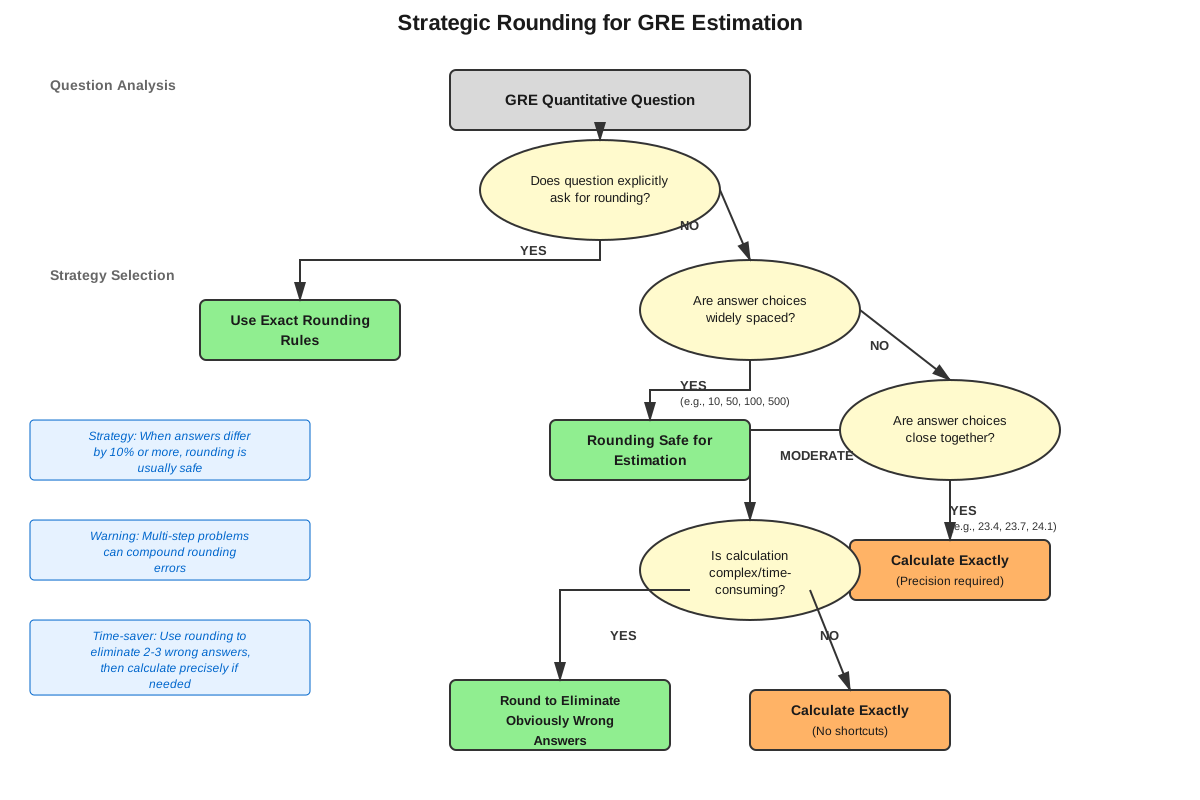
When approaching GRE rounding questions, first determine whether the question explicitly asks for rounding or whether rounding is a strategic tool for estimation. Look for trigger phrases such as "round to the nearest," "approximately," "closest to," "about," or "estimate." These phrases signal that exact precision is not required and that rounding is either expected or permitted.
For direct rounding questions, follow this systematic process:
- Identify the target place value from the question
- Locate the target digit in that position
- Examine the decision digit immediately to the right
- Apply the rounding rule (5+ rounds up, 0-4 rounds down)
- Verify that you've handled any cascading effects correctly
For word problems, read carefully to determine whether the context requires always rounding up (when you need "at least" or "enough"), always rounding down (when you can't exceed a limit or need "complete" units), or standard rounding. Context clues include words like "minimum," "at least," "complete," "whole," "maximum," and "no more than."
When using rounding for estimation and answer elimination, round numbers to values that simplify calculation while maintaining enough precision to distinguish between answer choices. If answer choices are widely spaced (e.g., 50, 100, 150, 200), aggressive rounding is safe. If choices are close together (e.g., 47, 49, 51, 53), use more conservative rounding or calculate exactly.
Time allocation: Direct rounding questions should take 30-45 seconds. If you find yourself spending more than one minute on a rounding question, you may be overcomplicating the problem. For estimation problems, strategic rounding should save time compared to exact calculation—if it doesn't, reconsider your approach.
Exam Tip: When answer choices are numerical and well-spaced, immediately consider whether estimation through rounding can eliminate options quickly. This strategy is especially powerful on quantitative comparison questions where you only need to determine which quantity is larger, not calculate exact values.
Memory Techniques
The "5 and Above, Give it a Shove" Mnemonic: Remember that 5, 6, 7, 8, and 9 all round up by thinking "5 and above, give it a shove (upward)." Numbers 0-4 "stay on the floor" (round down).
The TIDE Acronym for Rounding Steps:
- Target: Identify the target place value
- Inspect: Inspect the decision digit to the right
- Decide: Decide whether to round up (5+) or down (0-4)
- Execute: Execute the rounding and check for cascading
Visualization Strategy: Picture a number line with your target value in the center. If the decision digit is 5+, the actual number is on the right half of the interval, so it's closer to the next value up. If the decision digit is 0-4, the number is on the left half, closer to the current value.
Context Clue Memory: For word problems, remember "Can't split it? Round up to fit it" (for discrete items like buses or boxes) and "Can't exceed? Round down indeed" (for maximum limits).
Summary
Rounding is a high-yield GRE Quantitative Reasoning topic that appears both as a direct testing point and as a strategic tool for efficient problem-solving. The fundamental rounding rule—examining the digit immediately to the right of the target place value and rounding up if it's 5 or greater, down if it's less than 5—provides the foundation for all rounding operations. However, successful GRE performance requires distinguishing between standard rounding and context-dependent directional rounding in word problems, where practical considerations may require always rounding up or down regardless of the standard rule. Beyond answering direct rounding questions, strategic rounding enables rapid estimation that can eliminate incorrect answer choices and save valuable time on complex calculations. Mastery requires understanding place value, recognizing when rounding is being tested, applying the appropriate rounding method, and avoiding common pitfalls such as premature rounding in multi-step calculations or misapplying standard rules in practical contexts.
Key Takeaways
- The decision digit (immediately right of the target place) determines rounding direction: 5+ rounds up, 0-4 rounds down
- Context matters in word problems—determine whether you need standard rounding, always round up (for "at least" scenarios), or always round down (for "complete units" scenarios)
- Strategic rounding before calculation enables rapid estimation and answer elimination on complex problems
- Round only the final answer unless instructed otherwise; intermediate rounding compounds errors
- Watch for cascading effects when rounding 9s, which may affect the next left digit
- "To the nearest integer" means the ones place; "to the nearest tenth" means one decimal place
- Trigger words like "approximately," "closest to," and "estimate" signal that rounding is appropriate or expected
Related Topics
Estimation and Approximation: Building on rounding skills, this topic covers broader strategies for quickly approximating complex calculations, including front-end estimation and compatible numbers. Mastering rounding provides the foundation for these more advanced estimation techniques.
Significant Figures and Scientific Notation: These topics extend rounding concepts into scientific contexts, dealing with precision in measurements and expressing very large or small numbers efficiently. Understanding basic rounding is prerequisite to working with significant figures.
Percentages and Percent Change: Rounding frequently appears in percentage problems where exact calculations produce many decimal places but answers require practical precision. The estimation skills developed through rounding practice directly transfer to percentage problems.
Data Interpretation: Graphs, tables, and charts on the GRE often display rounded values, and questions may require rounding calculated results to match the precision of given data. Rounding skills are essential for accurate data interpretation.
Word Problems and Applied Arithmetic: Many real-world scenarios in GRE word problems require understanding when and how to round, particularly when dealing with discrete quantities that can't be fractional.
Practice CTA
Now that you've mastered the core concepts and strategies for rounding, it's time to reinforce your learning through active practice. Attempt the practice questions to test your ability to identify when rounding is being tested, apply the correct rounding rules, and use strategic rounding for efficient problem-solving. The flashcards will help you memorize key facts and rules for quick recall during the exam. Remember, rounding is a high-yield topic that appears throughout the GRE Quantitative section—investing time in practice now will pay dividends in both accuracy and speed on test day. You've got this!
Sign up free to keep reading
Create a free AnvayaPrep account to finish this GRE guide on Rounding — plus flashcards and practice questions.