Overview
Squares represent one of the most frequently tested geometric shapes on the GRE, appearing in approximately 15-20% of all Quantitative Reasoning geometry questions. A square is a special quadrilateral with four equal sides and four right angles, combining properties of both rectangles and rhombuses. Understanding squares goes beyond memorizing formulas—it requires recognizing how square properties interact with other geometric concepts, algebraic relationships, and coordinate geometry principles that appear throughout the GRE.
Mastery of GRE squares problems is essential because these questions often serve as building blocks for more complex geometric reasoning. Squares frequently appear in problems involving area maximization, diagonal relationships, inscribed and circumscribed circles, coordinate geometry, and composite figures. The GRE tests not just computational ability but also conceptual understanding of how changing one dimension of a square affects its area, perimeter, and diagonal measurements. Questions may present squares rotated 45 degrees, embedded within other shapes, or described algebraically rather than visually.
Within the broader Quantitative Reasoning framework, squares connect directly to fundamental concepts including the Pythagorean theorem, special right triangles (45-45-90), area and perimeter relationships, and quadrilateral properties. They also bridge pure geometry with algebra through problems involving variable side lengths, optimization, and coordinate plane applications. Strong command of square properties enables efficient problem-solving across multiple question types, from Quantitative Comparison to Data Interpretation questions involving geometric figures.
Learning Objectives
- [ ] Identify when Squares is being tested in GRE questions, including non-obvious presentations
- [ ] Explain the core rule or strategy behind Squares, including all fundamental properties and formulas
- [ ] Apply Squares concepts to GRE-style questions accurately and efficiently
- [ ] Calculate area, perimeter, and diagonal length given any one measurement
- [ ] Recognize and solve problems involving squares in coordinate geometry contexts
- [ ] Determine relationships between inscribed and circumscribed circles and squares
- [ ] Solve multi-step problems involving squares as components of composite figures
Prerequisites
- Basic algebra: Solving equations with one or two variables is essential for finding unknown side lengths when given area or perimeter
- Pythagorean theorem: Understanding a² + b² = c² is necessary for diagonal calculations and recognizing right triangle relationships within squares
- Area and perimeter concepts: Familiarity with these fundamental measurements provides the foundation for all square calculations
- Properties of right angles: Knowing that perpendicular lines form 90-degree angles helps identify squares and understand their internal structure
- Exponents and square roots: Computing areas (squaring) and finding side lengths from areas (square roots) requires comfort with these operations
Why This Topic Matters
Squares appear in real-world contexts ranging from architecture and urban planning to computer graphics and data visualization. Understanding square properties enables practical problem-solving in fields like construction (calculating materials for square rooms), landscaping (determining fencing for square gardens), and technology (pixel arrangements in digital displays). The mathematical elegance of squares—their perfect symmetry and predictable relationships—makes them fundamental to both theoretical mathematics and applied problem-solving.
On the GRE, square-related questions appear in multiple formats: approximately 8-12% of Quantitative Comparison questions involve geometric figures including squares, while 5-8% of Problem Solving questions directly test square properties. Questions may appear as pure geometry problems, word problems requiring geometric reasoning, or Data Interpretation questions where understanding square relationships helps analyze charts or diagrams. The GRE particularly favors questions that combine square properties with other concepts, testing whether students can integrate multiple mathematical ideas.
Common GRE presentations include: comparing areas when side lengths change proportionally; finding diagonal lengths and recognizing the 45-45-90 triangle relationship; determining the area of shaded regions when squares overlap or are inscribed in circles; solving for unknown dimensions when given algebraic expressions for side lengths; and analyzing squares positioned on the coordinate plane. The exam also tests conceptual understanding through questions asking how area changes when perimeter doubles, or comparing the perimeter of one square to the area of another.
Core Concepts
Fundamental Properties of Squares
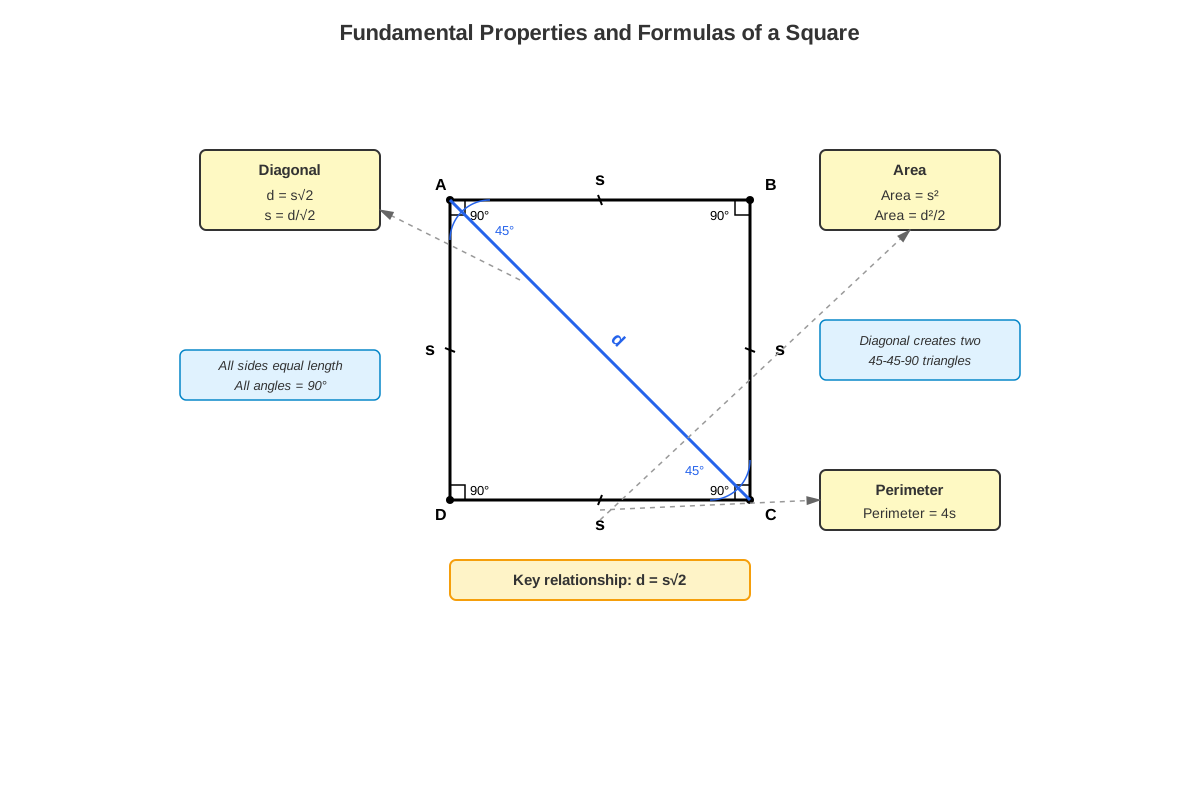
A square is defined as a quadrilateral with four congruent sides and four right angles (90-degree angles). This definition makes squares simultaneously a special type of rectangle (all angles are right angles), a special type of rhombus (all sides are equal), and a special type of parallelogram (opposite sides are parallel). Every square possesses perfect four-fold rotational symmetry and four lines of reflectional symmetry (two through opposite vertices and two through midpoints of opposite sides).
The equality of all sides means that if one side length is known, all geometric properties of the square can be determined. This unique characteristic distinguishes squares from most other quadrilaterals, where multiple measurements are typically required. The right angles ensure that adjacent sides are perpendicular, creating the foundation for applying the Pythagorean theorem to find diagonal lengths.
Side Length, Perimeter, and Area Relationships
If a square has side length s, its fundamental measurements follow these formulas:
Perimeter = 4s
Area = s²
The perimeter represents the total distance around the square's boundary. Since all four sides are equal, the perimeter is simply four times the side length. Conversely, if the perimeter is known, the side length equals the perimeter divided by 4.
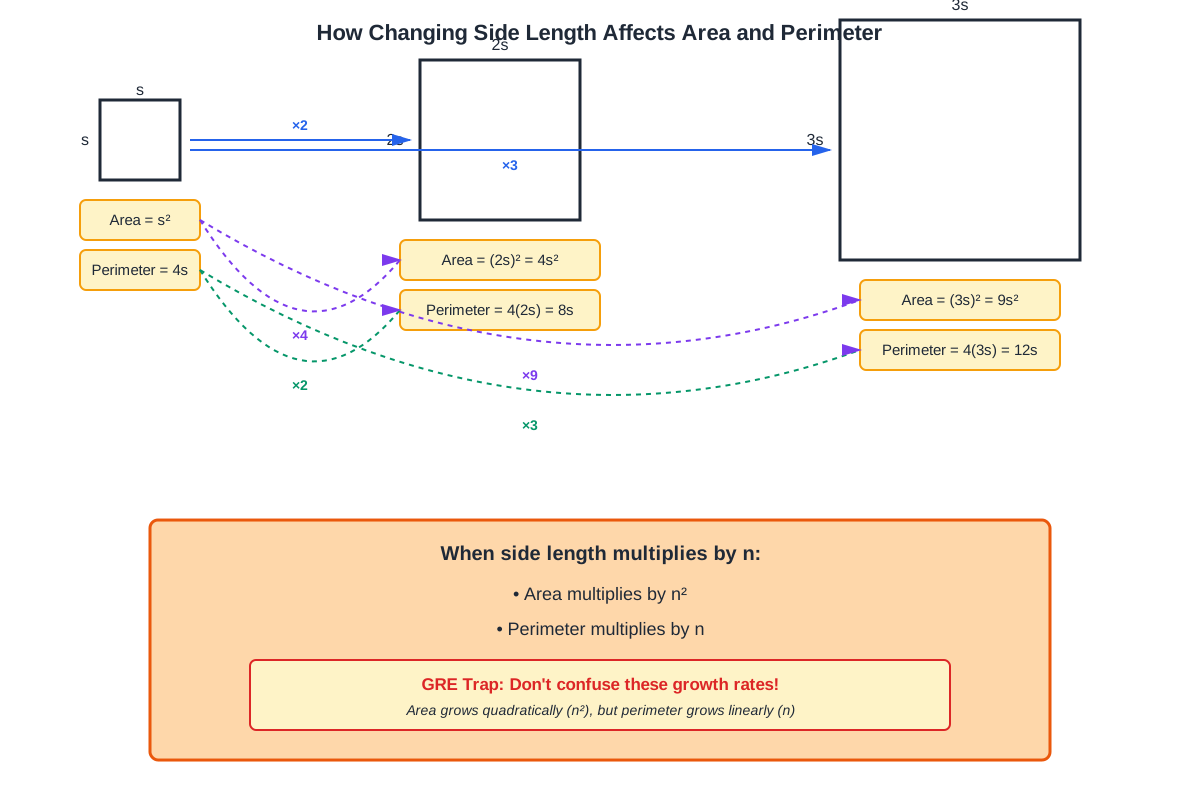
The area represents the two-dimensional space enclosed by the square. Because area is calculated by multiplying length times width, and both dimensions equal s in a square, the area equals s². This quadratic relationship is crucial: when the side length doubles, the area quadruples (multiplies by 4); when the side length triples, the area increases ninefold (multiplies by 9).
| Side Length | Perimeter | Area |
|---|---|---|
| 1 | 4 | 1 |
| 2 | 8 | 4 |
| 3 | 12 | 9 |
| 4 | 16 | 16 |
| 5 | 20 | 25 |
This table illustrates the critical insight that while perimeter increases linearly with side length, area increases quadratically. At s = 4, the numerical values of perimeter and area are equal, but this is merely coincidental—the units differ (linear units for perimeter, square units for area).
Diagonal Properties and the 45-45-90 Triangle
The diagonal of a square connects two opposite vertices, creating two congruent right triangles within the square. Each triangle has legs of length s (the sides of the square) and a hypotenuse equal to the diagonal length. Applying the Pythagorean theorem:
d² = s² + s²
d² = 2s²
d = s√2
Therefore, the diagonal of a square equals the side length multiplied by √2 (approximately 1.414). This relationship appears frequently on the GRE, often testing whether students recognize that knowing the diagonal allows calculation of the side length: s = d/√2 = d√2/2 (after rationalizing the denominator).
The two triangles formed by a diagonal are 45-45-90 triangles, one of the special right triangles tested on the GRE. The ratio of sides in a 45-45-90 triangle is 1:1:√2, corresponding to leg:leg:hypotenuse. Recognizing this pattern enables quick calculations without repeatedly applying the Pythagorean theorem.
The square has two diagonals, and they possess special properties:
- Both diagonals have equal length (d = s√2)
- The diagonals bisect each other (intersect at their midpoints)
- The diagonals are perpendicular (meet at 90-degree angles)
- The diagonals bisect the vertex angles (each 90-degree angle is split into two 45-degree angles)
Squares in Coordinate Geometry
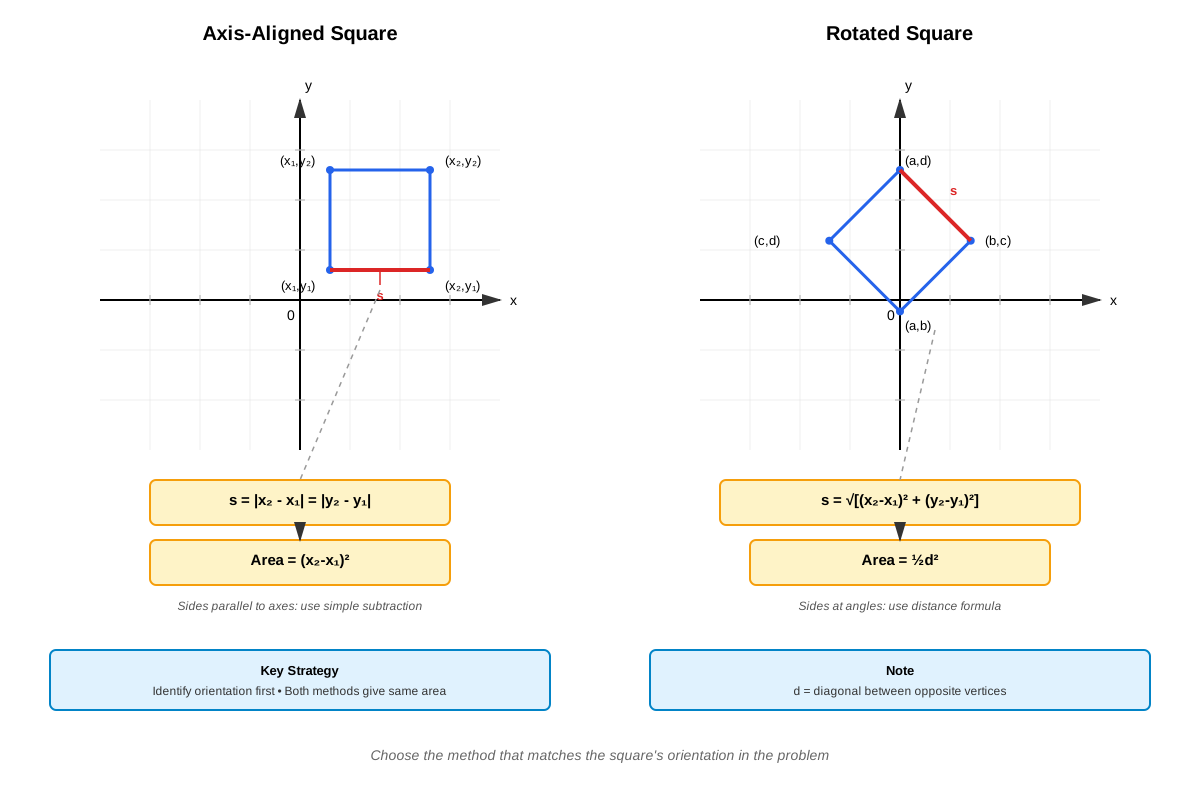
When a square is positioned on the coordinate plane with sides parallel to the axes, its properties simplify calculations. If one vertex is at point (x₁, y₁) and the side length is s, with sides parallel to the axes, the four vertices are:
- (x₁, y₁)
- (x₁ + s, y₁)
- (x₁ + s, y₁ + s)
- (x₁, y₁ + s)
The area can be calculated using the standard formula s², and the perimeter remains 4s. However, GRE questions often present squares rotated 45 degrees, where vertices lie on the axes or at other strategic points. In such cases, the diagonal becomes horizontal or vertical, and the side length must be calculated using the distance formula or by recognizing the 45-45-90 relationship.
For a square with vertices at (0, a), (a, 0), (0, -a), and (-a, 0), the diagonals lie along the x and y axes, each with length 2a. Using d = s√2, we find s = 2a/√2 = a√2, and the area equals (a√2)² = 2a².
Inscribed and Circumscribed Circles
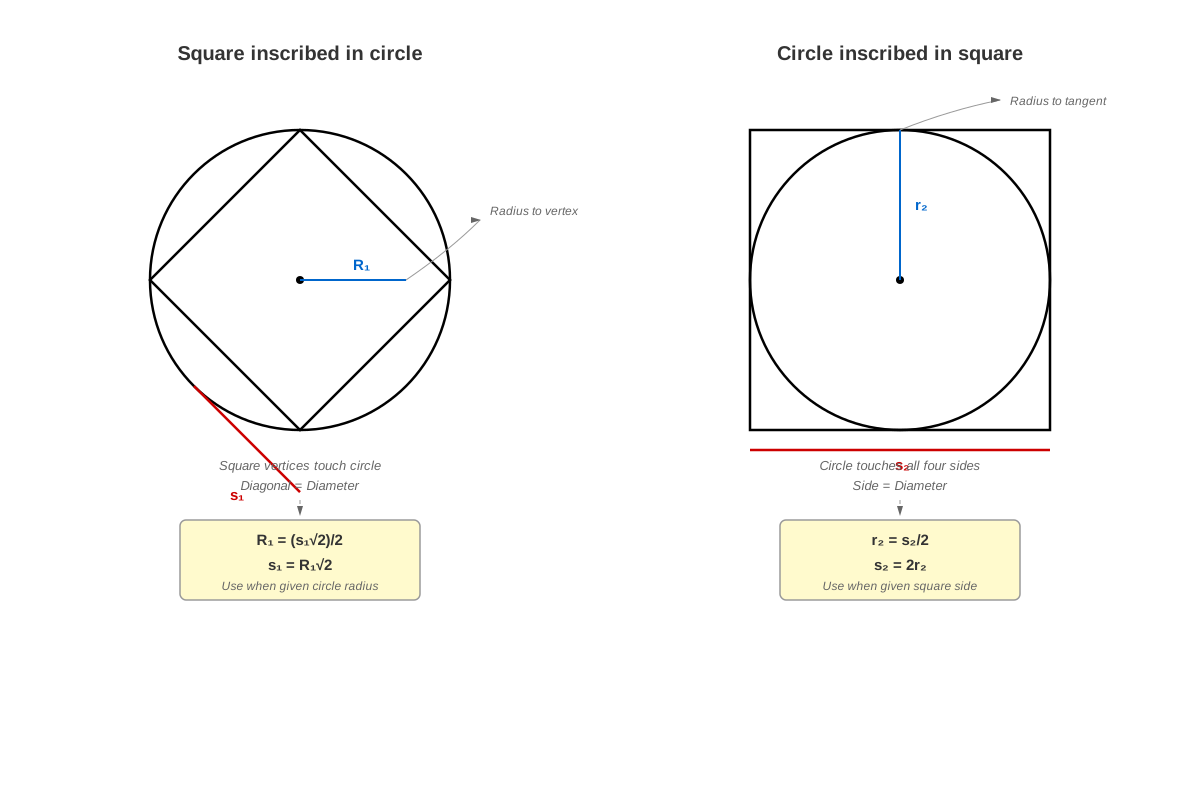
A circle inscribed in a square (the largest circle that fits inside) has its diameter equal to the side length of the square. If the square has side length s:
- Inscribed circle diameter = s
- Inscribed circle radius = s/2
- Inscribed circle area = π(s/2)² = πs²/4
A circle circumscribed around a square (the smallest circle that contains the square) has its diameter equal to the diagonal of the square. If the square has side length s:
- Circumscribed circle diameter = s√2
- Circumscribed circle radius = s√2/2
- Circumscribed circle area = π(s√2/2)² = πs²/2
Notice that the circumscribed circle has exactly twice the area of the inscribed circle, a relationship frequently tested on the GRE.
Composite Figures and Shaded Regions
The GRE commonly presents squares as components of larger figures or asks for the area of shaded regions created by overlapping shapes. Strategies include:
- Addition: When a figure comprises multiple squares, add their individual areas
- Subtraction: When a shape is removed from a square, subtract the removed area from the square's area
- Symmetry exploitation: Use the square's symmetry to simplify calculations by finding one section and multiplying
For example, if a circle is inscribed in a square with side length 10, the shaded region (square minus circle) has area:
- Square area = 10² = 100
- Circle area = π(5)² = 25π
- Shaded area = 100 - 25π ≈ 100 - 78.5 = 21.5
Concept Relationships
The fundamental property of equal sides → determines both perimeter (4s) and area (s²) → which have different scaling relationships when s changes. The right angles at each vertex → enable application of the Pythagorean theorem → yielding the diagonal formula d = s√2 → which creates 45-45-90 triangles within the square.
Understanding area and perimeter → connects to optimization problems where these quantities are compared or constrained. The diagonal relationship → links to special right triangles → which appear throughout GRE geometry. Coordinate geometry applications → require integration of distance formula and square properties → enabling solutions to problems involving vertices at specific points.
Inscribed and circumscribed circles → depend on understanding the relationship between side length and diagonal → demonstrating how square properties extend to circular geometry. Composite figures → require combining area formulas and geometric decomposition → building on basic square calculations to solve complex problems.
These interconnections mean that mastering squares provides foundational knowledge for rectangles, rhombuses, parallelograms, right triangles, circles, and coordinate geometry—making this topic a high-leverage investment of study time.
Quick check — test yourself on Squares so far.
Try Flashcards →High-Yield Facts
⭐ The area of a square equals the side length squared: A = s²
⭐ The diagonal of a square equals the side length times √2: d = s√2
⭐ When the side length of a square doubles, its area quadruples (multiplies by 4)
⭐ The diagonals of a square are perpendicular, bisect each other, and create four congruent 45-45-90 triangles
⭐ A circle inscribed in a square has diameter equal to the square's side length; a circle circumscribed around a square has diameter equal to the square's diagonal
- The perimeter of a square equals four times the side length: P = 4s
- All four angles in a square measure exactly 90 degrees
- A square has four lines of symmetry and 90-degree rotational symmetry
- The ratio of a square's perimeter to its area is 4/s (varies with side length)
- If a square's area is A, its side length is √A and its perimeter is 4√A
- The area of a square inscribed in a circle of radius r is 2r²
- Each diagonal of a square divides it into two congruent isosceles right triangles
- The distance from the center of a square to any vertex equals (s√2)/2
Common Misconceptions
Misconception: The diagonal of a square equals twice the side length.
Correction: The diagonal equals the side length times √2 (approximately 1.414 times the side length), not 2 times the side length. This comes from applying the Pythagorean theorem: d² = s² + s² = 2s², so d = s√2.
Misconception: When the side length doubles, the perimeter and area both double.
Correction: When the side length doubles, the perimeter doubles (linear relationship), but the area quadruples (quadratic relationship). If s becomes 2s, then P = 4s becomes 8s (doubled), but A = s² becomes 4s² (quadrupled).
Misconception: A square with area 16 has a perimeter of 16.
Correction: If the area is 16, then s² = 16, so s = 4. The perimeter is 4s = 4(4) = 16. This is coincidentally true for this specific case, but it's not a general rule. For area 25, the side is 5 and perimeter is 20, not 25.
Misconception: All rectangles are squares.
Correction: All squares are rectangles (they have four right angles), but not all rectangles are squares. A rectangle only becomes a square when all four sides are equal in length. Squares are a special subset of rectangles.
Misconception: The area of a square can be found by multiplying its perimeter by its side length.
Correction: Area equals s², not P × s. While P × s = 4s × s = 4s², this is four times the actual area. The confusion arises from conflating the formulas for different measurements.
Misconception: A square rotated 45 degrees is no longer a square.
Correction: Rotation doesn't change a shape's properties. A square rotated at any angle remains a square with the same side length, area, perimeter, and diagonal length. The orientation doesn't affect the classification or measurements.
Misconception: The diagonal divides a square into two rectangles.
Correction: The diagonal divides a square into two congruent right triangles (specifically, 45-45-90 triangles), not rectangles. Each triangle has two legs of length s and a hypotenuse of length s√2.
Worked Examples
Example 1: Multi-Step Area and Diagonal Problem
Problem: A square has an area of 72 square units. What is the length of its diagonal?
Solution:
Step 1: Find the side length from the area.
- Given: A = 72
- Formula: A = s²
- Therefore: s² = 72
- Taking the square root: s = √72
Step 2: Simplify √72.
- Factor 72: 72 = 36 × 2 = 6² × 2
- Therefore: √72 = √(36 × 2) = 6√2
Step 3: Calculate the diagonal using the side length.
- Formula: d = s√2
- Substitute: d = (6√2)(√2)
- Simplify: d = 6 × 2 = 12
Answer: The diagonal is 12 units.
Key insights: This problem tests the connection between area and diagonal, requiring two formula applications. Recognizing that √72 simplifies to 6√2 is crucial, as it makes the final multiplication straightforward. This exemplifies how GRE questions layer multiple concepts—you must work backward from area to side length, then forward from side length to diagonal.
Example 2: Coordinate Geometry with Rotated Square
Problem: A square has vertices at points (3, 0), (0, 3), (-3, 0), and (0, -3) on the coordinate plane. What is the area of this square?
Solution:
Step 1: Recognize the square's orientation.
- The vertices lie on the coordinate axes
- The square is rotated 45 degrees from the standard orientation
- The diagonals are horizontal and vertical (along the axes)
Step 2: Calculate the diagonal length.
- Horizontal diagonal: from (-3, 0) to (3, 0)
- Length = 3 - (-3) = 6 units
- Vertical diagonal: from (0, -3) to (0, 3)
- Length = 3 - (-3) = 6 units
- Both diagonals equal 6 (confirming it's a square)
Step 3: Find the side length from the diagonal.
- Formula: d = s√2
- Given: d = 6
- Therefore: 6 = s√2
- Solving: s = 6/√2 = 6√2/2 = 3√2
Step 4: Calculate the area.
- Formula: A = s²
- Substitute: A = (3√2)²
- Simplify: A = 9 × 2 = 18
Answer: The area is 18 square units.
Alternative approach: For a square with diagonals of length d, the area can be calculated directly as A = d²/2. Using d = 6: A = 36/2 = 18. This formula works because the diagonals of a square are perpendicular and bisect each other, creating a convenient area calculation.
Key insights: This problem tests recognition that a rotated square's diagonals provide the most direct path to finding its area. The GRE frequently presents squares in non-standard orientations to test conceptual understanding rather than formula memorization.
Exam Strategy
When approaching GRE questions involving squares, first identify the given information and what's being asked. Look for explicit statements about side length, area, perimeter, or diagonal, and note whether the square is presented visually or described algebraically. Questions often provide one measurement and ask for another, requiring formula manipulation.
Trigger words and phrases that signal square problems include: "quadrilateral with equal sides," "four right angles and equal sides," "regular quadrilateral," "inscribed in/circumscribed around," and "diagonal of a square." Visual cues include figures with four equal sides marked with tick marks and small squares in corners indicating right angles. Be alert for squares embedded in composite figures or presented on coordinate planes.
Process-of-elimination strategies:
- In Quantitative Comparison questions, test extreme values (very small or very large side lengths) to see if the relationship holds
- Eliminate answer choices with incorrect units (linear units for area questions, square units for perimeter questions)
- For numerical answers, quickly estimate using rounded values (√2 ≈ 1.4) to eliminate unreasonable choices
- Check whether answer choices reflect the quadratic relationship between side length and area
Time allocation: Straightforward square problems (given one measurement, find another) should take 30-60 seconds. Multi-step problems involving composite figures or coordinate geometry may require 90-120 seconds. If a problem requires more than two minutes, mark it for review and move on—you may be missing a simpler approach.
Common shortcuts:
- Memorize that d = s√2 to avoid repeatedly deriving it from the Pythagorean theorem
- Recognize 45-45-90 triangles immediately when you see a square's diagonal
- For rotated squares on coordinate planes, use the diagonal to find area: A = d²/2
- When comparing a square's perimeter and area numerically, remember they're equal only when s = 4
Exam Tip: If a problem seems to require complex calculations, look for a conceptual shortcut. The GRE rewards mathematical reasoning over computational endurance.
Memory Techniques
Mnemonic for square formulas - "Side Powers All Dimensions":
- Side length is the foundation
- Perimeter = 4s (four sides)
- Aarea = s² (side squared)
- Diagonal = s√2 (side root-two)
Visualization strategy: Picture a square as a "perfect box" where everything is balanced and equal. When you draw a diagonal, imagine it as a "slash" that creates two identical triangular "halves." The diagonal is always longer than the side (by a factor of √2), like how the hypotenuse is always the longest side of a right triangle.
The "Double-Quadruple" rule: When the side length doubles, the perimeter doubles but the area quadruples. Remember: "Linear doubles, quadratic quadruples." This applies to any scaling factor: triple the side, triple the perimeter, but multiply the area by nine (3²).
Acronym for diagonal properties - PBPC:
- Perpendicular (diagonals meet at 90°)
- Bisect each other (meet at midpoints)
- Partition into 45-45-90 triangles
- Congruent (both diagonals equal length)
Circle-square relationship memory aid: "Inside = In-diameter" (inscribed circle's diameter equals side), "Outside = Out-diagonal" (circumscribed circle's diameter equals diagonal). The inscribed circle touches the sides; the circumscribed circle touches the vertices.
Summary
Squares represent a fundamental geometric shape tested extensively on the GRE, requiring mastery of formulas, properties, and conceptual relationships. The defining characteristics—four equal sides and four right angles—generate all other properties through logical consequences. The three essential formulas (P = 4s, A = s², d = s√2) enable calculation of any measurement from any other, while understanding the quadratic relationship between side length and area is crucial for comparison questions. Diagonals create 45-45-90 triangles, connecting square geometry to special right triangles. Squares appear in multiple contexts: standard orientation, rotated 45 degrees, on coordinate planes, in composite figures, and in relationship to inscribed and circumscribed circles. Success requires not just memorizing formulas but understanding how properties interconnect and recognizing non-obvious presentations. The GRE tests conceptual understanding through questions about scaling relationships, geometric transformations, and multi-step problems requiring integration of multiple concepts.
Key Takeaways
- A square's three fundamental formulas—P = 4s, A = s², and d = s√2—allow calculation of any measurement from any other
- When side length changes by a factor of k, perimeter changes by k but area changes by k² (quadratic relationship)
- The diagonal creates two 45-45-90 triangles, making d = s√2 a high-yield relationship to memorize
- Inscribed circles have diameter = s; circumscribed circles have diameter = s√2 (the diagonal)
- Squares on coordinate planes may be rotated 45 degrees, requiring recognition that diagonals provide the most direct solution path
- All four angles are exactly 90°, and diagonals are perpendicular, bisect each other, and have equal length
- Composite figure problems require strategic addition or subtraction of areas, often exploiting symmetry
Related Topics
Rectangles: Building on square knowledge, rectangles have four right angles but unequal adjacent sides, requiring separate length and width measurements. Mastering squares provides the foundation for understanding how rectangles generalize square properties.
Rhombuses: Like squares, rhombuses have four equal sides, but their angles aren't necessarily 90 degrees. Understanding squares helps distinguish between properties that depend on equal sides versus right angles.
Special Right Triangles (45-45-90 and 30-60-90): The diagonal of a square creates 45-45-90 triangles, making this topic a natural extension. These triangles appear throughout GRE geometry.
Circles and Inscribed/Circumscribed Figures: The relationship between squares and circles extends to other polygons, with squares serving as the simplest case for understanding these geometric relationships.
Coordinate Geometry: Squares on the coordinate plane integrate algebraic and geometric reasoning, preparing for more complex problems involving distance, midpoint, and slope calculations.
Area and Perimeter Optimization: Understanding how squares maximize area for a given perimeter (or minimize perimeter for a given area) among rectangles connects to calculus concepts and practical problem-solving.
Practice CTA
Now that you've mastered the core concepts, properties, and strategies for GRE square problems, it's time to solidify your understanding through active practice. Attempt the practice questions to test your ability to recognize square problems in various formats, apply formulas accurately, and solve multi-step problems efficiently. Use the flashcards to reinforce key formulas and relationships until they become automatic. Remember: understanding the concepts is essential, but speed and accuracy come from deliberate practice. Each problem you solve strengthens your pattern recognition and builds the confidence needed to excel on test day. You've invested the time to learn—now invest the effort to practice, and watch your performance soar!
Sign up free to keep reading
Create a free AnvayaPrep account to finish this GRE guide on Squares — plus flashcards and practice questions.