Overview
The order of operations is a fundamental mathematical convention that dictates the sequence in which operations must be performed when evaluating expressions containing multiple operations. On the GRE, this topic appears with remarkable frequency, often embedded within more complex quantitative reasoning problems where a single misstep in calculation order can lead to an incorrect answer. Mastery of GRE order of operations is non-negotiable for achieving a competitive Quantitative Reasoning score, as these rules form the foundation for virtually every numerical calculation on the exam.
Understanding order of operations extends far beyond simple arithmetic—it's the grammatical structure of mathematical language. Just as misplacing a comma can change the meaning of a sentence, performing operations in the wrong sequence fundamentally alters the value of an expression. The GRE tests this concept both directly through straightforward calculation problems and indirectly through algebraic manipulation, equation solving, and data interpretation questions where proper sequencing is assumed knowledge.
This topic serves as a critical bridge between basic arithmetic and advanced quantitative reasoning. It connects directly to algebraic simplification, function evaluation, inequality manipulation, and even geometry problems involving formulas. Students who struggle with order of operations often find themselves making careless errors across multiple question types, while those who have internalized these rules can confidently navigate complex multi-step problems with accuracy and efficiency.
Learning Objectives
- [ ] Identify when Order of operations is being tested
- [ ] Explain the core rule or strategy behind Order of operations
- [ ] Apply Order of operations to GRE-style questions accurately
- [ ] Distinguish between expressions requiring different operation sequences
- [ ] Evaluate nested expressions with multiple grouping symbols correctly
- [ ] Recognize and avoid common order of operations errors under time pressure
- [ ] Apply order of operations within algebraic expressions and equations
Prerequisites
- Basic arithmetic operations: Understanding addition, subtraction, multiplication, and division is essential because order of operations governs how these operations interact within expressions
- Exponents and powers: Familiarity with exponential notation is necessary since exponentiation has a specific place in the operation hierarchy
- Algebraic notation: Recognition of variables, coefficients, and terms helps apply order of operations in algebraic contexts
- Parentheses and grouping symbols: Understanding that brackets, braces, and parentheses indicate grouped operations is fundamental to proper evaluation
Why This Topic Matters
Order of operations appears in approximately 15-20% of GRE Quantitative Reasoning questions, either as the primary concept being tested or as a necessary skill for solving more complex problems. This makes it one of the highest-yield topics in the entire arithmetic section. Questions may present expressions requiring direct evaluation, algebraic equations needing simplification, or word problems that must be translated into mathematical expressions where operation order determines the correct setup.
In real-world applications, order of operations governs everything from financial calculations (compound interest formulas, tax computations) to scientific measurements (unit conversions, statistical formulas) to programming and data analysis. The convention ensures universal consistency in mathematical communication—a formula written in one context will be interpreted identically anywhere in the world.
On the GRE, this topic commonly appears in several formats: direct evaluation problems presenting complex numerical expressions; quantitative comparison questions where two expressions must be evaluated and compared; data interpretation questions requiring formula application; and algebraic word problems where translating language into mathematics requires proper operation sequencing. The test makers frequently design trap answers that result from common order of operations errors, making this knowledge essential for avoiding predictable mistakes.
Core Concepts
The PEMDAS Hierarchy
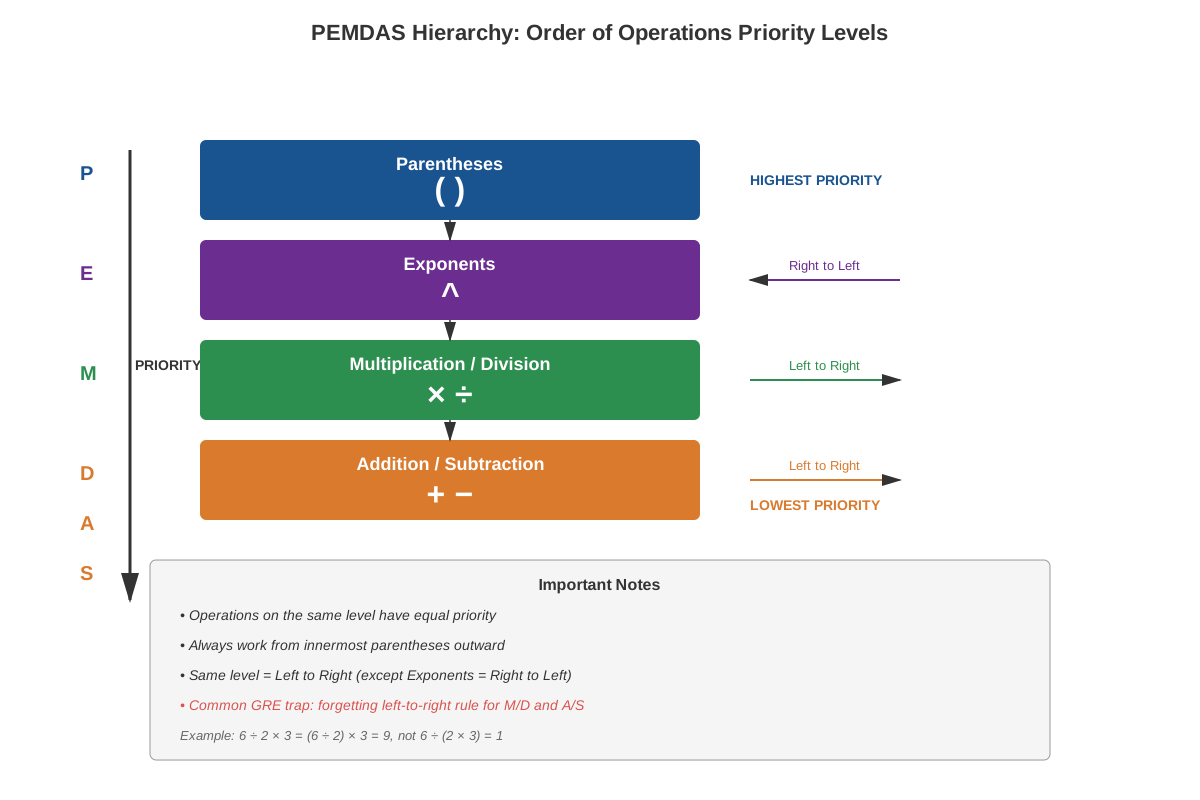
The order of operations follows a strict hierarchy remembered by the acronym PEMDAS: Parentheses, Exponents, Multiplication and Division (left to right), Addition and Subtraction (left to right). This sequence determines which operations must be performed first when evaluating any mathematical expression.
Parentheses (and all grouping symbols including brackets [ ], braces { }, and absolute value bars | |) take absolute priority. Any operations contained within grouping symbols must be completed before operations outside those symbols. When multiple grouping symbols are nested, work from the innermost to the outermost.
Exponents (including powers, roots, and exponential expressions) are evaluated second, after all grouping symbols have been resolved. This includes squared terms, cubed terms, and any expression with a superscript.
Multiplication and Division share equal priority and are performed from left to right as they appear in the expression. This is a critical point: multiplication does not take precedence over division. When both operations appear at the same level, simply work left to right.
Addition and Subtraction also share equal priority and are performed from left to right after all higher-priority operations are complete. Like multiplication and division, neither operation takes precedence over the other.
Grouping Symbols and Nested Operations
Grouping symbols create sub-expressions that must be fully evaluated before being incorporated into the larger expression. Consider the expression: 3 × (4 + 2) = 3 × 6 = 18, which differs dramatically from 3 × 4 + 2 = 12 + 2 = 14.
When expressions contain nested grouping symbols, such as 2 × [3 + (4 × 5)], evaluation proceeds from the innermost grouping outward:
- First: 4 × 5 = 20 (innermost parentheses)
- Second: 3 + 20 = 23 (brackets)
- Third: 2 × 23 = 46 (final multiplication)
Fraction bars act as grouping symbols, requiring complete evaluation of both numerator and denominator before performing the division. The expression (6 + 4)/(3 - 1) requires calculating 10/2 = 5, not processing operations across the fraction bar prematurely.
Exponents in the Hierarchy
Exponents are evaluated after grouping symbols but before multiplication, division, addition, and subtraction. The expression 2 + 3² equals 2 + 9 = 11, not 5² = 25. This distinction is frequently tested on the GRE.
When exponents appear with negative signs, careful attention to grouping is essential. The expression -3² equals -(3²) = -9, because the exponent applies only to the 3, not to the negative sign. However, (-3)² = 9, because the parentheses indicate that the entire negative number is being squared.
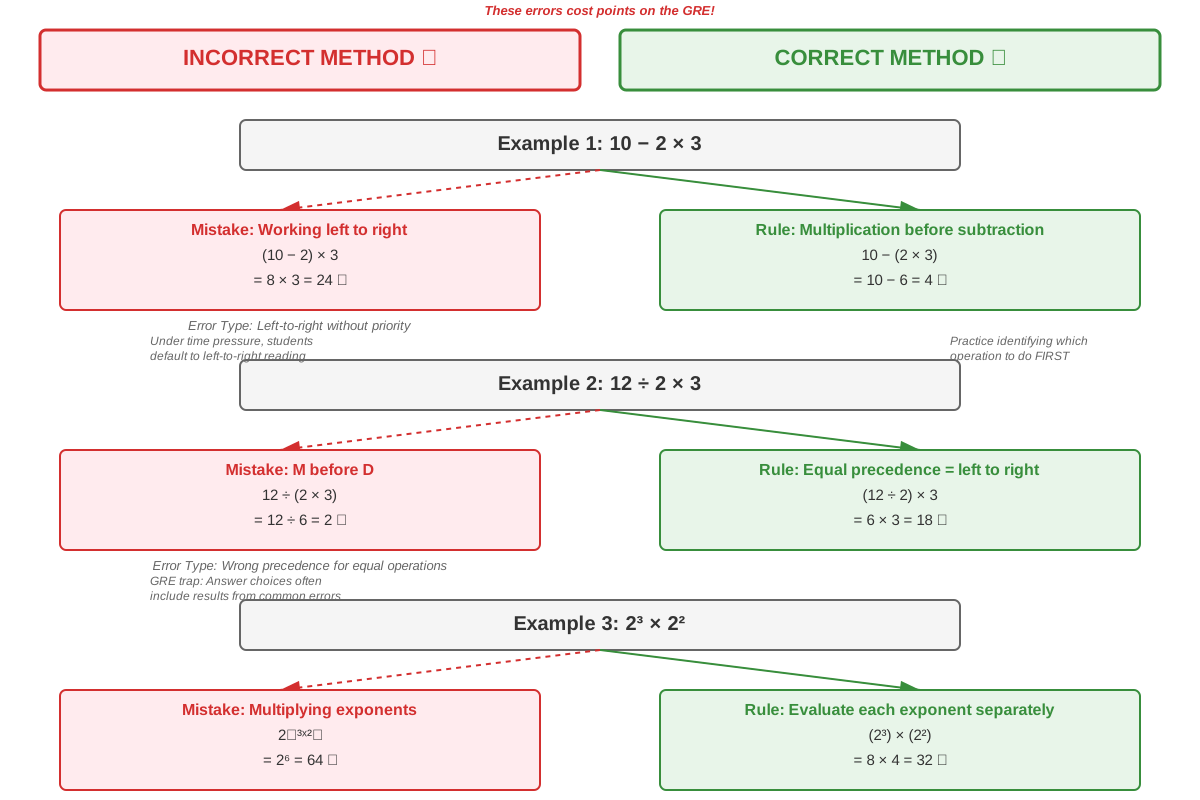
Multiple exponents in sequence are evaluated right to left: 2^(3^2) = 2^9 = 512, not (2^3)^2 = 8^2 = 64. However, this right-to-left rule applies only when exponents are stacked without explicit grouping.
Multiplication and Division: Left-to-Right Processing
A common error involves treating multiplication as having higher priority than division. In the expression 20 ÷ 4 × 5, both operations have equal priority, so evaluation proceeds left to right: (20 ÷ 4) × 5 = 5 × 5 = 25. The incorrect approach of performing multiplication first yields 20 ÷ (4 × 5) = 20 ÷ 20 = 1.
This left-to-right rule applies regardless of how the operations are written. The expression 20/4 × 5 follows the same rule as 20 ÷ 4 × 5, both equaling 25. Similarly, 20 × 5 ÷ 4 = 100 ÷ 4 = 25.
Addition and Subtraction: Left-to-Right Processing
Like multiplication and division, addition and subtraction share equal priority and are processed left to right. The expression 10 - 3 + 2 equals (10 - 3) + 2 = 7 + 2 = 9, not 10 - (3 + 2) = 10 - 5 = 5.
This becomes particularly important when expressions mix positive and negative terms. The expression 5 + 3 - 2 + 4 should be processed sequentially: 5 + 3 = 8, then 8 - 2 = 6, then 6 + 4 = 10.
Implied Multiplication and Coefficient Notation
In algebraic expressions, multiplication is often implied rather than explicitly written. The expression 2(3 + 4) means 2 × (3 + 4), and the parentheses must be evaluated first: 2(7) = 14. Similarly, 3x means 3 × x, and when substituting values, the multiplication follows standard order of operations rules.
The expression 2x² means 2 × (x²), not (2x)². When x = 3, this evaluates to 2 × 9 = 18, not 36. The exponent applies only to the variable immediately preceding it unless parentheses indicate otherwise.
Order of Operations in Complex Expressions
| Expression Type | Example | Evaluation Steps | Result |
|---|---|---|---|
| Nested grouping | 3[2 + (4 × 5)] | 4 × 5 = 20; 2 + 20 = 22; 3 × 22 | 66 |
| Mixed operations | 8 + 12 ÷ 4 - 2 | 12 ÷ 4 = 3; 8 + 3 = 11; 11 - 2 | 9 |
| Exponents with operations | 2 × 3² + 4 | 3² = 9; 2 × 9 = 18; 18 + 4 | 22 |
| Fraction bars | (6 + 4)/(10 - 5) | 6 + 4 = 10; 10 - 5 = 5; 10 ÷ 5 | 2 |
Concept Relationships
The order of operations serves as the foundational rule system that governs all mathematical expression evaluation. This topic connects directly to basic arithmetic operations (prerequisite knowledge), as it determines how addition, subtraction, multiplication, and division interact when combined in expressions. Without order of operations, the same expression could yield multiple different values, making mathematical communication impossible.
The hierarchy flows logically: Grouping symbols → Exponents → Multiplication/Division → Addition/Subtraction. Each level must be completely resolved before moving to the next level, creating a cascading evaluation process.
Order of operations enables progression to more advanced topics including algebraic simplification (where terms must be combined following proper operation sequences), equation solving (where both sides of equations must be manipulated consistently), function evaluation (where input values must be processed through function rules correctly), and formula application (where geometric, statistical, and scientific formulas require precise calculation sequences).
The relationship extends to quantitative comparison questions, where two expressions must be evaluated accurately to determine their relative values, and data interpretation problems, where formulas and calculations must be performed correctly to extract information from tables and graphs. Even word problems depend on order of operations, as translating verbal descriptions into mathematical expressions requires understanding which operations to perform in which sequence.
Quick check — test yourself on Order of operations so far.
Try Flashcards →High-Yield Facts
- ⭐ PEMDAS stands for Parentheses, Exponents, Multiplication and Division (left to right), Addition and Subtraction (left to right)
- ⭐ Multiplication and division have equal priority and are performed left to right, not multiplication before division
- ⭐ Addition and subtraction have equal priority and are performed left to right, not addition before subtraction
- ⭐ Fraction bars act as grouping symbols, requiring complete evaluation of numerator and denominator before dividing
- ⭐ The expression -x² equals -(x²), not (-x)², unless parentheses explicitly group the negative sign with the base
- Nested grouping symbols are evaluated from innermost to outermost
- Implied multiplication (coefficient notation like 3x) follows the same rules as explicit multiplication
- Exponents are evaluated right to left when stacked: a^(b^c) means a^(b^c), not (a^b)^c
- Absolute value bars function as grouping symbols and must be evaluated before operations outside them
- The expression 2x² means 2(x²), not (2x)², affecting substitution and evaluation
- Operations within grouping symbols must follow PEMDAS hierarchy internally before the grouped result is used
- Calculator order of operations may differ from mathematical convention; always verify calculator logic
Common Misconceptions
Misconception: Multiplication always comes before division in any expression.
Correction: Multiplication and division have equal priority and are performed strictly from left to right as they appear. The expression 20 ÷ 4 × 5 equals 25, not 1, because division appears first and must be performed first.
Misconception: Addition always comes before subtraction in any expression.
Correction: Addition and subtraction have equal priority and are performed from left to right. The expression 10 - 3 + 2 equals 9, not 5, because subtraction appears first and must be performed first.
Misconception: The negative sign in -3² is included in the squaring operation.
Correction: Without parentheses, -3² means -(3²) = -9, not (-3)² = 9. The exponent applies only to the number immediately preceding it. Parentheses are required to include the negative sign in the base being squared.
Misconception: In the expression 2x², the exponent applies to both the coefficient and the variable.
Correction: The expression 2x² means 2 × (x²), not (2x)². When x = 3, this evaluates to 2 × 9 = 18, not 36. Only the variable is squared unless parentheses indicate otherwise.
Misconception: Operations can be performed in any order as long as you're careful with the arithmetic.
Correction: Order of operations is a universal convention, not a suggestion. Performing operations in the wrong sequence will produce incorrect results. The expression 2 + 3 × 4 must equal 14 (not 20) regardless of how carefully the arithmetic is performed.
Misconception: Brackets and parentheses have different priorities in the operation hierarchy.
Correction: All grouping symbols (parentheses, brackets, braces) have equal priority. The different symbols are used only for visual clarity when nesting groups. Evaluate from innermost to outermost regardless of symbol type.
Worked Examples
Example 1: Multi-Operation Expression with Grouping
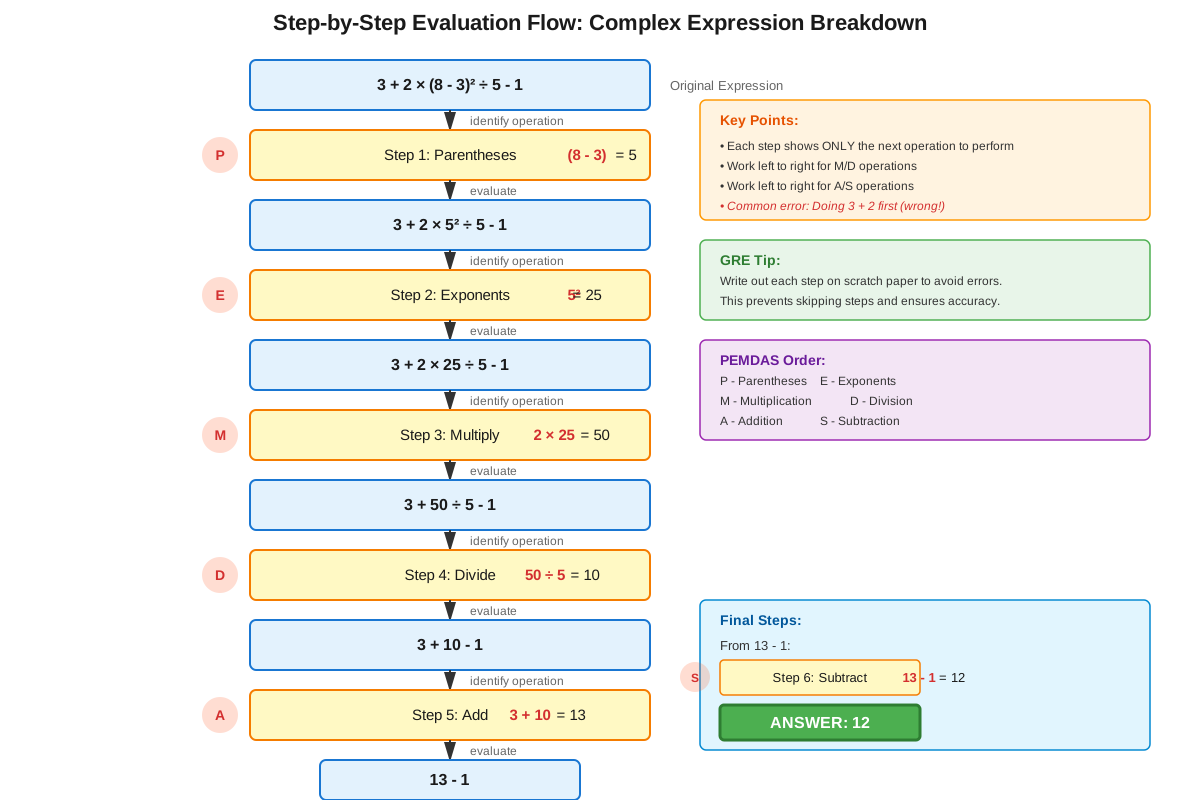
Problem: Evaluate the expression: 3 + 2[8 - (3 × 2)]² ÷ 4
Solution:
Step 1: Identify the innermost grouping symbol and evaluate it first.
- Innermost operation: (3 × 2) = 6
Step 2: Substitute and evaluate the next level of grouping.
- Expression becomes: 3 + 2[8 - 6]² ÷ 4
- Evaluate brackets: 8 - 6 = 2
- Expression becomes: 3 + 2(2)² ÷ 4
Step 3: Evaluate the exponent.
- 2² = 4
- Expression becomes: 3 + 2(4) ÷ 4
Step 4: Perform multiplication and division from left to right.
- First: 2 × 4 = 8
- Expression becomes: 3 + 8 ÷ 4
- Then: 8 ÷ 4 = 2
- Expression becomes: 3 + 2
Step 5: Perform addition.
- 3 + 2 = 5
Answer: 5
Connection to Learning Objectives: This problem demonstrates identification of order of operations testing (nested grouping symbols and multiple operation types), application of the core PEMDAS strategy (working through each level systematically), and accurate execution under GRE-style complexity.
Example 2: Algebraic Expression with Substitution
Problem: If x = 3 and y = 2, evaluate: 2x² - 3y + (x + y)²/5
Solution:
Step 1: Substitute the given values.
- Expression becomes: 2(3)² - 3(2) + (3 + 2)²/5
Step 2: Evaluate grouping symbols.
- (3 + 2) = 5
- Expression becomes: 2(3)² - 3(2) + (5)²/5
Step 3: Evaluate exponents.
- 3² = 9
- 5² = 25
- Expression becomes: 2(9) - 3(2) + 25/5
Step 4: Perform multiplication and division from left to right.
- 2 × 9 = 18
- 3 × 2 = 6
- 25 ÷ 5 = 5
- Expression becomes: 18 - 6 + 5
Step 5: Perform addition and subtraction from left to right.
- 18 - 6 = 12
- 12 + 5 = 17
Answer: 17
Connection to Learning Objectives: This problem illustrates order of operations in algebraic contexts, demonstrates proper handling of coefficient notation (2x² means 2 times x-squared), and shows how fraction bars function as grouping symbols requiring complete evaluation before division.
Exam Strategy
When approaching GRE questions involving order of operations, begin by scanning the expression for grouping symbols and identifying the operation hierarchy before performing any calculations. This preview prevents premature calculation errors and helps identify potential trap answers.
Trigger words and phrases that indicate order of operations testing include: "evaluate the expression," "simplify," "what is the value of," "calculate," and any problem presenting a complex expression with multiple operations. Quantitative comparison questions frequently test whether students correctly evaluate expressions on both sides.
Process of elimination strategy: On multiple-choice questions, quickly eliminate answers that result from common errors. If the expression is 2 + 3 × 4, immediately eliminate 20 (the result of incorrectly adding first) and focus on verifying that 14 is correct. Test makers consistently include trap answers representing predictable mistakes.
Time allocation: Simple order of operations problems should take 30-45 seconds. If spending more time, verify that each step follows PEMDAS rather than recalculating repeatedly. For complex expressions, invest 15-20 seconds planning the evaluation sequence before beginning calculations to avoid mid-problem errors requiring restart.
Exam Tip: When expressions contain fraction bars, draw a mental or physical line separating numerator from denominator and evaluate each completely before dividing. This prevents the common error of performing operations across the fraction bar prematurely.
Use parentheses liberally when working through problems on scratch paper. Writing 20 ÷ 4 × 5 as (20 ÷ 4) × 5 = (5) × 5 = 25 makes the left-to-right sequence explicit and prevents errors. The few extra seconds spent adding clarifying parentheses saves time by preventing mistakes.
For quantitative comparison questions, evaluate each side completely and independently before comparing. Don't attempt to manipulate both sides simultaneously unless you're certain about operation precedence in the manipulation.
Memory Techniques
PEMDAS Mnemonic: "Please Excuse My Dear Aunt Sally" remains the most widely used memory device, with each word's first letter corresponding to an operation level: Parentheses, Exponents, Multiplication, Division, Addition, Subtraction.
Alternative Mnemonic: "Purple Elephants May Destroy A School" provides the same sequence with more memorable imagery. Visualize a purple elephant (unusual and attention-grabbing) systematically destroying a school building from top to bottom, mirroring the top-to-bottom hierarchy of operations.
Left-to-Right Reminder: For multiplication/division and addition/subtraction, remember "SAME LEVEL, SAME DIRECTION." Operations at the same priority level are performed in the same direction: left to right, like reading English text.
Grouping Symbol Visualization: Picture grouping symbols as boxes or containers that must be completely unpacked before their contents can interact with outside elements. Nested symbols are boxes within boxes—unpack the innermost box first.
Exponent Position Memory: Remember "exponents are elevated" (positioned as superscripts) and therefore "elevated in priority" (performed before ground-level operations like multiplication and addition).
Fraction Bar Technique: Visualize fraction bars as horizontal grouping symbols creating a "roof" over the numerator and a "floor" under the denominator. Everything under the roof and above the floor must be completed before the division occurs.
Summary
Order of operations is the universal mathematical convention governing the sequence in which operations must be performed when evaluating expressions containing multiple operations. The PEMDAS hierarchy—Parentheses, Exponents, Multiplication and Division (left to right), Addition and Subtraction (left to right)—provides the framework for all expression evaluation. Mastery requires understanding that multiplication and division share equal priority (as do addition and subtraction), necessitating left-to-right processing when these operations appear together. Grouping symbols, including parentheses, brackets, and fraction bars, take absolute priority and must be evaluated from innermost to outermost. This topic appears frequently on the GRE both as a direct testing point and as foundational knowledge required for algebraic manipulation, equation solving, and formula application. Success depends on systematic application of the hierarchy, careful attention to implied operations in algebraic notation, and recognition of common trap answers resulting from operation sequence errors.
Key Takeaways
- PEMDAS defines the universal hierarchy: Parentheses, Exponents, Multiplication/Division (left to right), Addition/Subtraction (left to right)
- Multiplication and division have equal priority and must be performed left to right, not multiplication before division
- Addition and subtraction have equal priority and must be performed left to right, not addition before subtraction
- All grouping symbols (parentheses, brackets, fraction bars) require complete internal evaluation before their results interact with external operations
- The expression -x² equals -(x²) unless parentheses explicitly include the negative sign in the base: (-x)²
- Order of operations appears in 15-20% of GRE Quantitative Reasoning questions and serves as foundational knowledge for algebraic and formula-based problems
- Systematic application of PEMDAS prevents careless errors and enables confident navigation of complex multi-step calculations
Related Topics
Algebraic Simplification: Mastering order of operations enables combining like terms, distributing coefficients, and simplifying complex algebraic expressions where operation sequence determines correctness.
Equation Solving: Solving linear and quadratic equations requires applying order of operations when manipulating both sides and when checking solutions through substitution.
Function Evaluation: Computing f(x) for given x-values demands precise order of operations application, particularly when functions involve multiple operations and nested grouping.
Exponent Rules: Understanding how exponents interact with other operations through order of operations provides the foundation for learning exponent properties and manipulation techniques.
Rational Expressions: Simplifying and evaluating fractions with polynomial numerators and denominators requires treating fraction bars as grouping symbols and applying proper operation sequences.
Practice CTA
Now that you've mastered the core concepts and strategies for order of operations, it's time to solidify your understanding through active practice. Attempt the practice questions designed specifically for this topic, focusing on applying the PEMDAS hierarchy systematically and avoiding common trap answers. Use the flashcards to reinforce high-yield facts and test your recall of key principles under time pressure. Remember: order of operations mastery isn't about memorizing individual problems—it's about internalizing a systematic approach that applies to any expression you encounter. Your investment in deliberate practice now will pay dividends across every quantitative question type on test day.
Sign up free to keep reading
Create a free AnvayaPrep account to finish this GRE guide on Order of operations — plus flashcards and practice questions.