Overview
Rational expressions are algebraic fractions in which both the numerator and denominator are polynomials. These expressions form a critical component of the GRE Quantitative Reasoning section, appearing in approximately 10-15% of algebra questions. Mastery of rational expressions enables test-takers to simplify complex algebraic fractions, solve equations involving fractions, and manipulate expressions efficiently—skills that directly translate to faster problem-solving and higher scores.
Understanding gre rational expressions requires comfort with factoring polynomials, identifying restrictions on variables, and performing arithmetic operations with algebraic fractions. The GRE tests these concepts through direct simplification problems, equation-solving scenarios, and word problems that require setting up and manipulating rational expressions. Questions may appear in both Quantitative Comparison and Problem Solving formats, often combining rational expressions with other algebraic concepts like quadratic equations or systems of equations.
The relationship between rational expressions and broader Quantitative Reasoning concepts is fundamental. Rational expressions build upon polynomial operations, factoring techniques, and fraction arithmetic while serving as prerequisites for more advanced topics like function behavior and asymptotic analysis. Students who master rational expressions develop algebraic fluency that accelerates their performance across multiple question types, from pure algebra problems to applied scenarios involving rates, proportions, and work problems.
Learning Objectives
- [ ] Identify when Rational expressions is being tested
- [ ] Explain the core rule or strategy behind Rational expressions
- [ ] Apply Rational expressions to GRE-style questions accurately
- [ ] Simplify complex rational expressions by factoring and canceling common terms
- [ ] Perform arithmetic operations (addition, subtraction, multiplication, division) with rational expressions
- [ ] Determine domain restrictions and identify values that make rational expressions undefined
- [ ] Solve equations containing rational expressions using appropriate algebraic techniques
Prerequisites
- Polynomial operations: Ability to add, subtract, multiply, and expand polynomials is essential for manipulating numerators and denominators
- Factoring techniques: Recognizing common factors, difference of squares, and trinomial factoring enables simplification of rational expressions
- Fraction arithmetic: Understanding how to add, subtract, multiply, and divide numerical fractions provides the foundation for operations with algebraic fractions
- Solving linear and quadratic equations: Required for finding solutions when rational expressions appear in equations
- Understanding of domain and restrictions: Recognizing when expressions are undefined prevents mathematical errors
Why This Topic Matters
Rational expressions appear throughout mathematics, science, and real-world applications. In physics, they model relationships like resistance in parallel circuits and gravitational forces. In economics, they represent average cost functions and marginal analysis. In everyday life, rational expressions underlie rate problems, mixture problems, and efficiency calculations—all common GRE word problem scenarios.
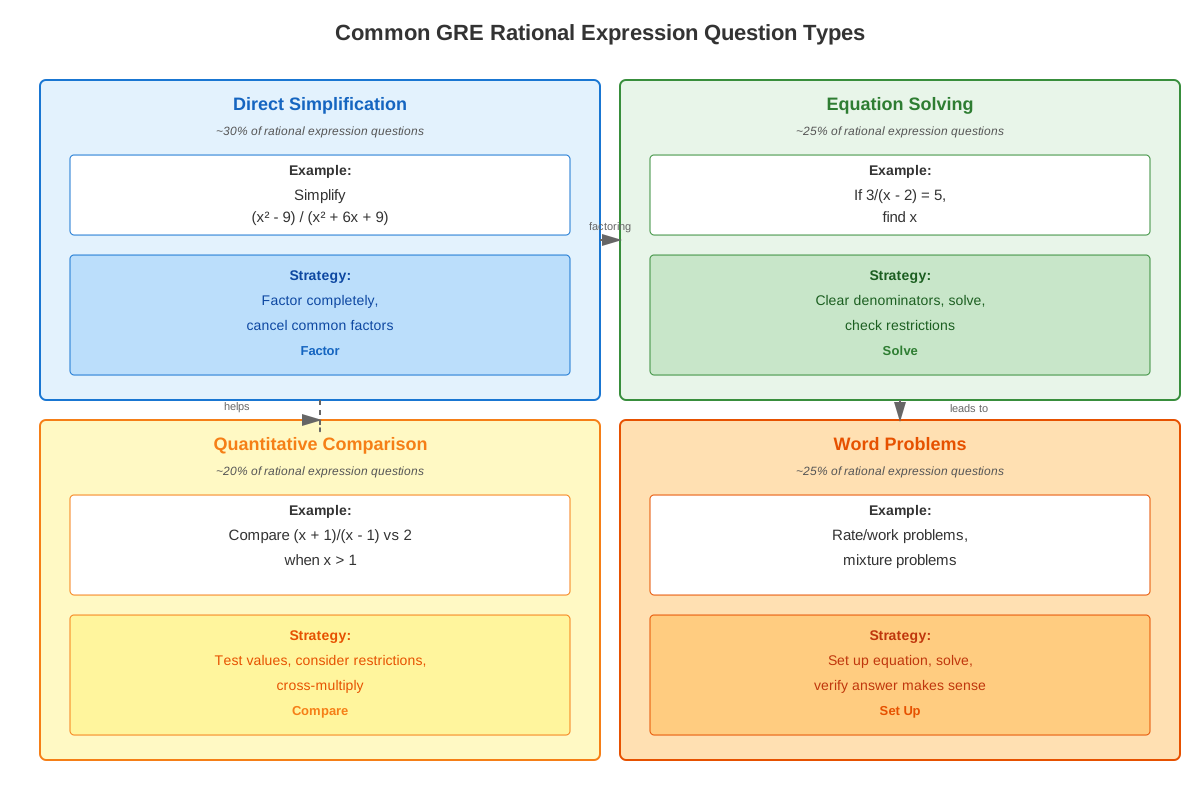
On the GRE, rational expressions appear in approximately 2-3 questions per test, representing roughly 10-15% of algebra questions. These questions typically appear as:
- Direct simplification problems: "Which of the following is equivalent to [complex rational expression]?"
- Equation-solving scenarios: "If (x+3)/(x-2) = 5, what is the value of x?"
- Quantitative Comparisons: Comparing two rational expressions or determining relationships between variables
- Word problems: Rate problems, work problems, and mixture problems that require setting up rational equations
The GRE particularly favors questions that combine rational expressions with other concepts, testing whether students can recognize when simplification will make a problem tractable. Questions often include answer choices designed to catch common errors like incorrect cancellation or sign mistakes. Understanding rational expressions thoroughly provides a significant competitive advantage, as many test-takers struggle with these problems under time pressure.
Core Concepts
Definition and Structure
A rational expression is a fraction where both the numerator and denominator are polynomials. The general form is:
f(x) = P(x)/Q(x)where P(x) and Q(x) are polynomials and Q(x) ≠ 0. Examples include:
- Simple: (x+2)/(x-3)
- Complex: (x²-4)/(x²+5x+6)
- Compound: [(x+1)/(x-1)] / [(x²-1)/(x+2)]
The key characteristic distinguishing rational expressions from other algebraic expressions is the presence of a variable in the denominator, which creates domain restrictions and requires careful handling during operations.
Domain Restrictions and Undefined Values
The domain of a rational expression consists of all real numbers except those that make the denominator equal to zero. Identifying these restrictions is crucial for GRE problems, as test questions often include trap answers that represent undefined values.
Process for finding restrictions:
- Set the denominator equal to zero
- Solve for the variable
- Exclude these values from the domain
For example, in the expression (x+5)/(x²-9):
- Set x²-9 = 0
- Factor: (x+3)(x-3) = 0
- Restrictions: x ≠ 3 and x ≠ -3
GRE Tip: Always check whether answer choices represent values that would make the original denominator zero, even after simplification.
Simplifying Rational Expressions
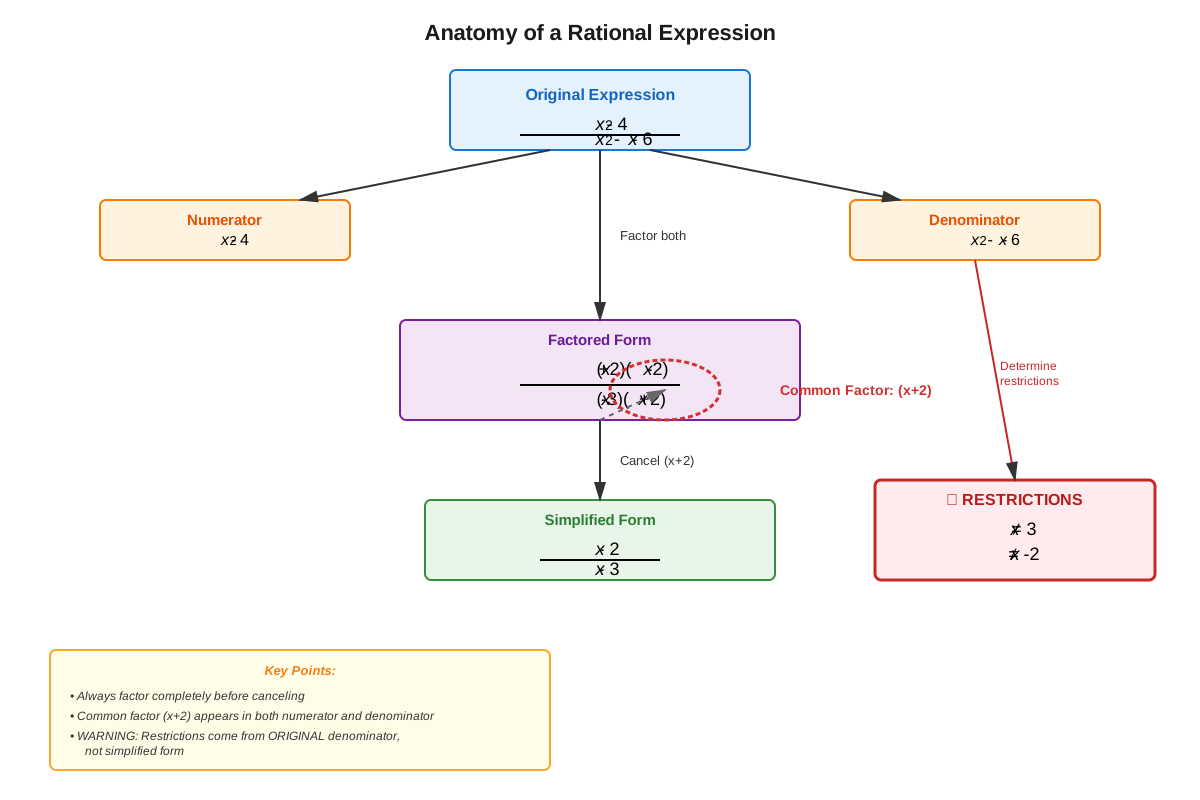
Simplification involves reducing rational expressions to lowest terms by canceling common factors from the numerator and denominator. This process mirrors simplifying numerical fractions but requires factoring polynomials first.
Simplification steps:
- Factor both numerator and denominator completely
- Identify common factors
- Cancel common factors (divide both by the common factor)
- State any domain restrictions
Example: Simplify (x²-4)/(x²-x-6)
- Factor numerator: (x+2)(x-2)
- Factor denominator: (x-3)(x+2)
- Cancel common factor (x+2): (x-2)/(x-3)
- Restriction: x ≠ -2, x ≠ 3
Critical rule: Only factors can be canceled, never terms. The expression (x+3)/(x+5) cannot be simplified by canceling the x's because they are terms, not factors.
Multiplication and Division
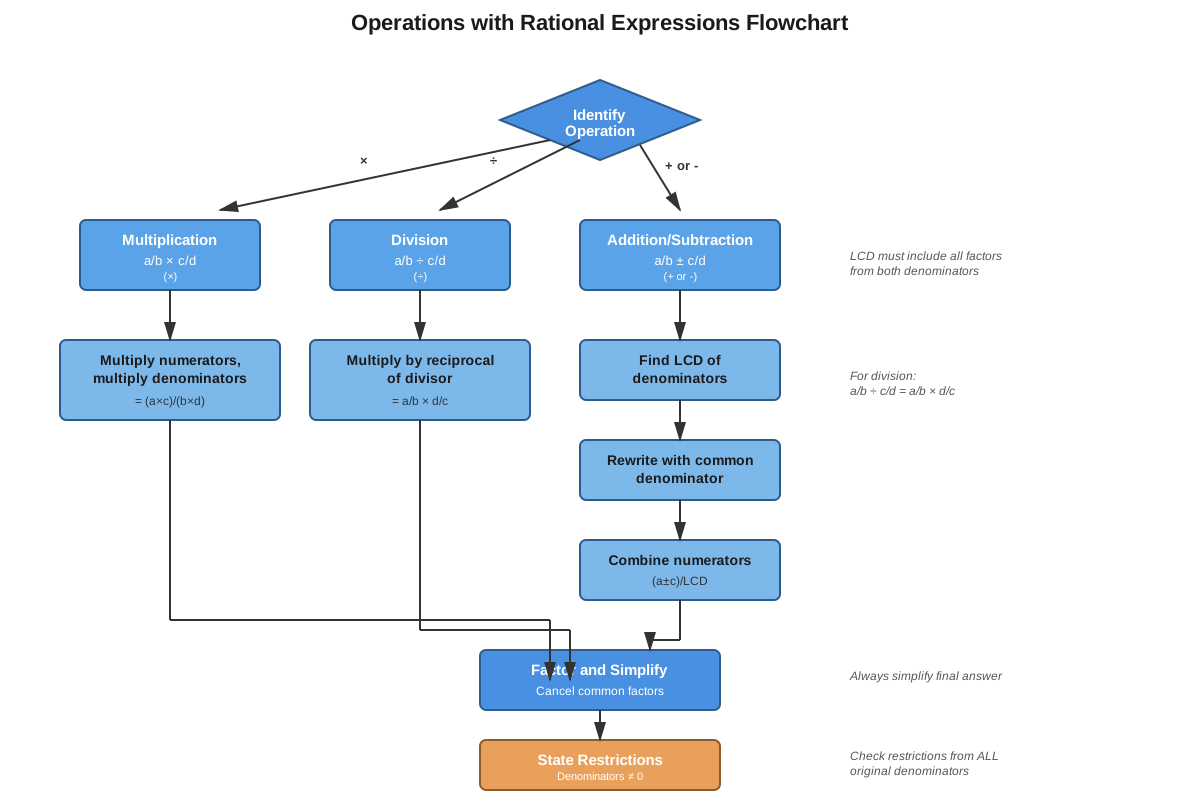
Multiplication of rational expressions follows the same principle as multiplying numerical fractions: multiply numerators together and denominators together, then simplify.
(A/B) × (C/D) = (A×C)/(B×D)Strategy: Factor before multiplying to identify cancellations early and avoid working with unnecessarily large expressions.
Division of rational expressions uses the "multiply by the reciprocal" rule:
(A/B) ÷ (C/D) = (A/B) × (D/C) = (A×D)/(B×C)Example: Simplify (x²-1)/(x+2) ÷ (x-1)/(x²+3x+2)
- Rewrite as multiplication: (x²-1)/(x+2) × (x²+3x+2)/(x-1)
- Factor: [(x+1)(x-1)]/(x+2) × [(x+1)(x+2)]/(x-1)
- Cancel common factors: (x+1)(x+1) = (x+1)²
- Restrictions: x ≠ -2, x ≠ 1, x ≠ -1
Addition and Subtraction
Adding and subtracting rational expressions requires a common denominator, just like numerical fractions. This is often the most challenging operation for students.
Process for addition/subtraction:
- Factor all denominators
- Find the Least Common Denominator (LCD)
- Rewrite each fraction with the LCD
- Combine numerators over the common denominator
- Simplify the resulting expression
Example: Add 3/(x-2) + 5/(x+1)
- LCD = (x-2)(x+1)
- Rewrite: [3(x+1)]/[(x-2)(x+1)] + [5(x-2)]/[(x-2)(x+1)]
- Combine: [3(x+1) + 5(x-2)]/[(x-2)(x+1)]
- Expand: [3x+3+5x-10]/[(x-2)(x+1)]
- Simplify: (8x-7)/[(x-2)(x+1)]
| Operation | Rule | Key Strategy |
|---|---|---|
| Multiplication | Multiply straight across | Factor first, cancel early |
| Division | Multiply by reciprocal | Flip second fraction, then multiply |
| Addition/Subtraction | Find common denominator | Factor denominators to find LCD |
Complex Rational Expressions
Complex rational expressions (also called compound fractions) contain fractions within fractions. These appear frequently on the GRE and can be simplified using two methods:
Method 1: Multiply by LCD of all small fractions
Method 2: Simplify numerator and denominator separately, then divide
Example: Simplify [(1/x) + (1/y)] / [(1/x) - (1/y)]
Method 1 (multiply by LCD = xy):
- Numerator: xy(1/x + 1/y) = y + x
- Denominator: xy(1/x - 1/y) = y - x
- Result: (x+y)/(y-x)
Method 2 (combine separately):
- Numerator: (y+x)/(xy)
- Denominator: (y-x)/(xy)
- Divide: [(y+x)/(xy)] ÷ [(y-x)/(xy)] = (y+x)/(y-x)
Solving Equations with Rational Expressions
When rational expressions appear in equations, the standard approach is to clear the denominators by multiplying both sides by the LCD of all fractions.
Steps:
- Identify all denominators and find the LCD
- Multiply every term by the LCD
- Solve the resulting polynomial equation
- Check solutions against domain restrictions (exclude any that make original denominators zero)
Example: Solve 3/(x-1) = 2/(x+2)
- LCD = (x-1)(x+2)
- Multiply: 3(x+2) = 2(x-1)
- Expand: 3x+6 = 2x-2
- Solve: x = -8
- Check: x = -8 doesn't make any denominator zero ✓
Critical GRE Warning: Always verify solutions. Extraneous solutions that make denominators zero are common trap answers.
Quick check — test yourself on Rational expressions so far.
Try Flashcards →Concept Relationships
The concepts within rational expressions form a hierarchical structure. Domain restrictions must be identified before any operations, as these constraints persist throughout all manipulations. Simplification serves as the foundation for all other operations—recognizing when and how to factor and cancel determines efficiency in multiplication, division, addition, and subtraction.
Multiplication and division are closely related, with division being multiplication by a reciprocal. Both operations are generally simpler than addition and subtraction because they don't require finding common denominators. Addition and subtraction build upon multiplication concepts, as creating equivalent fractions with common denominators involves multiplying by strategic forms of 1.
Complex rational expressions integrate all previous concepts, requiring students to apply simplification, operations, and strategic thinking about order of operations. Equation solving represents the application of all these skills in a problem-solving context, adding the additional layer of checking for extraneous solutions.
Connection to prerequisites: Rational expressions directly extend fraction arithmetic to algebraic contexts. Every operation with rational expressions mirrors the corresponding operation with numerical fractions, but requires polynomial factoring to identify common factors and equation-solving skills to find restrictions and solutions.
Relationship map:
Domain Restrictions → Simplification → Multiplication/Division → Addition/Subtraction → Complex Expressions → Equation Solving
Each concept builds upon previous ones, with simplification skills appearing in every subsequent operation.
High-Yield Facts
⭐ A rational expression is undefined when its denominator equals zero; always identify these restrictions before simplifying
⭐ Only factors can be canceled in rational expressions, never terms; (x+3)/(x+5) cannot be simplified
⭐ When multiplying rational expressions, factor first and cancel common factors before multiplying to avoid large expressions
⭐ The LCD for adding/subtracting rational expressions is found by taking the product of all unique factors at their highest powers
⭐ To divide rational expressions, multiply by the reciprocal of the divisor: (A/B) ÷ (C/D) = (A/B) × (D/C)
- When solving equations with rational expressions, multiply all terms by the LCD to clear denominators
- Solutions that make any original denominator zero are extraneous and must be rejected
- Complex rational expressions can be simplified by multiplying numerator and denominator by the LCD of all internal fractions
- The domain of a simplified rational expression excludes values that made the original denominator zero, even if those factors were canceled
- Rational expressions with the same denominator can be added/subtracted by combining numerators: A/C + B/C = (A+B)/C
Common Misconceptions
Misconception: Terms in the numerator and denominator can be canceled like factors.
Correction: Only common factors can be canceled. In (x+5)/(x+3), the x's cannot cancel because they are terms being added, not factors being multiplied. To cancel, the entire numerator and denominator must share a common factor: (x+5)/(x+5) = 1.
Misconception: After simplifying a rational expression, the domain restrictions change.
Correction: Domain restrictions from the original expression persist even after simplification. If (x²-4)/(x+2) simplifies to (x-2), the restriction x ≠ -2 still applies because the original expression was undefined there.
Misconception: When adding fractions with different denominators, you can add the numerators and add the denominators.
Correction: Addition requires a common denominator. The expression 1/x + 1/y does not equal 2/(x+y). Instead, find the LCD (xy) and rewrite: y/(xy) + x/(xy) = (x+y)/(xy).
Misconception: All solutions to equations involving rational expressions are valid.
Correction: Solutions must be checked against domain restrictions. If solving (x+2)/(x-3) = 5 yields x = 3, this solution is extraneous because it makes the original denominator zero.
Misconception: Complex rational expressions must be simplified by combining the numerator and denominator separately.
Correction: While this method works, multiplying the entire expression by the LCD of all internal fractions is often faster and less error-prone, especially under time pressure.
Worked Examples
Example 1: Simplification and Domain
Problem: Simplify (2x²-8)/(x²+x-6) and state all domain restrictions.
Solution:
Step 1: Factor the numerator
- 2x²-8 = 2(x²-4) = 2(x+2)(x-2)
Step 2: Factor the denominator
- x²+x-6: Find factors of -6 that add to 1: (+3)(-2)
- x²+x-6 = (x+3)(x-2)
Step 3: Identify domain restrictions (before canceling)
- Set denominator equal to zero: (x+3)(x-2) = 0
- Restrictions: x ≠ -3 and x ≠ 2
Step 4: Cancel common factors
- [2(x+2)(x-2)]/[(x+3)(x-2)] = [2(x+2)]/(x+3)
Step 5: Write final answer with restrictions
- Simplified form: 2(x+2)/(x+3) or (2x+4)/(x+3)
- Domain: all real numbers except x = -3 and x = 2
Key insight: Even though (x-2) was canceled, x ≠ 2 remains a restriction because the original expression was undefined there. This concept frequently appears in GRE questions.
Example 2: Complex Operations
Problem: Simplify: [(x²-1)/(x+2)] ÷ [(x+1)/(x²-4)] + 2/(x-2)
Solution:
Step 1: Handle the division first (convert to multiplication)
- [(x²-1)/(x+2)] × [(x²-4)/(x+1)]
Step 2: Factor all expressions
- x²-1 = (x+1)(x-1)
- x²-4 = (x+2)(x-2)
- Expression becomes: [(x+1)(x-1)/(x+2)] × [(x+2)(x-2)/(x+1)]
Step 3: Cancel common factors
- (x+1) cancels with (x+1)
- (x+2) cancels with (x+2)
- Result: (x-1)(x-2) = x²-3x+2
Step 4: Add the remaining term
- (x²-3x+2) + 2/(x-2)
- Need common denominator: (x-2)
- Rewrite: [(x²-3x+2)(x-2)]/(x-2) + 2/(x-2)
Step 5: Expand and combine
- Numerator: (x²-3x+2)(x-2) + 2
- = x³-2x²-3x²+6x+2x-4+2
- = x³-5x²+8x-2
- Final answer: (x³-5x²+8x-2)/(x-2)
Key insight: Breaking complex problems into steps (division first, then addition) prevents errors. Factoring early reveals cancellations that simplify subsequent work.
Exam Strategy
Recognition triggers: Watch for these phrases that signal rational expression problems:
- "Simplify the expression"
- "Which of the following is equivalent to"
- "For all values of x except"
- "The expression is undefined when"
- Problems involving rates, work, or combined rates
Approach strategy:
- Scan for restrictions first: Quickly identify values that make denominators zero—these often appear as trap answers
- Factor aggressively: Most GRE rational expression problems become manageable after factoring
- Look for cancellations before computing: Don't multiply out large expressions if factors will cancel
- Check answer choices: Sometimes working backwards from answers is faster than algebraic manipulation
Process of elimination tips:
- Eliminate any answer choice that includes restricted values (values that make original denominators zero)
- For simplification problems, plug in a simple test value (like x=0 or x=1) to eliminate incorrect answers
- Check signs carefully: many wrong answers differ only in sign
- For Quantitative Comparison, test x=0, x=1, and x=-1 to find relationships
Time allocation:
- Simple simplification: 45-60 seconds
- Operations (multiply/divide): 60-90 seconds
- Addition/subtraction with LCD: 90-120 seconds
- Complex expressions or equations: 120-150 seconds
Power Strategy: If a problem seems algebraically intensive, try substituting a simple number for x (avoiding restricted values) to test answer choices. This can save significant time.
Memory Techniques
FACTOR mnemonic for simplification:
- Find all factors in numerator and denominator
- Assess domain restrictions
- Cancel common factors only
- Test your answer with a simple value
- Omit restricted values from domain
- Rewrite in simplest form
"Flip and Multiply" for division: Visualize flipping the second fraction like a pancake, then multiplying straight across.
LCD visualization: Think of the LCD as a "common language" that all fractions must speak before they can be combined. Each fraction needs to be "translated" into this common language.
"Keep-Change-Flip" for subtraction: When subtracting rational expressions, keep the first fraction, change subtraction to addition, and flip the sign of every term in the second numerator.
Domain restriction check: Use the phrase "Denominator Zero Bad" (DZB) to remember to check what makes denominators zero before finalizing answers.
Summary
Rational expressions are algebraic fractions with polynomials in both numerator and denominator, forming a high-yield GRE topic that appears in 10-15% of algebra questions. Mastery requires understanding domain restrictions (values that make denominators zero), simplification through factoring and canceling common factors, and performing operations (multiplication, division, addition, subtraction) using techniques that parallel numerical fraction arithmetic. The key principle is that only factors—never terms—can be canceled, and domain restrictions persist even after simplification. Complex rational expressions and equations require systematic approaches: multiply by the LCD to clear denominators, factor aggressively to reveal cancellations, and always verify that solutions don't create undefined expressions. Success on GRE rational expression problems depends on recognizing when factoring will simplify the problem, avoiding common cancellation errors, and efficiently finding common denominators for addition and subtraction.
Key Takeaways
- Rational expressions are undefined when denominators equal zero; identify and track these restrictions throughout all operations
- Only common factors can be canceled between numerators and denominators, never individual terms
- Factor polynomials completely before attempting any operations with rational expressions
- Multiplication and division are simpler than addition/subtraction because they don't require common denominators
- When solving equations with rational expressions, multiply by the LCD to clear fractions, then check solutions against domain restrictions
- Complex rational expressions simplify efficiently by multiplying by the LCD of all internal fractions
- GRE questions often include trap answers representing restricted values or common cancellation errors
Related Topics
Polynomial Operations and Factoring: Deepening factoring skills (factoring by grouping, sum/difference of cubes) enables faster simplification of complex rational expressions and is essential for advanced algebra problems.
Quadratic Equations: Many rational expression problems lead to quadratic equations after clearing denominators; mastering both topics together builds comprehensive equation-solving ability.
Functions and Graphs: Rational functions extend rational expressions to graphing contexts, introducing concepts like vertical asymptotes (at restricted values) and horizontal asymptotes.
Rate and Work Problems: These applied problems frequently require setting up and solving rational equations, making rational expressions essential for word problem success.
Inequalities with Rational Expressions: Advanced problems involve solving inequalities where rational expressions must remain positive or negative, requiring sign analysis and interval testing.
Practice CTA
Now that you've mastered the core concepts of rational expressions, it's time to cement your understanding through practice. Attempt the practice questions to apply these strategies under test-like conditions, and use the flashcards to reinforce high-yield facts and common patterns. Remember: rational expressions appear on virtually every GRE, and the time you invest in mastering this topic will directly translate to points on test day. Focus especially on problems that combine multiple concepts—these mirror the complexity you'll face on the actual exam and build the pattern recognition that separates good scores from great ones.
Sign up free to keep reading
Create a free AnvayaPrep account to finish this GRE guide on Rational expressions — plus flashcards and practice questions.