Overview
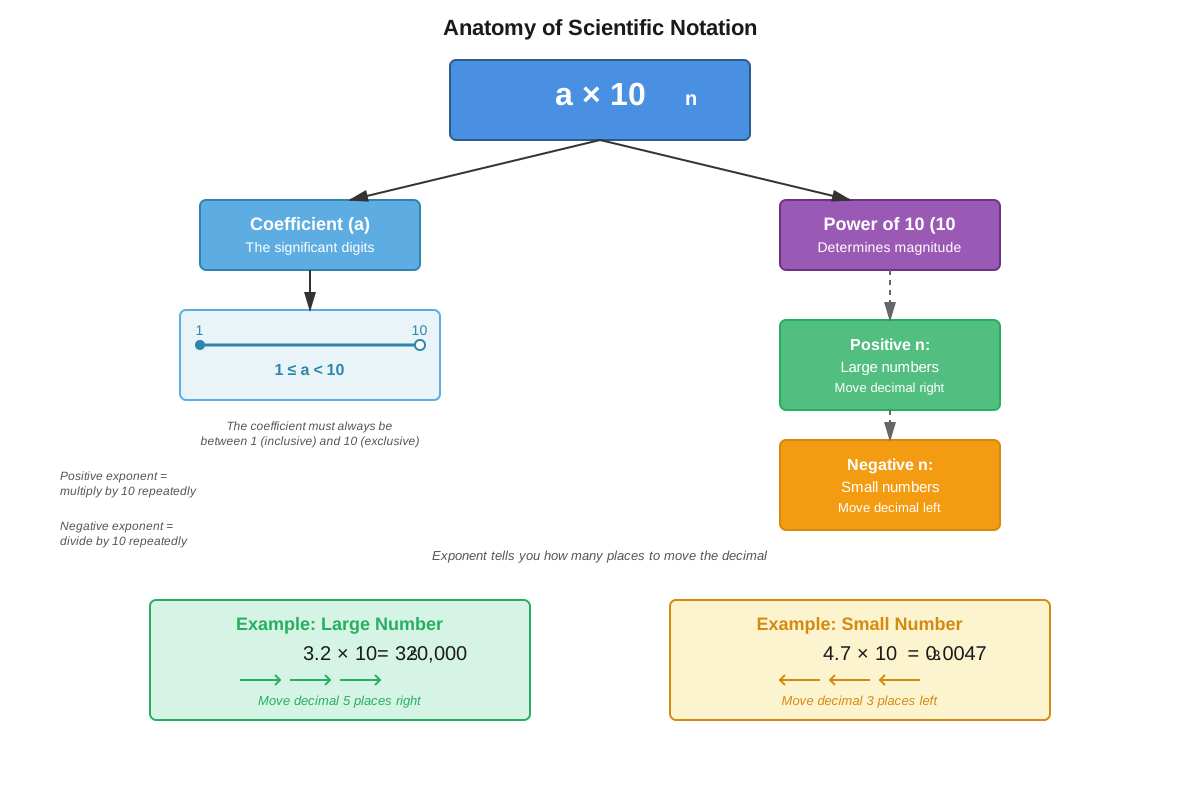
Scientific notation is a standardized mathematical method for expressing very large or very small numbers in a compact, manageable form. On the GRE, this topic appears regularly in Quantitative Reasoning sections, testing both computational fluency and conceptual understanding. The format follows the structure a × 10^n, where "a" is a number between 1 and 10 (including 1 but excluding 10), and "n" is an integer representing the power of ten. This notation system allows test-takers to efficiently handle calculations involving astronomical distances, microscopic measurements, or any values that would otherwise require writing many zeros.
Understanding gre scientific notation is essential because the exam frequently embeds these problems within data interpretation questions, word problems, and quantitative comparison formats. The GRE tests not only the ability to convert between standard and scientific notation but also the capacity to perform arithmetic operations (multiplication, division, addition, and subtraction) while numbers remain in scientific form. Questions may require comparing magnitudes, estimating products or quotients, or recognizing when scientific notation simplifies complex calculations.
This topic connects fundamentally to exponents, powers of ten, and order of magnitude reasoning—all critical components of the Arithmetic unit. Mastery of scientific notation enhances performance across multiple GRE question types, including those involving percentages, ratios, and real-world data analysis. The ability to quickly manipulate numbers in scientific notation often determines whether a student can solve certain problems within the exam's strict time constraints, making this a high-value skill for score optimization.
Learning Objectives
- [ ] Identify when Scientific notation is being tested
- [ ] Explain the core rule or strategy behind Scientific notation
- [ ] Apply Scientific notation to GRE-style questions accurately
- [ ] Convert fluently between standard notation and scientific notation in both directions
- [ ] Perform multiplication and division operations with numbers in scientific notation
- [ ] Compare magnitudes of numbers expressed in scientific notation without full conversion
- [ ] Recognize when scientific notation provides computational advantages over standard form
Prerequisites
- Exponent rules and properties: Understanding how to manipulate powers, particularly powers of 10, is fundamental to working with scientific notation since the notation itself is built on exponential expressions.
- Basic arithmetic operations: Proficiency with multiplication, division, addition, and subtraction ensures accurate computation when performing operations on numbers in scientific notation.
- Place value system: Knowledge of how digits relate to powers of ten (ones, tens, hundreds, tenths, hundredths) enables smooth conversion between standard and scientific notation.
- Order of operations: Following PEMDAS/BODMAS correctly ensures proper sequencing when evaluating expressions containing scientific notation.
Why This Topic Matters
Scientific notation serves as the universal language for expressing extreme values across scientific, engineering, and financial contexts. In real-world applications, professionals use this notation to communicate measurements ranging from the mass of subatomic particles (9.11 × 10^-31 kilograms for an electron) to the distance between galaxies (2.5 × 10^6 light-years to Andromeda). Financial analysts employ scientific notation when dealing with national debts, global market capitalizations, or microscopic interest rate changes that compound over time.
On the GRE, scientific notation appears in approximately 10-15% of Quantitative Reasoning questions, either as the primary focus or as a tool embedded within more complex problems. The exam presents this topic through multiple question formats: quantitative comparison questions asking students to compare two values expressed in scientific notation, problem-solving questions requiring calculations with scientific notation, and data interpretation sets where graphs or tables display values using powers of ten. The GRE particularly favors questions that test whether students can estimate and compare orders of magnitude without performing full calculations—a skill that saves precious time.
Common exam scenarios include comparing population statistics, analyzing scientific data from experiments, evaluating financial projections, and interpreting measurements in physics or chemistry contexts. The GRE often combines scientific notation with other arithmetic concepts like percentages, ratios, or unit conversions, creating multi-step problems that assess integrated mathematical reasoning. Questions may present one value in scientific notation and another in standard form, testing whether students recognize the need to convert for accurate comparison.
Core Concepts
Structure and Definition of Scientific Notation
Scientific notation expresses any number as the product of two factors: a coefficient and a power of ten. The standard form is a × 10^n, where the coefficient "a" must satisfy the condition 1 ≤ a < 10, and the exponent "n" is an integer (positive, negative, or zero). This restriction on the coefficient ensures uniqueness—each number has exactly one correct scientific notation representation.
The coefficient represents the significant digits of the number, capturing its precision. The exponent indicates the order of magnitude, showing how many places the decimal point has moved from its position in the coefficient. A positive exponent signals a large number (greater than or equal to 10), while a negative exponent indicates a small number (between 0 and 1). An exponent of zero means the number equals its coefficient, falling between 1 and 10.
For example, the number 4,500 in scientific notation becomes 4.5 × 10^3 because the decimal point moves three places to the left from its position after the last zero. Conversely, 0.0067 becomes 6.7 × 10^-3 because the decimal point moves three places to the right to position it after the first non-zero digit.
Converting from Standard to Scientific Notation
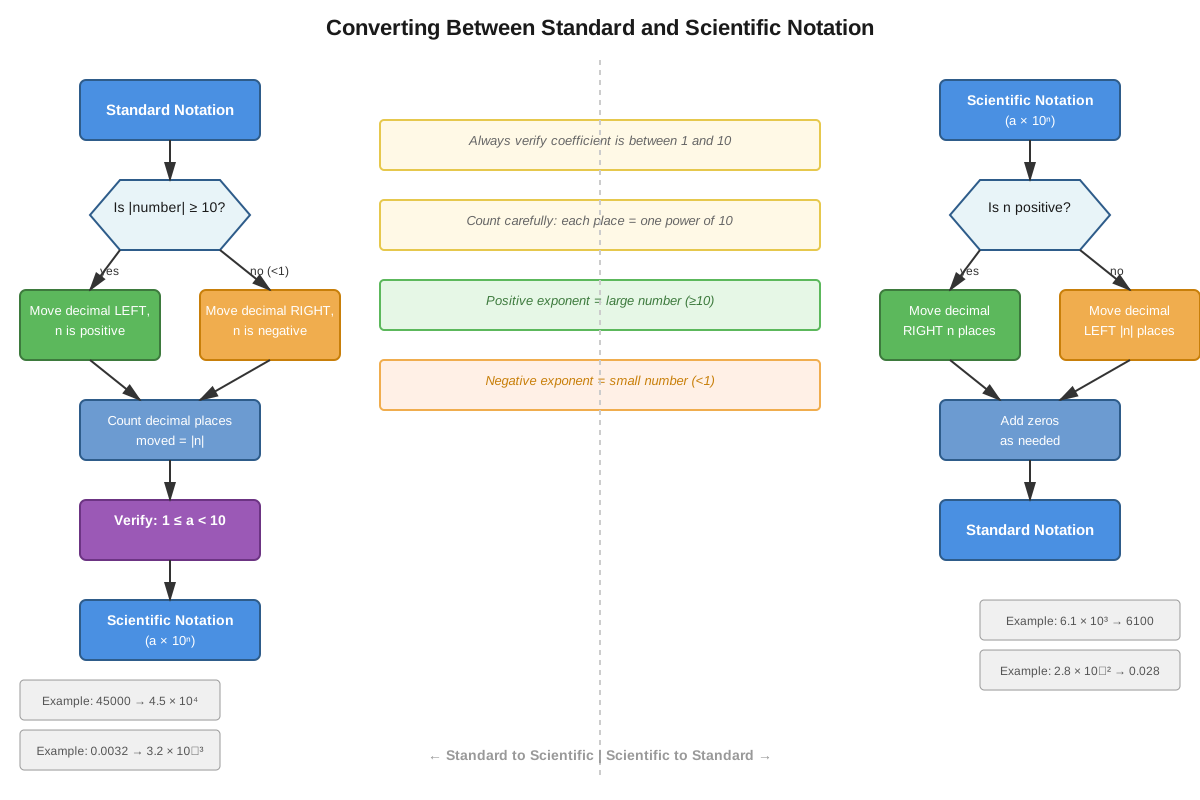
The conversion process follows a systematic approach:
- Identify the first non-zero digit in the number, reading from left to right
- Place the decimal point immediately after this first non-zero digit
- Count the number of places the decimal point moved from its original position
- Determine the sign of the exponent: positive if the original number was ≥ 10, negative if it was between 0 and 1, zero if it was between 1 and 10
- Write the result as coefficient × 10^exponent
For large numbers like 850,000,000, the decimal point starts after the last zero (or is understood to be there) and moves 8 places left to sit after the 8, yielding 8.5 × 10^8. For small numbers like 0.000042, the decimal point moves 5 places right to position after the 4, producing 4.2 × 10^-5.
Converting from Scientific to Standard Notation
Reversing the process requires understanding the exponent's instruction:
- Start with the coefficient as written
- If the exponent is positive, move the decimal point that many places to the right, adding zeros as needed
- If the exponent is negative, move the decimal point that many places to the left, adding zeros as needed
- If the exponent is zero, the coefficient is already the answer
For 3.7 × 10^4, move the decimal 4 places right: 37,000. For 2.1 × 10^-3, move the decimal 3 places left: 0.0021. This conversion skill proves essential when the GRE asks for answers in standard form or when comparing values requires a common format.
Multiplication in Scientific Notation
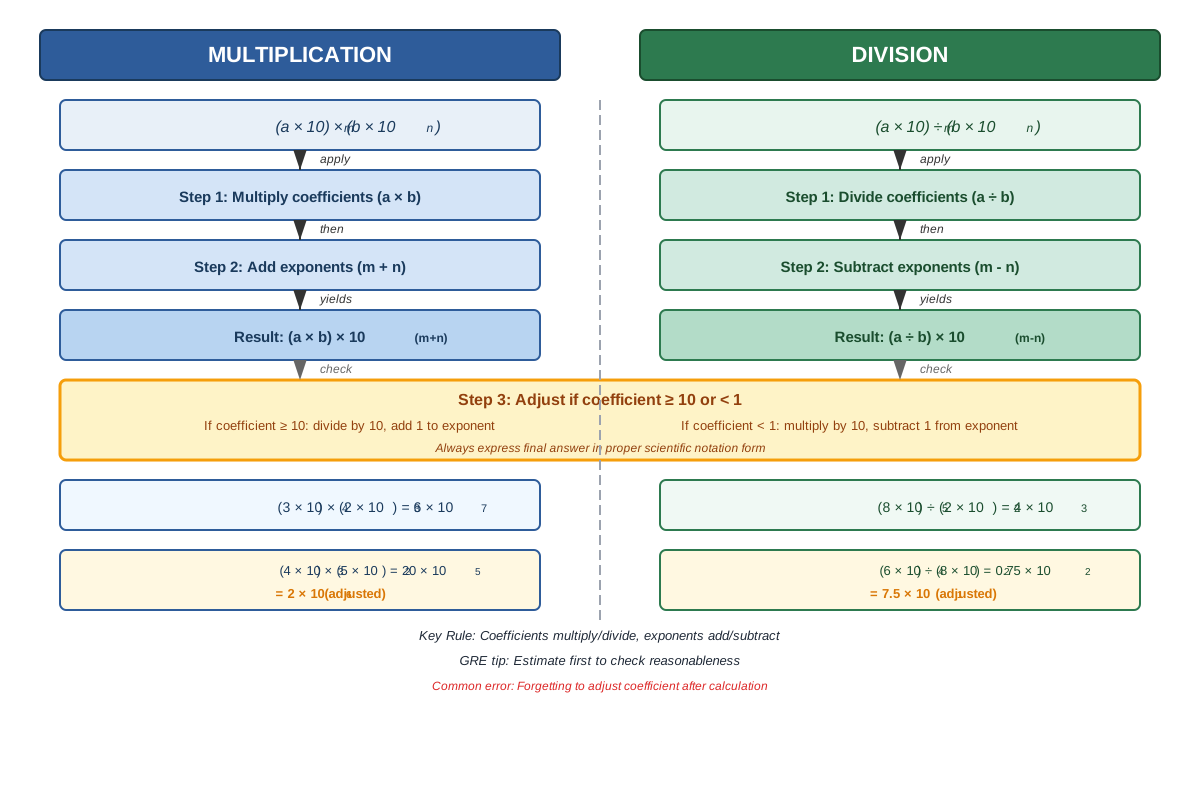
When multiplying numbers in scientific notation, apply the associative and commutative properties to group coefficients and powers separately:
(a × 10^m) × (b × 10^n) = (a × b) × 10^(m+n)
Procedure:
- Multiply the coefficients: a × b
- Add the exponents: m + n
- Adjust if necessary to maintain proper scientific notation form (coefficient between 1 and 10)
Example: (3 × 10^5) × (4 × 10^7) = (3 × 4) × 10^(5+7) = 12 × 10^12
Since 12 is not between 1 and 10, convert: 12 = 1.2 × 10^1, so the result becomes 1.2 × 10^1 × 10^12 = 1.2 × 10^13.
Division in Scientific Notation
Division follows a parallel structure, separating coefficients and powers:
(a × 10^m) ÷ (b × 10^n) = (a ÷ b) × 10^(m-n)
Procedure:
- Divide the coefficients: a ÷ b
- Subtract the exponents: m - n
- Adjust if necessary to maintain proper form
Example: (8 × 10^9) ÷ (2 × 10^4) = (8 ÷ 2) × 10^(9-4) = 4 × 10^5
If the coefficient division yields a result outside the 1-10 range, adjust accordingly. For (3 × 10^8) ÷ (6 × 10^5) = 0.5 × 10^3, convert 0.5 to 5 × 10^-1, giving 5 × 10^-1 × 10^3 = 5 × 10^2.
Addition and Subtraction in Scientific Notation
These operations require a common exponent before combining coefficients:
Procedure:
- Express both numbers with the same power of 10 (typically the larger exponent)
- Add or subtract the coefficients while keeping the common exponent
- Adjust the result to proper scientific notation if needed
Example: (5.2 × 10^6) + (3.1 × 10^5)
First, rewrite 3.1 × 10^5 as 0.31 × 10^6, then add: (5.2 + 0.31) × 10^6 = 5.51 × 10^6.
This process is more cumbersome than multiplication or division, which is why the GRE less frequently tests addition/subtraction in scientific notation directly, though it may appear in multi-step problems.
Comparing Magnitudes
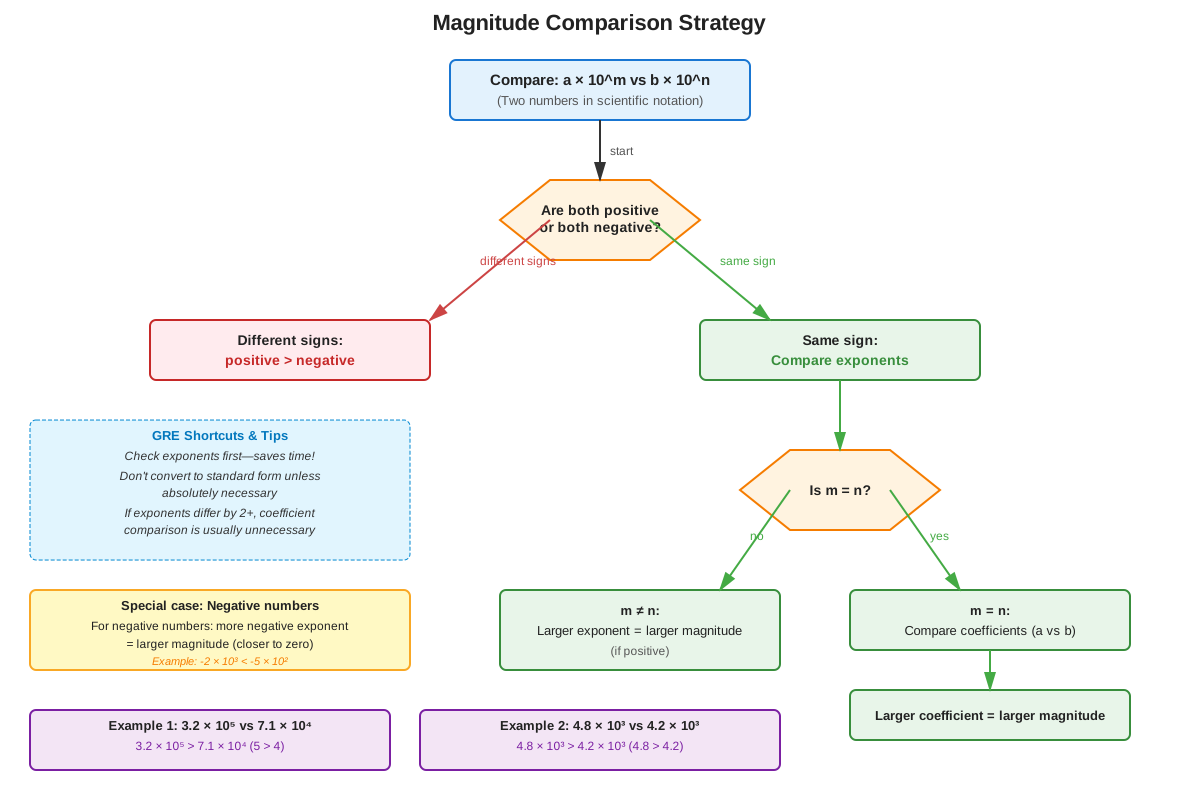
The GRE frequently asks students to compare numbers in scientific notation without full calculation:
| Comparison Rule | Application |
|---|---|
| Different exponents | The number with the larger exponent is greater (assuming positive coefficients) |
| Same exponent | Compare coefficients directly |
| Negative vs. positive exponent | Positive exponent yields larger number (for positive coefficients) |
| Both negative exponents | Less negative exponent yields larger number |
For example, 3.2 × 10^8 > 9.9 × 10^7 because 8 > 7, regardless of coefficients. But 4.5 × 10^6 < 7.2 × 10^6 because exponents match and 4.5 < 7.2.
Concept Relationships
The foundation of scientific notation rests on exponent rules, particularly the laws governing powers of ten. Understanding that 10^3 = 1,000 and 10^-2 = 0.01 enables the conceptual leap to expressing any number as a coefficient times an appropriate power. This connection flows directly: place value system → powers of ten → scientific notation structure.
Within scientific notation itself, the concepts form a hierarchy: basic conversion (standard ↔ scientific) serves as the prerequisite for operations (multiplication, division, addition, subtraction), which in turn enable magnitude comparison and estimation. The conversion skills must become automatic before operations can be performed efficiently.
The relationship between multiplication/division and addition/subtraction in scientific notation mirrors their relationship in standard arithmetic: multiplication and division are simpler because they operate on exponents independently (add or subtract exponents), while addition and subtraction require a common base (same exponent), making them more complex.
Scientific notation connects forward to logarithms (the exponent in scientific notation approximates the base-10 logarithm), significant figures (the coefficient captures precision), and order of magnitude estimation (the exponent alone often suffices for rough comparisons). These connections extend beyond the GRE into advanced mathematics and scientific reasoning.
Quick check — test yourself on Scientific notation so far.
Try Flashcards →High-Yield Facts
⭐ Scientific notation format: a × 10^n where 1 ≤ a < 10 and n is an integer
⭐ Positive exponent: indicates a number ≥ 10; the exponent shows how many places the decimal moves right
⭐ Negative exponent: indicates a number between 0 and 1; the absolute value shows how many places the decimal moves left
⭐ Multiplication rule: multiply coefficients, add exponents: (a × 10^m)(b × 10^n) = ab × 10^(m+n)
⭐ Division rule: divide coefficients, subtract exponents: (a × 10^m) ÷ (b × 10^n) = (a/b) × 10^(m-n)
- Quick comparison: when exponents differ, the number with the larger exponent is greater (for positive numbers)
- Zero exponent: 10^0 = 1, so a × 10^0 = a (numbers between 1 and 10 have exponent zero in scientific notation)
- Adjustment rule: if coefficient falls outside 1-10 range after operations, adjust by moving decimal and changing exponent accordingly
- Powers of ten pattern: each increase of 1 in the exponent multiplies the number by 10; each decrease divides by 10
- Addition/subtraction requirement: numbers must share the same exponent before coefficients can be combined
- Estimation advantage: scientific notation allows rapid order-of-magnitude calculations by focusing on exponents alone
- Conversion shortcut: count zeros in standard form to determine exponent magnitude quickly
Common Misconceptions
Misconception: The coefficient in scientific notation can be any number, including values ≥ 10 or < 1.
Correction: Proper scientific notation requires the coefficient to be between 1 and 10 (1 ≤ a < 10). While 35 × 10^4 is mathematically equivalent to 3.5 × 10^5, only the latter is correct scientific notation. The GRE may present improperly formatted answers as distractors.
Misconception: When multiplying numbers in scientific notation, multiply the exponents.
Correction: Exponents are added during multiplication, not multiplied. The rule (10^m)(10^n) = 10^(m+n) comes from exponent laws. Multiplying exponents would apply only when raising a power to a power: (10^m)^n = 10^(mn).
Misconception: A negative exponent makes the entire number negative.
Correction: A negative exponent indicates a small positive number (a fraction), not a negative number. For example, 5 × 10^-3 = 0.005, which is positive. To express a negative number, place a negative sign before the coefficient: -5 × 10^-3 = -0.005.
Misconception: Larger exponents always mean larger numbers.
Correction: This holds only when comparing positive numbers with positive exponents or when both numbers have the same sign. When comparing 2 × 10^-2 and 3 × 10^-5, the first is larger despite having the smaller exponent (in absolute value) because -2 > -5. The number closer to zero on the exponent scale is larger when exponents are negative.
Misconception: To add numbers in scientific notation, simply add the coefficients and add the exponents.
Correction: Addition requires a common exponent first. You cannot add (3 × 10^5) + (2 × 10^3) by getting 5 × 10^8. Instead, rewrite with matching exponents: (3 × 10^5) + (0.02 × 10^5) = 3.02 × 10^5, or convert both to standard form, add, then convert back.
Misconception: Moving the decimal point right always increases the exponent.
Correction: When converting from standard to scientific notation, moving the decimal right (for numbers less than 1) creates a negative exponent. The direction of decimal movement and the sign of the exponent depend on whether the original number is greater than or less than 1.
Misconception: Scientific notation is only for extremely large or small numbers.
Correction: While scientific notation excels at expressing extreme values, any number can be written in scientific notation. The number 42 becomes 4.2 × 10^1, and 7 becomes 7 × 10^0. The GRE may test whether students recognize that scientific notation is valid across all scales.
Worked Examples
Example 1: Multiplication and Comparison
Problem: If A = (2.5 × 10^8) × (4 × 10^-3) and B = (5 × 10^6) ÷ (2 × 10^1), which quantity is greater?
Solution:
First, calculate A:
- Multiply coefficients: 2.5 × 4 = 10
- Add exponents: 8 + (-3) = 5
- Result: 10 × 10^5
Adjust to proper scientific notation:
- 10 = 1 × 10^1
- So: 1 × 10^1 × 10^5 = 1 × 10^6
- Therefore, A = 1 × 10^6
Next, calculate B:
- Divide coefficients: 5 ÷ 2 = 2.5
- Subtract exponents: 6 - 1 = 5
- Result: 2.5 × 10^5
- This is already in proper form
- Therefore, B = 2.5 × 10^5
Compare A and B:
- A = 1 × 10^6 = 1,000,000
- B = 2.5 × 10^5 = 250,000
- Since the exponent of A (6) is greater than the exponent of B (5), A > B
Answer: Quantity A is greater.
Connection to Learning Objectives: This problem requires applying scientific notation operations (multiplication and division) accurately, then comparing magnitudes—demonstrating mastery of both computational and analytical skills with scientific notation.
Example 2: Conversion and Real-World Context
Problem: A bacteria population starts at 3,500 and grows to 8,750,000 after several hours. Express both populations in scientific notation, then determine how many times larger the final population is compared to the initial population.
Solution:
Convert initial population to scientific notation:
- 3,500 = 3.5 × 10^3 (decimal moves 3 places left)
Convert final population to scientific notation:
- 8,750,000 = 8.75 × 10^6 (decimal moves 6 places left)
Calculate the growth factor:
- Growth factor = Final ÷ Initial
- = (8.75 × 10^6) ÷ (3.5 × 10^3)
- Divide coefficients: 8.75 ÷ 3.5 = 2.5
- Subtract exponents: 6 - 3 = 3
- Result: 2.5 × 10^3 = 2,500
Answer: The initial population is 3.5 × 10^3, the final population is 8.75 × 10^6, and the final population is 2,500 times larger than the initial population.
Connection to Learning Objectives: This example demonstrates identifying when scientific notation simplifies a problem (large numbers), converting between standard and scientific notation, and applying division operations in scientific notation to solve a real-world scenario typical of GRE data interpretation questions.
Exam Strategy
When approaching gre scientific notation questions, begin by identifying the question type: Does it ask for conversion, computation, or comparison? This classification determines the optimal strategy. For conversion questions, focus on decimal point movement and counting places carefully—these are typically straightforward but error-prone under time pressure.
Trigger words and phrases that signal scientific notation problems include: "express in scientific notation," "order of magnitude," "powers of ten," "approximately how many times larger," and any context involving very large numbers (astronomical, population, financial) or very small numbers (microscopic, molecular, probability). Data interpretation questions with axes labeled in powers of ten (10^3, 10^6, etc.) implicitly test scientific notation understanding.
For quantitative comparison questions, avoid full calculation when possible. Compare exponents first—if they differ by more than one, the answer is often determinable without computing coefficients. For example, comparing 9.9 × 10^7 with 1.1 × 10^9 requires only noting that 9 > 7 by two orders of magnitude, making the second quantity definitively larger regardless of coefficients.
Process of elimination works effectively when answer choices are in scientific notation: eliminate any options with incorrect exponent signs (positive vs. negative), then check coefficient ranges. If a calculation should yield a result in the millions, eliminate answers with exponents of 3 or 4 (thousands) or 9 or 10 (billions).
Time allocation: Simple conversion problems should take 30-45 seconds. Problems requiring one operation (multiplication or division) should take 60-90 seconds. Multi-step problems combining operations may require up to 2 minutes. If a problem seems to require extensive calculation, reconsider whether estimation or comparison of exponents alone suffices—the GRE often rewards strategic thinking over brute-force computation.
Calculator considerations: The GRE's on-screen calculator handles scientific notation, but entering it requires care. Use the calculator for coefficient arithmetic but track exponents manually to avoid input errors. For many problems, mental math with exponents proves faster than calculator use.
Memory Techniques
Mnemonic for exponent signs: "Positive = Powerful (big numbers), Negative = Not much (small numbers)" helps remember that positive exponents create large numbers while negative exponents create small fractions.
Decimal movement visualization: Picture the decimal point as a slider on a number line. Moving it right makes the number smaller (requiring a negative exponent to compensate), while moving it left makes the number larger (requiring a positive exponent). The exponent always "undoes" what the decimal movement did.
Operation acronym - MADS:
- Multiply coefficients, Add exponents (for multiplication)
- Divide coefficients, Subtract exponents (for division)
Coefficient range reminder: "One to Ten-ish" (but not quite ten) captures the 1 ≤ a < 10 requirement. Visualize a number line from 1 to 10 with 10 excluded.
Powers of ten anchor points: Memorize these reference points for quick magnitude estimation:
- 10^3 = thousand (K)
- 10^6 = million (M)
- 10^9 = billion (B)
- 10^12 = trillion (T)
The acronym KMBT (like "combat" without the 'o') helps recall this sequence.
Comparison shortcut: "Exponent Exceeds, Everything else" reminds you that when exponents differ, they determine the comparison—everything else (coefficients) becomes secondary.
Summary
Scientific notation provides a standardized method for expressing numbers as a coefficient between 1 and 10 multiplied by a power of ten (a × 10^n). This system enables efficient representation and manipulation of extremely large or small values, which the GRE tests through conversion, computation, and comparison questions. Mastery requires fluency in converting between standard and scientific notation by counting decimal place movements, performing multiplication (multiply coefficients, add exponents) and division (divide coefficients, subtract exponents), and comparing magnitudes by examining exponents first. The GRE frequently embeds scientific notation within data interpretation, quantitative comparison, and word problems, making it essential for both accuracy and time management. Success depends on recognizing when scientific notation simplifies calculations, maintaining proper form (coefficient between 1 and 10), and avoiding common errors like confusing exponent operations or misinterpreting negative exponents as negative numbers. Strategic approaches include comparing exponents before coefficients, using estimation rather than exact calculation when possible, and tracking exponents separately from coefficient arithmetic to minimize errors.
Key Takeaways
- Scientific notation format (a × 10^n) requires coefficient between 1 and 10; positive exponents indicate large numbers, negative exponents indicate small numbers between 0 and 1
- Multiplication: multiply coefficients and add exponents; division: divide coefficients and subtract exponents
- Quick comparison strategy: when exponents differ, the larger exponent indicates the larger number (for positive values)
- Conversion relies on counting decimal places moved: left movement creates positive exponents, right movement creates negative exponents
- Addition and subtraction require matching exponents before combining coefficients, making them more complex than multiplication and division
- The GRE tests scientific notation through multiple question types, often combining it with estimation, data interpretation, or real-world contexts
- Time-saving approach: compare exponents first, calculate coefficients only when necessary, and recognize when scientific notation provides computational advantages
Related Topics
Exponent Rules and Properties: Deepening understanding of exponent laws (product rule, quotient rule, power rule) strengthens scientific notation skills, as these rules form the mathematical foundation for operations in scientific notation.
Logarithms: Scientific notation connects directly to logarithmic thinking, where the exponent approximates the base-10 logarithm of a number, enabling advanced estimation and problem-solving techniques.
Significant Figures and Precision: The coefficient in scientific notation captures significant digits, making this topic essential for understanding measurement precision and rounding in scientific contexts.
Order of Magnitude Estimation: Mastering scientific notation enables rapid approximation skills, where focusing on exponents alone provides quick estimates for complex calculations—a valuable GRE time-saving strategy.
Unit Conversions: Scientific notation frequently appears in problems requiring conversion between units (kilometers to meters, grams to kilograms), where powers of ten facilitate systematic scaling.
Practice CTA
Now that you've mastered the core concepts, rules, and strategies for scientific notation, reinforce your learning by attempting the practice questions designed specifically for this topic. These problems mirror actual GRE question formats and difficulty levels, providing essential experience with the types of scenarios you'll encounter on test day. Work through the flashcards to cement key facts and formulas in your memory, ensuring automatic recall during the exam. Consistent practice transforms conceptual understanding into the rapid, accurate performance that distinguishes top scorers. You've built the foundation—now apply it with confidence!
Sign up free to keep reading
Create a free AnvayaPrep account to finish this GRE guide on Scientific notation — plus flashcards and practice questions.