Overview
Percent change is one of the most frequently tested arithmetic concepts on the GRE Quantitative Reasoning section. This topic measures a student's ability to calculate and interpret relative changes in quantities—a skill that appears across multiple question formats including Quantitative Comparison, Multiple Choice, and Numeric Entry questions. Understanding percent change goes beyond simple memorization of formulas; it requires recognizing when values increase or decrease relative to an original amount and accurately computing that change as a percentage. The GRE tests this concept both directly through straightforward calculation problems and indirectly through word problems involving price changes, population growth, salary adjustments, and data interpretation scenarios.
Mastering gre percent change is essential because it serves as a foundational skill that connects to numerous other quantitative topics. Percent change problems often appear alongside ratio and proportion questions, statistics problems involving data analysis, and real-world application scenarios that test mathematical reasoning. The GRE frequently embeds percent change within multi-step problems, requiring students to first calculate a percent change and then use that result for subsequent calculations. Additionally, the exam tests whether students can distinguish between percent change and percentage point change—a subtle but critical distinction that trips up many test-takers.
The strategic importance of this topic cannot be overstated. Percent change questions typically appear 2-4 times per GRE Quantitative section, and the concept underlies many data interpretation questions involving graphs, charts, and tables. Students who develop fluency with percent change calculations gain a significant advantage in time management, as these problems can be solved quickly when the proper framework is applied. Furthermore, understanding percent change strengthens overall numerical reasoning skills and builds confidence for tackling the diverse problem types that characterize the GRE Quantitative Reasoning section.
Learning Objectives
- [ ] Identify when Percent change is being tested
- [ ] Explain the core rule or strategy behind Percent change
- [ ] Apply Percent change to GRE-style questions accurately
- [ ] Distinguish between percent change and percentage point change in various contexts
- [ ] Calculate successive percent changes and determine the net effect on an original value
- [ ] Recognize and avoid common calculation errors involving the reference value
- [ ] Solve reverse percent change problems where the final value is known but the original value must be determined
Prerequisites
- Basic percentage calculations: Understanding how to convert between percentages, decimals, and fractions is essential for performing percent change calculations efficiently
- Arithmetic operations with decimals: Percent change problems require multiplication and division with decimal values, making computational fluency necessary
- Algebraic manipulation: Setting up and solving equations is required for reverse percent change problems and multi-step scenarios
- Ratio and proportion concepts: Percent change fundamentally expresses a ratio between the change amount and the original value
Why This Topic Matters
Percent change appears throughout real-world contexts that the GRE draws upon for question scenarios. Business applications include calculating profit margins, revenue growth, price markdowns, and sales tax. Scientific contexts involve population changes, experimental measurements, and statistical variations. Economic scenarios feature inflation rates, investment returns, and currency fluctuations. The GRE leverages these authentic applications to create problems that test both mathematical competency and practical reasoning skills.
From an exam perspective, percent change questions appear with high frequency across all GRE Quantitative Reasoning question types. Data interpretation sets—which present graphs, charts, or tables—routinely ask students to calculate percent changes between data points or time periods. Quantitative Comparison questions often present two scenarios involving different percent changes and ask which results in a greater final value. Word problems embed percent change within narratives about shopping discounts, salary increases, or population demographics. Research indicates that approximately 15-20% of GRE Quantitative questions either directly test percent change or require it as an intermediate step in solving more complex problems.
The GRE specifically tests whether students understand that percent change is always calculated relative to the original value (the starting point), not the new value. This conceptual understanding distinguishes strong performers from those who merely memorize formulas. Additionally, the exam frequently presents scenarios involving successive percent changes—where a value undergoes multiple percentage increases or decreases—to test whether students recognize that these changes cannot simply be added together. Understanding these nuances is critical for achieving a competitive Quantitative Reasoning score.
Core Concepts
The Fundamental Percent Change Formula
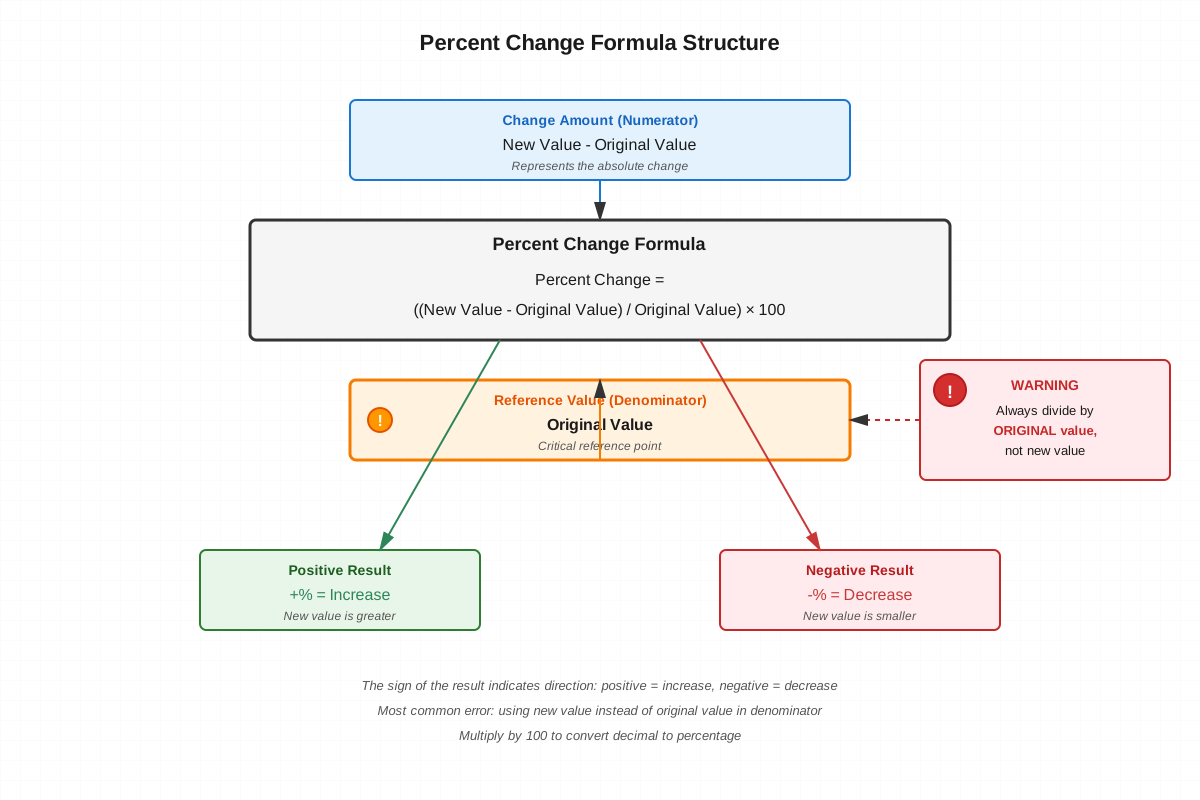
The percent change formula expresses the relative difference between an original value and a new value as a percentage of the original value. The formula is:
Percent Change = (New Value - Original Value) / Original Value × 100%This formula yields a positive result when the new value exceeds the original value (representing an increase) and a negative result when the new value is less than the original value (representing a decrease). The critical element is that the denominator must always be the original value—the starting point before any change occurred. This ensures that the percentage reflects how much the quantity changed relative to where it started.
For example, if a stock price increases from $40 to $50, the percent change is:
- Change amount: $50 - $40 = $10
- Percent change: ($10 / $40) × 100% = 25%
The stock increased by 25% relative to its original price of $40.
Percent Increase vs. Percent Decrease
While the fundamental formula applies to both increases and decreases, the GRE often uses specific terminology that students must recognize:
| Term | Meaning | Formula Application | Sign of Result |
|---|---|---|---|
| Percent Increase | New value is greater than original | (New - Original) / Original × 100% | Positive |
| Percent Decrease | New value is less than original | (Original - New) / Original × 100% | Positive |
| Percent Change | General term for either direction | (New - Original) / Original × 100% | Positive or Negative |
When calculating a percent decrease, many students prefer to rearrange the formula to ensure a positive result:
Percent Decrease = (Original Value - New Value) / Original Value × 100%For instance, if enrollment drops from 500 students to 400 students:
- Decrease amount: 500 - 400 = 100
- Percent decrease: (100 / 500) × 100% = 20%
The enrollment decreased by 20%.
Calculating New Values After Percent Change
The GRE frequently provides the original value and the percent change, then asks for the new value. This requires rearranging the percent change relationship:
New Value = Original Value × (1 + Percent Change as decimal)For a percent increase, the percent change is positive. For a percent decrease, the percent change is negative (or subtract instead of add).
Example for increase: A $200 item increases by 15%
- New Value = $200 × (1 + 0.15) = $200 × 1.15 = $230
Example for decrease: A $200 item decreases by 15%
- New Value = $200 × (1 - 0.15) = $200 × 0.85 = $170
This approach is more efficient than calculating the change amount separately and then adding or subtracting it.
Successive Percent Changes
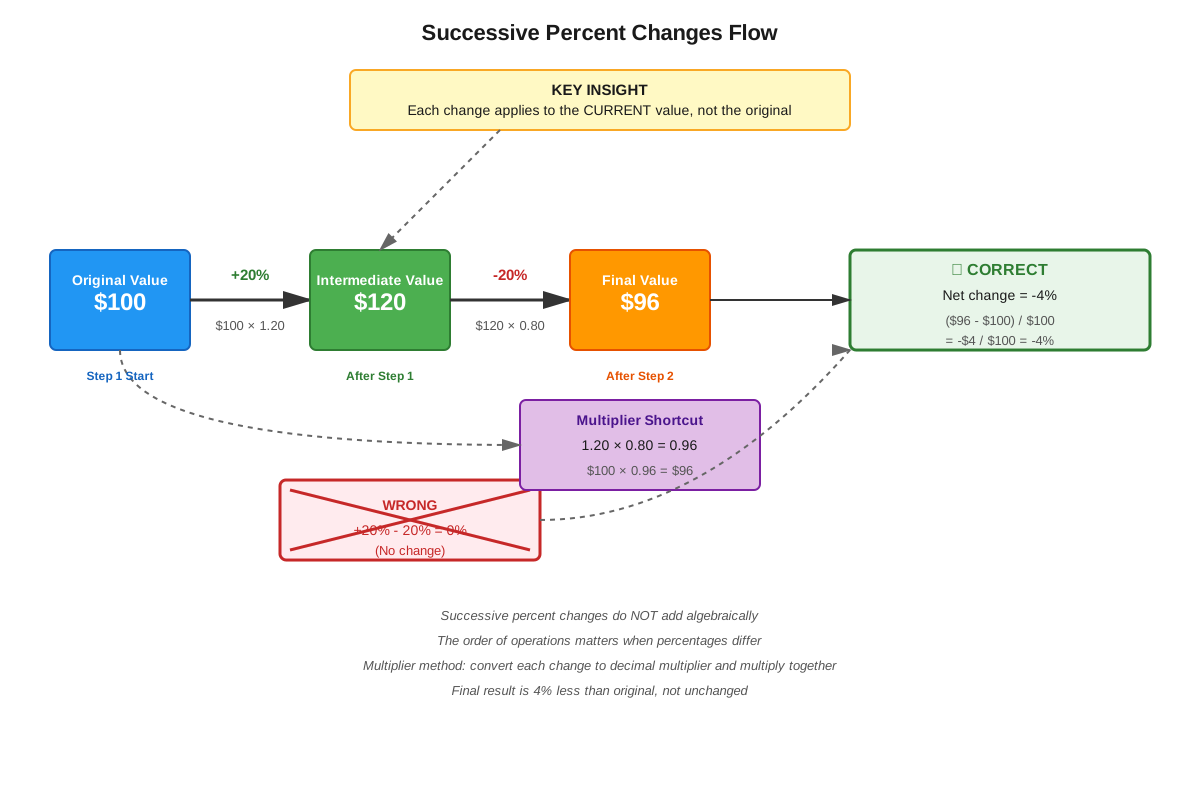
One of the most commonly tested concepts involves applying multiple percent changes sequentially to the same value. A critical principle: successive percent changes cannot be added directly. Each subsequent change is calculated based on the value after the previous change, not the original value.
Example: A price increases by 20%, then decreases by 20%
- Original price: $100
- After 20% increase: $100 × 1.20 = $120
- After 20% decrease: $120 × 0.80 = $96
- Net result: The final price is $96, not $100
The net effect can be calculated using:
Final Value = Original Value × (1 + r₁) × (1 + r₂) × ... × (1 + rₙ)where r₁, r₂, etc. are the decimal forms of each percent change (negative for decreases).
For the example above: $100 × 1.20 × 0.80 = $96
The overall percent change from original to final is: ($96 - $100) / $100 = -4%, a 4% decrease.
Reverse Percent Change Problems
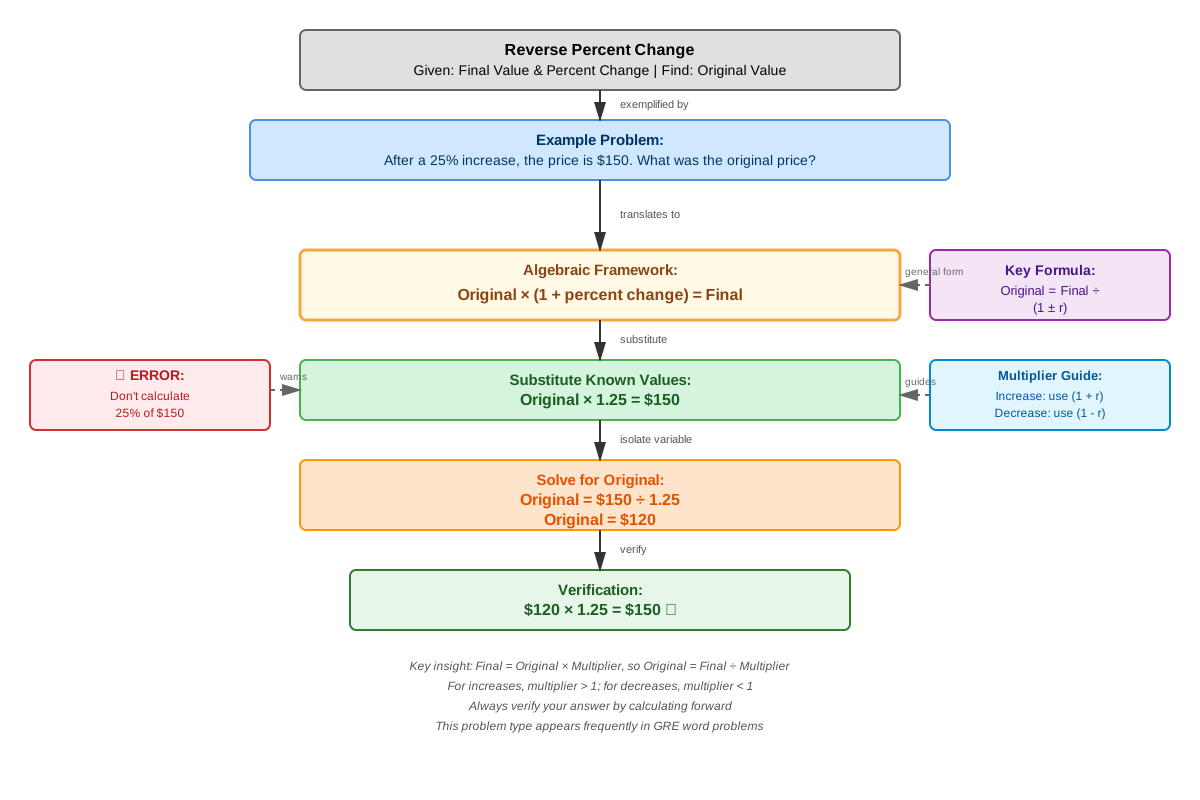
The GRE tests whether students can work backward from a final value to determine either the original value or the percent change. These reverse problems require algebraic thinking.
Type 1: Finding the original value
If a value after a 25% increase is $150, what was the original value?
- Let x = original value
- x × 1.25 = $150
- x = $150 / 1.25 = $120
Type 2: Finding the percent change
If a value changes from an unknown original to $180, and this represents a 20% increase, what was the original?
- Let x = original value
- x × 1.20 = $180
- x = $150
- Verification: ($180 - $150) / $150 = 30/150 = 20% ✓
Percent Change vs. Percentage Point Change
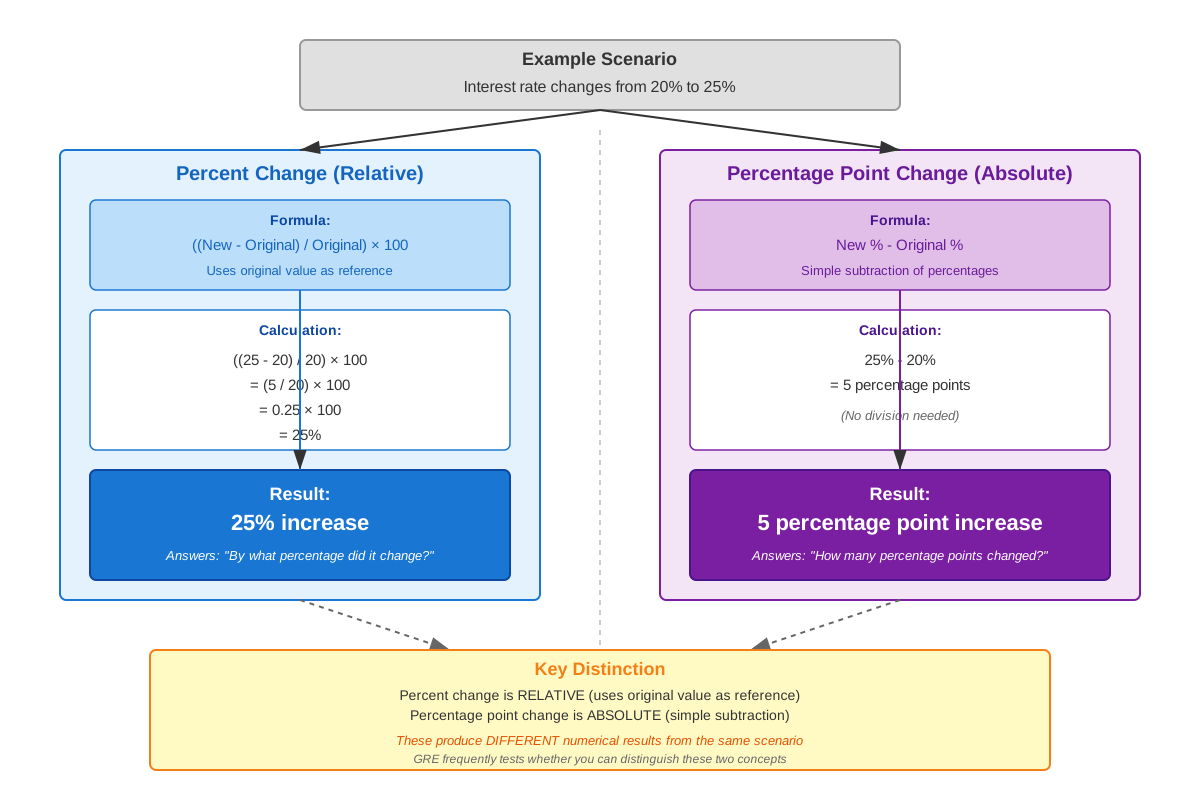
The GRE tests the distinction between percent change and percentage point change—two fundamentally different concepts that students often confuse.
- Percentage point change: The arithmetic difference between two percentages
- Percent change: The relative change in a percentage, calculated using the percent change formula
Example: An interest rate increases from 5% to 8%
- Percentage point change: 8% - 5% = 3 percentage points
- Percent change: (8% - 5%) / 5% × 100% = 60%
The interest rate increased by 3 percentage points, which represents a 60% increase in the rate itself.
This distinction is crucial in data interpretation questions involving graphs of percentages, market shares, or rates.
Concept Relationships
The concepts within percent change build upon each other in a logical progression. The fundamental percent change formula serves as the foundation for all other concepts. Understanding this formula enables calculation of both percent increase and percent decrease, which are simply applications of the same principle with attention to which value is larger.
The ability to calculate new values after percent change flows directly from rearranging the fundamental formula, transforming it from a tool for finding percent change into a tool for finding resulting values. This rearrangement skill is essential for tackling successive percent changes, where each new value becomes the original value for the next calculation. The successive percent changes concept reveals why percent changes cannot be simply added—each operates on a different base value.
Reverse percent change problems represent the algebraic inverse of standard percent change calculations, requiring students to work backward through the same relationships. Finally, understanding the distinction between percent change and percentage point change requires recognizing that percentages themselves can be treated as quantities that undergo percent change.
The relationship map flows as follows:
Fundamental Formula → enables → Percent Increase/Decrease Calculations → rearranges to → New Value Calculations → applies repeatedly in → Successive Percent Changes → inverts to → Reverse Problems → distinguishes from → Percentage Point Change
Connections to prerequisite topics include heavy reliance on basic percentage calculations for converting between forms, decimal arithmetic for all computational steps, and algebraic manipulation for reverse problems. Percent change also connects forward to more advanced topics like compound interest (which is essentially successive percent changes over time), exponential growth and decay, and data interpretation questions involving trends and comparisons.
High-Yield Facts
⭐ The denominator in percent change calculations must always be the original value, never the new value
⭐ Successive percent changes cannot be added; each must be applied sequentially to the updated value
⭐ A 20% increase followed by a 20% decrease does not return to the original value
⭐ Percent change and percentage point change are different concepts; the GRE tests whether you can distinguish them
⭐ To find a new value after a percent increase, multiply the original by (1 + decimal form of percent)
- To find a new value after a percent decrease, multiply the original by (1 - decimal form of percent)
- A 100% increase means the value doubles (new value = 2 × original)
- A 50% decrease means the value is halved (new value = 0.5 × original)
- The percent change from A to B is different from the percent change from B to A (they use different denominators)
- When a value increases by x% then decreases by x%, the net result is always a decrease
- A decrease of more than 100% is impossible (the minimum value is zero, representing a 100% decrease)
- In reverse problems where the final value and percent change are known, divide the final value by (1 + decimal form of percent change)
Quick check — test yourself on Percent change so far.
Try Flashcards →Common Misconceptions
Misconception: Percent change can be calculated using either the original or new value as the denominator, whichever is more convenient.
Correction: The denominator must always be the original value (the starting point). Using the new value produces an entirely different calculation that does not represent percent change. This is one of the most common errors on the GRE.
Misconception: If a value increases by 20% and then decreases by 20%, it returns to the original value because +20% and -20% cancel out.
Correction: Successive percent changes operate on different base values. After a 20% increase, the 20% decrease is calculated on the larger value, resulting in a net decrease. For example: 100 × 1.20 × 0.80 = 96, not 100.
Misconception: Percentage point change and percent change are the same thing.
Correction: Percentage point change is the arithmetic difference between two percentages (e.g., from 40% to 50% is a 10 percentage point increase). Percent change applies the percent change formula to percentages themselves (e.g., from 40% to 50% is a 25% increase: (50-40)/40 = 25%).
Misconception: To find the original value when given a final value after a percent increase, subtract the percent from the final value.
Correction: You must divide the final value by (1 + decimal form of percent increase). For example, if a value after a 25% increase is $150, the original is $150 ÷ 1.25 = $120, not $150 - 25 = $125.
Misconception: A 200% increase means the value doubles.
Correction: A 200% increase means the value triples. The new value equals the original plus 200% of the original: Original × (1 + 2.00) = Original × 3. A 100% increase means doubling.
Misconception: When calculating percent decrease, the result should be negative.
Correction: Percent decrease is typically expressed as a positive number with the word "decrease" indicating direction. While the general percent change formula yields a negative result for decreases, in practice we report "a 30% decrease" rather than "a -30% change."
Worked Examples
Example 1: Multi-Step Successive Percent Changes
Problem: A retail store marks up the wholesale cost of an item by 60% to set the retail price. During a sale, the store offers a 25% discount off the retail price. If the wholesale cost is $50, what is the sale price, and what is the overall percent change from wholesale cost to sale price?
Solution:
Step 1: Calculate the retail price after the 60% markup.
- Retail price = Wholesale cost × (1 + 0.60)
- Retail price = $50 × 1.60 = $80
Step 2: Calculate the sale price after the 25% discount.
- Sale price = Retail price × (1 - 0.25)
- Sale price = $80 × 0.75 = $60
Step 3: Calculate the overall percent change from wholesale to sale price.
- Percent change = (Sale price - Wholesale cost) / Wholesale cost × 100%
- Percent change = ($60 - $50) / $50 × 100%
- Percent change = $10 / $50 × 100% = 20%
Answer: The sale price is $60, representing a 20% increase from the wholesale cost.
Key Insight: Even though the item was discounted 25% from retail, the overall change from wholesale is still an increase because the initial markup was larger than the subsequent discount. This problem demonstrates why successive percent changes cannot be simply added (60% - 25% ≠ 20%) and reinforces that each change operates on a different base value.
Connection to Learning Objectives: This example applies percent change to a GRE-style multi-step problem and demonstrates the core strategy of calculating successive changes sequentially.
Example 2: Reverse Percent Change with Algebraic Setup
Problem: After a population decreased by 40%, the town had 7,200 residents. What was the population before the decrease? Additionally, if the population then increases by 50% from the 7,200 level, what will be the percent change from the original population to this new level?
Solution:
Step 1: Find the original population using reverse percent change.
- Let x = original population
- After a 40% decrease: x × (1 - 0.40) = 7,200
- x × 0.60 = 7,200
- x = 7,200 / 0.60 = 12,000
Step 2: Calculate the population after a 50% increase from 7,200.
- New population = 7,200 × (1 + 0.50)
- New population = 7,200 × 1.50 = 10,800
Step 3: Calculate the overall percent change from the original 12,000 to the final 10,800.
- Percent change = (10,800 - 12,000) / 12,000 × 100%
- Percent change = -1,200 / 12,000 × 100%
- Percent change = -10%
Answer: The original population was 12,000 residents. After the decrease and subsequent increase, the population is 10,800, representing a 10% decrease from the original level.
Key Insight: This problem illustrates that a 40% decrease followed by a 50% increase does not result in a net 10% increase. The 50% increase is calculated on the smaller base of 7,200, not the original 12,000. The problem also demonstrates the reverse percent change technique of dividing by (1 - decimal form) to find an original value.
Connection to Learning Objectives: This example addresses reverse percent change problems, successive percent changes, and reinforces the core strategy of always identifying the correct reference value (original value) for percent change calculations.
Exam Strategy
When approaching gre percent change questions on the exam, begin by identifying the original value (the starting point) and clearly labeling it. Many errors occur because students lose track of which value serves as the denominator. Circle or underline the original value in the problem to maintain focus.
Trigger words and phrases that signal percent change questions include:
- "increased by," "decreased by," "grew by," "fell by"
- "percent more than," "percent less than"
- "markup," "discount," "markdown"
- "appreciation," "depreciation"
- "growth rate," "decline rate"
- "what percent greater/smaller"
When you encounter these phrases, immediately set up the percent change formula with the original value in the denominator.
For Quantitative Comparison questions involving percent changes, avoid calculating exact values when possible. Instead, compare the multipliers. For example, if Quantity A involves a 30% increase (multiply by 1.30) and Quantity B involves a 25% increase (multiply by 1.25), and both start from the same original value, Quantity A must be larger without performing full calculations.
Process-of-elimination strategies specific to percent change:
- Eliminate answer choices that suggest successive percent changes can be added directly
- Eliminate choices that would result in impossible values (e.g., negative quantities when the context requires positive values)
- For reverse problems, eliminate choices that simply subtract the percent from the given value
- When comparing percent changes, eliminate choices that ignore which value serves as the base
Time allocation: Standard percent change problems should take 60-90 seconds. If a problem involves more than two successive percent changes or requires complex algebraic setup, allocate up to 2 minutes. If you find yourself spending more time, mark the question for review and move on—these problems should be straightforward once you identify the structure.
Quick calculation tip: For common percentages, memorize the multipliers:
- 10% increase: × 1.1 | 10% decrease: × 0.9
- 20% increase: × 1.2 | 20% decrease: × 0.8
- 25% increase: × 1.25 | 25% decrease: × 0.75
- 50% increase: × 1.5 | 50% decrease: × 0.5
This eliminates the need to convert percentages to decimals during the exam, saving valuable seconds.
Memory Techniques
Mnemonic for the percent change formula: "New Over Original Times 100" → "NOOT 100"
- (New - Original) / Original × 100%
- Remember: the denominator is always Original, never New
Visualization for successive percent changes: Picture a staircase where each step represents a percent change. You cannot jump from the bottom to the top by adding the heights of individual steps—you must climb each step sequentially, with each step starting from where the previous one ended.
Acronym for reverse problems: "FLIP" → Final value, Let x equal original, Identify the multiplier, Perform division
- When given the final value and percent change, divide the final value by the multiplier to find the original
Memory aid for percent vs. percentage point: "Percent change needs a calculation (both have 'c'), while percentage point is just plain subtraction (both have 'p')."
Rhyme for the denominator rule: "Original is where you start, that's the bottom of the chart" (meaning the denominator of the fraction)
Visual for why successive changes don't add: Imagine a $100 bill. A 50% increase makes it $150. A 50% decrease from $150 is $75, not $100. The second change operates on a different amount—visualize physically cutting the $150 in half to get $75, not the original $100.
Summary
Percent change is a fundamental arithmetic concept that measures the relative difference between an original value and a new value, expressed as a percentage of the original value. The core formula—(New Value - Original Value) / Original Value × 100%—must always use the original value as the denominator, a principle that underlies all percent change calculations. The GRE tests this concept through direct calculation problems, word problems involving real-world scenarios like price changes and population growth, and data interpretation questions requiring analysis of trends in graphs and tables. Critical skills include calculating new values after a given percent change by multiplying the original by (1 ± decimal form of the percent), handling successive percent changes by applying each sequentially rather than adding them, solving reverse problems where the final value is known but the original must be determined, and distinguishing between percent change and percentage point change. Common pitfalls include using the wrong value as the denominator, incorrectly adding successive percent changes, and confusing percent change with percentage point change. Mastery requires both computational fluency with the formulas and conceptual understanding of what percent change represents—a relative measure that always references the starting point.
Key Takeaways
- The original value must always be the denominator in percent change calculations; using the new value produces an incorrect result
- Successive percent changes cannot be added; each must be calculated sequentially on the updated value, using the formula: Final = Original × (1 + r₁) × (1 + r₂) × ...
- To find a new value after a percent change, multiply the original by (1 + decimal form) for increases or (1 - decimal form) for decreases
- Reverse percent change problems require dividing the final value by the multiplier: Original = Final / (1 ± decimal form)
- Percent change and percentage point change are distinct concepts; the former uses the percent change formula while the latter is simple subtraction
- A percent increase followed by an equal percent decrease always results in a net decrease because the decrease operates on a larger base value
- Trigger words like "increased by," "markup," "discount," and "growth rate" signal percent change problems and should prompt immediate identification of the original value
Related Topics
Ratios and Proportions: Percent change problems often involve proportional relationships, and understanding ratios strengthens the ability to set up percent change equations correctly. Mastering percent change provides a foundation for more complex ratio problems.
Compound Interest: This topic applies successive percent changes over time periods, where each interest calculation builds on the previous balance. Percent change mastery is essential before tackling compound interest formulas.
Data Interpretation: Graphs, charts, and tables frequently require calculating percent changes between data points or across time periods. Strong percent change skills enable quick analysis of trends and comparisons in data sets.
Exponential Growth and Decay: These concepts extend percent change to continuous or repeated applications over time, modeling phenomena like population growth or radioactive decay. Understanding discrete percent changes prepares students for exponential functions.
Statistics and Data Analysis: Percent change appears in statistical contexts when analyzing changes in means, medians, or other measures across samples or time periods. This topic builds on percent change fundamentals.
Practice CTA
Now that you have mastered the core concepts, formulas, and strategies for percent change, it's time to solidify your understanding through active practice. Attempt the practice questions designed specifically for this topic, focusing on applying the systematic approach outlined in this guide. Work through the flashcards to reinforce the high-yield facts and formulas until they become automatic. Remember that percent change appears frequently on the GRE, making your investment in practice highly valuable for your overall Quantitative Reasoning score. Approach each practice problem methodically: identify the original value, determine whether you're calculating percent change or finding a new value, and watch for successive changes that require sequential calculation. With focused practice, you'll develop the speed and accuracy needed to excel on test day!
Sign up free to keep reading
Create a free AnvayaPrep account to finish this GRE guide on Percent change — plus flashcards and practice questions.